


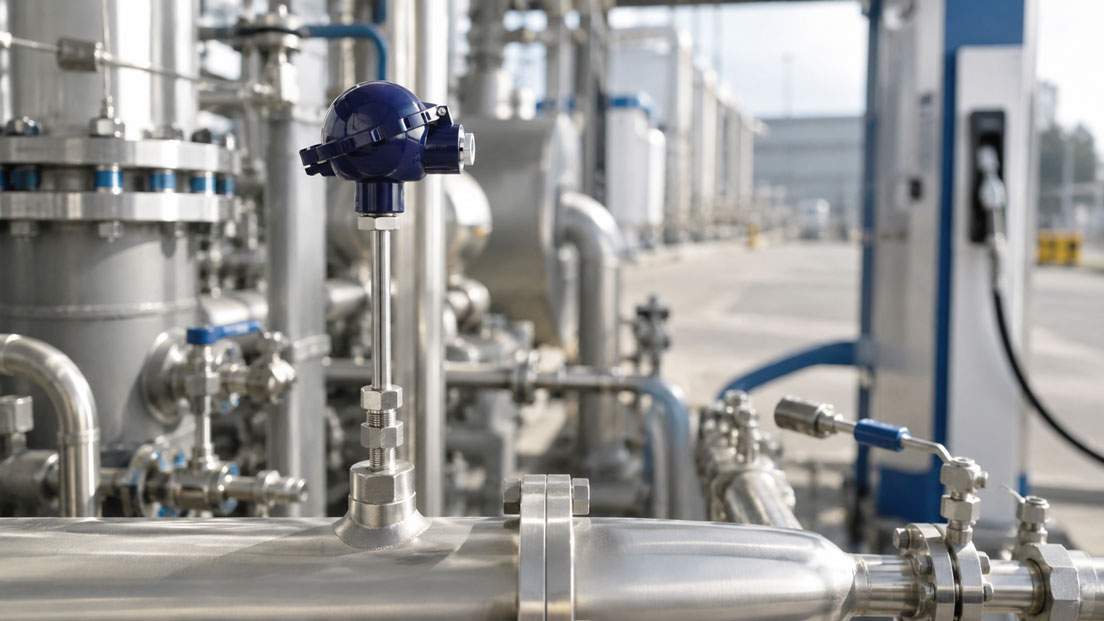
Temperature is a key process and safety variable in hydrogen systems. It influences gas density, the thermal load on compressors and storage systems, refuelling time, and the behaviour of seals, materials and lubricants.
The requirements vary considerably. Rapidly rising gas temperatures can occur at the outlet of a hydrogen compressor. During refuelling, the heating of the vehicle tank or storage vessel must be monitored. Liquid hydrogen, at temperatures close to −253 °C, places entirely different demands on the sensor, thermowell, electrical feedthrough and calibration.
A temperature sensor must therefore not be selected solely according to its nominal measuring range. The complete measuring system comprising the sensing element, thermowell or sensor sheath, process connection, materials, sealing concept, response time, transmitter and Ex design is decisive.
Table of Contents
- What tasks does temperature measurement perform in hydrogen systems?
- Typical temperature measuring points
- Temperature monitoring during H₂ compression
- Temperature measurement during hydrogen refuelling
- Liquid hydrogen and cryogenic conditions
- Pt100 or thermocouple?
- Materials, leak tightness and hydrogen suitability
- Thermowell, insertion length and response time
- Pressure and temperature compensation
- Explosion protection and safe measuring points
- Measuring signal and control-system connection
- Typical configuration and installation errors
- Practical example at a hydrogen compressor station
- Selecting the correct temperature sensor
- Which measuring instruments / products are suitable?
- Conclusion
- Frequently asked questions
What tasks does temperature measurement perform in hydrogen systems?
Temperature measurements are not used solely to display a process value. They may form part of the control system, condition monitoring, quantity calculation or a shutdown function.
Typical tasks include:
- monitoring the inlet and outlet temperatures of compressor stages,
- checking intercoolers and aftercoolers,
- protecting seals, bearings and lubricants against excessive temperature,
- monitoring high-pressure storage systems and buffer vessels,
- controlling pre-cooling at hydrogen refuelling stations,
- determining gas density and standard volume together with the absolute pressure,
- monitoring cryogenic pipelines, tanks and vaporisers,
- detecting unusual temperature profiles during filling or depressurisation.
The requirements differ depending on the task. For a slowly changing storage temperature, high accuracy may be more important than an extremely short response time. At the outlet of a compressor stage, by contrast, the sensor must reliably detect rapid temperature rises.
Typical temperature measuring points
| Measuring point | Typical task | Special requirement |
|---|---|---|
| Compressor inlet | Recording intake conditions | Accurate measurement for process comparison and compressor monitoring |
| Compressor outlet | Detection of compression heat | Short response time and a sufficient upper measuring limit |
| Intercooler | Checking cooling performance | Comparison of inlet and outlet temperatures |
| High-pressure storage system | Monitoring filling and withdrawal | Pressure-resistant and permanently leak-tight process connection |
| Refuelling line | Monitoring cooled hydrogen | Fast response at high pressure and varying flow |
| Vehicle tank or test vessel | Monitoring tank temperature during filling | Representative position and low thermal delay |
| LH₂ tank | Monitoring the liquid phase, vapour space and evaporation | Suitability for temperatures close to −253 °C |
| Cryogenic transfer line | Monitoring cooling and heat input | Minimised heat input through the sensor and feedthrough |
A single measuring point is generally not sufficient to describe the thermal condition of a complete system. Several temperature values are particularly necessary for multi-stage compressors and long refuelling lines.
Temperature monitoring during H₂ compression
The gas temperature rises when hydrogen is compressed. The extent of the temperature rise depends, among other factors, on the pressure ratio, compressor design, efficiency, cooling and operating condition.
The temperature is therefore frequently measured before and after each compressor stage. The difference allows conclusions to be drawn regarding the load on the individual stage and the effectiveness of intercooling.
An unusual temperature rise may indicate problems such as:
- insufficient cooling,
- contaminated heat exchangers,
- faulty valves,
- increased friction,
- incorrect compressor control,
- an unusually high inlet temperature,
- deviating pressure ratios.
A short response time is particularly important at the compressor outlet. Although a heavy-duty thermowell provides high mechanical strength, it may indicate a rapid temperature rise only after a considerable delay.
The design must therefore balance pressure resistance, vibration resistance and measurement dynamics. For very rapid processes, a small measuring insert with optimised heat transfer inside a mechanically calculated thermowell may be suitable.
Temperature measurement during hydrogen refuelling
During rapid filling, the temperature in the storage system rises due to the compression of the hydrogen and heat exchange with the tank wall and surroundings. Excessive temperatures may exceed the permissible operating limits of the tank, seals and connected components.
Hydrogen is therefore pre-cooled in many high-pressure refuelling processes. The temperature must be measured at a representative point in the dispensing system. Depending on the system design, additional measuring points may be required at the heat exchanger, storage system, dispenser and test vessel.
The following characteristics are particularly important for refuelling:
- rapid measurement of changing gas temperatures,
- low dead volume,
- high resistance to pressure and pressure cycling,
- sufficient leak tightness during repeated temperature cycles,
- suitable materials for hydrogen and low temperatures,
- short and clearly documented signal delay.
During a rapid filling process, a sensor with a large thermal mass may indicate a significantly higher temperature than the pre-cooled hydrogen actually flowing past it. The measuring point should therefore not be selected solely according to mechanical convenience.
The position immediately downstream of a heat exchanger is also critical. Insufficient insertion depth or a highly thermally conductive process connection may result in the pipe-wall temperature being measured rather than the actual gas temperature.
Liquid hydrogen and cryogenic conditions
Liquid hydrogen is stored at temperatures close to −253 °C. This range is below the usual operating range of many industrial Pt100 resistance thermometers.
A nominal lower limit of −196 °C is not sufficient for direct LH₂ measurement. −196 °C approximately corresponds to the temperature range of liquid nitrogen and is still around 57 K above the boiling temperature of hydrogen at atmospheric pressure.
Specially designed cryogenic sensors must therefore be used for direct measurement in liquid hydrogen. Depending on the measuring task, suitable thermocouples or special resistance sensors may be considered.
Not only the sensing element but also the following must be checked:
- sensor sheath and thermowell material,
- welded joints and process connection,
- electrical insulation at cryogenic temperatures,
- seals and cable feedthroughs,
- heat conduction along the sensor stem,
- calibration within the temperature range actually required,
- mechanical stress caused by severe temperature cycling.
A transmitter capable of processing thermocouples down to −270 °C initially confirms only the electrical input range. It does not automatically confirm that the connected sensor, thermowell and process connection are suitable for liquid hydrogen.
In vacuum-insulated tanks or transfer lines, the sensor may also form an undesirable thermal bridge. The installation must therefore be designed to limit heat input and prevent the measured value from being distorted by heat conduction from the surroundings.
Pt100 or thermocouple?
| Criterion | Pt100 resistance thermometer | Thermocouple |
|---|---|---|
| Typical strength | High accuracy and good long-term stability | Wide temperature range and short response time possible |
| Lower temperature range | Industrial versions frequently suitable down to approximately −196 °C | Depending on the type and design, nominally suitable down to approximately −270 °C |
| Signal | Change in resistance | Small thermoelectric voltage |
| Lead-wire error | Can be reduced using a 3- or 4-wire connection | Compensating cable and cold-junction compensation required |
| Dynamic response | Depends on the design and thermowell | Very fast response possible with a thin measuring insert |
| Typical application | Accurate process, storage and coolant measurement | Rapid temperature changes and very wide measuring ranges |
A Pt100 is often a good solution for gaseous hydrogen within a moderate or low temperature range. For long cable runs and high accuracy requirements, a 4-wire connection or a temperature transmitter installed close to the sensor should be considered.
Thermocouples are particularly suitable for rapid temperature changes and very wide measuring ranges. However, their accuracy depends on the thermocouple type, tolerance class, compensating cable, cold-junction compensation and installation.
For direct LH₂ measurements, selection based solely on the lower limit stated in a thermocouple table is not sufficient. A suitable sensor design and traceable calibration within the cryogenic range are required.
Materials, leak tightness and hydrogen suitability
Hydrogen has a high diffusion capability. At high pressure, changing temperatures and frequent load cycles, the process connection, welds, thermowell and seals are subjected to particular stress.
Metallic materials must be selected according to the pressure, temperature, hydrogen purity, load cycles and applicable material specifications. A general statement such as “stainless steel is always suitable” is not sufficient.
Particular attention must be paid to:
- pressure-retaining welded joints,
- threads and sealing surfaces,
- material condition and heat treatment,
- possible hydrogen embrittlement,
- permeation through non-metallic seals,
- temperature changes between pre-cooling and ambient conditions,
- permissible leakage rate of the complete measuring point.
At high pressures, a metal-sealed or welded design is often advantageous. Whether it is required depends on the specific application and plant standard.
Hydrogen suitability must be confirmed for the complete sensor, not merely for the sensing element.
Thermowell, insertion length and response time
A thermowell separates the temperature sensor from the process. It often allows the measuring insert to be replaced without fully opening the system and protects the sensor against pressure, flow and mechanical stress.
However, the thermowell affects the measurement dynamics. Increasing wall thickness and mass result in a slower measurement. At the same time, a thermowell that is too thin may not be mechanically adequate at high pressure, under vibration or in pulsating flow.
The following factors must be considered during design:
- maximum process and test pressure,
- gas velocity and flow direction,
- insertion length and unsupported length,
- outside diameter and tip diameter,
- material and process connection,
- natural frequency and flow-induced excitation,
- required response time.
The sensor must extend sufficiently far into the process so that heat conduction through the process connection and pipe wall does not dominate the measured value. In small pipelines, installation in a pipe bend or at an angle against the flow may be appropriate, provided the mechanical design permits it.
A surface sensor clamped to the outside initially measures the pipe-wall temperature. It may be useful for trend monitoring or an additional plausibility check, but it does not automatically replace direct measurement of the gas temperature.
Pressure and temperature compensation
The density of gaseous hydrogen depends on pressure and temperature. At least the absolute pressure and gas temperature are therefore required to convert an actual volume flow into a standard volume flow or mass flow.
At high pressures, a simple ideal-gas equation may not be sufficient depending on the required accuracy. A suitable real-gas model for hydrogen must then be used.
Pressure and temperature measurements should represent the same process state wherever possible. If the temperature sensor is located far downstream of the pressure measuring point, coolers, valves or pipeline losses may mean that the two values do not correspond.
Different response times may also cause errors. During a rapid refuelling or compression process, the pressure sensor may respond within a few milliseconds while a heavy-duty temperature measuring system requires several seconds.
For dynamic compensation, the measuring-point position, sampling rate, damping and sensor delay must therefore be considered together.
Explosion protection and safe measuring points
Hydrogen forms an explosive atmosphere with air. Whether a specific measuring point is classified as a hazardous area is determined by the risk assessment and explosion-protection document for the installation.
If the measuring point is located in a potentially explosive atmosphere, the sensor, connection head, temperature transmitter, cable gland and electrical circuit must be suitable for the relevant zone and type of protection.
The following in particular must be checked:
- ATEX or IECEx design,
- equipment category and protection level,
- temperature class,
- permissible ambient temperature,
- intrinsically safe circuit or another type of protection,
- associated apparatus and cable parameters,
- equipotential bonding and shielding.
Ex approval does not automatically confirm the hydrogen suitability of the pressure-retaining process connection. Explosion protection, pressure resistance and media compatibility are separate requirements that must all be fulfilled.
Measuring signal and control-system connection
A Pt100 or thermocouple can be connected directly to a suitable input module or converted into a standardised signal using a temperature transmitter.
A 4–20 mA transmitter offers advantages over longer cable runs and in industrial environments with electrical interference. Depending on the instrument, HART diagnostics, sensor-break detection and a defined alarm current may also be available.
During commissioning, the analogue PLC input can be tested using the Druck UPS4E current-loop calibrator. The temperature transmitter is disconnected and replaced with defined current values.
The electrical test confirms the scaling and wiring of the current loop. It does not replace temperature calibration of the sensor or complete measuring system.
For a safety-related shutdown, it should be assessed whether the control measurement and protective function must be implemented independently of one another. A single sensor must not be used simultaneously for process control and as the sole safety shutdown device without an appropriate assessment.
Typical configuration and installation errors
The sensor range ends at −196 °C but is intended to measure LH₂ directly
The stated lower limit is not sufficient for liquid hydrogen at approximately −253 °C. A special cryogenic design is required.
Only the sensing element is assessed as suitable for hydrogen
The process connection, thermowell, welds, seals and cable feedthrough are not considered.
The thermowell is selected solely according to the pressure
A very heavy-duty design may delay rapid temperature changes so significantly that the control or shutdown system responds too late.
The insertion depth is insufficient
The measured value is influenced by the temperature of the pipe wall and surroundings and does not correspond to the actual gas temperature.
The surface temperature is treated as identical to the gas temperature
Significant temperature differences and time delays may exist between the gas, pipe wall and surroundings.
The temperature transmitter supports −270 °C
It is therefore assumed that the connected sensor and process connection are also suitable for LH₂. The electrical input range alone does not confirm this.
The pressure and temperature values originate from different process conditions
The measuring points are too far apart or have significantly different response times. The resulting density or standard-volume calculation may be incorrect.
The Ex design is considered only at a later stage
The connection head, transmitter or cable gland may then be unsuitable for the intended zone or type of protection.
Practical example: Temperature monitoring at a hydrogen compressor station
A hydrogen installation compresses gaseous hydrogen in several stages and subsequently stores it in high-pressure vessels. The operator wishes to monitor the compressors, intercoolers and storage system thermally.
The following measuring points are planned:
- temperature at the inlet of the first compressor stage,
- outlet temperature of each compressor stage,
- temperature downstream of each intercooler,
- gas temperature upstream of the high-pressure storage system,
- temperature at several storage vessels.
Accurate Pt100 resistance thermometers are used for the inlet and storage temperatures. Faster measuring inserts with mechanically calculated thermowells are specified at the compressor outlets.
During commissioning, the second compressor stage indicates a significantly higher outlet temperature than the other stages. However, the value rises only very slowly. Inspection shows that a particularly heavy-duty thermowell with insufficient insertion depth was installed at this point.
Following a new mechanical calculation, a more flow-optimised design with lower thermal mass and sufficient mechanical strength is installed. The sensor now detects the temperature rise considerably earlier.
The temperature values downstream of the intercoolers are also linked with pressure and flow. This allows the controller to distinguish between an elevated inlet temperature, inadequate cooling and deviating compressor performance.
For a later extension involving LH₂ storage, the existing Pt100 measuring points cannot be adopted without modification. The cryogenic section of the installation requires separate sensors, feedthroughs and calibration concepts for temperatures close to −253 °C.
Selecting the correct temperature sensor
At least the following information is required for a reliable configuration:
- gaseous, liquid or two-phase hydrogen,
- minimum, normal and maximum temperature range,
- operating, test and possible fault pressure,
- static or rapidly changing temperature,
- required accuracy and response time,
- nominal pipe size, flow velocity and installation position,
- process connection and permissible leakage rate,
- material and sealing requirements,
- direct installation or thermowell,
- Pt100, thermocouple or project-specific cryogenic sensor,
- Ex zone and required type of protection,
- output signal and control-system connection,
- calibration and documentation requirements.
For high-pressure refuelling and liquid hydrogen in particular, the measuring point should be designed as a complete assembly. A single catalogue value is not sufficient for assessing pressure resistance, leak tightness, dynamics and cryogenic suitability.
Which measuring instruments / products are suitable?
H₂ temperature sensors
The H² temperature sensors category includes resistance thermometers and thermocouples for hydrogen applications such as generation, storage, compression and pipeline systems.
The specific suitability depends on the measuring range, pressure, materials, process connection and Ex requirements. For cryogenic applications, it must additionally be checked whether the complete design covers the low-temperature range actually required.
WIKA Type TR10-B resistance thermometer
The WIKA Type TR10-B is a resistance thermometer designed for installation in a thermowell. It can be fitted with Pt100 or Pt1000 sensors and is available in explosion-protected versions.
The stated sensor range from −196 to +600 °C covers many gaseous-hydrogen applications, cooling processes and compressor measuring points. However, the lower limit of −196 °C is not sufficient for direct measurement in liquid hydrogen.
WIKA Types TC12-B and TC12-M
The WIKA Types TC12-B and TC12-M are process thermocouples designed for installation in a thermowell or base module.
They are particularly suitable for compressors, process pipelines and plant areas involving higher temperatures or rapid temperature changes. Different temperature transmitters and explosion-protected versions are available.
The application range stated on the product page begins at −40 °C. This version is therefore not intended for direct LH₂ measurement.
WIKA Type TC40 cable thermocouple
The WIKA Type TC40 is a compact cable temperature sensor for direct installation in machinery, pipelines and vessels.
Its compact size can enable short response times. However, the process connection, sensor sheath and sealing arrangement must be selected to suit the pressure, hydrogen and installation conditions. The standard version is not automatically approved for high-pressure hydrogen or cryogenic LH₂ operation.
Temperature sensors for project-specific cryogenic measurements
The temperature sensors category includes further Pt100, thermocouple and process-sensor designs.
For direct LH₂ measurement, a project-specific configuration must be assembled using a suitable sensing element, cryogenic measuring range, H₂-compatible materials, pressure-resistant process connection and appropriate calibration concept.
The nominal lower limit of a thermocouple or temperature transmitter is only one selection criterion. Approval must relate to the complete assembled measuring system.
Conclusion: Hydrogen temperature measurement must be matched to the process section
During hydrogen compression, the rapid detection of temperature rises is the primary requirement. The thermowell, insertion length and thermal mass must be designed so that high pressure resistance does not result in an unacceptably slow measurement.
During refuelling, pre-cooling, rapid pressure changes and short process times must be considered. The sensor and measuring point must record the actual gas temperature and must not be influenced predominantly by the pipe wall or surroundings.
Liquid hydrogen requires a separate cryogenic design. A sensor range down to −196 °C is not sufficient. A transmitter input down to −270 °C also does not confirm the suitability of the complete sensor for LH₂.
Pt100 sensors provide high accuracy and stability for gaseous hydrogen. Thermocouples offer advantages for rapid temperature changes and particularly wide measuring ranges. However, the final selection depends on the pressure, temperature, materials, leak tightness, dynamics and explosion protection.
For a reliable solution, the sensor, thermowell, process connection, transmitter and calibration should be configured as one complete measuring system.
Frequently asked questions about temperature measurement in hydrogen systems
Can a standard Pt100 be used for hydrogen?
The sensing element may in principle be suitable. However, hydrogen suitability also depends on the sensor sheath, thermowell, process connection, seals, pressure and temperature.
Is a Pt100 rated down to −196 °C suitable for liquid hydrogen?
No, not for direct measurement of the liquid phase close to −253 °C. A specially designed cryogenic sensor assembly is required.
Why does the temperature rise when hydrogen is compressed?
Energy is transferred to the gas during compression. Without complete heat dissipation, this results in a temperature rise that must be limited by intercoolers and aftercoolers.
Why is hydrogen cooled before refuelling?
Rapid filling and pressurisation heat the hydrogen and storage system. Pre-cooling limits the temperature rise during the refuelling process.
Which sensor responds faster: a Pt100 or a thermocouple?
The design is often more important than the measuring principle. A thin thermocouple can respond very quickly, while a Pt100 inside a heavy-duty thermowell may be significantly slower. Fast-response Pt100 designs are also possible.
Can the pipe-wall temperature be used as the gas temperature?
Only after technical assessment. During rapid temperature changes, with poor heat transfer or external temperature influences, the pipe wall may differ significantly from the gas temperature.
Does every H₂ temperature sensor require ATEX approval?
No. Ex approval is required when the measuring point is classified as a potentially explosive atmosphere. The exact design depends on the zone and protection concept.
Which information does ICS Schneider require for the configuration?
The required information includes the medium and physical state, temperature and pressure range, rate of temperature change, pipe data, process connection, material specifications, required accuracy and response time, Ex requirements, output signal, and calibration and documentation requirements.