


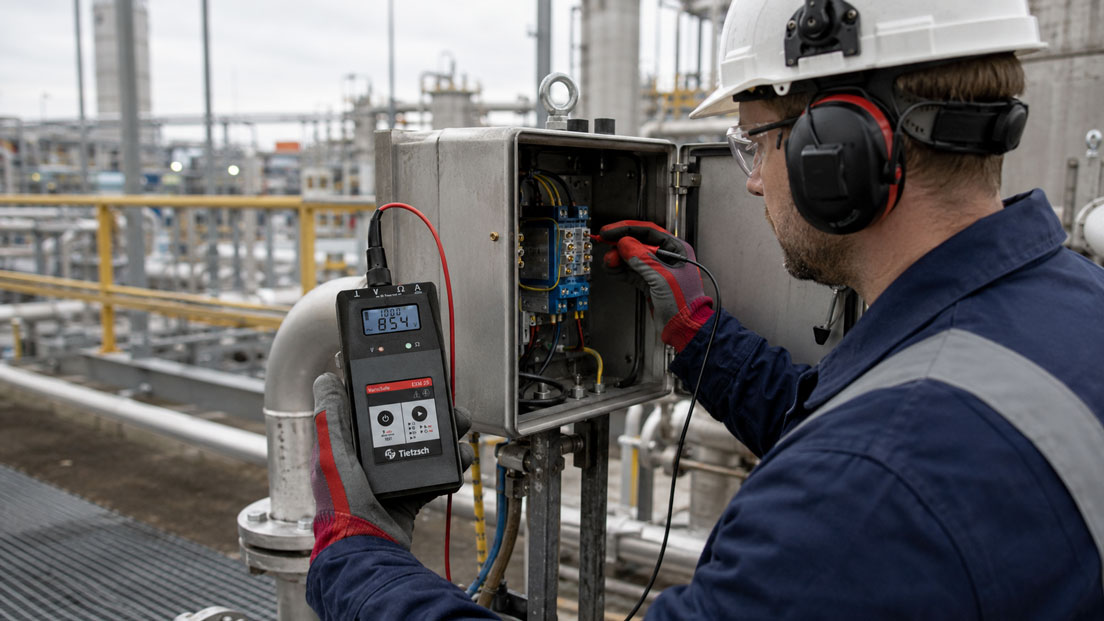
Electrical voltages must also be tested in potentially explosive atmospheres—for example, when troubleshooting pumps, valves, transmitters, control cabinets or Ex terminal boxes. In addition to the electrical hazard, there is a further risk: the test instrument itself may become an ignition source due to sparks, hot surfaces or unsuitable energy sources.
A robust standard voltage tester with a high measurement category is therefore not automatically suitable for use in an Ex zone. For measurements within a potentially explosive atmosphere, the complete measuring system must be explicitly approved for this purpose. This includes not only the main instrument but also test leads, probes, adapters, batteries and, where applicable, temperature- or current-measuring accessories.
Before every measurement, the zone, gas or dust group, equipment category, temperature class, electrical measurement task and permissible voltage range must be checked. Only then can it be determined which Ex measuring instrument may be used and whether live measurement is actually necessary and authorised.
Table of Contents
- Why does voltage testing in hazardous areas require special instruments?
- Correctly assigning ATEX zones and equipment categories
- Understanding the Ex marking of the test instrument
- Distinguishing between ATEX approval and measurement category
- Which electrical test is to be carried out?
- Measuring voltage or verifying the absence of voltage?
- Test leads, probes and accessories
- Batteries and power supply in hazardous areas
- Safe test procedure step by step
- Continuity and resistance testing
- Typical errors and misinterpretations
- Practical example in a tank farm
- Selecting the correct Ex test instrument
- Which measuring instruments / products are suitable?
- Conclusion
- Frequently asked questions
Why does voltage testing in hazardous areas require special instruments?
An explosive atmosphere can occur when flammable gases, vapours, mists or dusts mix with air. If an effective ignition source is then present, an explosion may occur.
Electrical test instruments may contain various potential ignition sources. These include switching sparks at contacts, electrical arcs when applying the probe, electrostatic charging of the housing, impermissibly high surface temperatures or a short circuit within the battery.
Ex measuring instruments are designed so that these risks are controlled within the scope of their approval. With intrinsically safe instruments, the available electrical and thermal energy is limited. However, this does not mean that any measurement can be carried out without risk. The approval applies only within the specified operating, voltage and environmental limits.
The electrical installation itself must also be suitable for the measurement. Sparks or arcs may occur when contacting a measuring point, particularly if probes slip, cause short circuits or are disconnected under load. An Ex approval for the measuring instrument therefore replaces neither the risk assessment nor the company’s working and permit procedures.
Correctly assigning ATEX zones and equipment categories
Potentially explosive atmospheres are classified according to how frequently and for how long a hazardous explosive atmosphere is expected to occur. Zones 0, 1 and 2 are used for gases, vapours and mists. Zones 20, 21 and 22 apply to combustible dusts.
| Area | Occurrence of the explosive atmosphere | Equipment category generally required |
|---|---|---|
| Zone 0 | Continuously, frequently or for long periods due to gases, vapours or mists | Category 1G |
| Zone 1 | Occasionally during normal operation due to gases, vapours or mists | Category 1G or 2G |
| Zone 2 | Normally not present during normal operation or present only briefly | Category 1G, 2G or 3G |
| Zone 20 | Continuously, frequently or for long periods due to combustible dust | Category 1D |
| Zone 21 | Occasionally during normal operation due to combustible dust | Category 1D or 2D |
| Zone 22 | Normally not present during normal operation or present only briefly | Category 1D, 2D or 3D |
The equipment category alone is not sufficient for selection. The gas or dust group, temperature class, equipment protection level, type of protection, ambient temperature and, where applicable, special conditions stated in the certificate must also correspond.
An instrument with gas approval only must not automatically be used in a dust zone. Likewise, a Category 2G instrument is generally not intended for Zone 0. The complete marking and the associated certificate are always decisive.
Understanding the Ex marking of the test instrument
A typical marking on an Ex measuring instrument may, for example, include elements such as “II 2G Ex ib IIC T6 Gb”. Each part describes a specific aspect of the approval.
| Element | General meaning |
|---|---|
| II | Equipment group for areas other than mines susceptible to firedamp |
| 2G | Equipment Category 2 for explosive gas atmospheres |
| Ex | Explosion-protected design |
| ib | Intrinsic safety type of protection with the specified protection level |
| IIC | Gas group for which the instrument has been tested |
| T6 | Temperature class or limitation of the permissible surface temperature |
| Gb | Equipment protection level for gas atmospheres |
Additional information may follow the marking, such as a permissible ambient temperature range or an “X”. An “X” indicates special conditions for safe use. These conditions must be obtained from the certificate and operating instructions before use.
Different versions may also exist within one instrument model. The battery version, accessories, probes or maximum voltage may affect the approval. The model designation alone is therefore not sufficient for authorisation.
Distinguishing between ATEX approval and measurement category
ATEX approval and the electrical measurement category address different hazards. The Ex marking indicates whether the instrument may be used in a specific explosive atmosphere. The measurement category, by contrast, describes the stress caused by transient overvoltages within low-voltage electrical installations.
A voltage tester rated CAT IV 600 V may be designed for measurements at an installation’s supply point without having any Ex approval. Conversely, an Ex measuring instrument must also be checked to determine the electrical measurement category and maximum operating voltage for which the instrument, including its accessories, is intended.
Both requirements must therefore be met for the application:
- suitable Ex approval for the zone, substance group and temperature class,
- suitable measurement category and rated voltage for the electrical measuring point.
A high CAT rating does not replace ATEX approval. Conversely, ATEX approval does not permit measurements above the stated voltage or measurement category.
Which electrical test is to be carried out?
Before selecting the instrument, the measurement task must be clearly defined. The term “voltage test” can describe different activities:
- determining whether voltage is generally present,
- accurately measuring an AC or DC voltage,
- troubleshooting a 24 V control circuit,
- testing an intrinsically safe measuring circuit,
- measuring a non-intrinsically safe mains circuit,
- verifying the absence of voltage before work begins,
- continuity or resistance testing on an isolated cable.
An intrinsically safe multimeter may be suitable for quantitative voltage measurements and troubleshooting. However, this does not automatically mean that it is approved for every company test procedure or for formally verifying the absence of voltage.
A distinction must also be made between measurements on an intrinsically safe signal circuit and on a high-power mains circuit. The measuring instrument must be suitable for both aspects: the Ex zone and the electrical energy of the circuit being measured.
Measuring voltage or verifying the absence of voltage?
During troubleshooting, an exact voltage value often needs to be determined. A suitable Ex multimeter is useful for this purpose. When verifying the absence of voltage, however, the primary objective is to establish safely whether the relevant part of the installation is de-energised.
Not every multimeter is automatically a voltage tester for formally verifying the absence of voltage. Conversely, a two-pole voltage tester often has no Ex approval. The instrument used and the test procedure must therefore be suitable for the specific company task.
Before work is carried out on electrical installations, isolation should, wherever possible, be performed outside the potentially explosive atmosphere. The absence of voltage must then be verified in accordance with the defined electrical procedure. If the test must be carried out within an Ex zone, the explosion-protection document and company permit rules must additionally be observed.
A single-pole phase tester or non-contact voltage indicator is not sufficient to provide reliable verification of the absence of voltage. Such functions may provide supplementary indications only.
Test leads, probes and accessories
The Ex approval applies to a defined instrument configuration. An arbitrary standard test lead must therefore not be connected to an Ex measuring instrument without verification.
Before use, the following in particular must be checked:
- approval of the test leads and probes for the specific instrument,
- permissible voltage and measurement category of the accessories,
- Ex approval or inclusion in the certificate,
- undamaged insulation and touch protection,
- correct plug connection and locking,
- sufficiently short exposed metal probe tips,
- suitability for moisture, contamination and ambient temperature.
Adapters, crocodile clips and current-measuring accessories may alter the permissible measurement category or Ex area of use. The lowest permissible voltage or protection level within the complete measuring arrangement always applies.
Damaged leads must not be repaired provisionally or continue to be used with insulating tape. The instrument must be removed from service and checked in accordance with the specified inspection or repair procedure.
Batteries and power supply in hazardous areas
The battery is a safety-relevant component of an intrinsically safe test instrument. The cell type, internal fuse, current limitation and mechanical design may form part of the Ex approval.
Only batteries, rechargeable batteries or power packs approved by the manufacturer may therefore be used. A battery with the same dimensions and nominal voltage is not automatically permissible.
Battery replacement, charging and opening of the battery compartment may only be carried out in accordance with the operating instructions. If these activities are not explicitly permitted within the Ex zone, they must be carried out outside the potentially explosive atmosphere.
The charge or battery status should be checked before entering the area. Replacing the battery during the measurement is not an appropriate solution from either an organisational or safety perspective.
Safe test procedure step by step
Measurements on live installations in hazardous areas may only be carried out by appropriately qualified persons as part of an approved working procedure. Where isolation is possible, it generally takes priority over live measurement.
- Clarify the measurement task: Determine whether quantitative voltage measurement, troubleshooting or verification of the absence of voltage is required.
- Check the work area: Determine the zone, gas or dust group, temperature class and current operating conditions from the explosion-protection document.
- Assess the measuring circuit: Clarify the expected voltage, AC/DC, measurement category, possible short-circuit power and intrinsic safety of the circuit.
- Compare the instrument marking: Check whether the Ex marking, voltage limit, measurement category and ambient temperature are suitable for the task.
- Check the accessories: Use only approved test leads, probes and energy sources.
- Carry out visual and functional checks: Inspect the housing, display, leads, insulation, plug connections and instrument self-test.
- Test the instrument on a known source: Where required by the specified test procedure, confirm correct operation before the actual measurement.
- Contact the measuring point safely: Avoid short circuits, slipping and unintended contact with adjacent components.
- Evaluate the reading and status: Consider not only the numerical value but also warning indicators, measuring range and instrument status.
- Carry out a post-test: After the measurement, check again that the test instrument continues to function correctly.
- Document the result: Record the measuring point, instrument, accessories, Ex marking, measured value and special conditions.
A gas clearance measurement or work permit can provide additional safety, but it does not automatically cancel all Ex requirements. The company permit procedure and the determination of whether the area may actually be treated as non-hazardous for the duration of the work are decisive.
Continuity and resistance testing
During a continuity or resistance measurement, the test instrument itself supplies a small amount of electrical energy to the circuit. Within an Ex zone, this may only be carried out using an instrument approved for the purpose and within the specified parameters.
The circuit being tested must generally be de-energised. Capacitors, long cables and connected electronic equipment may nevertheless contain residual energy. The condition of the installation and possible energy-storage components must therefore be considered before resistance testing.
The same principle applies here: the Ex approval of a multimeter does not automatically mean that every measuring function may be used under all conditions. Different test leads and operating limits may apply to voltage, current, resistance, frequency or temperature.
For specialised tasks such as low-resistance measurement of equipotential bonding conductors or insulation testing in Ex zones, dedicated Ex test instruments should be used. A standard multimeter does not replace these test procedures.
Typical errors and misinterpretations
A CAT IV voltage tester is automatically considered suitable for Ex areas
The measurement category describes electrical overvoltage stress. Without explicit Ex marking, the instrument must not be used in an Ex zone solely because of its CAT rating.
Only the main instrument is checked
Unapproved test leads, adapters or batteries can invalidate the Ex suitability of the complete measuring arrangement.
Approval for Zone 1 is applied to Zone 0
A Category 2G instrument is generally intended for Zones 1 and 2, not automatically for Zone 0.
Gas approval is equated with dust approval
An instrument marked “G” does not automatically have approval for dust zones. Corresponding “D” marking is required.
The Ex multimeter is used indiscriminately as a voltage tester
Quantitative voltage measurement and formal verification of the absence of voltage are different test tasks. The instrument must be intended for the respective procedure.
Batteries are replaced with similar standard types
In intrinsically safe instruments, the energy source may form part of the approval. Only approved battery or rechargeable-battery types may be used.
The current process situation is ignored
A location normally classified as Zone 2 may need to be assessed differently during a malfunction, opening or maintenance operation. The risk assessment and work permit are decisive.
Practical example: Voltage testing in a tank farm
An intrinsically powered level transmitter fails in a tank farm. The measuring point is located in a gas atmosphere classified as Zone 1. According to the explosion-protection document, Gas Group IIC must be taken into account.
The technician must check whether the 24 V DC supply reaches the Ex terminal box. A measurement outside the area has already confirmed that the power supply in the control cabinet is operating. An Ex multimeter is selected for the on-site test whose marking is suitable for Zone 1, the required gas group and the applicable voltage range.
Before entering the area, the instrument, approved DATA-HOLD probes, leads and power pack are checked. Correct function is tested on a known voltage source. The measurement is then carried out at the authorised terminal box in accordance with the company working procedure.
A voltage of 24.2 V DC is measured at the input terminals. However, no voltage is present directly at the output to the transmitter. After isolation, a loose terminal is identified. The connection is repaired and the installation is tested again.
The example shows that Ex approval is only one part of the safe test procedure. The correct measurement task, a suitable electrical voltage range, approved accessories, the work permit and functional verification of the test instrument are equally important.
Selecting the correct Ex test instrument
At least the following information is required for instrument selection:
- gas or dust hazardous area,
- zone and required equipment category or EPL,
- gas or dust group,
- temperature class and ambient temperature,
- intrinsically safe or non-intrinsically safe measuring circuit,
- maximum AC and DC voltage,
- required measurement category,
- quantitative measurement or verification of the absence of voltage,
- additional functions such as current, resistance, frequency or temperature,
- required probes, adapters and test leads,
- requirements for degree of protection, display and documentation.
Selection must not be based solely on the largest measuring range. An instrument with a very high maximum voltage may be unsuitable if its Ex marking does not correspond to the zone. Conversely, an instrument approved for Zone 0 must not be used above its electrical voltage or measurement-category limits.
Which measuring instruments / products are suitable?
Ex measuring and test instruments
The Ex measuring and test instruments category includes intrinsically safe instruments for voltage, resistance, earthing and insulation tests in potentially explosive atmospheres.
The instruments have different Ex markings and measuring functions. Before selection, it must therefore be checked whether the relevant version is suitable for gas, dust, mining, zone, substance group and measuring circuit.
VARIOSAFE EXM 25
The VARIOSAFE EXM 25 is an intrinsically safe multimeter for electrical measurements in potentially explosive atmospheres in the chemical industry and mining.
For Ex II applications, it is intended for voltage measurements up to 690 V. Depending on the equipment and approved accessories, it enables measurements of voltage, resistance, current, frequency and temperature. The antistatic housing, special power packs and protected probes form part of the instrument concept.
With its Category 2G marking, the instrument is suitable for correspondingly classified gas areas in Zones 1 and 2. The specific gas group, temperature class and permissible measuring configuration must be checked before every application.
MTX 3297Ex
The MTX 3297Ex is an intrinsically safe TRMS multimeter for demanding electrical maintenance and diagnostic tasks.
Depending on its complete marking, it is designed for Gas Zones 0, 1 and 2, Dust Zones 20, 21 and 22, and mining applications. It is therefore particularly suitable for users who work in both gas and dust hazardous areas and need to measure additional electrical variables accurately alongside voltage.
Different operating and voltage limits also apply to this instrument inside and outside the Ex area. The test leads, input sockets and measuring function must be suitable for the specific task.
Conventional two-pole voltage testers
The voltage testers / meter-starting testers category includes robust two-pole voltage testers for general electrical installations.
These instruments may be suitable for detecting voltage, phase-sequence testing, continuity testing or load switching. Without explicit Ex approval, however, they must not be used within a hazardous zone solely because of their VDE testing, degree of protection or measurement category.
Conclusion: CAT safety alone is not sufficient in hazardous areas
For voltage tests in potentially explosive atmospheres, the test instrument must be suitable for both the electrical installation and the Ex zone. ATEX marking, equipment category, gas or dust group, temperature class, measurement category and maximum voltage must be assessed together.
A conventional two-pole voltage tester is not automatically suitable for hazardous areas. Intrinsically safe multimeters such as the VARIOSAFE EXM 25 or MTX 3297Ex are used for quantitative measurements and troubleshooting, provided their specific approval is suitable for the measuring point.
The complete measuring system is decisive. Unapproved test leads, probes, adapters or batteries can prevent safe use. Opening, charging and battery replacement may also only be carried out in accordance with the operating instructions.
Ex approval does not replace isolation, risk assessment or a work permit. Live measurement should only be carried out when technically necessary and permitted by the company procedure.
Frequently asked questions about voltage testers in hazardous areas
May a normal two-pole voltage tester be used in Zone 1?
Only if the specific instrument is explicitly approved for this Ex zone. A high measurement category, VDE testing or robust design is not sufficient.
Is a CAT IV multimeter automatically ATEX approved?
No. CAT IV describes resistance to electrical overvoltages. Suitability for potentially explosive atmospheres must be demonstrated through separate Ex marking and certification.
Can an instrument marked II 2G be used in Zone 0?
Generally not. Category 2G is intended for Gas Zones 1 and 2. Zone 0 normally requires an instrument in Category 1G or with a corresponding equipment protection level.
May a gas-approved Ex measuring instrument also be used in a dust zone?
Not automatically. Dust zones require corresponding dust approval with a “D” marking. The complete instrument marking is decisive.
May arbitrary test leads be used with an Ex multimeter?
No. Test leads and probes must be approved for the specific instrument, voltage, measurement category and Ex application. The accessories may form part of the certification.
May the battery be replaced within the Ex zone?
Only if this is explicitly permitted in the operating instructions and approval. Otherwise, battery replacement, charging and opening of the instrument must take place outside the potentially explosive atmosphere.
Is an Ex multimeter automatically suitable for verifying the absence of voltage?
Not necessarily. Quantitative voltage measurement and formal verification of the absence of voltage are different tasks. The instrument used must be intended and approved for the company test procedure.
Which information does ICS Schneider require for product selection?
The required information includes the zone, gas or dust group, temperature class, complete Ex requirements, expected AC and DC voltage, measurement category, type of circuit, required measuring functions, ambient temperature and details of the probes, accessories and intended working procedure.