


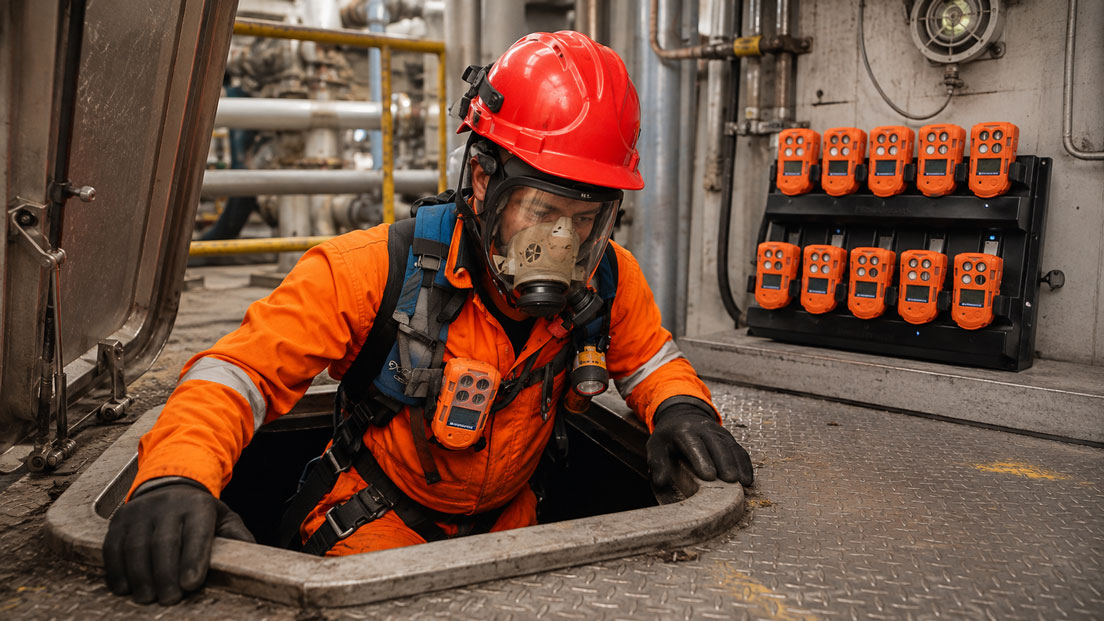
A catalytic gas sensor may appear to be in perfect condition, indicate a stable zero reading and still have lost a substantial proportion of its sensitivity. This is precisely what makes sensor poisoning so dangerous: the gas detector starts normally, indicates 0% LEL in clean air and may not report an internal fault. However, during an actual release of flammable gas, it responds too weakly, too slowly or not at all.
Typical causes include volatile silicone compounds, sulphur compounds, substances containing lead or phosphorus and certain halogenated hydrocarbons. These substances can permanently poison the catalyst of a catalytic bead sensor or temporarily inhibit it.
A visual inspection and a plausible zero reading are therefore insufficient. Sensitivity can only be assessed by exposing the sensor to a suitable test gas under controlled conditions. Following possible exposure to catalyst poisons, a bump test, quantitative calibration check and, where necessary, sensor replacement are required.
Suitable instruments can be found in the ICS category Portable Gas Detectors. Fixed detectors and transmitters are grouped under Fixed Gas Detectors.
Table of Contents
- How does a catalytic gas sensor work?
- Why can a poisoned sensor continue to indicate zero?
- What does sensor poisoning mean?
- Distinguishing between poisoning, inhibition and blockage
- Which substances can affect catalytic sensors?
- Why are silicones particularly critical?
- How do sulphur compounds affect the sensor?
- Why does the sensor require oxygen?
- High gas concentrations and measuring-range overexposure
- How can a loss of sensitivity be detected?
- Distinguishing between a bump test, calibration check and calibration
- Why must the response time also be tested?
- Procedure following suspected exposure
- Protecting sensors against catalyst poisons
- Using filters correctly
- Correctly testing fixed gas detection systems
- Safely managing portable gas detectors
- When are IR or MPS sensors appropriate?
- Practical example: Silicone spray in a workshop
- Typical errors when handling catalytic sensors
- What should be included in the test and exposure documentation?
- Which products and solutions are suitable?
- Conclusion
- Frequently asked questions
How does a catalytic gas sensor work?
Catalytic sensors for flammable gases are also referred to as catalytic bead sensors, pellistors or catalytic combustion sensors. They usually contain two electrically heated sensing elements:
- an active element with a catalytically active surface,
- a reference element without corresponding catalytic activity.
When a flammable gas-air mixture reaches the active sensing element, the gas is oxidised on the heated catalyst surface. This generates heat. The temperature and therefore the electrical resistance of the active element increase relative to the reference element.
A measuring bridge detects this difference and converts it into a signal displayed as a percentage of the lower explosive limit:
0 to 100% LEL
The lower explosive limit is the lowest concentration of a flammable gas or vapour in air at which an explosive atmosphere can form.
Sensitivity depends, among other factors, on:
- the catalyst material used,
- the temperature of the sensing element,
- the calibration gas,
- the target gas actually present,
- the oxygen concentration,
- temperature and humidity,
- the condition of the diffusion opening and filter,
- possible catalyst poisons.
A sensor calibrated with methane will also respond to numerous other flammable gases and vapours. However, the signal level may differ significantly. The calibration gas, target gas and correction or response factors specified by the manufacturer must therefore be considered when assessing the result.
Why can a poisoned sensor continue to indicate zero?
In clean air, no relevant combustion takes place on the active sensing element. The active element and reference element therefore remain approximately balanced, even when the sensor is poisoned.
The sensor may continue to indicate:
0% LEL
This zero reading merely confirms that there is no measurable differential effect between the sensing elements at that particular time. It does not prove that the active catalyst still responds sufficiently to a flammable gas.
Other functions may also continue to appear normal:
- the instrument can be switched on,
- the self-test is completed,
- the display and battery function correctly,
- the audible and visual alarms can be tested electrically,
- the zero point is stable,
- communication with the gas detection controller operates correctly.
An electronic self-test can check open circuits, the power supply, memory or internal electronics. However, it cannot necessarily confirm that the target gas reaches the sensor surface and still produces a sufficient catalytic reaction there.
The complete functional chain is only tested by exposing the sensor to a suitable test gas.
What does sensor poisoning mean?
During sensor poisoning, substances are deposited on the catalytically active surface or react with the catalyst material. As a result, fewer active sites are available for oxidising the flammable gas.
Possible consequences include:
- reduced signal level,
- longer response time,
- increased calibration requirements,
- significantly different responses to different gases,
- the required calibration value can no longer be reached,
- complete loss of sensitivity.
Poisoning may develop gradually. Repeated exposure to a low concentration can cause a continuous reduction in sensitivity over a period of weeks or months. By contrast, a high concentration of a particularly effective catalyst poison can significantly damage the sensor within a short period.
The severity of the effect depends on:
- the type of contaminant,
- the concentration,
- the exposure duration,
- the sensor type and catalyst design,
- the sensor temperature,
- any flammable gas present at the same time,
- the protective filters used.
Distinguishing between poisoning, inhibition and blockage
A reduced sensor response does not automatically mean permanent catalyst poisoning.
| Fault condition | Effect | Possible recovery |
|---|---|---|
| Catalyst poisoning | The active surface is permanently chemically altered or coated | Frequently irreversible; sensor replacement required |
| Inhibition | The catalytic reaction is temporarily suppressed | The sensor may recover partially or completely in clean air |
| Diffusion blockage | Gas does not reach the sensor sufficiently because of dust, oil, water or a blocked filter | Frequently rectifiable after approved cleaning or filter replacement |
| Oxygen deficiency | Insufficient oxygen is available for catalytic oxidation | Normal response may return after a suitable atmosphere has been restored |
| Incorrect calibration gas | The sensor responds differently from what is expected for the target gas | Suitable calibration or correction factors required |
| Ageing | Sensitivity decreases because of normal operation and thermal stress | Calibration or sensor replacement, depending on the condition |
Whether a substance acts primarily as a poison or an inhibitor on a particular sensor depends on the sensor type. These terms must therefore not be assigned solely on the basis of the substance name. The information provided by the sensor or instrument manufacturer is decisive.
Following unusual exposure, the function must be checked with test gas regardless of the suspected type of impairment.
Which substances can affect catalytic sensors?
| Substance group | Typical sources | Possible effect |
|---|---|---|
| Silicones and siloxanes | Silicone spray, sealants, RTV silicone, release agents, lubricants, polishes, antifoaming agents | Frequently severe and permanent loss of sensitivity |
| Sulphur compounds | Hydrogen sulphide, sulphur dioxide, mercaptans, sulphur-containing processes | Inhibition or poisoning, depending on the sensor and exposure |
| Lead compounds | Leaded fuels, certain aviation fuels, historical industrial products | Severe and frequently irreversible catalyst poisoning |
| Phosphorus compounds | Phosphate esters, certain hydraulic fluids, flame retardants and additives | Permanent reduction in catalytic activity possible |
| Halogenated hydrocarbons | Chlorinated cleaning agents, degreasers, solvents, certain refrigerants | Frequently inhibition; permanent damage is also possible following intensive exposure |
| Hydrides | Silane, phosphine and specialised semiconductor or chemical processes | Severe interference or poisoning possible |
| Oil, grease and aerosols | Spray oils, machine mist, painting and coating processes | Blockage of the filter or sintered element and possible introduction of additional contaminants |
This list is not exhaustive. Products that are not explicitly labelled as containing silicone, sulphur or phosphorus may still contain corresponding additives.
Safety data sheets, technical product data and information from the gas detector manufacturer should therefore be assessed together as part of the risk assessment.
Why are silicones particularly critical?
Volatile silicone compounds may be present in products that are perceived as harmless during everyday work. Typical examples include:
- silicone lubricating and release sprays,
- RTV sealants,
- silicone oils and greases,
- mould-release agents,
- antifoaming agents,
- impregnating agents,
- polishes and care products,
- certain adhesives and potting compounds.
If siloxanes evaporate near the heated pellistor, they can decompose on the sensor surface. This produces solid silicon-containing deposits that cover the catalytically active sites.
The affected quantity does not have to be visible. The sensor may appear clean externally and still have lost a significant proportion of its sensitivity.
Particularly critical situations include:
- spray mist directly adjacent to portable gas detectors,
- curing silicone sealants in enclosed areas,
- storing detectors together with chemicals and spray cans,
- maintenance work directly adjacent to fixed sensor heads,
- drawing contaminated air through pumps and sample tubing.
A gas detector should not be stored or charged next to open sealants, cleaning agents or lubricant sprays.
How do sulphur compounds affect the sensor?
Hydrogen sulphide and other sulphur compounds can reduce the catalytic activity of a pellistor. Depending on the sensor design, concentration and exposure duration, the effect may be temporary or permanent.
Multi-gas detectors present a particular difficulty: an electrochemical H₂S sensor may continue to respond correctly to hydrogen sulphide, while the catalytic LEL sensor is damaged by the same atmosphere.
A successful response from the H₂S channel therefore does not automatically confirm that the flammable-gas sensor is functioning correctly.
Following a high H₂S exposure or prolonged use in a sulphur-containing atmosphere, at least the following should be checked:
- the response of the LEL sensor to test gas,
- the signal level achieved,
- the response time,
- the available calibration reserve,
- comparison with previous test results.
The fact that the reading returns to zero is not sufficient evidence of complete recovery.
Why does the sensor require oxygen?
The catalytic measuring principle is based on oxidation of the flammable gas. Sufficient oxygen must therefore be present in the measured atmosphere.
In an oxygen-deficient or largely inert atmosphere, a pellistor may:
- indicate too low a value,
- respond very slowly,
- produce no usable signal at all.
This may occur, for example, in:
- vessels inerted with nitrogen,
- process systems using protective gas,
- tanks containing very high hydrocarbon concentrations,
- areas with severe oxygen displacement,
- samples that are not sufficiently mixed with air before reaching the sensor.
The required minimum oxygen concentration depends on the sensor and gas. A universal value must not be assumed. The manufacturer’s specifications for the particular sensor version are decisive.
Depending on the target gas, other measuring principles may be required for measurements in inert atmospheres, such as infrared, thermal-conductivity or specially designed sensor systems.
High gas concentrations and measuring-range overexposure
Catalytic LEL sensors are designed for concentrations below the lower explosive limit. At very high concentrations, the reading can become misleading.
As the gas concentration increases, the oxygen available for catalytic oxidation becomes limited. As a result, the sensor reading may:
- reach the end of the measuring range,
- enter an over-range condition,
- fall again after reaching a maximum,
- be switched off by a protective function.
A falling reading in this situation does not mean that the atmosphere has become safe again. On the contrary, it may indicate a very high flammable-gas concentration or oxygen displacement.
Following severe over-range exposure, the instrument must be tested in accordance with the manufacturer’s instructions. Many portable instruments lock the LEL channel or require confirmation or a functional test before they can be used again.
How can a loss of sensitivity be detected?
Sensor poisoning frequently cannot be identified reliably without test gas. However, possible warning signs include:
- a reading that is too low for a known test-gas concentration,
- a delayed alarm during the bump test,
- a longer time before a stable reading is reached,
- frequent recalibration being required,
- an unusually large correction during calibration,
- calibration failure or cancellation,
- different behaviour between identical instruments,
- a sudden change following maintenance or cleaning work,
- notable exposure to silicone, sulphur or solvent vapours.
A comparison with documented previous tests is particularly informative. A gradual reduction in signal level or a continuously increasing response time may indicate the onset of ageing or poisoning, even though the sensor still passes a simple alarm test.
Distinguishing between a bump test, calibration check and calibration
Bump test or functional check
During a bump test, the gas detector is briefly exposed to a suitable test-gas concentration. The test checks whether:
- the gas reaches the sensor,
- the sensor responds,
- the alarm thresholds are exceeded,
- the audible, visual and vibration alarms function.
A simple bump test is primarily a qualitative functional check. It does not automatically confirm measuring accuracy.
Quantitative calibration check
During a calibration check, the indicated concentration is compared with the known concentration of the certified test gas.
The following should also be assessed:
- the permissible deviation,
- the response time,
- the stability of the reading,
- the return to zero.
The permissible tolerances are defined by the instrument manufacturer or the company test procedure.
Full calibration
During a full calibration, the instrument’s zero point and sensitivity are adjusted using known reference gases.
A successful calibration can compensate for normal sensor drift. However, it cannot repair a severely damaged catalyst surface.
If the required calibration factor is unusually high, the response time is outside the specification or calibration cannot be completed, the instrument must be removed from service and the sensor inspected or replaced.
Why must the response time also be tested?
A sensor may still reach the expected final value when exposed to test gas for a longer period, but respond considerably more slowly than when it was new.
The response time is crucial to the safety function. A delayed warning may result in a person entering a hazardous atmosphere or the gas release continuing before an alarm is issued.
The test should therefore assess not only the final value but also the following times:
- time to the first alarm,
- time to the main alarm,
- t50, or time to reach 50% of the final value,
- t90, or time to reach 90% of the final value,
- recovery time after removing the test gas.
Sample tubes, pumps, filters and calibration adapters also affect the measured response time. Comparative measurements must therefore be carried out using the same arrangement, flow rate and test gas.
Procedure following suspected exposure
- Label the instrument or measuring channel: Do not continue using it without testing.
- Document the exposure: Record the substance, product name, duration, location and approximate concentration.
- Check the safety data sheet: Identify silicone, sulphur, lead, phosphorus or halogen compounds.
- Allow the instrument to stabilise in suitable clean air: Observe the manufacturer’s specifications for purging and recovery times.
- Inspect the diffusion path: Check the filter, sintered element, pump inlet and calibration adapter for contamination.
- Perform a bump test: Test the sensor and alarms using suitable test gas.
- Perform a quantitative calibration check: Compare the reading and response time with the permissible values.
- Perform a full calibration where necessary: Only in accordance with the manufacturer’s instructions.
- Replace the sensor: If calibration, sensitivity or response time does not meet the specifications.
- Document the release for use: Do not return the instrument to service until it has passed the test.
A poisoned sensor must not be kept in operation artificially by increasing the calibration factor or lowering the alarm thresholds.
Unauthorised heating, burning off, cleaning with solvents or mechanical treatment of the sensing element is not permitted. Such actions may damage the sensor, flame arrestor and explosion protection.
Protecting sensors against catalyst poisons
The most effective protection is to keep critical substances away from the sensor.
Suitable organisational measures include:
- Avoid or replace silicone products in monitored areas.
- Carry out a substance assessment before introducing new sprays, lubricants and sealants.
- Do not store gas detectors together with chemicals.
- Prevent portable detectors from being contaminated during cleaning and spraying work.
- Include fixed sensor heads in maintenance clearances and work permits.
- Carry out a documented functional test after potentially damaging work.
- Inform maintenance, production and occupational-safety personnel about catalyst poisons.
- Record exposures in the instrument or sensor service history.
If a fixed measuring channel has to be disabled or bypassed during maintenance work, this may only be done in accordance with an approved procedure. Alternative protective measures, identification, time limitation and the subsequent recommissioning test must be documented.
A disabled measuring channel must not simply be enabled again electronically after the work has been completed. Before release, test gas must be used to confirm that the complete gas path and sensor response function correctly.
Using filters correctly
Manufacturers may offer special filters to keep dust, water or certain catalyst poisons away from the sensor.
However, a filter can also:
- increase the response time,
- adsorb certain target gases,
- attenuate heavy hydrocarbons,
- become blocked by oil or contamination,
- lose its protective effect after saturation.
Only filters approved for the specific detector, sensor and target gas may therefore be used.
An arbitrary activated-carbon filter is not a universal solution. Although it may retain certain contaminants, it may also reduce or completely remove the gas being monitored.
Filter-replacement intervals must be derived from the manufacturer’s specifications, environmental exposure and the results of functional tests. The gas response must be checked after every filter replacement.
Correctly testing fixed gas detection systems
For fixed gas detection systems, the complete safety chain must be considered:
Gas entry → sensor head → transmitter → wiring or bus → gas detection controller → alarm relay → ventilation, shutdown or alarm indication
An electrical simulation of the 4–20 mA signal checks the evaluation, alarm thresholds and downstream functions, but not:
- gas entry to the sensor,
- the permeability of the filter and sintered element,
- the catalytic sensitivity,
- the actual response time.
For a complete functional test, suitable test gas must be applied directly to the sensor head.
The following must be documented during the test:
- test gas and concentration,
- gas flow rate,
- calibration adapter,
- sensor reading,
- response time,
- first and main alarm,
- output signal,
- response of the gas detection controller,
- activated protective functions.
The test intervals are derived from the manufacturer’s specifications, the risk assessment, applicable rules, operational experience and the importance of the safety function.
Safely managing portable gas detectors
Portable gas detectors are exposed to changing environments. They may come into contact with spray mist, solvents, high gas concentrations, moisture and mechanical impacts.
A suitable instrument-management system includes:
- clear identification of the instrument and sensor,
- a functional test before the intended use in accordance with the manufacturer’s and company requirements,
- regular quantitative calibration checks,
- full calibration at defined intervals,
- testing after unusual exposure or an over-range event,
- documentation of bump tests and calibrations,
- checking the test gas, expiry date and cylinder pressure,
- controlled removal from service of instruments that fail a test.
Automatic test stations reduce operating errors and allow the test results to be assigned traceably to the relevant instrument.
Even when an automatic station is used, the test gas, regulator, gas path, adapter and software configuration must be suitable for the instrument.
When are IR or MPS sensors appropriate?
An alternative measuring principle may be appropriate in areas where catalyst poisons occur regularly.
Infrared sensors
Infrared sensors measure the absorption of specific wavelengths by the target gas. They do not require catalytic combustion and are therefore not poisoned by silicones or sulphur compounds in the same way as pellistors.
Advantages include:
- the target gas is not consumed at the sensor,
- no catalytic catalyst is used,
- measurement is possible even at a low oxygen concentration,
- good long-term stability for suitable hydrocarbons.
Limitations include:
- Hydrogen is not detected by conventional hydrocarbon IR sensors.
- The response depends on the particular gas and calibration gas.
- Optical contamination and condensation may affect the measurement.
MPS sensors
MPS sensors determine properties of a heated sensing element and use these to evaluate different flammable gases. Suitable versions are resistant to typical pellistor catalyst poisons and can detect several flammable gases using one sensor configuration.
Nevertheless, their suitability must still be verified for the target gases, measuring range, environmental conditions, explosion protection and required safety function.
Poison-resistant pellistors
For applications in which the catalytic principle remains necessary, more poison-resistant pellistor versions are available. They provide greater resistance but are not inherently immune to every concentration or exposure duration.
Practical example: Silicone spray in a workshop
Several portable four-gas detectors are used in a maintenance workshop. The instruments monitor carbon monoxide, hydrogen sulphide, oxygen and flammable gases.
During maintenance of pneumatic components, a new silicone-containing lubricant spray is used. The gas detectors remain switched on and are placed on a nearby workbench during the work.
All instruments start normally on the following working day:
- The self-test is passed.
- The LEL reading is 0%.
- The oxygen reading is plausible.
- No fault message is displayed.
During the functional test with test gas, two instruments respond normally. The third instrument indicates only 18% LEL on the LEL channel, although the test gas should produce an expected value of 50% LEL. The alarm is triggered with a delay.
A controlled calibration check confirms the insufficient sensitivity. A full calibration cannot be completed within the permissible adjustment limits. The catalytic sensor is replaced.
The subsequent organisational measures include:
- prohibiting silicone-containing sprays in the storage and test area for the detectors,
- testing and identifying suitable replacement products,
- including catalyst-damaging substances in the work-permit procedure,
- performing a functional test after corresponding maintenance work,
- separate storage of gas detectors and chemicals.
The example demonstrates that a zero reading and a successful electronic self-test do not rule out sensor poisoning.
Typical errors when handling catalytic sensors
| Error | Possible consequence | Suitable corrective action |
|---|---|---|
| Zero reading treated as proof of correct function | A poisoned sensor remains undetected | Regularly expose the sensor to suitable test gas |
| Only an electronic self-test performed | The gas path and catalytic sensitivity are not tested | Perform a complete functional check at the sensor head |
| Silicone spray used next to the detector | Permanent catalyst poisoning may occur | Avoid critical substances and subsequently perform a test-gas check |
| H₂S channel responds, so the LEL channel is assumed to be functional | A damaged catalytic sensor remains undetected | Test every sensor channel using suitable test gas |
| Bump test assessed only on the basis of the alarm | Insufficient signal level or slow response is overlooked | Also document the reading and response time |
| Incorrect test gas used | The sensor response cannot be assessed correctly | Observe the manufacturer’s approval and gas factors |
| Test gas applied at an incorrect flow rate | Implausible reading or damage to the sensor | Use the specified regulator and calibration adapter |
| Expired test gas used | Incorrect calibration or assessment | Check the expiry date and certificate |
| Sensor used immediately after an over-range event | Damage or reduced sensitivity remains undetected | Observe the manufacturer’s instructions and repeat the functional test |
| Arbitrary activated-carbon filter installed | The target gas is also retained | Use only approved filter accessories |
| Measuring channel only enabled electronically after maintenance | Sensor poisoning or a blocked gas path remains undetected | Apply test gas to the sensor before release |
| Calibration factor continuously increased | A severely aged sensor is artificially kept in service | Assess the calibration reserve and replace the sensor in good time |
| Catalytic sensor used in an inert atmosphere | Dangerously low or absent reading | Check oxygen dependency and select a suitable measuring principle |
What should be included in the test and exposure documentation?
Traceable documentation should include at least:
- instrument and sensor identification,
- sensor principle and target gas,
- calibration gas and configured gas response profile,
- date, time and responsible person,
- test-gas designation and concentration,
- cylinder number and expiry date,
- regulator and gas flow rate used,
- bump-test result,
- maximum indicated value,
- time to the first and main alarm,
- result of the calibration check,
- calibration performed,
- calibration factor or sensitivity trend,
- filter condition and filter replacement,
- possible exposure to catalyst poisons,
- over-range or alarm events,
- sensor replacement and replacement-part identification,
- release for use or removal from service.
Where poisoning is suspected, the product used should additionally be documented with its trade name, manufacturer and safety data sheet. This makes it possible to associate recurring failures with particular maintenance or production substances.
Which products and solutions are suitable?
T4 portable four-gas personal monitor
The T4 simultaneously monitors carbon monoxide, hydrogen sulphide, oxygen and flammable gases. It features audible, visual and vibration alarms as well as a status indication for the instrument condition.
The specific sensor configuration and sensor technology must be checked for the particular instrument version. If the version uses a catalytic sensor, the described requirements concerning test gas, oxygen concentration and possible catalyst poisons apply.
I-Test automatic test station
The I-Test station automatically performs bump tests on compatible T4 and Gas-Pro instruments.
The station checks the sensor response, gas path and audible and visual alarms. A bump test takes less than one minute. Test and calibration data can be stored and documented using the associated software.
This makes it possible to identify instruments whose LEL sensor responds insufficiently or too slowly to the test gas.
Gas-Pro IR
The Gas-Pro IR uses infrared sensor technology to measure flammable gases. It is therefore not sensitive to catalyst poisons in the same way as a pellistor.
The IR version is particularly suitable for areas in which silicones or other catalyst-damaging substances may occur regularly. It should be noted that conventional hydrocarbon IR sensors do not detect hydrogen.
T4x with MPS sensor
The T4x is available with MPS sensor technology for flammable gases. The sensor is resistant to typical pellistor catalyst poisons and can account for more than 15 flammable gases.
This version can be a suitable alternative where changing flammable gases are present or where there is a relevant risk from silicones, sulphur compounds and other catalyst poisons.
SMART S-MS fixed gas detector
The SMART S-MS is a fixed gas detector for industrial and petrochemical applications.
Different sensor heads and sensing principles are available depending on the target gas and configuration. For flammable gases, catalytic and alternative measuring principles can be compared during project planning.
SMART 3G-D3 fixed gas detector
The SMART 3G-D3 supports catalytic, electrochemical and infrared sensors. The instrument provides 4–20 mA, communication and relay functions for industrial gas detection systems.
This allows the sensor technology to be selected specifically for the target gas, environmental conditions and risk of sensor poisoning.
ICS Schneider Messtechnik provides support in selecting the sensor technology, target and calibration gases, test gas, test station and gas detection controller, as well as in planning bump-test, calibration and maintenance procedures.
Conclusion
Catalytic sensors detect flammable gases through oxidation on a heated catalyst surface. Silicones, sulphur, lead and phosphorus compounds and certain halogen compounds can inhibit or permanently poison this surface.
A damaged sensor may continue to indicate a stable zero reading and pass an electronic self-test. A zero reading therefore does not prove that the sensor remains sufficiently sensitive.
Complete functionality can only be confirmed by applying a suitable test gas. A bump test generally checks gas entry, sensor response and alarm activation. For a reliable assessment of sensitivity, the indicated reading and response time must also be evaluated.
Following possible exposure to catalyst poisons, the instrument must be labelled, tested and, where necessary, removed from service. A full calibration can correct normal drift but cannot regenerate a permanently poisoned catalyst.
Silicone-containing sprays, sealants and lubricants should be kept away from gas detectors and sensor heads. Maintenance work involving critical substances must be considered in work permits and instrument tests.
In areas where sensor poisons occur regularly, infrared, MPS or more poison-resistant sensor versions may be technically more suitable. However, the selection must always be matched to the target gas, oxygen concentration, explosion protection and safety function.
Frequently asked questions about catalytic gas sensor poisoning
Can a poisoned sensor continue to indicate 0% LEL?
Yes. In clean air, the zero point may continue to appear plausible even though sensitivity to flammable gas has been significantly reduced.
Does the internal self-test detect sensor poisoning?
Not necessarily. Many self-tests check the electronics, power supply and electrical connections, but not the actual catalytic response to gas.
Which substances poison catalytic sensors?
Silicones and siloxanes, lead and phosphorus compounds and, depending on the sensor, sulphur compounds, hydrides and halogenated hydrocarbons are particularly critical.
Can a single use of silicone spray damage the sensor?
Intensive exposure to volatile silicone compounds can cause a significant loss of sensitivity. The effect depends on the product, concentration, distance and exposure duration.
Is hydrogen sulphide always a permanent sensor poison?
The effect depends on the sensor and exposure. Hydrogen sulphide can temporarily inhibit or permanently damage catalytic sensors. A test-gas check is required after exposure.
What is the difference between a bump test and calibration?
A bump test is primarily a functional test of the sensor response and alarms. A calibration check assesses the quantitative reading. During a full calibration, the instrument is adjusted to known reference values.
Is it sufficient for the alarm to activate during the bump test?
Not always. A damaged sensor may activate the alarm with a delay or only just reach the threshold. Following critical exposure, the signal level and response time should also be assessed.
Can a poisoned sensor be recalibrated?
Minor drift can be corrected. In the event of permanent poisoning, calibration cannot restore the original catalytic activity. The sensor must be replaced.
Why do catalytic sensors not respond correctly in nitrogen?
The measuring principle requires oxygen to oxidise the flammable gas. In inert or severely oxygen-deficient atmospheres, the reading may be significantly too low.
Are infrared sensors unaffected by silicones?
They do not contain a catalytic pellistor and are therefore not poisoned in the same way. However, optical contamination, condensation and unsuitable target gases may still affect their operation.
Can an IR sensor detect hydrogen?
Conventional IR sensors for flammable hydrocarbons do not detect hydrogen. A different sensor technology suitable for hydrogen is required.
May a fixed channel be covered during work involving silicones?
Only as part of an approved procedure with suitable alternative protective measures. After the work, the cover or bypass must be removed and the sensor function confirmed using test gas.