


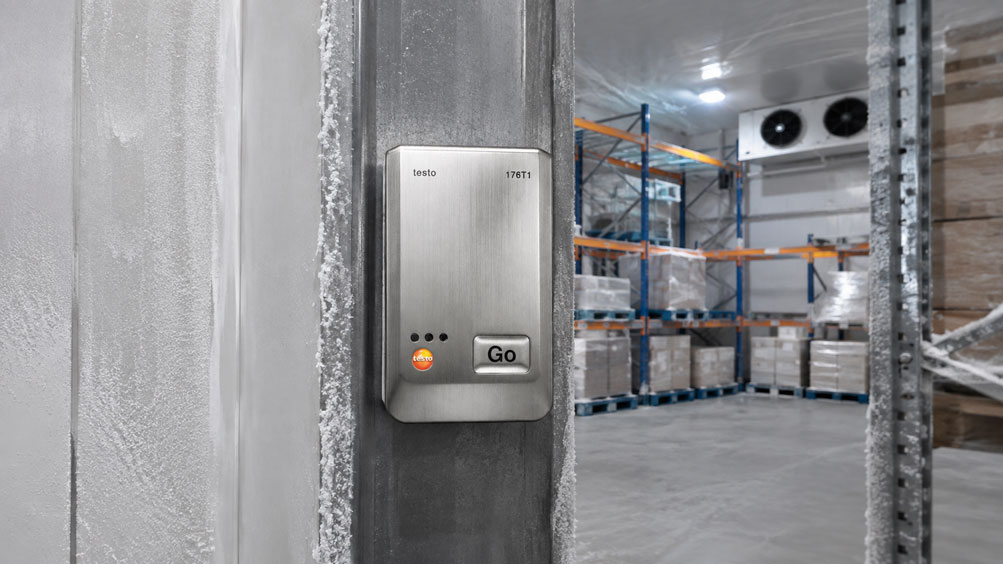
According to the datasheet, a temperature data logger may be approved for operation at -30 °C and have a specified battery life of several months or even years. Nevertheless, the device may suddenly report a low battery in a freezer warehouse, respond sluggishly when data is retrieved or fail earlier than expected. Such cases do not necessarily mean that the logger is unsuitable or that the battery is defective.
The key point is: temperature range and battery life are two different technical specifications. A data logger may, for example, be specified for operation at -30 °C, while the nominal battery life was determined under considerably more favorable conditions – often at room temperature and with a defined measurement interval.
At low temperatures, the electrochemical characteristics of a battery change. The power currently available decreases, internal resistance increases and the terminal voltage can drop more sharply under load. At the same time, measurement, memory access, the display and especially wireless transmissions require energy. Long-term measurements in freezer applications therefore need to be planned differently from the same measurement at +20 °C.
Additional practical factors must also be considered: LCDs may respond more slowly in cold conditions, frequent temperature changes increase the risk of condensation, and with a logger using an internal sensor, the complete device must be exposed to the low temperature. In some applications, a logger with an external temperature probe is therefore the better solution.
Suitable instruments can be found at ICS Schneider under temperature data loggers. An overview of additional measuring and recording systems can be found under data loggers and universal measuring instruments.
Table of Contents
- Why cold temperatures affect battery life
- The role of battery chemistry
- Why nominal battery life cannot simply be assumed
- Choosing the measurement and wireless transmission intervals correctly
- What happens to the display at sub-zero temperatures
- Distinguishing measurement range, operating temperature and storage temperature
- Avoiding condensation during temperature changes
- What happens to measured data when the battery is depleted?
- Preparing the logger at room temperature
- When external temperature probes are useful
- Planning data retrieval correctly in freezer applications
- Typical faults with data loggers at low temperatures
- Selection and test procedure before a long-term measurement
- Practical example: temperature recording at -28 °C
- Suitable temperature data loggers
- Conclusion
- FAQ
Why cold temperatures affect battery life
A battery provides electrical energy through electrochemical reactions. As temperature decreases, these processes slow down. At the same time, the effective internal resistance of the cell typically increases.
For the data logger, this means that as soon as the electronics require current, battery voltage can drop more sharply at low temperatures than at room temperature.
In simplified form, the voltage drop across the internal resistance can be described as:
ΔU = I · Ri
Where:
- ΔU = voltage drop within the battery,
- I = current being drawn at that moment,
- Ri = effective internal resistance of the battery.
If Ri increases at low temperature, the same current causes a larger voltage drop. The electronics may therefore reach their undervoltage threshold even though chemical energy is still present in the battery.
Another important point is that part of this cold-temperature effect is reversible. If an otherwise intact battery warms up again, its voltage and available performance may partially recover. A battery that appears “empty” at -30 °C is therefore not necessarily completely discharged at room temperature.
The role of battery chemistry
Not every battery behaves in the same way at low temperatures. The battery chemistry used has a significant influence on how strongly voltage and performance decrease in cold conditions.
Data loggers may use lithium primary cells or lithium coin cells, among other battery types. Lithium systems can generally be suitable for low temperatures. However, the specific cell chemistry and the manufacturer’s approval are decisive.
The simple statement “The logger has a lithium battery, so it will work without problems at -30 °C” is not technically sufficient.
When selecting an instrument, the following factors should therefore always be considered together:
- operating temperature of the data logger,
- battery type used,
- battery life specified by the instrument manufacturer,
- temperature at which this battery life was specified,
- measurement interval,
- any wireless or communication intervals.
The fourth point is particularly important. A battery life of several years may initially sound excellent. However, if this value was determined at +25 °C, it cannot simply be transferred to continuous operation at -30 °C.
Why nominal battery life cannot simply be assumed
The battery life of a data logger is normally specified for defined boundary conditions. A typical specification might read:
“Battery life: 500 days at a 15-minute measurement interval and +25 °C.”
This does not mean:
“The logger is guaranteed to operate for 500 days at every permissible operating temperature.”
Several factors determine the actual operating time:
| Influencing factor | Effect on energy demand or available battery performance |
|---|---|
| Low temperature | Available performance may decrease and battery voltage may drop more sharply under load |
| Short measurement interval | Electronics and sensor are activated more frequently |
| Frequent wireless transmission | Additional current consumption by the wireless module |
| Display activity | Additional energy consumption depending on the device |
| Battery age | Available reserve may already be reduced before the measurement begins |
| Very long measurement campaign | Self-discharge and aging become increasingly relevant |
For critical freezer measurements, sufficient reserve should therefore be planned. The intended measurement duration must not simply be equated with the battery life specified at room temperature.
Choosing the measurement and wireless transmission intervals correctly
An important factor affecting battery life and memory requirements is the measurement interval.
Whether measurements are required every second, every minute or only every 15 minutes depends on the application.
In a large freezer warehouse with slowly changing temperatures, a very short interval may be unnecessary. During refrigerated transport, when doors are opened or when rapid temperature changes are being investigated, a shorter interval may be required.
The interval should therefore not simply be maximized to extend battery life. The decisive question is:
What time resolution is required to ensure that relevant temperature events are still reliably detected?
Measurement interval and memory are directly related
The theoretical recording duration until the memory is full can be approximately calculated as:
Recording duration = number of memory values × measurement interval
A larger memory therefore enables either longer measurement campaigns or shorter measurement intervals.
Wireless communication can require more energy than the measurement itself
With wireless data loggers, a distinction must also be made between the measurement interval and the communication interval.
A logger may, for example, measure frequently but transmit the data only at longer intervals. From an energy perspective, this may be more efficient than transmitting every individual measurement immediately.
This point is particularly relevant in cold conditions because the temporarily higher currents required for wireless transmission can cause a more pronounced voltage drop in a cold battery.
Anyone intending to use a wireless logger at low temperatures should therefore check not only the sensor’s measurement range, but explicitly also the permissible operating temperature of the complete wireless logger and its battery concept.
What happens to the display at sub-zero temperatures
Many data loggers have an LCD that displays, for example, the current measured value, limit values, minimum/maximum values or battery status.
Liquid crystal displays can react more slowly at low temperatures. Individual segments may switch more sluggishly, contrast may change and the display may become more difficult to read.
However, a sluggish display does not automatically mean that internal data acquisition has also failed. Display, sensor, memory and processor are separate components.
Conversely, a still-visible display does not necessarily mean that the logger is continuing to record reliably under all conditions.
The decisive factor is therefore the operating temperature of the complete device specified by the manufacturer.
For particularly low temperatures, a logger with LED status indication or a measurement concept using an external probe may be more suitable than a device whose display must be operated permanently inside the freezer area.
Distinguishing measurement range, operating temperature and storage temperature
Different temperature specifications in datasheets can easily be confused.
| Specification | Meaning |
|---|---|
| Measurement range | Temperature range over which the installed sensor can measure temperature |
| Operating temperature | Temperature range within which the complete device may be operated as intended |
| Storage temperature | Temperature range within which the device may be stored while not in operation |
Particularly with loggers using external probes, the sensor may have a significantly wider measurement range than the electronics themselves.
A Pt100 probe, for example, may be suitable for very low temperatures, while the connected data logger may only be operated down to -35 °C. If measurements are required at even lower temperatures, the probe can be installed inside the freezer area while the logger remains outside.
A specification such as “measurement range down to -100 °C” therefore does not automatically mean that the complete display instrument may also be operated at -100 °C.
Avoiding condensation during temperature changes
In practice, the greatest problem is often not the cold itself, but the subsequent transition into a warm and humid environment.
If a data logger that has cooled to -25 °C is removed from a freezer and brought into an environment at, for example, +20 °C, the surface of the device initially remains very cold. If its temperature is below the dew point of the ambient air, moisture condenses on the logger.
This can be particularly problematic at:
- USB connections,
- SD card slots,
- battery compartments,
- connectors for external probes,
- sealing surfaces and housing openings.
A high IP protection rating is helpful, but it does not replace correct handling during temperature changes. The IP classification describes protection against the ingress of water and foreign objects under defined test conditions. It is not a general statement that condensation is harmless under every conceivable operating condition.
Practical procedure when removing the logger from the freezer
If permitted by the manufacturer’s instructions, the following procedure is useful:
- Do not open the logger unnecessarily while it is still in the cold area.
- Keep the battery compartment and interfaces closed.
- If appropriate, place the device in a dry, sealed bag or container before it warms up.
- Allow the logger sufficient time to reach ambient temperature.
- Only then open the battery cover, USB port or other sensitive areas.
This helps prevent large quantities of humid room air from immediately condensing on the still very cold internal components.
What happens to measured data when the battery is depleted?
The question of data retention is particularly important for freezer measurements. At low temperatures, a battery may reach its undervoltage threshold earlier than expected.
Suitable data loggers store measured values in non-volatile memory. However, whether and how data is retained when the battery is depleted must be checked for the specific device.
Reliable measurement planning should therefore answer the following questions:
- Are already stored data retained when the battery is depleted?
- Are the data retained during a battery replacement?
- Does an active measurement automatically resume after a voltage drop?
- Does the logger need to be restarted after battery replacement?
- What happens when the memory is full?
- Does recording stop or are old values overwritten?
For data integrity, these points can be even more important than battery life itself.
For the testo 174 T as well as the testo 176 T1 and T2 loggers, automatic or secure data retention is explicitly provided in the event of a depleted battery or battery replacement. Already stored values are therefore not lost simply because the battery is changed.
Preparing the logger at room temperature
A data logger should, wherever possible, be fully prepared before being placed in the freezer area.
This includes:
- Check battery status.
- Program the logger.
- Set the measurement interval.
- Configure limit values.
- Check date and time.
- Check or read out the memory.
- Start the measurement.
- Check the start status.
- Only then place the logger in the cold area.
This primarily offers practical advantages: buttons, displays, connectors and computer interfaces do not need to be operated at -30 °C.
Starting the logger at room temperature does not, however, automatically extend the total battery life of a freezer measurement lasting several months. After sufficient cooling time, the logger battery will also reach the ambient temperature.
Allow for thermal stabilization time
When a logger with an internal temperature sensor is placed in the freezer area, it initially records its own cooling process as well.
The logger requires a certain amount of time before the housing and sensor are sufficiently close to the actual ambient temperature. The first measured values after a major temperature change should therefore not automatically be interpreted as representative storage temperature.
When external temperature probes are useful
At very low temperatures, it may be useful not to place the complete data logger in the cold area.
Instead, only an external temperature probe is positioned inside the freezer room or freezer cabinet, while the logger, battery and display remain outside.
This solution offers several advantages:
- the battery operates at a higher temperature,
- the display remains easier to read,
- data can be retrieved more easily,
- the logger does not need to be moved repeatedly between warm and cold environments,
- condensation problems on the device can be reduced,
- with suitable probes, temperatures below the permissible operating temperature of the logger itself can be measured.
However, several points must also be considered:
- The external probe must be specified for the required temperature.
- The probe cable and insulation must be suitable for low temperatures.
- Door seals must not be adversely affected by the cable.
- Wall feedthroughs must be checked for sealing and thermal bridges.
- The probe location must be representative of the measurement task.
Particularly for ultra-low-temperature freezers, this concept is often more suitable than exposing a standard logger completely to the extreme temperature.
Planning data retrieval correctly in freezer applications
Data retrieval should also form part of the measurement planning. If a logger has to be removed from the freezer every time data is read out, each maintenance operation creates another temperature cycle.
Possible strategies include:
- using a large internal memory and reading out data infrequently,
- using an SD card or suitable interface where provided by the device,
- installing the logger with an external probe outside the freezer area,
- using a wireless or remote monitoring system for suitable applications.
With wireless solutions, however, the energy balance must again be considered. Convenient and frequent data transmission can increase energy consumption.
For critical long-term measurements, the following question should therefore be clarified before installation:
How will the data be retrieved from the logger without unnecessarily interrupting the measurement or regularly exposing the device to major temperature changes?
Typical faults with data loggers in freezer applications
| Observation | Possible cause | Recommended check |
|---|---|---|
| Low-battery warning appears much earlier than expected | Battery life was specified at a higher reference temperature | Compare operating temperature with the manufacturer’s battery-life specification |
| Logger works again at room temperature | Possible cold-induced voltage drop or increased battery impedance | Check battery and actual operating limits |
| Display reacts very slowly | Temperature-dependent LCD behavior | Check operating temperature and read out stored data |
| Measured values are initially significantly too high after the logger is placed in the freezer | Logger or internal sensor has not yet reached thermal equilibrium | Allow for cooling curve and required stabilization time |
| Water forms on the device after removal | Condensation because the surface temperature is below the dew point | Allow the closed device to warm up and open interfaces only later |
| Corrosion at a connector or battery compartment | Repeated condensation or moisture ingress | Check handling during temperature changes and inspect seals |
| Memory is full before the end of the measurement campaign | Measurement interval too short or insufficient memory planning | Calculate memory capacity and measurement interval before starting |
| Short temperature peaks are missing from the recording | Measurement interval too long | Shorten the interval according to process dynamics |
| Wireless connection becomes unreliable in the cold | Power supply, wireless conditions or device operated outside suitable conditions | Check operating temperature, battery condition and wireless connection separately |
| Data logger measures temperatures lower than permitted by the device specification | Sensor measurement range confused with logger operating temperature | Check measurement range, operating temperature and storage temperature separately |
Selection and test procedure before a long-term measurement
Before a measurement campaign lasting several weeks or months in a freezer environment, the logger should not be selected solely on the basis of its temperature measurement range.
A useful test procedure is:
- Determine the lowest actual ambient temperature: Consider not only the normal setpoint but also possible local cold spots.
- Check operating temperature: Is the complete device approved for this temperature?
- Check measurement range: Does the sensor cover the required range with sufficient accuracy?
- Read the battery specification: At what temperature and measurement interval is the nominal battery life valid?
- Define the measurement duration: Allow sufficient reserve for the planned campaign.
- Determine the measurement interval: As long as possible, but as short as necessary for the application.
- Check memory capacity: Is there sufficient memory until the planned data retrieval?
- Clarify data-loss behavior: Are stored values retained when the battery is depleted?
- Evaluate the protection rating: Consider moisture, cleaning and possible condensation.
- Plan data retrieval: Define USB, SD card, wireless transmission or external installation.
- Consider an external probe: At very low temperatures, determine whether the electronics can remain outside.
- Perform a preliminary test: For critical applications, test the complete setup under realistic temperature conditions.
Practical example: temperature recording at -28 °C
In a freezer warehouse, the temperature is to be continuously recorded over several months. The typical storage temperature is approximately -28 °C.
A compact data logger with a permissible operating temperature down to -30 °C is initially considered for the measurement. The specified battery life is several hundred days.
At first glance, this appears to provide sufficient reserve.
Step 1: Check the boundary conditions of the battery specification
The datasheet shows that the nominal battery life was specified for a defined measurement interval at +25 °C. The planned application, however, is permanently close to the lower permissible operating temperature.
The nominal operating time is therefore not assumed to be a guaranteed operating time at -28 °C on a one-to-one basis.
Step 2: Define the measurement interval
The operator does not need to detect fluctuations every second. A longer measurement interval that matches the process dynamics reduces both memory requirements and energy consumption.
Step 3: Plan data retrieval
The logger should not be removed from the freezer every week. It is therefore checked whether the memory capacity is sufficient for the selected readout interval.
Step 4: Consider condensation
For subsequent data retrieval, it is specified that the cold device will not be opened immediately in a warm environment. Interfaces and the battery compartment remain closed until the logger has sufficiently acclimatized.
Step 5: Consider an alternative with an external probe
Since a technical area with higher temperatures is located directly next to the freezer warehouse, a solution with an external Pt100 probe is also considered. The probe is installed in the freezer, while the logger, battery and display remain outside.
Result: Both concepts can be technically suitable. For a particularly long measurement campaign, however, the external probe solution offers the advantage that the electronics and battery do not have to operate permanently at -28 °C.
This example demonstrates: The temperature measurement range alone is not sufficient for complete instrument selection. Battery concept, operating temperature, memory and data retrieval must also be included in the planning.
Suitable temperature data loggers for sub-zero applications
testo 176 T1 – for long-term measurements in refrigerated and freezer rooms
The testo 176 T1 is particularly suitable for stationary long-term measurements in refrigerated and freezer environments. The logger uses an internal Pt100 sensor and has a temperature measurement and operating range of -35 °C to +70 °C.
For demanding storage environments, the IP68 protection rating is particularly useful. The internal memory stores up to 2,000,000 measured values. Stored measurement data are retained even if the battery is depleted or replaced.
One specification is particularly important when considering battery life: the manufacturer specifies a battery life of up to 8 years at a 15-minute measurement interval and +25 °C. This figure should therefore not be interpreted without further consideration as an eight-year battery life during continuous operation at -30 °C.
Further information can be found under testo 176 T1 temperature data logger at ICS Schneider.
testo 174 T – compact logger down to -30 °C
For compact, locally read temperature recordings, the testo 174 T is an interesting solution.
The logger features:
- a measurement and operating range of -30 °C to +70 °C,
- internal memory for 16,000 measured values,
- IP65 protection rating,
- two CR2032 lithium batteries,
- automatic data retention if the battery is depleted or replaced.
The specified battery life of 500 days applies at a 15-minute measurement interval and a temperature of +25 °C. This logger therefore illustrates particularly well why battery life and the minimum permissible operating temperature must be considered separately.
Further information can be found under testo 174 T mini temperature data logger at ICS Schneider.
testo 176 T2 – external Pt100 probes for flexible measuring points
If the measuring electronics should not be installed directly at the coldest point, the testo 176 T2 is particularly interesting.
The data logger has two connections for external Pt100 probes. The measuring range of the Pt100 inputs extends from -100 °C to +400 °C, while the operating temperature of the logger itself is specified as -35 °C to +70 °C.
This distinction is particularly important in freezer applications: with a suitably rated external probe, temperature can be measured at a very cold measuring point while the logger is installed in a more favorable location.
The testo 176 T2 stores up to 2,000,000 measured values and supports data transfer via USB or SD card. Stored measurement data are also retained if the battery is depleted or replaced.
Further information can be found under testo 176 T2 temperature data logger at ICS Schneider.
testo 184 T4 – specialized logger for dry ice down to -80 °C
For temperatures far below those of a standard freezer warehouse, a logger specifically designed for such conditions is required.
The testo 184 T4 is designed for transport applications with dry ice down to -80 °C. It stores up to 40,000 measured values and uses a replaceable lithium battery.
The battery documentation is particularly interesting: for this device, Testo specifies a battery life of 100 days at -80 °C and a 15-minute measurement cycle. The battery-life specification therefore refers directly to the extreme operating temperature and is considerably more meaningful for planning than a battery-life figure specified only at room temperature.
The logger features USB and NFC and generates a PDF report after being connected to a computer. It is particularly suitable for transport monitoring of temperature-sensitive goods using dry ice.
Which logger is suitable for which low-temperature application?
| Application | Suitable approach |
|---|---|
| Refrigerated and freezer warehouses down to approximately -30 °C | Logger with internal sensor and explicitly suitable operating temperature |
| Long-term measurements in freezer rooms | Large memory, suitable lithium battery and sufficient battery-life reserve |
| Very cold measuring point while electronics can remain outside | Logger with an external probe suitable for the required temperature |
| Dry ice transport down to -80 °C | Transport logger specifically designed for ultra-low temperatures |
| Frequent data retrieval required | Consider interface or wireless communication concept during instrument selection |
Additional devices can be found under temperature data loggers at ICS Schneider.
Conclusion
A data logger may be specified for -30 °C and still report a low battery considerably earlier than the nominal battery life would suggest. This is not a contradiction: permissible operating temperature and battery life describe different characteristics of the device.
For reliable long-term measurements in freezer applications, battery type, temperature, measurement interval, wireless operation, memory capacity and data retrieval must therefore be planned together.
Handling during temperature changes is equally important. If a strongly cooled logger is brought into warm, humid air, condensation can form on the housing and connections. Interfaces and battery compartments should therefore not be opened immediately after the device is removed from the cold area.
At particularly low temperatures, an external probe can be the technically better solution: The sensor measures inside the freezer area while the battery, display and data logger remain in a warmer environment.
Instrument selection should therefore not only answer the question “How low can the logger measure?”, but also: At what temperature may the complete device be operated, under which conditions was battery life specified and how will the data be stored and retrieved safely throughout the entire measurement campaign?
FAQ: Data loggers at sub-zero temperatures and in freezer applications
Why does a data logger battery last less time in cold conditions?
At low temperatures, the electrochemical processes within the battery change. Among other effects, internal resistance can increase, causing battery voltage to drop more sharply under load. As a result, the electronics may reach their undervoltage threshold earlier than at room temperature.
Can a data logger be operated at -30 °C if its battery life is specified at +25 °C?
If the manufacturer approves an operating temperature down to -30 °C, the device may generally be operated within this specified range. However, the battery life specified at +25 °C must not automatically be interpreted as an identical operating time at -30 °C.
What does a battery life of 500 days at +25 °C mean?
It describes the expected battery life under the specified reference conditions, for example at +25 °C and a defined measurement interval. If the temperature or measurement conditions change, the actual operating time may also change.
Which battery is suitable for a data logger at sub-zero temperatures?
This depends on the specific battery chemistry and the data logger. Lithium primary batteries are frequently used in devices with extended temperature ranges. However, the approval of the instrument manufacturer for the intended operating temperature is always decisive.
Can a data logger indicate an empty battery in the cold even though the battery works again later?
This is generally possible. At low temperatures, battery voltage can drop more sharply under load. After warming up, the available voltage of a battery that is not completely discharged may increase again. Such behavior should nevertheless be taken as a reason to check battery condition and operating conditions.
Why does the display of a data logger become slow in the cold?
Liquid crystal displays respond differently depending on temperature. At low temperatures, segment changes may become more sluggish and contrast may change. The decisive point is whether the complete device remains within its approved operating temperature range.
Does a slow display mean that the logger has stopped measuring?
Not necessarily. Display output and internal data acquisition are separate functions. Whether the logger has actually continued recording should be checked using the device status or stored data.
What is the difference between measurement range and operating temperature?
The measurement range describes the temperature range of the sensor. The operating temperature, by contrast, describes the permissible temperature range of the complete data logger. Particularly with external probes, the sensor may have a significantly wider measurement range than the electronics.
Why does condensation occur when the logger is removed from the freezer?
The data logger is initially much colder than the surrounding air. If its surface temperature is below the dew point, moisture from the air condenses on the device. Open connectors, battery compartments and plug connections are particularly sensitive.
Should the logger be read out via USB immediately after being removed?
With a strongly cooled device, it is advisable to first allow sufficient temperature equalization and to follow the manufacturer’s instructions. This reduces the risk of humid room air reaching very cold components when protective covers or connections are opened.
Are the measured data lost if the battery is depleted?
This depends on the specific data logger. Many modern loggers use non-volatile memory. With the testo 174 T and the testo 176 T1 and T2 described here, already stored measurement data are retained even if the battery is depleted or replaced.
How does the measurement interval affect battery life?
With shorter measurement intervals, the sensor and electronics are activated more frequently and more memory accesses occur. Depending on the device, this can increase energy consumption. The interval should therefore be adapted to the time resolution actually required.
Why is the wireless transmission interval important for data loggers at low temperatures?
Wireless transmissions can temporarily require considerably more current than the measurement itself. With a cold battery, this can cause a stronger voltage drop. For wireless loggers, the measurement interval and transmission interval should therefore be considered separately.
When is an external temperature probe better than an internal sensor?
An external probe is particularly useful if the measuring point is colder than the permissible operating temperature of the logger or if the battery, display and interfaces should deliberately remain outside the freezer area.
Can a logger specified for -35 °C also be used at -40 °C?
Not without corresponding approval from the manufacturer. If the actual ambient temperature is outside the specified operating range, the battery, display and electronics are being operated outside their specified limits – even if the temperature sensor itself has a wider measurement range.
Which data logger is suitable for a freezer warehouse at approximately -30 °C?
A suitable logger is one whose complete operating temperature range covers the intended conditions. For corresponding long-term measurements, for example, the testo 176 T1 with an operating range of -35 °C to +70 °C can be used. For more compact applications, the testo 174 T can be used down to -30 °C.
Which data logger is suitable for dry ice at approximately -80 °C?
Such temperatures require an ultra-low-temperature logger specifically designed for this purpose. The testo 184 T4 is designed for transport applications with dry ice down to -80 °C and has a battery life specified for these operating conditions.
How can premature failure during a long-term measurement be avoided?
Before starting the measurement, the actual minimum temperature, logger operating temperature, battery specifications, measurement and wireless intervals, memory requirements, data retrieval and measurement duration should all be considered together. For critical applications, a preliminary test under realistic temperature conditions is also advisable.