


A pH sensor has just been calibrated but still shows a slowly drifting value in the sample. Or the electrode suddenly requires several minutes before the pH value stabilizes. In such situations, the sensor is often calibrated again – and initially the measurement may indeed appear plausible once more.
However, if the problem reappears after a short time, the cause is often not the calibration itself. Deposits on the glass membrane, a clogged reference junction, a dried-out electrode, unsuitable storage or significant temperature differences can alter the electrochemical behavior of the measuring chain.
Such effects are particularly common in water treatment, the food industry and chemical applications. Proteins, fats, scale, process residues or media with low conductivity can cause an otherwise functional pH electrode to respond significantly more slowly or to exhibit increased drift.
Reliable troubleshooting should therefore not begin with the question: “When was the last calibration performed?”, but with the complete measuring chain. This includes the glass membrane, reference electrode, junction, electrolyte, temperature measurement, installation conditions and buffer solutions.
Suitable instruments for these measuring tasks can be found at ICS Schneider under pH, conductivity and dissolved oxygen measuring instruments. Further measuring technology can be found under other products.
Table of Contents
- How a pH electrode actually measures
- The function of the glass membrane
- Why the reference system is equally important
- What does drift mean in pH measurement?
- Why does a pH electrode respond slowly?
- Sensor deposits as a common cause
- Clogged junction and reference problems
- Drying out and incorrect storage
- Electrolyte and refillable electrodes
- Understanding temperature and temperature compensation correctly
- Flow, installation position and measuring point
- Using two-point and multipoint calibration correctly
- Using buffer solutions correctly
- Typical fault patterns
- Systematic diagnostic procedure
- Cleaning and regeneration
- When should the pH electrode be replaced?
- Practical example: pH value drifts after a few minutes
- Suitable pH measuring instruments
- Conclusion
- FAQ
How a pH electrode actually measures
The pH value describes the activity of hydrogen ions in an aqueous solution. In practical measurements, a so-called combination pH electrode is usually used. The measuring electrode and reference electrode are integrated into a single sensor body.
The actual pH-dependent voltage is generated at the glass membrane of the measuring electrode. This voltage is measured against the reference electrode’s potential, which should remain as constant as possible.
In simplified terms, the measurement follows the Nernst equation. At 25 °C, the theoretical change in electrode potential is approximately:
59.16 mV per pH unit
If the pH value changes by one unit, for example, the electrode potential changes by approximately this amount. The exact slope is temperature-dependent.
The measuring instrument then converts the measured voltage into a pH value. During calibration, parameters including the zero point and slope of the actual electrode are determined.
For stable measurement, both sides of the measuring chain must therefore operate reliably:
- the pH-sensitive glass membrane,
- the reference system with junction.
A clean glass membrane alone is not sufficient if the reference junction is clogged at the same time.
The function of the glass membrane
The glass membrane is the actual pH-sensitive part of a conventional pH electrode. When it comes into contact with water, a hydrated layer forms on its surface in which hydrogen ions interact with the glass surface.
For this interaction to take place reliably, the membrane must:
- be sufficiently hydrated,
- be clean,
- be completely wetted by the measuring medium,
- be free of air bubbles,
- be mechanically undamaged.
A contaminated glass surface does not necessarily mean that pH measurement is no longer possible at all. Frequently, the electrode initially simply responds much more slowly.
The deposit then acts as an additional diffusion layer between the sample and the glass membrane. The composition directly at the membrane adapts to the new sample only with a delay.
Typical consequence:
The pH value slowly moves toward the correct value but only reaches it after an unusually long period of time.
Why the reference system is equally important
In addition to the glass membrane, pH measurement requires a reference potential that is as stable as possible. This is provided by the reference electrode.
An electrically conductive transition exists between the internal reference electrolyte and the sample. Depending on the electrode design, this can be implemented using a ceramic, fiber, ground-joint or other type of junction.
The junction has two functions:
- it establishes ionic contact between the reference system and the sample,
- at the same time, it limits exchange between the sample and the internal electrolyte.
This small transition is a frequent source of measurement problems.
If the junction becomes clogged by process components or if the composition in the transition area changes, an unstable junction potential may develop.
Possible consequences include:
- slow stabilization,
- continuous drift,
- poor repeatability,
- deviating calibration values,
- different measured values despite an identical sample.
For this reason, troubleshooting a drifting pH measurement should not focus only on the glass bulb. The reference junction is at least equally important.
What does drift mean in pH measurement?
Drift refers to a continuously changing displayed value even though the sample itself is not changing significantly.
Example:
A stable pH 7 buffer solution is measured. The logger initially displays pH 7.12, followed by 7.08, 7.04, 7.01 and, after several minutes, 6.98.
A brief settling period immediately after immersion is normal. It becomes problematic when:
- stabilization takes an unusually long time,
- the value continues to drift even after an extended period,
- the final value differs significantly between repeated measurements.
Possible causes include:
- contaminated glass membrane,
- clogged junction,
- unstable reference potential,
- dried-out electrode,
- temperature change in the sample,
- chemical changes in the sample during measurement,
- electrical interference,
- unsuitable sensor design for the medium.
Why does a pH electrode respond slowly?
A slow pH electrode is not automatically worn out. In many cases, the problem is initially reversible.
Typical causes of increased response time include:
- deposits on the glass membrane,
- drying out of the glass membrane,
- contaminated or partially clogged junction,
- very low temperature,
- low conductivity of the sample,
- insufficient mixing,
- aging glass membrane.
Temperature also plays an important role. At low temperatures, both diffusion and electrochemical processes proceed more slowly. A pH electrode may therefore require considerably more time to stabilize in a cold sample than at room temperature.
In very weakly buffered or very low-conductivity water, even slight influences on the sample can additionally cause visible pH changes. Such measurements often require particularly stable measuring conditions.
Sensor deposits as a common cause
In many applications, a contaminated sensor surface is the first potential cause that should be investigated.
Typical deposits include:
- scale and mineral deposits,
- fats and oils,
- protein residues,
- food residues,
- biofilm,
- dyes or pigments,
- process chemicals,
- solid deposits from wastewater.
The effect depends strongly on the type of deposit.
A thin film of grease, for example, can impair wetting of the glass membrane. A mineral deposit, by contrast, can impede mass transfer to the surface. Protein deposits can additionally affect the junction.
Calibration does not remove deposits
Recalibration may appear to compensate for the error temporarily. The measuring instrument adjusts the zero point and slope to the electrode’s current condition.
The actual deposit, however, remains in place.
The following rule therefore applies:
A contaminated electrode should first be cleaned and only then recalibrated.
Otherwise, in the worst case, the system is simply recalibrated to an already faulty sensor condition.
Clogged junction and reference problems
A clogged reference junction can cause symptoms similar to those of a contaminated glass membrane. The two fault patterns are therefore frequently confused.
Particularly critical media include those containing:
- high levels of solids,
- proteins,
- fats,
- precipitates,
- crystallization,
- organic deposits.
Restricted electrolyte contact can make the reference potential unstable.
Typical indication
The electrode can initially be calibrated in a buffer solution but subsequently drifts strongly or only slowly produces repeatable results after being transferred to another sample.
In this case, the junction should be specifically inspected in addition to the glass membrane.
Even an electrode that appears visually clean can have a partially blocked junction.
Drying out and incorrect storage
A conventional pH glass electrode should not be allowed to dry out permanently. The hydrated layer on the glass surface required for measurement changes during prolonged dry storage.
Typical consequences include:
- significantly increased response time,
- unstable measured values,
- poor calibration performance.
A dried-out electrode is not necessarily immediately unusable. Depending on the sensor type, it may be regenerated by conditioning it for a sufficient period in the storage or electrolyte solution specified by the manufacturer.
Do not store permanently in deionized water
Deionized or distilled water is unsuitable for long-term storage of many conventional pH electrodes. Electrolyte can diffuse out of the reference system and impair its operation.
The solution specified by the electrode manufacturer should therefore always be used for storage.
Electrolyte and refillable electrodes
In refillable pH electrodes, the reference system contains a liquid electrolyte, often based on a concentrated potassium chloride solution.
With these electrodes, the following points must be checked:
- is sufficient electrolyte present?
- is the electrolyte clean?
- are crystals or deposits visible?
- is the electrolyte flowing properly toward the junction?
- is the refill opening in the correct condition during measurement according to the manufacturer’s instructions?
With many refillable electrodes, a small amount of electrolyte should flow outward during measurement. The internal pressure or liquid level must therefore be suitable.
If the electrolyte level is too low or the refill opening of an electrode designed for this purpose is closed, the function of the junction may be impaired.
With gel-filled or low-maintenance electrodes, refilling is normally not intended. The specific electrode design must therefore always be taken into account.
Understanding temperature and temperature compensation correctly
Temperature affects pH measurement in two different ways. These two effects should not be confused.
1. Temperature affects electrode slope
The theoretical Nernst slope of a glass electrode is temperature-dependent. As temperature changes, the voltage per pH unit changes accordingly.
If the measuring system has a temperature sensor, the instrument can automatically account for this influence. This is commonly referred to as automatic temperature compensation.
2. The actual pH value of the sample can change with temperature
Separate from this is the chemical temperature dependence of the sample itself.
If the temperature of a solution changes, chemical equilibria may shift. As a result, the actual pH value of the sample can also change.
Automatic temperature compensation cannot generally “correct away” this effect.
This means:
A pH value of 7.20 at 20 °C does not necessarily correspond chemically to the pH value of the same sample at 40 °C.
For reproducible comparative measurements, measurements should therefore be performed at defined temperatures wherever possible, or the respective measurement temperature should be documented.
Buffer solutions are also temperature-dependent
Calibration buffers also have temperature-dependent pH values. A modern measuring instrument uses corresponding temperature tables for known buffer sets.
With manual entry or special buffers, however, it must be ensured that the correct pH value for the respective calibration temperature is used.
Flow, installation position and measuring point
In process pH measurement, measurement quality does not depend solely on the electrode. The installation conditions are also important.
The pH-sensitive membrane and reference junction must remain reliably in contact with the measuring medium.
Potentially problematic conditions include:
- air bubbles on the glass membrane or junction,
- a measuring point that temporarily runs dry,
- areas with heavy deposits,
- unfavorable dead zones,
- strongly fluctuating flow,
- locally different temperature,
- non-representative sampling points.
In laboratory measurements, the sample should also be sufficiently homogeneous. Different degrees of sample movement can affect the settling time.
For comparative measurements, it is therefore advisable to measure under similar conditions each time – for example, using the same immersion depth and reproducible, moderate mixing.
The permissible installation position of a process pH electrode should always comply with the respective manufacturer’s instructions.
Using two-point and multipoint calibration correctly
Calibration compares the behavior of the actual electrode with known buffer solutions.
One-point calibration
With one-point calibration, essentially the zero point or offset is adjusted.
However, a single buffer is not sufficient for a complete assessment of electrode slope.
Two-point calibration
With two-point calibration, two buffers with sufficiently different pH values are used.
This allows both:
- zero point,
- slope
of the electrode to be determined.
For many routine applications, this is the most important calibration method.
Three-point or multipoint calibration
For a wider measuring range, three-point or multipoint calibration may be useful. Additional reference points are distributed across the relevant pH range.
It is essential that the buffers sensibly cover the actual working range.
An application primarily measuring between pH 6 and 8 does not automatically require the same buffer combination as an application operating between pH 2 and 12.
More calibration points do not repair a poor electrode
A very important basic rule is:
Multipoint calibration cannot repair a contaminated, aged or unstable electrode.
If stabilization in the buffers already takes a very long time or calibration values fluctuate significantly, the condition of the sensor should be checked first.
Using buffer solutions correctly
Even a technically sound pH electrode can be calibrated incorrectly if the buffer solutions are not used properly.
Typical errors include:
- expired or excessively old buffer solution,
- contamination by the previous sample,
- pouring used buffer back into the stock bottle,
- incorrect assignment of the buffer value,
- large temperature differences between buffer and sensor,
- insufficient stabilization before accepting the calibration point.
Practical calibration procedure
- Prepare fresh or suitable buffers.
- Rinse the electrode with suitable water.
- Carefully remove adhering droplets without rubbing the glass membrane excessively.
- Immerse the electrode in the first buffer.
- Allow sufficient time for stabilization.
- Accept the calibration point.
- Rinse the electrode again.
- Use the next buffer.
- After calibration, check the slope or sensor evaluation.
Used buffer should not be poured back into the original bottle, as even small amounts of carryover can alter the reference value.
Typical fault patterns in pH measurement
| Observation | Possible cause | Recommended check |
|---|---|---|
| pH value drifts continuously | Contaminated reference junction, unstable temperature or aged electrode | Repeat measurement in fresh buffer; check temperature and junction |
| Electrode responds very slowly | Deposits on the glass membrane, drying out or low temperature | Clean or condition the sensor and check again |
| Calibration works, but the sample still drifts | Matrix effect, junction problem or unsuitable sensor design | Compare behavior in buffer and sample |
| Measured value fluctuates strongly | Contact problem, air bubble, electrical interference or unstable reference system | Check connector, cable, sensor position and junction |
| Electrode requires a very long time to stabilize after storage | Glass membrane has dried out | Rehydrate or condition according to the manufacturer’s instructions |
| Slope becomes worse after every calibration | Aging, deposits or damage to the glass membrane | Clean, recalibrate and compare calibration values |
| Zero point shifts significantly | Reference system or junction has changed | Check reference electrode, electrolyte and junction |
| Measured value changes significantly with sample temperature | Actual temperature dependence of the sample or inadequate temperature measurement | Document temperature and check temperature sensor |
| Repeated measurements differ | Different immersion depth, carryover or insufficient stabilization | Standardize the measurement procedure |
| Measured value improves briefly after cleaning but then becomes unstable again | Junction permanently impaired or electrode aged | Evaluate reference system and replace electrode if necessary |
Systematic diagnostic procedure for drifting or slow pH measurements
If a pH measurement becomes abnormal, the sensor should not immediately be recalibrated several times in succession. A structured procedure provides considerably more information.
- Check the sample: Can the pH value of the sample itself actually change?
- Check temperature: Are the sample, sensor and temperature probe thermally stable?
- Inspect the sensor: Are the glass membrane or junction visibly contaminated?
- Rinse the sensor: Remove loose residues.
- Check the reference junction: Are deposits or crystals visible?
- Check the electrolyte: For refillable electrodes, check level and condition.
- Check conditioning: Could the electrode have dried out?
- Use fresh buffer: Do not perform diagnostics using potentially contaminated buffer solution.
- Observe stabilization time: How quickly does the electrode reach a stable value in pH 7 buffer?
- Measure a second buffer: Check behavior across a wider pH range.
- Evaluate calibration values: Check zero point, slope or the instrument’s sensor evaluation.
- Measure the sample again: Only return to the process after successful sensor verification.
If the electrode remains unstable even in fresh buffers or continues to respond very slowly despite correct cleaning and conditioning, this indicates a problem with the electrode itself.
Cleaning and regeneration
The correct cleaning method depends on the type of deposit. There is no universal cleaning agent suitable for every pH electrode and every type of contamination.
Typical categories include:
| Deposit | Suitable approach |
|---|---|
| Loose water-soluble residues | Thorough rinsing with suitable water |
| Mineral deposits | Manufacturer-approved cleaning method for inorganic deposits |
| Grease and oil film | Degreasing cleaning procedure compatible with the sensor materials |
| Protein deposits | Special electrode cleaning solution for protein deposits |
| Crystals at the junction | Dissolve according to the manufacturer’s instructions and subsequently condition the sensor |
Strong acids, alkalis, solvents or mechanical tools should not be used without first verifying sensor compatibility.
The glass membrane in particular is sensitive. It should not be scraped with hard objects or otherwise mechanically treated.
Always condition and recalibrate after cleaning
Chemical cleaning can change the immediate conditions at the glass membrane and junction.
The following procedure is therefore advisable afterward:
- rinse the sensor thoroughly,
- condition it in a suitable solution if necessary,
- use fresh buffers,
- recalibrate,
- check calibration values and response time.
When should the pH electrode be replaced?
A pH electrode is an electrochemical wear component. Its service life depends strongly on the application, temperature, measuring medium, cleaning and storage conditions.
Replacement should be considered particularly when:
- the electrode remains very slow despite cleaning,
- the measured value drifts strongly even in fresh buffers,
- calibration regularly fails or is aborted,
- zero point or slope are outside the permissible evaluation limits of the measuring system,
- the junction is permanently clogged,
- the reference system is visibly damaged,
- the glass membrane is mechanically damaged.
The decisive factor is not simply age in months or years. An electrode used in clean water can age very differently from the same sensor type used in a hot, highly alkaline or protein-rich process medium.
Practical example: pH value drifts after a few minutes
In a food processing plant, the pH value of a process sample is regularly checked using a portable pH meter. The electrode can be calibrated without any problems in the morning.
In the first product sample, the meter initially displays pH 5.42. The value then slowly decreases to 5.31 and, after several minutes, to 5.24.
The electrode is recalibrated. Immediately afterward, the measurement initially performs better, but the same behavior occurs again later.
Step 1: Check the buffers
Fresh buffers are used to determine whether the drift already occurs during calibration. The electrode does stabilize in the buffers, but it requires considerably more time than usual.
Step 2: Inspect the sensor surface
A thin, barely visible product film is present on the glass membrane. Deposits are also visible at the junction.
Step 3: Suitable cleaning
The electrode is cleaned using a procedure suitable for both the existing contamination and the sensor, and is then conditioned in accordance with the manufacturer’s instructions.
Step 4: Recalibrate
After conditioning, a new multipoint calibration is performed using fresh buffers. Stabilization is now significantly faster.
Step 5: Measure the sample again
In the product sample, the measured value now reaches a stable value within a reproducible period of time.
Result: Calibration was not the actual cause. The sensor had gradually changed due to product deposits and an impaired junction. Repeated calibration was able to compensate for this condition temporarily, but could not eliminate it.
The example demonstrates why the glass membrane and reference system must always be considered together when troubleshooting drifting pH sensors.
Suitable pH measuring instruments for diagnostics and routine measurements
For portable pH measurements, ICS Schneider offers, among other products, the ProfiLine instruments from WTW. Reliable measurement always depends on the combination of the measuring instrument and a pH electrode suitable for the respective medium.
WTW ProfiLine pH 3310 – for documented and more demanding pH measurements
The ProfiLine pH 3310 is particularly suitable for applications in which not only a single pH value is measured, but the quality of the calibration and the development of measured values should also be traceable.
The instrument offers, among other features:
- pH, mV and temperature measurement,
- 1- to 5-point calibration,
- 22 stored buffer sets,
- calibration timer,
- CMC function to support evaluation of the measuring range,
- integrated data logger function,
- memory for up to 5,000 GLP-compliant entries,
- USB interface for data transfer.
Multipoint calibration is particularly useful for troubleshooting because it allows electrode behavior to be assessed over a wider pH range.
The data logger function can also be useful when investigating whether a measured value in a sample stabilizes slowly or continues to drift.
Further information can be found under WTW ProfiLine pH 3310 at ICS Schneider.
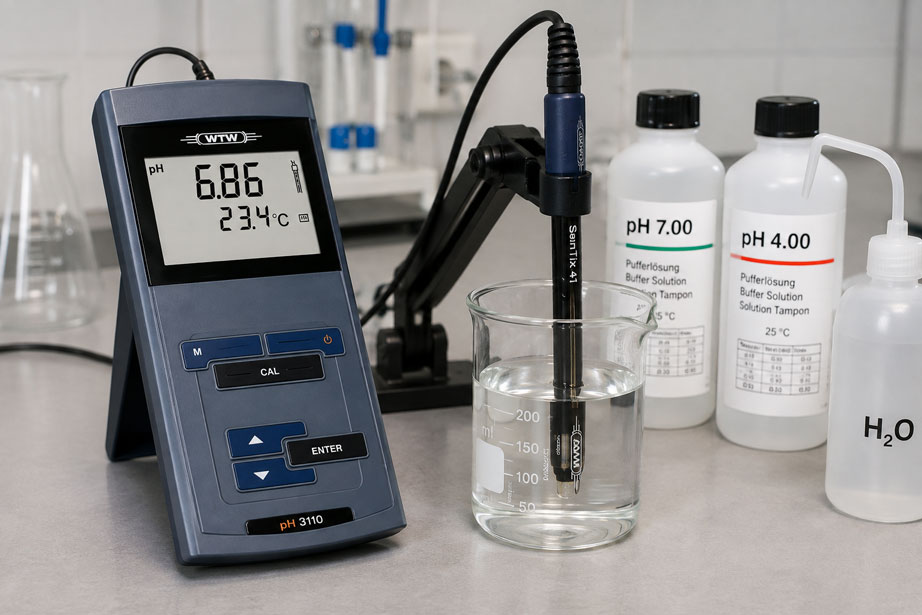
WTW ProfiLine pH 3110 – robust instrument for routine measurements
The ProfiLine pH 3110 is suitable for conventional portable routine measurements.
The instrument measures pH, mV and temperature and offers, among other features:
- 3-point calibration,
- integrated calibration timer,
- AutoRead function for reproducible acceptance of measured values,
- IP67 protection rating.
The AutoRead function is particularly useful with slowly stabilizing electrodes because measured-value acceptance does not have to rely solely on a subjectively selected waiting time.
Further information can be found under WTW ProfiLine pH 3110 at ICS Schneider.
The correct electrode is more important than additional instrument functions
A high-performance pH meter cannot compensate for an unsuitable electrode.
Electrode selection should therefore match the application. Relevant factors include:
- measurement range,
- temperature,
- conductivity of the medium,
- solids content,
- protein or fat contamination,
- chemical resistance,
- type of reference junction,
- integrated or external temperature measurement.
An overview of suitable measuring instruments can be found under pH, conductivity and dissolved oxygen measuring instruments at ICS Schneider.
Conclusion
If a pH sensor responds slowly or continuously drifts, recalibration is not automatically the correct solution.
Reliable pH measurement requires a functioning glass membrane and a stable reference system. Deposits on the membrane slow down mass transfer, while a contaminated or blocked junction can alter the reference potential.
Drying out, electrolyte condition and temperature must also be considered. It is particularly important to distinguish between temperature-dependent electrode slope and the actual temperature-dependent change in the pH value of a sample. Automatic temperature compensation can only account for the influence on the measuring system – it does not automatically make the actual pH value of a solution identical at different temperatures.
A simple troubleshooting sequence therefore applies: check the measuring conditions, inspect the sensor, clean or condition it, use fresh buffers and only then recalibrate.
If the electrode remains slow or unstable even in buffer solutions afterward, replacement is often more appropriate than repeated calibration attempts.
FAQ: Drifting or slow pH sensors
Why does my pH sensor drift?
Common causes include a contaminated reference junction, deposits on the glass membrane, temperature changes, an unstable reference system or an aged electrode. The first step should be to check whether the drift also occurs in a fresh buffer solution.
Why does a pH electrode suddenly respond so slowly?
An increased response time can be caused by deposits, drying out, a partially clogged junction, low temperature or progressive sensor aging. Cleaning followed by conditioning can help when the cause is reversible.
Does recalibration help with a drifting electrode?
Only if the cause is actually a normal change in zero point or slope. If deposits or a reference-system problem are present, calibration often compensates for the error only temporarily. The sensor should therefore first be checked and cleaned if necessary.
How can you recognize a contaminated pH electrode?
Typical indications include significantly longer stabilization times, poorer repeatability or changed calibration values. Deposits do not always have to be clearly visible. Grease or protein films in particular can be very thin.
What is the junction of a pH electrode?
The junction establishes ionic contact between the internal reference electrode and the sample. If this transition becomes contaminated or blocked, the reference potential can become unstable and the pH measurement can drift.
Why is the reference electrode important for pH measurement?
The pH-sensitive glass membrane only generates a useful measurement signal if its voltage is measured against a stable reference potential. Changes in the reference system therefore directly affect the displayed pH value.
What happens if a pH electrode dries out?
The hydrated layer of the glass membrane changes. As a result, the electrode may respond significantly more slowly or become difficult to calibrate. Depending on the sensor type, conditioning in a suitable storage solution may improve its function again.
Can a pH electrode be stored in distilled water?
Distilled or deionized water is unsuitable for long-term storage of many conventional pH electrodes. The storage or electrolyte solution specified by the electrode manufacturer should be used instead.
What does automatic temperature compensation mean in pH measurement?
It primarily compensates for the temperature-dependent slope of the pH electrode. However, it cannot generally compensate for the actual chemical change in the pH value of a sample with temperature.
Why does the pH value of a sample change with temperature?
Chemical equilibria and dissociation processes are temperature-dependent. The same sample can therefore actually have different pH values at different temperatures.
Is two-point calibration better than one-point calibration?
Using two suitable buffers allows both the zero point and electrode slope to be determined. Two-point calibration therefore provides more information about the condition of the electrode than a simple one-point calibration.
When is three-point calibration useful?
Three-point or multipoint calibration is particularly useful when measurements are performed over a wider pH range. The buffers used should appropriately cover the actual working range.
Can three-point calibration make an old electrode accurate again?
No. Additional calibration points cannot repair an aged, contaminated or unstable electrode. If the buffer values are already reached slowly or unstably, the electrode must first be inspected.
How often should a pH electrode be calibrated?
The appropriate interval depends on the application, accuracy requirements, sensor design and operating conditions. Critical measurements or frequently changing media may require considerably more frequent calibration than simple routine measurements in stable samples.
How can you determine whether the sensor or the sample is causing the drift?
The electrode should be checked in a fresh, temperature-stable buffer solution. If the measured value is also unstable there, the cause is likely to be the electrode, measuring instrument or measuring conditions. If the buffer remains stable and only the sample drifts, the sample itself or its chemical stability should be investigated.
When should a pH electrode be replaced?
Replacement is advisable if the electrode remains permanently slow or unstable despite cleaning and conditioning, can no longer be calibrated reliably, or if the reference system or glass membrane is permanently damaged.
Which pH meter is suitable for portable routine measurements?
For simple portable routine measurements, the WTW ProfiLine pH 3110 with 3-point calibration and AutoRead function is suitable, for example. For more extensive documentation, data logging and multipoint calibration, the ProfiLine pH 3310 provides additional functions.