


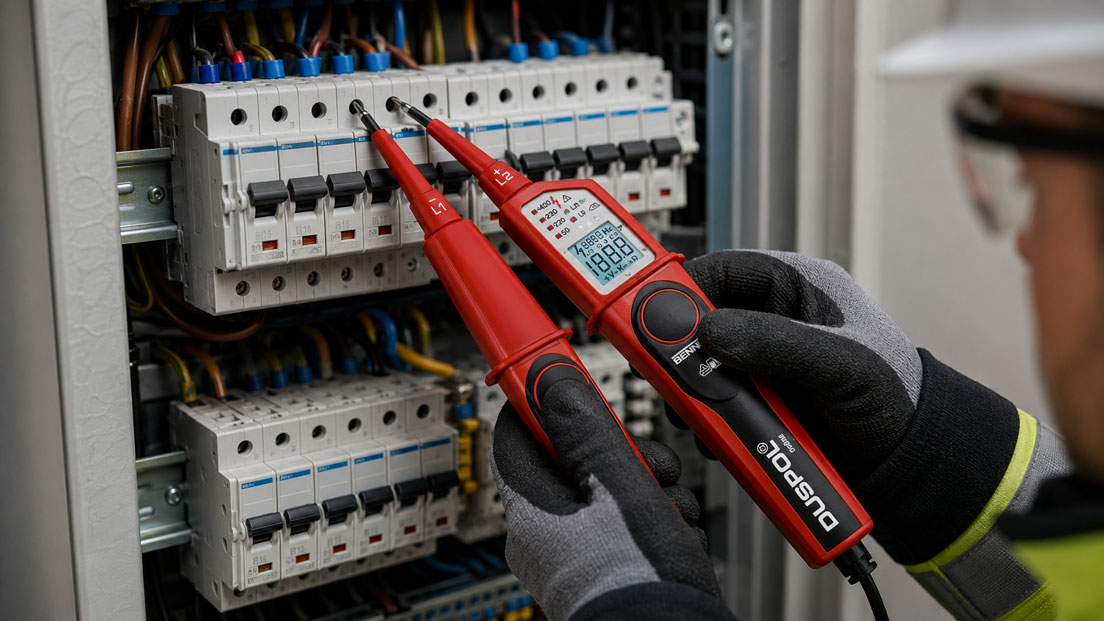
When selecting a voltage tester, many users first look at the voltage range. 690 V, 1000 V AC/DC or a digital display may seem like the most important criteria at first glance. In practice, however, another specification is at least just as important: the measurement category. Whether a voltage tester is rated for CAT III or CAT IV determines the electrical environment in which it may be used safely.
The measurement category describes not only the rated voltage, but above all the transient overvoltages to be expected. These short, high-energy voltage peaks can occur, for example, due to switching operations, faults in the network, proximity to supply points, large consumers, inductive loads or atmospheric influences. The closer a measuring point is to the supply and the power distribution network, the higher these stresses can be.
For electricians, maintenance technicians, service technicians and installation testers, this means that a voltage tester must not only match the voltage being measured, but also the measuring environment. A device that is sufficient in a sub-distribution board is not automatically suitable for work in the main distribution board, at the supply point or in industrial switchgear. Work on electrical installations may only be carried out by qualified personnel in compliance with the applicable safety rules, standards and manufacturer specifications.
Table of contents
- Basics: what do CAT III and CAT IV mean?
- Why transient overvoltages are so critical
- CAT III: measurements in distribution boards, control cabinets and fixed installations
- CAT IV: measurements close to the supply and at the service connection
- Why 1000 V alone is not enough
- Test leads, probe tips and accessories: the weakest point counts
- Selecting the right voltage tester: application before device comparison
- Typical mistakes in selection and use
- Practical example: voltage testing in sub-distribution and main distribution
- Which measuring instruments / products are suitable?
- Conclusion: the measurement category is a safety feature, not a secondary value
- FAQ: frequently asked questions about CAT III and CAT IV for voltage testers
Basics: what do CAT III and CAT IV mean?
The measurement categories CAT II, CAT III and CAT IV describe the areas of an electrical installation for which a measuring instrument is designed. The higher the category, the closer the measuring point is typically to the energy source and the higher the expected energy of possible overvoltages. For voltage testers used in electrical installations, CAT III and CAT IV are particularly important.
CAT III applies to measurements in fixed building installations. This includes, for example, sub-distribution boards, permanently connected consumers, control cabinets, distribution circuits, industrial plant areas and measurements downstream of the main distribution board. High short-circuit capacities and transient overvoltages can already occur here, especially in industrial environments with motors, contactors or frequency converters.
CAT IV is intended for measurements at the origin of the low-voltage installation. This includes areas close to the supply, main distribution boards, service connection areas, meter panels, conductors at the supply point and measuring points with particularly high available energy. Overvoltage impulses can be significantly more energetic there than in circuits located further downstream.
It is important to note that the category always applies together with a voltage. A voltage tester may, for example, be specified as CAT IV 600 V and CAT III 1000 V. This does not mean that CAT IV and CAT III are the same. It means that the device has been rated for different environments with different maximum voltages.
| Measurement category | Typical area | Practical examples | Why relevant? |
|---|---|---|---|
| CAT II | Consumers and plug-in devices | Device connections, household appliances, simple laboratory environments | Usually not sufficient for electrical installations and distribution boards. |
| CAT III | Fixed installation and distribution boards | Sub-distribution boards, control cabinets, machine connections, fixed circuits | Important for typical work carried out by electricians in buildings and installations. |
| CAT IV | Origin of the installation and proximity to the supply | Main distribution board, meter panel, service connection, supply point, outdoor installations | Required where particularly energetic overvoltages and high network power are present. |
Why transient overvoltages are so critical
An electrical installation operates under normal conditions at a specific mains voltage, for example 230 V or 400 V AC. For the safety of a measuring instrument, however, this normal operating value is not the only decisive factor. Critical are short overvoltage impulses that may last only a fraction of a second but contain very high energy. Such transient overvoltages can overload an unsuitable measuring instrument.
Transient overvoltages can be caused by switching operations of large loads, fault disconnections, inductive consumers, compensation systems, long cable runs, nearby lightning effects or network feedback. The lower the impedance of the network and the closer the measuring point is to the supply, the more energy may be available in the event of a fault.
For the user, the danger is not always visible. A socket, terminal block or busbar area may appear inconspicuous from the outside. Electrically, however, the available energy can vary greatly. That is why it is not enough to ask: “What voltage is present?” The better question is: “In which area of the electrical installation is the measurement being taken?”
The measurement category helps classify this environment. CAT III and CAT IV are therefore not convenience features, but safety specifications. They provide the user with guidance as to whether the voltage tester is suitable for the expected overvoltage conditions.
CAT III: measurements in distribution boards, control cabinets and fixed installations
CAT III is very frequently relevant in electrical installation and industrial environments. Typical measuring points include sub-distribution boards, permanently connected machines, control cabinets, motor feeders, control distribution boards, socket circuits within the fixed installation and distribution circuits downstream of the main distribution board. In these areas, fault currents and switching overvoltages can be significantly higher than directly at an individual consumer.
A voltage tester with CAT III suitability is therefore required for many classic tasks in building installation, mechanical engineering and maintenance. This includes voltage testing before work, checking phase conductors, neutral conductor and protective conductor, detecting external voltages, checking three-phase connections and simple tests in control cabinets.
With CAT III, the geometry of the probe tips is also important. In control cabinets and distribution boards, terminals are often close together. Probe tips that are too long and unprotected increase the risk of an unintended short circuit between adjacent contacts. For this reason, probe tips, protective caps and accessories should be used according to the environment.
Even though CAT III is sufficient for many installation tasks, this does not mean that CAT III is automatically suitable for all measuring points. As soon as work is carried out closer to the supply, at main distribution boards or in areas with high available short-circuit capacity, it must be checked whether CAT IV is required.
CAT IV: measurements close to the supply and at the service connection
CAT IV applies to measurements in the area with the highest overvoltage stress within a low-voltage installation. This includes measuring points close to the supply, main distribution boards, service connection areas, meter panels, overhead line or underground cable connections, outdoor installations and areas where strong network impulses may occur.
In these areas, the available energy in the event of a fault is particularly high. A measuring instrument with too low a category can be overloaded in the event of an overvoltage event or operating error. The risk affects not only the device, but above all the user. Electric arcs, device damage, burns or dangerous touch voltages may result.
CAT IV is therefore particularly important whenever measurements are carried out directly at the origin of the installation or close to the supply. This includes, for example, work on main distribution boards, meter installations, network changeover systems, incoming supply panels, construction site distribution boards or installations with their own supply.
A voltage tester with a high CAT IV rating offers greater safety against transient overvoltages in such areas. Nevertheless, the measurement category does not replace personal protective equipment, the five safety rules, risk assessment or professional working practices. It is a necessary element within the overall safety concept.
Why 1000 V alone is not enough
A common mistake when selecting a device is comparing only the maximum voltage. If a voltage tester is marked “1000 V”, this initially sounds sufficient for most low-voltage installations. However, the decisive factor is the measurement category for which this voltage applies. A device with 1000 V CAT III is not automatically equivalent to a device with 1000 V CAT IV.
The rated voltage describes up to which voltage the device may be used within the specified category. The measurement category describes the possible overvoltage stress and the energy in the respective installation area. Two devices with the same voltage rating can therefore differ significantly in terms of safety.
It becomes particularly critical when accessories do not match the device category. A voltage tester may have a high measurement category, but be used with probe tips, adapters or leads that are rated lower. In that case, the lower category effectively applies to the entire measurement setup. The safest voltage tester is of little use if the probe tips used are not suitable for the measuring point.
| Specification on the device | What it means | Typical misinterpretation | Correct evaluation |
|---|---|---|---|
| 1000 V | Maximum permissible voltage under specific conditions | “The device is suitable for every 1000 V measurement.” | Always check measurement category and accessory rating as well. |
| CAT III 1000 V | Suitable for CAT III environments up to 1000 V | “This automatically allows measurement in CAT IV up to 1000 V.” | Check CAT IV separately; CAT III and CAT IV are not the same. |
| CAT IV 600 V | Suitable for CAT IV environments up to 600 V | “600 V is worse than 1000 V.” | Near the supply, CAT IV can be more important than a higher CAT III voltage rating. |
| Probe tip without clear category | Accessory rating is unclear or lower | “The accessory automatically adopts the device category.” | The lowest category in the measuring chain determines the permissible application. |
Test leads, probe tips and accessories: the weakest point counts
With voltage testers, attention is often focused only on the main device. In practice, however, probe tips, protective caps, adapters, leads and, where applicable, clamps are part of the measurement setup. For safety, the entire chain counts. If an accessory is approved only for a lower measurement category or voltage, it limits the permissible application.
Probe tips must match the measuring point. In distribution boards and control cabinets, touch-protected tips and suitable protective caps are particularly important because the distances between active parts can be small. Unsuitable tips increase the risk of bridging adjacent contacts. This can cause a short circuit or electric arc.
Damaged test leads are also a significant risk. Cracks in the insulation, bent tips, loose protective caps, crushed cables or contaminated contacts should not be ignored. A voltage tester is a safety tool. Before use, the device and accessories should be checked visually to ensure they are in perfect condition.
Compatibility is another important point. Accessories should not be swapped arbitrarily between devices simply because they fit mechanically. Manufacturer specifications, measurement category, dielectric strength, touch protection and suitability for the specific application are decisive.
Selecting the right voltage tester: application before device comparison
The correct selection does not start with the device, but with the measuring task. An electrician who mainly works on socket circuits, sub-distribution boards and control cabinets requires different features than a service technician who regularly tests main distribution boards, supply points or industrial power distribution systems.
For classic electrical installation, a two-pole voltage tester with a suitable CAT III and often also CAT IV rating is useful. It should provide a clear voltage indication, robust design, suitable probe tips, good readability and reliable function even under harsh conditions. In practice, additional functions such as load connection, vibration alarm, continuity testing, phase sequence indication or measuring point illumination are often helpful.
For work close to the supply, CAT IV suitability should be given particular attention. Here, not only the maximum voltage is decisive, but the combination of measurement category, accessories, personal protective equipment and working procedure. Especially in main distribution boards or meter panels, no device should be used if its category does not clearly match the measuring point.
In industrial installations, additional requirements apply. Voltage testers must be robust, remain easy to handle in control cabinets and deliver reliable results even in poor lighting or confined spaces. If capacitively or inductively coupled voltages can occur, load connection can help distinguish between load-bearing and non-load-bearing voltages. However, a displayed voltage must never be prematurely assessed as harmless.
| Application | Typical measuring environment | Recommended focus when selecting |
|---|---|---|
| Building installation | Sockets, sub-distribution boards, fixed circuits | CAT III, two-pole voltage testing, robust probe tips, clear display |
| Control cabinet and mechanical engineering | Controls, motor feeders, terminal strips, distribution boards | CAT III / CAT IV depending on measuring point, good handling, illumination, continuity test |
| Main distribution board and supply | Meter panel, incoming supply panel, main distribution board, construction site distribution board | CAT IV suitability, suitable accessories, high safety reserves |
| Service and maintenance | Different installations, unknown conditions, troubleshooting | Wide voltage range, CAT IV reserve, load connection and robust design |
| Industry and power supply | High short-circuit capacity, large consumers, switchgear | High measurement category, suitable probe tips, clear work approval and protective measures |
Typical mistakes in selection and use
A typical mistake is assuming that a voltage tester with a high voltage rating is automatically suitable for every measuring point. In reality, it must be checked whether the measurement category matches the environment. Another mistake is using old or damaged probe tips whose category is no longer legible or not sufficient.
Confusing a multimeter with a two-pole voltage tester can also be problematic. For determining the absence of voltage in electrical installations, a suitable two-pole voltage tester is the practical tool. A multimeter can measure voltages, but it is not automatically suitable for the same safety and testing situation. The applicable rules and the suitability of the specific device are always decisive.
In existing installations, it is also often underestimated that measuring points cannot always be clearly assigned to one area. A sub-distribution board close to the supply, a machine with its own supply, a photovoltaic feed-in or a construction site distribution board can place higher demands on the measuring instrument than a simple indoor socket.
Finally, visual inspection before measurement is also important. A voltage tester should not be used if the housing, lead, probe tips, display or protective caps are damaged. Before and after safety-relevant tests, the function of the voltage tester should be checked on a known voltage source.
Practical example: voltage testing in sub-distribution and main distribution
A service technician is called to a fault in a production hall. First, he checks several outgoing circuits in a sub-distribution board. The measuring points are within the fixed installation and are separated from the supply point by upstream protective devices. For these measurements, a suitable two-pole voltage tester with an appropriate CAT III rating and sufficient voltage class is generally intended.
Later, the main distribution board also has to be checked because a supply or changeover fault is suspected. Here, the conditions change. The measuring point is closer to the energy source, the available short-circuit capacity is higher, and transient overvoltages can be more energetic. The technician therefore checks whether his voltage tester and the probe tips used are suitable for CAT IV in the required voltage class.
This example shows why the same site can place different requirements on different measuring points. Within an installation, it is not enough to speak generally of “230/400 V”. The decisive factor is whether the measurement is being taken at a consumer, in a sub-distribution board, in a control cabinet, at the main distribution board or close to the supply.
The technician also checks the probe tips, protective caps and leads. The measurement is evaluated not only according to voltage range, but also according to measurement category, condition of the accessories and working environment. This reduces the risk of using a device outside its safe operating range.
Which measuring instruments / products are suitable?
For selecting suitable two-pole voltage testers, ICS Schneider Messtechnik offers the category voltage testers / meter start-up testers. This includes various devices for electrical installation, service, industry and power distribution. Selection should be based on measurement category, voltage range, display type, load connection, robustness, probe tips and the specific application.
The DUSPOL® expert voltage tester is a suitable solution when a two-pole voltage tester is required for electrical installation, service and maintenance. It combines voltage testing up to 1000 V AC/DC with CAT IV 600 V or CAT III 1000 V, optical and acoustic continuity testing, measuring point illumination and other practical functions. Especially for work in distribution boards, control cabinets and fixed installations, such a combination of safety category and usability is important.
The C.A 771 is particularly interesting within the voltage tester selection when a robust two-pole voltage test with a high CAT IV rating is required. It is suitable for low-voltage installations, power distribution networks and service tasks where reliable voltage assessment and a high safety category are the main priorities. Depending on the application, it should be checked which display type, probe tips and additional functions are required.
Other devices from the category, for example digital CAT IV voltage testers or models with load connection, can be useful when special requirements apply to display, illumination, phantom voltage detection, one-handed testing or robust industrial use. The decisive factor is not which device offers the most functions on paper, but which device safely fits the measuring point.
| Product / area | Typical use | Particularly relevant for |
|---|---|---|
| Voltage testers / meter start-up testers | Selection of two-pole voltage testers and robust test instruments | Electrical installation, service, maintenance, distribution boards and power supply |
| DUSPOL® expert voltage tester | Two-pole voltage testing with extended practical functions | CAT IV 600 V, CAT III 1000 V, distribution boards, control cabinets, service and troubleshooting |
| C.A 771 voltage tester | Robust two-pole voltage testing in low-voltage installations | High CAT IV requirements, power distribution networks, service and industrial applications |
| Digital CAT IV voltage testers | Voltage testing with digital display and additional functions | Precise readability, control cabinets, dark measuring points, maintenance and testing tasks |
| Voltage testers with load connection | Reliable assessment of voltage indications under load | Phantom voltages, capacitive coupling, troubleshooting and installation testing |
Conclusion: the measurement category is a safety feature, not a secondary value
CAT III and CAT IV are not minor technical details for voltage testers. They describe the electrical environment for which a device is designed and which overvoltage stresses it should safely withstand. Anyone who looks only at the maximum voltage overlooks a decisive part of the safety assessment.
CAT III is relevant for many measurements in fixed installations, sub-distribution boards, control cabinets and machine environments. CAT IV becomes particularly important when measurements are carried out close to the supply, at main distribution boards, meter panels, construction site distribution boards or other areas with high available energy. In addition, probe tips, leads and accessories must have the same suitability for the specific measuring point.
The most important recommendation is: always clarify where in the installation the measurement is being taken before measuring. Only then should voltage range, measurement category, accessories and device condition be evaluated. A suitable two-pole voltage tester with the correct CAT category is an essential safety tool for qualified electricians, but it never replaces professional working practices and the applicable safety rules.
FAQ: frequently asked questions about CAT III and CAT IV for voltage testers
What does CAT III mean for a voltage tester?
CAT III describes measurements in the fixed electrical installation. This includes, for example, sub-distribution boards, control cabinets, permanently connected machines and distribution circuits. A CAT III voltage tester is designed for higher overvoltage stresses than a device for measurements only on consumers or plug-in equipment.
What does CAT IV mean for a voltage tester?
CAT IV describes measurements at the origin of the low-voltage installation or close to the supply. Typical examples are main distribution boards, service connection, meter panel, construction site distribution board or outdoor installations. Particularly energetic transient overvoltages can occur there.
What is the difference between CAT III and CAT IV?
CAT IV is intended for areas closer to the supply and with higher available energy. CAT III concerns the fixed installation downstream of the supply, for example sub-distribution boards and control cabinets. Both categories can carry the same rated voltage, but they differ in the expected overvoltage stress.
Why is the specification 1000 V alone not sufficient?
The voltage specification only states up to which voltage the device may be used in a certain category. The measurement category is also decisive. A device with CAT III 1000 V is not automatically suitable for CAT IV 1000 V.
Is CAT IV 600 V better than CAT III 1000 V?
That depends on the measuring point. Close to the supply, CAT IV 600 V can be more relevant for safety than CAT III 1000 V, even though the voltage number appears lower. The category describes the overvoltage environment, not just the rated voltage.
Where is a CAT III voltage tester typically used?
A CAT III voltage tester is typically used in sub-distribution boards, control cabinets, machine installations, fixed circuits and building installations. Whether CAT III is sufficient depends on the specific measuring point and the existing power distribution.
When should a CAT IV voltage tester be used?
A CAT IV voltage tester should be used when measurements are carried out close to the supply or in areas with high available energy. This includes main distribution boards, meter panels, service connection areas, construction site distribution boards and certain outdoor or power supply areas.
Do probe tips need to have the same CAT category as the voltage tester?
Yes, the entire measurement setup must be suitable for the measuring point. If probe tips, adapters or leads have a lower rating than the device, they limit safe use. The weakest component effectively determines the permissible measurement category.
Why are protective caps on probe tips important?
Protective caps reduce the exposed metal length of the probe tip and therefore reduce the risk of accidentally bridging adjacent contacts. This is particularly important in distribution boards and control cabinets, where terminals are close together.
Can a multimeter replace a two-pole voltage tester?
A multimeter can be useful for certain measurement tasks. However, for safely detecting voltage or absence of voltage in electrical installations, a suitable two-pole voltage tester is the practical tool. The applicable rules and the suitability of the specific device are decisive.
What does transient overvoltage mean?
A transient overvoltage is a short, often very energetic voltage peak. It can occur due to switching operations, network faults, inductive loads or atmospheric influences. Measurement categories take into account how strongly such impulses can occur in different areas of an installation.
Why is CAT IV particularly important in main distribution boards?
In main distribution boards, the measuring point is closer to the supply. The available short-circuit capacity and the energy of possible overvoltages are higher there than in end circuits further downstream. This is why a higher measurement category is particularly important for such areas.
What should be checked before every voltage test?
Before voltage testing, the device, leads, probe tips, protective caps, display and housing should be checked for visible damage. The function of the voltage tester should also be checked on a known voltage source, especially before and after safety-relevant tests.
What role does load connection play?
Load connection can help distinguish capacitively or inductively coupled voltages from load-bearing voltages. However, it does not replace a safety assessment. A displayed voltage must never be prematurely assessed as harmless merely because it collapses under load.
Which voltage tester is useful for electricians?
For electricians, a robust two-pole voltage tester with suitable CAT III and CAT IV rating, clear display, suitable probe tips and practical additional functions is useful in many cases. The specific selection depends on whether the main work is carried out on sub-distribution boards, control cabinets, main distribution boards or changing installations.
What is the most important rule for CAT III and CAT IV?
The most important rule is: the measurement category must match the measuring point. Not only the voltage, but also the position within the electrical installation, proximity to the supply, accessories and device condition determine safe use.