


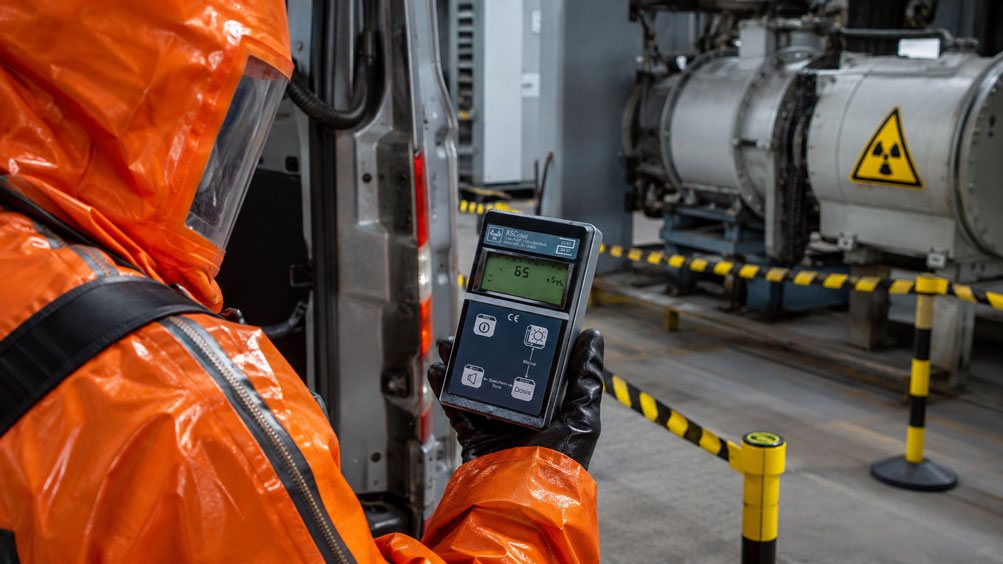
A dose rate meter displays:
2.8 mSv/h
next to a pulsed X-ray source.
The measuring range of the instrument extends significantly higher.
Can it therefore be assumed that the measured value is reliable?
Not automatically in the case of pulsed X-ray radiation.
The central problem is that the radiation is not distributed evenly over time.
Instead, a high dose can be delivered within a very short pulse, followed by a much longer pause.
At least three different quantities must therefore be distinguished:
dose per pulse
dose rate within the pulse
average dose rate over many pulses
A measuring instrument may appear to operate within its normal measuring range with regard to the average dose rate while still exceeding a detector or electronics limit during each individual pulse.
This particularly affects measuring systems whose detectors count individual radiation events.
At very high instantaneous count rates, the following can occur:
- dead-time effects,
- pulse losses,
- overlapping detector pulses,
- saturation of the evaluation electronics
.
The critical result can then be:
actual dose rate higher than indicated dose rate
For pulsed X-ray fields, the question must therefore not only be: “How high is the measuring range?”, but also: “Which pulse duration, dose per pulse and instantaneous dose rate can the specific measuring system reliably detect?”
Dose rate meters for gamma and X-ray radiation can be found at ICS Schneider under Dose Rate Meters. An overview of the complete product group can be found under Radiation Measurement Technology.
Table of Contents
- What is pulsed X-ray radiation?
- Which pulse parameters are decisive?
- Distinguishing average and instantaneous dose rate
- Calculation example: moderate average reading, high pulse value
- Why the detector type is important
- Geiger-Müller counter tube with pulsed radiation
- What does detector dead time mean?
- Saturation and under-response
- Scintillation detectors
- Ionization chambers
- Why a peak-value display does not automatically mean pulse measurement
- Correctly interpreting the measuring range
- Measure dose instead of dose rate?
- Influence of pulse frequency
- Influence of pulse duration
- Consider photon energy
- Distance, scattered radiation and measurement geometry
- Performing comparison measurements correctly
- Standards-related classification of pulsed fields
- Typical fault patterns
- Systematic instrument selection
- Practical example: industrial pulsed X-ray system
- Suitable ICS products
- Conclusion
- FAQ
What is pulsed X-ray radiation?
With continuous radiation, radiation energy is emitted continuously during the period under consideration.
In simplified form:
████████████████████████████
With pulsed radiation, by contrast:
██ ██ ██ ██ ██
Comparatively long pauses can occur between the individual radiation pulses.
Typical applications
Pulsed X-ray radiation can occur, for example, in:
- diagnostic X-ray systems,
- pulsed fluoroscopy,
- industrial X-ray systems,
- computed tomography,
- accelerator systems,
- certain non-destructive testing methods,
- flash X-ray systems.
The temporal structure is decisive
Two radiation fields can have the same average dose rate and still differ completely in terms of the demands placed on the detector.
Example:
continuous: 1 mSv/h
versus:
short, intense pulses with an average of 1 mSv/h
For the measuring instrument, these two fields are not necessarily equivalent.
Which pulse parameters are decisive?
For evaluating a pulsed X-ray source, at least the following parameters should be known:
- pulse duration,
- pulse frequency or repetition rate,
- dose per pulse,
- dose rate within the pulse,
- average dose rate,
- photon energy or X-ray spectrum.
Pulse duration
The pulse duration can, for example, be:
10 µs
1 ms
or:
100 ms
.
Pulse frequency
A source can, for example, emit:
10 pulses/s = 10 Hz
.
Dose per pulse
The dose delivered during a single pulse is a particularly important parameter for pulsed fields.
Dose rate within the pulse
In simplified form:
dose rate in the pulse = dose per pulse / pulse duration
Average dose rate
For uniformly recurring pulses, the following applies approximately:
average dose rate = dose per pulse × pulse frequency
taking into account the time units used.
Distinguishing average and instantaneous dose rate
This distinction is at the heart of many measurement problems.
The user often sees the average value
The dose rate meter displays, for example:
3 mSv/h
Within the radiation pulse, however
a dose rate can occur that is several orders of magnitude higher.
Why?
Because the entire dose is delivered within a very small fraction of the total time.
Duty cycle
For regularly recurring pulses, the temporal duty cycle can be calculated approximately as:
duty cycle = pulse duration × pulse frequency
Example
Pulse duration:
10 µs
Pulse frequency:
10 Hz
results in:
10 µs × 10/s = 100 µs/s
The radiation is therefore active for only a very small fraction of the total time.
Calculation example: moderate average reading, high pulse value
An X-ray source generates:
0.1 µSv per pulse
at:
10 pulses/s
Average dose rate
Per second, this gives:
0.1 µSv × 10 = 1 µSv/s
Converted to one hour:
1 µSv/s × 3600 = 3.6 mSv/h
Now the pulse duration is taken into account
Assume each pulse lasts only:
10 µs
Instantaneous dose rate during the pulse
Then:
0.1 µSv / 10 µs = 0.01 Sv/s
corresponding to:
36 Sv/h
Comparison
| Quantity | Value |
|---|---|
| Average dose rate | 3.6 mSv/h |
| Dose rate during the pulse | 36 Sv/h |
Consequence
An instrument may appear to operate without difficulty within its measuring range with regard to the indicated average dose rate.
However, during an individual pulse the detector is briefly exposed to a much higher instantaneous intensity.
This is exactly why the statement “measuring range up to xx mSv/h” is not sufficient for evaluating pulsed radiation.
Why the detector type is important
Dose rate meters can be based on different detector principles.
Typical examples include:
- Geiger-Müller counter tubes,
- proportional counters,
- scintillation detectors,
- semiconductor detectors,
- ionization chambers.
The temporal response differs
The question is not only:
Does the detector detect X-ray radiation?
but:
Can the complete detector, including the evaluation electronics, correctly process this temporal radiation structure?
The complete measuring system matters
This includes:
- detector,
- preamplifier,
- pulse processing,
- dead-time correction,
- measurement algorithm,
- integration time,
- display update rate.
Geiger-Müller counter tube with pulsed radiation
Geiger-Müller counter tubes are robust and widely used detectors in radiation protection instruments.
They are generally very well suited to many measurements of gamma and X-ray radiation.
The counter tube registers individual events
A radiation event generates a gas discharge in the counter tube.
This produces an electrical pulse.
In simplified form:
photon → ionization → gas discharge → electrical pulse → count
A problem arises at high event rates
After a registered event, the detector requires a certain amount of time before the next event can again be fully detected.
This period is referred to as:
dead time
.
What does detector dead time mean?
During dead time, a counting detector cannot detect additional incoming events separately, or cannot do so completely.
At a low count rate
the radiation events are spaced far apart in time.
This normally does not cause a problem.
At a very high instantaneous count rate
numerous events reach the detector within a short period of time.
Some of them may occur during the dead time.
Consequence
The number of registered events no longer increases proportionally to the actual radiation intensity.
The measured value can therefore be:
too low
.
Why pulsed fields are particularly critical
The average event rate over one second may be moderate.
Within a pulse lasting only a few microseconds, however, the photons strike the detector in a highly concentrated manner.
Saturation and under-response
As radiation intensity increases, different regions can be distinguished.
Linear range
The measured value and the actual intensity are sufficiently proportional to each other.
Beginning dead-time losses
Individual events are no longer registered.
The measured value increases more slowly than the actual radiation intensity.
Saturation range
The detector or evaluation electronics reach a limit.
Particularly problematic
With unsuitable systems, overload does not necessarily mean:
display = OVERLOAD
A seemingly plausible but too-low reading can also occur.
For radiation protection measurements, an undetected under-response is significantly more critical than a clearly indicated measuring-range exceedance.
Scintillation detectors
In a scintillation detector, ionizing radiation produces flashes of light in the scintillator material.
These are then evaluated optically or electronically.
Simplified principle
radiation → light pulse → photodetector → electrical signal
High sensitivity
Scintillation detectors can be very sensitive and, depending on the design, can have a fast response.
But limits also exist here
At high instantaneous pulse rates, the following can occur, for example:
- pulse pile-up,
- dead-time effects,
- saturation of the photodetectors,
- saturation of the electronics
.
Therefore, the same principle applies here
The designation:
fast detector
or:
scintillation detector
alone is not sufficient proof of suitability for a specific pulsed X-ray field.
Ionization chambers
Ionization chambers measure the electrical charge generated by ionizing radiation in a gas volume.
Basic principle
radiation → ionization of the gas → charge collection → measuring signal
Advantage
Because each individual photon does not necessarily have to be counted as a discrete event, appropriately designed ionization chambers can offer advantages for high or pulsed radiation intensities.
But an ionization chamber is not automatically suitable either
The following must be checked, among other things:
- charge collection,
- recombination,
- electrometer range,
- time constant,
- dose per pulse,
- pulse duration.
The measuring principle alone therefore does not replace a pulse specification for the complete instrument.
Why a peak-value display does not automatically mean pulse measurement
A measuring instrument can have a function referred to as:
Peak
Maximum
or:
peak value
.
This can easily be misunderstood
A user might conclude:
peak display = maximum dose rate within each microsecond pulse
This does not have to be the case
A peak function may, for example, merely store the highest dose rate value calculated by the normal measurement algorithm.
Temporal resolution is decisive
To evaluate a short pulse, it must be clarified:
- which integration time is used,
- how quickly the detector responds,
- which maximum dose per pulse can be detected,
- which maximum dose rate within the pulse is permissible.
Key point
A peak-value display is not automatically proof that the physical peak dose rate of the pulse is actually measured.
Correctly interpreting the measuring range
For continuous radiation fields, the specified dose rate measuring range is a central selection parameter.
Example
An instrument has a measuring range up to:
20 mSv/h
For pulsed radiation, this information is not sufficient
Additional information that may be required includes:
- maximum dose rate in the pulse,
- maximum dose per pulse,
- minimum measurable pulse duration,
- permissible pulse frequency range.
Overload capability is also not the same as measuring range
A detector may withstand a higher radiation intensity without damage without being able to measure it correctly.
The following must therefore be distinguished:
measuring range
overload range
maximum permissible exposure
reliable pulse range
Measure dose instead of dose rate?
For very short X-ray exposures, a purely instantaneous dose-rate display can be problematic.
An alternative approach is integrated dose
For example:
dose before exposure = 12.0 µSv
dose after exposure = 13.5 µSv
The additional registered dose is therefore:
1.5 µSv
This can be helpful for certain tasks
Particularly when a short X-ray exposure is to be assessed.
However
Dose integration also only works correctly if the detector can fully capture the information generated during the pulse.
If saturation or dead-time losses already occur within the pulse, the integrated dose can also be too low.
Influence of pulse frequency
With all other pulse parameters unchanged, the average dose rate increases with pulse frequency.
Example
Dose per pulse:
0.1 µSv
at:
1 Hz → 0.1 µSv/s
10 Hz → 1 µSv/s
100 Hz → 10 µSv/s
Two aspects are relevant for the detector
- exposure within a single pulse,
- time between two pulses.
Recovery time
A measuring system must return to a defined state between individual pulses or be able to process the data correctly.
Influence of pulse duration
For the same dose per pulse, a shorter pulse duration results in a higher dose rate within the pulse.
Example
Dose per pulse:
1 µSv
at:
100 ms
places a different load on the detector than the same dose delivered in:
10 µs
The shorter the pulse
the higher the instantaneous dose rate can become for the same pulse dose.
Pulse duration is therefore a separate instrument specification
The statement:
measures X-ray radiation
is not sufficient for this application.
Consider photon energy
The temporal structure is not the only selection criterion.
The energy dependence of the detector must also be considered.
X-ray radiation has a spectrum
The energy distribution depends, among other things, on:
- tube voltage,
- filtration,
- anode material,
- geometry,
- scattering material.
Measuring instrument and radiation quality must match
An instrument may appear suitable in terms of its dose rate measuring range but be operated outside its specified energy range.
Both dimensions must therefore always be checked
photon energy
and:
temporal pulse structure
Distance, scattered radiation and measurement geometry
Radiation protection measurements on X-ray systems are often not performed directly in the primary beam.
Instead, the following are examined, for example:
- scattered radiation,
- leakage radiation,
- shielding,
- access areas,
- workplaces.
Document the measurement position
Even small changes in position can influence the measured value.
The following should be documented, for example
- distance from the source,
- detector height,
- orientation,
- position relative to the shielding,
- X-ray parameters,
- operating mode.
Comparison measurements only with identical geometry
If two measuring instruments are compared, they should be tested under reproducible geometrical conditions wherever possible.
Performing comparison measurements correctly
A comparison measurement can help investigate an unexpected indication.
However, it does not replace a suitability assessment
Two unsuitable instruments can produce the same incorrect measured value.
A useful comparison measurement is made with
a measuring system whose behavior for the specific pulsed radiation source is known or specified.
Keep the following constant
- tube voltage,
- tube current or system power,
- pulse duration,
- pulse frequency,
- distance,
- measurement position,
- shielding.
Test several operating conditions
It is particularly informative to deliberately vary:
- pulse frequency at the same dose per pulse,
- dose per pulse,
- pulse duration,
- distance.
If the measuring instrument shows implausible or non-proportional behavior, its suitability must be investigated in more detail.
Standards-related classification of pulsed fields
Requirements exist for conventional dose and dose-rate meters for measurements of beta, X-ray and gamma radiation.
Pulsed radiation fields require additional considerations
For a pulsed field, particularly relevant parameters include:
- maximum measurable dose rate within the pulse,
- maximum measurable dose per pulse,
- minimum pulse duration,
- permissible pulse repetition frequency range.
Important for procurement and risk assessment
The general suitability of an instrument for:
X-ray radiation
therefore does not automatically mean:
suitable for all pulsed X-ray fields
Typical errors when measuring pulsed X-ray radiation
| Observation | Possible cause | Recommended check |
|---|---|---|
| Measured value appears unexpectedly low | Dead time or saturation during the pulse | Check pulse dose, pulse duration and maximum dose rate in the pulse |
| Two instruments show very different values | Different temporal detector response | Compare pulse suitability and measuring principle |
| Measured value does not increase proportionally with system power | Beginning detector saturation | Compare measurement with a suitable reference system |
| Peak indication appears low | Peak function only captures the highest smoothed measured value | Check temporal resolution of the peak function |
| Dose rate value fluctuates strongly | Low pulse frequency in relation to integration time | Check pulse frequency and measurement time constant |
| Dose value is lower than expected | Detector already loses events within the pulses | Check pulse dose and detector limits |
| Instrument appears to remain within the normal measuring range | Average dose rate is low, pulse peak value is very high | Calculate instantaneous dose rate within the pulse |
| Reading changes strongly when pulse frequency is changed | Temporal measurement characteristics influence evaluation | Check instrument specification for repetition frequency |
| Measured value changes strongly with a different tube voltage | Energy dependence of the detector | Check energy range and radiation quality |
| High nominal measuring range creates false confidence | Measuring range for continuous radiation is confused with pulse suitability | Request separate pulse parameters for the instrument |
Systematic selection of a measuring instrument for pulsed X-ray radiation
- Determine the type of radiation: Check whether X-ray radiation or photon radiation is actually to be measured.
- Define the measurement task: Distinguish between ambient dose rate, integrated dose, leakage radiation, scattered radiation or shielding inspection.
- Define the measured quantity: For example ambient dose equivalent rate Ḣ*(10).
- Determine tube voltage: Establish energy range or radiation quality.
- Document the operating mode: Distinguish between continuous and pulsed radiation.
- Determine pulse duration: Record microsecond, millisecond or longer pulses.
- Determine pulse frequency: Document pulses per second.
- Determine dose per pulse: Where possible, obtain from system data or reference measurement.
- Determine average dose rate: Estimate the expected operating range.
- Estimate dose rate within the pulse: Divide pulse dose by pulse duration.
- Check detector principle: Consider GM tube, scintillation, ionization chamber or another principle.
- Check normal measuring range: The expected average dose rate must lie within the specified range.
- Check pulse specifications: Determine maximum dose rate in the pulse, maximum dose per pulse, minimum pulse duration and frequency range.
- Check overload behavior: Ensure that overload does not lead to undetected under-response.
- Check integration time: Consider the time constant or update rate of the measured value.
- Interpret peak function correctly: Do not automatically equate it with pulse peak dose rate.
- Check energy dependence: The photon spectrum must match the specified energy range.
- Define measurement geometry: Document distance, orientation and shielding.
- Plan reference measurement: For critical applications, compare with a system characterized for the specific pulsed field.
- Obtain manufacturer confirmation: If pulse specifications are missing, provide the specific application and pulse parameters to the manufacturer or supplier.
- Document the measurement procedure: Record instrument, serial number, operating mode, source, pulse parameters and measurement position.
Practical example: industrial pulsed X-ray system
An industrial X-ray system is used to inspect components.
The ambient dose equivalent rate is to be checked outside the shielding.
Known system data
The X-ray source operates in pulsed mode.
The following are known:
pulse frequency: 10 Hz
pulse duration: 100 µs
Step 1: Switch on the measuring instrument
The dose rate meter displays a seemingly plausible value outside the shielding.
Step 2: Do not rely solely on the measuring range
The indicated value is well below the maximum dose rate measuring range.
However, this does not prove that the detector operates linearly within every individual pulse.
Step 3: Evaluate pulse parameters
The following must additionally be determined or estimated:
dose per pulse
and from this:
dose rate within the pulse
Step 4: Compare with instrument specification
It is then checked whether information is available for the specific measuring system regarding:
- maximum dose per pulse,
- maximum dose rate in the pulse,
- minimum pulse duration,
- pulse frequency.
Step 5: Specification is missing
The standard product data sheet only describes general measurement of gamma and X-ray radiation and the continuous dose rate measuring range.
Correct consequence
Not:
instrument measures X-rays → instrument is suitable
but:
provide pulse parameters to manufacturer / supplier → obtain confirmation of specific suitability
Step 6: Comparison measurement
For safety-relevant measurements, an additional comparison can be made with a reference system suitable for the existing pulsed field.
Result
Reliable assessment is not based solely on the indicated dose rate value, but on the combination of radiation energy, pulse duration, pulse frequency, pulse dose, detector principle and proven instrument suitability.
Suitable ICS products for dose rate measurements on X-ray radiation
GRAETZ X5C plus
A dose rate measuring system for gamma and X-ray radiation listed by ICS is the:
GRAETZ X5C plus
ICS lists the following, among other things
- measurement of gamma and X-ray radiation,
- measured quantity Ḣ*(10) ambient dose equivalent rate,
- energy-compensated Geiger-Müller counter tube,
- dose and dose rate display,
- dose rate peak value,
- dose rate average value,
- freely programmable alarm thresholds,
- measured-value storage with date and time,
- interface for external probes.
Dose rate measuring range of the base unit
ICS specifies:
1 µSv/h … 19.99 mSv/h
Important limitation for this article
The ICS product description confirms suitability for gamma and X-ray radiation.
However, it does not provide explicit information on:
- maximum dose rate within an X-ray pulse,
- maximum dose per pulse,
- minimum detectable pulse duration,
- permissible pulse frequency range.
The X5C plus should therefore not be considered suitable for a specific highly pulsed X-ray field solely on the basis of its general X-ray measuring range.
The pulse parameters of the application should be checked in advance with ICS or the manufacturer.
Correctly understanding the peak display
According to ICS, the X5C plus has a display for the dose rate peak value.
Without additional technical specification, however, it must not be concluded that this directly measures the physical peak dose rate of a microsecond X-ray pulse.
Further information can be found under GRAETZ X5C plus at ICS Schneider.
GRAETZ GammaTwin S
As a more compact dose rate meter, ICS also offers the:
GRAETZ GammaTwin S
ICS specifies
- gamma and X-ray radiation,
- ambient dose equivalent rate Ḣ*(10),
- ambient dose equivalent H*(10),
- energy-compensated Geiger-Müller counter tube,
- connection option for external pulse probes.
Dose rate measuring range
ICS specifies:
0.5 µSv/h … 50 mSv/h
The same applies here
General suitability for measuring X-ray radiation does not automatically confirm suitability for arbitrary pulsed X-ray fields.
For the GammaTwin S as well, the specific pulse parameters of such an application must be compared with the permissible instrument characteristics.
Further information can be found under GRAETZ GammaTwin S at ICS Schneider.
Important terminology distinction: “pulse probe”
In the GRAETZ probe range, ICS lists so-called:
pulse probes
.
In this product context, the term refers to probes whose detection events are evaluated as pulse rate or pulse count.
“Pulse probe” must therefore not be equated with “probe for pulsed X-ray radiation”.
GRAETZ probe range
For the X5C series, ICS also offers various measuring probes for:
- extending the measuring range,
- measurement from a safe distance,
- pulse-rate measurement,
- detection of different types of radiation.
However, even when using an external probe, the suitability of the complete system for the specific pulse characteristics must be evaluated.
Further information can be found under GRAETZ Probe Range at ICS Schneider.
Which ICS solution is suitable?
| Application | Recommended approach |
|---|---|
| Continuous gamma/X-ray dose rate measurement | Consider GRAETZ X5C plus or GammaTwin S according to measuring range and application |
| X-ray radiation with unknown pulse structure | First determine pulse duration, pulse frequency and pulse dose |
| Highly pulsed X-ray source | Explicitly obtain confirmation of pulse-specific instrument suitability |
| High dose rate from a safe distance | Consider X5C system with suitable GRAETZ probe or telescope solution |
| Measuring-range extension with external probe | Consider GRAETZ probe range; assess pulse suitability separately |
Conclusion
Pulsed X-ray radiation places special demands on dose rate meters.
The main reason is the large difference between:
average dose rate
and:
dose rate within the individual pulse
An apparently low average value can be misleading
An instrument may, for example, display only a few:
mSv/h
while instantaneous dose rates within the individual short pulses may occur in the:
Sv/h range or above
.
With counting detectors
high instantaneous event rates can lead to:
- dead-time losses,
- pulse overlap,
- saturation,
- under-response
.
The normal dose rate measuring range is therefore not sufficient
For pulsed fields, the following should additionally be considered:
- dose per pulse,
- dose rate in the pulse,
- pulse duration,
- pulse repetition frequency,
- detector response.
Peak displays must also be interpreted correctly
A peak-value function does not automatically mean that an instrument can resolve the instantaneous dose rate of a microsecond pulse.
For the GRAETZ instruments available from ICS
The GRAETZ X5C plus and the GRAETZ GammaTwin S are dose rate meters listed for gamma and X-ray radiation.
However, the published ICS product data does not provide a general approval for arbitrary highly pulsed X-ray fields.
For such an application, the specific:
- pulse durations,
- pulse frequencies,
- pulse doses,
- photon energies,
- expected dose rates
should therefore be specified before selecting the instrument, and the suitability of the specific instrument/probe combination should be confirmed.
For practical applications: determine the radiation source → determine energy or tube voltage → determine pulse duration → determine pulse frequency → determine dose per pulse → calculate average dose rate → estimate dose rate in the pulse → check detector principle → check normal measuring range → check pulse-specific limits → do not equate peak display with pulse peak value → consider energy dependence → define measurement geometry → obtain manufacturer confirmation if the specification is missing → where appropriate, carry out a comparison measurement with a pulse-capable reference system → document the measurement conditions.
FAQ: Dose Rate Measurement of Pulsed X-Ray Radiation
What is pulsed X-ray radiation?
With pulsed X-ray radiation, the radiation is not emitted continuously but in individual pulses of limited duration.
Why is pulsed X-ray radiation more difficult to measure?
Because very high instantaneous radiation intensity can occur within very short pulses even though the dose rate averaged over a longer period is comparatively low.
What is dose per pulse?
Dose per pulse describes the dose delivered during a single radiation pulse.
What is the dose rate in the pulse?
It approximately describes the dose rate occurring during the pulse duration and can be determined in simplified form by dividing the dose per pulse by the pulse duration.
What is the average dose rate?
It describes the dose rate averaged over a longer period, including the pauses between the individual pulses.
Can the dose rate in the pulse be much higher than the average dose rate?
Yes. With short pulses and long pauses, the two quantities can differ by several orders of magnitude.
Why is the measuring range in mSv/h not sufficient?
Because this measuring range does not automatically describe which maximum dose rate or dose within a short pulse can be processed correctly.
What is the dead time of a radiation detector?
Dead time is the period after a registered event during which a counting detector cannot detect additional events separately, or cannot do so completely.
What happens if the count rate is too high?
Events can be lost. As a result, the measuring instrument may indicate too low.
Are Geiger-Müller counter tubes suitable for pulsed X-ray radiation?
This depends on the specific pulse parameters and the design of the complete measuring system. General suitability for X-ray radiation alone is not sufficient proof.
Why can a GM counter tube under-respond?
At high instantaneous event rates, additional radiation events can occur during the dead time and may not be registered separately.
Can a measuring instrument show a low value even during overload?
Depending on the detector and evaluation method, high instantaneous exposure can lead to count losses or saturation and therefore to under-response. The specific overload behavior must therefore be known.
Are scintillation detectors automatically better?
No. Scintillation detectors and their electronics also have limits in terms of pulse rate, saturation and temporal processing.
Are ionization chambers suitable for pulsed radiation?
Appropriately designed ionization chambers can offer advantages at high radiation intensities. However, pulse dose, recombination, electronics and temporal behavior must also be considered.
What does pulse frequency mean?
Pulse frequency indicates how many radiation pulses are generated per second. The unit is hertz.
What does pulse duration mean?
Pulse duration describes how long an individual radiation pulse lasts.
Why is a short pulse duration problematic?
For the same dose per pulse, a shorter pulse duration results in a higher instantaneous dose rate.
Can I simply use the peak value of the measuring instrument?
Not without knowing the instrument function. A stored dose rate peak value is not automatically identical to the physical peak dose rate within a very short X-ray pulse.
What do I need to know about the peak function?
In particular, the integration time, temporal resolution and maximum measurable pulse intensity of the instrument.
Is the integrated dose more reliable for pulsed radiation?
It can be a useful measured quantity for short exposures. However, if the detector already saturates or loses events during a pulse, the integrated dose can also be incorrect.
What information should I provide when requesting an instrument?
At least the type of radiation, tube voltage or energy, pulse duration, pulse frequency, expected dose per pulse, expected average dose rate and measurement task.
Why is the X-ray energy important?
Detector sensitivity can depend on energy. Therefore, the energy range of the measuring instrument must match the X-ray radiation being used.
Which measured quantity is commonly used for area measurements?
For radiation protection measurements, the ambient dose equivalent rate Ḣ*(10) is frequently used.
What is ISO 18090?
The series of standards deals with the characteristics of reference fields of pulsed ionizing radiation for testing or calibrating corresponding radiation protection measuring instruments.
Which pulse parameters are considered when assessing instrument suitability?
Important parameters include maximum dose rate in the pulse, dose per pulse, minimum pulse duration and pulse repetition frequency.
What is the GRAETZ X5C plus?
The X5C plus is a dose rate measuring system listed by ICS for gamma and X-ray radiation with an energy-compensated Geiger-Müller counter tube.
Which measured quantity does the X5C plus measure?
ICS specifies the ambient dose equivalent rate Ḣ*(10) and the corresponding dose H*(10).
What dose rate measuring range does the X5C plus have?
ICS specifies a measuring range of 1 µSv/h to 19.99 mSv/h for the base unit.
Does the X5C plus have a peak display?
Yes. ICS specifies a display for the dose rate peak value and the dose rate average value.
Does the peak display mean that microsecond pulses are measured correctly?
No. No such conclusion can be drawn from the peak function alone. Pulse-specific technical data is required for this.
Is the X5C plus suitable for pulsed X-ray radiation?
The ICS product page confirms general measurement of gamma and X-ray radiation but does not specify a universal pulse specification. For a specific pulsed application, suitability should therefore be confirmed based on the actual pulse parameters.
What is the GRAETZ GammaTwin S?
The GammaTwin S is a compact dose rate meter listed by ICS for gamma and X-ray radiation with a connection option for external probes.
What dose rate measuring range does the GammaTwin S have?
ICS specifies a range of 0.5 µSv/h to 50 mSv/h.
Is a GRAETZ “pulse probe” specifically intended for pulsed X-ray radiation?
No. In this product context, the term pulse probe refers to a probe whose individual detection events or pulse rates are evaluated. This does not automatically imply suitability for pulsed X-ray fields.
Can an external probe extend the measuring range?
Yes. For the GRAETZ X5C series, ICS offers various probes for measuring-range extension and special measurement tasks.
Is an extended measuring range up to 10 Sv/h automatically sufficient for pulsed radiation?
No. Even a high nominal dose rate measuring range does not replace a specification of the maximum permissible dose or dose rate within an individual pulse.
How do I check an existing measuring instrument?
First, manufacturer documentation should be checked for pulse-specific parameters. If these are missing, the parameters of the existing X-ray source should be submitted to the manufacturer or supplier and suitability should be explicitly clarified.
When is a comparison measurement useful?
For safety-relevant or unexpected measurement results, a comparison measurement with a reference system characterized for the specific pulsed field can be useful.
Where can I find the GRAETZ X5C plus at ICS Schneider?
Further information can be found under GRAETZ X5C plus at ICS Schneider.
Where can I find the GRAETZ GammaTwin S at ICS Schneider?
Further information can be found under GRAETZ GammaTwin S at ICS Schneider.
Where can I find the GRAETZ probe range at ICS Schneider?
Further information can be found under GRAETZ Probe Range for the X5C Series at ICS Schneider.
Where can I find additional dose rate meters?
An overview can be found under Dose Rate Meters at ICS Schneider.