


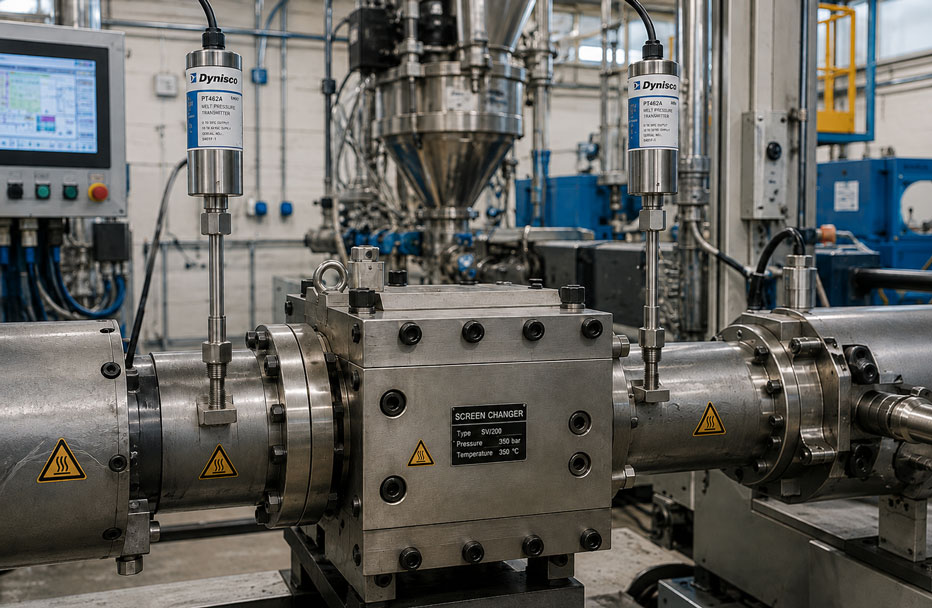
The melt pressure upstream of an extruder screen changer is increasing continuously. Is there a problem with the extruder, is the melt too cold, or is the screen pack becoming increasingly clogged? A single pressure value is often not sufficient to answer this question reliably. An increasing inlet pressure can be caused by a contaminated filter, but also by a higher throughput, a lower melt temperature, higher viscosity, or changed conditions in the downstream process.
Monitoring becomes much more informative when the melt pressure is measured both upstream and downstream of the screen changer. The pressure difference across the screen pack can then be calculated from the two measured values. If this differential pressure increases under comparable process conditions, the flow resistance of the filter section is increasing. This relationship makes differential pressure monitoring an important tool for assessing contamination and filter service life.
However, differential pressure must not be considered in isolation. Pressure losses in a polymer melt depend, among other factors, on throughput, temperature, viscosity, material, screen fineness, and filter design. An alarm limit should therefore not simply be defined as an arbitrary fixed pressure value, but should be derived from the actual behavior of the respective extrusion process.
For reliable screen monitoring, it is therefore not only a high pressure upstream of the filter that matters, but how much the pressure drops between the measurement point before and the measurement point after the screen pack and how this pressure loss develops under comparable process conditions.
Why measure upstream and downstream of the screen changer?
A screen changer or screen pack removes contaminants from the polymer melt before the material reaches the downstream process. The melt has to flow through a filter structure that inherently causes a pressure loss. This pressure loss is present even with a clean screen and depends, among other factors, on the material, throughput, and screen configuration used.
If only the pressure upstream of the screen changer is measured, it is not possible to determine clearly where a pressure change originates. If, for example, the pressure downstream of the screen pack also increases at the same time, the cause may lie further downstream. Only the second measurement point makes it possible to distinguish between the general process pressure and the actual pressure loss across the filter section.
For evaluation, the pressure directly upstream of the screen pack is designated as p1 and the pressure downstream of the screen pack as p2. The differential pressure is calculated in simplified form as:
Δp = p1 - p2
If, for example, the melt pressure upstream of the filter is 180 bar and the pressure downstream is 140 bar, the pressure loss across the screen pack is 40 bar. If, under comparable operating conditions, the inlet pressure later rises to 210 bar while the pressure downstream of the screen remains approximately 140 bar, the differential pressure increases to 70 bar. This indicates a significantly higher flow resistance in the screen pack area.
What does the differential pressure reveal about the screen pack?
The differential pressure describes how much pressure the melt loses while flowing through the screen changer. Part of the available pressure is required to overcome the flow resistance of the filter pack. If foreign particles, agglomerates, or other constituents accumulate in the screen, the effectively available flow cross-section is reduced. At the same material throughput, the melt must therefore flow through smaller free areas, which increases the pressure loss.
| Observation | Possible meaning | Assessment |
|---|---|---|
p1 and p2 remain largely constant |
Stable process conditions | Filter condition probably unchanged |
p1 increases, p2 remains similar |
Pressure loss across the screen changer increases | Check for contamination or increasing filter resistance |
p1 and p2 increase similarly |
Pressure level of the entire downstream process increases | Do not consider the screen pack alone |
p1 drops significantly after a screen change |
Flow resistance has been reduced | Indication that the previous screen pack was loaded |
For this reason, not only the current differential pressure but also its development over production time is particularly valuable. A gradually increasing value can indicate increasing filter loading much earlier than a single absolute limit value.
Why does the pressure increase as contamination increases?
A screen pack has only a limited free filter area. During production, contaminants are retained and an increasing proportion of this free area becomes blocked. If the same mass throughput is to continue through the remaining cross-section, a higher pressure gradient is required.
This typically appears as an increasing pressure upstream of the screen changer. The pressure downstream of the screen does not necessarily have to increase to the same extent because the conditions of the downstream die or further melt flow path continue to dominate there. This is exactly why the difference between the two pressure measurements is much more informative than considering the inlet pressure alone.
An increasing differential pressure can therefore be used to plan the screen change. Instead of replacing the screen solely after a fixed operating time, its actual loading condition can be taken into account. However, this requires the other process conditions to be sufficiently well known.
Why high differential pressure does not automatically mean contamination
The pressure loss of a polymer melt is not determined solely by the condition of the screen. If the throughput changes, the flow through the filter pack also changes. The viscosity of the melt likewise influences the required pressure. A cooler or more viscous melt can therefore cause a higher differential pressure across the same screen than a warmer or more free-flowing material.
| Influencing factor | Possible effect on differential pressure | Practical consequence |
|---|---|---|
| Higher throughput | Pressure loss may increase | Compare values directly only at comparable production rates |
| Lower melt temperature | Viscosity may increase, resulting in higher pressure loss | Evaluate the temperature trend together with the pressure trend |
| Material change | Different rheological properties | New reference values may be required |
| Finer screen pack | Higher basic pressure loss possible | Adapt the alarm limit to the filter configuration |
| Increasing filter loading | Differential pressure increases over time | Plan a screen change or process check |
A meaningful trend comparison should therefore be performed with similar material, similar melt temperature, and comparable throughput wherever possible. If these parameters change significantly, the differential pressure trend alone may otherwise be misinterpreted.
Where should the pressure sensors be installed?
For meaningful differential pressure measurement, both measurement points must record the pressure as representatively as possible immediately upstream and downstream of the filter section being monitored. If the first sensor is installed far upstream of the screen changer, additional pressure losses in the melt flow path between the sensor and the screen changer can become part of the measured value. The same applies if the second measurement point is located too far downstream.
At the same time, the sensor position must be mechanically and thermally suitable for melt pressure sensors. The process connection must be designed so that the sensor diaphragm is positioned correctly relative to the melt. Unsuitable mounting holes, residues in the measurement bore, or incorrect insertion depths can not only influence the measured value but also damage the sensor diaphragm.
For calculating the differential pressure, it is also advantageous if both measurement points are designed comparably. Different sensor ranges, different accuracy classes, or strongly differing thermal conditions can reduce the reliability of a small differential pressure measurement.
Selecting the correct measuring ranges for both sensors
When selecting the measuring ranges, it is not sufficient to consider only the typical operating pressure. Particularly upstream of a screen pack that becomes increasingly contaminated, the pressure can rise significantly over the filter service life. The sensor upstream of the screen must therefore also be able to measure the maximum expected process pressure safely.
However, an unnecessarily large measuring range is not automatically ideal either. The larger the measuring range compared with the pressure change actually of interest, the more difficult it may become to evaluate small differences precisely. When differential pressure is calculated from two independent pressure sensors, the measurement uncertainties of both measurement points must be taken into account.
For example, a process with absolute melt pressures of several hundred bar may have only a comparatively small pressure loss across a clean screen. If this difference is to be monitored accurately, sensor resolution, accuracy, and measuring range become correspondingly important. The measuring ranges should therefore be derived jointly from the normal operating pressure, maximum expected fault pressure, and the required sensitivity of the differential pressure monitoring.
Influence of melt temperature and viscosity
In polymer melts, pressure and temperature are closely linked because the viscosity of the material changes with temperature. If the melt temperature decreases, the material may become more viscous. A higher pressure gradient is then required for the same throughput. An increasing differential pressure can therefore sometimes be caused by a temperature change even though the screen pack itself has not changed.
Material changes are also critical. Two polymers or even different batches of the same material can behave differently at the same nominal temperature. If differential pressure values are used for filter monitoring, it should therefore always be clear under which process conditions the respective reference values were determined.
In automated plants, it can be useful to record differential pressure, melt temperature, throughput or extruder speed, and material condition together. This makes it much easier to distinguish whether an increase in pressure results from actual filter loading or from a change in the operating condition.
Defining alarm limits for the screen changer
There is no universal alarm limit for the maximum permissible differential pressure. It depends on the screen changer, filter pack, material, throughput, and permissible operating pressures of the plant. A limit should therefore be defined on the basis of the specific process.
In practice, it is often useful first to record the typical differential pressure with a new or clean screen pack under defined production conditions. The development of this value is then observed as the filter service life increases, and the pressure level at which a screen change becomes necessary for process or quality reasons is determined.
An alarm strategy can, for example, include several levels. A pre-alarm indicates increasing filter loading and allows the screen change to be planned. A second limit can signal that intervention is required in the short term. Regardless of this, the maximum permissible pressures of the sensors, screen changer, extruder, and downstream components must always be observed.
Assessing filter service life from the pressure trend
The development of differential pressure over time can provide more information than a single limit value. After a new screen pack has been installed, a characteristic baseline pressure loss is initially established. During production, this value may slowly increase. The rate of this increase provides an indication of how quickly the filter is becoming clogged.
For recurring products, typical curves and approximate filter service lives can be derived from this behavior. If the slope suddenly changes significantly, this may indicate a change in material quality, increased contamination, or another process condition. Such trend analysis can help make screen changes more predictable and avoid unnecessary production interruptions.
The differential pressure should always be stored together with the relevant process parameters. Only then can it later be assessed whether a higher value was actually caused by increased filter loading or merely by a higher throughput.
Practical example: increasing pressure upstream of the screen pack
An extruder operates for several hours with largely constant material, throughput, and temperature. Immediately after a screen change, 160 bar is measured upstream of the screen pack and 135 bar downstream. The initial differential pressure is therefore 25 bar.
As production continues, the pressure upstream of the screen gradually increases. Several hours later, 195 bar is measured, while the pressure downstream of the screen remains at approximately 137 bar. The differential pressure is now 58 bar. Since throughput and melt temperature have remained largely constant during this period, the significant increase in pressure loss indicates increasing flow resistance of the screen pack.
If, on the other hand, the pressure downstream of the screen were to rise at the same time from 135 bar to, for example, 170 bar, the interpretation would be different. A large part of the additional inlet pressure could then result from increased back pressure in the downstream process. This is precisely where the advantage of the second measurement point becomes clear: it separates the filter pressure loss from the general pressure level of the melt flow path.
For diagnosis, the decisive question is therefore not “How high is the pressure upstream of the screen?”, but “How does the pressure loss between the two measurement points change under comparable process conditions?”
Systematic approach
- Define one measurement point immediately upstream and one immediately downstream of the screen changer.
- Select sensors suitable for the melt temperature, material, and maximum process pressure.
- Select the measuring ranges so that both normal operation and the maximum expected pressure can be measured safely.
- Install both sensors in technically correct and clean measurement bores.
- After a screen change, record the differential pressure of the clean screen pack under defined conditions.
- Document throughput, melt temperature, and material together with the pressure values.
- Calculate the differential pressure as
Δp = p1 - p2and monitor it over production time. - Determine typical pressure curves for recurring products.
- Derive a pre-alarm and maximum permissible alarm limit from the actual process.
- If an unusual pressure increase occurs, first check whether throughput, temperature, or material condition has changed.
- After the screen change, verify that the differential pressure returns to a plausible baseline value.
Common mistakes
- Monitoring only the pressure upstream of the screen changer: Increasing inlet pressure can also result from higher back pressure in the downstream process.
- Interpreting every increase in differential pressure as filter contamination: Throughput, melt temperature, and material viscosity also influence the pressure loss.
- Installing sensors too far away from the screen pack: Additional pressure losses in the melt flow path can then become part of the differential measurement.
- Using unsuitable measuring ranges: A range that is too small may be exceeded as filter loading increases, while an unnecessarily large range can make it more difficult to evaluate small pressure changes.
- Incorrect sensor bore or insertion depth: Installation that does not match the sensor design can cause measurement errors and damage the diaphragm.
- Using a fixed alarm limit without reference to the process: A meaningful limit must match the screen pack, material, throughput, and permissible operating pressure.
- Ignoring temperature changes: Changes in melt viscosity can alter the differential pressure even if the filter condition remains unchanged.
- Considering only individual measured values: The differential pressure trend over time often provides much more information about filter loading.
Dynisco melt pressure sensors for extrusion
Monitoring the pressure upstream and downstream of a screen changer requires sensors designed for direct measurement in hot polymer melts. Conventional pressure transmitters for liquids or gases are not automatically suitable for this installation. Melt pressure sensors have an isolation diaphragm designed for direct contact with the melt and are installed in the extrusion process through a suitable measurement bore.
For differential pressure monitoring, it is particularly important that both measurement points are suitable for the application and can be meaningfully compared with each other. Measuring range, temperature exposure, electrical output signals, process connection, and installation conditions should therefore be considered together during the planning stage.
Dynisco offers melt pressure sensors and associated measurement equipment specifically for extrusion and plastics processing. Suitable devices can be found under Dynisco products at ICS Schneider.
Conclusion
The pressure upstream of a screen changer alone is often not sufficient to assess the condition of the screen pack reliably. Only a second pressure measurement point downstream of the filter section makes it possible to determine the actual pressure loss across the screen.
If the pressure upstream of the screen increases while the pressure downstream remains largely constant, the differential pressure increases. Under comparable conditions, this may indicate increasing filter loading and rising flow resistance. If both pressures increase to a similar extent, however, the downstream process must also be considered as a possible cause.
At the same time, differential pressure is not independent of the process. Throughput, melt temperature, viscosity, material, and screen configuration also change the pressure loss. Alarm limits should therefore be derived from the actual operating behavior of the respective plant and not adopted as generic values.
The trend over time is particularly informative. If differential pressure is documented together with temperature and production rate, increasing filter loading can be detected at an early stage and the remaining filter service life can be estimated more effectively.
For reliable screen monitoring, the key principle is therefore: measure pressure upstream and downstream of the screen pack, evaluate the differential pressure under comparable process conditions, and do not prematurely interpret a single high pressure value as filter contamination.
FAQ: Differential pressure across an extruder screen changer
Why measure pressure upstream and downstream of the screen changer?
Two pressure measurement points make it possible to determine the pressure loss across the screen pack. This makes it easier to distinguish whether a pressure increase is caused by the filter or by the downstream process.
How is the differential pressure across the screen changer calculated?
In simplified form, Δp = p1 - p2. Here, p1 is the melt pressure upstream of the screen pack and p2 is the pressure downstream.
Why does the differential pressure increase when a screen becomes contaminated?
As filter loading increases, the freely available flow area is reduced. A higher pressure gradient is therefore required for the same material flow, and the pressure loss across the screen pack increases.
Does increasing differential pressure always mean that the screen is contaminated?
No. Higher throughput, lower melt temperature, higher material viscosity, or a different screen configuration can also increase the pressure loss.
Where should the melt pressure sensors be installed?
The measurement points should be located as representatively as possible immediately upstream and downstream of the screen changer. This helps prevent additional pressure losses along long melt flow paths from unnecessarily distorting the assessment of the filter pressure loss.
How do you define the alarm limit for a screen changer?
The alarm limit should be derived from the actual process. Important factors include the differential pressure with a clean screen, its development over the filter service life, material, throughput, temperature, and the maximum permissible operating pressures of the plant.
Can filter service life be determined from differential pressure?
The differential pressure trend can be a good indicator of increasing filter loading. For recurring processes, typical pressure curves can be determined and used to plan the screen change.
Why is melt temperature important for differential pressure measurement?
Temperature influences the viscosity of the polymer melt. If the melt becomes more viscous, the pressure loss can increase even if the screen pack itself remains unchanged.
Do both melt pressure sensors need to have the same measuring range?
Not necessarily. However, the ranges should suit the respective pressure measurement point and the required differential pressure evaluation. For small pressure differences, the accuracy and measurement uncertainty of both sensors must also be taken into account.
Why does the pressure upstream of the screen often drop significantly after a screen change?
A new or clean screen pack typically has a lower flow resistance than a heavily loaded filter. Under comparable process conditions, the pressure loss across the screen changer therefore often decreases.
Which sensors are suitable for pressure measurement on an extruder?
Melt pressure sensors designed for direct pressure measurement in hot polymer melt are used for this purpose. Measuring range, temperature exposure, process connection, and installation conditions must be suitable for the specific extrusion system.