


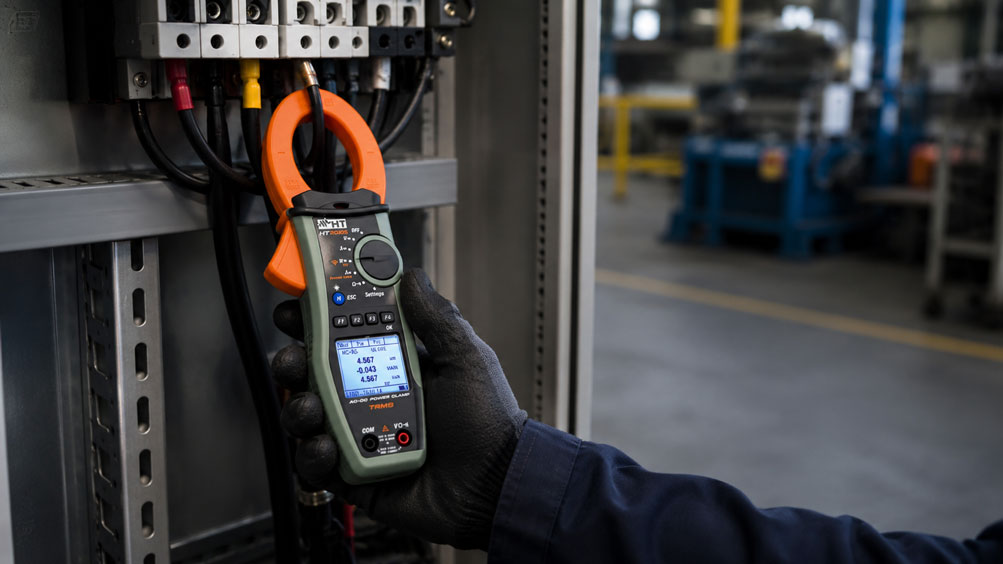
Rising energy costs make it increasingly important for many companies to better understand the power consumption of individual machines. In many cases, the total consumption of a hall, workshop or production line is known, but it is not clear which machine consumes particularly high current, when load peaks occur or whether older systems are operating much less efficiently than expected.
A clamp meter can be very helpful for the initial analysis, because the current consumption of individual loads can be checked during operation without disconnecting the cable. However, it is important to understand what is possible with a simple current measurement and when a suitable measuring instrument such as a clamp meter, a power and energy analyzer or a data logger for current and voltage is required for a real power or energy analysis.
Table of contents
- Why the power consumption of individual machines should be checked
- How a clamp meter helps with consumption analysis
- Current consumption is not the same as energy consumption
- Measuring single-phase loads correctly
- Correctly assessing three-phase machines and systems
- Comparing load conditions: No-load, partial load and full load
- Detecting load peaks: Why min/max values and inrush functions are important
- Finding energy wasters: When a machine is suspicious
- Limits of simple current measurement
- When continuous recording is useful
- Practical example: Older machine causes unexpectedly high current consumption
- Suitable measuring devices for power consumption, load peaks and energy analysis
- Conclusion: Clamp meter as a quick entry point into consumption analysis
- FAQ: Frequently asked questions about power consumption measurement with a clamp meter
Why the power consumption of individual machines should be checked
In many companies, energy is still mainly evaluated through total consumption. The electricity bill shows how much energy was consumed over a certain period of time, but it does not automatically show which machine was responsible for it. This is exactly where the practical challenge begins: If only the total consumption is known, individual energy wasters, unfavorable operating conditions or unnecessary load peaks often remain undetected for a long time.
Especially in workshops, production halls, test benches, compressor rooms and machine parks, a single system can account for a significant share of total consumption. This does not only apply to large machines. Older pumps, fans, extraction systems, compressors, heating devices or drives can also consume more energy in daily operation than expected. This often only becomes noticeable when electricity costs rise, fuses trip, cables become unusually warm or load peaks appear in the energy management system.
Checking individual machines helps to better understand the operation. It shows whether a machine draws unnecessary current at no-load, whether the current demand rises sharply during certain production steps or whether several loads generate load peaks at the same time. This makes it easier to identify technical problems, inefficient operating methods and organizational savings potential.
How a clamp meter helps with consumption analysis
A clamp meter measures the current flowing through a conductor without the cable having to be disconnected. In practice, this is a major advantage because machines and systems often need to be checked while they are running. The clamp is placed around a single conductor and records the current consumption of the connected load.
For an initial assessment, this measurement is often sufficient. If it is known that a machine should usually have a certain current consumption during normal operation, a clearly deviating measured value can already provide an important indication. A higher current can, for example, indicate mechanical stiffness, worn bearings, a blocked pump, an incorrect setting or an unfavorable operating mode.
However, correct use is important. A clamp meter usually has to enclose a single active conductor. If the entire connection cable with phase and neutral conductor is enclosed together on a single-phase load, the currents cancel each other out and the measurement does not provide a meaningful value. In three-phase machines, the phases must be considered individually so that load distribution and possible unbalanced loads can be detected.
Classic clamp meters and flexible current transformers are suitable for general current measurements. If power, energy consumption or power quality are to be evaluated in addition to current, devices with power analysis or separate energy analyzers are the better choice.
Current consumption is not the same as energy consumption
A common mistake is to equate the measured current consumption directly with energy consumption. Current in amperes is an important measured value, but it does not yet describe the complete energy consumption. Voltage, power factor, network type and operating time are also decisive for electrical power.
With a simple ohmic load, for example a heater, the power can still be estimated relatively easily. With motors, frequency inverters, switching power supplies or complex machines, this is much more difficult. Reactive power, power factor, harmonics and changing load conditions play an important role there. A simple current measurement can show that a machine draws a lot of current, but it does not always show exactly how high the actual active power or energy consumption in kilowatt hours is.
| Measured value | What it indicates | Typical application |
|---|---|---|
| Current in A | Current consumption of a conductor or load at that moment | Quick check, comparison of operating conditions, suspected overload |
| Power in kW | Actual active power of the load | Assessment of energy demand during operation |
| Energy in kWh | Consumption over a period of time | Cost assessment, consumption verification, energy management |
| Power factor | Ratio of active power to apparent power | Assessment of motors, drives and grid load |
For a reliable statement about the energy consumption of individual machines, the current should therefore not be considered alone. The clamp meter is a very good entry point for troubleshooting and preliminary analysis. If specific energy figures are to be derived from this, a power measurement or energy recording is useful.
Measuring single-phase loads correctly
For single-phase loads, measurement is generally simple if the individual conductor is accessible. The clamp meter is placed around the phase while the load is running in the desired operating condition. It is important that the entire cable with phase and neutral conductor is not enclosed together. In this case, the clamp meter would measure the sum of the outgoing and returning currents, which would lead to an incorrect or almost zero result.
Single-phase loads are often found in workshops, smaller machines, heating devices, fans, pumps, chargers, laboratory equipment or auxiliary units. For a meaningful assessment, the measurement should not be carried out only at a random moment. It is more informative to look at different states: switching on, start-up, no-load operation, normal operation and load.
If a device already shows high current consumption at no-load, this may indicate inefficient operation or a technical defect. If the current consumption only rises sharply under load, it should be checked whether the mechanical load, process conditions or machine setting are suitable for the application.
Correctly assessing three-phase machines and systems
With three-phase machines, it is not sufficient to measure only one phase and draw a general conclusion about the entire machine. The three phase conductors should be checked individually and compared with each other. Only in this way can unbalanced loads, phase failures, unevenly loaded drives or wiring problems be detected.
In an ideal condition, the currents of the three phases in a symmetrically loaded three-phase motor are similar. Small deviations are normal in practice. Larger differences, however, can indicate an unbalanced load, a supply problem, a faulty winding, mechanical imbalance or uneven loading.
Special care is required for machines with frequency inverters. The current waveform is often not sinusoidal. A simple clamp meter without True RMS measurement can then display implausible values. Suitable TRMS clamp meters or measuring devices with power analysis should be used for such applications.
If the machine is not only to be checked electrically but also evaluated energetically, a three-phase power or energy analysis is useful. Devices from the power and energy analyzers category can provide significantly more information than a simple current measurement.
Comparing load conditions: No-load, partial load and full load
A single current measurement usually says little about the behavior of a machine. Comparing different load conditions is much more informative. Many machines do not operate permanently under full load, but switch between standby, no-load, partial load and short-term peaks. Exactly these differences are important when energy wasters or inefficient operating conditions are to be found.
One example is an extraction system that continues to run at high power even when no machine is currently active. Another example is a compressor that frequently starts again because there are leaks in the compressed air network. Pumps, fans or conveyor systems can also consume more energy than expected in partial-load operation if they are incorrectly controlled, contaminated or mechanically loaded.
With a clamp meter, it can first be checked whether the current consumption changes plausibly in different operating conditions. If a machine draws almost the same current at no-load as under load, this may indicate unnecessary energy consumption. If the current rises sharply under load, it should be checked whether the machine is overloaded or whether the process places unusually high demands on it.
Detecting load peaks: Why min/max values and inrush functions are important
Load peaks often occur when motors, compressors, pumps, transformers or larger power supplies start. These peaks often last only a very short time, but they can still trip fuses, load cables or appear in load management. A normal instantaneous measurement often does not reliably capture such events because the measured value is only displayed at the moment it is read.
Clamp meters with min/max function, peak hold or inrush function can make such short-term peaks more visible. This makes it possible to determine whether a machine only causes high currents during start-up or whether it also draws an unusually high current during continuous operation.
This distinction is very important in practice. A high starting current is normal for many motors as long as it remains short-term and the electrical system is designed for it. Permanently increased current consumption during operation, on the other hand, is often an indication of overload, wear or unfavorable operating conditions.
Finding energy wasters: When a machine is suspicious
A machine is not automatically an energy waster just because it has high current consumption. Large machines naturally require more energy than small loads. A machine becomes suspicious when its current consumption does not match the expected operating condition, when it is significantly higher compared to similar systems or when it consumes unnecessarily high energy outside actual production time.
In practice, comparison is therefore useful. Similar machines can be measured under comparable conditions. If an older machine consumes significantly more current than a newer system while performing the same task, this may indicate wear, unfavorable control or inefficient drive technology. A machine can also be suspicious if it continues to cause a high base load during waiting times, breaks or standby phases.
Auxiliary units should also not be underestimated. Compressed air, extraction, cooling, pumps, fans and heating elements often run in the background and are initially overlooked in energy analyses. However, these consumers often offer savings potential because they are not always needed continuously or because their control can be improved.
Limits of simple current measurement
Current measurement with a clamp meter is fast, flexible and very useful for an initial assessment. However, it has limits. The measured current alone does not automatically show the exact energy consumption. Especially in three-phase systems, motors with poor power factor, frequency inverters or non-linear loads, the current value alone can lead to incorrect conclusions.
If only the current consumption is considered, it is not always clear how high the active power is. Reactive power, harmonics, voltage quality or time-based load profiles often remain unconsidered in simple measurements. For an economic assessment, however, it is decisive how much energy is actually consumed over a certain period of time.
It is therefore useful to distinguish between three levels: The clamp meter is used for quick checking and narrowing down the problem. A power clamp meter or power meter provides additional information on active power, power factor and partly energy. An energy analyzer or data logger documents the trend over a longer period and makes load profiles visible.
When continuous recording is useful
Many energy problems cannot be detected with a single measurement. Load peaks may occur only in the morning when production starts. A compressor may start unusually often at night. A machine may cause high current consumption only with certain products, tools or process parameters. In such cases, time-based recording is significantly more meaningful than a single measured value.
With a data logger or energy analyzer, current, voltage, power and energy consumption can be documented over hours, days or weeks. This creates a load profile. It shows when a machine actually consumes energy, how high the base load is and whether load peaks are related to certain operating processes.
For temporary analyses, data loggers for current and voltage can be useful. If power quality, harmonics or three-phase power values are also to be assessed, power and energy analyzers are the more suitable solution.
Practical example: Older machine causes unexpectedly high current consumption
In a workshop, it becomes apparent that electricity costs have increased in recent months. The main meter data shows the total consumption, but not which machine is causing the additional consumption. The suspicion falls on an older machining unit that runs for several hours a day and becomes warm more often compared to newer systems.
Using a clamp meter, the current consumption is first checked in different operating conditions. At no-load, the machine already shows comparatively high current consumption. Under load, the current continues to rise, not only during short machining peaks, but over longer periods. A comparable machine performing a similar task is then measured. It becomes clear that the older system consumes significantly more current for a comparable task.
The measurement alone does not replace a complete energy analysis, but it provides a clear indication. During further inspection, mechanical stiffness, bearing condition, drive settings and auxiliary units are checked. In addition, a daily profile is recorded using a data logger. This shows that the machine also causes an unnecessarily high base load during longer idle periods.
This example shows how a clamp meter can serve as a quick entry point into the analysis. It helps to identify suspicious consumers and decide whether a more detailed power or energy recording is useful.
Suitable measuring devices for power consumption, load peaks and energy analysis
Robust clamp meters that can be used to check individual conductors during operation are suitable for quick current measurements on machines. For applications with motors, frequency inverters or non-sinusoidal currents, suitable TRMS measurement should be ensured. Devices such as the HT9021 digital clamp meter can be used for general AC/DC current measurements in industrial applications.
If power values, energy consumption or load trends are also of interest in addition to current consumption, clamp meters with power analysis and data logger function are particularly helpful. These include, for example, the HT9022 TRMS clamp meter with power analysis, data logger and Bluetooth or the HT9023 TRMS clamp meter with power analysis, data logger and WLAN.
For more extensive investigations, for example with three-phase loads, load profiles, power quality or energy management, power and energy analyzers are the more suitable solution. They do not only provide instantaneous values, but also enable a much more precise assessment of consumption, load profile and electrical influencing factors.
Conclusion: Clamp meter as a quick entry point into consumption analysis
If you want to check the power consumption of individual machines, you do not always need to install a fixed measuring point immediately. A clamp meter is a very practical tool for recording current consumption during operation, comparing load conditions and quickly narrowing down suspicious consumers.
For an initial assessment, current measurement is often sufficient. It shows whether a machine draws an unusually high current at no-load, partial load or full load. It also helps to detect load peaks during switching on and to compare similar machines with each other. However, as soon as the actual energy consumption, active power or a load profile over a longer period is to be evaluated, a power analysis or energy recording is necessary.
Suitable solutions can be found in the area of clamp meters and flexible current transformers, in power and energy analyzers and in data loggers for current and voltage.
FAQ: Frequently asked questions about power consumption measurement with a clamp meter
Can I measure the power consumption of a machine with a clamp meter?
With a clamp meter, you can first measure the current consumption of a machine. For the actual energy consumption in kilowatt hours, voltage, power factor and the time profile are also important. Some clamp meters with power analysis can also record these values.
Why is current consumption alone not always sufficient for assessing energy consumption?
The current in amperes only shows how much current is flowing at that moment. Energy consumption also depends on voltage, active power, power factor and operating time. Especially with motors, frequency inverters and non-linear loads, a simple current measurement may not be sufficient.
How do I measure a machine correctly with a clamp meter?
The clamp meter must be placed around a single active conductor. With single-phase loads, the complete connection cable with phase and neutral conductor must not be enclosed together. With three-phase machines, the phases should be measured individually and compared with each other.
How do I find load peaks of a machine?
Load peaks can be recorded with clamp meters that offer min/max, peak-hold or inrush functions. For longer analyses, data loggers or energy analyzers are useful because they document the trend over a period of time.
What does inrush measurement mean?
Inrush measurement records short-term switch-on or starting currents that can occur when motors, compressors, transformers or power supplies start. These currents are often significantly higher than the normal operating current.
How can I tell whether a machine is an energy waster?
A machine is suspicious if its current consumption does not match the operating condition, if it draws significantly more current compared to similar machines or if it causes a high base load even during standby or no-load phases.
What role does True RMS play in current measurement?
True RMS measurement is important when currents are not sinusoidal. This is the case, for example, with frequency inverters, switching power supplies or electronically controlled drives. A simple clamp meter can provide inaccurate values in such applications.
Can I check three-phase machines with a clamp meter?
Yes, but the three phases should be measured individually and compared with each other. For a complete power or energy analysis of three-phase machines, a suitable three-phase measuring device or an energy analyzer is useful.
When do I need an energy analyzer instead of a clamp meter?
An energy analyzer is useful if not only current consumption but also active power, energy consumption, load profile, power factor, power quality or harmonics are to be evaluated. This applies especially to three-phase systems and complex machines.
Which products are suitable for checking machine consumption?
Clamp meters are suitable for quick current measurements. For measurements with power analysis, devices such as the HT9022 or HT9023 are suitable. For longer recordings and detailed consumption analyses, power and energy analyzers or data loggers for current and voltage are suitable.