


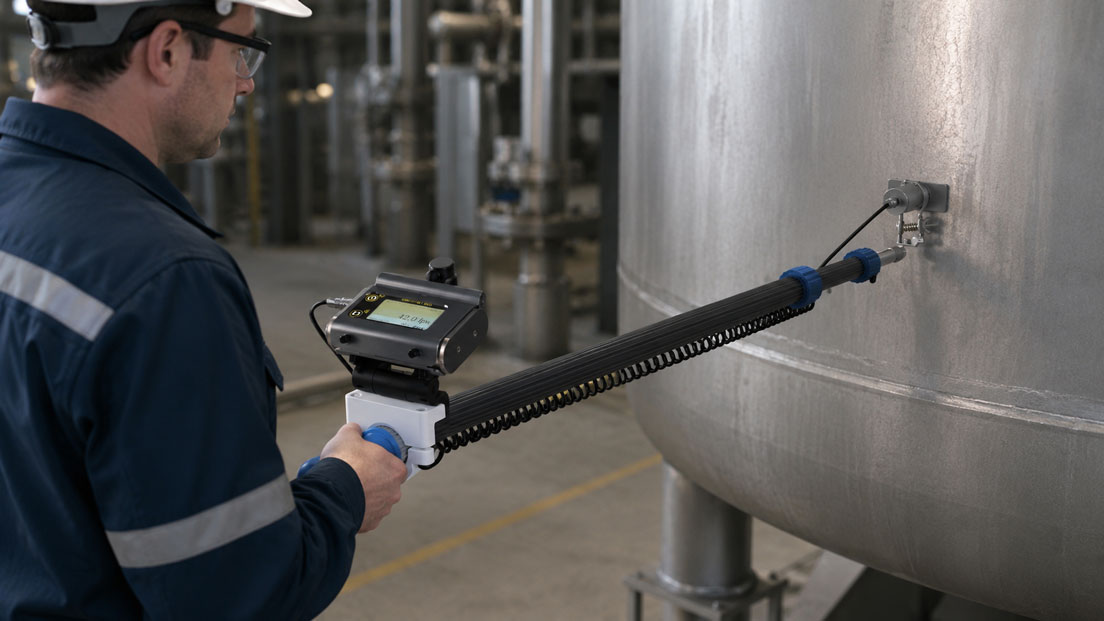
Telescopic probes make it possible to measure the dose rate at potentially higher-radiation or hard-to-reach locations without requiring the operator to move their entire body close to the measuring point. The detector is positioned at the tip of an extendable telescope, while the measuring instrument and operator remain further away.
The additional distance can significantly reduce radiation exposure and facilitates the inspection of vessels, vehicles, pipelines, shafts, debris areas or shielded plant components. At the same time, a telescopic probe can help to narrow down local areas with an increased dose rate.
However, a telescopic probe does not automatically make an unknown situation safe. The measuring range, radiation type, probe type, response time, measuring distance and personal dosimetry must be suitable for the task. In addition, a measured maximum value does not necessarily correspond to the actual position or shape of the radiation source.
Table of Contents
- Using distance as a protection principle
- How does a telescopic probe work?
- Applying the inverse-square law correctly
- Considering the limitations of the inverse-square law
- Distinguishing dose rate from contamination
- Selecting the correct measuring probe
- Measuring range, overload and response time
- Locating hotspots systematically
- Documenting the measuring geometry and distance
- Shielding, scattered radiation and shadowing effects
- Typical applications
- Handling the telescope and measuring instrument safely
- Personal dosimetry and operational limits
- Preventing contamination of the telescope
- Recommended measuring strategy
- Typical measurement and selection errors
- Practical example: Suspicious container at a recycling facility
- Information required for selection
- Which products are suitable?
- Conclusion
- Frequently asked questions
Using distance as a protection principle
The fundamental radiation-protection measures are:
- limiting the time spent in the radiation field,
- increasing the distance from the source,
- using suitable shielding.
A telescopic probe primarily supports the distance principle. It moves the detector to the required measuring point while allowing the operator and base instrument to remain further away.
This is particularly useful when:
- a source is initially only suspected,
- an increased dose rate cannot be ruled out,
- a measuring point is mechanically difficult to reach,
- measurements must be taken over or behind shielding,
- vessels, containers or vehicles should not be entered,
- approach is permitted only in gradual stages.
The additional distance does not automatically reduce every exposure by the same proportion. The decisive factor is the dose rate at the operator’s actual location. If the operator remains within a largely homogeneous radiation field, the benefit of the telescope may be lower than with a small, locally confined source.
How does a telescopic probe work?
A telescopic probe generally consists of:
- an extendable telescopic tube,
- a detector or holder for interchangeable probes,
- an electrical connection to the base instrument,
- a dose-rate meter or evaluation electronics.
Depending on the design, the base instrument is mounted directly at the operator end or connected to the probe through a coiled cable or internal lead.
Two concepts must be distinguished:
| Concept | Characteristic | Typical application |
|---|---|---|
| Fixed telescopic probe | Detector, telescope and measuring-instrument connection form a matched system | Measurement of high gamma and X-ray dose rates from a greater distance |
| Universal telescope | Different measuring probes can be attached | Changing dose-rate, pulse-counting or special measurements |
In a universal system, the measuring range and radiation sensitivity are not determined by the telescope alone. The decisive factor is the probe used in combination with the compatible base instrument.
Applying the inverse-square law correctly
For a small point-like radiation source, the dose rate in a free radiation field decreases approximately with the square of the distance.
The simplified calculation is:
Ḣ2 = Ḣ1 × (r1 / r2)2
Where:
- Ḣ1: known dose rate at distance r1,
- Ḣ2: expected dose rate at distance r2,
- r: distance between the radiation source and the detector or person being considered.
Simplified example without additional shielding:
| Distance from the source | Relative dose rate | Example with 1 mSv/h at a distance of 1 m |
|---|---|---|
| 1 m | 100 % | 1 mSv/h |
| 2 m | 25 % | 0.25 mSv/h |
| 3 m | approx. 11 % | approx. 0.11 mSv/h |
| 4 m | 6.25 % | 0.0625 mSv/h |
If the detector is moved closer to a source using a telescope while the operator remains further away, high values may be measured at the detector even though the dose rate at the operator’s position is considerably lower.
For a meaningful assessment, two distances must therefore be distinguished:
- distance between the detector and the suspected source,
- distance between the operator and the suspected source.
Considering the limitations of the inverse-square law
The inverse-square law is an approximation for a point-like source in a free radiation field. Significant deviations can occur in real installations.
The simplified calculation is particularly limited in the case of:
- large or area-shaped sources,
- long contaminated pipelines,
- distributed radioactive material,
- very short distances from the source,
- sources inside vessels or shielding,
- strong scattered radiation,
- several sources present at the same time.
With an extended source, doubling the distance may produce a considerably smaller reduction than with a point source. The geometric centre of a source is also often unknown.
The inverse-square law is therefore useful for plausibility checks and operational planning, but it must not be used to extrapolate unknown radiation fields without control measurements.
Distinguishing dose rate from contamination
A telescopic probe for dose-rate measurement primarily answers the question:
What is the dose rate at the detector position?
A contamination measurement, by contrast, answers:
Are radioactive substances present on a surface?
| Measuring task | Suitable instrument group | Important measuring condition |
|---|---|---|
| Measure gamma or X-ray dose rate | Dose-rate probe or telescopic probe | Defined distance and suitable dose-rate measuring range |
| Search for alpha/beta contamination | Suitable contamination or pulse probe | Very small and consistent distance from the surface |
| Identify an unknown radionuclide | Radionuclide identifier | Sufficient measuring time and suitable measuring geometry |
With alpha radiation, even a small air gap between the surface and detector can significantly influence the result. A gamma dose-rate probe is therefore not a substitute for a contamination probe.
For beta radiation, the detector window, energy, distance and shielding are also decisive. If a universal telescope is to be used with a pulse probe, the probe, measuring mode and permissible measuring geometry must be explicitly suitable for the task.
Selecting the correct measuring probe
The probe determines which radiation type and measuring range can be detected.
Important selection criteria include:
- sensitivity to gamma, X-ray, beta or alpha radiation,
- dose-rate measurement or pulse counting only,
- lower and upper measuring-range limits,
- energy range,
- detector area and directional dependence,
- response and averaging time,
- compatibility with the base instrument and telescope,
- calibration or verification capability.
A different probe is appropriate for locating a gamma hotspot inside a vessel than for examining a surface for alpha or beta contamination.
For changing measuring tasks, a telescope with interchangeable probes offers greater flexibility. However, this also increases the risk of an unsuitable combination. Before use, the operator must know exactly which measured variable the base instrument displays and which measuring range applies with the connected probe.
Measuring range, overload and response time
With an unknown source, the dose rate at the detector head may be considerably higher than at the starting point of the measurement. The probe must therefore have a sufficiently high upper measuring limit.
An excessively sensitive detector may:
- go into overrange,
- exceed its measuring range,
- display only an overload warning,
- display incorrect measured values if unsuitable technology is used.
A relatively insensitive high-dose detector, by contrast, may be unsuitable for detecting small increases above natural background radiation.
With automatic range switching, it must be considered that the display requires time to stabilise after a significant change in the measured value. The probe should therefore not be moved too quickly past a possible source.
A reproducible movement speed is important when searching for hotspots. The more strongly the displayed value is smoothed, the more slowly the probe must be moved to avoid missing a local maximum.
Locating hotspots systematically
In practice, a hotspot is a local area in which the measured dose rate is higher than in the surrounding area.
A safe search is not carried out by approaching as directly and quickly as possible, but in several stages:
- Determine the initial value: Measure the background or dose rate in a known safe area.
- Determine the general direction: Measure at several positions from a greater distance.
- Reduce the measuring grid: Examine the area with the highest values in progressively greater detail.
- Extend the telescope: Move the detector closer without moving the operator forward to the same extent.
- Hold the measuring point: Allow for the instrument’s response and averaging time.
- Compare laterally: Measure to the right, left, above and below using comparable geometry.
- Observe the limits: Stop the measurement or initiate the required measures when defined dose-rate or dose limits are reached.
The highest indication initially marks only the position with the highest measured dose rate. The source may be located:
- directly behind this surface,
- deeper inside the vessel,
- behind partial shielding,
- offset to one side,
- in several separate areas
.
A second measuring direction can help to narrow the area down further. However, no additional circling or approach must be carried out if this conflicts with the operational or radiation-protection plan.
Documenting the measuring geometry and distance
A dose-rate value is only of limited comparability without the measuring geometry.
Traceable documentation should include:
- measured value and unit,
- measured quantity, for example Ḣ*(10),
- date and time,
- base instrument and probe used,
- detector position,
- distance between the detector and object,
- distance between the operator and object,
- orientation of the probe,
- telescope length,
- shielding between the source and probe,
- measuring or waiting time,
- special environmental conditions.
If only “2 mSv/h at the container” is documented, it remains unclear whether the measurement was taken directly at the surface, at a distance of one metre or from four metres away.
Measured values from different angles may also be compared only if the distance and shielding are comparable.
Shielding, scattered radiation and shadowing effects
Vessel walls, concrete, metal, water and other materials can attenuate gamma and X-ray radiation. At the same time, scattered radiation can result in measurable values outside the direct line between the source and detector.
During hotspot searches, shielding effects can provide useful indications:
- A sharp decrease in the measured value behind a solid component may indicate its shielding effect.
- A local maximum at a joint or opening may be caused by a lower material thickness.
- A high value at a pipe bend may result from altered geometry or a deposit.
- A measured value behind shielding may be influenced by scattered radiation.
The position with the highest dose rate is therefore not always the location with the greatest activity. It may also be the position with the least shielding.
The telescope itself does not provide relevant shielding for the operator. Its benefit primarily results from the spatial separation between the detector and operator.
Typical applications
| Application | Benefit of the telescopic probe | Particularly important considerations |
|---|---|---|
| Fire brigades and civil protection | Inspection of unknown objects and damaged vessels | Operational limits, dosimeters, documentation and decontamination |
| Scrap yards and recycling | Locating suspicious components in skips, containers or vehicles | Shielding by scrap and several possible sources |
| Waste disposal and dismantling | Measurements in shafts, vessels or behind plant components | Contamination risk and reproducible measuring grid |
| Industrial radiography | Inspection of difficult-to-see areas or possible source positions | Release procedures and the responsible radiation-protection organisation |
| Pipelines and process installations | Locating deposits or areas with increased radiation | Extended sources and limited validity of the inverse-square law |
| Transport and storage containers | Comparing different sides of a container and measuring points | Consistent distance from the surface and defined measuring positions |
| Research and nuclear technology | Measurements on shielded or difficult-to-reach components | Measuring range, probe calibration and plant approval |
Handling the telescope and measuring instrument safely
A fully extended telescope changes the weight, centre of gravity and leverage of the measuring system.
The following should be checked before use:
- mechanical locking of the telescopic sections,
- secure attachment of the probe and base instrument,
- condition of internal or external cables,
- connectors, snap-in connection and strain relief,
- battery or rechargeable-battery condition,
- self-test and calibration status,
- correct indication of the connected probe type,
- configured warning thresholds.
The telescope must not be used as a support, lever or tool. The detector head should not be struck against vessel walls or immersed in liquids unless the system is explicitly designed for this purpose.
When used with protective gloves, extending, locking, reading and retracting the telescope should be practised in advance. Rare emergency situations are not an appropriate time to learn the basic operation for the first time.
Personal dosimetry and operational limits
The telescopic probe measures the dose rate at the detector. It does not automatically monitor the individual dose received by the operator.
For applications involving possible occupational or operational exposure, the following may additionally be required:
- personal dosimeters,
- alarm dosimeters,
- defined dose and dose-rate limits,
- limits on the time spent in the area,
- communication with radiation-protection officers or specialist advisers,
- cordoning-off and withdrawal rules.
The operator must not rely solely on the measured value at the telescope head. The following are also relevant:
- dose rate at the operator’s own location,
- personal dose already received,
- expected duration of the remaining work,
- possible changes in the source or shielding.
A telescope provides more favourable measuring geometry. However, it does not replace authorisation to enter an area or a competent assessment of the radiological situation.
Preventing contamination of the telescope
If the probe is moved into a contaminated area or touches a surface, the detector head and telescope themselves may become contaminated.
The following should therefore be clarified before use:
- whether direct contact is necessary,
- whether a defined spacer can be used,
- whether suitable protective film is permissible,
- how the instrument will be checked after use,
- which cleaning and decontamination agents are permitted.
Protective film can reduce the spread of contamination, but depending on the radiation type and detector window, it may influence the measuring behaviour. With alpha and low-energy beta radiation, even a thin covering may be problematic.
After use, the telescope, probe, cables, handles and transport case must be checked in accordance with the operational plan.
Recommended measuring strategy
- Define the measuring task: Clearly distinguish dose rate, contamination and pulse rate.
- Select a suitable instrument combination: Check the compatibility of the base instrument, probe and telescope.
- Perform a functional check: Check the self-test, background value, battery and warning thresholds.
- Ensure personal protection: Define dosimeters, operational limits and the withdrawal route.
- Begin from a large distance: Record the first values outside the suspected main radiation field.
- Move the detector gradually: Extend the telescope without unnecessarily moving the operator forward.
- Allow for the response time: Hold each important measuring point for a sufficient period.
- Use a measuring grid: Maintain comparable distances and movement directions.
- Observe the limits: Comply with defined warning, stop and withdrawal criteria.
- Document the measured values: Record the detector position, operator distance, time and geometry.
- Check the instrument: Inspect it for damage and possible contamination after use.
Typical measurement and selection errors
The operator follows the detector as the telescope is extended
The potential distance advantage is lost because the person moves towards the source together with the probe.
The inverse-square law is applied to every source without assessment
Extended sources, shielding and scattered radiation can result in significantly different behaviour.
The distance is measured from the telescope handle rather than the detector
The documented measuring geometry does not correspond to the actual detector distance.
A gamma dose-rate probe is used for contamination measurement
Surface contamination, particularly alpha or beta contamination, cannot be assessed reliably.
The probe is moved too quickly
The response time and measured-value filter prevent a narrow hotspot from being displayed completely.
Only the highest value is documented
The distance, orientation, measuring time and spatial distribution remain unknown.
The upper measuring range is too low
The probe goes into overrange during approach or can no longer display the actual value.
The hotspot is assumed to be the exact source position
The highest dose rate may be caused by an opening, lower wall thickness or scattered radiation.
Personal dosimetry is omitted
The probe indicates the dose rate at the measuring head, but not the cumulative dose received by the person carrying out the work.
The telescope is not checked after use
Possible contamination may be spread to a vehicle, equipment room or transport case.
Practical example: Suspicious container at a recycling facility
During the incoming inspection at a recycling facility, an increased dose rate is detected at a container loaded with metal scrap. The precise source inside the container is unknown.
The first control measurement is performed from a greater distance using a suitable dose-rate meter. The background level is 0.10 µSv/h. A value of 2.5 µSv/h is measured at one side of the container from a distance of three metres.
A telescopic probe is used for further localisation. The operator remains behind a defined line while the detector is moved gradually closer to different points on the container wall.
The measurements are:
| Measuring point | Detector distance from the container wall | Dose rate |
|---|---|---|
| Left side wall | 50 cm | 8 µSv/h |
| Centre of the side wall | 50 cm | 35 µSv/h |
| Right side wall | 50 cm | 12 µSv/h |
| Central lower edge | 20 cm | 90 µSv/h |
The values indicate a more highly affected area in the lower central section of the container. However, they do not yet prove which component is causing the radiation or whether several sources are present.
The area is secured in accordance with the facility’s radiation-protection plan. Further work is carried out only after assessment by qualified personnel. Separate instruments and defined measures are used for subsequent identification and recovery.
In this example, the telescopic probe did not replace the complete assessment. However, it made it possible to narrow down the suspicious area without requiring the operator to approach the container wall.
Information required for selection
At least the following information is required when selecting a suitable telescope and probe system:
- expected radiation type,
- dose-rate measurement or pulse counting,
- expected minimum and maximum measured values,
- required measured quantity and unit,
- required telescope length,
- measurements at difficult-to-reach locations or at high dose rates,
- fixed or interchangeable probe,
- existing dose-rate meter,
- required verification or calibration capability,
- fire-service, industrial or laboratory application,
- degree of protection and environmental conditions,
- weight and operability when wearing protective gloves,
- warning and alarm functions,
- documentation and data-transfer requirements,
- cleaning and decontamination requirements.
A meaningful enquiry could read as follows:
Telescopic probe for gamma and X-ray dose-rate measurement during fire-service and industrial operations, measurements up to 10 Sv/h, total length of at least 4 m, existing GRAETZ X5C FW, indication at the operator’s position, robust design and operable while wearing protective gloves.
Which products are suitable?
Telescopes for radiation measurements
The telescopes category includes systems for dose-rate and pulse measurements from a greater distance and at difficult-to-reach measuring points.
Depending on the version and probe, the instruments are suitable for:
- fire brigades and civil protection,
- industry and non-destructive testing,
- recycling and waste-disposal facilities,
- research and nuclear technology,
- radiology and nuclear medicine.
GRAETZ DE telescopic probe
The GRAETZ DE telescopic probe is intended for measuring high gamma and X-ray dose rates from a greater distance and at difficult-to-reach locations.
Its main features include:
- dose-rate measuring range up to 10 Sv/h for the ambient dose equivalent rate Ḣ*(10),
- continuously extendable stainless-steel telescope with a total length of up to 4 m,
- snap-in connection without a separate probe cable between the telescope and compatible base instrument,
- compatible with the GRAETZ X5C plus, X5C plus SE and X5C FW,
- automatic measuring-range switching,
- dose-rate indication at the operator’s position,
- IP54 with the telescope retracted and protective cap fitted.
The DE telescopic probe is particularly suitable when high dose rates are expected and a defined, robust instrument combination is required.
GRAETZ CE telescope
The GRAETZ CE telescope is a flexible telescopic solution for different probes from the GRAETZ range.
Depending on the connected probe, it can be used for:
- different gamma dose-rate ranges,
- pulse rates,
- alpha-, beta- and gamma-sensitive measurements,
- measurements at difficult-to-reach locations
.
The measuring range, energy range and measured quantity depend on the probe used. The specific combination of telescope, probe and base instrument must therefore be defined before ordering.
Probes for radiation-measuring instruments
The probes category includes gamma and pulse probes for extending compatible radiation-measuring instruments.
Depending on the instrument, available options include:
- gamma probes for different dose-rate ranges,
- contamination and pulse probes,
- NaI scintillation probes,
- telescopic probes for high dose rates.
Radiation measurement technology
In addition to telescopes and probes, the broader radiation measurement technology category also includes dose-rate meters, dosimeters, contamination monitors, dose-rate warning instruments, radionuclide identifiers and stationary monitoring systems.
Professional applications generally require a coordinated combination of instruments. A telescopic probe supplements the measuring strategy but does not replace a personal dosimeter, contamination monitor or radionuclide identifier.
Conclusion: Move the detector closer, not the operator
A telescopic probe puts the distance principle of radiation protection into practice. It allows the detector to be positioned at a potentially higher-radiation or difficult-to-reach measuring point while the operator remains further away.
With small point-like sources, the dose rate can decrease sharply as the distance increases. However, the inverse-square law is only an approximation. Extended sources, shielding, vessel geometries and scattered radiation must be taken into account through actual measurements.
For hotspot searches, a suitable measuring range, sufficiently slow probe movement and documented measuring geometry are essential. The highest indication does not automatically identify the precise source, but initially only a maximum within the radiation field.
The probe used must be suitable for the radiation type and measuring task. A gamma dose-rate probe does not replace alpha/beta contamination measurement. Similarly, a measurement at the telescope head does not replace personal dosimetry for the operator.
Safe use is achieved only through the combination of suitable measuring technology, distance, limited exposure time, shielding, personal monitoring, clearly defined operational limits and trained personnel.
Frequently asked questions about telescopic probes in radiation protection
How does a telescopic probe reduce radiation exposure?
The detector can be moved closer to the measuring point while the operator remains further away from the suspected source. The actual reduction depends on the source geometry, distance and shielding.
Does the inverse-square law always apply to radiation?
No. It applies approximately to small point-like sources in a free radiation field. Significant deviations can occur with extended sources, shielding, scattered radiation and very short distances.
Can a telescopic probe determine the precise position of a source?
It can narrow down areas with an increased dose rate. However, the highest indication may also be caused by reduced shielding, openings or scattered radiation and is not automatically the exact source position.
Can a telescopic probe measure alpha and beta contamination?
Only with a suitable probe and appropriate measuring conditions. Alpha and beta measurements generally require a very small distance from the surface. A gamma dose-rate probe is not suitable for this purpose.
Why must the probe be moved slowly?
The detector, range switching and measured-value filter require time to respond to a change in dose rate. If the probe is moved too quickly, a small hotspot may be missed or displayed too low.
Which distance must be documented?
At least the distance between the detector and measuring object. For telescopic measurements, the distance between the operator and suspected source should also be documented.
Does a telescopic probe replace a personal dosimeter?
No. The telescopic probe measures the dose rate at the detector head. A personal dosimeter monitors the cumulative dose received by the operator.
What must be checked after use in a contaminated area?
The probe, telescope, cables, handles and transport accessories must be checked for possible contamination and cleaned or decontaminated in accordance with the defined procedure.
Which information does ICS Schneider require for selection?
The required information includes the radiation type, measuring task, expected measuring range, existing base instrument, required telescope length, operating environment, verification or calibration requirements, warning functions and requirements for robustness, operation and decontamination.