


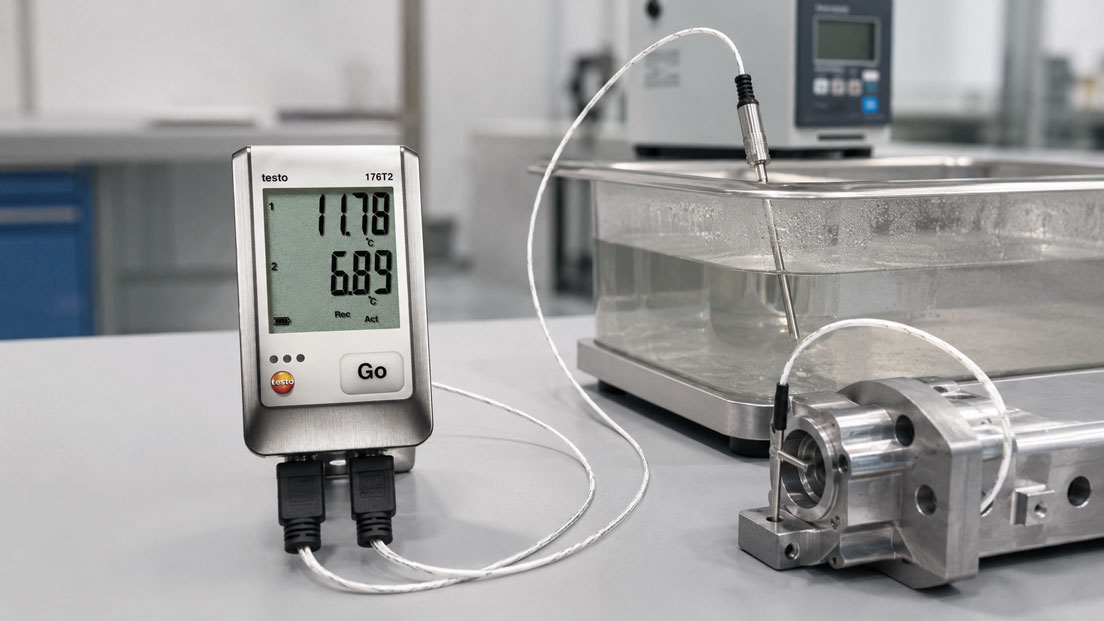
When selecting a temperature data logger, many users initially focus on memory capacity, measuring channels, battery life and software. However, the connected probe type is at least as important for the actual quality of the temperature recording.
A Pt100 probe often offers advantages in terms of accuracy, long-term stability and reproducible measurements in the low and medium temperature range. Thermocouples, by contrast, can be made very compact, respond quickly and measure considerably higher temperatures.
However, the decision must not be based solely on the maximum temperature range. Probe design, cable length, immersion depth, response time, connection type, calibration and the sensor types supported by the logger together determine whether the measured values are actually suitable for laboratory work, quality assurance or industrial processes.
Table of Contents
- Pt100 and thermocouple: the fundamental difference
- Direct comparison of Pt100 and thermocouples
- When is a Pt100 data logger useful?
- When is a thermocouple data logger useful?
- Selecting thermocouple types K, J, T and N
- Distinguishing the measuring ranges of the logger and probe
- Evaluating the accuracy of the complete measuring chain
- Response time and probe diameter
- Adapting the probe design to the measuring task
- Cable length and electrical connections
- Using multiple temperature channels correctly
- Defining the measuring interval and recording duration
- Calibrating the logger and temperature probes
- Typical selection and measurement errors
- Typical applications and suitable probe types
- Selecting the correct temperature data logger
- Which measuring instruments and products are suitable?
- Conclusion
- Frequently asked questions
Pt100 and thermocouple: the fundamental difference
A Pt100 is a resistance thermometer. Its electrical resistance changes with temperature. The designation Pt100 means that the sensing element has a nominal resistance of 100 ohms at 0 °C.
The data logger measures the resistance, applies the standardised characteristic curve and calculates the temperature. Pt100 probes are used particularly frequently where high accuracy and good repeatability are required.
A thermocouple, by contrast, consists of two different metallic conductors. A temperature-dependent thermoelectric voltage is generated at their junction. The logger measures this very small voltage and calculates the temperature using the characteristic curve of the selected thermocouple type.
For correct thermocouple measurement, the temperature at the connection point must also be taken into account. This function is known as cold-junction compensation and is normally integrated into a suitable thermocouple data logger.
Direct comparison of Pt100 and thermocouples
| Criterion | Pt100 | Thermocouple |
|---|---|---|
| Measuring principle | Temperature-dependent electrical resistance | Temperature-dependent thermoelectric voltage generated by two metals |
| Typical strength | Accuracy, stability and repeatability | Wide temperature range and robust, fast-response designs |
| Typical application | Laboratories, refrigeration, quality assurance and precise process measurement | Furnaces, exhaust gases, machinery, surfaces and rapid temperature changes |
| High temperatures | Limited by the probe and insulation | Depending on the type and design, temperatures well above 1,000 °C are possible |
| Low temperatures | Very well suited to accurate measurements | Types T and K can also measure low temperatures |
| Response time | Depends on the sensing element, thermowell and diameter | Very fast versions with exposed or thin measuring junctions are possible |
| Cable influence | Cable resistance must be compensated for by a suitable circuit | Suitable extension or thermocouple cable and correct polarity are required |
| Long-term stability | Very good in many applications | Depends on the type, temperature and thermal loading |
The table describes general properties. A thin Pt100 probe may respond faster than a solid thermocouple installed in a thick thermowell. Similarly, a high-quality thermocouple may be more suitable for a particular application than an incorrectly installed Pt100.
When is a Pt100 data logger useful?
A Pt100 data logger is particularly suitable for measuring tasks in which small temperature differences must be detected reliably and compared over extended periods.
Typical applications include:
- refrigerated and frozen-storage areas,
- laboratory and test chambers,
- water and oil baths,
- food and pharmaceutical applications,
- comparison of several climatic zones,
- quality assurance and validation,
- process monitoring in the low and medium temperature range.
Pt100 probes are often the first choice when measurement deviations of only a few tenths of a degree are relevant. However, the achievable accuracy depends on the probe class, logger, wiring and installation conditions.
Even with a Pt100 data logger, the specific probe must be suitable for the temperature range. Cable insulation, connector, thermowell and potting compound may have a significantly smaller operating range than the Pt100 sensing element itself.
When is a thermocouple data logger useful?
Thermocouple data loggers are particularly suitable when high temperatures, rapid changes or several robust measuring points must be recorded simultaneously.
Typical applications include:
- industrial and laboratory furnaces,
- heat-treatment processes,
- exhaust-gas and flue-gas temperatures,
- motors, gearboxes and machine surfaces,
- hot plates and tools,
- temperature profiles during heating and cooling,
- comparison of flow and return temperatures.
Thermocouples can be manufactured in very small designs with low thermal mass. This enables rapid temperature changes to be recorded. At high temperatures, however, it must be checked whether the measuring wire, insulation, sheath material and connector are permanently suitable.
The logger must be explicitly configured for the thermocouple type being used. Types K, J, T and N have different characteristic curves. An incorrect setting may produce plausible-looking but technically incorrect measured values.
Selecting thermocouple types K, J, T and N
| Thermocouple type | Typical strength | Common application | Important note |
|---|---|---|---|
| Type K | Wide operating range and broad availability | Furnaces, machinery, exhaust gases, surfaces and general industrial applications | The probe design and logger determine the actual permissible range |
| Type J | Well suited to medium and higher industrial temperatures | Machinery, tools, plastics processing and thermal processes | The usable upper range is often lower than that of type K |
| Type T | Well suited to low and moderately positive temperatures | Refrigeration systems, laboratories, food applications and freezing processes | Not intended for very high process temperatures |
| Type N | Suitable for elevated temperatures and demanding long-term measurements | Furnaces, heat treatment and industrial high-temperature processes | The logger used must explicitly support type N |
Type K as a universal thermocouple probe
Type K is used very frequently and is available in numerous designs. These include air, surface, penetration, screw-in and mineral-insulated thermocouples.
With the testo 176T4, the instrument-side measuring range for type K extends from −200 to +1,000 °C. However, the connected probe may have a narrower range.
Type J for industrial temperature measurement
Type J is used in machinery, tools and industrial processes, among other applications. With the testo 176T4, the instrument-side range extends from −100 to +750 °C.
Especially at higher temperatures, the permissible continuous load and ambient conditions of the specific probe must be taken into account.
Type T for low temperatures
Type T is particularly suitable for refrigeration, laboratory and food applications. With the testo 176T4, type T can be evaluated from −200 to +400 °C.
A Pt100 system may nevertheless be advantageous for particularly accurate measurements in the medium temperature range. Type T is often selected when a very thin, fast-response or flexibly routed probe is required.
Type N for higher thermal loads
Type N is frequently selected for industrial high-temperature applications and long-term measurements at elevated temperatures. However, it is not automatically compatible with every thermocouple data logger.
The testo 176T4 supports only types K, J and T. A different logger or suitable multichannel measuring system is therefore required for type N.
Distinguishing the measuring ranges of the logger and probe
Temperature measurements are always subject to several range limitations:
- measuring range of the logger input,
- measuring range of the sensing element,
- permissible temperature of the probe cable,
- permissible temperature of the connector,
- permissible ambient temperature of the data logger.
The smallest of these ranges limits the complete measuring chain.
A thermocouple data logger may, for example, process temperatures up to +1,000 °C. However, if a probe with a PTFE cable is used, the cable may only be exposed to a considerably lower temperature range.
The logger itself is normally installed outside the hot process. Only the probe tip, sheath or thermowell is exposed to the high temperature.
Likewise, a Pt100 probe must not be selected solely according to the theoretical operating range of the sensing element. The complete probe, including cable and connection, determines the permissible temperature.
Evaluating the accuracy of the complete measuring chain
Measurement accuracy is not determined solely by the specification of the data logger. At least the following must be considered:
- accuracy of the logger input,
- tolerance of the Pt100 or thermocouple,
- display and storage resolution,
- cable and contact errors,
- cold-junction compensation for thermocouples,
- calibration uncertainty,
- installation and heat-conduction errors.
A logger with an accuracy of ±0.2 °C does not automatically produce an overall measurement accuracy of ±0.2 °C. If the connected probe also has a tolerance, the relevant contributions must be assessed together.
With the testo 176T2, for example, the instrument accuracy with a Pt100 input between −100 and +200 °C is ±0.2 °C plus one digit. The deviation of the connected Pt100 probe must be added when evaluating the complete measurement.
With thermocouples, the relative error component may increase at high temperatures. Particularly when comparing several channels, probes from the same tolerance class should be used and, wherever possible, calibrated together.
Response time and probe diameter
The response time describes how quickly a probe follows a temperature change. It is significantly influenced by the following factors:
- diameter of the probe tip,
- material and wall thickness of the thermowell,
- thermal mass,
- heat transfer in the gas or liquid,
- flow velocity,
- immersion depth and contact area.
A thin mineral-insulated probe usually responds faster than a solid screw-in probe. At the same time, it is mechanically more sensitive and may have lower pressure or vibration resistance.
During rapid furnace or machine cycles, a slow-response probe may significantly smooth the actual temperature peaks. For long-term warehouse monitoring, the same damping is often uncritical or may even be beneficial.
Thermocouples enable very fast designs with small measuring junctions. Pt100 probes can also respond quickly when the sensing element and thermowell are designed accordingly.
Adapting the probe design to the measuring task
| Probe design | Suitable measuring task | Typical error |
|---|---|---|
| Air probe | Room, cabinet and climate temperature | The probe rests against a wall and primarily measures the surface temperature |
| Penetration probe | Food, soft media and samples | Insufficient penetration depth or measurement too close to the edge |
| Immersion probe | Liquids and process baths | The probe touches the bottom or vessel wall |
| Surface probe | Pipes, hot plates, motors and housings | Poor contact or strong influence from the ambient air |
| Mineral-insulated probe | Furnaces, exhaust gases and rapid process measurement | Bending radius too small or excessive mechanical loading |
| Screw-in probe | Pressurised pipelines and vessels | Insufficient immersion depth or excessively solid thermowell |
A surface probe does not automatically measure the temperature of the medium inside a pipe. Significant temperature differences may exist between the medium, pipe wall, probe and surroundings.
In liquids, the probe tip must be immersed sufficiently deeply. Insufficient immersion depth causes heat to be conducted away through the probe stem and cable and may distort the measured value.
Cable length and electrical connections
Pt100 cables
With Pt100 probes, the resistance of the connecting cable generally influences the measurement. Depending on the measuring system, two-, three- or four-wire circuits are used to compensate for this influence to different degrees.
The logger and probe must be compatible in terms of connection, number of conductors and characteristic curve. A mechanically compatible connector does not automatically confirm electrical compatibility.
Thermocouple cables
Thermocouples require thermocouple or compensation cables that match the sensor type. Additional transitions made from other metals can generate unwanted thermoelectric voltages.
The following are particularly important:
- correct thermocouple type,
- correct polarity,
- suitable thermocouple connector,
- suitable compensation cable,
- clean and stable contact points.
If positive and negative are reversed, the measured value may change in the wrong direction during heating or deviate significantly from the actual value.
Long cables should also not be routed parallel to power-carrying motor, heating or variable-frequency drive cables. Shielding, separate cable routing and suitable earthing can reduce electrical interference.
Using multiple temperature channels correctly
Multichannel data loggers enable the simultaneous comparison of several measuring points. Typical examples include:
- flow and return,
- furnace chamber and workpiece,
- several levels within a cold room,
- inlet and outlet of a heat exchanger,
- several positions within a control cabinet,
- reference probe and probe under test.
For meaningful differential measurements, the channels should be recorded synchronously. If two independent loggers are used, different clocks, starting times and measuring intervals may make evaluation more difficult.
The probes should also be comparable. Two different probe designs may indicate different values during rapid temperature changes even though both measure correctly under steady-state conditions.
Defining the measuring interval and recording duration
The measuring or storage interval must match the dynamics of the process. An interval of 15 minutes is suitable for long-term warehouse monitoring but unsuitable for a short heating process.
| Application | Typical approach |
|---|---|
| Warehouse and cold room | Measuring intervals in the minute range |
| Laboratory test | Seconds to minutes, depending on the temperature change |
| Machine cycle | Significantly faster than the shortest relevant process section |
| Furnace profile | Short intervals during heating, holding and cooling |
| Long-term monitoring | Compromise between time resolution, memory and battery life |
A short measuring interval can reveal rapid processes only if the probe also responds sufficiently quickly. Recording every second does not turn a slow thermowell probe into a fast sensor.
Calibrating the logger and temperature probes
For quality-relevant measurements, the complete measuring chain should be calibrated. This includes the data logger, connection and probe used.
Suitable calibration points depend on the application. A logger used in a cold room should, for example, be calibrated within the low temperature range actually used. Calibration only at room temperature provides limited information for measurements at −40 °C.
For interchangeable probes, the following should be documented clearly:
- which probe is used on which channel,
- serial or identification number,
- probe type and tolerance class,
- calibration points and measurement uncertainty,
- permissible operating range,
- next calibration date.
If probes are exchanged between several loggers, it must be clarified whether the calibration certificate applies to the individual probe or to the complete combination.
Typical selection and measurement errors
The logger range is treated as identical to the probe range
The logger can measure up to +1,000 °C, but the connected cable or probe is approved only up to +250 °C.
Pt100 is selected solely because of its higher accuracy
The solid probe used responds too slowly for the rapid machine cycle.
Thermocouples are connected without specifying the type
The logger is configured for type K while a type J probe is used. The displayed temperature is incorrect.
Thermocouple connectors are connected with reversed polarity
The thermoelectric voltage has the wrong direction and the indication responds implausibly.
An unsuitable extension cable is used
Standard copper cable and additional junctions produce errors in the thermocouple measurement.
The probe does not have sufficient contact
A surface probe is only partly in contact with the pipe and is strongly influenced by the ambient air.
The immersion depth is insufficient
Heat is conducted away through the probe stem. The measured value does not correspond to the actual medium temperature.
The measuring interval is too long
Short temperature peaks are not recorded between two storage points.
The measuring interval is short, but the probe is slow
Many stored values merely show the delayed response of the probe.
Only the logger is calibrated
Probe deviations and influences from the complete measuring chain are not taken into account.
Typical applications and suitable probe types
| Application | Frequently suitable probe type | Reason |
|---|---|---|
| Cold room from −30 to +10 °C | Pt100 | High accuracy and good stability |
| Laboratory bath from −80 to +150 °C | Pt100 or type T | Pt100 for accuracy, type T for thin and fast-response designs |
| Industrial furnace up to +900 °C | Type K thermocouple | Wide temperature range and robust probes available |
| Heat treatment at continuously high temperature | Type K or, with a suitable logger, type N | Selection according to temperature, atmosphere and long-term stability |
| Heating-system flow and return | Pt100 or thermocouple | Pt100 for precise temperature differences, thermocouple for flexible servicing measurements |
| Rapid surface temperature on a machine | Thin thermocouple | Low thermal mass and short response time |
| Quality assurance at room temperature | Pt100 | Repeatable and accurate measurement within a moderate range |
Selecting the correct temperature data logger
At least the following information is required for selection:
- minimum, normal and maximum temperature range,
- required accuracy and resolution,
- rapidly or slowly changing temperature,
- number of measuring points required simultaneously,
- air, surface, penetration or immersion measurement,
- Pt100 or thermocouple type K, J, T or N,
- required probe and cable length,
- material and diameter of the probe tip,
- moisture, dust and degree of protection,
- measuring interval and recording duration,
- memory, export and software requirements,
- limit alarm and on-site display,
- calibration points and required calibration certificate.
A complete enquiry should therefore not merely state “temperature data logger up to 500 °C”. A better specification would be:
Four measuring points in an industrial furnace, normal range from 100 to 450 °C, maximum 500 °C for short periods, type K thermocouples, mineral-insulated probes Ø 3 mm, cable length 2 m, measuring interval 5 seconds and PC evaluation.
Which measuring instruments and products are suitable?
Temperature data loggers
The temperature data loggers category includes instruments with internal sensors as well as connections for external Pt100, NTC and thermocouple probes.
Depending on the version, one or more channels, different measuring ranges, degrees of protection, memory capacities and evaluation options are available.
testo 176T2 for external Pt100 probes
The testo 176T2 has two inputs for external Pt100 probes and is suitable for particularly accurate temperature recording at two measuring points.
Its key features include:
- measuring range from −100 to +400 °C,
- two external Pt100 channels,
- logger accuracy of ±0.2 °C between −100 and +200 °C plus one digit,
- IP65 degree of protection,
- memory for up to two million measured values,
- automatic data backup in the event of an empty battery or battery replacement.
The logger is particularly suitable for laboratories, quality assurance, refrigeration and accurate comparison measurements. The probes must be selected separately and matched to the respective design.
testo 176T4 for four thermocouples
The testo 176T4 records up to four temperatures simultaneously and supports thermocouples of types K, J and T.
| Thermocouple type | Logger measuring range |
|---|---|
| Type K | −200 to +1,000 °C |
| Type J | −100 to +750 °C |
| Type T | −200 to +400 °C |
Additional features include:
- four external measuring channels,
- resolution of 0.1 °C,
- IP65 degree of protection,
- memory for up to two million measured values,
- measuring interval from one second,
- USB and SD-card interface.
The testo 176T4 is suitable for temperature profiles, furnace processes, machine measurements and multichannel recordings. At least one compatible external thermocouple probe is required for commissioning.
testo 176T3 with robust metal housing
The testo 176T3 also has four connections for thermocouples of types K, J and T.
Its robust metal housing makes it particularly suitable for industrial process monitoring and demanding environmental conditions. As with the testo 176T4, the respective measuring range depends on the selected thermocouple type.
testo 175T3 for two thermocouple channels
The testo 175T3 is a compact two-channel logger for type K and type T thermocouples.
It is suitable, for example, for:
- flow and return measurements,
- two temperature points on machinery,
- mobile servicing applications,
- smaller process and comparison measurements.
With type K, the logger covers an instrument-side range from −50 to +1,000 °C; with type T, from −50 to +400 °C.
testo 176T1 with internal Pt100
The testo 176T1 has an internal Pt100 sensor and is designed for continuous monitoring of the ambient temperature.
It covers a range from −35 to +70 °C and is particularly suitable for refrigerated, frozen-storage and warehouse areas where no external probe is required.
Conclusion: The probe determines the quality of the temperature recording
Pt100 data loggers are particularly suitable for accurate and stable measurements in the low and medium temperature range. Typical applications include laboratories, quality assurance, refrigeration and comparative process measurements.
Thermocouple data loggers offer advantages at high temperatures, during rapid changes and for robust multichannel measurements. Type K is particularly versatile, type T is suitable for low temperatures and type J for many industrial processes. With suitable measuring systems, type N may be an alternative for elevated temperatures.
The measuring range of the logger must not be confused with the permissible range of the complete probe. The cable, connector, insulation and probe design may limit the temperature that can be used in practice.
The response time also depends more strongly on the diameter, thermowell and installation than on the measuring principle alone. A fast logger cannot compensate for a slow-response probe.
For quality-relevant applications, the logger and probe should be selected, identified and calibrated as a complete measuring chain at the temperature points actually used.
Frequently asked questions about Pt100 and thermocouple data loggers
Which is more accurate: Pt100 or thermocouple?
In the low and medium temperature range, a Pt100 often offers greater accuracy and better long-term stability. However, the actual accuracy depends on the logger, probe class, installation and calibration.
Which probe type is suitable for a furnace up to 900 °C?
A type K thermocouple is frequently used. The probe, sheath material, insulation and connection cable must be suitable for the maximum temperature and furnace atmosphere.
Can I use a type N thermocouple with the testo 176T4?
No. The testo 176T4 supports thermocouple types K, J and T. A correspondingly compatible data logger is required for type N.
Why does a thermocouple display incorrect values?
Common causes include an incorrectly selected thermocouple type, reversed polarity, unsuitable extension cables, poor contacts or a damaged probe.
Is a thermocouple always faster than a Pt100?
No. The response time is largely determined by the design. A thin thermocouple can be very fast, but a compact Pt100 probe may respond faster than a solid thermocouple installed in a thermowell.
Can the logger measure up to 1,000 °C if the cable is suitable only up to 250 °C?
The logger can process the signal in principle, but the cable must not be used above its permissible temperature range. The complete measuring chain is limited by its weakest component.
How many measuring channels do I need?
This depends on the application. Two channels are sufficient for flow and return measurements. Four or more channels may be required for furnace profiles, climatic chambers or spatial temperature distributions.
Should the data logger and probes be calibrated together?
For quality-relevant measurements, calibration of the complete measuring chain is advisable. This takes into account both the deviation of the logger and that of the connected probe.
Which information does ICS Schneider require for selection?
The required information includes the temperature range, accuracy requirement, number of measuring points, required probe type, probe design, response time, cable length, ambient conditions, measuring interval, recording duration and requirements for software and calibration.