


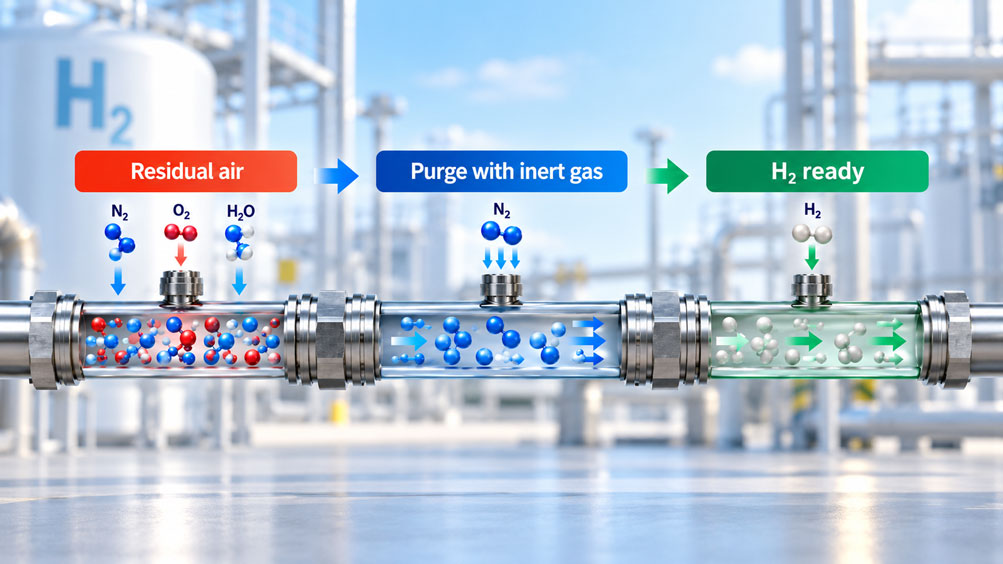
A newly installed measurement line initially contains air. This also applies if it has an internal diameter of only a few millimeters and covers only a short distance between the process connection and the pressure sensor.
If hydrogen is then introduced into this line, the hydrogen comes into contact with the oxygen still present in the air. This can temporarily create an ignitable gas mixture inside the line.
This is precisely why purging hydrogen-carrying measurement, impulse and instrument lines must be included in commissioning planning. It is not enough simply to purge the line. The purge path must be designed so that air can also be removed from valve chambers, tees, sensor connections and other areas with poor flow-through.
For gaseous hydrogen systems, a suitable inert gas is typically used for this purpose. In many applications, this is nitrogen. Different conditions apply to cryogenic hydrogen systems because nitrogen is not suitable at liquid-hydrogen temperatures.
Another important point is verification of successful purging. A specified purge time or a general number of gas-volume exchanges is not automatically sufficient for every line geometry. Dead spaces, branches and long stub lines in particular can be exchanged much more slowly than a straight, continuously flushed pipe.
Measurements should therefore be taken where residual air is most likely to remain or where the exiting gas actually represents the condition of the line being purged.
For commissioning a hydrogen system, H2Tools recommends as a best practice reducing the oxygen concentration to below 1% before introducing hydrogen. However, this value is not a universal substitute for project-specific approval criteria. Plant standards, operator requirements, manufacturer specifications and risk assessments may require stricter limits.
The pressure measurement technology itself must also be considered. A pressure sensor can indicate whether a line is pressurized. However, it cannot determine whether the line is sufficiently free of oxygen or foreign gases. A suitable analysis or gas-measurement method is required to verify the gas composition.
The key point is: A hydrogen measurement line is only ready for commissioning once the entire relevant line volume has been purged according to a defined procedure, the required residual gas composition has been verified at a suitable point and the leak-tightness of the system has been ensured.
Table of Contents
- Why must a hydrogen measurement line be purged?
- Why do small measurement lines require particular attention?
- Why should hydrogen and residual air not come into direct contact?
- What is the function of the inert gas?
- What basic purging methods are available?
- Why are dead spaces and stub lines critical?
- Where should the residual gas composition be checked?
- What oxygen concentration is permissible?
- Why is a fixed purge time alone insufficient?
- What role does pressure play?
- Why must the purge gas be discharged safely?
- Correctly distinguish leak testing from purging
- Why can the pressure sensor not verify purge quality?
- Consider hydrogen-compatible materials and sensors
- How can residual gas affect measurement dynamics?
- Transitioning from inert gas to hydrogen operation
- Why is this topic also relevant during maintenance?
- Correctly understanding ISO/TS 15916 and other standards
- Systematically diagnose typical faults
- Suitable hydrogen measurement technology from ICS Schneider
- Conclusion
- Frequently asked questions about purging hydrogen measurement lines
1. Why must a hydrogen measurement line be purged?
After installation or maintenance, an opened line normally contains ambient air.
This air contains oxygen, among other gases. If hydrogen is subsequently introduced without sufficiently displacing the air, areas with different mixing ratios are created during the gas exchange.
Some of these mixtures can be flammable.
The purpose of purging is therefore to remove the oxygen or air from the relevant system volume before the actual introduction of hydrogen.
ISO/TS 15916, published in 2026, describes purging accordingly as a procedure for removing unwanted substances and explicitly cites the removal of air before introducing hydrogen as an example for preventing a flammable mixture.
This principle is just as relevant to measurement lines as it is to larger pipelines or vessels.
2. Why do small measurement lines require particular attention?
A thin instrument line contains only a small gas volume. This can easily create the impression that its contents are insignificant during commissioning.
From both a measurement and safety perspective, however, the total volume is not the only decisive factor.
Measurement lines are often designed as stub lines. A pressure sensor, pressure gauge, valve manifold or differential-pressure transmitter may, for example, be installed at the end.
With such a configuration, there is not necessarily continuous flow through the complete line.
Gas can therefore remain longer in areas with poor flow-through.
Valve chambers, branches, short dead ends, pressure-gauge connections, sensor cavities and areas with changing cross-sections are particularly relevant.
The line must therefore be considered as an actual three-dimensional volume rather than simply by its length.
3. Why should hydrogen and residual air not come into direct contact?
Hydrogen has a wide flammability range in air and requires only a low ignition energy.
Unnecessary formation of a hydrogen-air mixture inside a plant should therefore be avoided.
During controlled commissioning, the air is first displaced using a suitable inert gas.
This creates a non-flammable or strongly oxygen-reduced atmosphere between the original air content and the hydrogen introduced later.
This principle also reduces dependence on how hydrogen and air actually mix within a complex line geometry.
The specific procedure must nevertheless be defined for the respective system.
4. What is the function of the inert gas?
The inert gas creates an intermediate atmosphere during commissioning.
It first displaces the air or reduces its oxygen content to the value specified for the system.
Only after this step is the inerted line transferred to the intended hydrogen operating condition.
Nitrogen is frequently used for gaseous hydrogen systems.
For cryogenic liquid-hydrogen systems, however, nitrogen is not generally suitable. H2Tools specifies helium for this purpose because nitrogen can solidify at liquid-hydrogen temperatures.
| Medium | Typical function | Important note |
|---|---|---|
| Nitrogen | Inerting gaseous hydrogen systems | Check suitability for temperature and system |
| Helium | Inert gas particularly for cryogenic H₂ systems | Consider different material properties and costs |
| Hydrogen | Subsequent process medium | Introduce only after approved inerting |
| Air | Possible initial condition after opening/installation | Remove in a controlled manner before H₂ commissioning |
The gas that may actually be used must be defined in the specific plant and operating procedure.
5. What basic purging methods are available?
Various basic methods are available for replacing air in hydrogen systems with an inert gas.
With flow-through purging, inert gas is introduced at one point and discharged in a controlled manner at another.
This method is particularly straightforward for simple line layouts.
For more complex volumes, pressure-cycle methods can also be used in which the contents are diluted step by step.
For certain systems, evacuation may also form part of an approved procedure.
| Principle | Basic concept | Particularly important |
|---|---|---|
| Flow-through purging | Inert gas displaces the existing gas along a defined flow path | Dead spaces and branches |
| Pressure cycling | Step-by-step dilution by controlled pressurization and depressurization | Pressure resistance and approved venting |
| Vacuum-assisted method | Residual gas is partially removed before inert-gas pressurization | Only for components and procedures suitable for this purpose |
The method used cannot be selected universally. Line geometry, components, pressure rating, plant standard and safety concept determine the appropriate procedure.
6. Why are dead spaces and stub lines critical?
With a straight line and clearly defined inlet and outlet, a relatively unambiguous purge path can be established.
However, a measurement installation often consists of more than just one straight pipe section.
A tee can, for example, lead to a pressure transmitter while the main gas flow passes by it.
Gas exchange in this stub line is then limited.
The same applies to closed valve pockets or line sections that are not flowed through during purging.
The statement “the main line has been sufficiently purged” therefore does not automatically mean that every connected measurement line has reached the same gas condition.
The plant concept should therefore already take into account during the design stage how instrument lines can be purged and, where necessary, analyzed.
7. Where should the residual gas composition be checked?
A gas sample is meaningful only if the sampling location actually represents the area being assessed.
An oxygen measurement directly at the inert-gas inlet, for example, mainly confirms the quality of the gas being supplied.
It does not necessarily indicate whether air is still present at the end of a long measurement line.
For a reliable assessment, a suitable analysis point at the relevant outlet or at a point representative of the least favorable part of the line is considerably more informative.
Complex systems may require several test points.
H2Tools also notes that systems should have sufficient analysis points where gas composition is used as an approval criterion.
8. What oxygen concentration is permissible?
There is no universal oxygen limit for every hydrogen system.
As a best practice, H2Tools recommends reducing the oxygen concentration to below 1% before recommissioning a hydrogen system.
This value is an important guideline but must not automatically be adopted as the release criterion for every plant.
Depending on the system, process, purity requirement and applicable regulations, lower limits may be required.
In fuel-cell systems, electrolyzers or high-purity test benches, not only explosion safety but also the required gas quality can be decisive.
The operational release criterion must therefore be defined before purging begins.
9. Why is a fixed purge time alone insufficient?
An instruction such as “purge with nitrogen for five minutes” initially specifies only a duration.
It does not automatically account for line length, free cross-section, dead volume, gas flow, branches or actual mixing behavior.
The specified time may be sufficient for a simple line but insufficient for another geometry.
Even a calculated number of volume exchanges should not be used in safety-relevant applications without taking the actual flow conditions into account.
The more robust strategy is to qualify the procedure for the specific system and verify the intended final condition where it is relevant.
This turns purging from a simple time-based operation into a controlled process.
10. What role does pressure play?
Measurement lines in hydrogen systems can operate from a few millibars up to several hundred bar.
However, the subsequent operating pressure must not be confused with the required pressure during the purging process.
The purging procedure must be compatible with all participating lines, valves, sensors and venting devices.
Uncontrolled depressurization of an instrument line under hydrogen pressure is particularly critical.
H2Tools documents an incident in which a pressure-transmitter line was still under significant hydrogen pressure and gas was suddenly released when a connection was loosened.
A fitting should therefore not be used as an improvised venting point.
Dedicated valve and venting paths should form part of the measurement-point design.
11. Why must the purge gas be discharged safely?
The gas displaced during purging does not simply disappear. It must be discharged to a designated safe location.
During the initial inerting process, the outlet initially contains mainly air and progressively more inert gas.
During the later transition to hydrogen operation, the discharged gas can also contain hydrogen.
The discharge path must therefore form part of the safety concept.
In enclosed spaces, it must also be taken into account that large quantities of nitrogen or other inert gases can reduce the oxygen concentration of the surrounding atmosphere.
Safe hydrogen purging must therefore not create a new asphyxiation hazard through the inert gas being used.
12. Correctly distinguish leak testing from purging
Leak testing and inerting perform different tasks.
Leak testing checks whether lines and connections safely contain the medium under the specified test conditions.
Purging, by contrast, changes the gas composition inside the system.
A leak-tight system can still be completely filled with air.
Conversely, a line may have been successfully purged and still have a leak.
Both conditions must therefore be assessed independently.
Depending on the plant concept, inert-gas systems may also be used for pressure or leak testing. However, this does not replace the respectively specified test procedure.
13. Why can the pressure sensor not verify purge quality?
A pressure transmitter measures pressure.
At the same temperature, a line section containing nitrogen, air or hydrogen can, for example, have the same pressure.
The displayed pressure therefore provides no information about which gas is actually present in the line.
A stable pressure indication also does not prove that the oxygen has been sufficiently removed.
A suitable analysis method must therefore be used to approve the gas composition.
Pressure measurement and gas analysis perform different tasks and should not be confused during commissioning planning.
14. Consider hydrogen-compatible materials and sensors
After successful purging, the measurement line is permanently exposed to hydrogen.
Material selection and sensor construction therefore become relevant.
Hydrogen can penetrate metallic materials and, depending on the material, pressure, temperature and loading, can influence their properties or long-term stability.
Hydrogen-contacting components therefore require suitable materials.
For numerous hydrogen applications, WIKA particularly refers to austenitic stainless steels such as 316L or 316Ti. Electronic pressure sensors may additionally use specially suitable materials for the sensing element.
The suitability of a standard pressure sensor should therefore not be assumed merely because its process connection is made of stainless steel.
Diaphragm, sensing element, welded joints and, where applicable, seals are also part of the wetted construction.
15. How can residual gas affect measurement dynamics?
Residual gas in a pressure measurement line is not only a safety or purity issue.
The geometry of the measurement line also influences dynamic pressure transmission.
Long, narrow lines, valves and dead volumes can attenuate or delay rapid pressure changes.
For fast test benches or fuel-cell systems, it must therefore be checked whether the selected instrumentation can actually transmit the required dynamics.
A completely purged measurement line does not automatically solve an unfavorable dynamic line geometry.
Conversely, an unusually slow pressure response should not automatically be interpreted as a sensor fault.
The measurement line, process connection and sensor together form the dynamic measurement chain.
16. Transitioning from inert gas to hydrogen operation
Once the required inerting condition has been verified, the line must be transferred to the actual operating condition in a controlled manner.
During this process, the existing inert gas is progressively replaced by hydrogen.
This transition must also take place through the designated gas path.
For applications with hydrogen-purity requirements, it may additionally be necessary to verify that the previously used inert gas has been sufficiently removed from the measurement or process system.
A line that is sufficiently inerted from a safety perspective is therefore not automatically already in the final process condition with regard to gas purity.
Explosion protection, process purity and measurement readiness are separate release criteria.
17. Why is this topic also relevant during maintenance?
During maintenance, the situation is reversed.
A measurement line that contains hydrogen during operation must not simply be regarded as safe to open merely because it has been depressurized.
Hydrogen may still remain in the line volume even after the pressure has been reduced.
Before any work involving the opening of a connection, the hydrogen-containing section must therefore be taken out of service and purged according to the specified procedure.
H2Tools explicitly recommends removing hydrogen from the system before maintenance work and confirming release using the specified procedure or suitable analysis.
Purgeability should therefore already be considered when designing the measurement point and not only when the first sensor replacement is required.
18. Correctly understanding ISO/TS 15916 and other standards
The current fundamental international publication covering general safety aspects of hydrogen systems is ISO/TS 15916:2026.
It covers fundamental properties, hazards and risk-reduction measures for gaseous and liquid hydrogen.
The previously used ISO/TR 15916:2015 has been withdrawn and replaced by ISO/TS 15916:2026.
Additional standards apply to specific applications.
ISO 19880-1:2020, for example, covers the design, installation, commissioning, operation and maintenance of gaseous hydrogen fueling stations.
Electrolyzers, fuel-cell systems, test benches and other installations may be subject to other product-specific standards and operator requirements.
A general technical article therefore cannot replace the project-specific safety assessment.
19. Systematically diagnose typical faults
| Observation | Possible cause | Recommended check |
|---|---|---|
| O₂ value at the main outlet is low, but the measurement line is still abnormal | Stub line or dead space not sufficiently purged | Check gas composition at a representative end point of the measurement line |
| Oxygen value decreases only very slowly | Dead volume, low exchange rate or complex line routing | Check purge path and valve positions according to the approved procedure |
| After switching to H₂, purity remains outside the specification | Residual inert gas in the line volume | Check gas quality at the designated analysis point |
| Pressure is stable, but O₂ release criterion has not been confirmed | Pressure measurement incorrectly treated as proof of purging | Perform suitable gas analysis |
| Measured value responds unusually slowly | Long measurement line, small internal diameter or throttling effect | Investigate the dynamics of the complete measurement line |
| Measured value drifts over the long term under H₂ | Hydrogen permeation or unsuitable sensor version | Check H₂ suitability of the sensor and operating conditions |
| Gas escapes when a fitting is loosened | Line not safely depressurized or purged | Stop work and apply the approved depressurization/purging procedure |
| Nitrogen is released into the working area | Unsuitable purge-gas routing | Evaluate venting and the risk of an oxygen-deficient atmosphere |
20. Suitable hydrogen measurement technology from ICS Schneider
ICS Schneider Messtechnik offers pressure sensors, transmitters, mechanical pressure instruments and other instrumentation for hydrogen applications. An overview can be found under H² Hydrogen Applications and H² Pressure Sensors.
20.1 Druck UNIK 5000H
The Druck UNIK 5000H has been optimized specifically for demanding hydrogen applications.
The series covers measuring ranges from 700 mbar to 700 bar and, depending on the version, achieves accuracy down to ±0.04% FS.
The wetted materials are designed for hydrogen applications. The construction uses, among other materials, 316L stainless steel and an optimized barrier to protect the sensing element against hydrogen permeation.
With a frequency response of up to 3.5 kHz, the sensor is also suitable for more dynamic pressure measurements, provided that the upstream measurement line does not already limit this dynamic response.
20.2 WIKA IS-3
The WIKA IS-3 is a pressure transmitter for hazardous areas with extensive ATEX, IECEx, FM and CSA approvals.
For hydrogen applications, the specific device version must be selected with regard to measuring range and wetted materials.
WIKA explicitly notes that hydrogen diffusion into sensor structures can lead to increased long-term drift and that temperature, hydrogen content and diaphragm geometry influence suitability.
20.3 Consider the measurement line and sensor as one complete system
The pressure range alone is not sufficient for selecting a hydrogen pressure sensor.
Relevant parameters include hydrogen purity, pressure, temperature, pressure cycling, required dynamic response, hazardous-area classification, process connection, materials and the design of the upstream instrument line.
With a long or highly restricted measurement line, even a very fast sensor cannot provide a correspondingly fast process measurement.
ICS Schneider therefore supports the selection of sensors and measurement-point concepts for test benches, electrolysis, fuel cells and other H₂ applications.
21. Conclusion
A hydrogen measurement line must not be treated as an insignificant small auxiliary volume during commissioning.
After installation or maintenance, it initially contains air and therefore oxygen.
If hydrogen is introduced directly, a flammable mixture can form inside the line during the gas exchange.
For this reason, a defined inerting process is carried out before hydrogen operation.
Nitrogen is frequently used for gaseous hydrogen systems. Different requirements may apply to cryogenic applications.
Dead spaces and stub lines are particularly important. A properly purged main line does not automatically prove that every instrument line has reached the same condition.
Likewise, a fixed purge time alone is not sufficient if the actual gas exchange has not been verified for the specific geometry.
The gas composition should therefore be checked at a representative point. H2Tools recommends reducing the oxygen concentration to below 1% before recommissioning, although project-specific requirements may specify stricter limits.
Pressure measurement and gas analysis must be clearly distinguished. A pressure sensor can confirm neither oxygen concentration nor hydrogen purity.
After inerting, leak-tightness, the controlled transition to hydrogen operation and, where applicable, the final gas purity must also be taken into account.
For reliable planning, the following sequence therefore applies:
Determine line geometry and dead spaces → define a suitable inert gas and approved purging procedure → provide safe inlet and outlet paths → fully account for measurement and valve volumes → check gas composition at a representative location → confirm the project-specific release criterion → transition to hydrogen operation in a controlled manner → verify gas purity again where necessary → check leak-tightness and measurement function → document the purging and release condition.
The most important practical principle is therefore: The duration of purging alone does not determine whether a hydrogen measurement line is ready for commissioning. What matters is the verified condition of the line volume that will actually be put into operation.
22. Frequently asked questions about purging hydrogen measurement lines
22.1 Why must hydrogen measurement lines be purged?
To remove air and particularly oxygen from the line before introducing hydrogen and thereby avoid unnecessarily creating a flammable hydrogen-air mixture inside the system.
22.2 Which gas is used for purging?
Nitrogen is frequently used as an inert gas for gaseous hydrogen systems. However, the actual permissible purge gas must be compatible with the plant, temperature and safety concept.
22.3 Can a measurement line be purged directly with hydrogen?
For certain small pipe systems, special procedures may allow this under defined conditions. However, this should not be assumed as a general procedure. The approved project-specific procedure is decisive.
22.4 Why are stub lines critical?
Because they often do not have continuous flow. Gas in a closed line end can therefore be exchanged much more slowly than gas in a continuously flushed main line.
22.5 Is it sufficient to purge only the main line?
No, if connected measurement or instrument lines are not included in the intended purge path. All relevant volumes must be taken into account.
22.6 Is a fixed purge time sufficient?
Not generally. The required purging depends on geometry, volume, flow path, dead spaces and the defined procedure.
22.7 What oxygen value should be reached before hydrogen operation?
As a best practice, H2Tools recommends reducing the oxygen concentration to below 1% O₂ before recommissioning. However, stricter limits may apply to the specific system.
22.8 Where should the oxygen concentration be measured?
At an analysis point that represents the line section being assessed. Complex systems may require several measurement points.
22.9 Can pressure indicate whether the line has been sufficiently purged?
No. Air, nitrogen and hydrogen can have the same pressure at the same temperature. A suitable analysis method is required to determine the gas composition.
22.10 Is a pressure test the same as purging?
No. Pressure or leak testing evaluates the integrity of the system. Purging changes and verifies the gas composition inside the system.
22.11 Why must the purge gas be discharged in a controlled manner?
Because, depending on the phase of the procedure, the exiting gas stream can contain air, inert gas and later also hydrogen. The discharge path must therefore be safely designed for the intended operating condition.
22.12 Is nitrogen harmless?
Nitrogen is non-flammable but can displace oxygen in enclosed areas. Purge-gas routing must therefore also take into account the risk of an oxygen-deficient atmosphere.
22.13 Must a line be purged again after maintenance?
If it has been opened and air has entered again, the purging and release procedure specified for recommissioning must be carried out again.
22.14 Why must hydrogen pressure sensors be selected specifically?
Hydrogen can affect materials through permeation and embrittlement. Sensor materials, measuring diaphragm and sensor construction must therefore be suitable for the respective operating conditions.
22.15 Which materials are typical for hydrogen pressure measurement?
Depending on the application, suitable austenitic stainless steels such as 316L or 316Ti are frequently used. However, suitability must be assessed for the complete wetted construction.
22.16 Is the UNIK 5000H designed for hydrogen?
Yes. The Druck UNIK 5000H was developed specifically for hydrogen applications and features hydrogen-compatible wetted materials as well as an optimized barrier against hydrogen permeation.
22.17 Can a long measurement line slow down pressure measurement?
Yes. Length, internal cross-section, valves, restrictions and dead volume can limit the dynamic transmission of rapid pressure changes.
22.18 Which current ISO publication covers fundamental hydrogen safety?
ISO/TS 15916:2026 covers fundamental safety aspects, properties, hazards and risk-reduction measures for hydrogen systems.
22.19 Does ISO 19880-1 apply to every hydrogen system?
No. ISO 19880-1:2020 specifically covers gaseous hydrogen fueling stations. Electrolyzers, fuel cells, test benches and other applications are additionally or alternatively subject to the applicable specific standards.
22.20 What information does ICS Schneider require when selecting a measurement point?
Useful information includes minimum and maximum operating pressure, hydrogen content or purity, temperature range, expected pressure cycling, required measurement dynamics, existing measurement line, process connection, material requirements, hazardous-area classification, output signal and information on whether the measurement point is used on a test bench, electrolyzer, fuel cell or another H₂ installation.