


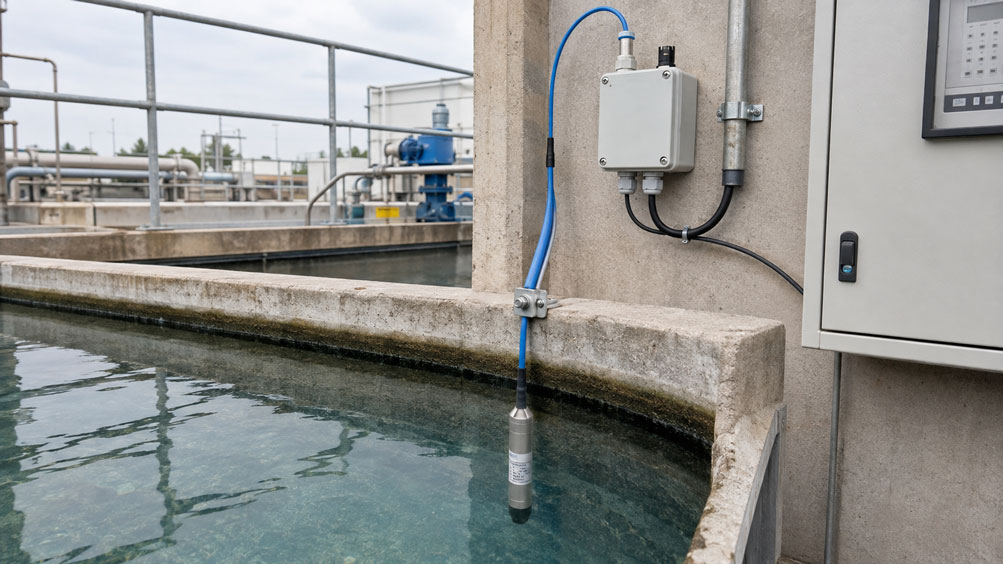
A hydrostatic submersible probe reliably measures the level of an open tank for months. After a change in weather, however, the measured value suddenly deviates significantly even though the actual liquid level has hardly changed.
One possible cause may not be the sensor element or measuring diaphragm, but rather the other end of the cable:
The vent capillary is damp, contaminated or blocked.
With a submersible probe using gauge pressure measurement, the sensor requires the current atmospheric pressure as a reference. For this purpose, a thin vent tube is integrated into the connection cable and connects the reference chamber of the pressure sensor to the surrounding atmosphere.
If this connection becomes blocked or moisture enters the capillary, atmospheric pressure can no longer be compensated correctly. Changes in atmospheric pressure then appear directly as apparent changes in level.
During installation, it is therefore not sufficient to protect only the probe immersed in the medium. The dry cable end and the vent opening are particularly important for permanently reliable measurement.
A suitable example is the WIKA LH-10 Level Probe. It is designed for hydrostatic level measurement and can be combined with a suitable terminal box and filter element to protect the vent capillary. Further solutions can be found under Level Measurement Technology and under Submersible Probes at ICS Schneider.
Table of Contents
- How a hydrostatic submersible probe measures level
- Why gauge pressure measurement requires an atmospheric reference
- Purpose of the vent capillary
- What happens when the vent is blocked?
- Calculation example: atmospheric pressure change becomes a level error
- Why moisture is particularly critical
- Installing the cable end correctly
- Filter element and vent membrane
- When desiccant can be useful
- Terminal box instead of an exposed cable end
- Why IP68 does not solve the problem
- Avoiding condensation in the terminal box
- Cable damage and capillary action
- Typical effects on the zero point
- Typical error patterns
- Systematically checking the vent
- Practical example on an open water tank
- Recommended installation setup
- Suitable submersible probes from ICS Schneider
- Conclusion
- FAQ
How a hydrostatic submersible probe measures level
A submersible probe is lowered into the liquid to a defined position.
The hydrostatic pressure of the liquid column above acts on the measuring diaphragm.
In simplified form:
p = ρ · g · h
Where:
p= hydrostatic pressure,ρ= density of the liquid,g= acceleration due to gravity,h= liquid height above the measuring diaphragm.
Example for water
A water column of approximately:
10.2 m
generates a hydrostatic pressure of approximately:
1 bar
The height of the liquid column can therefore be determined directly from the measured pressure.
Why gauge pressure measurement requires an atmospheric reference
In an open tank, atmospheric pressure also acts on the liquid surface.
The absolute pressure at the submersible probe is therefore:
pabs = patm + ρ · g · h
For level measurement, however, only:
ρ · g · h
is relevant.
Atmospheric pressure should not influence the displayed level.
For this purpose, the probe operates with gauge pressure
The reference chamber on the rear side of the sensor element is exposed to the current atmospheric pressure.
The sensor therefore measures:
pmeas = pabs − patm
and therefore:
pmeas = ρ · g · h
If the weather and therefore atmospheric pressure change, the reference pressure of the probe changes at the same time. With a functioning vent, the displayed level therefore remains largely unaffected.
Purpose of the vent capillary
In many submersible probes, the atmospheric reference is provided by a thin tube inside the connection cable.
This is referred to as:
Vent capillary
or:
Vent Tube
It runs from the reference chamber of the sensor through the entire cable to the dry cable end.
The capillary does not have to transport large quantities of air
It only needs to allow sufficient free pressure equalization.
The cable end must therefore not be exposed directly to moisture and dirt, but it must also not simply be hermetically sealed.
This is precisely what makes installation particularly important.
What happens when the vent is blocked?
If the capillary is completely sealed, a certain air pressure remains trapped in the reference chamber.
The sensor then no longer operates with the current atmospheric pressure.
In simplified form, it then measures
pmeas = ρ · g · h + patm current − pref trapped
As long as:
patm current = pref trapped
the reading may initially appear plausible.
If atmospheric pressure subsequently changes, however, an additional component is added to the measured value.
The result
The probe interprets an:
increase in atmospheric pressure
or:
decrease in atmospheric pressure
partly as a change in the liquid column.
The error can therefore be weather-dependent and drift over a period of hours or days.
Calculation example: atmospheric pressure change becomes a level error
A submersible probe measures water.
The vent capillary becomes blocked at an atmospheric pressure of:
1,000 hPa
Later, atmospheric pressure rises to:
1,020 hPa
The difference is:
20 hPa = 20 mbar = 2,000 Pa
The equivalent water column can be calculated approximately as:
h = Δp / (ρ · g)
with:
ρ ≈ 1,000 kg/m³
Therefore:
h ≈ 2,000 / (1,000 · 9.81)
and thus:
h ≈ 0.204 m
This means
Although the actual water level has not changed at all, a gauge-pressure probe with an impaired vent can theoretically show an error of approximately:
20 cm water column
due to this atmospheric pressure change.
Especially with small measuring ranges, an impaired atmospheric reference can therefore cause an error significantly greater than the actual accuracy specification of the sensor.
Why moisture is particularly critical
An open capillary is, by design, a connection between the environment and the sensor reference chamber.
With unsuitable installation, not only air but also moisture can therefore enter toward the sensor.
Possible sources include
- rainwater,
- splash water,
- high humidity,
- condensation,
- water inside the cable terminal box.
Within the thin reference tube, capillary effects can additionally promote moisture transport.
If water penetrates far enough into the tube, it can:
- impair pressure equalization,
- shift the zero point,
- cause corrosion,
- damage the sensor or electronics over the long term.
Condensation is particularly critical
The cable end may appear to be installed in a dry location and still absorb moisture if condensation forms inside an unsuitable enclosure due to temperature changes.
Installing the cable end correctly
The free cable end of a gauge-pressure submersible probe should generally:
- be located above possible flooding areas,
- be protected from rain and splash water,
- not terminate in a permanently damp shaft,
- be protected from dirt and dust,
- continue to allow atmospheric pressure equalization.
An unfavorable example is
allowing the cable end to hang loosely inside a pump shaft.
There:
- high humidity,
- splash water,
- condensation
can act directly on the vent opening.
Also incorrect
is supposedly protecting the capillary by completely sealing it with:
- silicone,
- potting compound,
- heat-shrink tubing,
- adhesive.
This would keep water out, but at the same time interrupt the required atmospheric reference.
Filter element and vent membrane
A technically suitable solution is a filter element at the end of the vent capillary.
The principle is
pressure equalization possible + liquid water and dirt retained
Hydrophobic membranes, for example, are used for this purpose.
They allow the required pressure equalization while making it more difficult for water to enter the reference tube.
Corresponding accessories are available for the WIKA LH-10
The filter element protects the vent capillary against:
- dirt,
- moisture.
For harsher installation conditions, a protected cable termination using a suitable terminal box is usually the better solution.
When desiccant can be useful
In environments with continuously high humidity, systems can additionally use desiccant.
The desiccant reduces the moisture content of the air in contact with the reference system.
However, it is important to note
Desiccant is a consumable or maintenance item.
Depending on the design, it must be:
- checked regularly,
- replaced,
- or regenerated.
Saturated desiccant does not provide permanent protection.
Pressure equalization must not be blocked here either
A desiccant container must be designed so that a connection to the atmosphere remains available.
It does not automatically replace a suitable:
vent membrane + protected connection environment
Terminal box instead of an exposed cable end
A particularly clean solution is to terminate the special cable of the submersible probe inside a terminal box designed for this purpose.
The terminal box performs two functions
It protects:
electrical connections + atmospheric reference
and allows the electrical measurement signal to be continued using a standard installation cable.
For WIKA level probes, for example, a terminal box with:
- IP67 protection,
- waterproof vent element
is available.
The terminal box itself should not be submerged
It is installed in a dry environment, outside the tank or shaft, or inside a control cabinet.
This ensures that the sensitive atmospheric reference is no longer exposed at an unprotected open cable end in the field.
Why IP68 does not solve the problem
A common misconception is:
Submersible probe IP68 → the entire system can get wet everywhere
This is not correct.
IP68 protection is required because:
- the probe is completely immersed in the medium,
- part of the special cable is permanently submerged.
The atmospheric reference, however, must intentionally communicate with the environment
The end of the vent capillary therefore cannot simply be treated like a completely hermetically sealed electrical connection.
The WIKA LH-10 level probe itself is designed for permanent measurements up to 300 m water column with IP68 protection.
However, this does not change the fact that the end of the vent system must remain dry and functional.
Avoiding condensation in the terminal box
A weather-protected terminal box can still become damp.
With changing temperatures, the air volume inside an enclosure changes.
Without suitable pressure equalization
moist outside air can be drawn into the enclosure through:
- cable glands,
- sealing points,
- small leaks.
If the air then cools down, water can condense.
A suitable vent membrane is therefore useful
It enables controlled pressure equalization without simply exposing the enclosure directly to the environment.
Particularly unfavorable connection points are:
- directly above warm process water,
- inside humid shafts,
- at locations with large day/night temperature fluctuations.
Cable damage and capillary action
Moisture can enter not only at the intended end of the vent capillary.
Mechanical damage to the special cable can also be problematic.
Typical causes include
- sharp tank edges,
- unsuitable cable clamps,
- crushing,
- excessively small bending radii,
- abrasion inside the shaft,
- chemically unsuitable cable material.
A damaged cable sheath can create an additional moisture path over time.
The cable should therefore be mechanically strain-relieved
A suitable cable strain relief clamp supports the weight of:
- the probe,
- the cable
and prevents the electrical or pressure-related cable entry from being permanently loaded as the mechanical suspension point.
Typical effects on the zero point
An impaired vent often first appears as a zero-point problem.
Typical behavior
The tank has a known level, but the probe suddenly indicates an offset of:
+15 cm
or:
-10 cm
.
After a few hours, the error changes again.
It is particularly suspicious
if the deviation:
- varies with weather changes,
- started after heavy rain,
- appears after work on the cable connection,
- drifts even though the actual level remains constant.
In this case, the atmospheric reference should be checked before recalibrating or replacing the sensor.
Typical error patterns
| Observation | Possible cause | Recommended check |
|---|---|---|
| Level changes with the weather | Vent capillary blocked | Check reference opening and filter |
| Measured value drifts after heavy rain | Moisture at the cable end | Check terminal box and vent |
| Zero point slowly shifts | Moisture inside the capillary | Check cable termination and sensor |
| Error started after rewiring | Capillary accidentally sealed | Check cable connection |
| Probe works in the laboratory but is unstable in the shaft | High humidity or condensation | Check installation location of the cable end |
| Measured value reacts slowly to atmospheric pressure changes | Vent tube partially blocked | Check filter or capillary |
| Deviation increases over time | Moisture ingress or cable damage | Inspect cable sheath and connection |
| Moisture inside the terminal box | Condensation or unsuitable pressure equalization | Check membrane, installation location and glands |
| Measured value remains offset after weather change | Reference chamber no longer at atmospheric pressure | Check vent system |
Systematically checking the vent
- Check the actual level: Compare with an independent reference where possible.
- Review the measured-value trend: Check for a correlation with weather, rain or temperature changes.
- Locate the cable end: Determine where the vent capillary terminates.
- Check the environment: The cable end must not be exposed to water, condensation or permanently high humidity.
- Inspect the filter: Check for contamination, damage or saturation with moisture.
- Open the terminal box: Check for condensation, corrosion or water.
- Check the cable glands: Verify mechanical sealing and correct installation.
- Inspect the cable sheath: Look for crushing, cuts and abrasion.
- Do not pierce the vent: Do not insert wires or tools into the fine capillary.
- Do not recalibrate the sensor too quickly: First eliminate the cause of the zero-point error.
- Monitor after repair: Observe the measured value over a sufficiently long period.
Practical example on an open water tank
An open rainwater tank has a hydrostatic submersible probe with:
measuring range 0 … 4 mH₂O
The 4…20 mA signal is evaluated by a PLC.
Original installation
The submersible probe is suspended correctly in the tank.
However, the special cable terminates loosely inside a side installation shaft.
After several months, the following behavior occurs:
- different level readings in the morning and evening,
- deviation during major weather changes,
- significantly larger errors in some cases after rain.
During inspection
moisture is found at the open cable end.
The submersible probe itself and its measuring diaphragm are mechanically undamaged.
Improved installation
The probe cable is routed outside the damp shaft into a suitable terminal box.
The box has:
- suitable ingress protection,
- a waterproof vent element,
- proper strain relief.
From there, the measuring signal is routed to the PLC using a standard installation cable.
This maintains atmospheric pressure equalization while protecting the sensitive open end of the vent capillary from direct moisture.
Recommended installation setup
For a conventional gauge-pressure submersible probe in an open tank, the following setup is appropriate:
submersible probe in the medium → special cable with vent capillary → cable strain relief → dry terminal box with vent membrane → standard signal cable → evaluation system
The following should apply in particular
- The probe is suspended freely at a defined height.
- The cable does not carry the complete weight uncontrollably through its cable entry.
- The cable end is located above possible flooding areas.
- The vent capillary remains open for atmospheric pressure equalization.
- A membrane or filter protects against moisture and dirt.
- The terminal box itself is installed in as dry an environment as possible.
- After the transition, the electrical signal can be continued using a standard installation cable.
Suitable submersible probes from ICS Schneider
WIKA LH-10 High-Performance Level Probe
The WIKA LH-10 is suitable for demanding hydrostatic level measurement applications.
ICS specifies, among other things:
- accuracy of 0.25%,
- IP68 protection,
- permanent level measurement up to 300 m water column,
- stainless-steel housing and PUR cable as standard,
- Hastelloy® and FEP cable as options,
- optional integrated temperature measurement.
Suitable accessories
The following are available for installation:
- cable strain relief clamp for mechanical load relief,
- terminal box with waterproof vent element,
- filter element to protect the vent capillary against dirt and moisture.
The terminal box and filter element are particularly important for the topic of this article.
WIKA LS-10 for standard applications
For simpler applications, the WIKA LS-10 is available.
It also operates according to the hydrostatic measuring principle and provides a standard:
4 … 20 mA
output signal.
Further submersible probes
Depending on the application, ICS Schneider also offers different versions for:
- small measuring ranges,
- HART communication,
- explosion protection,
- aggressive media,
- integrated temperature measurement.
An overview can be found under Submersible Probes at ICS Schneider.
Conclusion
For a submersible probe using gauge pressure measurement, the vent capillary is part of the measuring chain.
The sensor requires the current atmospheric pressure
Only in this way can the hydrostatic pressure of the liquid column be reliably determined from the total pressure acting on the sensor.
A blocked capillary creates an apparent level error
Changes in atmospheric pressure are then no longer compensated correctly.
Moisture is particularly critical
It can impair the vent and, over time, penetrate as far as the sensor or electronics.
The cable end should not remain exposed in the field
A suitable terminal box with controlled pressure equalization provides significantly better protection for the cable termination.
IP68 protection of the probe does not replace this protection
The sensor immersed in the medium must be watertight, while the atmospheric reference simultaneously requires functioning pressure equalization.
For practical applications
Select a submersible probe suitable for the measuring range → provide mechanical strain relief for the cable → route the cable end above moisture and flooding areas → never hermetically seal the vent capillary → use a filter or waterproof vent membrane → install the terminal box in a dry location → avoid condensation → inspect the cable for damage → in the event of weather-dependent zero-point errors, check the atmospheric reference first.
FAQ: Protecting the Vent of Gauge-Pressure Submersible Probes
Why does a submersible probe have a vent tube?
A gauge-pressure submersible probe requires atmospheric pressure as its reference. The vent capillary transfers this pressure through the connection cable to the sensor reference chamber.
What happens if the vent capillary becomes blocked?
The sensor can no longer correctly compensate for the current atmospheric pressure. Weather-related pressure changes can therefore be displayed as apparent changes in level.
Can an atmospheric pressure change cause a large measurement error?
Yes. For water, a pressure difference of 20 mbar corresponds to approximately 20 cm of water column. This is already a significant deviation for small measuring ranges.
Can I seal the vent capillary?
No. A gauge-pressure probe requires atmospheric pressure equalization. Hermetically sealing the capillary can cause a systematic measurement error.
How do I protect the capillary from water?
Suitable solutions include purpose-designed filter elements or air-permeable, water-impermeable membranes.
Can the cable end of a submersible probe get wet?
The end of the atmospheric reference should be installed in a dry location and protected from direct water. It should not terminate freely inside a wet shaft or flooding area.
Why is the probe IP68 if the cable end must remain dry?
IP68 protects the submerged probe. The atmospheric reference, however, is intentionally designed for pressure equalization with the environment and therefore requires a suitably protected cable termination.
Can condensation cause an error?
Yes. Condensation inside the terminal box or at the vent opening can enter the reference tube and impair pressure equalization.
Is a waterproof terminal box sufficient?
It must also provide suitable pressure equalization. For gauge-pressure submersible probes, terminal boxes with an air-permeable and water-impermeable vent element are therefore particularly suitable.
Can I route the vent into a normal control cabinet?
Yes, provided a dry and suitable environment is available there and atmospheric pressure equalization remains possible.
Is desiccant necessary?
Not necessarily. In particularly humid environments, a suitable desiccant system can provide additional protection. However, it must be checked regularly and must not prevent pressure equalization.
Can a damaged submersible probe cable absorb moisture?
Yes. Damage to the cable sheath can create additional paths for moisture. The cable should therefore be mechanically protected and routed without unnecessary stress.
Why should a cable strain relief clamp be used?
It absorbs mechanical tensile forces and prevents the cable entry and probe from being unnecessarily loaded by the weight of the cable.
Why does my submersible probe drift only when the weather changes?
This is a typical indication of an impaired atmospheric reference. The filter, vent capillary and cable termination should be checked.
Should I recalibrate immediately if there is a zero-point error?
No. First determine whether the vent, moisture, installation or another external cause is responsible for the error.
Which WIKA submersible probe is suitable for demanding applications?
The WIKA LH-10 is designed for demanding hydrostatic level measurement applications.
How accurate is the WIKA LH-10?
ICS specifies an accuracy of 0.25%.
How deep can the WIKA LH-10 be used?
With IP68 protection, the probe is designed for permanent level measurement up to 300 m water column.
Are accessories available to protect the vent?
Yes. For corresponding WIKA level probes, a terminal box with a waterproof vent element and a filter element to protect the capillary against dirt and moisture are available.
Where can I find further submersible probes?
An overview can be found under Submersible Probes at ICS Schneider.