


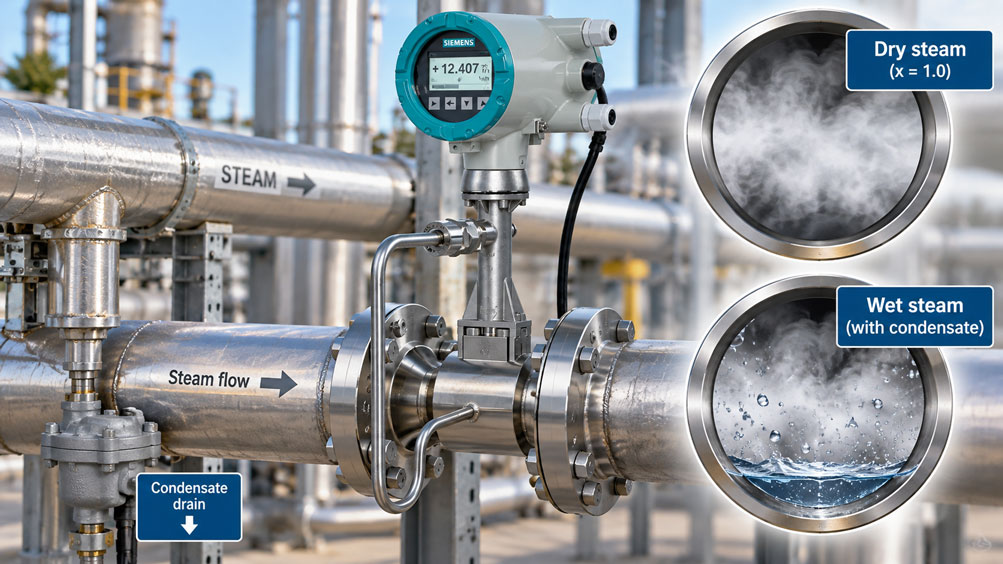
A vortex flowmeter appears to operate reliably in a steam line for months. Pressure and temperature are within the expected range, the indication is stable and the calculated mass flow appears plausible. Nevertheless, the energy balance does not match the actual consumption. The differences become particularly noticeable after extended periods of partial load, during morning start-up or on cold days.
One possible cause is not the flowmeter itself, but the condition of the steam. Instead of dry saturated steam, wet steam may temporarily be flowing through the pipe. In addition to the gaseous steam phase, liquid condensate is then present in the pipe. A comparatively well-defined single-phase steam measurement thus becomes a two-phase flow.
This distinction is important for the vortex measurement principle. The instrument generates a Kármán vortex street behind a bluff body and determines the flow velocity or volumetric flow from the vortex shedding frequency. Condensate droplets, liquid films on the pipe wall or larger quantities of condensate, however, change the actual flow conditions.
At the same time, pressure and temperature compensation alone is not automatically sufficient for wet steam. Pressure and temperature can describe a saturated-steam condition, but in a two-phase mixture they do not necessarily indicate what proportion of the mass is actually present as steam and what proportion is liquid water.
The most important rule is therefore: In vortex steam measurement, steam condition and steam quality must be considered just as carefully as pressure, temperature, inlet run and measuring range. Condensate is not merely a mechanical side issue; it can directly affect flow and energy balances.
How does vortex flow measurement work with steam?
A bluff body is located inside the measuring tube of a vortex flowmeter. As steam flows past this body, vortices are alternately shed behind it. Above a sufficiently high Reynolds number, there is a defined relationship between the vortex shedding frequency and the average flow velocity.
In simplified form:
f ∝ v
Here, f is the vortex shedding frequency and v the average flow velocity.
The calibrated K-factor of the instrument is used to calculate the volumetric flow. If a mass flow is subsequently to be output, the density of the steam must also be known:
ṁ = ρ × QV
For steam applications, correct determination of the density is therefore essential. With dry saturated steam, it can be derived from the saturation condition. With superheated steam, pressure and temperature are normally required.
The vortex sensor itself therefore does not initially measure “kilograms of steam” directly. Its primary signal is generated by the flow in the measuring tube. Correct interpretation as a mass or energy flow requires the actual medium condition to match the model stored in the instrument.
What is wet steam?
Wet steam is not simply an unusually humid gas in the conventional sense, but a two-phase mixture of saturated water vapour and liquid water. Both phases are present simultaneously.
The condensate can be transported in different forms. Depending on flow velocity, pipe diameter and liquid fraction, this may include fine droplets, a liquid film on the pipe wall, wavy structures or larger quantities of condensate at the bottom of the pipe.
This distinction is particularly relevant to flow measurement. The steam phase often flows considerably faster than the much denser liquid condensate. The measuring instrument therefore sees neither a homogeneous liquid with one single velocity nor ideally dry steam.
Even a relatively small condensate mass can occupy only a very small volume because liquid water is much denser than steam. A pipe that appears visually to be almost completely filled with steam can therefore still carry a relevant condensate mass.
What do steam quality and dryness fraction mean?
Steam quality – also commonly referred to as dryness fraction – describes the mass fraction of the gaseous steam phase in the total wet-steam flow.
In simplified form:
x = msteam / (msteam + mcondensate)
A dryness fraction of:
x = 0.95
therefore means that 95% of the total mass is present as steam and 5% as liquid condensate.
| Steam condition | Dryness fraction x | Practical meaning |
|---|---|---|
| Dry saturated steam | approximately 1.00 | No relevant liquid phase in the steam flow under consideration |
| Slightly wet steam | e.g. 0.98 | A small condensate mass is present; already relevant for demanding balances |
| Wet steam | e.g. 0.90 | 10% of the total mass is present as liquid |
| Very wet steam | significantly below 1 | Two-phase effects become increasingly dominant; check the measuring point and steam system |
Important: A dryness fraction of 90% does not mean that 10% of the pipe cross-section is filled with water. The value refers to mass. Due to the large difference in density, the volumetric liquid fraction can be much smaller.
Why condensate affects vortex measurement
A conventional vortex flowmeter is particularly well suited to single-phase flows. With wet steam, however, the flow consists of a rapidly moving gas phase and a much denser liquid phase.
The condensate phase can affect the measurement in various ways. Liquid droplets and films alter the flow distribution within the measuring tube. Larger quantities of condensate can interfere with the formation or detection of the vortex street. Condensate accumulation inside the meter changes the free cross-sectional area and can produce an unstable measuring signal.
There is also the mass balance to consider. A conventional vortex instrument determines the volumetric flow primarily from the flowing main phase. If a density based on the assumption of dry saturated steam is then assigned, the additional liquid mass being carried along is not automatically accounted for correctly.
Depending on the instrument, algorithm and actual two-phase flow pattern, the resulting deviation can vary. A general correction such as “5% condensate = 5% measurement error” should therefore not be assumed for wet steam.
What matters instead is whether the measurement system explicitly takes wet steam or a known dryness fraction into account, or whether it has been designed and parameterised for dry saturated steam.
Why pressure and temperature do not fully describe wet steam
With dry saturated steam, pressure and saturation temperature have a unique relationship. The thermodynamic saturation condition can be determined from either one of these values.
With superheated steam, the temperature lies above the saturation temperature corresponding to the respective pressure. If pressure and temperature are measured, the condition can be calculated accordingly.
With wet steam, the situation is more complex. Steam and condensate in thermodynamic equilibrium are also located on the saturation line. A steam flow with a dryness fraction of 0.90 can therefore have practically the same saturation temperature and pressure as dry saturated steam with x ≈ 1.
Pressure and temperature alone cannot then determine whether an additional 1%, 5% or 10% of the mass is present as liquid.
This is one of the most important points in wet-steam measurement:
A plausible combination of saturated-steam pressure and saturation temperature does not automatically prove that the steam is dry.
Conversely, a temperature significantly above the saturation temperature indicates superheated steam. A temperature below the saturation condition expected for the measured pressure should likewise prompt a check of measuring-point position, heat losses and liquid fractions.
Distinguishing pressure, temperature and steam-quality compensation
Modern vortex instruments often combine several types of compensation, but technically these perform different tasks.
| Function | What is corrected? | What is not automatically detected? |
|---|---|---|
| Temperature compensation for saturated steam | Density or state variables corresponding to saturation temperature | Unknown, changing condensate fraction |
| Pressure and temperature compensation | Density of gases or superheated steam based on real process values | Steam quality of a two-phase mixture without an additional model |
| Fixed Dryness Factor | The calculation is corrected using a predefined dryness fraction | Steam quality changing during operation is not measured automatically |
| Dedicated wet-steam measurement | Additionally determines or evaluates steam quality | Still remains subject to the specified instrument and process range |
This distinction prevents a common misunderstanding: An instrument with an integrated temperature and pressure sensor is not automatically an online steam-quality measuring system.
Pressure and temperature compensation significantly improves mass-flow calculation if the actual steam condition matches the stored model. An unknown and variable condensate fraction, however, is an additional process variable.
Choose the installation point so that condensate cannot accumulate
The pipe geometry helps determine whether condensate is drained in a controlled manner or accumulates directly at the measuring point.
A low point in the steam line where condensate can remain is particularly unfavourable. A vortex flowmeter should not unintentionally become a condensate collection point.
Siemens explicitly points out for SITRANS FX instruments that installation in a lower pipe bend is problematic for steam and gas measurements. There is a risk of condensate formation or accumulation. In addition to inaccurate measurements, considerable mechanical loads can also occur under unfavourable conditions.
The specific installation must therefore always follow the manufacturer’s instructions for the respective instrument version. Particular attention should be paid to installation position, pipe slope, condensate drainage and the location of control valves.
Even a generally suitable installation point can become problematic if it is located directly downstream of a poorly functioning steam trap, a long uninsulated pipe section or a strong pressure reduction.
Drainage and steam conditioning upstream of the measuring point
Good wet-steam diagnostics often begin not at the flowmeter, but in the steam network itself.
Condensate inevitably forms when steam loses heat to the surroundings or to the process. A correctly designed steam distribution system must therefore remove this condensate in a controlled manner.
Depending on the system, relevant components may include:
- correctly sized condensate collection points or drain pockets,
- properly functioning steam traps,
- suitable pipe slopes,
- steam separators upstream of sensitive consumers or measuring points,
- adequate pipe insulation,
- controlled warm-up and start-up procedures.
A flowmeter should not be expected to compensate metrologically for a poorly drained steam network.
If larger amounts of condensate are regularly transported through the sensor, not only the parameterisation of the vortex instrument should be checked. The upstream steam infrastructure must also be investigated.
Consider heat losses and pipe insulation
The more heat a steam line loses to its surroundings, the more steam can condense. Poor or damaged insulation therefore not only increases energy costs but also changes the medium condition along the pipe.
Between the boiler house and the consumer, steam that was originally generated with high quality can become increasingly wet as a result of heat losses.
The pipe insulation upstream and downstream of the flowmeter should therefore be in good condition. At the same time, the instrument’s insulation limits must be observed. Electronic housings and designated cooling or neck sections must not simply be fully insulated if the manufacturer does not permit this.
A local thermal bridge directly upstream of the measuring point can also be relevant. An uninsulated flange, valve or larger metallic support can remove heat from the steam and locally increase condensate formation.
Evaluate start-up operation separately
When a cold steam line is started, considerably more condensate is often produced than during steady-state operation. The entire pipe must first be heated. Part of the supplied steam energy is therefore used not for the consumer but to heat the pipe, valves and insulation.
During this phase, the steam condition at the measuring point can differ considerably from the later steady-state condition.
The vortex indication may be less stable in this situation while larger quantities of condensate are simultaneously discharged through the drainage system. Depending on the plant concept, it should therefore be defined whether the start-up phase is to be included in consumption or energy accounting at all.
It is particularly problematic to permanently “correct” a deviation occurring during start-up by changing the K-factor or scaling. This would impair the actual measurement during stable operation.
Recognising typical indications of wet steam
Wet steam cannot be diagnosed reliably from a single symptom alone. However, several observations together can provide a strong indication.
| Observation | Possible cause | Sensible check |
|---|---|---|
| Measured value becomes unstable after extended partial-load operation | Increasing condensate formation | Check drainage, insulation and operating condition |
| Deviation occurs particularly during morning start-up | Large quantity of condensate in a cold pipe | Evaluate start-up separately from steady-state operation |
| Measurement problem at a low point in the pipe | Condensate accumulates around the sensor | Check installation position and pipe slope |
| Steam energy does not match process heat | Steam quality or incorrect state assumption may be involved | Check mass flow, pressure, temperature and condensate together |
| Loud noises or impacts in the steam network | Condensate accumulation or water hammer may be present | Check the system from a safety perspective and inspect drainage |
| Pressure and temperature lie on the saturation line, but the balance is still incorrect | Wet steam may be present despite plausible saturated-steam values | Do not derive steam quality from p/T alone |
Comparing different operating conditions is particularly helpful. If the problems occur exclusively at low load, in cold weather or after extended shutdowns, a process-related condensate cause is often more plausible than a permanent electronic instrument fault.
Effects on mass and energy measurement
Steam quality is already relevant for pure volumetric flow measurement because the two phases have different flow velocities and densities.
For mass-flow measurement, there is the additional question of which mass is actually detected by the measuring system or calculated from the volumetric signal.
For energy accounting, the situation becomes even more demanding. Liquid condensate has a different specific enthalpy from dry saturated steam. If a wet-steam flow is treated simply as dry saturated steam, not only the quantity calculation but also the specific energy used in the calculation may be incorrect.
The actual enthalpy of a wet-steam condition can be approximated as a combination of the liquid and steam fractions:
h = hf + x × (hg - hf)
Here, x denotes the dryness fraction, hf the enthalpy of the saturated liquid and hg the enthalpy of dry saturated steam.
The further the dryness fraction deviates from 1, the more important this distinction becomes for a reliable energy or efficiency balance.
The direction and magnitude of the total error of a particular flow and energy measurement system should not, however, be predicted in general terms. It depends on how the specific instrument detects the steam phase and which correction models or process values are included in the calculation.
Correctly interpreting the Dryness Factor on the SITRANS FX330
For saturated-steam applications, the SITRANS FX330 provides a configurable Dryness Factor. The intended adjustment range is 0.85 to 1.0.
This allows a known steam quality to be included in the calculation. The key word, however, is known.
If, for example, a verified process design consistently assumes a dryness fraction of 0.97, the corresponding factor can be entered. If the actual steam condition later changes to 0.90, however, this fixed value no longer matches the real process.
The configured Dryness Factor must therefore not be confused with continuous online measurement of the current dryness fraction.
For applications with strongly varying steam quality, it must be evaluated whether dedicated wet-steam measurement, additional process diagnostics or improvement of the steam conditioning system is the more appropriate solution.
Practical example from a steam network
A production facility measures the steam consumption of a process line using a vortex flowmeter. During normal operation, the network runs at an almost constant saturated-steam pressure. The mass flow appears plausible and remains stable for several hours.
After extended production breaks, however, the instrument shows considerably more fluctuating values during the first 20 minutes. At the same time, a high condensate flow is observed at the steam trap upstream of the consumer.
An inspection reveals that a longer section of pipe is only partially insulated. During the shutdown period, it cools down considerably. When the system is restarted, a relevant proportion of the supplied steam initially condenses there.
Pressure and temperature at the vortex measuring point nevertheless remain close to the expected saturation condition. From these values alone, it would therefore not have been possible to determine how large the liquid fraction actually was during the start-up phase.
After improving the pipe insulation and checking the drainage system, the start-up phase becomes significantly shorter and the vortex signal stabilises more quickly.
The example demonstrates an important principle: a recurring wet-steam effect should not first be “repaired” by changing the instrument scaling. The cause is often the condition of the steam network.
Systematic test procedure
If wet steam or condensate influence is suspected, a structured inspection of the complete measuring point is recommended.
- Check the steam type: Is the application intended to measure dry saturated steam, superheated steam or deliberately wet steam?
- Record pressure and temperature: Evaluate process values as close as possible to the flow measuring point.
- Compare the saturation condition: Check whether temperature and pressure are generally consistent with the assumed steam condition.
- Consider steam quality separately: Do not automatically infer dry steam from a matching saturation temperature.
- Check the installation position: Avoid low points and potential condensate collection points.
- Check pipe slope: Condensate must be able to reach the intended drainage points in a controlled manner.
- Check steam traps: Verify function, sizing and operating condition.
- Assess the insulation: Identify damaged or missing insulation upstream of the measuring point.
- Separate start-up and steady-state operation: Check whether deviations occur only during thermal transitions.
- Check inlet runs: Consider bends, valves and pressure reductions in accordance with manufacturer requirements.
- Check minimum flow: During partial load, ensure that a stable vortex signal can be generated.
- Check instrument parameterisation: Verify steam type, unit, pressure, temperature and, where applicable, Dryness Factor settings.
- Evaluate the signal trend: Compare fluctuations with condensate drainage, load and weather conditions.
- Compare the balance: Assess flow, condensate return and process energy together for plausibility.
A trend recording of flow, pressure and temperature together with operating conditions is particularly useful. This makes it possible to determine whether the deviation is linked to a specific load range, a start-up phase or the outside temperature.
Common misinterpretations
Equating saturated steam with dry saturated steam
A two-phase mixture of steam and condensate is also located on the saturation line. Matching pressure and temperature values therefore do not automatically guarantee a dryness fraction of 1.
Treating pressure and temperature compensation as wet-steam measurement
Correct density calculation from pressure and temperature does not automatically replace determination of the liquid fraction.
Interpreting a fixed Dryness Factor as online steam-quality measurement
A stored dryness factor describes an assumed or known condition. If the steam quality changes, this change must be considered separately.
Treating condensate merely as a minor measurement issue
Larger quantities of condensate can affect not only the measured value but also cause water hammer and high mechanical loads within the steam network.
Installing the measuring instrument at a low point in the pipe
Condensate can accumulate there. The installation point must be selected so that the measuring point does not become a condensate sump.
Changing the K-factor immediately after detecting a deviation
The factory K-factor describes the geometry and calibration of the vortex sensor. A condensate problem should not be compensated by arbitrarily changing this calibration basis.
Comparing start-up values with steady-state consumption
When a cold steam line is heated, more condensate is typically generated. The start-up phase can therefore involve significantly different measuring conditions.
Looking only at the vortex sensor
In steam applications, the pipeline, drainage, insulation, steam traps, pressure control and measuring instrument together form the complete measuring point.
Suitable vortex measurement technology at ICS Schneider
ICS Schneider Messtechnik offers vortex flowmeters for steam, gas and liquid applications as well as additional flow solutions for process and energy systems.
The Siemens SITRANS FX330 is a digital vortex flowmeter for steam, gases and liquids. The instrument is equipped as standard with an integrated temperature sensor; an integrated pressure sensor is optionally available. Depending on the configuration, this allows not only volumetric flow but also mass flow, density and heat energy to be determined.
For saturated-steam applications, the FX330 provides suitable temperature compensation. A Dryness Factor can additionally be configured. For applications with changing wet-steam quality, however, it must be checked whether a fixed dryness fraction adequately represents the actual measurement task.
The SITRANS FX300 is also designed for steam, gas and liquid applications and is used, among other things, for saturated and superheated steam.
For correct instrument selection, in addition to nominal pipe size and maximum flow, the minimum flow, steam pressure, temperature, steam condition, required measured variable and installation conditions are particularly important.
Coriolis and vortex flowmeters at ICS Schneider
Further reading: Installing vortex flowmeters correctly
Further reading: Measuring steam flow – why pressure and temperature compensation are important
Conclusion
Vortex flowmeters are very well suited to numerous industrial steam applications. Reliable values, however, require a steam condition that matches the parameterisation and the intended measuring principle.
Wet steam is not a purely saturated-steam flow, but a two-phase mixture of steam and condensate. The liquid fraction has different density, flow and energy properties and can therefore affect both the vortex signal and the downstream mass and energy calculations.
It is particularly important to distinguish between saturation condition and steam quality. Pressure and temperature can indicate that the medium is on or close to the saturation line. However, this does not automatically mean that the dryness fraction is 100%.
Integrated pressure and temperature compensation significantly improves state calculation, but it does not necessarily replace evaluation of a changing condensate fraction. A configured Dryness Factor can account for a known condition, but it must be distinguished from continuous steam-quality measurement.
When measured values appear unusual, anyone who considers installation position, condensate drainage, pipe slope, insulation, start-up condition, steam quality and instrument parameterisation together can distinguish much more effectively between an actual flowmeter fault and a change in the medium condition.
FAQ on vortex flow measurement with wet steam
Can a vortex flowmeter measure wet steam?
This depends on the specific instrument, application and required accuracy. Conventional vortex flowmeters are primarily designed for defined single-phase flows. With wet steam, the influence of the liquid phase must be explicitly considered.
What is wet steam?
Wet steam is a two-phase mixture of saturated water vapour and liquid condensate.
What does a dryness fraction of 95% mean?
It means that 95% of the total mass is present as steam and 5% as liquid water.
Does a dryness fraction of 95% mean that 5% of the pipe volume is filled with water?
No. The dryness fraction is a mass ratio. Because of the large difference in density between water and steam, the volumetric liquid fraction can be much smaller.
Can I detect wet steam from pressure and temperature alone?
Not reliably in terms of dryness fraction. Wet steam can exist at the same saturation pressure and saturation temperature as dry saturated steam. Pressure and temperature alone therefore do not automatically determine the liquid fraction.
Why does condensate interfere with vortex measurement?
The liquid phase changes the flow inside the measuring tube. Droplets, wall films or condensate accumulation can affect vortex formation or signal detection and can also alter the mass balance.
Can condensate cause the indicated value to be too low?
This is possible, particularly if the additional condensate mass is not adequately taken into account by a measurement and calculation model designed for dry steam. The actual magnitude of the error depends on the instrument and flow condition.
Can condensate also cause fluctuating measured values?
Yes. A changing two-phase flow or condensate accumulation can lead to an unstable vortex signal and poorly reproducible measuring conditions.
What is the Dryness Factor?
It describes the proportion of the steam phase in the total mass of a wet-steam condition. A value of 1 corresponds approximately to dry saturated steam.
Can the SITRANS FX330 take a Dryness Factor into account?
Yes. A configurable Dryness Factor is available for saturated-steam applications. It represents a stored dryness fraction and must be distinguished from continuous online measurement of changing steam quality.
Is pressure and temperature compensation the same as steam-quality measurement?
No. Pressure and temperature enable more accurate state and density calculation. An unknown condensate fraction is an additional process variable.
Where should a vortex flowmeter not be installed for steam measurement?
Installation at points where condensate can accumulate is problematic. In particular, low pipe bends or condensate collection points should be avoided in accordance with the manufacturer’s instructions.
Why is a steam trap upstream of or near the measuring point important?
Effective drainage prevents larger quantities of condensate from being transported uncontrollably through the steam line and measuring point.
Can poor pipe insulation affect the measurement?
Yes. Additional heat losses create additional condensate and can therefore change the steam condition at the measuring point.
Why do wet-steam problems often occur during start-up?
The initially cold pipe removes a large amount of heat from the incoming steam. Considerably more condensate is therefore generated during the warm-up phase than during steady-state operation.
Should I simply change the K-factor of the vortex instrument when wet steam is present?
No. The K-factor is part of the instrument’s calibration and geometry. A changed process condition should not be compensated by arbitrarily altering the instrument calibration.
Which data is required for sizing a vortex steam measuring point?
Required information includes minimum, normal and maximum flow, steam pressure, temperature, nominal pipe size, steam condition, expected steam quality, installation position, available inlet runs, drainage, required output variable and, where applicable, Ex requirements.
Which Siemens instrument is suitable for industrial steam measurement?
The SITRANS FX330 is designed for steam, gas and liquid measurement and provides integrated temperature measurement as well as optional pressure measurement and heat calculation. The specific version must be selected to match the respective steam and process application.