


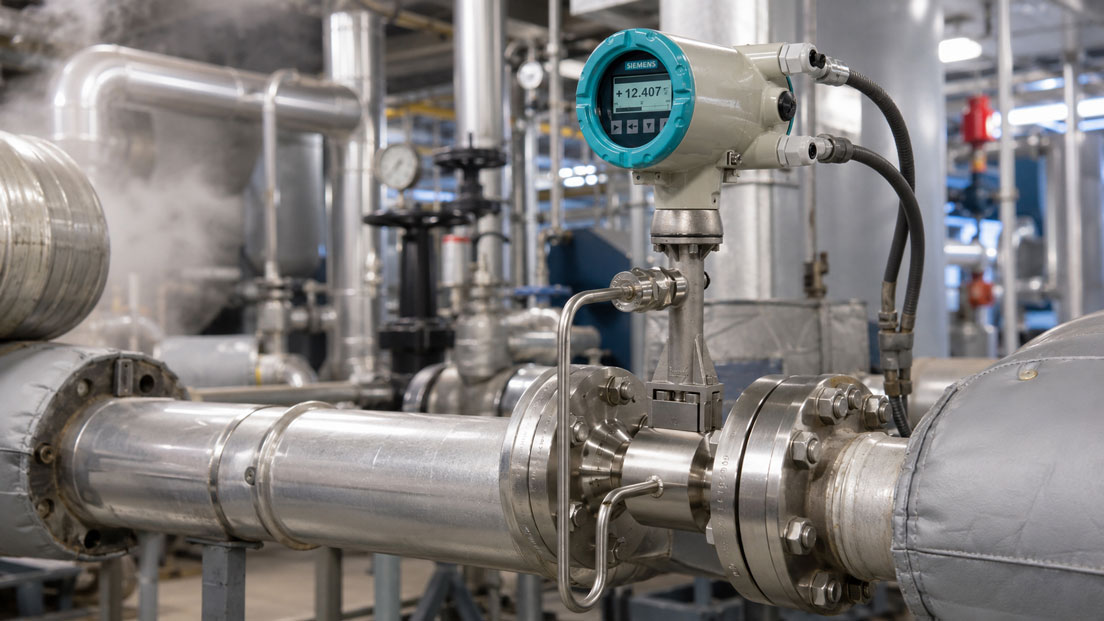
Steam is one of the most important energy carriers in many industrial plants. It is used for process heat supply, sterilization, cleaning, drying, heating, humidification, drive energy or as a heat transfer medium in production processes. Whether in the boiler house, steam distribution system, at consumers or in energy monitoring systems: anyone measuring steam flow usually does not only want to know that steam is flowing, but also how much energy is actually being transported and consumed.
This is exactly where the challenge lies. Steam is compressible, its density changes with pressure and temperature, and depending on its condition it may be saturated steam or superheated steam. A pure volumetric flow value is therefore often not sufficient to reliably assess the actual mass flow or energy consumption. Without pressure and temperature compensation, measured values can deviate significantly from the real process situation.
This article explains why pressure and temperature compensation are so important in steam flow measurement, what role vortex flow meters play and what should be considered when planning the measuring point. The focus is on saturated steam, superheated steam, volumetric flow, mass flow, density, energy consumption, boiler house, steam distribution, process heat, installation, insulation, signal processing and suitable measuring instruments such as the SITRANS FX300.
Table of contents
- Basics: why steam flow is more demanding than liquid flow
- Volumetric flow or mass flow: which variable is decisive for steam?
- Saturated steam: pressure and temperature are directly linked
- Superheated steam: why pressure and temperature are required separately
- Pressure and temperature compensation: what happens in the measuring system?
- Vortex flow meters for steam: operating principle and advantages
- Measuring point planning: installation location, pipe run and process conditions
- Steam as an energy variable: assessing consumption, distribution and efficiency
- Output signal, PLC connection and measured value testing
- Typical errors in steam flow measurement
- Practical example: steam measurement upstream of a process consumer
- Which measuring instruments / products are suitable?
- Conclusion: steam flow can only be interpreted correctly with state evaluation
- FAQ: frequently asked questions about steam flow measurement
Basics: why steam flow is more demanding than liquid flow
For many liquids, flow measurement is comparatively easy to interpret. A volumetric flow of, for example, 10 m³/h of water remains easy to understand in practical operation because the density of water fluctuates only to a limited extent in many applications. With steam, this is different. Steam is a gaseous medium whose density depends strongly on pressure and temperature. The same volumetric flow can therefore represent a very different mass and thus a different amount of energy depending on the operating condition.
A flow meter in a steam line first detects a flow variable in a specific pipeline. For evaluating the plant, however, the mass flow is often of interest, meaning how many kilograms of steam per hour are being transported. The energy content can be even more important when steam consumption is compared, consumers are balanced or efficiency measures are assessed.
Without compensation, fixed density assumptions are often used. This may be sufficient under stable and known operating conditions, but it becomes problematic when pressure or temperature fluctuate. In real plants, boiler pressure, network load, pressure reducing stations, consumer operation, start-up conditions and heat losses change. This also changes the steam condition at the measuring point.
A meaningful steam flow measurement must therefore consider more than just flow velocity or volumetric flow. It must include the condition of the medium. Pressure and temperature compensation ensure that the measured flow can be converted into a more meaningful mass flow or energy-related value.
| Influencing variable | Why important for steam? | Possible consequence without evaluation |
|---|---|---|
| Pressure | Strongly influences steam density | Volumetric flow is incorrectly converted into mass flow. |
| Temperature | Indicates the thermal condition of the steam | Saturated steam and superheated steam are not correctly distinguished. |
| Density | Links volumetric flow and mass flow | Energy or consumption values become inaccurate. |
| Steam condition | Saturated steam, superheated steam or wet steam behave differently | Measured values are technically misinterpreted. |
| Installation location | Flow profile, condensate and heat losses influence the measurement | Display fluctuates or delivers systematically incorrect values. |
Volumetric flow or mass flow: which variable is decisive for steam?
Volumetric flow describes which volume flows through a pipe per unit of time. For steam, this value alone is often not very meaningful because the volume depends strongly on the condition of the steam. One cubic meter of steam at low pressure contains a different mass than one cubic meter of steam at higher pressure. For energy balances, cost centers or consumer assessments, the mass flow is therefore usually decisive.
Mass flow describes how many kilograms of steam are transported per unit of time. Based on mass flow, the steam consumption of a consumer, a line or a plant section can be assessed much more clearly. If enthalpy or condensate return is also considered, the actually transferred energy can also be analyzed.
The basic relationship is simple: mass flow results from volumetric flow and density. The difficulty lies in the fact that the density of steam is not constant. It must be determined from pressure, temperature and steam condition or compensated within the measuring system. This is precisely why pure volumetric flow measurement is often not sufficient for steam.
In practice, this means: anyone who only wants to monitor steam as a flow can initially work with a volumetric flow value. However, anyone who wants to assess consumption, energy, efficiency, costs or process performance should consider mass flow and compensation. This distinction is particularly important in boiler houses, steam distribution networks and process heat applications.
Saturated steam: pressure and temperature are directly linked
Saturated steam exists when steam and water belong together under equilibrium conditions. With saturated steam, temperature is clearly linked to pressure. If the pressure rises, the saturated steam temperature also rises. If the pressure falls, the corresponding saturated steam temperature falls. For ideal saturated steam, the condition can therefore often be described using either pressure or temperature.
In practice, however, this assumption is only reliable if dry saturated steam is actually present and the measuring point is properly designed. Condensate content, heat losses, pressure drops, poor insulation, wet steam or unfavorable pipe routing can cause the real situation to deviate from the ideal table value.
Pressure compensation is often used for saturated steam measurements. The corresponding saturated steam density can be determined from the measured pressure. The flow meter provides the flow information, the compensation evaluates the condition, and the mass flow is calculated from this. In many steam networks, this is a practical approach.
Nevertheless, temperature should not be ignored. It can provide indications of heat losses, superheating, an incorrect measuring point condition or condensate problems. For safety-related and energy-related applications, it is advisable to plan the measuring point so that the actual steam condition remains traceable.
| Steam condition | Typical characteristic | Relevance for measurement |
|---|---|---|
| Saturated steam | Pressure and temperature are in a fixed relationship | Pressure compensation can be sufficient for density evaluation if dry saturated steam is present. |
| Wet steam | Steam contains water droplets or condensate fractions | Measurement can become unstable or inaccurate; condensate drainage and pipe routing are important. |
| Superheated steam | Temperature is above the saturated steam temperature at the respective pressure | Pressure and temperature must be considered separately. |
| Steam after pressure reduction | Condition can change due to pressure jump and expansion | The measuring point should not be located directly in disturbed flow. |
| Steam during start-up | The line is not yet thermally stable | Condensate, fluctuating pressure and unstable temperature can influence measured values. |
Superheated steam: why pressure and temperature are required separately
Superheated steam is present when the steam temperature is above the saturated steam temperature at the respective pressure. This condition occurs in power plants, process plants, turbine applications, superheated steam networks and certain industrial heating processes. With superheated steam, pure pressure evaluation is not sufficient because pressure and temperature are no longer fixedly coupled.
For density and mass flow calculation, pressure and temperature must therefore be considered together. If only pressure is measured and a saturated steam assumption is used even though superheated steam is present, the calculated density may deviate. This leads to incorrect mass flow and energy values.
The same applies the other way around: if superheated steam is assumed although the line partly contains condensate or wet steam, the evaluation is also not clean. The actual steam condition at the measuring point is therefore decisive. Process knowledge, measuring point position and additional temperature information help avoid misinterpretations.
For superheated steam, the combination of vortex flow measurement, pressure measurement and temperature measurement is particularly valuable. The flow meter detects the flow, while pressure and temperature values enable state correction. This allows the measuring system to determine the mass flow much better than with a fixed density assumption.
Pressure and temperature compensation: what happens in the measuring system?
Pressure and temperature compensation means that the measured flow value is calculated together with current state data of the medium. The measuring system uses pressure and temperature to determine the density of the steam under current conditions. The volumetric flow can then be converted into a mass flow.
For saturated steam, depending on the measuring concept, compensation can be performed using pressure or temperature. For superheated steam, both variables are required. The accuracy of the entire measurement then depends not only on the flow meter, but also on pressure measurement, temperature measurement, installation, parameterization and correct selection of steam condition.
The correct assignment of measuring points is particularly important. Pressure and temperature must represent the condition at the flow measuring point. If pressure or temperature are measured at another point with a significantly different condition, the compensation can deliver incorrect values. This applies especially downstream of pressure reducers, upstream or downstream of control valves, in long pipelines or where there are high heat losses.
Compensation is therefore not merely a software function. It only works reliably if the physical input values are correctly captured. Measuring range, sensor position, insulation, response time and parameterization must match the application.
| Measured variable | Role in compensation | Typical error |
|---|---|---|
| Flow | Detects the flow in the pipeline | Incorrect installation or disturbed flow profile influences the base value. |
| Pressure | Important for steam density and saturated steam condition | Pressure is measured at the wrong location or with the wrong measuring range. |
| Temperature | Especially important for superheated steam | Temperature sensor responds too slowly or does not measure representatively. |
| Steam table / state model | Converts pressure and temperature into density or enthalpy reference | Wrong steam condition selected in the parameterization. |
| Output signal | Transmits volumetric flow, mass flow or energy reference to the control system | PLC expects a different unit or scaling than the transmitter outputs. |
Vortex flow meters for steam: operating principle and advantages
Vortex flow meters are frequently used in steam applications. The measuring principle is based on vortices that form behind a bluff body in the flow. The frequency of this vortex shedding has a defined relationship to the flow velocity. The volumetric flow can be calculated from this frequency.
For steam, vortex is particularly interesting because the measuring principle is robust and works without moving parts in the measuring tube. This is an important advantage in hot, pressurized and industrial steam networks. At the same time, vortex is suitable not only for steam, but also for many gases and liquids, provided the application and measuring range are correctly designed.
In steam applications, integrated or supplementary compensation is a central point. A vortex flow meter detects the flow, but pressure and temperature conditions must be considered for a meaningful mass flow. Devices such as the SITRANS FX300 are therefore particularly interesting when steam is to be measured not only volumetrically, but also with state evaluation.
It is important that vortex meters require a minimum flow. If the flow is too low, the vortex signal can become weak or unstable. Inlet runs, outlet runs, pipe filling, condensate, vibration and installation position must also be considered. A good measuring point is therefore just as important as the measuring instrument itself.
Measuring point planning: installation location, pipe run and process conditions
Good steam flow measurement starts with proper measuring point planning. The flow meter should be located where the steam condition is representative, the flow is sufficiently stable and the pipeline is suitable for the measuring principle. Disturbances caused by bends, valves, reducers, pressure regulators, pumps, branches or condensate separators can influence the flow profile.
Inlet and outlet runs are important for vortex measurements because a disturbed flow profile can influence vortex formation. The measuring point should be checked particularly carefully directly downstream of control valves, pressure reducing stations or multiple pipe bends. If the installation location is unfavorable, even a correctly parameterized device can deliver unstable or systematically incorrect values.
With steam, condensate is an additional factor. During start-up, with poor insulation or unfavorable pipe routing, condensate fractions can occur in the line. Wet steam, water droplets or water hammer can distort measured values and stress the plant. Suitable drainage, insulation and pipe routing are therefore part of measuring point quality.
Pressure and temperature measuring points must also be positioned sensibly. If compensation works with separate sensors, these should represent the condition at the flow meter as closely as possible. Long distances, heat losses or pressure changes between the measuring points can lead to incorrect compensation values.
Steam as an energy variable: assessing consumption, distribution and efficiency
In many plants, steam is considered not only as a process medium, but also as an energy carrier. Steam flow shows which consumers require how much steam, how loads are distributed over the day and whether the boiler house, steam network and consumers are operating efficiently. Without reliable mass flow measurement, meaningful energy evaluation is difficult.
Typical applications include consumption measurement on main lines, sub-distributions, individual production lines, heat exchangers, dryers, autoclaves, cleaning processes or heating coils. The measured values can help detect leaks, unnecessary consumption, incorrect operating states or load peaks. They are also important for internal cost centers, energy performance indicators and optimization projects.
If only volumetric flow is considered, pressure and temperature changes can distort the comparison. A consumer may then appear to use more or less steam, although only the operating condition has actually changed. Mass flow is much more meaningful for such evaluations.
For an even more precise energy balance, the enthalpy of the steam and the condition of the condensate return can also be considered. This is especially relevant when not only steam consumption but the actually transferred heat is to be evaluated. Flow measurement remains a central component, but it must be combined with state data.
Output signal, PLC connection and measured value testing
In modern plants, steam flow values are often transmitted to PLCs, control systems, energy management systems or data loggers. It must be clear which variable the output signal represents: volumetric flow, mass flow, temperature, pressure, energy reference or another calculated value. Errors often occur when transmitter and control system use different units or scaling.
For analog 4–20 mA signals, it must be defined which measured value is output at 4 mA and which at 20 mA. If the transmitter outputs a mass flow in kg/h but the PLC expects a volumetric flow in m³/h, incorrect process values result. Damping, fault current, limit values and alarm behavior must also match the application.
The UPS4E loop calibrator is suitable for testing 4–20 mA signals. It can be used to measure or simulate current loops, detect scaling errors between transmitter, display, PLC and data logger, and test signals specifically during commissioning or troubleshooting.
For digital communication such as HART or fieldbus, data point, unit, measured value selection and diagnostic information should also be checked. Modern flow meters often provide several measured variables. The control system must therefore clearly know which value is being used and how it must be interpreted.
Typical errors in steam flow measurement
Errors in steam flow measurement are often not caused by a defective sensor, but by incorrect assumptions about the process. One of the most common causes is the use of a fixed density although pressure and temperature fluctuate. As a result, the calculated mass flow is correct only at one specific operating condition.
Another typical error is the incorrect distinction between saturated steam and superheated steam. If the measuring system is parameterized as a saturated steam application but the process carries superheated steam, the compensation may be wrong. Conversely, condensate or wet steam can impair measurement if dry steam is assumed.
The installation situation also often causes problems. Too short inlet runs, proximity to control valves, vibrations, poor insulation, condensate accumulation or unfavorable measuring point positions can make measured values unstable. With vortex measurements, it must also be checked whether the flow is within the valid measuring range and whether the minimum flow is reached.
Finally, signal processing must not be overlooked. A correctly operating measuring point can still deliver incorrect values in the PLC if output signal, unit, scaling or data point are parameterized incorrectly. The complete measurement chain from the steam line to the display should therefore be assessed.
| Error pattern | Possible cause | Test approach |
|---|---|---|
| Mass flow appears permanently too high or too low | Incorrect density assumption or wrong steam condition | Check pressure, temperature and compensation parameterization. |
| Measured value fluctuates strongly | Disturbed flow, condensate, vibration or minimum flow not reached | Assess installation location, pipe routing, drainage and operating range. |
| Consumption values do not match the energy balance | Volumetric flow instead of mass flow or missing state evaluation | Check output variable and energy reference of the measuring point. |
| PLC value does not match the device | Incorrect scaling, unit or data point assignment | Check analog signal or digital communication separately. |
| Measurement is implausible during start-up | Line still cold, condensate present, pressure and temperature unstable | Assess start-up condition separately and compare stable operating phase. |
Practical example: steam measurement upstream of a process consumer
A production plant wants to record the steam consumption of a large process consumer. So far, only the boiler house total consumption has been considered. As a result, it is unclear which share is attributable to individual lines. A vortex flow meter is installed in a steam line to the consumer. Initially, only the volumetric flow is considered.
During operation, it becomes apparent that the measured values deviate significantly from expectations. During load changes and pressure fluctuations, the evaluation shows consumption changes that do not match production. The cause is not the vortex measuring principle, but the evaluation: the volumetric flow was interpreted as consumption without sufficient pressure and temperature compensation.
After adding or activating compensation, pressure and temperature at the measuring point are considered. The transmitter now outputs a state-compensated mass flow. The values fit much better with production load, valve position and energy evaluation. In addition, the PLC scaling is checked so that kg/h are displayed and recorded correctly.
The example shows: with steam, pure flow measurement is only part of the task. Only with pressure and temperature information does the flow value become a reliable consumption value for operation, maintenance and energy management.
Which measuring instruments / products are suitable?
For steam applications, the SITRANS FX300 vortex flow meter is a suitable solution. It is designed for measuring steam, gases and liquids and, depending on the version, offers integrated pressure and temperature compensation. This makes it particularly suitable for applications in which steam flow is not only to be evaluated as volumetric flow, but as a meaningful mass flow.
The category flow measurement technology is the right starting point when different measuring principles for steam, gases, liquids, water, chemicals, energy or process applications are to be compared. Depending on medium and task, vortex, Coriolis, electromagnetic, ultrasonic, thermal mass flow, turbine or other measuring principles may be suitable.
For steam, vortex is often a very practical choice because the measuring principle is robust and suitable for industrial steam networks. However, proper sizing remains decisive: nominal size, pressure, temperature, steam condition, measuring range, installation run, process connections, communication, output signal and compensation must match the application.
If a steam flow meter is integrated into a PLC or energy management system via 4–20 mA, the UPS4E loop calibrator is a helpful tool for commissioning and troubleshooting. It can be used to check whether the transmitter outputs the correct signal and whether the display, PLC or data logger scale the value correctly.
| Product / area | Typical use | Particularly relevant for |
|---|---|---|
| SITRANS FX300 | Vortex flow measurement for steam, gases and liquids | Saturated steam, superheated steam, pressure and temperature compensation, industrial steam distribution |
| Flow measurement technology | Selection of suitable flow measurement principles | Steam, gases, liquids, energy consumption, process heat and plant monitoring |
| Pressure measurement | Recording the current steam pressure for compensation | Saturated steam, pressure reducing stations, fluctuating network pressure conditions |
| Temperature measurement | Recording the thermal condition of the steam | Superheated steam, energy evaluation, diagnosis of heat losses |
| UPS4E loop calibrator | Testing and simulation of 4–20 mA signals | PLC scaling, commissioning, signal testing and troubleshooting on analog signals |
Conclusion: steam flow can only be interpreted correctly with state evaluation
Steam flow measurement is more than detecting a flow in a pipeline. Because steam is compressible and its density depends on pressure and temperature, the steam condition must be considered during evaluation. Especially for consumption, energy, efficiency and process heat, mass flow is significantly more meaningful than pure volumetric flow.
Vortex flow meters such as the SITRANS FX300 are a robust and practical solution for many steam applications. Their strength becomes particularly apparent when flow measurement, pressure and temperature compensation, correct measuring point planning and clean signal processing are considered together.
The most important recommendation is: always plan steam measuring points as a complete system consisting of medium, steam condition, measuring principle, installation location, pressure, temperature, compensation and evaluation. Only then do the measured values provide a reliable basis for plant operation, energy management and process optimization.
FAQ: frequently asked questions about steam flow measurement
Why is steam flow measurement demanding?
Steam is compressible, and its density changes strongly with pressure and temperature. A pure volumetric flow value is therefore often not sufficient to reliably assess consumption or energy.
What is the difference between volumetric flow and mass flow?
Volumetric flow describes the volume flowing through per unit of time, for example m³/h. Mass flow describes the mass per unit of time, for example kg/h. With steam, mass flow is usually more meaningful.
Why is mass flow important for steam?
Mass flow shows how much steam is actually transported or consumed. For energy consumption, cost centers, process heat and efficiency evaluation, it is much better suited than pure volumetric flow.
What does pressure compensation mean?
With pressure compensation, the current steam pressure is used to determine the density of the steam. This allows the measured flow to be converted more accurately into a mass flow.
What does temperature compensation mean?
With temperature compensation, the current steam temperature is included in the state evaluation. This is particularly important for superheated steam because pressure and temperature are not fixedly coupled.
When is pure pressure compensation sufficient?
For dry saturated steam, pressure can often provide a good basis for density evaluation because pressure and temperature are linked. However, the real application must be checked.
Why must superheated steam be evaluated differently?
With superheated steam, the temperature is above the saturated steam temperature at the respective pressure. Pressure and temperature must therefore be considered separately to correctly evaluate density and mass flow.
What happens with wet steam?
Wet steam contains water droplets or condensate fractions. This can influence the measurement, make measured values unstable and make evaluation more difficult. Pipe routing, drainage and insulation are then particularly important.
Why are vortex flow meters often used for steam?
Vortex flow meters work robustly and without moving parts in the measuring tube. They are well suited for many industrial steam, gas and liquid applications if measuring range and installation are suitable.
What does a vortex flow meter measure directly?
A vortex flow meter detects the vortex frequency behind a bluff body. From this, the flow velocity or volumetric flow is calculated. For mass flow, the density is additionally required.
Why are inlet runs important?
A disturbed flow profile can influence vortex formation. Therefore, vortex meters should not be installed immediately downstream of strong disturbances such as control valves, multiple bends or pressure reducing stations unless the installation conditions allow this.
What role does condensate play?
Condensate can distort measured values, disturb the flow and mechanically stress the plant. Condensate must be considered especially during start-up or with poor insulation.
Why is insulation important on steam lines?
Good insulation reduces heat losses and helps keep the steam condition stable. Poor insulation can promote condensate formation and worsen measuring conditions.
Where should temperature be measured?
The temperature should represent the condition at the flow measuring point as well as possible. If it is measured too far away or at a thermally different point, the compensation can become inaccurate.
What must be considered for PLC scaling?
It must be clear which variable is being transmitted, for example volumetric flow, mass flow or temperature. Unit, measuring range, 4–20 mA scaling, data point and limit values must match.
How do you test a 4–20 mA output signal?
A loop calibrator can be used to measure or simulate the signal. This makes it possible to check whether transmitter, display, PLC or data logger use the same scaling.
When is steam measurement useful for energy management?
It is useful when steam consumption is to be assigned to individual plant sections, production lines or consumers. A suitable measuring point with correct state evaluation is required.
Which information is required for sizing?
Required information includes medium, steam condition, pressure, temperature, flow range, pipe nominal size, installation situation, desired output value, process connections, communication and requirements for compensation and documentation.