


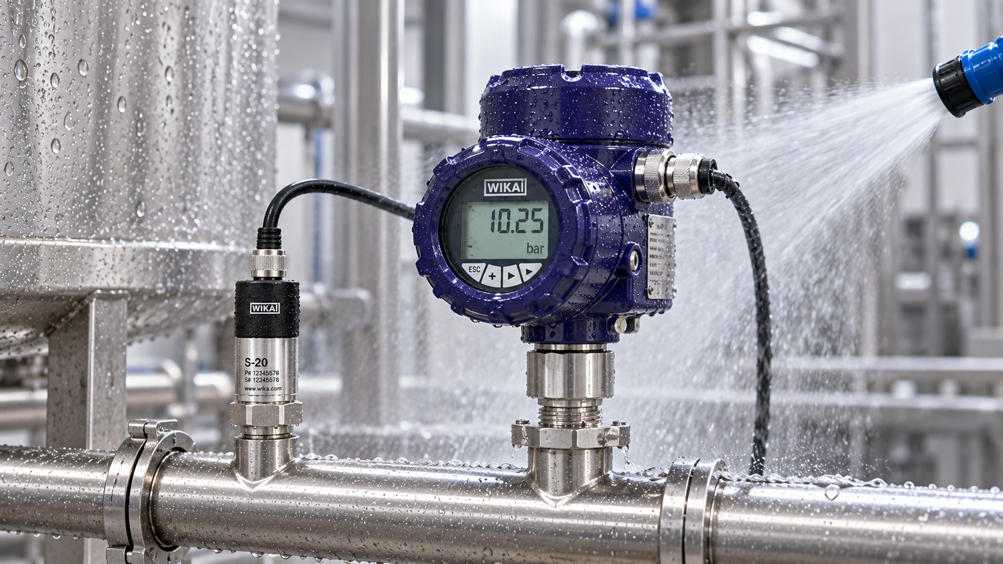
A pressure transmitter in an industrial wash system often operates under conditions that are significantly more demanding than the actual process pressure might suggest.
During normal operation, the sensor measures water, pump or line pressure, for example. During cleaning, hot water at high velocity then strikes the housing, connectors, cables and process connection from the outside.
This is where many failures occur.
The transmitter itself may have a robust stainless-steel housing, while the electrical connection used only provides IP65 or IP67 protection. Or an M12 connector is used whose mating connector and cable are not designed for washdown applications.
Even a high degree of protection does not solve every problem. IP69 or IP69K describes protection against the ingress of dust and water under defined test conditions. It does not automatically mean that seals, cable jackets and plastics are permanently resistant to alkaline or acidic cleaning agents.
The process connection must also suit the actual measurement task. A small pressure channel may work perfectly with clean water, but can become blocked when used with media containing particles or deposits. In such cases, a flush diaphragm may be the better choice.
With pulsating pumps, pressure surges must also be taken into account. A transmitter whose nominal measuring range exactly matches the normal operating pressure can therefore be subjected to unnecessarily high loads.
The key point is: In wash systems, not only the pressure sensor but the complete measuring point must be designed correctly. Degree of protection, electrical connection, mating connector, cable, materials, seals, process connection, pressure peaks and cleaning conditions must all be compatible.
Table of Contents
- Why are wash systems particularly demanding for pressure transmitters?
- What does IP69 or IP69K mean?
- Correctly distinguishing IP69 and IP69K
- What a high IP degree of protection does not guarantee
- Why the electrical connection is often the weak point
- When is an M12 connector suitable for washdown?
- Why a DIN angle connector is not automatically suitable for high-pressure cleaning
- When is a fixed cable outlet more suitable?
- Consider cleaning agents and material resistance
- Correctly assess temperature changes and condensation
- Select the process connection to suit the wash system
- When is a flush diaphragm useful?
- Do not underestimate seals and threads
- Correctly size the measuring range and overload reserve
- Consider pressure surges and pulsations
- Optimize installation position and cable routing for washdown
- Do not confuse washdown with hygienic design
- Select the output signal to suit the machine
- Test the measuring point in practice after installation
- Systematically diagnose typical faults
- Suitable pressure measurement technology from ICS Schneider
- Conclusion
- Frequently asked questions about pressure transmitters in wash systems
1. Why are wash systems particularly demanding for pressure transmitters?
At a normal industrial pressure measuring point, the process medium mainly acts on the sensor from the inside.
In a wash system, there is also significant external exposure.
Water can strike the housing, connection points and connectors at high pressure. Depending on the cleaning process, elevated water temperatures may also be involved.
The exposure is also not a one-time event.
In food, beverage, vehicle, machine or vessel cleaning systems, cleaning cycles may take place daily or even several times per shift.
A small weak point at a connector can therefore lead to moisture ingress over many cleaning cycles.
Cleaning agents, temperature changes and mechanical stresses also affect cables and seals.
For a long service life, specifying only the measuring range and output signal is therefore not sufficient.
2. What does IP69 or IP69K mean?
The IP degree of protection describes how well an enclosure is protected against the ingress of solid foreign objects and water.
The first digit 6 indicates a very high level of protection against dust.
The second digit 9 refers to testing with water during high-pressure and high-temperature cleaning.
This makes the degree of protection particularly relevant for systems that are cleaned intensively on a regular basis.
However, it is important to specify the actual standard.
For general electrical equipment, the designation IP69 according to IEC or DIN EN 60529 is used today.
Within the scope of ISO 20653, however, a K designation continues to be used.
The term IP69K, which is widely used in industry, is therefore often used generally to describe washdown suitability, even though the formal test designations may differ.
3. Correctly distinguishing IP69 and IP69K
IP69 and IP69K or IP6K9K describe similar requirements for protection against high-pressure and high-temperature water, but originate from different standards systems.
| Designation | Typical standard reference | Practical significance |
|---|---|---|
| IP69 | IEC 60529 / DIN EN 60529 | High-pressure and high-temperature water for general electrical equipment |
| IP6K9K | ISO 20653 | Testing for electrical equipment, particularly in automotive applications |
| IP69K | Commonly used practical shorthand | Always verify the underlying standard when specifying |
For a technical specification, wording such as “IP69 according to IEC 60529” is therefore clearer than simply stating “IP69K”.
If a customer explicitly requires a specific standard, exactly that version or test must be documented.
4. What a high IP degree of protection does not guarantee
A high IP degree of protection is often interpreted as a general quality characteristic.
However, its meaning is more limited.
IP69 or IP69K describes protection against the ingress of water and dust under defined test conditions.
The degree of protection is not a general proof of chemical resistance.
A cable jacket or O-ring can, for example, pass the high-pressure water test and still become brittle over time when exposed to an alkaline cleaning agent.
Likewise, IP69 does not automatically mean that a measuring point is suitable for permanent immersion.
Tests for water jets, high-pressure cleaning and immersion are different requirements.
If water remains permanently around a measuring point after cleaning or the sensor is temporarily submerged, the required protection against immersion must therefore also be checked.
5. Why the electrical connection is often the weak point
The degree of protection of a pressure transmitter often depends directly on the selected electrical connection.
The same sensor housing can therefore have different degrees of protection depending on the connector or cable outlet.
A WIKA S-20, for example, can be configured with numerous electrical connections and, in corresponding versions, can achieve a degree of protection up to IP69K or IP6K9K.
A standard version with an angle connector, however, does not automatically provide the same washdown suitability.
With pluggable connections, another point must be considered: The specified degree of protection generally applies only when a suitable and correctly installed mating connector is used.
An IP69-capable sensor combined with a simple IP67 cable therefore does not automatically create an IP69 measuring point.
The complete connector system must therefore always be considered during selection.
6. When is an M12 connector suitable for washdown?
M12 connectors are widely used in mechanical engineering and are well suited to compact sensor connections.
However, the connector format alone does not define washdown suitability.
There are M12 connections with IP67 as well as versions specifically designed for wet and hygienic environments with IP69 or IP69K.
For a wash system, the degree of protection of the actual mating connector must therefore be checked.
The material of the coupling nut, the seal material and the cable jacket are also relevant.
Washdown cables are available, for example, with stainless-steel couplings and cable materials suitable for cleaning chemicals.
Installation also affects the protective performance.
An M12 connector that is not fully tightened cannot reliably achieve its specified degree of protection.
The tightening torque specified by the manufacturer should therefore be observed.
7. Why a DIN angle connector is not automatically suitable for high-pressure cleaning
The angle connector according to DIN EN 175301-803 is a proven industrial connection for pressure transmitters.
It is robust and easy to wire for conventional machinery and hydraulic applications.
However, for direct high-pressure cleaning, the specific degree of protection must be taken into account.
With many pressure transmitters, this connection type achieves IP65, for example.
IP65 protects against water jets, but is not equivalent to a high-pressure/high-temperature test according to IP69.
If the sensor can be installed outside the direct wash zone, such a connection may still be appropriate.
If the transmitter is regularly exposed directly to a high-pressure jet, however, a connection version specifically rated for this purpose should be selected.
8. When is a fixed cable outlet more suitable?
A permanently attached cable reduces the number of plug and sealing points directly at the sensor.
This can be an advantage in very wet environments.
For suitable pressure transmitters, cable outlets with higher degrees of protection up to IP69K or IP6K9K are available.
The advantage is that the transition from the sensor housing to the cable is factory-assembled and tested.
However, this only shifts the critical point further toward the cable end.
The cable must not be routed in such a way that water can travel along the jacket into a control cabinet or junction box.
The cable material and temperature range must also suit the cleaning environment.
A PVC cable designed for dry machine rooms is not automatically the best solution for aggressive cleaning media.
9. Consider cleaning agents and material resistance
Wash systems do not always operate with water alone.
Depending on the application, alkaline cleaners, acidic cleaning agents, disinfectants or other chemical additives may be used.
These media can affect sensors both from the process side and from the outside.
Stainless-steel housings offer high resistance for many washdown applications.
However, the weak points may be located elsewhere.
Seals, plastic connectors, cable jackets and identification labels can be considerably more sensitive.
IP69 or IP69K therefore does not replace a material compatibility check.
When designing the measuring point, the actual cleaning chemical, including its concentration, temperature and contact time, should be specified.
10. Correctly assess temperature changes and condensation
A pressure transmitter may be relatively cool during operation and then be exposed to hot cleaning water.
Conversely, cold process water may enter the line after hot cleaning.
Such temperature changes place stress on housings, seals and electrical connection points.
Condensation can also form during cooling inside poorly protected connection areas.
This is precisely why moisture must be prevented from entering the electrical connection in the first place.
For gauge-pressure sensors with an atmospheric reference, it must also be considered how pressure equalization is implemented in the design.
An open reference must not become a path for water ingress.
11. Select the process connection to suit the wash system
The external degree of protection says nothing about which process connection is suitable for the actual pressure measurement.
G1/4, G1/2 or NPT connections are commonly used in machinery and wash systems.
The appropriate connection depends on the pressure range, pipework, medium and maintenance concept.
With clean water, a conventional pressure connection with an internal pressure channel can be completely sufficient.
With media containing dirt, solids, cleaning-agent residues or high viscosity, however, deposits can accumulate in this channel.
The sensor may then respond increasingly slowly or may no longer transmit the correct pressure.
The process connection and process medium should therefore be selected just as carefully as the electrical connection.
12. When is a flush diaphragm useful?
A flush diaphragm does not have a deep pressure channel in front of the actual sensing element.
This creates fewer hard-to-reach areas where material can accumulate.
This is particularly useful with viscous, pasty, crystallizing or solids-containing media.
A flush connection can also make cleaning easier in applications with frequent media changes.
For normal clean wash water, however, a flush diaphragm is not automatically required.
It should be used when the process conditions genuinely justify it.
For hygienic applications, specially designed process connections such as Tri-Clamp or Varivent® may also be suitable.
13. Do not underestimate seals and threads
With a parallel-thread process connection, sealing is normally provided by a separate sealing element.
Its material must be compatible with the process medium and temperature.
A standard seal suitable for water may be unsuitable for an aggressive cleaning medium.
Depending on the application, elastomer or metallic seals may be used.
The mounting surface must also match the type of seal.
A damaged O-ring or scratched sealing surface can cause leakage even at relatively low pressure.
During maintenance, not only the transmitter but also the process seal should therefore be inspected.
14. Correctly size the measuring range and overload reserve
The maximum normal operating pressure is not automatically the highest pressure the sensor will experience during its lifetime.
Pressure peaks can occur when pumps are switched on, valves operate rapidly or the water flow is suddenly interrupted.
A sensor with a measuring range of 0 … 10 bar may therefore be poorly sized in a system operating normally at 9.5 bar.
For industrial pressure sensors, the specified overload limit should be considered in addition to the normal operating range.
A sufficiently larger measuring range increases the load reserve.
However, the range should not be selected unnecessarily large either, as this can reduce usable resolution and increase measurement uncertainty relative to the actual operating pressure.
The design is therefore a compromise between measurement accuracy and pressure-surge reserve.
15. Consider pressure surges and pulsations
Wash pumps can generate highly dynamic pressure profiles.
Fast-acting valves and long water-filled pipelines can create additional pressure surges.
Such events are often much shorter than the normal PLC sampling cycle and may therefore not be visible in the process display.
Nevertheless, the measuring diaphragm of the pressure transmitter is mechanically stressed.
With pronounced pressure surges, restrictors, snubbers or sensors specifically designed for such conditions may be useful.
For extremely high process pressures, a special version is also required.
The WIKA HP-2, for example, is specifically designed for ultra-high-pressure applications and is used, among other applications, in high-pressure cleaning.
However, this must be clearly distinguished from the IP degree of protection: The HP-2 addresses high process pressure, whereas IP69/IP69K describes protection of the device against externally applied water.
16. Optimize installation position and cable routing for washdown
Even a correctly specified sensor should be installed so that water can drain away as easily as possible.
Connectors, cable loops and housing recesses should not unnecessarily become collection points for water.
The cable should be mechanically strain-relieved and should not be under tension directly at the connector.
Tight bending radii should also be avoided.
With regular high-pressure cleaning, it should also be considered from which directions the cleaning nozzle typically strikes the measuring point.
A protective plate can be useful on certain machines, but it must not cause water to remain trapped behind it.
A good design therefore combines the required degree of protection with an installation arrangement that allows water to drain away.
17. Do not confuse washdown with hygienic design
A high degree of protection does not automatically make a pressure transmitter a hygienic measuring instrument.
Hygienic design primarily concerns the product-contacting side.
Dead spaces, surface roughness, weld seams, process connections and cleanability of the measuring point are decisive.
A robust industrial pressure transmitter with IP69K can therefore be ideally suited to a machine that is regularly cleaned externally without being designed for a sterile product process.
Conversely, a hygienic transmitter can have a flush and CIP-/SIP-capable process side, while the specific electrical connection version must still be checked separately for washdown suitability.
Both requirements should therefore be specified independently.
18. Select the output signal to suit the machine
Washdown suitability does not directly determine the choice of output signal.
For industrial machinery, 4 … 20 mA remains a robust solution.
The current signal is resistant to many cable-related influences and is suitable for longer cable runs.
0 … 10 V can be useful for shorter cable lengths and suitable PLC input technology.
Digital interfaces or IO-Link can provide additional diagnostic and configuration options.
Regardless of the signal, however, the electrical connection must suit the cleaning environment in terms of degree of protection, cable and connector.
A modern digital signal does not solve a mechanical sealing problem.
19. Test the measuring point in practice after installation
Data-sheet selection should be supplemented by proper commissioning.
First, the process connection, seal and electrical connection are checked.
It should then be verified that the pressure value is plausible and stable during normal operation.
After a typical cleaning cycle, it should be checked whether moisture is visible at the connector, cable or housing.
Temporary signal disturbances immediately after cleaning can also indicate moisture or electrical problems.
For critical machinery, a documented test under actual washdown conditions is useful.
This makes it possible to verify whether not only the individual transmitter but the complete installed measuring point can withstand the intended cleaning process on a long-term basis.
20. Systematically diagnose typical faults
| Observation | Possible cause | Recommended check |
|---|---|---|
| Sensor fails only after cleaning cycles | Moisture at the electrical connection | Check connector, mating connector, seal and cable |
| Sensor is IP69K, but mating connector is only IP67 | The complete connection does not achieve the expected washdown suitability | Evaluate the connector system as a complete assembly |
| Measured value drifts after hot cleaning | Temperature stress or moisture | Check temperature limits and connection area |
| Pressure response becomes increasingly slow | Process channel partially blocked | Clean the process connection and consider a flush version |
| Process connection leaks after maintenance | Seal damaged or incorrectly installed | Check sealing surface and seal material |
| Sensors fail prematurely despite the correct degree of protection | Cleaning chemical attacks the cable or seals | Check chemical resistance separately |
| Short, severe pressure peaks | Pump, valve actuation or water hammer | Record the pressure dynamically and check overload reserve |
| Water remains permanently in the connection area | Unfavorable installation position | Change cable and sensor orientation |
21. Suitable pressure measurement technology from ICS Schneider
ICS Schneider Messtechnik offers pressure sensors and process transmitters for mechanical engineering, water technology, process plants and harsh industrial environments. An overview can be found under Pressure Measurement Technology and Pressure Sensors.
21.1 WIKA S-20 for Harsh Industrial Environments
The WIKA S-20 is a highly configurable pressure transmitter for demanding industrial applications.
It covers measuring ranges from 0 … 0.4 to 0 … 1,600 bar and is available with various current and voltage outputs.
A wide range of electrical and mechanical connection options is also available.
WIKA offers heavy-duty versions of the S-20 with degrees of protection up to IP69K or IP6K9K.
For a wash system, it is therefore not sufficient to specify simply “S-20”; the exact electrical connection version must also be defined.
A standard version with a DIN angle connector must be assessed differently for washdown than a cable or heavy-duty version specifically designed for this purpose.
21.2 WIKA IPT-20 / IPT-21 for Demanding Process Applications
The WIKA IPT-20 and IPT-21 are process transmitters with a welded metallic measuring cell and a wide selection of housing and process connection options.
For demanding wet or hygienic environments, an electropolished stainless-steel housing is available, among other options.
WIKA specifies IP69K protection for this housing version.
The series is therefore of interest when, in addition to a high external degree of protection, advanced process functions, HART or fieldbus communication, or special process connections are required.
21.3 WIKA HP-2 for the Actual High-Pressure Cleaning Process
If the objective is not to protect the sensor from external cleaning, but rather to measure the high pressure of the cleaning medium itself, a different device class may be required.
The WIKA HP-2 was developed for ultra-high-pressure applications up to 15,000 bar and is explicitly used by WIKA for applications including high-pressure cleaning.
The series features high resistance to pressure cycling and a diaphragm protection system designed for highly dynamic pressures.
This highlights the need to assess two requirements separately:
The process pressure of the cleaning medium and the external washdown degree of protection of the electrical device are two different specifications.
21.4 Device Selection by ICS Schneider
When selecting a pressure transmitter for a wash system, relevant parameters include normal and maximum process pressure, possible pressure peaks, medium, temperature, cleaning pressure, cleaning-water temperature, chemicals used, required electrical connection, cable type, process connection and output signal.
It should also be specified whether the sensor is directly exposed to the cleaning jet or can be installed in a structurally protected position.
For hygienic applications, requirements relating to surfaces, dead spaces, CIP/SIP and process connection are also required.
22. Conclusion
A pressure transmitter in a wash system must meet significantly more requirements than simply having the correct measuring range.
With regular high-pressure cleaning, the degree of protection of the complete electrical connection is particularly important.
IP69 or IP69K describes a high level of resistance to defined high-pressure and high-temperature water exposure.
However, the designations should not be used indiscriminately. IP69 according to IEC 60529 and IP6K9K according to ISO 20653 originate from different standards systems.
It is equally important that the degree of protection often depends on the electrical connection.
A pressure transmitter with a cable outlet may have a very high degree of protection, while another connector version of the same device may only achieve IP65 or IP67.
With pluggable connections, the mating connector must also meet the same requirement and be installed correctly.
However, IP protection alone is not sufficient.
Cleaning chemicals can attack cables, plastics and seals. Their resistance must be checked separately.
On the process side, the medium and tendency to contamination are decisive. For clean water, a conventional pressure channel is often sufficient, while a flush connection offers advantages with deposits or viscous media.
Pressure peaks must not be underestimated either. Normal pressure, maximum process pressure and short-term dynamic peaks should all be considered together when selecting the measuring range.
For reliable selection, the following sequence therefore applies:
Determine normal and peak pressure → define the cleaning procedure → specify the required IP degree of protection and relevant standard → select the complete electrical connection including mating connector → check cable and seal materials for resistance to cleaning chemicals → select the process connection to suit the medium → consider overload reserve → install the measuring point so that water can drain away → test the complete measuring point under actual washdown conditions.
The most important practical principle is therefore: It is not enough for the transmitter itself to be IP69-capable. The complete installed measuring point, from the process connection to the cable, must be suitable for the actual washing and cleaning environment.
23. Frequently asked questions about pressure transmitters in wash systems
23.1 What does IP69 mean for a pressure transmitter?
IP69 describes a very high level of protection against dust as well as water during high-pressure and high-temperature cleaning according to the relevant IEC protection test.
23.2 Is IP69 the same as IP69K?
Not exactly. IP69 is used in connection with IEC 60529. The K designation originates from ISO 20653 and the automotive sector. The underlying standard should therefore always be specified in technical documentation.
23.3 Does IP69K automatically mean that a sensor is also IP68?
No. Protection against high-pressure cleaning and protection against immersion are different tests. If both conditions are required, both protection requirements should be specified explicitly.
23.4 Is every M12 connector IP69K?
No. M12 initially describes the connector format. Depending on the version, the degree of protection may be IP67 or IP69K, for example.
23.5 Does the degree of protection apply without a mating connector?
Normally not for pluggable electrical connections. The specified degree of protection requires a suitable and correctly installed mating connector.
23.6 Can I use an IP67 connector with an IP69K sensor?
Depending on the connection, the combination may function electrically, but the complete connector assembly does not automatically achieve the higher washdown degree of protection.
23.7 Is a DIN angle connector suitable for wash systems?
Yes, for many industrial applications. However, for direct high-pressure cleaning, the actual degree of protection must be checked. Typical DIN connection versions are often rated below IP69.
23.8 Is a fixed cable outlet better for washdown?
It can be advantageous because one additional plug connection is eliminated. However, the degree of protection of the cable outlet and the resistance of the cable jacket remain decisive.
23.9 Does IP69K mean chemical resistance to cleaning agents?
No. The IP test evaluates protection against the ingress of water and dust. The chemical resistance of the materials must be checked separately.
23.10 Which housing material is suitable for wash systems?
Stainless steel is very suitable for many wet and washdown applications. However, the exact material selection must also take into account the cleaning chemicals used.
23.11 When do I need a flush pressure connection?
Primarily with viscous, solids-containing, crystallizing or difficult-to-clean media. It is not generally required for clean water.
23.12 Which pressure connection is typical?
G1/4, G1/2 or NPT are commonly used in general mechanical engineering. Special hygienic connections are used for hygienic processes.
23.13 Why is the seal so important?
It must permanently withstand the process pressure, temperature and medium. A chemically attacked or mechanically damaged seal can cause leakage even if the sensor itself is in perfect condition.
23.14 How large should the measuring range be?
The range should safely cover the normal operating pressure and provide sufficient reserve for pressure peaks that actually occur. Excessive oversizing should be avoided because of its effect on measurement performance.
23.15 What is the difference between IP69K and the sensor’s high-pressure capability?
IP69K concerns water striking the device externally during cleaning. Process pressure resistance, by contrast, describes the pressure acting internally on the measuring diaphragm.
23.16 Which sensor is suitable for extremely high cleaning pressure?
If the pressure of the high-pressure cleaning medium itself is to be measured, the WIKA HP-2, for example, is intended for corresponding ultra-high-pressure applications.
23.17 Is the WIKA S-20 suitable for harsh washdown applications?
The S-20 is designed for harsh industrial environments and, depending on the specific version, can achieve a degree of protection up to IP69K or IP6K9K. The correct electrical connection version must be selected specifically.
23.18 When is the IPT-20 or IPT-21 of interest?
When process-transmitter functions, HART or fieldbus communication, hazardous-area approval or a wide selection of process connections are required in addition to a high external degree of protection.
23.19 Should the measuring point be subjected to a washdown test after installation?
For critical applications, a practical test under the actual intended cleaning conditions is useful because it also evaluates the mating connector, cable, installation and cable routing.
23.20 What information does ICS Schneider require for selection?
Useful information includes normal and maximum pressure, expected pressure peaks, medium, process and ambient temperature, cleaning pressure and temperature, cleaning agents used, electrical connection, required degree of protection with standard reference, process connection, output signal and information on whether the sensor is directly exposed to the high-pressure cleaning jet.