


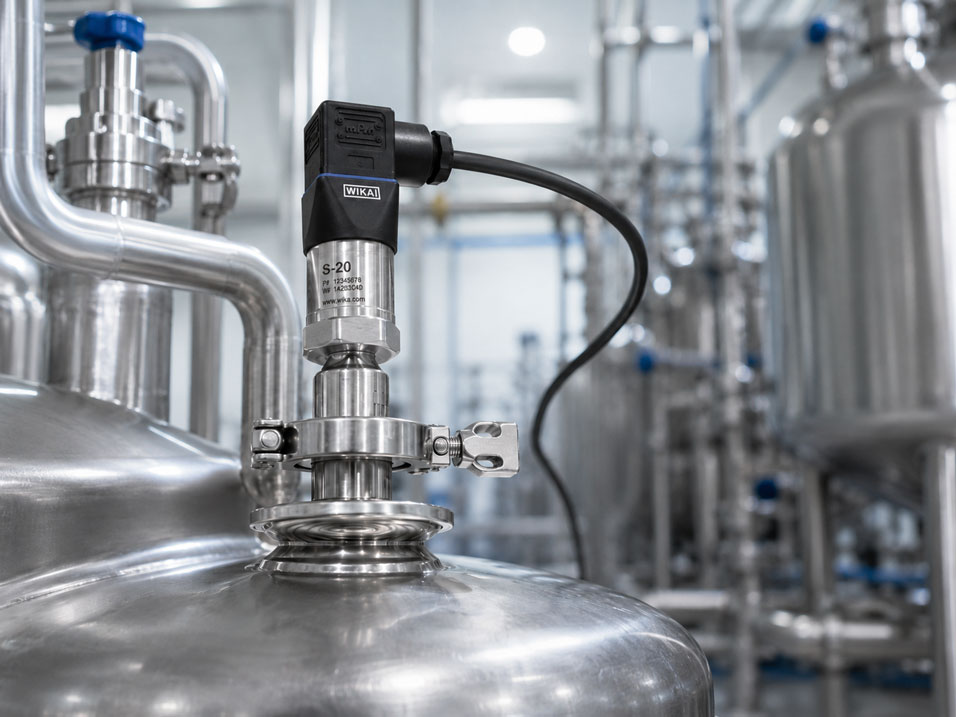
In hygienic processes, pressure measuring points have to do much more than in many classic industrial applications. They must reliably measure the process pressure, while at the same time being designed so that no product residues, cleaning media or microorganisms remain in dead spaces. Especially in the food industry, beverage production, pharmaceuticals, biotechnology, cosmetics, dairies and sterile process plants, the hygienic design of the measuring point is just as important as the measurement accuracy.
Diaphragm seals play a central role here. They separate the measuring instrument from the process medium and transmit the pressure via a flush or hygienic diaphragm to the pressure transmitter, pressure gauge or pressure switch. This means that the actual measuring instrument does not come into direct contact with the medium. At the same time, the measuring point can be designed so that it is easy to clean, sterilizable and suitable for the process connection.
This article explains what matters when using diaphragm seals in hygiene applications. The focus is on hygienic connections, flush diaphragms, dead-space-free design, cleanability, CIP, SIP, materials, surface roughness, sterile process connections, diaphragm material, fill fluid, temperature exposure, certificates and the correct selection of solutions such as WIKA 990.17 or WIKA DSS22T.
Table of contents
- Basics: why hygienic processes require special pressure measuring points
- What does a diaphragm seal do in a hygienic measuring point?
- Flush connections: why dead spaces must be avoided
- CIP cleaning: requirements for measuring point, diaphragm and connection
- SIP sterilization: temperature, steam and thermal load
- Selecting hygienic process connections correctly
- Materials, diaphragm material and surface roughness
- Fill fluid, temperature limits and measuring behavior
- Certificates, approvals and documentation
- Pressure transmitter, output signal and integration into the control system
- Typical errors in hygienic diaphragm seal measuring points
- Practical example: pressure measurement on a CIP-capable process line
- Which measuring instruments / products are suitable?
- Conclusion: hygienic pressure measurement starts at the process connection
- FAQ: frequently asked questions about diaphragm seals in hygiene applications
Basics: why hygienic processes require special pressure measuring points
In hygienic processes, pressure is often measured on tanks, pipelines, filters, separators, filling systems, fermenters, reactors, pasteurization systems, CIP lines or sterile media circuits. The measuring point must not unnecessarily disturb the process. It must be designed so that product, cleaning medium and sterilization steam can pass the measuring point safely.
A standard pressure connection with a bore or internal measuring channel can be problematic in such applications. If product residues accumulate in small cavities, gaps or blind holes, areas are created that are difficult to clean. Such dead spaces can be critical from a hygiene perspective because they can promote product carryover, microbial contamination or cleaning problems.
For this reason, flush or aseptic pressure connections are often used in hygiene processes. The diaphragm of the diaphragm seal is positioned as flush as possible with the process space. The medium touches a smooth, easy-to-clean surface. The pressure is transmitted to the measuring instrument via this diaphragm and a suitable fill fluid.
The selection of the correct pressure measuring point is therefore not purely a sensor question. The decisive factor is the combination of process connection, diaphragm geometry, material, surface quality, seal, cleaning method, temperature exposure, sterilization conditions and signal processing. Only when these points fit together is the measuring point suitable for hygienic processes.
| Requirement | Meaning in hygienic processes | Practical consequence |
|---|---|---|
| Cleanability | Product residues must be reliably removed | Prefer a flush, smooth and accessible measuring point. |
| Dead-space-free design | No poorly flushed areas or blind spaces | Select process connection and diaphragm shape accordingly. |
| CIP capability | Measuring point is cleaned in the installed condition | Material, seal and diaphragm must tolerate cleaning media. |
| SIP capability | Sterilization with steam or high temperature | Consider temperature resistance and thermal behavior. |
| Documentation | Materials and design must be traceable | Check certificates, surface specifications and approvals. |
What does a diaphragm seal do in a hygienic measuring point?
A diaphragm seal separates the measuring instrument from the process medium. In the process, there is a diaphragm that is deflected by the process pressure. Behind the diaphragm is a transmission fluid. This fill fluid transfers the pressure to the connected measuring instrument, for example a pressure transmitter, pressure gauge or pressure switch.
In hygiene applications, this design has two important advantages. First, the process side can be designed hygienically without the actual measuring instrument being in direct product contact. Second, the diaphragm can be designed so that it is flush, easy to clean and suitable for the hygienic process connection.
A diaphragm seal is particularly useful when the medium should not enter a small pressure bore. This applies to viscous, pasty, crystallizing, sticky or sensitive media as well as to food products, pharmaceutical products, culture media, cleaning media or sterile media. The diaphragm forms a defined, smooth separating surface between process and measuring instrument.
At the same time, the diaphragm seal influences measuring behavior. Diaphragm diameter, fill fluid, temperature, capillary line, measuring range and process conditions determine how quickly and stably the system responds. A hygienic measuring point must therefore always be designed both technically and hygienically.
Flush connections: why dead spaces must be avoided
Flush pressure connections are particularly important in hygienic processes. The diaphragm is positioned as flush as possible with the process side, so that no deep bores or cavities that are difficult to clean are created. The medium flows past a smooth surface instead of remaining in a measuring channel.
Dead spaces are critical from a hygiene point of view. Product residues can remain there and later enter the process again in subsequent batches. They can also make cleaning more difficult and promote microbial growth. Especially with changing products, sensitive media or sterile processes, such geometry is not acceptable.
Flush diaphragm seals reduce this risk. They facilitate CIP cleaning and, depending on the design, can also be suitable for SIP processes. However, it is crucial that not only the diaphragm itself is flush, but also that the connection to the pipeline or vessel is designed correctly from a hygienic point of view.
The practical design depends heavily on the process connection. Clamp, sterile threaded connection, DRD, Varivent, milk pipe thread, aseptic flanges or customized connections each have their own requirements for sealing surface, installation position, seal, tightening torque and cleanability. The connection selection should therefore be coordinated with the plant design at an early stage.
| Design | Hygienic benefit | What to pay attention to? |
|---|---|---|
| Flush diaphragm | No deep pressure bore, better cleanability | Diaphragm must not be mechanically damaged. |
| Aseptic connection | Suitable for sterile or hygienically demanding processes | Check connection standard, seal and installation specifications. |
| Clamp connection | Quickly detachable and easy to clean | Observe seal seat, preload and compatibility. |
| Hygienic weld-in fitting | Clean integration into vessel or pipeline | Qualify weld seam, surface and installation position. |
| Dead-space-free geometry | Reduces product residues and cleaning problems | Consider the entire measuring point, not just the sensor. |
CIP cleaning: requirements for measuring point, diaphragm and connection
CIP stands for Cleaning in Place. The system is cleaned in the installed condition without having to dismantle all components. Cleaning media, temperature, flow velocity and exposure time are selected so that product residues are reliably removed. The pressure measuring point must not only withstand this cleaning, but also support it by design.
For diaphragm seals, this means that the wetted materials must be resistant to the cleaning media used. In the food and pharmaceutical industries, alkaline, acidic or disinfecting media may be used. In addition, elevated temperatures and changing process conditions act on the diaphragm, seal and connection.
The geometry of the measuring point is just as important. If the diaphragm is not properly flushed or if product can settle behind an edge, even a suitable cleaning medium will only help to a limited extent. Diaphragm seals should therefore be installed so that the CIP flow reliably reaches the measuring point.
In CIP processes, it must also be considered that temperature changes can influence the measuring signal. Fill fluid, diaphragm and connected pressure transmitter react to thermal load. In critical applications, it should be checked whether measurement or monitoring is required during cleaning, or whether only the resistance of the measuring point is required.
SIP sterilization: temperature, steam and thermal load
SIP stands for Sterilization in Place. The system is sterilized in the installed condition, often with hot steam. For diaphragm seals and pressure sensors, SIP is particularly demanding because high temperatures, temperature changes and steam conditions act on the measuring point. This affects the diaphragm, fill fluid, seal, process connection and transmitter.
In SIP applications, the temperature resistance of the entire measuring chain must be checked. Not only the process connection must be suitable, but also the fill fluid in the diaphragm seal and the connected transmitter. Depending on the design, direct mounting may be possible; at higher temperatures, a cooling element or capillary line may be useful.
The reproducibility of the measuring signal after thermal load is also relevant. Strong temperature changes can influence zero point, response time or measured value stability. Especially with small measuring ranges or high accuracy requirements, the thermal effect should be considered during design.
SIP capability therefore means more than “withstands high temperature”. After sterilization, the measuring point must still be leak-tight, hygienic, capable of measurement and documentable. For this, process data, sterilization parameters and material requirements must be clearly known.
| Process | Typical load | Relevance for diaphragm seals |
|---|---|---|
| CIP | Cleaning media, temperature, flow | Check chemical resistance, cleanability and sealing material. |
| SIP | Steam, high temperature, temperature changes | Observe temperature limits of diaphragm, fill fluid and transmitter. |
| Product operation | Pressure, medium, viscosity, product contact | Diaphragm material and connection must be process-safe. |
| Batch change | Cleaning, rinsing, temperature changes | Measuring point must remain reproducible and residue-free. |
| Sterile operation | High hygienic requirements | Dead-space-free design and suitable certificates are decisive. |
Selecting hygienic process connections correctly
The process connection largely determines whether a pressure measuring point is hygienically suitable. Standardized hygienic connections are often used in food and pharmaceutical plants. These include, for example, clamp connections, sterile threaded connections, aseptic flange systems, milk pipe threads, DRD connections or industry-specific connection types.
The selection depends on the plant. An existing pipeline often defines the connection standard. In new plants, on the other hand, the connection can be selected to suit the cleaning strategy and plant design. It is important that diaphragm seal, seal, fitting and installation position fit together.
A hygienic connection is only hygienic if it is installed correctly. A poorly executed weld seam, an incorrect seal, an unsuitable installation angle or a measuring point that is difficult to access can worsen cleanability. Design, installation and quality inspection should therefore be considered together.
For sterile or aseptic applications, industry-specific requirements must also be taken into account. Depending on the process, EHEDG, 3-A, FDA-compliant materials, USP requirements or material certificates may be relevant. Which documents are actually required depends on the operator, process, medium and quality management.
Materials, diaphragm material and surface roughness
The wetted materials must be suitable for the product, cleaning media and sterilization conditions. Stainless steels such as 1.4435 or 316L are often used in hygiene applications. In particularly demanding cases, other materials may be required, for example with aggressive cleaners, high chloride loads or special pharmaceutical media.
The diaphragm is the central element of the diaphragm seal. It is in direct contact with the medium and must be suitable both mechanically and chemically. A damaged or deformed diaphragm can distort the measurement and impair the hygienic integrity of the measuring point. It must therefore be protected against mechanical stress.
Surface roughness is an important design factor in hygiene processes. Smooth surfaces are easier to clean and reduce deposits. Depending on the application, defined roughness values are required. Electropolishing may also be relevant if particularly high requirements are placed on cleanability and surface quality.
General statements about media compatibility are not meaningful without precise process data. Medium, concentration, temperature, cleaning chemicals, exposure time, pressure and operating duration determine whether a material is suitable. The operator or plant designer should therefore clearly define the material requirements.
| Design point | Why relevant? | Typical question |
|---|---|---|
| Material | Determines resistance to product and cleaning | Which stainless steel or special material is suitable for medium and CIP/SIP? |
| Diaphragm material | Direct product contact and pressure transmission | Is the diaphragm chemically and mechanically suitable? |
| Surface roughness | Influences cleanability and adhesion behavior | Which Ra requirement applies to the process? |
| Seal | Contact point between measuring instrument and process connection | Is the sealing material suitable for product, cleaning and temperature? |
| Weld seam / installation | Can create hygienic weak points | Is the fitting welded in correctly and documented? |
Fill fluid, temperature limits and measuring behavior
The fill fluid in the diaphragm seal system transmits the pressure from the diaphragm to the measuring instrument. It must be suitable for the temperature, measuring range, application and, if applicable, hygienic requirements. In sensitive applications, it may also be relevant which fill fluid could come into contact with the medium in the unlikely event of diaphragm damage.
The selection of the fill fluid influences the measuring behavior. Temperature changes cause volume changes in the fill fluid. This can influence zero point, response time and measured value stability. The larger the diaphragm seal system, the longer a capillary line and the smaller the measuring range, the more visible such effects can become.
In CIP and SIP, high temperatures or rapid temperature changes often act on the measuring point. The fill fluid must be suitable for these loads. At the same time, the connected pressure transmitter must be protected against excessive temperature. Depending on the process, direct mounting may be possible; in other cases, a cooling element, capillary line or special system design is required.
The diaphragm size also plays a role. Small diaphragms are more sensitive to temperature influences and mechanical loads at low measuring ranges. Larger diaphragms can be advantageous from a measurement point of view, but require suitable installation space and process connection. The design should therefore be evaluated not only hygienically, but also metrologically.
Certificates, approvals and documentation
In hygiene applications, documentation is often just as important as the product itself. Operators require proof of wetted materials, surface quality, conformity of seals, hygienic suitability, calibration or product-contact materials. Which documents are required depends on industry, process and quality management.
Typical documents may include material certificates according to EN 10204, surface roughness certificates, FDA declarations for seals or fill fluids, 3-A or EHEDG references, calibration certificates, pressure test certificates or manufacturer declarations. Not every application requires all documents, but missing certificates can become problematic during audits, validations or commissioning.
Especially in pharmaceuticals and biotechnology, it should be clarified early on which certificates are required. Subsequent documentation requirements are often more difficult to meet than a clear definition before ordering. For spare parts, it must also be checked whether the new version matches the existing plant in terms of documentation.
The documentation should also clearly describe the measuring chain. This includes diaphragm seal type, process connection, diaphragm material, fill fluid, pressure transmitter, measuring range, output signal, calibration and electrical integration. Only in this way does the measuring point remain traceable in the long term.
Pressure transmitter, output signal and integration into the control system
A hygienic diaphragm seal is often combined with a pressure transmitter. The transmitter converts the transmitted pressure into an electrical signal. In process plants, this is often a 4–20 mA signal, sometimes with HART or other communication options. In modern plants, digital interfaces, limit values or diagnostic information may also be relevant.
When integrating into a PLC or process control system, it must be clear which measuring range is being transmitted. A pressure transmitter with mounted diaphragm seal can work correctly from a measurement point of view, but still display incorrect values in the control system if 4 mA and 20 mA are scaled incorrectly. Unit, damping, fault current, alarm limits and filtering must also match the application.
The UPS4E loop calibrator is suitable for testing 4–20 mA signals. It can be used to measure or simulate current loops, detect scaling errors between pressure transmitter, display, PLC and process control system, and specifically test signals during commissioning or troubleshooting.
Especially in CIP/SIP processes, it should also be decided whether the pressure value is actively monitored during cleaning and sterilization or whether only product operation is evaluated. If temperature cycles shift measured values, the control system must correctly interpret these operating states.
Typical errors in hygienic diaphragm seal measuring points
A common error is selecting a pressure transmitter only according to measuring range and output signal without hygienically evaluating the process connection. In hygiene processes, however, the measuring point at the process is decisive. A technically good sensor can be unsuitable if the connection creates dead spaces or is not CIP/SIP-capable.
Another error is the incorrect assessment of temperature exposure. Product operation, cleaning and sterilization can have very different temperatures. If only the normal process temperature is considered, the measuring point can be overloaded during SIP. Rapid temperature changes can also influence the measuring signal.
A diaphragm that is too small for low measuring ranges or high temperature requirements can also be problematic. The system can then become slower, more temperature-sensitive or less stable. Conversely, a diaphragm that is too large or mechanically unfavorably positioned can be damaged in the process.
Missing documentation also causes difficulties in practice. If material certificates, surface specifications, seal certificates or calibration documents are requested only afterwards, this can lead to delays. Certificates and quality requirements should therefore already be defined at the inquiry stage.
| Error pattern | Possible cause | Test approach |
|---|---|---|
| Measuring point is difficult to clean | Non-flush connection, dead space or unfavorable installation position | Evaluate process connection and installation geometry hygienically. |
| Measured value drifts after SIP | Thermal load, fill fluid or transmitter temperature | Check temperature limits and system design. |
| Measured value reacts slowly | Capillary line, fill fluid, small diaphragm or damping | Match response time and diaphragm seal system to the application. |
| Audit documents are missing | Certificates not defined when ordering | Define material, surface, seal and calibration requirements early. |
| PLC value is incorrect | Scaling, unit or signal assignment faulty | Check 4–20 mA signal and parameterization separately. |
Practical example: pressure measurement on a CIP-capable process line
In a food plant, the pressure in a product line is to be measured. The medium is viscous, the line is regularly cleaned by CIP and rinsed at elevated temperatures during product changes. A standard pressure bore is not suitable because product residues could remain in the measuring opening.
A flush diaphragm seal with hygienic process connection is selected for the measuring point. The diaphragm is smooth on the product side and flush with the process. Material, seal and surface quality are selected to suit the medium and cleaning procedure. The pressure transmitter is designed so that measuring range and temperature exposure match the process.
During commissioning, not only the pressure value is checked. Installation position, cleanability, seal, documentation and PLC scaling are also checked. The 4–20 mA signal is compared with the display and control system so that the correct pressure range arrives in the process control system.
The example shows: in hygiene applications, a good pressure measuring point is not created by the sensor alone. The decisive factor is the combination of hygienic connection, suitable diaphragm seal, appropriate material selection, CIP/SIP evaluation and clean signal processing.
Which measuring instruments / products are suitable?
The category diaphragm seals is the right starting point when pressure measuring instruments need to be separated from the process medium. In hygiene applications, diaphragm seals are particularly relevant when flush, easy-to-clean or sterile process connections are required.
The WIKA 990.17 diaphragm seal with sterile connection is suitable for hygienic and sterile process connections where a flush or aseptic integration is required. It is particularly interesting when CIP cleaning, sterile vessel connections or easy-to-clean pressure measuring points are required.
The WIKA DSS22T pressure sensor with mounted diaphragm seal combines a pressure sensor with a mounted diaphragm seal and clamp connection. This design is particularly practical when fast cleaning, easy disassembly and suitability for CIP/SIP processes are required.
The UPS4E loop calibrator is helpful for electrically testing pressure transmitters with 4–20 mA output. It can be used to check the signal path between pressure transmitter, display, PLC and process control system without unnecessarily opening the hygienic process side.
| Product / area | Typical use | Particularly relevant for |
|---|---|---|
| Diaphragm seals | Separation of measuring instrument and process medium | Hygiene processes, hot media, viscous media, aggressive media and flush connections |
| WIKA 990.17 diaphragm seal with sterile connection | Hygienic pressure measurement with sterile connection | CIP cleaning, aseptic vessel connections, flush pressure transmission and sterile processes |
| WIKA DSS22T pressure sensor with mounted diaphragm seal | Pressure sensor with hygienic clamp diaphragm seal | CIP/SIP, fast cleaning, easy disassembly and hygienic pipeline applications |
| Hygienic process connections | Connection to pipeline, tank or vessel | Clamp, sterile connection, DRD, milk pipe, aseptic flanges and customized fittings |
| UPS4E loop calibrator | Testing and simulation of 4–20 mA signals | Commissioning, PLC scaling, signal testing and troubleshooting on pressure transmitters |
Conclusion: hygienic pressure measurement starts at the process connection
Diaphragm seals are often the decisive component for a safe and easy-to-clean pressure measuring point in hygiene applications. They separate the measuring instrument from the medium, enable flush or sterile connections and support hygienic integration into pipelines, tanks and process vessels.
The correct selection depends on many details. CIP, SIP, medium, pressure, temperature, material, surface roughness, seal, diaphragm material, fill fluid, measuring range, certificates and electrical integration must be considered together. A purely mechanically suitable design is not enough if cleanability or documentation do not fit.
The most important recommendation is: always plan diaphragm seals in hygiene processes as a complete measuring point. Process connection, diaphragm, diaphragm seal system, transmitter, signal, documentation and cleaning strategy must fit together. Only then are stable measured values and a hygienically reliable solution for food, pharmaceutical, biotech and beverage processes achieved.
FAQ: frequently asked questions about diaphragm seals in hygiene applications
Why are diaphragm seals used in hygiene applications?
Diaphragm seals separate the measuring instrument from the process medium and enable a hygienic, flush or sterile measuring point. This avoids product deposits in pressure bores and improves cleanability.
What does flush pressure connection mean?
Flush means that the diaphragm is positioned as flush as possible with the process side. No deep measuring channels or blind spaces are created in which product residues could remain.
What is a dead space?
A dead space is an area that is poorly flushed or difficult to clean. In hygiene processes, dead spaces are critical because product residues or contaminants can accumulate there.
What does CIP mean?
CIP stands for Cleaning in Place. The system is cleaned in the installed condition. The pressure measuring point must be easy to clean and resistant to cleaning media and cleaning temperatures.
What does SIP mean?
SIP stands for Sterilization in Place. The system is sterilized in the installed condition, often with steam. Diaphragm seal, seal, fill fluid and transmitter must be suitable for this thermal load.
Which process connections are hygienic?
Clamp connections, sterile threaded connections, aseptic flanges, milk pipe threads, DRD connections or industry-specific hygienic connection types are often used. The specific design and correct installation are decisive.
Is every clamp connection automatically hygienic?
No. Even with clamp connections, seal, installation position, surface quality, preload and cleanability must fit. A hygienic connection only works as a correctly designed complete measuring point.
Which materials are commonly used?
Stainless steels such as 316L or 1.4435 are often used in hygiene applications. The actual material selection depends on medium, cleaning chemicals, temperature and process requirements.
Why is surface roughness important?
Smooth surfaces are easier to clean and reduce deposits. For this reason, defined roughness values and, if necessary, electropolished surfaces are often required in hygiene processes.
What role does the diaphragm play?
The diaphragm is the direct interface to the process medium. It transmits the pressure and must be chemically, mechanically and hygienically suitable for the application. Damage can impair both measurement and hygiene.
What is the fill fluid in the diaphragm seal?
The fill fluid transmits the pressure from the diaphragm to the measuring instrument. It must suit temperature, measuring range and application. In sensitive processes, hygienic suitability may also be relevant.
Can CIP or SIP influence the measured value?
Yes. Temperature changes and high temperatures can influence zero point, response time or stability. The diaphragm seal system and transmitter must therefore be designed for the thermal load.
When is a capillary line useful?
A capillary line can be useful when the transmitter needs to be protected from high temperature or mounted in a more accessible location. However, it can influence the response time.
Which certificates may be required?
Depending on the application, material certificates, surface roughness certificates, FDA declarations, 3-A or EHEDG references, calibration certificates or pressure test certificates may be required.
Why should certificates be defined at the inquiry stage?
Many certificates must be specified with the order. If they are requested only afterwards, procurement can become more difficult, more expensive or in some cases no longer possible.
How is a hygienic pressure transmitter tested electrically?
For 4–20 mA outputs, a loop calibrator can be used. This makes it possible to check whether transmitter, display, PLC and process control system use the same scaling.
What must be considered with low measuring ranges?
Low measuring ranges are more sensitive to temperature, diaphragm size, fill fluid and capillary line. The diaphragm seal design must therefore be carried out particularly carefully.
Which products are suitable for hygienic pressure measuring points?
Hygienic diaphragm seals and pressure sensors with mounted diaphragm seals are suitable, for example WIKA 990.17 with sterile connection or WIKA DSS22T with clamp connection. The selection depends on process connection, medium, CIP/SIP requirements and documentation.