


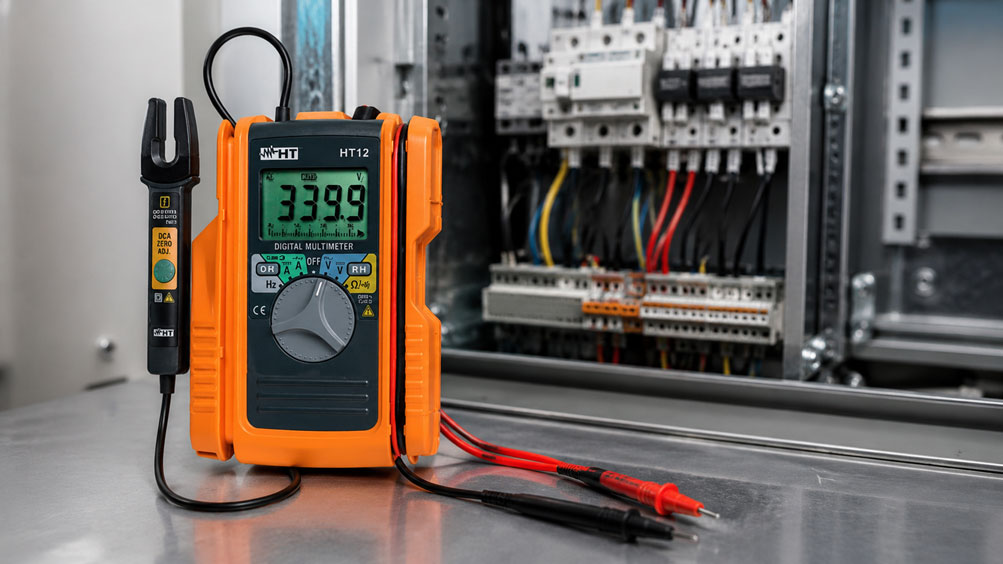
Current measurements are among the most common tasks in service, maintenance, control cabinet construction and troubleshooting. In practice, however, it is often impractical or even undesirable to disconnect a cable just to measure the current in series with a multimeter. Machines should not be stopped unnecessarily, control cables are tightly wired, and in distribution boards there is often not enough space for complex measuring setups.
This is exactly where a digital multimeter with an integrated current clamp or fork current clamp is particularly useful. It enables current measurements without disconnecting the conductor and without inserting test leads into the circuit. The conductor is enclosed by the clamp or fork, and the measuring instrument detects the current without direct electrical interruption of the current path.
This article explains when a digital multimeter with current clamp is useful, how it differs from classic current measurement with test leads, why different measuring principles are relevant for AC and DC currents and which typical application errors should be avoided. Suitable products and categories can be found, among others, in the area of electrical measuring and test instruments, current clamps / flexible current transformers and the HT12 digital multimeter with 60 A AC/DC fork current clamp.
Table of contents
- Why measure current without disconnecting the cable?
- Classic current measurement with a multimeter: Why it is often cumbersome
- How does current measurement with a current clamp or fork current clamp work?
- Digital multimeter, current clamp or combination instrument: What is the difference?
- Measuring AC and DC current: Why the measuring instrument must match the task
- Enclose only one conductor: The most important application error
- Typical measuring points in service and maintenance
- Correctly evaluating measuring range, resolution and accuracy
- Safety during current and voltage measurements
- Limits of current clamp measurement
- Suitable products and product areas
- Practical example: Checking the current consumption of a machine
- Conclusion: Current measurement becomes easier when the instrument matches the task
- FAQ: Frequently asked questions about digital multimeters with current clamp
Why measure current without disconnecting the cable?
A current measurement determines which electrical current flows through a conductor. In many applications, this value is crucial for evaluating load conditions, narrowing down faults or checking components. A motor draws too much current, a power supply is loaded more heavily than expected, a consumer does not switch correctly, or a machine shows sporadic failures. In such cases, current consumption is often an important indicator.
Classic current measurement with a multimeter requires the measuring instrument to be connected in series with the consumer. To do this, the circuit must be opened and the multimeter inserted into the current path. In practice, this is often impractical. Cables have to be loosened, terminals can be damaged, operation is interrupted, and incorrect handling creates additional safety risks.
A current clamp or fork current clamp avoids this problem. It measures the current via the magnetic field that forms around a current-carrying conductor. The conductor remains connected, the circuit remains closed, and the measurement can be carried out much faster. This saves time and reduces interference with the installation, especially during service work, in control cabinets, on machines or during recurring checks.
Compact combination instruments that combine a digital multimeter with an integrated current clamp are particularly practical. They can measure current without disconnecting cables and also provide typical multimeter functions such as voltage measurement, resistance measurement, continuity testing or frequency measurement. This makes one instrument sufficient for many simple diagnostic tasks.
Classic current measurement with a multimeter: Why it is often cumbersome
A normal digital multimeter measures current by allowing the current to flow through the measuring instrument itself. To do this, the circuit is interrupted and the multimeter is connected in series. This method can be very accurate, but it is only useful when the circuit can be opened safely and the expected current is within the measuring range of the multimeter.
In everyday service work, this is often not the case. In a control cabinet, cables are permanently wired, conductors are close together, terminals are difficult to access, and the system should ideally not be switched off. In addition, direct current measurement always carries the risk of connecting the multimeter incorrectly. If a multimeter in the current measuring range is accidentally connected in parallel to a voltage source, a short circuit can occur and the internal fuse of the measuring instrument may trip.
For higher currents, direct measurement via a multimeter is additionally limited. Many multimeters are designed only for specific current ranges and measuring durations. These limits can quickly be reached with machines, motors, heaters, power supplies or DC consumers. A clamp measurement is much more practical here because the load current is not routed through the measuring instrument.
This does not mean that classic current measurement is obsolete. It can still be useful for small currents, electronics, signal currents or precise laboratory measurements. For quick checks on installed cables, however, a current clamp or a multimeter with integrated fork current clamp is usually the much simpler solution.
How does current measurement with a current clamp or fork current clamp work?
Every electric current generates a magnetic field around the conductor. A current clamp uses this magnetic field to detect the current without electrically interrupting the conductor. Classic AC current clamps often use a transformer-based principle. The conductor acts like a primary winding, while the clamp acts as a measuring transformer. This works very well for alternating current, but not for direct current.
For DC current measurements, a different measuring principle is required, often using Hall sensors or comparable methods. These can also detect static magnetic fields and therefore measure DC currents. This is why it is important to know whether an instrument can measure only AC current or both AC and DC current.
A fork current clamp works in a similar way, but has a different mechanical design. Instead of a fully closing clamp, it has an open measuring fork. The conductor is guided into the fork without having to open and close a clamp. This is especially practical for individual conductors in control cabinets or easily accessible wires. The disadvantage is that conductor diameter and positioning can be more limited than with larger clamps.
With compact devices such as a digital multimeter with fork current clamp, the main advantage is ease of use. The user can measure current via the fork and also check voltage or resistance via test leads with the same instrument. This is very efficient for many maintenance and diagnostic tasks.
Digital multimeter, current clamp or combination instrument: What is the difference?
A digital multimeter is a universal measuring instrument for electrical quantities such as voltage, resistance, continuity, frequency and, depending on the version, current. Direct current measurement is carried out conventionally via test leads and internal current measuring ranges. This is flexible, but current measurement often requires the cable to be disconnected.
A current clamp, on the other hand, is designed for current measurement around the conductor. Many current clamps also offer multimeter functions, but they are mechanically larger and intended for larger conductor cross-sections or higher current ranges. They are very suitable for distribution boards, motor cables, power distribution, larger consumers and measurements on individual phase conductors.
A digital multimeter with integrated fork current clamp lies between these two worlds. It remains compact like a multimeter, but can also measure currents via the fork. This is ideal when small to medium currents need to be checked regularly without carrying a separate current clamp every time. For very high currents, large conductor diameters or power measurements, however, a larger current clamp, multifunction clamp meter or power analyzer is more suitable.
| Instrument type | Typical strength | Typical limitation |
|---|---|---|
| Digital multimeter | Universal measurement of voltage, resistance, continuity and small currents | Current measurement often requires opening the circuit |
| Current clamp | Current measurement without interrupting the cable, also at higher currents | Depending on the instrument, less compact and not always ideal for narrow control cabinets |
| Digital multimeter with fork current clamp | Compact combination of multimeter and current measurement without disconnecting the cable | Conductor diameter and current range are limited by the fork |
| Power analyzer | Evaluation of current, voltage, power, energy and power quality | Often too extensive for simple quick checks |
The right choice therefore depends not only on whether current needs to be measured. The decisive factors are how high the current is, whether AC or DC is being measured, how accessible the conductor is and whether voltage, power, energy or power quality must also be evaluated.
Measuring AC and DC current: Why the measuring instrument must match the task
An important selection criterion is whether alternating current, direct current or both must be measured. In classic installations and machines, AC currents often occur, for example with single-phase or three-phase consumers, motors, pumps, fans or heaters. In control systems, battery systems, DC drives, power supplies, vehicle technology or solar applications, DC currents may be relevant instead.
Not every current clamp can measure direct current. An instrument designed only for AC does not provide a meaningful value for DC currents. For direct current, an AC/DC current clamp or a multimeter with AC/DC fork current clamp is required. This applies especially to 24 V DC control circuits, battery applications or DC consumers in machines.
Mixed signals can also occur. Modern systems often contain frequency inverters, switched-mode power supplies and electronic consumers. The current waveform is then not always sinusoidal. For such measurements, it is important whether the measuring instrument records true RMS values and is suitable for the respective waveform. A simple average-value measurement can lead to incorrect results with distorted current waveforms.
For a quick service check, the question is often simply: Is current flowing at all, and is the magnitude plausible? For an accurate evaluation of power, network load or energy consumption, pure current measurement is not sufficient. In that case, voltage, phase angle, power factor and time profile must also be considered.
Enclose only one conductor: The most important application error
The most common mistake when measuring current with a clamp or fork is enclosing several conductors at the same time. If outgoing and return conductors are enclosed together, the magnetic fields largely cancel each other out. The measuring instrument then shows a much too low value or almost zero, even though current is actually flowing.
For this reason, current measurement must always be carried out on one individual current-carrying conductor. In a single-phase cable, this means, for example, only the phase conductor or only the neutral conductor, not the complete cable with both wires. In three-phase systems, one individual phase is measured depending on the question. If several phases are inside the clamp at the same time, the measured value cannot be interpreted as an individual phase current.
In practice, this is particularly important with connection cables of devices. A complete device plug or complete sheathed cable cannot simply be enclosed with the current clamp if the operating current is to be measured. Instead, one individual conductor must be accessible, for example in the control cabinet, at a terminal or via a suitable measuring adapter.
Exceptions are special residual current or leakage current measurements. In those cases, the sum of several conductors is deliberately considered in order to detect differential currents. However, this is a different measuring task and requires suitable measuring instruments with sufficiently high resolution. For normal load current measurement, the rule is: Always place only one conductor in the clamp or fork.
Typical measuring points in service and maintenance
A digital multimeter with current clamp is particularly useful when existing systems need to be checked quickly to see whether a consumer is drawing current. This can be done at motor outputs, power supplies, valves, heaters, pumps, fans, chargers, control circuits or DC consumers. The major advantage is that the circuit does not have to be opened.
In control cabinets, the current consumption of individual outputs can be checked. This makes it possible to see, for example, whether a consumer is actually switched on, whether a power supply is unusually heavily loaded or whether a machine draws different currents in different operating states. In DC control systems, an AC/DC fork current clamp can help check currents in 24 V circuits without removing wires from terminals.
The method is also helpful when troubleshooting machines. If a drive does not start, it can be checked whether current flows during the start attempt. If a solenoid valve does not switch, the current consumption of the coil can provide information. If a power supply regularly fails, the load on the output side can be checked.
| Measuring point | Typical question | Benefit of clamp measurement |
|---|---|---|
| Motor output | Is the motor drawing too much current during operation? | Fast comparison of current consumption without interrupting the cable |
| Power supply output | Is a 24 V DC circuit overloaded? | DC current can be checked without loosening terminals |
| Heater or heating circuit | Is the expected load current flowing? | Functional check possible during operation |
| Solenoid valve or coil | Is the coil electrically energized? | Current consumption shows whether the consumer is active |
| Machine output | Does the current change depending on the load state? | Load states can be compared quickly |
Current measurement often provides an initial diagnosis. It shows whether a consumer is active and roughly how much current is flowing. For a complete evaluation, further measurements may then be necessary, for example voltage, resistance, continuity or insulation condition.
Correctly evaluating measuring range, resolution and accuracy
When selecting a digital multimeter with current clamp, the measuring range should match the application. An instrument with 60 A AC/DC is very practical for many service tasks, control circuits, smaller consumers, DC loads and compact machine outputs. For large motors, main distribution boards or high load currents, however, a larger current clamp or multifunction clamp meter with a higher measuring range is required.
Resolution is particularly important for small currents. If only a few milliamperes or very small leakage currents need to be measured, a normal load current clamp is often not sufficient. Special mA current clamps or leakage current clamps are better suited for this. An instrument designed for 60 A is not automatically the best choice for very small residual currents.
The position of the conductor in the clamp or fork can also influence the measurement. Many instruments measure most accurately when the conductor is positioned as correctly as possible in the intended measuring area. In very tight control cabinets or with poorly accessible wires, unfavorable positioning can cause deviations.
The signal waveform should also be considered. With non-sinusoidal currents, frequency inverters or switched power supplies, measurement accuracy can depend on bandwidth, true RMS function and measuring method. This is often sufficient for simple plausibility checks, but for accurate electrical power assessments, a suitable measuring instrument should be used.
Safety during current and voltage measurements
Even though a current clamp does not open the circuit, the measurement is still work on or near electrical installations. The appropriate measurement category, permissible voltage, condition of the measuring instrument, test leads and environment must match the application. Especially in distribution boards, machines and industrial installations, high short-circuit currents and dangerous voltages can occur.
Voltage measurements with test leads have additional requirements. The test leads must be suitable and undamaged, the correct sockets must be used, and the measuring instrument must be set to the appropriate function. Especially with combination instruments, it is important to consciously distinguish between current measurement via the fork and voltage measurement via test leads.
Work on electrical installations may only be carried out by qualified persons or under their responsibility. Before each measurement, it should be clear which voltage level is present, which protective measures apply and whether measurement under voltage is permitted and necessary. Personal protective equipment and company safety rules must be observed.
Another safety aspect is the interpretation of the measured value. A current clamp shows whether current is flowing. It does not replace verification of absence of voltage. A conductor can be live even if no load current is flowing at that moment. Conversely, a current value can only be evaluated correctly if the circuit and operating state are known.
Limits of current clamp measurement
Current measurement with a clamp or fork is very practical, but it has clear limits. Initially, it only shows the current through the conductor being measured. It does not automatically indicate whether the voltage is correct, whether the power is correct, whether the power factor is unfavorable or whether a consumer is operating efficiently. For electrical power and energy, current and voltage must be considered together.
With three-phase consumers, measuring one phase is often only sufficient for an initial assessment. If unbalances, phase failures or different loads are suspected, all relevant phase conductors should be considered. With motors, the starting current can also be interesting, and a normal current measurement may not fully capture it.
For very small currents, leakage currents or residual currents, special measuring instruments are required. A normal load current clamp is usually not sensitive enough for this. For RCD problems, leakage currents or insulation faults, leakage current clamps, insulation testers or VDE testers are the more suitable solution.
Even with strongly switched, high-frequency or distorted signals, it should be checked whether the measuring instrument is suitable for the waveform. This applies, for example, to frequency inverters, switched-mode power supplies, LED drivers or certain DC/DC converters. In such cases, a simple current measurement can provide indications, but cannot replace a complete analysis.
Suitable products and product areas
For compact service and maintenance tasks, the HT12 digital multimeter with 60 A AC/DC fork current clamp is a suitable solution. It combines the advantages of a digital multimeter with an integrated fork current clamp. This allows AC and DC currents to be measured without disconnecting the conductor. In addition, typical multimeter functions for voltage, resistance, continuity and frequency are available.
If higher currents, larger conductor cross-sections or more extensive current measuring tasks are involved, instruments from the category current clamps / flexible current transformers are useful. Depending on the application, classic current clamps, multifunction clamp meters, flexible current transformers or special mA and leakage current clamps may be suitable.
For general electrical testing and measuring tasks, it is also worth looking at the category electrical measuring and test instruments. In addition to multimeters and current clamps, this area also includes installation testers, insulation testers, power quality analyzers, power and energy analyzers and other instruments for service, maintenance and electrical safety.
The selection should always be based on the measuring task. For quick AC/DC current checks on individual conductors, a compact multimeter with fork current clamp is very practical. For high currents, power analysis, power quality or long-term recording, specialized measuring instruments are the better choice.
Practical example: Checking the current consumption of a machine
In a workshop, it is noticed that a machine occasionally does not start reliably. The control system does not show a clear error message. The first suspicion is the power supply or a consumer that draws too much current when switching on. However, the machine should not be dismantled unnecessarily, and the cables in the control cabinet should not be disconnected for a simple measurement.
Using a digital multimeter with fork current clamp, the current consumption of an individual output is checked first. The technician guides the relevant conductor into the measuring fork and starts the machine. The current value shows whether the consumer is actually active during start-up and approximately how high the load is. Then different operating states are compared: standstill, start-up, normal operation and load caused by the process.
In addition, the supply voltage is checked using the test leads. This makes it possible to see whether the consumer is drawing current while a voltage dip occurs at the same time. The combination of current and voltage measurement provides a much clearer picture than a single measurement.
In this example, it turns out that a 24 V DC consumer draws significantly more current than expected. The cause is not the main drive, but an auxiliary consumer that is mechanically stiff. Without clamp current measurement, the fault would have been difficult to narrow down because the cable could not easily be disconnected.
The example shows: Current measurement without interrupting the cable is often the fastest way to make load conditions visible. It does not replace every further check, but it provides a very important basis for troubleshooting.
Conclusion: Current measurement becomes easier when the instrument matches the task
A digital multimeter with current clamp or fork current clamp is a very practical solution when currents need to be measured quickly and without disconnecting the cable. Especially in service, maintenance, control cabinet construction and machine testing, this measuring method saves time and reduces interference with existing wiring.
It is important to select the measuring instrument to match the application. AC and DC currents require a suitable measuring principle. The measuring range must match the expected current. The conductor must be captured individually. And for more complex questions such as power, energy, power quality, leakage current or inrush current, specialized measuring instruments may be required.
For compact AC/DC current measurements up to 60 A, the HT12 digital multimeter with fork current clamp is a suitable solution. For larger measuring tasks, additional current clamps and flexible current transformers as well as comprehensive electrical measuring and test instruments are available. The decisive factor is not only that current is measured, but that the measuring method fits the real situation.
FAQ: Frequently asked questions about digital multimeters with current clamp
Can current be measured without disconnecting the cable?
Yes. With a current clamp or fork current clamp, the current through an individual conductor can be measured without opening the circuit. The conductor is captured by the clamp or fork while the cable remains connected.
What is a digital multimeter with current clamp?
A digital multimeter with current clamp combines classic multimeter functions with current measurement via clamp or fork. This means that in addition to voltage, resistance or continuity, currents can also be measured without inserting test leads in series.
What is the advantage of a fork current clamp?
A fork current clamp is particularly compact and quick to use. The conductor is guided into the open measuring fork without having to open and close a clamp. This is especially practical for individual conductors in control cabinets.
Can a current clamp measure AC and DC current?
Only if it is designed for this. Many simple current clamps measure only AC current. For DC currents, an AC/DC-capable measuring instrument is required, for example a digital multimeter with AC/DC fork current clamp.
Why must the complete cable not be enclosed with the current clamp?
If outgoing and return conductors are captured at the same time, the magnetic fields largely cancel each other out. The measuring instrument then shows an incorrect or almost zero value. For load current measurements, one individual conductor must be enclosed.
Can I measure the power of a consumer with a current clamp?
A simple current clamp initially measures only the current. For electrical power, voltage and, depending on the application, phase angle and power factor must also be considered. Power analyzers or suitable clamp meters with power functions are useful for this.
Is current clamp measurement as accurate as direct current measurement?
That depends on the measuring instrument, measuring range, conductor position, current waveform and application. Clamp measurement is very practical for quick service and plausibility checks. For very small currents or high-accuracy laboratory measurements, direct measurement or a special measuring instrument may be required.
Which errors commonly occur when measuring current with a clamp?
Common errors include enclosing several conductors at the same time, using an unsuitable measuring range, using an AC-only instrument for DC current, incorrect conductor position in the clamp or confusing current measurement with power evaluation.
Can I measure leakage currents with a normal current clamp?
For small leakage or residual currents, a normal load current clamp is usually not sensitive enough. Special leakage current clamps or residual current clamps are better suited for this.
Which instrument is suitable for compact AC/DC current measurements in service?
For compact service tasks, for example, the HT12 digital multimeter with 60 A AC/DC fork current clamp is suitable. It enables AC/DC current measurements without interrupting the cable and also offers typical multimeter functions.
When do I need a larger current clamp instead of a multimeter with fork current clamp?
A larger current clamp is useful when higher currents, larger conductor diameters, three-phase measurements, power measurements, inrush current measurements or longer recordings are required. In that case, instruments from the area of current clamps / flexible current transformers are the more suitable solution.