


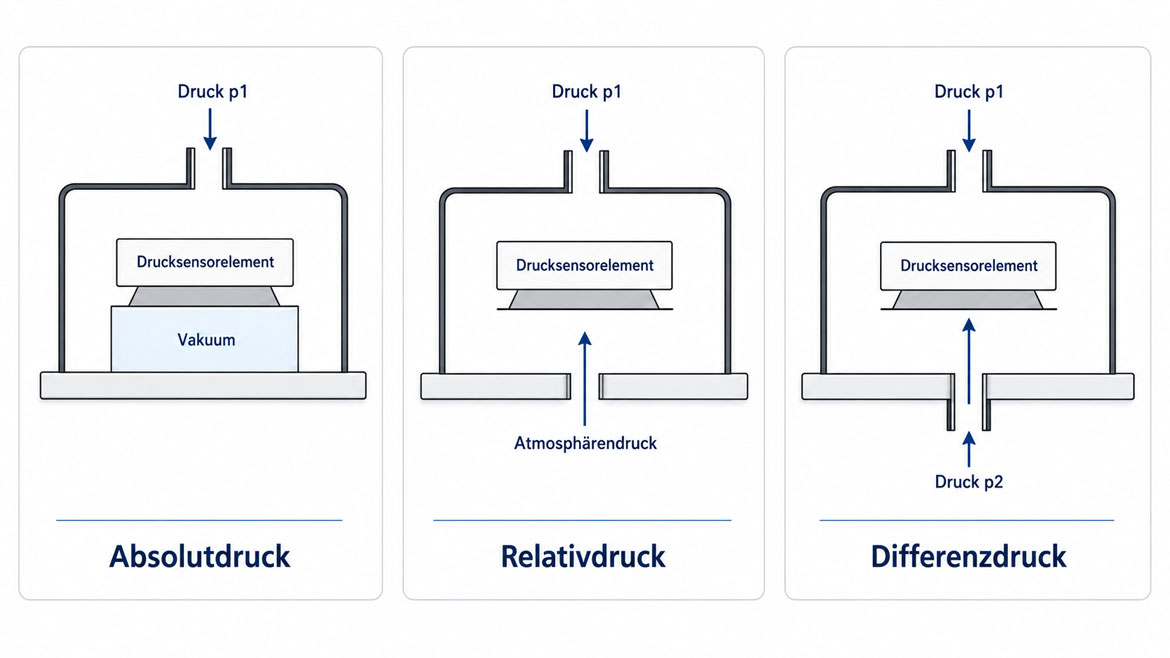
When selecting a pressure transmitter, the first questions are often about measuring range, output signal and process connection. These are important, but they are not enough. One of the key questions is: Which type of pressure actually needs to be measured? Gauge pressure, absolute pressure and differential pressure describe different measuring tasks. If the wrong pressure type is selected, even a technically high-quality pressure transmitter can deliver incorrect or unusable measured values.
Many incorrect orders arise exactly at this point. A pressure sensor for gauge pressure is not automatically suitable for absolute pressure measurement. An absolute pressure transmitter does not measure the same thing as a differential pressure transmitter. And a differential pressure transmitter is not only used for filter monitoring, but also for level measurement, flow measurement via differential pressure or density applications. This article explains the differences in an understandable way and uses typical practical examples to show which pressure transmitter is suitable for which application.
Suitable products and categories can be found, among others, in the areas of process transmitters / differential pressure transmitters, pressure sensors / differential pressure sensors, differential pressure sensors / differential pressure transmitters as well as products such as the SITRANS P320 process transmitter, the SITRANS P420 process transmitter, the UNIK 5000 pressure sensor, the ADROIT6000 pressure sensor and the WIKA S-20 pressure transmitter.
Table of contents
- Why the correct pressure type is so important
- Gauge pressure: Measurement against the current atmospheric pressure
- Absolute pressure: Measurement against absolute vacuum
- Differential pressure: Measurement between two pressure connections
- Gauge pressure, absolute pressure and differential pressure in comparison
- Tank pressure and process pressure: When gauge pressure is suitable
- Vacuum applications: Why absolute pressure is often the better choice
- Filter monitoring: Differential pressure as an indicator of contamination
- Level measurement with pressure and differential pressure
- Flow measurement via differential pressure
- Density and interface level: Advanced differential pressure applications
- Typical selection errors with pressure transmitters
- Choosing measuring range, zero point and units correctly
- Suitable pressure transmitters and product areas
- Practical example: One tank, three different measuring tasks
- Conclusion: The pressure type determines the correct measurement
- FAQ: Frequently asked questions about gauge pressure, absolute pressure and differential pressure
Why the correct pressure type is so important
Pressure is not always the same measured value. A pressure transmitter can measure against the environment, against absolute vacuum or against a second process pressure. This reference level determines what the sensor actually outputs. If the reference level does not match the application, the measured value may be stable and reproducible, but technically misinterpreted.
A typical error occurs when a user orders a gauge pressure sensor even though the application requires a stable reference to absolute vacuum. Conversely, an absolute pressure sensor is sometimes used even though the process actually only needs to measure overpressure relative to the environment. Confusion is particularly common in vacuum applications, closed vessels, filter monitoring, level measurement and flow measurement using differential pressure.
The difference is not merely theoretical. A gauge pressure sensor indirectly changes its measured value with atmospheric pressure because it is referenced against the current atmosphere. An absolute pressure sensor does not do this because its reference point is absolute vacuum. A differential pressure transmitter, in turn, only indicates the difference between two connections, regardless of whether both sides are at a high or low pressure level.
Therefore, the selection of a pressure transmitter should always begin with the question: Against which reference should the measurement be made? Only then should measuring range, accuracy, output signal, process connection, materials, approvals and electrical connection be considered.
Gauge pressure: Measurement against the current atmospheric pressure
Gauge pressure is the most commonly used pressure type in many industrial applications. The sensor measures the process pressure in relation to the current ambient pressure. If a pressure gauge or pressure transmitter indicates 0 bar gauge pressure, this means that the pressure at the process connection approximately corresponds to the current atmospheric pressure.
Gauge pressure is also often referred to as overpressure. In technical data, it is commonly marked with “g”, “gauge”, “rel.” or “overpressure”. A measuring range of 0…10 bar gauge means that the sensor measures from atmospheric pressure up to 10 bar above atmospheric pressure. Measuring ranges with a negative starting value, for example -1…+10 bar, can also detect vacuum relative to the environment.
Typical applications for gauge pressure include hydraulics, pneumatics, compressed air networks, pumps, machines, water lines, vessels with atmospheric reference and many general process pressure measurements. The major advantage is that the measured value corresponds to what many users know from a conventional pressure gauge display.
However, it must be noted that atmospheric pressure is not constant. It changes with weather conditions and altitude above sea level. For many overpressure applications this is not critical. However, in vacuum measurements, very low pressure ranges or processes where absolute pressure conditions are decisive, this dependency can cause problems.
Absolute pressure: Measurement against absolute vacuum
Absolute pressure is measured against absolute vacuum. The zero point of an absolute pressure sensor is therefore 0 bar absolute, a theoretically completely pressure-free state. Atmospheric air pressure is approximately 1 bar absolute, depending on the environment. An absolute pressure transmitter therefore does not show 0 bar when open to the atmosphere, but approximately the current atmospheric pressure.
This pressure type is always important when the actual physical pressure is required independently of weather influences or altitude. This is relevant, for example, in vacuum processes, barometry, laboratory applications, closed processes, vapor pressure considerations, gas laws, certain test benches or applications with very low pressures.
A typical difference can be seen in a vacuum application. A gauge pressure sensor with a measuring range of -1…0 bar shows the vacuum relative to the atmosphere. An absolute pressure sensor with a measuring range of 0…1 bar absolute, on the other hand, shows the actual residual pressure in the system. For many vacuum processes, this residual pressure is the more technically meaningful value.
Absolute pressure is often marked with “a”, “abs.” or “absolute”. This information is particularly important when ordering. A sensor 0…10 bar gauge and a sensor 0…10 bar absolute may look similar from the outside, but they deliver different measured values and are not interchangeable at will.
Differential pressure: Measurement between two pressure connections
Differential pressure describes the pressure difference between two measuring points. A differential pressure transmitter therefore has two pressure connections, often referred to as the plus and minus side. The device does not measure pressure against atmosphere or against vacuum, but the difference between the two connections.
If the plus side is at 5 bar and the minus side is at 4.8 bar, the differential pressure is 0.2 bar. The operating pressure on both sides can be significantly higher than the actual difference. This is exactly what makes differential pressure transmitters so important for process applications. They can detect small pressure differences even though both process connections are at a high static pressure level.
Typical applications include filter monitoring, level measurement in closed vessels, flow measurement via orifice plates or differential pressure elements, density or interface measurement as well as pressure loss measurements in pipelines, heat exchangers, ventilation systems and process systems.
The selection of a differential pressure transmitter requires special attention. In addition to the differential pressure measuring range, the permissible static pressure is also important. A transmitter must not only measure the small difference accurately, but also safely withstand the operating pressure on both sides.
Gauge pressure, absolute pressure and differential pressure in comparison
The following table shows the three pressure types in direct comparison. It serves as an initial orientation, but does not replace a specific design review. The decisive factors are always the application and the question of which reference point is relevant for the process.
| Pressure type | Reference point | Typical marking | Typical applications |
|---|---|---|---|
| Gauge pressure | Current atmospheric pressure | bar(g), rel., gauge, overpressure | Hydraulics, pneumatics, compressed air, pumps, water lines, general process pressure |
| Absolute pressure | Absolute vacuum | bar(a), abs., absolute | Vacuum processes, barometry, laboratory, closed processes, low absolute pressures |
| Differential pressure | Pressure difference between two connections | Δp, dP, mbar, Pa, bar differential | Filters, level in closed tanks, flow via differential pressure, density, pressure loss |
A simple rule of thumb helps with the initial selection: If the process pressure relative to the environment is relevant, gauge pressure is usually required. If the actual pressure independent of atmosphere and weather conditions is relevant, absolute pressure is required. If two pressure points are to be compared with each other, differential pressure is required.
Tank pressure and process pressure: When gauge pressure is suitable
For many vessels, pipelines and machines, gauge pressure is sufficient. If a compressed air vessel is operated at 8 bar, the user usually means 8 bar above atmospheric pressure. In hydraulic systems, pump pressure, water pressure or pneumatic systems, overpressure relative to the environment is also usually decisive.
Gauge pressure transmitters are therefore the obvious choice for many classic industrial applications. They provide a signal that corresponds to the technical understanding of many users. In such applications, a pressure switch, a pressure gauge and a gauge pressure transmitter often show comparable values, provided that measuring range and installation position are suitable.
In open vessels, gauge pressure can also be used for hydrostatic level measurement. The pressure at the bottom of the vessel depends on filling height, density and gravitational acceleration. Since the vessel is open to the atmosphere, atmospheric pressure also acts on the surface of the liquid. The gauge pressure at the lower measuring point then corresponds to the hydrostatic pressure of the liquid column.
Gauge pressure becomes problematic when the vessel is closed or blanketed. In this case, an additional gas or vapor pressure acts above the liquid. A single gauge pressure sensor at the bottom then measures not only the level pressure, but level plus head pressure. For such applications, differential pressure measurement or a suitable process measurement solution is often required.
Vacuum applications: Why absolute pressure is often the better choice
In vacuum applications, the choice of pressure type is particularly important. A gauge pressure sensor indicates the pressure below the current atmospheric pressure. This can be sufficient for simple technical vacuum indications, for example when the only question is whether a suction system generates vacuum.
However, if the actual residual pressure in the system is relevant, absolute pressure is often the better choice. In vacuum chambers, test benches, packaging processes, laboratory applications or drying processes, it is often important how close the process comes to a specific absolute pressure value. This value should not depend on whether the current weather conditions are high or low pressure.
An example shows the difference: A gauge pressure sensor may show -0.9 bar at good vacuum. An absolute pressure sensor, on the other hand, shows 0.1 bar absolute. Both values can describe the same condition, but they have different reference points. For technical specifications, it is decisive which representation is required.
For vacuum applications, it should also be checked whether the sensor is suitable for the desired pressure range. A gauge pressure sensor with -1…0 bar can be suitable for simple vacuum measurements. For finer vacuum ranges, very low absolute pressures or demanding processes, special absolute pressure sensors or vacuum measuring instruments are required.
Filter monitoring: Differential pressure as an indicator of contamination
Filters are often monitored using differential pressure. The pressure before and after the filter is compared. If the filter is clean, the pressure loss is low. As contamination increases, the resistance of the filter rises and the pressure difference increases. Differential pressure is therefore a direct measure of the filter condition.
A gauge pressure sensor before the filter is not sufficient for this task. It only shows the pressure at one point. If the operating pressure in the system fluctuates, this value can rise or fall without the filter condition actually changing. Only the difference between upstream and downstream pressure shows how strongly the filter is restricting the flow.
Differential pressure monitoring is used in liquid filters, gas filters, hydraulic filters, air filters, ventilation systems, cleanrooms, process plants and many machines. Depending on the application, very small differential pressures in pascal or millibar, or significantly higher values, may be relevant.
When selecting the transmitter, it is important that the differential pressure measuring range matches the expected pressure loss and that the transmitter safely withstands the static operating pressure. In a process with 10 bar operating pressure and 100 mbar filter differential pressure, the transmitter must measure the small difference accurately while also being suitable for the operating pressure.
Level measurement with pressure and differential pressure
Level can be measured via hydrostatic pressure. The pressure at the lower measuring point of a vessel increases with the filling height. In open vessels, a gauge pressure transmitter or hydrostatic level probe is often sufficient because the liquid surface is exposed to atmospheric pressure.
In closed or pressurized vessels, the situation is different. A gas pressure, vapor pressure or process pressure may exist above the liquid. A single gauge pressure sensor at the bottom would then measure the hydrostatic pressure plus the head pressure. The level would therefore be falsified.
In such cases, differential pressure is often used. The plus side of the transmitter is connected to the lower vessel connection, the minus side to the gas space or upper connection. The differential pressure then corresponds to the hydrostatic pressure of the liquid column, while the head pressure is compensated mathematically or by measurement.
For level measurements, density, medium temperature, installation height, capillary lines, diaphragm seals, condensation and possible vapor phases must also be considered. The correct pressure type is therefore only the first step. The mechanical and process-related design is equally important.
| Vessel type | Typical pressure measurement | Note |
|---|---|---|
| Open vessel | Gauge pressure or hydrostatic probe | Atmospheric pressure acts on the liquid surface |
| Closed vessel without pressure fluctuation | Gauge pressure or differential pressure, depending on application | Head pressure must be evaluated |
| Pressurized vessel | Differential pressure | Head pressure is compensated via a second measuring line |
| Vessel with vapor phase | Differential pressure with suitable process design | Observe condensate, temperature and diaphragm seals |
Flow measurement via differential pressure
Differential pressure transmitters are also used for flow measurements. A differential pressure primary element such as an orifice plate, nozzle, Venturi section or pitot element is installed in the pipeline. The flow creates a pressure difference between two measuring points. The flow rate can be calculated from this pressure difference.
This measuring method is widely used in many process plants. It is robust, well known and suitable for different media. However, the differential pressure is not linear to the flow rate. A square root function is often required because the flow rate is proportional to the square root of the differential pressure.
When selecting the transmitter, measuring span, static pressure, medium, temperature, impulse lines, zero point, mounting position and signal processing are important. A differential pressure transmitter for flow must not only cover the correct differential pressure range, but also match the process design of the primary element.
A common mistake is selecting a differential pressure range that is too large. The normal operating range then lies only in the lower part of the measuring span, and measurement accuracy deteriorates. Conversely, the range must not be selected too small if higher flows or pressure surges can occur.
Density and interface level: Advanced differential pressure applications
Differential pressure can measure not only pressure loss, level or flow. In certain applications, differential pressure can also be used to evaluate density or an interface between two liquids. This uses the fact that the hydrostatic pressure of a liquid column depends on filling height and density.
If the height is known and the differential pressure is measured, density can be inferred. Conversely, if the density is known, the level can be determined. In vessels with two liquids of different densities, differential pressure measurement can provide information about the position of the interface if the process conditions are sufficiently known.
Such applications are more demanding than simple pressure measurements. Temperature, density changes, process connections, diaphragm seals, capillary lines and installation situation must be considered very carefully. Parameterization of the transmitter and evaluation in the control system also play an important role.
This shows particularly clearly that differential pressure transmitters are very versatile. They do not only measure “two pressures”, but provide a process variable from which level, flow, density or filter condition can be derived depending on the application.
Typical selection errors with pressure transmitters
A common error is ordering a gauge pressure sensor for an absolute pressure application. This is often only noticed during operation, when measured values fluctuate slightly depending on weather conditions or location, or when they do not match the process specification. Especially in vacuum and low pressure ranges, this can lead to significant misunderstandings.
Another error is using a single gauge pressure sensor for level measurement in a closed, pressurized tank. The sensor then measures not only the level, but also the head pressure. If this head pressure fluctuates, the apparent level also fluctuates, even though the actual filling height may remain the same.
In filter monitoring, sometimes only the pressure before the filter is measured. However, this only allows the filter condition to be assessed to a limited extent, because the system pressure itself can fluctuate. A differential pressure transmitter is usually the much more meaningful solution here.
Confusing the differential pressure measuring range with the static operating pressure is also critical. A transmitter with a measuring range of 0…100 mbar differential pressure may still be able to operate at a process pressure of several bar if its static pressure rating is designed for this. Conversely, a small differential pressure measuring range must not automatically be confused with high process pressure resistance.
| Error | Possible consequence | Better approach |
|---|---|---|
| Gauge pressure selected instead of absolute pressure | Measured value depends on atmospheric pressure | Check absolute pressure for vacuum and absolute process limits |
| Single pressure sensor on a closed tank | Level is falsified by head pressure | Use differential pressure or a suitable level solution |
| Filter monitored with only one pressure point | Filter condition is not clearly detected | Compare pressure before and after the filter |
| Static pressure not considered | Differential pressure transmitter can be overloaded | Check operating pressure and overload in addition to measuring span |
| Measuring range selected too large | Poorer resolution and accuracy in the working range | Design measuring span to match the real process |
Choosing measuring range, zero point and units correctly
In addition to the pressure type, the measuring range must be selected sensibly. A pressure transmitter should cover the normal working range well while also providing sufficient reserve for overload, pressure peaks and operating conditions outside normal operation. A measuring range that is too small can lead to overload. A measuring range that is too large often reduces usable accuracy in the relevant range.
For gauge pressure measurements, it must be clarified whether only positive overpressure or also vacuum should be detected. A measuring range of 0…10 bar is not sufficient if the process also generates vacuum relative to atmosphere. In that case, a range such as -1…+10 bar can be useful, provided the sensor is suitable for it.
For absolute pressure measurements, the lower limit is particularly important. For simple applications, 0…2 bar absolute may be sufficient. For demanding vacuum processes, a significantly lower range may be required. The decisive question is which absolute residual pressure actually needs to be evaluated.
For differential pressure measurements, the measuring span must match the expected pressure difference. At the same time, static pressure, one-sided overload, possible pressure surges and correct assignment of the plus and minus sides must be considered. The unit is also important: Differential pressure can be specified in Pa, mbar, bar, kPa or other units. The unit should match the application and the required resolution.
Suitable pressure transmitters and product areas
For demanding process applications in which gauge pressure, absolute pressure, differential pressure, flow or level are to be measured, process transmitters / differential pressure transmitters are a suitable product group. Devices such as the SITRANS P320 or the SITRANS P420 are suitable for many applications in the process industry, energy, water/wastewater, chemicals, oil & gas and mechanical engineering.
For general pressure measurements in machines, plants, hydraulics or pneumatics, pressure sensors / differential pressure sensors are suitable. Depending on the version, gauge pressure, absolute pressure or differential pressure can be measured. Pressure sensors such as the WIKA S-20 are typical solutions for industrial pressure measuring tasks.
If a flexible sensor platform for different pressure types is required, the UNIK 5000 may be of interest. For precise measuring tasks with gauge pressure, absolute pressure or differential pressure, the ADROIT6000 series also offers suitable options.
For pure differential pressure tasks such as filter monitoring, pressure loss, flow or special process measurements, differential pressure sensors / differential pressure transmitters are the right product group. When selecting them, differential pressure measuring range, static pressure, medium, temperature, process connections and output signal should be considered together.
Practical example: One tank, three different measuring tasks
A plant operator wants to record several pressure variables on a tank. At first glance, it seems that all that is required is a pressure transmitter with a suitable measuring range. On closer inspection, however, three different measuring tasks arise.
First, the pressure in the gas space of the tank is to be monitored. This is about the process pressure relative to the environment. If the tank is operated in the normal overpressure range, a gauge pressure transmitter is often the suitable choice. It indicates how high the tank pressure is above the current atmospheric pressure.
In addition, a vacuum condition is to be monitored during a specific process step. If the actual residual pressure in the tank is relevant, a simple gauge pressure indication may not be sufficient. In this case, an absolute pressure transmitter can be useful because it measures independently of the current atmospheric pressure.
Finally, the level in the closed tank is to be measured. A single pressure sensor at the bottom of the tank would measure the hydrostatic pressure of the liquid plus the gas space pressure. If the head pressure fluctuates, the level would be incorrect. For this task, a differential pressure transmitter is useful because it compares the pressure at the tank bottom with the pressure in the gas space.
The example shows: The same tank can require gauge pressure, absolute pressure and differential pressure, depending on which process variable is actually needed. The correct pressure type therefore does not result from the vessel alone, but from the measuring task.
Conclusion: The pressure type determines the correct measurement
Gauge pressure, absolute pressure and differential pressure differ in their reference point. Gauge pressure measures against the current atmosphere, absolute pressure against absolute vacuum and differential pressure between two process connections. This distinction is decisive when selecting the right pressure transmitter.
For many standard applications in hydraulics, pneumatics, water lines and machines, gauge pressure is the right choice. For vacuum processes, barometry and absolute process limits, absolute pressure is required. For filter monitoring, level in closed vessels, flow via differential pressure and density applications, differential pressure is often the suitable solution.
To avoid incorrect orders, users should therefore not only specify measuring range and output signal, but always also describe the desired pressure type and the measuring task. Suitable solutions can be found in the areas of process transmitters / differential pressure transmitters, pressure sensors / differential pressure sensors and differential pressure sensors / differential pressure transmitters. Products such as SITRANS P320, SITRANS P420, UNIK 5000, ADROIT6000 or WIKA S-20 can be suitable starting points for selection, depending on the application.
FAQ: Frequently asked questions about gauge pressure, absolute pressure and differential pressure
What is the difference between gauge pressure and absolute pressure?
Gauge pressure measures against the current atmospheric pressure. Absolute pressure measures against absolute vacuum. A gauge pressure sensor shows approximately 0 bar when open to the atmosphere, whereas an absolute pressure sensor shows approximately the current atmospheric pressure.
When do I need a gauge pressure transmitter?
A gauge pressure transmitter is useful when pressure is to be measured relative to the environment. Typical applications include hydraulics, pneumatics, compressed air, water lines, pumps, machines and many general overpressure measurements.
When is absolute pressure required?
Absolute pressure is required when the actual pressure independent of the current atmospheric pressure is relevant. This often applies to vacuum processes, barometry, laboratory applications, closed processes or applications with low absolute pressures.
What does a differential pressure transmitter measure?
A differential pressure transmitter measures the pressure difference between two connections. It is used, for example, for filter monitoring, level measurement in closed tanks, flow measurement via differential pressure, density applications or pressure loss measurements.
Can I use a gauge pressure sensor for vacuum?
Yes, if the measuring range is designed for it, for example -1…0 bar or -1…+1 bar. However, if the actual residual pressure in the vacuum process is decisive, an absolute pressure sensor is often more suitable.
Why does an absolute pressure sensor not show 0 bar at atmosphere?
Because its zero point is absolute vacuum. When open to the atmosphere, it measures the current atmospheric pressure and therefore shows approximately 1 bar absolute, depending on weather conditions and altitude above sea level.
Which pressure transmitter do I need for an open tank?
For an open tank, a gauge pressure transmitter or hydrostatic level probe is often sufficient because the liquid surface is exposed to atmospheric pressure. The pressure at the bottom then corresponds to the hydrostatic pressure of the liquid column.
Which pressure transmitter do I need for a closed tank?
For a closed or pressurized tank, a differential pressure transmitter is often useful. It compares the pressure at the lower vessel connection with the pressure in the gas space and thereby compensates for the head pressure.
Why is differential pressure used for filter monitoring?
Differential pressure shows the pressure loss across the filter. When the filter becomes contaminated, the pressure loss increases. Differential pressure is therefore much more meaningful than a single pressure measurement before or after the filter.
How does flow measurement via differential pressure work?
In flow measurement via differential pressure, a primary element such as an orifice plate or Venturi section generates a pressure difference. The flow rate can be calculated from this difference. A square root function is often required for this.
What do bar(g) and bar(a) mean?
bar(g) stands for gauge pressure. bar(a) stands for absolute pressure. This information is important because 1 bar(g) is not the same as 1 bar(a).
Which products are suitable for gauge pressure, absolute pressure or differential pressure?
Depending on the application, process transmitters, pressure sensors / differential pressure sensors, SITRANS P320, SITRANS P420, UNIK 5000, ADROIT6000 or WIKA S-20 may be suitable.