


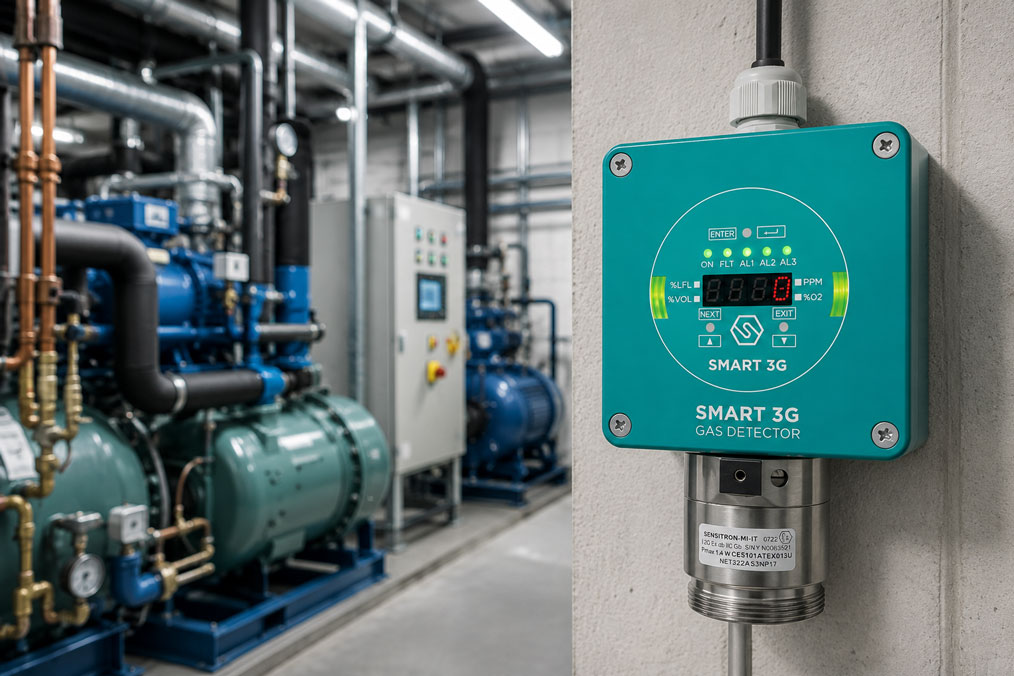
Refrigerants and SF₆ are used in very different technical systems, but they have one important thing in common: leaks should be detected as early as possible. In refrigeration systems, technical rooms, machine rooms, server rooms, heat pump systems, laboratory areas and switchgear rooms, an unnoticed release of F-gases can lead to safety risks, system malfunctions, environmental impact and high follow-up costs.
An F-gas detector is a stationary gas warning device specifically used to monitor certain fluorinated gases. Depending on the version, these include various refrigerant gases and sulfur hexafluoride, or SF₆ for short. Its purpose is not to control a refrigeration system or switchgear, but to detect a leak early and transmit a signal to a control system, building management system, gas warning control unit or alarm system.
This article explains when an F-gas detector is useful, which applications are typical and what should be considered when selecting, installing, alarming, maintaining and integrating it into the control system. The focus is on refrigerant leaks, SF₆ monitoring, stationary IR detection, technical rooms, switchgear, alarm concepts, 4–20 mA signals and regular function checks.
Table of contents
- Basics: what is an F-gas detector?
- Monitoring refrigerants: why leaks should be detected early
- SF₆ in switchgear: why gas monitoring can be useful
- Stationary IR detection: how an F-gas detector works
- Typical places of use: technical room, refrigeration plant room and switchgear room
- Sensor placement: consider gas behavior, leakage source and ventilation
- Alarming, threshold values and response in case of a fault
- Connection to control system, building management system or gas warning control unit
- Maintenance, function test and calibration
- F-gas detector, mobile leak detector or gas warning system?
- Practical example: refrigerant leak in a technical plant room
- Which measuring instruments / products are suitable?
- Conclusion: permanently monitor F-gases instead of detecting leaks too late
- FAQ: frequently asked questions about F-gas detectors for refrigerants and SF₆
Basics: what is an F-gas detector?
An F-gas detector is a stationary gas warning device for monitoring certain fluorinated gases. It is permanently installed in a room or plant area and continuously monitors the ambient air for the target gas. Depending on the version, the device can be designed for different refrigerants or for SF₆. If an increased concentration is detected, the detector outputs a signal that can be used for alarming, ventilation control, fault reporting or system shutdown.
The term F-gas does not refer to a single substance, but to a group of fluorinated gases. In practice, stationary monitoring often concerns refrigerants in refrigeration and air-conditioning systems or SF₆ in electrical switchgear. The detector must therefore always be selected to match the specific gas used. A gas detector is not automatically equally suitable for all refrigerants or all F-gases.
A stationary F-gas detector differs from a mobile leak detector. The mobile device is used selectively to search along pipes, connections, valves or service ports. The stationary detector remains permanently in the room and detects a leak even when no one is actively searching for it. This is an important advantage, especially in unattended technical rooms.
| Term | Meaning in practice | Typical application |
|---|---|---|
| F-gas detector | Stationary gas warning device for certain fluorinated gases | Technical rooms, refrigeration plant rooms, switchgear rooms |
| Refrigerant monitoring | Detection of leaks from refrigeration, air-conditioning or heat pump systems | Refrigeration systems, machine rooms, server rooms, building technology |
| SF₆ monitoring | Monitoring of sulfur hexafluoride in areas with SF₆-filled components | Medium- and high-voltage switchgear, switchgear rooms |
| Mobile leak detection | Targeted search for leaks | Service, maintenance, commissioning, repair |
| Gas warning control unit | Evaluation of multiple detectors and forwarding of alarms | Multiple rooms, larger systems, central alarming |
Monitoring refrigerants: why leaks should be detected early
Refrigerants are used in refrigeration systems, air-conditioning systems, heat pumps, cold stores, industrial refrigeration systems and technical building systems. A leak can have different effects. Depending on the refrigerant, charge quantity, room size, ventilation and system concept, risks to people, environmental impact, efficiency losses, system malfunctions and high refill costs can occur.
A typical problem is that small leaks are not immediately noticed at first. The system may continue to operate, but slowly loses refrigerant. This reduces efficiency, operating conditions shift, compressors are placed under greater load and maintenance costs rise. If the leak is only discovered late, the damage can be significantly greater than with early alarming.
Permanent monitoring is particularly useful in technical rooms or machine rooms where refrigerant lines, compressors, valves, heat exchangers or receivers are present. Stationary detectors can detect an increased concentration in the room air and send a signal to ventilation, building management system or fault reporting.
The design should not be based only on the term “refrigerant”. The decisive factors are which specific refrigerant is used, how much of it is present, where possible leakage sources are located, how the room is ventilated and whether people work there regularly or only occasionally for maintenance. Only from this can a sensible monitoring concept be developed.
SF₆ in switchgear: why gas monitoring can be useful
SF₆ is used in certain electrical switchgear as an insulating and arc-extinguishing gas. In these applications, a high level of tightness of the gas-filled components is important. In addition to the technical function of the switchgear, early detection of gas losses also plays a role. If SF₆ escapes into a room, stationary monitoring can help detect the leak more quickly.
In switchgear rooms, the situation is different from classic refrigeration rooms. Leakage sources are often located at gas-insulated components, screw connections, seals, service ports or fittings. The room is often only accessed occasionally, and a small leak may remain unnoticed if no suitable monitoring is installed.
An F-gas detector for SF₆ can be used as part of a monitoring concept. It does not replace gas density monitoring directly on the switchgear and it does not replace regular maintenance. It supplements these measures by monitoring the room air for escaping gas and forwarding a message to the control system or alarm system.
It is important that the detector is suitable for SF₆ and that the measuring range matches the application. In addition, sensor placement must match the behavior of the gas, the room geometry and possible leakage points. Incorrectly positioned monitoring can react too late or unreliably even with a suitable detector.
Stationary IR detection: how an F-gas detector works
Many F-gas detectors use infrared sensor technology. This makes use of the fact that certain gases absorb infrared radiation in characteristic ranges. The device detects from the change in the IR signal whether the target gas is present in the ambient air. This technology is particularly interesting for many refrigerant and SF₆ applications because it can work selectively and with long-term stability.
Compared with simple semiconductor sensors, infrared measurement can, depending on the device, be less sensitive to humidity, temperature changes or interfering gases. Nevertheless, an IR detector is not a universal measuring instrument for arbitrary gases. It must be matched to the respective target gas or gas group.
A stationary detector measures the room air continuously or in short measuring cycles. If a concentration above a defined alarm level is detected, an output signal can be issued. This signal can be directly integrated into a control system, gas warning control unit, building management system or ventilation control system.
When selecting a device, measuring range, resolution, response time, temperature range, enclosure protection rating, output signal, supply voltage and maintenance concept should be considered. It is equally important whether the device is suitable for the intended area of use, for example a non-hazardous technical room or an industrial environment.
| Selection criterion | Why important? | Typical design question |
|---|---|---|
| Target gas | The sensor must match the refrigerant or SF₆ | Which gas specifically needs to be monitored? |
| Measuring range | Determines which concentrations can be reliably detected | Is the goal early leak detection or high alarm thresholds? |
| Response time | Influences how quickly an alarm is triggered | How quickly must the room respond to a release? |
| Output signal | Determines integration into control system or control unit | Is 4–20 mA, relay, Modbus or another signal required? |
| Installation location | Influences actual leak detection | Where does the gas accumulate under real ventilation conditions? |
Typical places of use: technical room, refrigeration plant room and switchgear room
An F-gas detector is particularly useful in rooms where F-gases may be permanently present and where a leak is not immediately visible or noticeable by smell. These include refrigeration plant rooms, technical rooms, machine rooms, cold stores, building technology areas, heat pump systems, server room cooling systems and rooms with gas-insulated switchgear.
Refrigeration plant rooms often contain compressors, receivers, pipework, valves, safety valves and service ports. These are typical points where leaks can occur. Stationary monitoring is useful here because these rooms are not permanently occupied and a leak should still be detected early.
In building technical rooms, the focus is often on the combination of refrigeration system, ventilation, building management system and fault reporting. The detector can output an alarm message, activate ventilation or send a message to the control room. It is important that the alarm concept is clearly defined: who is informed, what happens automatically and which on-site measures are required?
In switchgear rooms with SF₆ technology, a detector can be used as a supplement to switchgear monitoring. It does not monitor the gas compartment of the switchgear itself, but the room air. This allows it to provide indications of escaping gas if leaks occur at gas-filled components.
Sensor placement: consider gas behavior, leakage source and ventilation
Correct sensor placement is one of the most important points for stationary gas warning devices. A detector only detects the gas that actually reaches its measuring point. The position should therefore not be chosen only for ease of installation, but according to gas behavior, possible leakage sources, room geometry and ventilation.
Many refrigerants are heavier than air and can collect near the floor, in depressions, shafts or poorly ventilated areas. Other gases or heated gas clouds may behave differently. SF₆ is also significantly heavier than air and can collect in lower areas when released. Nevertheless, placement must not be derived from a rule of thumb alone. Airflow, temperature, ventilation outlets, obstacles and room shape can strongly influence gas distribution.
The detector should be installed near likely leakage sources without being placed directly in disturbing airflows or areas where mechanical damage may occur. In larger rooms or complex systems, multiple detectors may be required. A single sensor in an unfavorable location can detect a leak too late.
Maintenance and accessibility must also be considered. The sensor must be accessible for function tests, visual inspection and maintenance. A theoretically ideal position is of little use if the device cannot later be checked or calibrated.
| Influence on sensor placement | Why relevant? | Practical consequence |
|---|---|---|
| Density of the target gas | Determines whether gas tends to accumulate lower down, higher up or in specific areas | Select mounting height according to gas behavior. |
| Leakage source | Gas is first released near the leaking point | Place sensors near critical components. |
| Ventilation | Airflows can dilute gas or transport it to other areas | Consider supply air, exhaust air, fans and air exchange. |
| Room geometry | Depressions, shafts, corners and obstacles influence gas accumulation | Check dead zones and poorly ventilated areas. |
| Accessibility | Maintenance and function testing must remain possible | Do not mount the sensor in an inaccessible or covered position. |
Alarming, threshold values and response in case of a fault
A gas detector is only as effective as the alarm concept behind it. It is not enough to install a sensor if it is not clear what happens when an alarm message occurs. Alarm thresholds, pre-alarm, main alarm, fault message, ventilation control, optical and acoustic signals and forwarding to a control room should be defined in advance.
For refrigerants, an alarm can, for example, trigger a technical fault message, activate ventilation, generate a maintenance message or restrict access to the room. For SF₆, a message to operating personnel or to switchgear monitoring may be useful. The exact response depends on the system, gas type, safety concept and operator requirements.
It is important to distinguish between measured value, warning and protective action. A detector provides a signal or alarm state. Which action follows from this must be defined on the system side. Without clear responsibilities, an alarm message can be overlooked, incorrectly assessed or processed too late.
False alarms should also be considered. A system that is set too sensitively can lead to unnecessary callouts. A system that is set too insensitively may detect leaks too late. Threshold values, delay times, relay logic and fault messages should therefore be set and documented professionally.
Connection to control system, building management system or gas warning control unit
Stationary F-gas detectors are often integrated into existing control or monitoring systems. Typical output signals are analog current or voltage signals, relay contacts, digital interfaces or connection to a gas warning control unit. The specific version depends on the detector, the system and the desired alarm concept.
A 4–20 mA signal is particularly common because it is robust, suitable for industrial use and easy to integrate into PLCs, building management systems or measurement data acquisition. It must be clearly defined which gas concentration corresponds to which mA value and how fault states are represented. An electrically correct signal can be interpreted incorrectly if the scaling in the control system does not match the detector parameterization.
The UPS4E loop calibrator is suitable for testing 4–20 mA signals. It can be used to measure and simulate mA signals, test current loops and detect scaling errors between gas detector, gas warning control unit, PLC or building management system. This is particularly helpful during commissioning, device replacement, maintenance and troubleshooting.
For relay outputs, it should be checked whether the contacts are used as normally closed or normally open contacts, how faults are signaled and whether wire break or supply failure should be detected. In safety-relevant applications, fail-safe design is particularly important. Documentation of the connection logic is also part of the alarm concept.
| Interface | Typical use | What to pay attention to? |
|---|---|---|
| 4–20 mA | Continuous concentration transmission to PLC or building management system | Check scaling, error current, load and supply. |
| 0–10 V / voltage signal | Integration into simple controls or building automation | Consider cable length, interference and input impedance. |
| Relay contact | Alarm, fault, ventilation release or collective message | Document contact logic, switching capacity and fail-safe behavior. |
| Gas warning control unit | Multiple detectors and central alarming | Define addressing, alarm levels, acknowledgement and maintenance mode. |
| Digital interface | Data transmission, diagnostics and integration into control systems | Coordinate protocol, parameterization and data point list. |
Maintenance, function test and calibration
A stationary gas detector must be checked regularly so that it responds reliably in an emergency. The specific intervals depend on the device, gas type, environment, operator requirements and manufacturer specifications. Typical points include visual inspection, function test, test gas application, checking alarm forwarding and, if necessary, calibration.
Maintenance should not only focus on the sensor. Housing, cable glands, supply voltage, output signal, relays, display, LEDs, fault messages and connection to the control system are also relevant. A detector can respond correctly locally, but the alarm message may not reach the building management system if an output is wired incorrectly or if there is a fault in the signal transmission.
A function test with suitable test gas shows whether the detector responds to the target gas. The correct test gas must be used. Not every gas is suitable for every sensor or every calibration. Test gas tubing, adapter, flow rate and test duration must also match the device instructions.
Calibration or adjustment should not be confused with a simple visual inspection. If measured values are outside permissible tolerances, recalibration may be required depending on the device. All tests should be documented so that the operator can trace when the system was last checked and whether it is ready for operation.
F-gas detector, mobile leak detector or gas warning system?
Different tools are available for monitoring refrigerants and SF₆. A stationary F-gas detector permanently monitors a room or area. A mobile leak detector is used specifically to find a leaking point. A gas warning system can evaluate multiple sensors, manage alarm levels and trigger various countermeasures.
These solutions do not always replace each other. A stationary detector detects that a leak may be present. However, it does not necessarily show exactly at which screw connection or component the leak is located. A mobile leak detector or service inspection is often needed for this. Conversely, a mobile device does not provide permanent room monitoring when no one is on site.
In larger systems, a combination is useful. Stationary detectors monitor critical rooms, a gas warning control unit collects and evaluates the signals, and mobile service equipment helps with precise localization and repair. In SF₆ applications, gas density monitoring, service equipment and tightness tests can also play a role.
The selection therefore depends on the task: should a leak be detected early? Should the exact leak location be found? Should a room be monitored permanently? Should ventilation start automatically? Should central alarming take place? Only from these questions does the appropriate system emerge.
Practical example: refrigerant leak in a technical plant room
In a building services plant room, a refrigeration system with several compressors and pipe sections is installed. The room is not permanently occupied. During maintenance, it is repeatedly noticed that refrigerant has to be topped up. A specific leakage point is initially not clearly found, and there is no direct alarm during normal operation.
The operator decides to additionally monitor the room with a stationary F-gas detector. The sensor is positioned so that likely leakage sources and the room’s airflow are taken into account. The output signal is connected to the building management system. If an increased concentration is detected, a fault message is triggered and the technical ventilation is activated.
A few weeks later, the detector reports an increased concentration during a partial-load phase. The maintenance team checks the system specifically and finds a leak at a connection. Thanks to the early message, the leak can be repaired more quickly before a larger refrigerant loss occurs.
The example shows: a stationary F-gas detector does not replace maintenance or mobile leak detection, but it improves continuous monitoring. Especially in unattended technical rooms, an early message can make the difference between a minor repair and a major system problem.
Which measuring instruments / products are suitable?
For stationary monitoring of refrigerants and SF₆, the F-Gas Detector is a suitable solution. It is available for the detection of various refrigerant gases as well as sulfur hexafluoride and is suitable for monitoring non-hazardous areas such as technical rooms, plant rooms or switchgear rooms. Thanks to stationary installation, a leak can be detected early and forwarded to a control system or alarm system.
The category stationary gas warning devices is the right starting point when other gas types, room monitoring or gas warning systems are to be considered in addition to F-gases. Different stationary detectors and monitoring solutions for industrial and technical applications can be classified there.
If an F-gas detector is integrated into a PLC, gas warning control unit or building management system via an analog signal, the UPS4E loop calibrator is a helpful tool for commissioning and troubleshooting. It can be used to test and simulate 4–20 mA signals and compare them with the scaling of the control system.
For SF₆ applications, it can also be useful to look at supplementary SF₆ measuring technology, gas density monitoring and service equipment. An F-gas detector monitors the room air, while gas density monitors or gas density sensors directly on the switchgear perform other tasks. In many systems, the combination of different monitoring and service components is the most technically sensible solution.
| Product / area | Typical use | Particularly relevant for |
|---|---|---|
| F-Gas Detector | Stationary detection of refrigerant gases and SF₆ | Refrigeration systems, technical rooms, switchgear rooms, early leak detection |
| Stationary gas warning devices | Permanent room and plant monitoring for critical gases | Industrial plants, technical plant rooms, gas warning systems and central alarming |
| Gas warning control unit | Evaluation of multiple detectors and forwarding of alarms | Multiple rooms, larger systems, alarm levels, collective messages and ventilation control |
| Mobile leak detector | Targeted search for the specific leakage point | Service, maintenance, repair and leak testing on system components |
| UPS4E loop calibrator | Testing and simulation of 4–20 mA signals | Commissioning, PLC scaling, gas warning control unit and troubleshooting on analog outputs |
Conclusion: permanently monitor F-gases instead of detecting leaks too late
Refrigerants and SF₆ should be monitored wherever leaks are not immediately visible and can have technical, safety-related or environmental consequences. A stationary F-gas detector is particularly useful in refrigeration plant rooms, technical rooms, machine rooms, switchgear rooms and other areas where F-gases may be permanently present.
The correct design is decisive. Target gas, measuring range, sensor placement, ventilation, room geometry, alarm thresholds, output signal, control system integration and maintenance must match. A detector in the wrong position or with incorrect parameterization can detect a leak too late or forward alarm messages unclearly.
The most important recommendation is: always consider F-gas monitoring as a complete system. The sensor is only one part of it. Only with sensible installation, clear alarming, regular function checks and clean integration into the control system or gas warning control unit does the detector become a reliable monitoring solution.
FAQ: frequently asked questions about F-gas detectors for refrigerants and SF₆
What is an F-gas detector?
An F-gas detector is a stationary gas warning device for detecting certain fluorinated gases. Depending on the version, it can be used for various refrigerants or SF₆.
When is an F-gas detector useful?
An F-gas detector is useful when refrigerants or SF₆ may be present in a room and a leak should be detected early. Typical places of use are refrigeration plant rooms, technical rooms, machine rooms and switchgear rooms.
Does an F-gas detector replace system maintenance?
No. An F-gas detector supports monitoring, but does not replace maintenance, leak testing or professional servicing. It reports a possible gas release, but does not automatically locate the exact leakage point.
Can an F-gas detector detect refrigerant leaks?
Yes, if the detector is suitable for the refrigerant used and has been correctly positioned. The selection must match the target gas and the application.
Can an F-gas detector detect SF₆?
Yes, there are F-gas detectors designed for SF₆. They can be used in switchgear rooms to detect escaping SF₆ in the room air.
How does an F-gas detector work?
Many devices use infrared sensor technology. This detects whether the target gas absorbs infrared radiation in a characteristic range. From this change, the device can detect a gas release.
Where should an F-gas detector be installed?
The mounting position depends on gas type, density, possible leakage sources, room geometry and ventilation. Many refrigerants and SF₆ are heavier than air, but the specific placement should always be assessed for the specific system.
Is one sensor sufficient for an entire technical room?
That depends on room size, airflow, leakage sources and obstacles. In large or complex rooms, multiple detectors may be required so that a leak can be reliably detected.
What happens in the event of an alarm?
That depends on the alarm concept. Possible responses include optical or acoustic warnings, notification to the building management system, activation of ventilation, fault message to a control room or other defined measures.
Can the detector be connected to a PLC?
Yes, many stationary detectors can be integrated into control systems via analog signals such as 4–20 mA or via relay contacts. Correct scaling and documentation of signal assignment are important.
How do you test the 4–20 mA signal of an F-gas detector?
A loop calibrator can be used to measure or simulate the mA signal. This makes it possible to check whether detector, control system, display or gas warning control unit use the same measuring range.
What is the difference between an F-gas detector and a mobile leak detector?
An F-gas detector permanently monitors a room. A mobile leak detector is used specifically to find the exact leaking point on a system. Both device types can complement each other effectively.
Does an F-gas detector need to be checked regularly?
Yes. Stationary gas detectors should be checked regularly according to manufacturer specifications and operator requirements. This includes visual inspection, function test, test gas application, signal testing and, if necessary, calibration.
Which test gas is required for the function test?
That depends on the target gas and the detector. Only suitable test gas that matches the device version and manufacturer instructions should be used.
Is an F-gas detector suitable for hazardous areas?
That depends on the specific device version and approval. The area of use must be checked before selection. Appropriately approved devices are required for hazardous areas.
Why is ventilation important for sensor placement?
Ventilation can dilute gas, transport it away or guide it into certain room zones. A sensor placed directly in an unfavorable airflow may detect a leak later or not representatively.
When should a gas warning control unit be used?
A gas warning control unit is useful when multiple detectors, multiple rooms, alarm levels, relay outputs, collective messages or central acknowledgement are required. It makes structured monitoring of larger systems easier.