


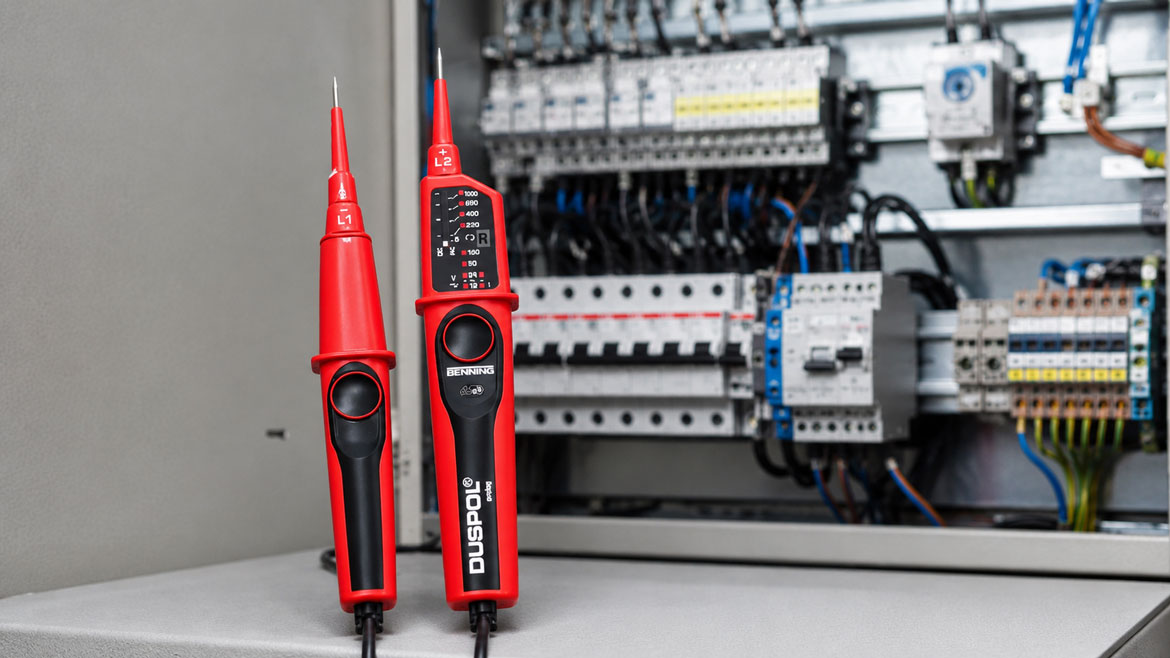
Before working on electrical installations, it must be reliably determined whether voltage is present or whether the relevant part of the installation is actually de-energized. In practice, this is often referred to as “verifying absence of voltage”. The decisive factor is not simply that some measuring device provides an indication, but that the test is carried out clearly, safely and suitably for the respective installation.
Single-pole phase testers, simple non-contact voltage detectors or unsuitable multimeters can lead to misinterpretations in certain situations. This can become dangerous, especially with induced voltages, defective neutral conductors, high-impedance displays or unclear earthing conditions.
This article explains why 2-pole voltage testers are the safe choice for voltage testing in electrical installation, industry and energy supply, which typical mistakes occur and what should be considered when selecting a suitable test device.
You can find an overview of suitable devices in our category
Voltage testers / meter start-up testers.
Table of contents
- Why is safely verifying absence of voltage so important?
- Why test with 2 poles instead of 1 pole?
- Limitations of single-pole phase testers and non-contact testers
- Multimeter or 2-pole voltage tester?
- Detecting phantom voltage and induced voltage
- Safe procedure for voltage testing
- Display, self-test and battery dependency
- Measurement category, test probes and operating environment
- Additional functions: continuity, phase rotation, load switching and RCD tripping
- Which 2-pole voltage testers are suitable?
- Practical examples from electrical installation and industry
- Checklist before voltage testing
- Conclusion
- FAQ: Frequently asked questions about 2-pole voltage testers
Why is safely verifying absence of voltage so important?
Verifying absence of voltage is a safety-relevant work step. If a cable, terminal, machine or distribution board is incorrectly assessed as de-energized, this can lead to electric shock accidents, arc flash events, damage to systems or dangerous incorrect actions.
Especially in modern installations, there are many situations in which voltages cannot be clearly identified immediately. These include long cables routed in parallel, control circuits, frequency converters, photovoltaic systems, emergency power supplies, UPS systems, backfeed or unclear wiring.
- Personal protection: Before work is carried out, it must be clear whether dangerous voltage is present.
- System protection: Incorrect testing can cause short circuits or damage.
- Avoiding misinterpretations: Induced voltages or high-impedance indications must be assessed correctly.
- Clear statement: A 2-pole voltage tester checks between two defined points.
- Practical testing: Suitable test devices are robust, quickly ready for use and designed for harsh environments.
Important: Work on electrical installations may only be carried out by appropriately qualified electricians or under their direction and supervision. The applicable standards, safety rules and company work instructions must be observed.
Why test with 2 poles instead of 1 pole?
A 2-pole voltage tester measures the voltage between two points, for example between phase conductor and neutral conductor, phase conductor and protective conductor or between two phase conductors. This gives the user a much clearer statement than a single-pole test.
A single-pole phase tester or non-contact voltage detector, on the other hand, often only indicates that an electric field is present near a conductor. This information can be useful for orientation, but it does not replace safe two-pole voltage testing.
| Test method | What is tested? | Assessment |
|---|---|---|
| Single-pole test | Indication of a phase or electric field | Possible for orientation, but not sufficient for a safe statement on absence of voltage. |
| Non-contact voltage test | Detection of an electric field without direct contact | Practical for preliminary checks, but susceptible to false indications and environmental conditions. |
| 2-pole voltage test | Voltage between two defined measuring points | Practical and significantly safer method for clear voltage testing. |
| 2-pole test with load switching | Voltage is additionally loaded | Helps to better identify induced or non-loadable voltages. |
2-pole voltage testers such as the
DUSPOL® expert
or the
DUSPOL® digital
are designed for safe voltage testing in the electrical trade and industry.
Limitations of single-pole phase testers and non-contact testers
Single-pole phase testers and non-contact voltage testers are often used because they are quick and easy to apply. However, they can create a false sense of safety if they are used for a task for which they are not intended.
Typical limitations
- Dependency on body, earth or environment: The indication can be influenced by location, footwear, floor and environmental conditions.
- No clear statement between two points: It is not reliably checked whether dangerous voltage is present between two conductors.
- Sensitivity to induced voltages: Cables routed in parallel can cause indications.
- Insufficient statement with interrupted neutral conductor: Faulty mains conditions can be overlooked.
- No loadable test: It often remains unclear whether a voltage is actually loadable.
| Situation | Risk with single-pole testing | Better procedure |
|---|---|---|
| Cable is to be disconnected before work | Indication may be missing or misinterpreted | Test 2-pole between all relevant points |
| Several cables are routed in parallel | Induced voltage may be indicated | Use a 2-pole voltage tester with suitable display |
| Socket outlet is tested | Single-pole tester does not detect all fault patterns | Test between L-N, L-PE and N-PE |
| Control cabinet with control circuits | Backfeed or external voltages may be overlooked | Test systematically at defined measuring points with 2 poles |
Multimeter or 2-pole voltage tester?
Multimeters are versatile measuring instruments and very useful for many electrical measuring tasks. For quickly and safely detecting voltage in electrical installations, however, a 2-pole voltage tester is often the better choice.
The reason: Many multimeters have a high input impedance. As a result, they can also display very small, induced or non-loadable voltages. This is useful for accurate measurements, but can lead to uncertainty when assessing absence of voltage.
| Device | Strength | Limitation when verifying absence of voltage |
|---|---|---|
| Multimeter | Accurate measurement of many electrical quantities | High-impedance measurement can display phantom voltages. |
| Single-pole phase tester | Quick indication of a phase | No safe two-pole statement. |
| Non-contact voltage tester | Contactless preliminary testing possible | Can be influenced by environment, cable routing and induction. |
| 2-pole voltage tester | Direct test between two measuring points | Select according to application and measurement category. |
| 2-pole voltage tester with load switching | Helps assess induced voltages | Function must be used consciously and safely. |
For precise voltage displays in industry and energy technology, digital voltage testers such as the
MULTISAFE DSP4
or the
MULTISAFE DSP5
may be of interest.
Detecting phantom voltage and induced voltage
A common problem in practice is so-called phantom voltages or induced voltages. They can occur when long cables are routed in parallel to live cables or when capacitive or inductive coupling occurs.
A high-impedance measuring device can then display a voltage even though this voltage is not loadable. The question for the user is: Is a dangerous voltage present or is it only an induced voltage?
| Error pattern | Possible cause | Practical solution |
|---|---|---|
| Multimeter shows voltage, but load does not work | Induced or high-impedance voltage | Test with a suitable 2-pole voltage tester |
| Voltage is displayed on a disconnected cable | Parallel cable routing or capacitive coupling | Use load switching or suitable test method |
| Display fluctuates or is implausible | Poor contact, open cable or external influence | Check measuring points, conductor assignment and test device |
| Different devices show different values | Different input impedance of the measuring devices | Consider test method and device properties |
Devices such as the
DUSPOL® analog
offer load switching. Devices such as the
C.A 771
are also relevant for applications where phantom voltages need to be detected and safely assessed.
Safe procedure for voltage testing
The specific procedure depends on the system, work order, risk assessment and applicable safety rules. In practice, it is important not only to carry out a single measurement, but to structure the test in a traceable and systematic way.
Basic test logic
- Check the test device before measurement: Visual inspection of device, measuring leads and test probes.
- Check function on a known voltage: This ensures that the device generally indicates correctly.
- Test the relevant part of the installation with 2 poles: Measure between all relevant conductors and reference points.
- Check the test device again after measurement: This excludes the possibility that the device failed during the test.
- Assess and document the result: Especially during maintenance, servicing and recommissioning.
| Test step | Why important? | Typical mistake |
|---|---|---|
| Visually inspect test device | Damaged test probes or leads can be dangerous | Device is used despite damaged lead |
| Check function before testing | Device must indicate safely before use | Defective device is only detected after measurement |
| Test 2-pole at the correct measuring point | Only defined measuring points provide a clear statement | Wrong terminal or wrong circuit is measured |
| Test several conductor combinations | Backfeed or neutral conductor faults may otherwise be overlooked | Only measured between L and N |
| Check function again afterwards | Device failure during testing is detected | Final check is omitted |
A compact voltage tester without batteries such as the
PROFISAFE LSP4
can be particularly useful where a low-maintenance test device with a clear display is desired.
Display, self-test and battery dependency
When selecting a 2-pole voltage tester, the display should suit the application well. In dark distribution boards, noisy environments or outdoor work, it can be decisive whether the device warns visually, audibly or additionally by vibration.
Another topic is battery dependency. Some devices enable certain voltage indications even without batteries, while other additional functions such as illumination, continuity testing or digital display require a battery.
| Feature | Benefit | What to consider? |
|---|---|---|
| LED display | Fast and clear voltage levels | Easy to read even in bright surroundings? |
| LCD display | More accurate display of measured value | Observe illumination and readability |
| Audible signal | Supports perception during testing | May be difficult to hear in noisy environments |
| Vibration alarm | Additional warning when voltage is present | Especially practical in difficult visibility or noise conditions |
| Self-test | Checks operational readiness of the device | Carry out consciously before use |
| Battery-independent indication | Voltage indication possible even without battery | Which functions are available without battery? |
The
DUSPOL® expert
is particularly interesting when safe voltage testing from 50 V is relevant even with empty batteries. The
DUSPOL® digital
adds a digital display and additional measuring functions.
Measurement category, test probes and operating environment
A voltage tester must not only match the voltage range, but also the operating environment. Measurement in a sub-distribution board, on machines, in industry, in control cabinet construction or in energy supply places different requirements on measurement category, robustness, protection rating and test probes.
| Selection point | Why important? | Example |
|---|---|---|
| Voltage range | Device must match the maximum possible voltage | 230 V, 400 V, 690 V, 1000 V or higher DC voltages |
| Measurement category | Indicates suitability for certain mains areas | CAT III or CAT IV depending on place of use |
| Test probes | Must match the terminal, socket or measuring point | Narrow terminals, sockets, control cabinet connections |
| Protection rating | Important in dust, moisture and outdoor use | Construction site, energy supply, industrial plant |
| Robustness | Test devices are heavily used in everyday work | Drop, impact, transport, tool bag |
| Ease of use | Testing must be clear even under time pressure | One-hand testing, illumination, clear display |
For applications in industry and energy technology, robust test devices such as the
MULTISAFE DSP5
or the
PRÜFBALL SPB DIGITAL
can be a suitable solution.
Additional functions: continuity, phase rotation, load switching and RCD tripping
Many 2-pole voltage testers can do more than simply indicate voltage. Depending on the device, additional functions such as continuity testing, phase rotation indication, single-pole phase testing, load switching or RCD tripping are available.
These functions can be very helpful in everyday work. However, it is important that they are classified correctly. A continuity test does not replace insulation measurement, RCD tripping with the voltage tester does not replace a complete RCD test and a single-pole phase test does not replace two-pole voltage testing.
| Function | Benefit | Limitation |
|---|---|---|
| Continuity test | Quick check of connections | Does not replace standard-compliant low-resistance measurement |
| Phase rotation indication | Helps with three-phase networks, motors and machines | Observe correct connection and test conditions |
| Load switching | Helps with induced voltages | Do not use without consideration; observe system condition |
| RCD tripping | Can show a rough functional response | Does not replace RCD testing with a suitable installation tester |
| Measuring point illumination | Makes work in dark distribution boards easier | Still identify the test point clearly |
For applications with phase rotation indication, devices such as the
HT6
or the
HT8
may be relevant. For load switching and robust voltage testing, the
DUSPOL® analog
can be a suitable solution.
Which 2-pole voltage testers are suitable?
The right choice depends heavily on the application area. Different priorities apply to the electrical trade and industry than to energy supply, control cabinet construction, machine testing or service work.
| Product | Especially relevant for | Note |
|---|---|---|
| DUSPOL® analog | Robust 2-pole voltage testing with load switching | Interesting when a proven battery-free voltage tester with load switching is required. |
| DUSPOL® expert | Electrical trade and industry with additional convenience functions | Suitable when continuity testing, measuring point illumination and safe voltage testing are to be combined. |
| DUSPOL® digital | Voltage testing with digital display and additional measuring functions | Useful when frequency, resistance or diode testing are relevant in addition to voltage indication. |
| PROFISAFE LSP4 | Compact and low-maintenance voltage testing without batteries | Relevant for trade and industry when simple operation and clear indication are the focus. |
| MULTISAFE DSP4 | Industrial and energy technology with accurate digital display | Suitable for users who want to combine robust voltage testing with precise display. |
| MULTISAFE DSP5 | Demanding applications in industry and energy supply | Interesting when high safety requirements and multimeter precision are needed in one voltage tester. |
| C.A 771 | Phantom voltages, phase rotation and robust voltage testing | Relevant when phantom voltage detection, self-test and high measurement category are important. |
| HT8 | Digital 2-pole voltage testing with phase rotation indication | Practical for electrical installation, service and simple three-phase tests. |
You can find a complete overview in the category
Voltage testers / meter start-up testers.
Practical examples from electrical installation and industry
Example 1: Cable shows voltage although it has been disconnected
A cable was disconnected in the distribution board. A multimeter still shows a voltage. The cause may be induced voltage from cables routed in parallel. With a suitable 2-pole voltage tester and, if necessary, load switching, it can be better assessed whether a loadable voltage is present.
Example 2: Socket outlet is to be checked before maintenance work
Before work is carried out on a connected device, the socket outlet is checked. A single-pole test is not sufficient for this. A 2-pole test between L-N, L-PE and N-PE is useful so that fault patterns such as a missing neutral conductor or protective conductor problems can also be detected.
Example 3: Control cabinet with backfeed
In a control cabinet, one section is switched off, but voltages may still be present via control circuits, frequency converters, UPS systems or external supplies. Therefore, the measuring points actually to be worked on must be tested with 2 poles. Simply switching off a main switch does not always guarantee absence of voltage at every terminal.
Example 4: Motor runs in the wrong direction after connection
After commissioning, a three-phase motor runs in the wrong direction. The cause is often an incorrect phase sequence. A 2-pole voltage tester with phase rotation indication, for example the
HT8,
can support checking the phase rotation.
Example 5: Working in harsh industrial environments
In industrial plants, test devices are heavily stressed. Dust, moisture, impacts and frequent transport can quickly damage simple devices. Robust voltage testers such as the
MULTISAFE DSP5
or the
PRÜFBALL SPB DIGITAL
can be useful for such applications.
Checklist before voltage testing
This checklist can be used to better prepare and structure the verification of absence of voltage.
| Check question | Why important? | Assessment |
|---|---|---|
| Is the test device suitable for the voltage range? | The maximum system value must not exceed the device limit. | Check voltage range and data sheet. |
| Does the measurement category match the installation? | CAT III and CAT IV refer to different places of use. | Select measurement category to match the measuring point. |
| Are test probes and leads undamaged? | Damaged insulation or loose probes are dangerous. | Carry out visual inspection before each use. |
| Was the function checked before measurement? | Only a functioning device can indicate safely. | Test on a known voltage. |
| Is the test really carried out with 2 poles? | Only two defined measuring points provide a clear statement. | Do not use single-pole indication as a replacement. |
| Have all relevant conductor combinations been tested? | Backfeed or conductor faults may otherwise be overlooked. | Test L-N, L-PE, N-PE and, with three-phase systems, also phase conductors against each other. |
| Could a phantom voltage be present? | High-impedance displays can show induced voltages. | Assess suitable test method or load switching. |
| Was the function checked again after measurement? | This detects device failure during the test. | Carry out final check on a known voltage. |
Conclusion: Verify absence of voltage safely only with a suitable test method
A 2-pole voltage tester is much better suited for safe voltage testing in electrical installations than a single-pole phase tester or a purely non-contact voltage detector. It tests between two defined measuring points and therefore provides a clearer statement on the voltage present.
Especially with phantom voltages, backfeed, long cables, industrial plants, distribution boards or three-phase systems, the correct selection of the test device is decisive. Important factors are voltage range, measurement category, display, self-test, battery dependency, test probes and additional functions such as load switching or phase rotation indication.
You can find a suitable preselection in our category
Voltage testers / meter start-up testers.
FAQ: Frequently asked questions about 2-pole voltage testers
Why should you use a 2-pole voltage tester?
A 2-pole voltage tester measures the voltage between two defined points. This makes the statement significantly more reliable than with a single-pole phase tester or a non-contact voltage detector.
Is a single-pole phase tester sufficient to verify absence of voltage?
No. A single-pole phase tester can at most serve as a rough indication. A suitable 2-pole test is required to safely verify absence of voltage.
Can I use a multimeter to verify absence of voltage?
A multimeter can measure voltages very accurately, but due to its high input impedance it is not always ideal for assessing induced or non-loadable voltages. In practice, a 2-pole voltage tester is often better suited.
What is a phantom voltage?
A phantom voltage is an apparent or induced voltage that can arise, for example, from cables routed in parallel. It can be displayed by high-impedance measuring devices even though no loadable supply is present.
What is load switching on a voltage tester useful for?
Load switching can help to better identify induced or non-loadable voltages. However, it must be used consciously and appropriately for the installation.
Does RCD tripping with a voltage tester replace an RCD test?
No. RCD tripping with a voltage tester can show a rough response, but it does not replace a complete RCD test with a suitable installation tester.
Does a 2-pole voltage tester need batteries?
That depends on the device. Some voltage testers indicate voltage even without batteries, while additional functions such as illumination, continuity testing or digital display may require a battery.
Can a 2-pole voltage tester indicate phase rotation?
Many devices offer phase rotation indication. This is particularly helpful for three-phase networks, motors, pumps and machines. Examples include the
HT6
or the
HT8.
Which measurement category should a voltage tester have?
The measurement category must match the operating environment. In electrical installation, industry and energy supply, CAT III or CAT IV are often relevant. The specific selection depends on the measuring point and installation area.
Where can I find suitable 2-pole voltage testers?
You can find an overview in the category
Voltage testers / meter start-up testers. There you will find various 2-pole voltage testers, robust test devices, devices with load switching, phase rotation indication and meter start-up testers.