


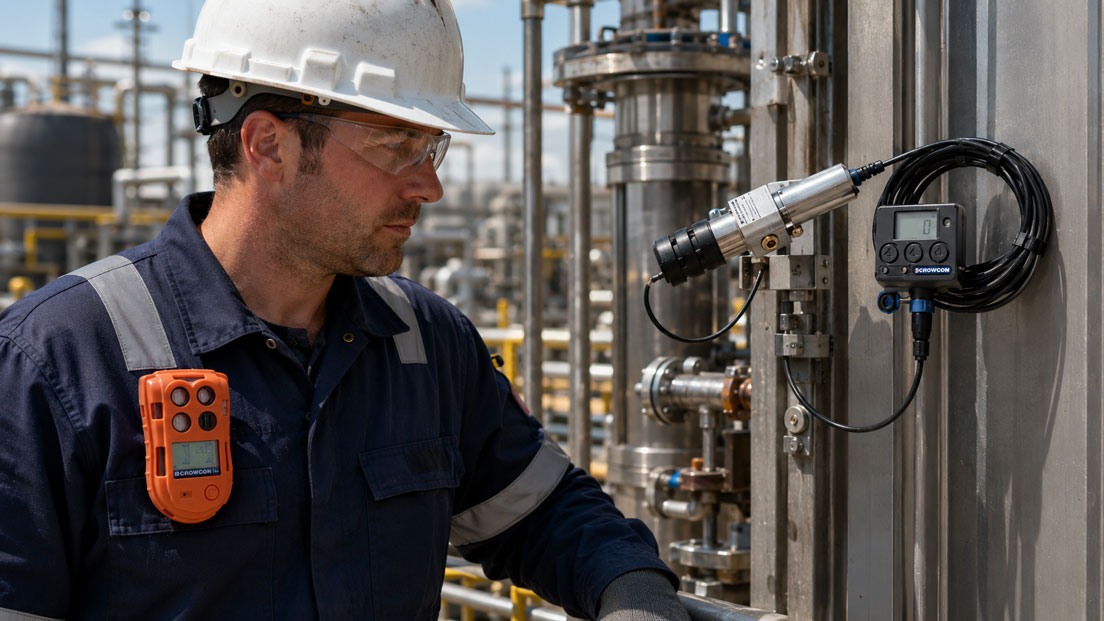
Gas detectors are used in chemical plants, refineries, tank farms, wastewater facilities, energy installations and industrial maintenance applications. They are intended to warn personnel of combustible gases, toxic substances, oxygen deficiency or oxygen enrichment.
However, if the area of use is classified as hazardous, it is not sufficient for the instrument merely to be described as “ATEX suitable”. The complete marking must correspond to the specified hazardous area, gas group, temperature class, ambient temperature and specific instrument version.
The installed sensors are equally important. A four-gas detector for oxygen, carbon monoxide, hydrogen sulphide and combustible gases does not automatically detect every toxic gas or solvent vapour. Catalytic, infrared and modern multi-gas sensor technologies also differ considerably in the measurement of combustible gases.
This article explains how portable and fixed gas detectors are selected, which limitations the different sensors have and why bump testing, calibration, the alarm concept and user training are essential for safe operation.
Table of contents
- What function a gas detector performs
- Correctly assigning the ATEX marking and hazardous area
- Distinguishing combustible gases, toxic gases and oxygen
- Which sensor technology is suitable for the gas hazard
- Correctly defining alarm types and alarm thresholds
- Portable or fixed gas detector?
- Distinguishing personal protection from clearance testing
- Diffusion measurement, pump and sampling hose
- Temperature, humidity, pressure and ambient conditions
- Sensor poisoning, cross-sensitivity and over-range exposure
- Bump testing, calibration and functional checks
- Charging, opening and servicing in hazardous areas
- Documentation and instrument management
- Typical selection and application errors
- Practical example: Entering a wastewater shaft
- Which measuring instruments / products are suitable?
- Conclusion
- Frequently asked questions about gas detectors in hazardous areas
What function a gas detector performs
A gas detector monitors the ambient air or a specifically extracted gas sample. If the measured concentration exceeds or falls below a defined alarm threshold, the instrument warns the user or initiates a technical response.
Depending on the application, the gas detector can monitor the following hazards:
- formation of an explosive atmosphere
- acute exposure to toxic gases
- time-weighted exposure to hazardous substances
- oxygen deficiency caused by displacement or consumption
- oxygen enrichment with an increased fire risk
A gas detector does not prevent the release of gas. It only detects the hazard once the gas reaches the sensor at a sufficiently high concentration. Ventilation, technical leak tightness, work permits and organisational protective measures therefore remain necessary.
The absence of an active alarm does not automatically prove that the entire work area is free of gas. Gas distribution, measuring location, air movement, stratification and the sampling method must be appropriate for the application.
Correctly assigning the ATEX marking and hazardous area
The hazardous area is defined by the operator as part of the risk assessment. The gas detector must provide at least the equipment protection level required for this area.
| Gas hazardous area | Occurrence of an explosive atmosphere | Typical required EPL | Typical ATEX category |
|---|---|---|---|
| Zone 0 | continuously, for long periods or frequently | Ga | 1G |
| Zone 1 | occasionally during normal operation | Gb | 2G or higher |
| Zone 2 | normally not present or present only briefly | Gc | 3G or higher |
A complete instrument marking may contain information about the equipment group, category, type of protection, gas group, temperature class, EPL and permissible ambient temperature.
The statement “ATEX certified” alone is therefore not sufficient. In particular, the following must be checked:
- Zone 0, 1 or 2
- equipment category and EPL
- gas group IIA, IIB or IIC
- temperature class
- permissible ambient-temperature range
- specific instrument and sensor version
A version approved for Zone 1 must not automatically be used in Zone 0. The marking may also differ between different sensor configurations of the same basic instrument.
ATEX approval also does not confirm that the instrument can measure the gases required for the application. Explosion-protection approval and metrological suitability must be assessed separately.
Distinguishing combustible gases, toxic gases and oxygen
Selection begins with a complete list of the possible gases and vapours. Different measured variables are used for the different hazards.
| Gas hazard | Typical unit | Examples | Purpose of measurement |
|---|---|---|---|
| Combustible gases and vapours | % LEL or vol.-% | Methane, propane, hydrogen, solvent vapours | Detect an explosion hazard |
| Toxic gases | ppm or mg/m³ | CO, H₂S, SO₂, NO₂, NH₃ | Monitor health hazards |
| Oxygen | vol.-% | O₂ deficiency or O₂ enrichment | Detect asphyxiation and fire hazards |
For combustible gases, a value expressed as a percentage of the lower explosive limit indicates how close the concentration is to the ignition limit. 100% LEL corresponds to the lower explosive limit of the reference gas and not to 100 vol.-% gas.
For toxic gases, concentrations in the ppm range may already be relevant. A combustible-gas sensor therefore does not replace a toxic-gas sensor, even if the same substance is both combustible and hazardous to health.
Oxygen must also be monitored separately. Depending on the measuring principle, a combustible-gas sensor may respond incorrectly or inadequately in an oxygen-deficient atmosphere, even though an asphyxiation hazard already exists for personnel.
Which sensor technology is suitable for the gas hazard
Catalytic sensors for combustible gases
Catalytic bead sensors, often referred to as pellistors, oxidise the combustible gas on a heated sensor surface. The resulting change in temperature is evaluated as the measuring signal.
They can detect many combustible gases but require sufficient oxygen to operate. In inerted vessels, at very high gas concentrations or in oxygen-deficient atmospheres, the measuring result may be unreliable.
Catalytic sensors can also be inhibited or permanently poisoned by silicones, sulphur compounds, halogenated substances or other contaminants. An instrument that appears externally undamaged may then have insufficient sensitivity.
Infrared sensors
Infrared sensors measure the absorption of specific infrared wavelengths. Depending on their design, they are particularly suitable for hydrocarbons or carbon dioxide and do not require oxygen for the measuring reaction.
They are resistant to many conventional catalyst poisons. However, an IR sensor only detects gases that absorb sufficiently within the spectral range being used.
Hydrogen cannot be detected using a conventional hydrocarbon IR sensor. The general statement that “IR measures all combustible gases” is therefore incorrect.
MPS sensors for multiple combustible gases
Modern MPS sensors evaluate the thermal or molecular properties of combustible gases. They can detect different combustible gases and gas mixtures without a separate standard calibration having to be selected for every gas.
The technology can offer advantages compared with the typical poisoning problems of catalytic sensors. Nevertheless, the range of gases, measuring range, ambient conditions and manufacturer approval must still match the application.
Electrochemical sensors
Electrochemical sensors are primarily used for toxic gases and oxygen. They are compact and can detect low concentrations.
The sensors have a limited service life and may exhibit cross-sensitivities to other gases. Temperature, humidity, ageing and previous exposure can influence their response.
PID sensors
Photoionisation detectors detect many volatile organic compounds. They are particularly useful for solvents and VOC exposure.
However, a PID does not automatically identify the substance unambiguously. The signal depends on the ionisation potential, calibration gas and correction factor. A PID also does not generally replace measurement of the explosion hazard in % LEL.
Correctly defining alarm types and alarm thresholds
Portable gas detectors generally provide a combination of:
- audible alarm
- visual warning lights
- vibration alarm
- display indication and gas identification
Multiple alarm types are important because loud machinery can mask the audible alarm, while bright surroundings or protective clothing can impair the perception of visual or vibrating warnings.
Different alarm values are frequently evaluated for toxic gases:
- instantaneous-value alarm
- short-term exposure limit
- time-weighted average
- peak value
For combustible gases, low and high alarms in % LEL are generally used. For oxygen, both a low alarm for oxygen deficiency and a high alarm for oxygen enrichment may be required.
Alarm thresholds must not be adopted from the factory settings without verification. They must correspond to the risk assessment, occupational exposure limits, evacuation route and intended technical measures.
Before use, the operator must know which action is required for each alarm. An alarm should not simply be acknowledged and the work then continued.
Portable or fixed gas detector?
| Characteristic | Portable gas detector | Fixed gas detector |
|---|---|---|
| Main function | Personal protection and temporary measurement | Continuous area and plant monitoring |
| Measuring location | Moves with the user | Permanently defined sensor position |
| Alarm output | Audible, visual and vibrating at the instrument | Control unit, relays, process control system, sounder or warning beacon |
| Power supply | Battery or rechargeable battery | Fixed power supply |
| Typical application | Maintenance, inspection rounds, clearance testing | Tank farm, technical room, process plant |
A fixed sensor only monitors the area that the gas actually reaches. Its position must be selected on the basis of the release source, ventilation, room geometry, gas behaviour and plant operation.
A portable instrument, by contrast, accompanies the person. It can usefully supplement a fixed system but does not automatically replace it. Conversely, a fixed detector does not reliably protect an employee outside its effective detection area.
Distinguishing personal protection from clearance testing
A personal gas detector is worn as close as possible to the breathing zone. It monitors the atmosphere surrounding the employee during the work.
A clearance test, by contrast, is performed before entering a vessel, shaft or confined space. The atmosphere is tested at several points or heights before a person enters the area.
An instrument with an internal pump and sampling hose may be required for clearance testing. After clearance has been granted, a personal gas detector often still has to be worn because the atmosphere may change during the work.
A multi-gas detector with a pump is therefore not automatically a substitute for personal monitoring. The measuring task, wearing position and operating mode must be defined clearly.
Diffusion measurement, pump and sampling hose
With a diffusion instrument, the gas reaches the sensor through natural air movement. The instrument must therefore be worn openly and must not be covered by clothing, tool bags or protective covers.
With pumped sampling, the sample is drawn through a hose to the instrument. The following must be considered:
- hose length and pump capacity
- purging and transport time
- leak tightness of the hose and connections
- possible adsorption of the target gas
- condensate, dust and filter condition
- measurement at different heights
The measured value is not available immediately after the hose is inserted. The complete hose volume must first be purged with the new gas sample. The actual sensor response time must then also be added.
Reactive gases or gases that adsorb readily may be partially retained by unsuitable hose materials. The sampling line and accessories must therefore be explicitly suitable for the target gas.
Temperature, humidity, pressure and ambient conditions
The Ex approval and metrological specifications apply only within the stated operating conditions.
The following must be checked, among other factors:
- minimum and maximum ambient temperature
- permissible relative humidity
- condensation and water ingress
- ambient pressure
- dust and dirt exposure
- battery operating time at low temperatures
- mechanical stress and ingress protection
Condensation can block the sensor opening or filter. Very low temperatures can slow the electrochemical reaction and reduce battery performance. High temperatures can limit sensor life and the permissible operating duration.
A high IP rating does not automatically mean that the instrument is immediately ready for measurement after complete immersion. Sensor filters and the gas inlet must be clean, dry and undamaged.
Sensor poisoning, cross-sensitivity and over-range exposure
A gas detector can be impaired metrologically without any external damage being visible.
Typical causes include:
- poisoning of catalytic sensors by silicones or sulphur compounds
- inhibition caused by high concentrations of certain substances
- cross-sensitivities of electrochemical sensors
- contamination or blockage of the sensor filter
- exposure above the approved measuring range
- ageing and depletion of electrochemical cells
After exposure to a high gas concentration, it must not automatically be assumed that the instrument is operating correctly again once the reading returns to zero. Depending on the sensor and manufacturer requirements, a functional test, fresh-air adjustment, calibration or sensor replacement may be required.
Cross-sensitivity means that a sensor also responds to other substances. This can cause an excessively high measured value. A negative cross-sensitivity is equally dangerous, as it can cause a target-gas value to be indicated too low under certain conditions.
Bump testing, calibration and functional checks
During a bump test, the gas detector is briefly exposed to a suitable test gas. This checks whether:
- the gas reaches the sensors
- the sensors respond
- the audible, visual and vibrating alarms are activated
- the display and instrument electronics function in principle
A bump test is not a complete calibration. During calibration, the indication is compared with a known test-gas concentration and adjusted where necessary.
The required interval depends on the manufacturer’s specifications, risk assessment, operating conditions and internal rules. An additional test may be required following exceptional exposure, an over-range event, a fall, water ingress or prolonged storage.
Automatic test stations can standardise test-gas supply, bump testing, calibration and documentation. However, they do not replace the user’s visual inspection and checks.
Charging, opening and servicing in hazardous areas
Even an intrinsically safe gas detector must not be opened, charged or connected to communication accessories arbitrarily within a hazardous area.
The following in particular must be checked before use:
- undamaged housing
- legible rating plate and complete Ex marking
- sufficient battery charge
- correctly fitted filters and covers
- absence of unauthorised replacement parts or modifications
With many portable instruments, battery charging, USB connection, data transfer or calibration accessories may only be used in a non-hazardous area. The operating instructions for the specific instrument version are always decisive.
Replacing a battery, sensor, housing component or seal with a non-approved part may invalidate the Ex approval.
Documentation and instrument management
A reliable gas-detection concept requires traceable instrument and test data.
At least the following should be documented:
- instrument identification and serial number
- installed sensors and measuring ranges
- ATEX or IECEx marking
- configured alarm thresholds
- bump tests and calibrations
- sensor replacements and repairs
- alarm and exposure events
- assignment to a user or area of operation
For larger instrument fleets, a test and management station simplifies the monitoring of overdue calibrations, failed bump tests and alarm events.
A current calibration label alone does not prove that the instrument is functional on the day of use, correctly configured and fitted with the required sensors.
Typical selection and application errors
| Error | Possible consequence | Better approach |
|---|---|---|
| Only the designation “ATEX” is checked | The instrument is unsuitable for the zone or gas group | Compare the complete Ex marking |
| A four-gas detector is considered a universal instrument | Toxic gases without installed sensors remain undetected | Identify all possible gases in advance |
| An IR sensor is specified for hydrogen | Hydrogen is not detected | Select a sensor technology suitable for H₂ |
| A pellistor is used in an inerted atmosphere | Insufficient or no indication | Assess an oxygen-independent measuring principle |
| The instrument is worn underneath work clothing | The gas reaches the sensors with a delay | Wear the instrument openly in the breathing zone |
| Hose delay is not considered | The area is declared safe too early | Allow for the purging and sensor response time |
| Only the zero indication in fresh air is checked | A poisoned sensor remains undetected | Perform a bump test using a suitable test gas |
| The alarm is acknowledged and work continues | Personnel remain in the hazardous area | Carry out the defined alarm and evacuation procedure |
Practical example: Entering a wastewater shaft
Before maintenance work begins, an employee is required to enter a wastewater shaft. The risk assessment considers oxygen deficiency, hydrogen sulphide, methane and carbon monoxide. For the specific work, the area around the entrance is classified as hazardous.
Before use, the multi-gas detector undergoes a visual inspection and bump test. A clearance measurement is then performed from outside the shaft using a pumped Gas-Pro.
Samples are taken consecutively from the upper, middle and lower sections of the shaft. For each height, the complete hose-purging time and sensor response time are allowed to elapse.
After clearance has been granted, the employee entering the shaft additionally wears a T4x openly in the breathing zone. The instrument continuously monitors:
- oxygen
- hydrogen sulphide
- carbon monoxide
- combustible gases
Ventilation remains in operation. An attendant positioned outside monitors the work and knows the defined actions to be taken in the event of a low alarm, high alarm or instrument fault.
The example illustrates the difference between clearance testing and personal monitoring. A one-off measurement before entry is not sufficient because the atmosphere can change as a result of inflow, deposits or the work being performed.
Which measuring instruments / products are suitable?
The gas measuring instruments and gas detectors category contains solutions for monitoring combustible and toxic gases as well as oxygen.
Compact instruments for personal protection, maintenance and clearance testing are available in the portable gas detectors category.
Crowcon T4x for personal four-gas protection
Depending on its configuration, the Crowcon T4x monitors oxygen, carbon monoxide, hydrogen sulphide and combustible gases.
The Zone 0 version carries the marking II 1G Ex ia IIC T4 Ga. Audible, visual and vibrating alarms support alarm perception in noisy and confusing working environments.
With an MPS sensor, the instrument is suitable for different combustible gases and mixtures. Nevertheless, the specific sensor configuration and instrument marking must be selected according to the application.
Crowcon Gasman for targeted single-gas monitoring
The Crowcon Gasman is a compact personal single-gas detector. Depending on the version, it is available for combustible gases, oxygen or different toxic gases.
A single-gas detector is useful when one clearly defined hazard has to be monitored and no other relevant gases can occur.
Crowcon Gas-Pro for clearance testing and multi-gas monitoring
Depending on its sensor configuration, the Crowcon Gas-Pro can monitor up to five gases. An optional internal pump supports sampling and testing before entering vessels or confined spaces.
Available sensor options include electrochemical, infrared and PID sensors. This enables the instrument to be adapted more specifically to particular gas hazards and clearance-testing applications.
IRmax for fixed hydrocarbon monitoring
The IRmax infrared gas detector is designed for the fixed monitoring of combustible hydrocarbon gases.
The instrument has a 4–20 mA output and, depending on the version, can be integrated into a gas detection system using additional communication options. A different suitable measuring principle is required for hydrogen.
Fixed gas detectors for continuous monitoring
Additional permanently installed detectors are available in the fixed gas detectors category.
For fixed systems, the sensor position, control unit, signal outputs, failure response, ventilation control and regular maintenance must be planned as a complete safety system.
ICS Schneider Messtechnik assists with selecting sensors, gas types, measuring ranges, ATEX versions, alarm functions and accessories. The required information includes the hazardous area, gas group, possible gases and concentrations, toxic exposure limits, oxygen hazards, ambient temperature, measuring task and required operating mode.
Conclusion: ATEX approval and sensor configuration must be compatible
A gas detector for hazardous areas must have complete marking that corresponds to the defined zone, gas group, temperature class and ambient temperature. A general ATEX specification is not sufficient for selection.
The metrological configuration is equally important. Combustible gases, toxic gases and oxygen are monitored using different sensors, measuring ranges and alarm thresholds.
Catalytic sensors can be poisoned by certain substances and require sufficient oxygen. Infrared sensors are resistant to many catalyst poisons but do not detect every combustible gas and, in particular, cannot detect hydrogen using a conventional hydrocarbon IR system.
Portable instruments protect personnel and support temporary measurements. Fixed detectors continuously monitor defined plant areas. For work in vessels or shafts, clearance testing and continuous personal monitoring must be considered separately.
Bump tests, calibrations, visual inspections, documented alarm thresholds and trained users are essential elements of safe operation. A gas detector is only reliable when the sensor, instrument, operating procedure and organisational measures are treated as one complete system.
Frequently asked questions about gas detectors in hazardous areas
Is the statement “ATEX certified” sufficient for selection?
No. The zone, equipment category, EPL, gas group, temperature class, ambient temperature and specific instrument version must be checked.
Can a Zone 1 gas detector be used in Zone 0?
Not automatically. Zone 0 normally requires a higher equipment protection level. The complete Ex marking is decisive.
Does a four-gas detector measure all hazardous gases?
No. It only measures the sensors that are actually installed and configured. Ammonia, chlorine, VOCs or other special gases may require additional sensors.
What does % LEL mean?
The indication represents the proportion of the lower explosive limit of the calibrated or evaluated gas. 100% LEL does not mean 100 vol.-% gas.
Can an infrared sensor detect hydrogen?
A conventional IR sensor for hydrocarbons cannot detect hydrogen. A sensor technology expressly suitable for H₂ must be used.
What is the difference between a bump test and calibration?
A bump test checks the sensor response and alarm functions using test gas. During calibration, the measured indication is compared with a known concentration and adjusted where necessary.
Can a gas detector continue to be used immediately after an over-range event?
Not without assessment. Depending on the sensor and the exposure, a functional test, calibration or sensor replacement may be required.
Why is a waiting period required when measuring through a hose?
The gas sample must first travel through the complete hose. The sensor then requires additional time to respond to the concentration.
Where should a personal gas detector be worn?
In accordance with the manufacturer’s and operating instructions, it should be worn openly within the breathing zone. Clothing or equipment must not obstruct the gas inlet or the alarms.
Which information does ICS Schneider require for selecting the instrument?
The required information includes the hazardous area, gas group, possible target and interfering gases, expected concentrations, portable or fixed application, clearance testing or personal protection, ambient conditions and requirements concerning alarm functions and documentation.