


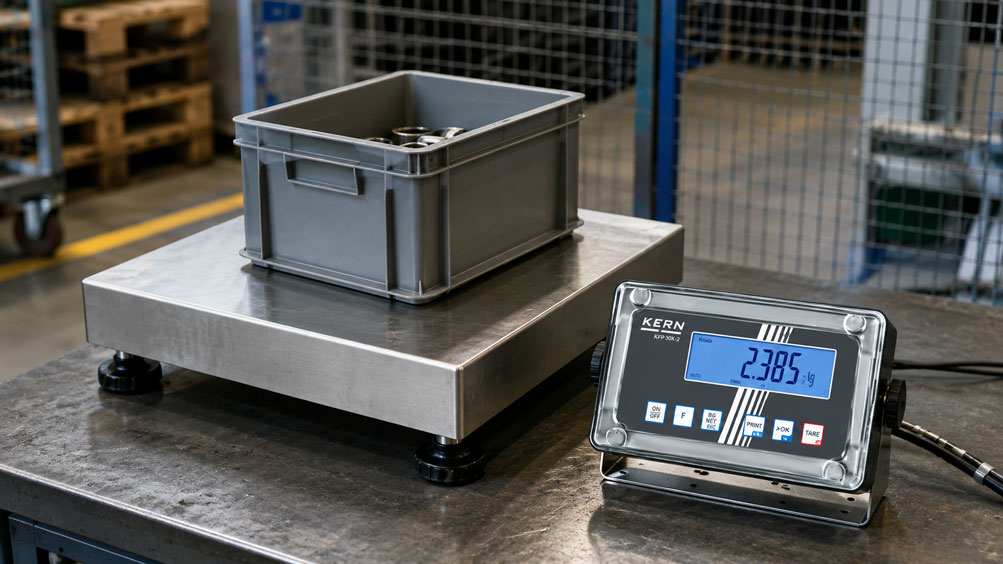
An industrial scale is required to weigh components up to:
50 kg
.
The user requires:
1 g resolution
and also wants to transmit the weight values to a PLC.
Is a scale with:
Max = 50 kg
and:
d = 1 g
therefore sufficient?
These specifications alone are not sufficient for a reliable selection.
First, it must be clarified how the weight value will be used.
Is it intended for:
internal process monitoring
or:
a legally regulated or billing-relevant weighing application?
Further parameters must then be distinguished:
Max = maximum capacity
Min = minimum load
d = readability / scale interval
e = verification scale interval
internal resolution ≠ accuracy ≠ legal metrology scale interval
Additional factors include:
- platform size,
- load distribution,
- force introduction,
- overload reserves,
- environmental influences,
- weighing electronics,
- interfaces,
- calibration or legal metrology requirements.
A scale is therefore not selected solely according to the required kilogram capacity. The complete measurement task, including the mechanical installation and the legal use of the measurement result, is decisive.
Complete industrial weighing systems can be found at ICS Schneider under Scales / Industrial Scales. Load cells and other mechanical sensors can be found under Force, Weighing, Speed and Torque Sensors.
Table of Contents
- Process scale or legal-for-trade application?
- When is a scale subject to legal metrology requirements?
- Distinguishing automatic and non-automatic weighing instruments
- Distinguishing legal-for-trade capable, conformity-assessed and verified
- Calibration is not legal verification
- Correctly determining maximum capacity Max
- Why tare does not increase maximum capacity
- What does minimum load Min mean?
- What does scale interval d mean?
- What does verification scale interval e mean?
- Do not confuse resolution and accuracy
- Why internal resolution is not the usable resolution
- Number of scale intervals and weighing range
- Multi-range and multi-interval scales
- Distinguishing load cell class and complete scale
- Selecting the correct platform size
- Corner load and off-center loading
- Mechanical force introduction
- Avoiding transverse forces and mechanical stress
- Installation surface and leveling
- Considering dynamic loads and overload
- Temperature, vibration and air flow
- Correct load cell wiring
- Interfaces and PLC connection
- Correctly classifying checkweighing
- Correctly designing process weighing
- Measurement uncertainty and process capability
- Systematic scale selection
- Typical error patterns
- Practical example: selecting a 30-kg platform scale
- Suitable ICS products
- Conclusion
- FAQ
Process scale or legal-for-trade application?
The most important question is often asked too late:
What will happen with the measured weight?
Typical process weighing
A weight value may, for example, be used for:
- internal dosing,
- machine control,
- determining the fill level of a vessel,
- process monitoring,
- internal quality control,
- trend recording.
Typical legally relevant weighing
By contrast, the weight may be used directly for:
- sales by weight,
- billing between business partners,
- calculating a price based on mass,
- certain legally or officially regulated applications,
- certain prepackaging or weight-labeling processes.
The technical difference is significant
For a pure process scale, the measurement task can be optimized more strongly for:
- process accuracy,
- dynamics,
- interfaces,
- machine integration
.
For legally regulated weighing, the metrological regulations applicable to the specific application must additionally be fulfilled.
When is a scale subject to legal metrology requirements?
Whether a scale is subject to legal metrology requirements does not depend solely on the instrument itself.
The decisive factor is:
the specific intended use
Example 1
A company weighs raw material exclusively for internal production control.
The measured value has no influence on billing.
This is a typical:
process weighing application
Example 2
The same material is billed between supplier and customer according to the determined net weight.
The same measured value therefore acquires a:
commercial or legally relevant function
Important
It is not the designation “industrial scale” that determines whether legal metrology requirements apply, but the use of the measurement result.
Distinguishing automatic and non-automatic weighing instruments
The operating principle of the scale is also legally relevant.
Non-automatic weighing instrument
With a non-automatic weighing instrument, operator intervention is required during the weighing process.
Example:
place component on platform → read weight
Automatic weighing instrument
An automatic weighing instrument determines the mass within an automatically executed process.
For example:
product moves along conveyor → scale determines weight → product is automatically accepted or rejected
Typical automatic applications
- checkweighers,
- sorting scales,
- weight labeling,
- automatic filling,
- certain belt and totalizing scales.
Why this distinction is important
Different regulatory requirements and approval bases apply to non-automatic and automatic weighing instruments.
A request should therefore not only state:
scale must weigh 50 kg
but also:
manual or automatic weighing?
Distinguishing legal-for-trade capable, conformity-assessed and verified
These terms are often used synonymously in everyday practice.
Technically and legally, however, they are not identical.
Legal-for-trade capable
This generally describes an instrument version designed or approved for a corresponding legally regulated weighing application.
For a new instrument
the relevant conformity assessment procedure for the complete scale is required for legally regulated use.
During subsequent operation
national verification periods and regulations governing continued use may also apply.
Important
A single legal-for-trade capable component does not automatically turn a self-built weighing system into a legally compliant scale for regulated use.
Calibration is not legal verification
These two terms must also be clearly distinguished.
Calibration
During calibration, the indication of a measuring system is compared with traceable reference values.
The result can, for example, be documented in a:
DAkkS calibration certificate
.
Legal verification or statutory metrological control
has a different purpose.
It concerns compliance with legal requirements for the intended regulated use.
Therefore
calibrated ≠ legally verified
and:
DAkkS calibration certificate ≠ legal metrology approval
Conversely
a legal-for-trade capable or verified scale can also be calibrated additionally if, for example, a quality assurance system requires detailed information on the actual measurement deviation.
Correctly determining maximum capacity Max
The maximum capacity:
Max
is one of the most important selection parameters.
Typical mistake
The product itself weighs a maximum of:
50 kg
so a:
50-kg scale
is selected.
However, the following may be overlooked
- container weight,
- fixtures,
- transport aids,
- adapter plates,
- dynamic loads.
Example
Product:
45 kg
Container:
8 kg
Fixture:
2 kg
Total load:
55 kg
The scale sees the gross load
Even if the display after taring shows:
0,000 kg
the load cells are still mechanically loaded by the container.
Why tare does not increase maximum capacity
A tare function changes the zero point of the display.
However, it does not change the mechanical load on the weighing system.
Example
Scale:
Max = 60 kg
Container:
20 kg
after taring:
Display = 0 kg
Remaining mechanical capacity
is not once again:
60 kg
but correspondingly lower.
Key point
Tare creates display capacity, but no additional mechanical load capacity.
What does minimum load Min mean?
Legal-for-trade scales frequently also specify:
Min
Minimum load
identifies the lower limit from which the scale may be used for the intended legally regulated measurement task or from which the corresponding metrological requirements apply.
This does not mean
that the display necessarily shows nothing below Min.
However
for legally relevant determination of weight, a displayed value below the permissible minimum load must not simply be treated as a regular legal-for-trade weighing result.
Example SFE 30K-2NM
ICS specifies:
Max = 30 kg
d = 10 g
e = 10 g
Min = 200 g
Consequence
A product weighing:
50 g
cannot therefore be considered legally correctly weighed merely because the display shows a value.
What does scale interval d mean?
The scale interval or display increment:
d
describes the smallest step of the weight display.
Example
With:
d = 10 g
the display may, for example, show:
12,340 kg
12,350 kg
12,360 kg
However
A display in 10-g increments does not mean that the scale measures with an accuracy of ±10 g under all conditions.
What does verification scale interval e mean?
For legally regulated scales, the:
verification scale interval e
is additionally specified.
The verification scale interval
is the scale interval relevant for legal metrology assessment.
Frequently
the following applies:
d = e
but the two terms must nevertheless be distinguished technically.
Example
For the SFE series listed by ICS, separate columns are specified for the corresponding legal-for-trade models, for example for:
- readability d,
- verification scale interval e,
- minimum load Min
.
Do not confuse resolution and accuracy
One of the most common misinterpretations is:
more digits on the display = more accurate scale
This is incorrect
Resolution initially only describes how finely changes can be displayed or processed internally.
Actual measurement quality is additionally influenced by
- linearity,
- repeatability,
- hysteresis,
- temperature behavior,
- corner load,
- mechanical force introduction,
- zero-point drift,
- filtering,
- environmental conditions.
Example
A system may internally resolve:
1.000.000 parts
.
This does not automatically mean that it achieves:
1 ppm accuracy
.
Why internal resolution is not the usable resolution
Modern weighing electronics use very high-resolution A/D converters.
Example SIWAREX WP351
ICS specifies an internal resolution of:
±20.000.000 parts
At the same time, ICS specifies for legal-for-trade applications
among other things:
3 × 6000 d
for a multi-range/multi-interval scale.
This clearly shows
internal digital resolution ≠ permissible scale division
Why is high internal resolution useful nevertheless?
It enables, for example:
- clean filtering,
- small usable signal changes,
- good control performance,
- precise dosing cut-off,
- diagnostics.
However, the resulting weight value must not simply be displayed with an arbitrary number of meaningful digits.
Number of scale intervals and weighing range
A simple parameter is:
n = Max / e
for the number of verification scale intervals in the corresponding weighing range.
Example
SFE 6K-3NM:
Max = 6 kg
e = 2 g
therefore:
6000 g / 2 g = 3000 scale intervals
Another example
SFE 300K-1LNM:
Max = 300 kg
e = 100 g
therefore likewise:
300.000 g / 100 g = 3000 scale intervals
Consequence
With the same number of usable scale intervals, a larger weighing range results in a larger weight increment.
Max should therefore not be selected unnecessarily high.
Multi-range and multi-interval scales
With a very large load range, there is often a conflict between:
high maximum capacity
and at the same time:
very small scale interval
One possible solution
is to use multi-range or multi-interval scales.
Example principle
A system could operate with a smaller scale interval in the lower range and a coarser interval at higher loads.
Advantage
This allows a larger overall range to be used without unnecessarily sacrificing resolution in the lower load range.
However
the specific switching logic and approval are instrument-specific.
Distinguishing load cell class and complete scale
For self-built weighing systems, a load cell with:
OIML R60 C3
is often selected.
Example
The:
SIWAREX WL260 SP-S SB
listed by ICS is available in accuracy class:
C3 according to OIML R60
.
ICS also specifies use in class III commercial scales.
Important distinction
The approval or accuracy class of an individual load cell is not automatically the approval of the complete scale.
The complete system additionally includes
- platform,
- force introduction,
- mechanical stops,
- wiring,
- junction box,
- weighing electronics,
- software,
- display.
Each of these components
can influence the actual weighing result.
Selecting the correct platform size
A platform scale must not only have the correct maximum capacity.
The dimensions must also suit the load
A container should:
- rest securely on the platform,
- not tip over,
- not permanently protrude excessively,
- not introduce impermissible moments into the load cell.
Example
A small single-point load cell may have sufficient load capacity.
However, a significantly oversized platform creates higher bending moments and corner-load stresses.
Manufacturers therefore often specify
for platform load cells a:
maximum permissible platform size
Corner load and off-center loading
Ideally, the load would always act exactly along the intended force introduction axis.
In everyday operation, however, a component is often positioned:
- to the left,
- to the right,
- at the front,
- at the rear
of the platform.
A suitable platform scale
must handle such changes in position within its specified limits.
Typical test
A defined weight is applied successively:
- in the center,
- at different corners or positions
.
If the indication varies significantly
the following should be checked:
- leveling,
- platform mechanics,
- load cell installation,
- mechanical stress,
- corner-load adjustment.
Mechanical force introduction
A load cell does not measure abstract “weight”.
It responds to the mechanical load applied to its measuring body.
Ideally
the force acts:
in the intended measuring direction
Problematic influences include
- lateral forces,
- bending moments,
- torsion,
- mechanical stress,
- mechanical friction points.
Particularly with vessel scales
connected:
- pipes,
- hoses,
- cables,
- agitators
can transmit additional forces to the weighing system.
Avoiding transverse forces and mechanical stress
A common error pattern is:
scale empty → zero point correct
vessel connected → zero point shifts
Possible cause
A rigid pipe pulls or pushes on the weighed vessel.
The weighing system then measures
not only:
weight force
but also additional mechanical reaction forces.
Therefore
flexible connections must not only be present, but must also be:
sufficiently mechanically flexible
.
Installation surface and leveling
A platform scale requires a stable mechanical base.
Unfavorable conditions include
- soft floors,
- unstable positioning,
- uneven feet,
- mechanical stress in the frame,
- vibrating machine foundations.
Leveling
is particularly important because the load cell is designed for a defined direction of force.
For mobile scales
the following should be checked after relocating the scale:
- stability,
- leveling,
- zero point,
- if necessary, a check weight.
Considering dynamic loads and overload
A scale with:
Max = 100 kg
is not automatically suitable if a:
100-kg component is regularly dropped onto the platform from a height of several centimeters
Distinguish static and dynamic loading
During impact, significantly higher forces can occur briefly.
Therefore consider
- mechanical overload capacity,
- impact loading,
- drop height,
- mechanical stops,
- transport operation.
In practice
An adequate reserve in maximum capacity is useful.
However, an unnecessarily large scale is also disadvantageous because usable resolution typically decreases.
Temperature, vibration and air flow
Even a correctly installed scale can be influenced by its environment.
Temperature
affects, among other things:
- load cell,
- electronics,
- mechanics.
Vibrations
can prevent a stable weight indication.
Air flow
is particularly relevant for:
- small loads,
- large lightweight components,
- high-resolution scales
.
Other influences
- moisture,
- dust,
- cleaning agents,
- electromagnetic interference.
Correct load cell wiring
Load cells often provide very small electrical signals.
Typical strain-gauge load cells, for example, operate in the range of:
mV/V
This makes signal transmission sensitive
to:
- EMC interference,
- potential differences,
- poor shielding,
- contact resistance,
- moisture in junction boxes.
Do not modify cables unnecessarily
For certain load cell designs, the connection cable is part of the specified measurement chain.
For multi-cell scales
the following are often used:
- summing boxes,
- junction boxes,
- digital junction boxes
.
Important
Mechanically perfect load cells cannot produce a stable scale if the millivolt signals are transmitted electrically in an unsuitable manner.
Interfaces and PLC connection
In industrial systems, a weight display alone is often not sufficient.
Additional interfaces may include
- RS-232,
- RS485,
- Ethernet,
- PROFINET,
- Modbus TCP,
- Modbus RTU,
- analog output,
- digital inputs and outputs.
Clarify before selection
Should the PLC only:
read the weight
or should it also:
- tare,
- zero,
- dose,
- control limit values,
- read status information?
Also consider the data rate
A static shipping scale does not require an extremely fast measurement update rate.
For automatic dosing, however:
response time and update rate
can be decisive.
Correctly classifying checkweighing
The term:
checkweighing
does not automatically mean:
legally regulated checkweigher
Internal checkweighing
For example:
A company checks internally whether a component weighs approximately:
12,5 kg
.
The result is used exclusively for internal process evaluation.
Automatic legally regulated checkweigher
In an automated production line, by contrast, a weight value may be used for legally relevant sorting or a prepackaging task.
Therefore
the following must be assessed together:
- intended use,
- degree of automation,
- legal function of the result
.
Correctly designing process weighing
If there is no legal metrology requirement, a scale can be optimized specifically for the process.
Typical requirements
- high repeatability,
- fast settling,
- small dosing increments,
- PLC connection,
- robust mechanics,
- high degree of protection.
Dosing example
A valve is to close when:
24,950 kg
is reached.
The static display alone is not sufficient here
Additional relevant factors include:
- measurement filtering,
- sampling rate,
- switching delay,
- product overrun,
- vessel mechanics.
Measurement uncertainty and process capability
For industrial applications, the theoretically smallest display increment is often not the decisive factor.
More important is:
How reliably can I distinguish a real process value?
Example
A scale displays:
0,1 g
increments.
Under real conditions, however, the same device under test fluctuates by:
±1,5 g
An additional decimal place
is then only of limited benefit to the process.
The following should therefore be considered
- repeatability,
- linearity,
- long-term drift,
- temperature,
- installation conditions,
- measurement uncertainty.
Systematic selection of an industrial scale
- Define the measurement task: Weighing, counting, dosing, checking or billing?
- Clarify legal use: Is the weight commercially, officially or otherwise legally relevant?
- Determine whether weighing is automatic or non-automatic: Operator intervention or automatic weighing?
- Determine maximum gross load: Add product, container, fixture and auxiliary equipment.
- Consider dynamic loads: Estimate impact, loading and overload.
- Define the smallest required usable weight increment: Do not specify only a desired display resolution.
- Check minimum load: Particularly for legal metrology applications.
- Distinguish d and e: Consider readability and verification scale interval separately.
- Check number of scale intervals: Evaluate the relationship between weighing range and required interval.
- Consider a multi-range solution: For a large load range combined with high resolution.
- Determine platform size: Consider the dimensions of the largest item to be weighed.
- Evaluate load position: Centered or frequently off-center loading?
- Check force introduction: Avoid lateral forces, bending and friction points.
- Check installation location: Evaluate floor, foundation, vibration and leveling.
- Define the environment: Consider temperature, dust, moisture, cleaning and degree of protection.
- Select material: Steel, stainless steel or hygienic design appropriate for the environment.
- Select load cell concept: Single-point or multi-cell solution according to the mechanics.
- Select weighing electronics: Consider measuring rate, filtering, I/O and diagnostics.
- Determine interfaces: Define PLC, MES, ERP, printer or PC connection.
- Define calibration requirements: Consider factory or DAkkS calibration.
- Define legal metrology requirements: If required, select only a version suitable for the specific regulated application.
- Evaluate the complete system: Do not consider only the load cell or display individually.
- Define test procedure: Check zero point, repeatability and several load points.
- Check corner load: Test different load positions on platform scales.
- Define documentation: Document instrument version, calibration, approval and test intervals.
Typical errors with industrial scales
| Observation | Possible cause | Recommended check |
|---|---|---|
| Scale has many decimal places, but results still vary | Resolution confused with accuracy | Check repeatability and environmental conditions |
| Weight depends on the position on the platform | Corner-load error or mechanical stress | Test the load at several positions |
| Scale reaches overload with a full container | Tare weight was omitted when selecting Max | Calculate maximum gross load |
| Small products are below the permissible minimum load | Weighing range selected too large | Consider a smaller scale or multi-range system |
| Display drifts after connecting a pipe | Mechanical force shunts | Check pipe connections or flexible connections |
| Value changes when the cable is touched | Cable strain or electrical contact problem | Check cable fastening and connection |
| Display fluctuates while machine is running | Vibrations | Check installation location and filtering |
| Weight jumps when a frequency converter is operating | EMC interference | Check shielding, cable routing and grounding |
| Display is no longer correct after relocation | Leveling or installation conditions changed | Re-level the scale and check with a test weight |
| Empty scale does not return exactly to zero | Mechanical friction or stress | Check platform for free movement |
| Load cell is C3, but complete scale is not legal-for-trade capable | Component approval confused with system approval | Check complete configuration and weighing electronics |
| DAkkS certificate is available, but scale may not be used for billing | Calibration confused with legal verification | Check legal requirements for the intended use |
| Automatic checkweigher was selected like a static platform scale | Dynamic and regulatory requirements were not considered | Design automatic weighing process separately |
Practical example: selecting a 30-kg platform scale
A manufacturer wants to weigh containers with product fillings of:
2 … 24 kg
.
The container weight is:
4 kg
Step 1: Determine gross load
Maximum load:
24 kg product + 4 kg container = 28 kg
Step 2: Weighing range
A scale with:
Max = 30 kg
is generally better matched to the application than an unnecessarily large 150-kg version.
Step 3: Resolution
Assume the required weight discrimination is:
10 g
It is then not sufficient merely to check whether:
d = 10 g
is available.
Repeatability and process conditions must also meaningfully support this requirement.
Step 4: Legal use
Variant A:
The weight is used only to monitor an internal filling process.
In this case:
process measurement
is the main focus.
Variant B
The customer pays exactly according to the net weight determined on this scale.
The specific scale must then be designed for the corresponding legally regulated use.
Step 5: Example SFE 30K-2NM
ICS specifies for this version:
Max = 30 kg
d = 10 g
e = 10 g
Min = 200 g
Step 6: Platform
It must additionally be checked whether the:
300 × 240 mm
platform is suitable for the container.
Step 7: Environment
If the scale is used in an industrial area with dust and splash water, the IP65 version of the SFE series is an additional relevant selection feature.
Result
Only the combination of gross load, scale interval, minimum load, platform size, environmental conditions and legal use determines whether the selected 30-kg scale is actually suitable.
Suitable ICS products for industrial and legal-for-trade weighing systems
SFE Platform Scale with Legal-for-Trade Approval [M]
For conventional industrial platform weighing, ICS offers the:
SFE Platform Scale
ICS specifies, among other things
- IP65 protection against dust and splash water,
- stainless steel weighing plate,
- stainless steel display unit,
- checkweighing function,
- hold function,
- legal-for-trade versions [M],
- optional DAkkS calibration certificate.
Available ranges on the ICS website
extend, depending on the version, from:
Max = 6 kg
to:
Max = 300 kg
Examples
| Model | Max | d | e | Min |
|---|---|---|---|---|
| SFE 6K-3NM | 6 kg | 2 g | 2 g | 40 g |
| SFE 30K-2NM | 30 kg | 10 g | 10 g | 200 g |
| SFE 60K-2NM | 60 kg | 20 g | 20 g | 400 g |
| SFE 100K-2LNM | 150 kg | 50 g | 50 g | 1000 g |
| SFE 300K-1LNM | 300 kg | 100 g | 100 g | 2000 g |
Why this series is particularly illustrative for this topic
The product data directly shows the relationship between:
weighing range → readability → verification scale interval → minimum load
Further information can be found under SFE Platform Scale at ICS Schneider.
SIWAREX WP351 – Weighing Electronics for Process and Legal-for-Trade Applications
For weighing systems integrated into machines and plants, ICS offers the:
SIWAREX WP351
ICS specifies, among other things
- internal resolution ±20.000.000 parts,
- digital output response time < 1 ms,
- 3 × 6000 d multi-range/multi-interval scale,
- 0,4 µV/e,
- integrated web server,
- various communication interfaces.
Legal-for-trade capability
ICS specifies legal-for-trade capability according to:
- OIML R-51,
- OIML R-61,
- OIML R-76,
- OIML R-107.
Typical applications according to ICS
include, among other things:
- precision mixing,
- filling,
- bagging,
- checking,
- dosing.
Particularly important for this article
The WP351 clearly demonstrates:
A very high internal electronic resolution must not be confused with the permissible or practically usable scale interval of the complete scale.
Further information can be found under SIWAREX WP351 at ICS Schneider.
SIWAREX WP231
Another legal-for-trade weighing electronic module listed by ICS is the:
SIWAREX WP231
ICS specifies
- integration into SIMATIC S7-1200,
- operation also possible without SIMATIC CPU,
- Ethernet,
- RS485 with Modbus,
- 4 digital inputs and outputs,
- analog output,
- accuracy 0,05 %,
- internal resolution up to 4 million parts,
- update rate 100 Hz.
Application
The WP231 is particularly suitable for static scales and machine-integrated weighing systems in which weight values are to be transferred directly to the automation system.
Further information can be found under SIWAREX WP231 at ICS Schneider.
SIWAREX WL260 SP-S SB – Platform Load Cell
For building compact platform scales, ICS offers the:
SIWAREX WL260 SP-S SB
ICS specifies
- rated loads of 6, 12, 30 and 60 kg,
- accuracy class C3 according to OIML R60,
- use in class III commercial scales,
- up to 3000 scale intervals,
- stainless steel,
- hermetically sealed,
- degree of protection IP68,
- maximum platform size 350 × 350 mm.
Typical applications
ICS specifies:
- platform scales,
- small belt scales,
- checkweighers,
- dosing applications.
However
The OIML R60 class of the load cell does not replace the assessment or approval of the complete weighing system.
Further information can be found under SIWAREX WL260 SP-S SB at ICS Schneider.
Which solution is suitable?
| Application | Suitable ICS solution |
|---|---|
| Manual industrial platform weighing | Consider SFE platform scale according to Max, d and platform size |
| Legal-for-trade platform weighing | Consider SFE version with legal-for-trade approval [M] according to the application |
| Weighing system directly integrated into SIMATIC S7-1200 | SIWAREX WP231 |
| Highly dynamic or demanding automatic weighing application | Consider SIWAREX WP351 according to the application |
| Custom compact platform scale up to 60 kg | Consider SIWAREX WL260 SP-S SB as load cell |
| Pure internal process weighing | Design weighing range, resolution, mechanics and interface according to process requirements |
| Legally regulated or billing-relevant weighing | Select a complete suitable and conformity-assessed/legal-for-trade system configuration |
An overview of the complete product group can be found under Scales / Industrial Scales at ICS Schneider.
Conclusion
When selecting an industrial scale, the statement:
“We need to weigh up to 50 kg.”
is not sufficient.
First, the use of the weight value must be clarified
The decisive question is:
internal process information or legally relevant weight determination?
Next comes the weighing range
The maximum capacity must be designed for the:
maximum gross load
.
Tare, container and fixture continue to load the load cell even when they have been zeroed on the display.
Resolution is not accuracy
The following must be distinguished:
- internal resolution,
- readability d,
- verification scale interval e,
- actual measurement deviation.
For legal-for-trade scales, Min must also be considered
A displayed weight below the minimum load must not simply be treated as a regular legally valid weighing result.
Mechanics are just as important as electronics
Even a highly accurate load cell delivers poor results in the presence of:
- lateral forces,
- mechanically stressed installation,
- unsuitable platform,
- unstable foundation,
- rigid pipe connections.
Approval of a component alone is also not sufficient
A:
C3 load cell
does not automatically turn a self-built structure into a complete legal-for-trade scale.
For practical applications
Determine intended use → distinguish process weighing from legal metrology weighing → determine automatic or non-automatic function → calculate maximum gross load → consider minimum load → define required weight increment → distinguish d and e → do not confuse internal resolution with accuracy → define platform size → check load position and force introduction → consider overload and dynamics → define environment and degree of protection → select load cell and electronics concept → define interfaces → define calibration or legal verification requirements → test the complete scale under real operating conditions.
FAQ: Selecting an Industrial Scale for Process or Legal-for-Trade Applications
What is an industrial scale?
An industrial scale is a robust weighing system for production, logistics, testing or process applications. Depending on the design, it can be configured as a platform, floor, counting, crane, vessel or automatic scale.
When do I need a legal-for-trade scale?
This depends on the specific use of the weight value. Particularly relevant examples include weighing processes in which mass is used for commercial billing or other legally regulated purposes.
Is every scale used for incoming goods subject to legal metrology requirements?
Not automatically. The decisive factor is the legal or commercial function of the determined weight.
What is a process scale?
A process scale provides weight information for control, monitoring, dosing or internal quality control within a technical process.
Can a process scale still be legal-for-trade capable?
Yes. A weighing system can technically be designed for legal-for-trade applications even if it is currently used exclusively for internal process purposes.
What does Max mean on a scale?
Max denotes the maximum capacity of the respective weighing range.
Does the container weight have to be included in Max?
Yes. Mechanically, the complete gross load consisting of product, container and any additional fixture acts on the scale.
Does taring increase the maximum load capacity?
No. Taring only resets the display. The mechanical load remains present.
What does Min mean?
For corresponding legal-for-trade scales, Min denotes the minimum load of the approved weighing range.
Can the scale still display a value below Min?
Yes, technically a value may still be displayed. However, this does not automatically mean that the value may be used for legally regulated weighing.
What does d mean?
d is the scale interval or smallest digit increment of the weight display.
What does e mean?
e is the verification scale interval used for metrological assessment of a legally relevant scale.
Are d and e always the same?
No. Although d = e applies to many industrial scales, they are technically different parameters.
What does scale resolution mean?
Depending on the context, this can refer to displayed resolution, internal resolution or counting resolution. The term should therefore always be specified more precisely in an inquiry.
Is a scale with a 1-g display accurate to 1 g?
Not automatically. Repeatability, linearity, temperature, mechanics and other influencing factors determine the actual measurement quality.
What is internal resolution?
It describes how finely the weighing electronics can internally process the electrical input signal in digital form.
Why do weighing electronics have millions of internal divisions?
High internal resolution provides reserves for filtering, control, linearization and small signal changes. It does not mean that the weight can be displayed or legally used with the same number of divisions.
What does n = Max / e mean?
This can be used to determine the number of verification scale intervals in the corresponding weighing range.
Why should I not select Max unnecessarily high?
An unnecessarily large weighing range often results in a coarser weight interval for a comparable number of divisions and therefore reduces usable resolution for small loads.
What is a multi-range scale?
A multi-range scale has several weighing ranges with different limits or scale intervals.
What is a multi-interval scale?
With a multi-interval scale, the scale interval changes within the total weighing range depending on the load zone.
What does C3 mean for a load cell?
C3 denotes an accuracy class according to OIML R60 for corresponding load cells.
Is a C3 load cell automatically legal-for-trade capable?
The load cell may be suitable for constructing corresponding legal-for-trade systems. However, the complete scale must meet the respective requirements as an overall system.
What is a single-point load cell?
It is designed for platform scales and can compensate for off-center loads within the specified platform size.
Why is the maximum platform size of a load cell important?
A larger platform creates higher moments and changes the mechanical loading of the load cell.
What is a corner-load error?
This describes a change in the indicated weight when the same load is applied at different positions on the platform.
Why must a platform scale not be installed under mechanical stress?
Mechanical stress can transfer additional forces to the load cells and thereby influence zero point, linearity and repeatability.
Why do pipes influence a vessel scale?
Rigid pipes can transmit forces to the weighed vessel that act on the load cells in addition to the actual weight force.
Why is leveling important?
Load cells are designed for a defined loading direction. An inclined installation can generate additional force components.
Can vibration influence a scale?
Yes. Mechanical vibration can cause an unstable indication and can particularly affect automatic dosing or checkweighing processes.
Which degree of protection should an industrial scale have?
This depends on dust, moisture, cleaning procedures and the installation location. For industrial wet or cleaning areas, IP65 or higher degrees of protection may be relevant, for example.
What is checkweighing?
During checkweighing, the measured weight is compared with predefined limits, for example for portioning, sorting or quality control.
Is checkweighing automatically subject to legal metrology requirements?
No. The specific application and use of the measurement result are decisive. However, corresponding metrological requirements apply to certain automatic legally regulated checkweighers.
What is a non-automatic weighing instrument?
A weighing instrument that requires operator intervention during the weighing process.
What is an automatic weighing instrument?
A weighing instrument that determines mass within a predefined automatic sequence without operator intervention during the actual weighing process.
Is calibration the same as legal verification?
No. Calibration documents the measurement deviation relative to traceable references. Legal verification or statutory metrological control concerns compliance with legal requirements.
Does a DAkkS calibration certificate make a scale legal-for-trade capable?
No. A DAkkS calibration certificate is not a substitute for the required legal metrology conformity.
Can a legal-for-trade scale additionally be DAkkS-calibrated?
Yes. This can be useful particularly for quality assurance and measurement uncertainty assessments.
What is the SFE platform scale?
The SFE listed by ICS is an IP65 platform scale for industrial applications that is available in different weighing ranges and with legal-for-trade approval [M].
Which weighing ranges are available in the SFE series?
Depending on the version, ICS lists maximum capacities from 6 kg to 300 kg.
Which values does ICS specify for the SFE?
Depending on the model, the data includes maximum capacity Max, readability d, verification scale interval e, minimum load Min and platform size.
What is the SIWAREX WP351?
The SIWAREX WP351 is a high-resolution weighing electronic module listed by ICS for various manual and automatic weighing applications.
What internal resolution does the WP351 have?
ICS specifies an internal resolution of ±20 million parts.
Does that mean 20 million legal-for-trade scale intervals?
No. ICS specifies 3 × 6000 d for the corresponding legal-for-trade multi-range/multi-interval function. The internal electronic resolution must therefore be clearly distinguished from the legal metrology scale interval.
What is the SIWAREX WP231?
The WP231 is a weighing electronic module for SIMATIC S7-1200 which, according to ICS, can also be used without a SIMATIC CPU and provides Ethernet and RS485 interfaces.
What is the SIWAREX WL260 SP-S SB?
It is a stainless-steel platform load cell with IP68 and C3 according to OIML R60, which ICS lists for platform scales, checkweighers and dosing scales, among other applications.
Which rated loads are available for the WL260 SP-S SB?
ICS specifies 6, 12, 30 and 60 kg.
Which platform size does ICS specify for the WL260 SP-S SB?
A maximum platform size of 350 × 350 mm is specified.
Where can I find industrial scales at ICS Schneider?
An overview can be found under Scales / Industrial Scales at ICS Schneider.
Where can I find load cells and force sensors at ICS Schneider?
An overview can be found under Force, Weighing, Speed and Torque Sensors at ICS Schneider.
Where can I find the SFE platform scale at ICS Schneider?
Further information can be found under SFE Platform Scale at ICS Schneider.
Where can I find the SIWAREX WP351 at ICS Schneider?
Further information can be found under SIWAREX WP351 at ICS Schneider.
Where can I find the SIWAREX WP231 at ICS Schneider?
Further information can be found under SIWAREX WP231 at ICS Schneider.
Where can I find the SIWAREX WL260 SP-S SB at ICS Schneider?
Further information can be found under SIWAREX WL260 SP-S SB at ICS Schneider.