


A portable gas detector is exposed to a very high concentration of combustible gas during use. The display reaches 100 % LEL, indicates an overrange condition, or the combustible gas channel is temporarily deactivated by a protective function. After the worker has left the hazardous area, the indication returns to zero in clean air. Can the device then be put back into service immediately?
With a catalytic LEL sensor, or pellistor, this conclusion should not be drawn too quickly. The sensor operates with a heated, catalytically active bead on which combustible gas is oxidized. A very high gas concentration can place a much greater load on the sensing element than normal operation within the specified LEL measuring range. Modern gas detectors may therefore include protective functions that switch off the pellistor during a severe overrange condition. This reduces the risk of damage, but does not automatically confirm that the sensor sensitivity has remained unchanged after the event.
It is also important to clarify what is actually meant by a “high gas concentration”. A brief exceedance of the measuring range, prolonged exposure to a concentration far above the LEL, and contact with substances that poison the sensor are different types of stress. After an overrange event, a sensor may once again show a plausible zero reading and still be less sensitive to the next gas event.
After an overrange condition, the return of the indication to zero should therefore not be assessed on its own. The sensor must first be allowed to stabilize sufficiently in clean air. A functional test with a defined test gas must then be carried out. If abnormal sensitivity or response time is observed, calibration or further inspection is required.
How does a catalytic LEL sensor work?
Catalytic combustible gas sensors are often referred to as pellistors or catalytic bead sensors. The sensor typically contains heated elements, one of which is catalytically active. When a combustible gas reaches the sensing bead, it is oxidized there. The additional heat generated changes the electrical resistance of the sensing bead. From this difference, a signal is derived that is assigned to the concentration of the combustible gas within the specified measuring range.
For explosion protection, the concentration is usually expressed as a percentage of the lower explosive limit, or % LEL. 100 % LEL therefore does not mean 100 vol.% gas, but that the lower explosive limit defined for the respective gas has been reached. The actual volumetric concentration depends on the gas. A pellistor is therefore primarily intended for monitoring concentrations up to the explosive limit and not for quantitatively determining arbitrarily high combustible gas concentrations.
In addition, the measuring principle is based on a chemical reaction. Temperature, oxygen availability, gas type and possible catalyst poisons therefore influence its behavior more strongly than with a purely physical measuring principle. Especially after an unusually high exposure, it is important to verify that the sensor still has the expected sensitivity.
What does overrange mean for a pellistor?
The measuring range of a typical catalytic combustible gas channel ends at 100 % LEL. If the actual concentration rises above this value, the sensor is operating outside its specified measuring range. The indication must then not simply be interpreted as if the actual concentration above the measuring range could be derived from the displayed end value.
An indication of 100 % LEL or an overrange warning may mean that the actual concentration is only slightly above the measuring range. However, it may also be significantly higher. In this condition, the gas detector becomes a warning device for a hazardous atmosphere rather than a concentration measuring instrument for gas levels above the specified range.
| Condition | Typical meaning | Assessment |
|---|---|---|
0 ... 100 % LEL |
Normal specified combustible gas measuring range | Assess the measured value according to the device specification |
| Indication reaches the end of the measuring range | Actual concentration may be higher | Leave the area and take the overrange condition into account |
| Overrange or protective mode | Sensor is exposed outside its normal operating range | Follow the device instructions for recommissioning |
| Indication returns to zero after returning to fresh air | Zero point has initially recovered | Does not yet confirm sensor sensitivity |
| Bump test after the event is abnormal | Sensor responds too weakly, too slowly or not at all | Calibration or service required |
Why can a high gas concentration stress the sensor?
Within the normal measuring range, only a limited amount of combustible gas is converted at the catalytic surface. At very high concentrations, the load on the heated sensing bead increases. Depending on the sensor design and duration of exposure, this can affect the catalytic surface or the sensor characteristics.
Prolonged exposure above the intended LEL measuring range is particularly critical. For this reason, some gas detectors have a special protection mode. If a defined threshold is exceeded, the pellistor power supply is switched off. This prevents the active sensing bead from continuing to operate for an extended period in a very high gas concentration.
However, whether the sensor has been permanently affected cannot be determined from the display behavior alone. Reduced sensitivity may cause the sensor to respond later or less strongly during the next gas event. This is why subsequent testing with a known test gas concentration is much more meaningful than simply observing the zero point.
What does a pellistor saver do?
A pellistor saver or overrange protection function monitors the signal from the combustible gas sensor. If a high concentration is detected, the electronics can interrupt the power supply to the catalytic sensing element. During this phase, the pellistor does not provide a normal concentration measurement. Instead, the gas detector maintains a warning or overrange condition.
This function is not an extended measuring range. Its purpose is to prevent the pellistor from being operated unnecessarily for an extended period under conditions that could impair its sensor characteristics. For this reason, a deactivated sensor must not simply be switched back on while combustible gas may still be present in the atmosphere.
It must first be ensured that the device is back in clean air or in an environment suitable according to the manufacturer’s instructions. The specified reactivation and stabilization procedure can then be carried out. The exact procedure is device-specific and must follow the relevant operating instructions.
Why does the sensor require recovery and stabilization time after the event?
After high gas exposure, a catalytic sensor does not necessarily return immediately to a clearly assessable normal condition. Residual gas must first be removed from the sensor cap, diffusion paths and any connected sampling lines. If the pellistor was switched off by a protective function, the heated sensing element also requires time after reactivation to return to a stable operating condition.
There is therefore no universal recovery time that applies to all pellistors. Sensor type, device, temperature, gas type, duration of exposure and the sampling system used all influence the process. The manufacturer’s specifications are decisive.
The sequence is important: first ensure a clean atmosphere, then wait for the device-specific restart or stabilization period, and only then assess the sensor metrologically. An indication that is still unstable should neither be manually zeroed nor used immediately to release the device for further operation.
Why is a correct zero point not sufficient?
The zero point describes only the sensor output when no target gas is present. It does not automatically indicate how strongly the sensor will respond to a defined combustible gas concentration. This is the key risk after an overrange event.
A sensor may once again indicate 0 % LEL in clean air while having lost sensitivity. If a defined test gas is then applied, the measured value may no longer reach the expected level or may take unusually long to do so. In actual operation, this could cause an alarm to be triggered later than intended.
| Test result after overrange | Possible interpretation | Further action |
|---|---|---|
| Zero point stable, test gas response normal | Sensor function appears plausible | Follow device-specific release procedure |
| Zero point stable, test gas response clearly too low | Possible loss of sensitivity | Calibration or service |
| Zero point stable, response unusually slow | Sensor, filter or gas path may be abnormal | Repeat functional test and investigate the cause |
| Zero point drifts after returning to fresh air | Sensor not yet stable or possibly altered | Do not return to service immediately |
| Insufficient response to test gas | Sensor function not confirmed | Do not release device; calibrate or service it |
Correctly distinguishing between bump test and calibration
A bump test is a functional test. The gas detector is exposed to a known test gas concentration and it is checked whether the sensors respond and the intended alarm functions are activated. After an overrange condition, this provides a quick way of verifying whether the combustible gas channel still responds sufficiently to gas.
Calibration goes further. Here, the quantitative sensor response is compared with a defined test gas concentration and the sensitivity of the device is adjusted if necessary. A sensor can therefore respond to gas and pass a simple alarm test even though its measurement deviation has already increased.
If a bump test is abnormal after high gas exposure or the specified response is not achieved, the device should not simply be zeroed again. Calibration or further inspection is then required. If the device still cannot reliably achieve the required sensor response afterwards, the sensor or gas detector must be serviced or replaced.
Distinguishing overrange from sensor poisoning
Not every reduction in pellistor sensitivity after use is caused solely by a high concentration of the actual combustible gas. Certain substances can impair the catalytically active surface. Typical problematic substances include, for example, silicone-containing compounds; high exposure to certain sulfur compounds can also be critical for catalytic sensors.
Two different failure mechanisms must therefore be distinguished. Overrange initially describes an exceedance of the specified combustible gas measuring range. Sensor poisoning, on the other hand, describes chemical impairment of the catalytic surface. Both effects can occur at the same time, but they do not necessarily do so.
Gradual poisoning is particularly critical because it does not necessarily produce an obvious device fault. The zero point may remain stable while the sensitivity to combustible gas gradually decreases. Regular functional testing with test gas is therefore a key element of a reliable gas detection strategy.
Systematically checking the sensor after high gas concentration
- Leave the hazardous area or secure the system: Do not use an overrange indication to quantitatively assess a very high gas concentration.
- Move the device into a suitable clean environment: Before reactivation, ensure that no hazardous combustible gas remains at the sensor.
- Follow the manufacturer’s instructions for overrange or saver mode: Do not bypass the protective function.
- Wait for the specified stabilization time: Assess the sensor only after stable operation has been restored.
- Observe the zero point: Check whether the combustible gas channel stabilizes reproducibly.
- Carry out a functional test with suitable test gas: Check sensor response and alarm function.
- Calibrate if the bump test is abnormal: Assess sensitivity more precisely using a defined test gas concentration.
- If the response remains insufficient, remove the device from service: Service or replace the sensor or gas detector.
For safety-related measuring instruments, these steps should be integrated into the company’s testing and release procedures. A documented overrange event can also be a useful reason to check the event log, calibration status and previous sensor exposures.
Practical example: device returns to 0 % LEL after overrange
A service technician uses a portable 4-gas detector to inspect part of a plant. Due to an unexpected gas release, the combustible gas channel rises very quickly to the end of the measuring range. The device alarms and the technician leaves the area. After returning to clean air, the combustible gas channel returns to 0 % LEL after some time.
The device is nevertheless not immediately returned to service. After the specified stabilization procedure, a bump test is performed. The test gas should produce a clear response and trigger the intended alarm. If the sensor reacts significantly more slowly than usual or the indication remains considerably below the expected response, proper functionality has not been sufficiently confirmed.
In this case, a calibration check is performed. If the expected sensitivity can be restored reproducibly and both response and zero point remain stable, the device can be released again in accordance with the company’s procedures. If the sensor cannot be calibrated correctly, it must be serviced or replaced.
The key point is this: returning to 0 % LEL answers only the question of the current zero signal. Whether the sensor will still alarm in time during the next gas event can only be confirmed by testing it with gas.
What applies to fixed gas detectors?
The same basic principle also applies to fixed catalytic gas detectors. During a process event, a fixed sensor may likewise be exposed to a concentration above its specified LEL measuring range. Depending on the device, the electronics may latch the overrange condition or temporarily switch off the pellistor.
Before resetting the device, it must be established whether a suitable atmosphere is actually present again at the sensor head. This is particularly important in poorly ventilated areas, pits or enclosed spaces. Resetting the detector merely because the process release is assumed to have ended would not be sufficient.
A functional test is also advisable for fixed systems after a significant overrange exposure. In safety-related gas detection systems, the requirements of the relevant operating instructions, the manufacturer and the applicable safety concept must also be taken into account.
Common mistakes
- Equating 0 % LEL with “the sensor is fine again”: A stable zero point does not confirm sensitivity to combustible gas.
- Interpreting 100 % LEL as the actual maximum concentration: During an overrange condition, the real concentration may be significantly higher than the end of the measuring range.
- Treating a pellistor saver as an extended measuring range: The function protects the sensor; it does not quantitatively measure higher concentrations.
- Reactivating the sensor while it is still in a gas-contaminated atmosphere: Before restarting, a suitable clean environment must be ensured in accordance with the device instructions.
- Calibrating immediately after switching the sensor back on: The specified stabilization period must first be completed.
- Performing only a zero adjustment after an overrange event: This cannot reveal a loss of sensitivity.
- Confusing overrange with sensor poisoning: Silicones or other problematic substances can impair the catalytic surface independently of the actual combustible gas.
- Ignoring a failed bump test: Insufficient response to test gas must be investigated before the next safety-related use.
Gas detectors with catalytic combustible gas measurement
Portable multi-gas detectors with different sensor technologies are available for personal protection in areas where combustible gas releases may occur. With catalytic combustible gas measurement, it is particularly important that the specific sensor is suitable for the gas type, oxygen conditions, operating environment and testing strategy.
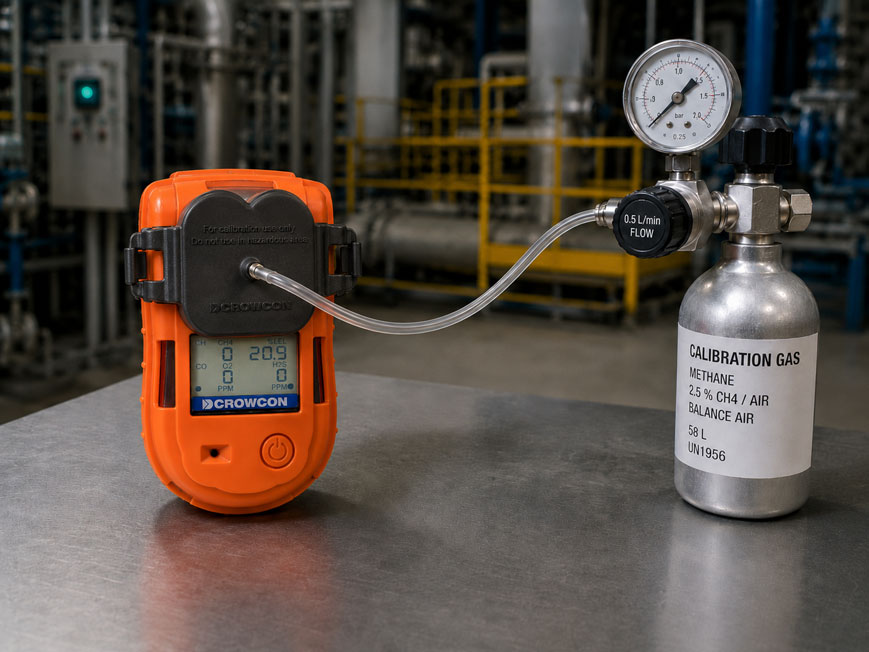
One example is the Crowcon T4 in a version with a pellistor for combustible gases. The compact personal safety device can simultaneously monitor combustible gas, oxygen, carbon monoxide and hydrogen sulfide. The catalytic combustible gas channel includes a protection function for very high combustible gas concentrations. For regular functional testing, the device can be used with a calibration/bump-test plate or an automatic test station.
Suitable portable and fixed gas detectors, test gas solutions and accessories can be found under gas detectors and gas warning devices at ICS Schneider. Information on the device particularly suitable for this application can be found under Crowcon T4.
Conclusion
A high combustible gas concentration can expose a catalytic LEL sensor to conditions outside its specified measuring range. If the device reaches the end of the measuring range or enters an overrange or pellistor-saver condition, the displayed end value must not be interpreted as the actual concentration above the measuring range.
After leaving the hazardous area, the sensor must first return to its normal operating condition under suitable conditions. The required procedure and stabilization time depend on the device. Premature resetting or zeroing is not an appropriate functional test.
It is particularly important to distinguish between zero point and sensitivity. A pellistor can once again show a perfect zero reading and still be less sensitive to combustible gas. For this reason, a functional test with a defined test gas should be performed after a relevant overrange exposure. If the response is abnormal, the sensitivity must be assessed by calibration or further inspection.
For safe handling after an overrange event, the following therefore applies: treat high concentration as an exceptional sensor exposure, observe the manufacturer’s protection and recovery requirements, allow the sensor to stabilize in clean air and verify its actual response to test gas before releasing it for further use.
FAQ: Catalytic LEL sensor after high gas concentration
What does overrange mean for an LEL sensor?
Overrange means that the combustible gas concentration has exceeded the specified measuring range of the sensor. With a measuring range up to 100 % LEL, the displayed end value does not indicate how high the actual concentration above this range was.
Can a catalytic sensor be damaged by excessively high gas concentration?
Strong or prolonged exposure above the specified measuring range can impair the sensor characteristics. Some gas detectors therefore include a protective function that switches off the pellistor at high concentrations.
What is a pellistor saver?
A pellistor saver is a protective function that temporarily deactivates the catalytic combustible gas sensor during very high gas exposure. This is intended to prevent unnecessary further loading of the heated catalytic sensing element.
Can the gas detector be used again immediately after returning to 0 % LEL?
Not solely on the basis of the zero reading. The device-specific requirements for stabilization or recommissioning must first be fulfilled. The function should then be checked using a suitable test gas.
Why is the zero point not sufficient after an overrange event?
The zero point shows only the sensor behavior without target gas. A sensor can correctly indicate zero in clean air while still having lost sensitivity. This becomes apparent only when it is exposed to a known combustible gas concentration.
What should be checked after an overrange event?
After sufficient stabilization, the zero point, response to test gas and alarm function should be checked. If the test gas response is abnormal, calibration or further sensor inspection should be carried out.
What is the difference between a bump test and calibration?
A bump test primarily confirms that the sensor responds to test gas and that the alarm functions operate. During calibration, the quantitative sensor response is assessed against a known test gas concentration and adjusted if necessary.
Can a pellistor become permanently less sensitive after an overrange condition?
Yes, this is possible. Sensitivity should therefore not be inferred from the zero point but should be checked with test gas after a significant overrange exposure.
What is the difference between overrange and sensor poisoning?
Overrange refers to a concentration above the specified measuring range. Sensor poisoning, on the other hand, results from substances that impair the catalytic surface of the pellistor. Both effects can influence sensor response but have different causes.
Which specific device is suitable for catalytic LEL monitoring?
One example is the Crowcon T4 in the version with a pellistor for combustible gases. The device monitors combustible gas up to 100 % LEL and can be regularly tested for sensor and alarm functionality using a suitable bump-test or calibration system.