


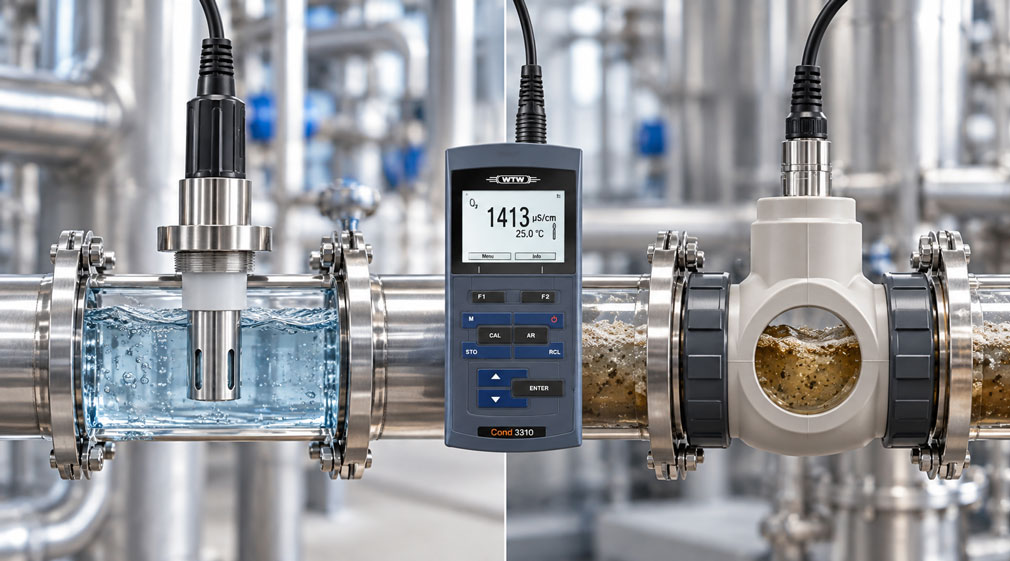
In a water treatment system, the electrical conductivity of clean process water is reliably measured with a conventional conductivity cell. A few metres further downstream, the same measured variable is to be monitored in a highly conductive cleaning solution. However, deposits regularly form on the sensor there, the measured values change and the probe has to be cleaned much more frequently.
At first glance, the measured variable is identical: electrical conductivity in µS/cm or mS/cm. From a metrological point of view, however, these are two very different applications.
With conventional conductive conductivity measurement, electrodes are in direct contact with the medium. An alternating electrical current or voltage is applied and evaluated between them. Depending on the cell geometry, cell constant and measuring method, a very wide conductivity range can be covered.
Inductive conductivity measurement works differently. Two magnetically coupled coils or toroids are electrically isolated from the medium. A transmitter coil generates an alternating magnetic field and thereby induces a current in the conductive medium. This current in turn generates a magnetic field that is detected by a second coil. Conductivity is therefore determined without exposed measuring electrodes.
Both principles have clear strengths. A conductive measuring cell can measure very sensitively at low conductivities and is therefore particularly suitable for ultrapure water and clean water samples. An inductive measuring point, on the other hand, has no exposed electrodes where conventional polarization can occur and is therefore particularly attractive for high conductivities, aggressive media and processes with a strong tendency to form deposits.
The decision is therefore not simply “electrode or no electrode”. What matters is the actual electrical conductivity of the medium, how strongly its composition varies, what deposits occur, which cleaning processes take place and how the measuring point can be mechanically installed.
The most important rule is therefore: The measuring principle should be selected according to the actual process medium. Very clean and weakly conductive media place different demands on the sensor than concentrated alkalis, contaminated wastewater or a CIP process. Conductive and inductive conductivity measurement are not competing technologies with one general winner, but tools for different measuring tasks.
What does electrical conductivity mean?
Electrical conductivity describes a medium’s ability to carry electric current. In aqueous solutions, this current transport is mainly provided by mobile ions.
For example, when a salt dissolves in water, it dissociates into positively and negatively charged ions. These can move under the influence of an electric field. As the number of freely mobile charge carriers increases, electrical conductivity generally also increases.
Very pure water, by contrast, contains only a low concentration of ions and therefore conducts poorly.
Depending on the application, conductivity can therefore vary over many orders of magnitude. Ultrapure water lies in a completely different range from drinking water, wastewater or a concentrated acid or alkali.
Typical units are µS/cm, mS/cm and, for very highly conductive media, also S/cm.
1 mS/cm = 1,000 µS/cm
A sensor does not directly measure the ion concentration of one individual substance. Different ions have different mobilities and several dissolved substances contribute simultaneously to the total conductivity.
Conductivity measurement is therefore initially a collective measurement of the electrically active ions present in the medium.
For process applications, this is often exactly the advantage. Conductivity can, for example, be used to monitor water quality, concentration changes, rinsing processes, product changes or cleaning processes.
How does conductive conductivity measurement work?
In a conductive measuring cell, conductive electrodes are located directly in the medium. An alternating electrical quantity is applied or evaluated between these electrodes.
The medium itself forms part of the electrical current path.
The higher its conductivity, the lower the electrical resistance between the electrodes. The specific conductivity is then determined from the measured conductance and the geometrical cell constant.
In simplified form:
κ = K × G
where:
κ = specific conductivity
K = cell constant
G = measured conductance
The cell constant describes, in simplified terms, the geometry of the electrode area and electrode spacing. This means that the same liquid can produce a completely different raw conductance value with different measuring cells, even though its specific conductivity naturally remains the same.
The evaluation electronics take this geometry into account and use it to determine the conductivity value of the medium.
Conductive measuring cells can be designed with two or more electrodes. 2- and 4-electrode systems are particularly common.
Their major advantage is direct electrical coupling to the medium. This means that even very low conductivities can be measured, provided the cell constant, electronics and measuring cell are designed for this purpose.
How does inductive conductivity measurement work?
With inductive conductivity measurement, there is no conventional current path via exposed electrodes.
Instead, the sensor contains two magnetic coils or toroids.
A transmitter coil is excited with alternating current. This produces an alternating magnetic field. The field induces an electrical current in the conductive medium.
The current in the medium in turn generates a magnetic field. This is detected by the receiver coil.
The strength of the received signal depends on the electrical conductivity of the medium.
In simplified terms, the liquid therefore acts as an electrically coupled secondary loop between the two coils.
The actual coils can be fully isolated from the medium by chemically resistant sensor material.
This is the fundamental advantage of the principle: there are no exposed measuring electrodes whose interface with the medium directly forms part of the measurement.
As a result, conventional electrode polarization effects do not occur and the sensor can be significantly more robust in highly conductive or deposit-forming media.
However, inductive does not mean that the liquid does not come into contact with the sensor. The process medium flows through or around the insulated sensor body. Only the electrical contact with metallic measuring electrodes is eliminated.
Direct comparison of the two measuring principles
| Criterion | Conductive measurement | Inductive measurement |
|---|---|---|
| Electrical contact | Electrodes are in direct contact with the medium | Coils are galvanically isolated from the medium |
| Low conductivity | Very well measurable with a suitable cell constant | Lower measuring limit depends on the sensor |
| High conductivity | Depending on cell design, polarization and electrode effects must be considered | Often particularly suitable |
| Polarization | Can become relevant, particularly with unsuitable design | No conventional electrode polarization |
| Deposits | Deposits directly on the electrodes can influence the measured value | No exposed electrodes, therefore often more robust against deposits |
| Ultrapure water | Suitable 2-electrode cells are particularly attractive | Often not the preferred principle |
| CIP / alkalis / acids | Possible depending on medium and measuring range | Often advantageous at high conductivity and with deposits |
| Sensor size | Very compact measuring cells are possible | Toroidal design generally requires a larger sensor cross-section |
| Installation environment | Cell constant and wetting are particularly important | The environment of the electromagnetic field must also be considered |
This comparison is deliberately not intended as a rigid selection rule.
A modern 4-electrode sensor can also work extremely well in comparatively high conductivity ranges. Likewise, inductive sensors are available with very broad measuring ranges.
The specific sensor design therefore remains decisive.
Why conductive sensors have advantages at low conductivity
At very low conductivity, only an extremely small electrical current flows through the medium.
This is precisely where direct conductive measurement shows its strength.
Suitable electrode geometries and small cell constants allow the high electrical resistance of very pure media to be measured sensitively.
For ultrapure water, specially designed 2-electrode measuring cells are therefore often used.
A cell constant of, for example, 0.1 cm-1 or 0.01 cm-1 can be significantly more suitable for such applications than a universal measuring cell for normal process water.
At the same time, the complete measuring point becomes more demanding.
At very low conductivity, even minor contamination can have a significant relative influence. An insufficiently rinsed sample vessel, residues on the measuring cell or absorption of carbon dioxide from ambient air can alter the measured value.
The measuring principle alone therefore does not guarantee good ultrapure-water measurement. Sensor, sample, temperature and handling must all be considered together.
Why inductive sensors become attractive at high conductivity
As conductivity increases, the challenge changes.
The electrical resistance between conductive electrodes decreases and the current density at the electrodes can increase. At the same time, interface effects and polarization become more relevant if the measuring frequency, cell geometry and electronics are not appropriately designed.
With inductive measurement, this direct electrode-medium interface does not exist.
This makes the principle particularly attractive for highly conductive acids, alkalis and concentrated process solutions.
In CIP processes, for example, conductivity can be used to distinguish between rinse water and highly conductive cleaning solution.
In such applications, high conductivity is not the only relevant factor. Significant chemical stress is often also present.
A completely encapsulated sensor body made from a suitable plastic can then provide a more robust solution than several exposed metallic electrodes.
However, the lower measuring limit of an inductive sensor must always be checked. A measuring principle that performs excellently in concentrated alkali does not automatically provide the same measurement quality in very pure rinse water.
Correctly assess electrode polarization
In a conductive measuring cell, an electrochemical transition occurs at the interface between electrode and electrolyte.
If this interface is electrically loaded unfavourably, charge carriers in the immediate vicinity of the electrode can become distributed differently from those in the rest of the medium.
This effect is known as polarization.
It creates an additional electrical influence that no longer results solely from the actual bulk resistance of the liquid.
Modern conductivity meters therefore use alternating electrical signals and adapted measuring frequencies. This reduces electrochemical DC effects.
In 4-electrode measuring cells, current injection and voltage measurement are also functionally separated. Two electrodes inject the measuring current, while another electrode pair measures the voltage in the medium.
This can significantly reduce the influence of the current-carrying electrode surfaces on the voltage measurement.
This extends the usable conductivity range and makes 4-electrode cells particularly interesting for varying conductivities.
Inductive measurement, by contrast, has no exposed electrodes and therefore no conventional polarization effect at an electrode surface.
Contamination and deposits affect the two principles differently
A commonly stated advantage of inductive sensors is that they are “insensitive to contamination”. As a general tendency this is correct, but it should not be understood as an absolute statement.
In a conductive measuring cell, the critical region lies directly on the electrodes.
An insulating deposit reduces the electrically effective surface area or changes the current path. The measured conductance can therefore decrease.
Conductive deposits, on the other hand, can create additional electrical paths.
Even a geometrically small change at an electrode can be relevant in a precise measuring cell.
With an inductive sensor, there are no exposed electrodes whose surface forms part of this current transfer. A thin deposit is therefore often significantly less critical.
Nevertheless, contamination is not completely without effect.
If, for example, the annular opening of a toroidal sensor becomes heavily restricted by deposits, the geometry of the current-carrying medium changes. A thick, poorly conductive deposit can also alter the effective measuring region.
Inductive sensors are therefore often more resistant to contamination, but they are not automatically maintenance-free.
Distinguishing 2- and 4-electrode cells
The choice between conductive and inductive measurement is not the only fundamental decision.
Different cell concepts also exist within conductive measurement technology.
In a conventional 2-electrode cell, the same two electrodes are used both to inject the measuring current and to evaluate the electrical response.
This design is mechanically simple and can be extremely sensitive with suitable cell constants.
This is an important advantage, particularly at low conductivities.
At high conductivities, however, the influence of the electrode interfaces increases. In this range, 4-electrode systems can offer advantages.
A universal 4-pole cell such as the TetraCon 325, for example, uses graphite electrodes and is intended for a broad range of typical aqueous applications.
This does not mean, however, that a 4-electrode cell is inherently better.
For ultrapure water, a specially optimized 2-electrode cell may be significantly more suitable.
The actual choice therefore often is not simply:
conductive or inductive?
but rather:
2-electrode, 4-electrode or inductive?
The cell constant remains crucial for conductive measurement
In conductive measuring cells, the cell constant determines how the measured electrical conductance is converted into the specific conductivity of the medium.
A small cell constant is generally more suitable for very low conductivities. A larger cell constant shifts the suitable range toward higher conductivities.
If an incorrect cell constant is configured in the measuring instrument, the displayed value can be systematically incorrect.
A factor-of-ten error in the cell constant can, for example, result in a conductivity value that is also wrong by approximately a factor of ten.
Especially with interchangeable sensors on portable instruments, it should therefore be checked which measuring cell is actually connected and which cell constant the instrument is using.
With high-quality measuring cells, the individual cell constant is often determined or calibrated at the factory.
Inductive measurement also has a sensor- and geometry-dependent characteristic curve, but evaluation is based on the electromagnetic measuring principle rather than on two directly wetted electrodes.
Why installation geometry matters with inductive sensors
The absence of exposed electrodes on an inductive sensor does not mean that its surroundings are electrically irrelevant.
The electromagnetic measuring field extends through the sensor ring and the surrounding conductive medium.
A nearby pipe wall can therefore influence the field distribution.
Whether this influence is relevant depends, among other things, on whether the pipe is electrically conductive or insulating, the pipe diameter and the distance between the sensor and the wall.
Manufacturers may specify an installation factor for such situations.
This factor takes into account the actual field influence caused by the process geometry.
A sensor that works correctly in a large open tank can therefore experience different boundary conditions when installed very tightly in a small pipeline.
With inductive sensors, the installation instructions should therefore be taken just as seriously as the cell constant of a conductive measuring cell.
Consider temperature compensation with both principles
The electrical conductivity of a liquid is strongly temperature-dependent.
As temperature increases, ions in many aqueous solutions become more mobile and conductivity rises.
This means that two samples with identical chemical composition can show different conductivity values if they are measured at different temperatures.
For comparable measurements, the value is therefore often compensated to a reference temperature, for example 25 °C.
This temperature compensation is independent of the actual sensor principle.
Both conductive and inductive measuring points require temperature evaluation that is appropriate for the application.
The compensation model used is also decisive.
A simple linear temperature correction may be sufficient for certain salt solutions. Natural water or highly concentrated acids and alkalis, however, can exhibit significantly non-linear behaviour.
An inductive sensor in a CIP solution is therefore not automatically more accurate simply because it is less sensitive to electrode deposits. If an unsuitable temperature compensation model is used, the concentration assessment can still be incorrect.
Select chemical resistance according to the medium
Chemical resistance is a key selection criterion for both measuring principles.
With conductive measuring cells, the electrodes are in direct contact with the process medium. The electrode material and sensor body must therefore be resistant to acids, alkalis, salts, solvents and, where relevant, cleaning agents.
Graphite, stainless steel, platinum and other electrode materials have different operating limits.
With an inductive sensor, the coils are isolated from the medium by the sensor body. This eliminates direct chemical exposure of a metallic electrode.
Instead, the resistance of the complete sensor body becomes decisive.
Materials such as PEEK or PFA are therefore used for demanding chemical process applications.
Here too, however, the specific combination of medium, concentration, temperature and process pressure remains decisive.
A material that is resistant to a dilute chemical at room temperature does not necessarily provide the same service life at 120 °C and a much higher concentration.
Detect gas bubbles and incomplete wetting
With conductive conductivity measurement, the relevant electrodes must be completely wetted by the medium.
An air bubble on an electrode replaces part of the conductive medium with practically non-conductive air. This immediately changes the electrical current path.
The measured value can jump, become too low or react unusually unstably.
With an inductive sensor, the situation is somewhat different, but trapped air can also be problematic.
The region intended for the inductive current loop must be sufficiently filled with conductive medium.
A large gas bubble inside the sensor opening reduces the effective conductive cross-section and can alter the measuring signal.
The same therefore applies to both principles: suitable installation position and complete wetting remain important.
The statement “inductive measurement works without contact” must therefore not be confused with “the installation situation is irrelevant”.
Realistically assess cleaning and maintenance effort
A clean conductivity measuring cell does not automatically require regular cleaning according to a fixed calendar interval.
The maintenance requirement depends largely on the medium to which the measuring point is exposed.
In clean drinking or process water, a conductive cell can operate stably for a long period.
In biologically contaminated water, fatty media or strongly crystallizing salt solutions, however, the same sensor type can quickly develop deposits.
This is where inductive measurement offers a clear practical advantage. Because there is no electrode surface acting as a sensitive electrochemical interface, many deposits have a less direct effect on the measurement.
Nevertheless, an inductive sensor must also be inspected and cleaned where necessary.
Particularly heavy deposits in the sensor opening or flow passage can change the geometry. Hygienic requirements may also make regular cleaning necessary regardless of the immediate measuring effect.
The objective is therefore not “maintenance-free”, but a measuring principle whose maintenance requirements suit the real process.
Calibration and reference solutions
A conductivity measuring point can be checked using suitable reference solutions.
The reference value, temperature and measuring range must match the actual measuring cell.
A calibration solution of 1,413 µS/cm or 1.413 mS/cm, for example, is a common reference for many water applications.
For ultrapure-water measurements or highly concentrated process media, however, a different test point may be more appropriate.
With conductive measuring cells, one of the aspects checked is whether the effective cell constant still corresponds to the expected value.
Deposits, damage or changes to the electrode surface can cause deviations.
Inductive systems can also be checked using known solutions. Sensor- and installation-specific manufacturer procedures should be taken into account.
Calibration should also be distinguished from process diagnostics.
If a sensor reads correctly in a clean reference solution in the laboratory but not in the process, the cause is more likely to lie in installation, medium, temperature, contamination or process conditions than in the basic calibration of the instrument.
Practical example: process water and CIP solution
A plant has two conductivity measuring points.
The first measuring point monitors treated process water. Conductivity normally ranges between approximately 100 and 800 µS/cm. The water is visually clean and only minor deposits occur.
A conductive 4-electrode measuring cell provides a wide measuring range and robust water analysis for this application. The measurement responds quickly and the sensor remains comparatively compact.
The second measuring point is located in the CIP return line.
Here, rinse water alternates with highly conductive alkaline cleaning solution. Product residues and deposits can also occur. During cleaning, conductivity is several orders of magnitude higher than during the water rinse step.
A conductive sensor can in principle also perform this task, provided the measuring range, electrodes and chemical resistance are suitable.
However, inductive measurement offers several practical advantages in this case. There are no exposed measuring electrodes, conventional polarization does not occur and deposits on the sensor body are often less critical.
An inductive process measuring point is therefore selected for the CIP application.
This does not completely solve the task, however. The lower conductivity limit must still extend sufficiently into the rinse-water range. Sensor body and seals must be suitable for the alkali and temperature used. The pipe geometry must also be compatible with the inductive measuring point.
The example demonstrates the decisive point: the abstract measured variable “conductivity” does not determine the sensor; the complete process situation does.
Systematically diagnose implausible measured values
If a conductivity value suddenly appears implausible, the first step should be to determine which measuring principle is installed.
With a conductive measuring point, electrode condition, deposits, wetting and cell constant are particularly important points to check.
With an inductive sensor, the sensor opening, installation geometry, sufficient minimum conductivity and possible heavy deposits become more important.
Temperature and process composition must be checked with both principles.
| Observation | Possible cause | Sensible check |
|---|---|---|
| Conductive sensor drifts slowly | Electrode deposits or change in surface condition | Inspect and clean sensor and check with reference solution |
| Conductive value jumps | Air bubbles or unstable wetting | Check installation position and sample |
| Inductive sensor shows unstable values in a weakly conductive medium | Conductivity close to or below the device limit | Check measuring range and minimum conductivity |
| Inductive measured value changes after modification of the pipeline | Changed installation geometry or wall influence | Check installation instructions and installation factor |
| Both sensor principles change strongly with temperature | Actual temperature dependence or incorrect compensation | Check temperature value and compensation model |
| Measured value is correct in standard solution but not in the process | Process, installation or contamination influence | Investigate the measuring point under actual operating conditions |
A structured diagnosis prevents unnecessary sensor replacement when the actual cause is a changed measuring task or installation situation.
Systematically select the measuring principle
Selection should begin with the actual conductivity range.
If the medium is in the very low µS/cm range or is ultrapure water, a conductive measuring cell specifically designed for this purpose is often the obvious solution.
For normal water and changing medium conductivity, a 4-electrode measuring cell offers a very broad practical operating range.
If conductivity rises significantly and aggressive chemicals, deposits or CIP processes are also involved, the inductive principle becomes increasingly attractive.
Temperature, pressure, material compatibility and mechanical installation conditions must then also be checked.
With inductive measurement, sufficient space for the intended electromagnetic measuring geometry is also required.
With a conductive measuring point, the cell constant must match the measuring range.
Only then should the questions of interface, display, data logger or automation be addressed.
This prevents selection of a convenient measuring instrument with extensive electronics whose actual measuring cell is unsuitable for the process medium.
Suitable conductivity measurement technology at ICS Schneider
Within the category pH / conductivity / oxygen / measuring instruments, ICS Schneider Messtechnik offers various portable systems for water analysis, environmental measurement, laboratory work and control measurements.
The WTW ProfiLine Cond 3310 is particularly interesting for applications where different conductivity ranges and measuring cells are to be used. The instrument supports 2- and 4-pole measuring cells, has an integrated data logger and is also suitable for ultrapure-water measurements.
This makes it particularly suitable as a flexible portable measuring instrument for laboratories, water treatment, process checks and comparative measurements on different media.
The TetraCon 325, among others, can be used as a universal measuring cell. It operates according to the conductive 4-pole principle with graphite electrodes and has a cell constant of approximately 0.475 cm-1. This allows it to cover a broad range of typical aqueous media.
For very low conductivities, special 2-pole cells with smaller cell constants are available instead. This demonstrates that even within a single measuring instrument, selecting the correct measuring cell can be just as important as selecting the instrument itself.
The WTW ProfiLine Cond 3110 is designed for robust routine measurements. The portable and waterproof instrument is used particularly for natural waters and wastewater and provides automatic temperature compensation as well as salinity measurement.
For a process measuring point, it should already be stated in the enquiry whether a portable spot-check measurement or continuous inline measurement is required.
For continuous applications, process connection, pressure, temperature, material, cleaning conditions and required output signal are additionally important. For highly conductive or deposit-forming applications, it should be specifically checked whether an inductive measuring point offers advantages over a conventional electrode measurement.
pH, conductivity and oxygen measuring instruments at ICS Schneider
Conclusion
Conductive and inductive conductivity measurement pursue the same objective, but use two fundamentally different electrical principles.
With conductive measurement, the electrode surface is a direct part of the measuring system. With inductive measurement, conductivity is detected electromagnetically using a coil arrangement that is galvanically isolated from the medium.
This structural difference determines a large part of the practical differences between the two methods.
For low conductivities and particularly ultrapure water, specially designed conductive measuring cells are often the better solution. With a suitable cell constant, they can sensitively detect very small conductance values.
At higher conductivities, with strong deposits and aggressive process media, inductive measurement becomes increasingly attractive. There are no exposed electrodes, conventional polarization is eliminated and deposits often have less influence on the measurement.
This does not mean, however, that an inductive sensor is universally better. It requires a sufficient minimum conductivity and its electromagnetic measuring zone can be influenced by the installation geometry. Heavy contamination can also become relevant over time.
Likewise, a conductive measuring point is not inherently maintenance-intensive. In clean water, a correctly designed electrode cell can operate very stably for long periods.
The correct decision therefore results from the combination of conductivity range, tendency to contamination, medium, temperature, chemical resistance, installation situation and maintenance strategy.
Considering these factors during selection avoids many typical problems later: constantly drifting electrodes in a strongly deposit-forming alkali as well as an inductive sensor that has insufficient signal reserve at very low conductivity.
FAQ on conductive and inductive conductivity measurement
What is the main difference between conductive and inductive conductivity measurement?
With conductive measurement, electrodes are in direct electrical contact with the medium. With inductive measurement, the current is detected via electromagnetically coupled coils without exposed measuring electrodes.
Which method is better suited to ultrapure water?
For very low conductivities, specially designed conductive 2-electrode measuring cells with a small cell constant are often particularly suitable.
Which method is better suited to highly conductive alkalis?
At high conductivity, with strong chemical exposure and a tendency to form deposits, an inductive measuring point can offer significant practical advantages.
Why are inductive sensors less susceptible to polarization?
They do not have exposed measuring electrodes. This eliminates the conventional electrochemical interface between electrode and medium where polarization can occur.
Is an inductive conductivity sensor completely insensitive to contamination?
No. It is often significantly more robust against deposits, but heavy deposits can change the geometry of the measuring zone and therefore also affect the measurement.
Can an inductive sensor measure very low conductivity?
This depends on the specific sensor. Inductive systems have a device-specific lower conductivity limit and are often less suitable for extremely weakly conductive media than specially designed conductive cells.
Why are there 2- and 4-electrode sensors?
In 2-electrode cells, current and voltage are measured via the same electrode pair. 4-electrode systems separate current injection and voltage measurement and can therefore reduce the influence of electrode polarization.
Is a 4-electrode sensor always better than a 2-electrode sensor?
No. 4-electrode sensors offer a broad measuring range, while special 2-electrode cells can provide clear advantages at very low conductivities, for example.
What is the cell constant?
The cell constant describes the geometry of a conductive measuring cell and is required to determine the specific conductivity of the medium from the measured conductance.
Why must the cell constant match the measuring range?
A small cell constant is generally more suitable for low conductivities, while larger cell constants can be suitable for higher conductivity ranges.
Does the cell constant also play a role with inductive sensors?
Inductive sensors also have a geometry-dependent sensor characteristic. However, the conventional electrode cell constant of a conductive measuring cell is not used in the same way.
Why does temperature influence conductivity?
The mobility of ions changes with temperature. In many aqueous solutions, conductivity increases significantly as temperature rises.
Does an inductive sensor also require temperature compensation?
Yes. Temperature dependence primarily originates from the medium rather than the electrode principle. It must therefore be considered with both conductive and inductive measurement.
Can an air bubble affect conductivity measurement?
Yes. In a conductive cell, it can interrupt the direct electrode contact or current path. In an inductive sensor, a gas bubble can reduce the conductive cross-section within the measuring zone.
Why is installation geometry important with inductive sensors?
The electromagnetic measuring field can be influenced by nearby pipe walls. Pipe material, diameter and sensor distance from the wall must therefore be considered according to the manufacturer’s specifications.
Is inductive measurement suitable for CIP systems?
It is often particularly attractive because CIP media can reach high conductivities and there are no exposed electrodes. Temperature, chemical resistance and the lower conductivity limit must nevertheless be checked.
Can a conductive sensor also be used in CIP media?
Yes. If the measuring range, electrode material, cell constant, temperature resistance and chemical resistance are suitable, conductive measurement can also be appropriate.
How can I tell that the wrong sensor technology has been selected?
Typical indications include the need for constant electrode cleaning, insufficient signal reserve at very low conductivity, strong measured-value drift, problems across a very wide conductivity range or significantly changed values during process and cleaning transitions.
Which portable conductivity meters does ICS offer?
Available instruments include the WTW ProfiLine Cond 3110 and Cond 3310. The Cond 3310 can be used with different 2- and 4-pole measuring cells and has an integrated data logger.
What information is important when selecting a conductivity measuring point?
Important information includes the minimum and maximum conductivity range, medium and concentration, temperature, pressure, contamination or deposit behaviour, cleaning process, required accuracy, installation method and whether a portable control measurement or continuous process measurement is intended.