


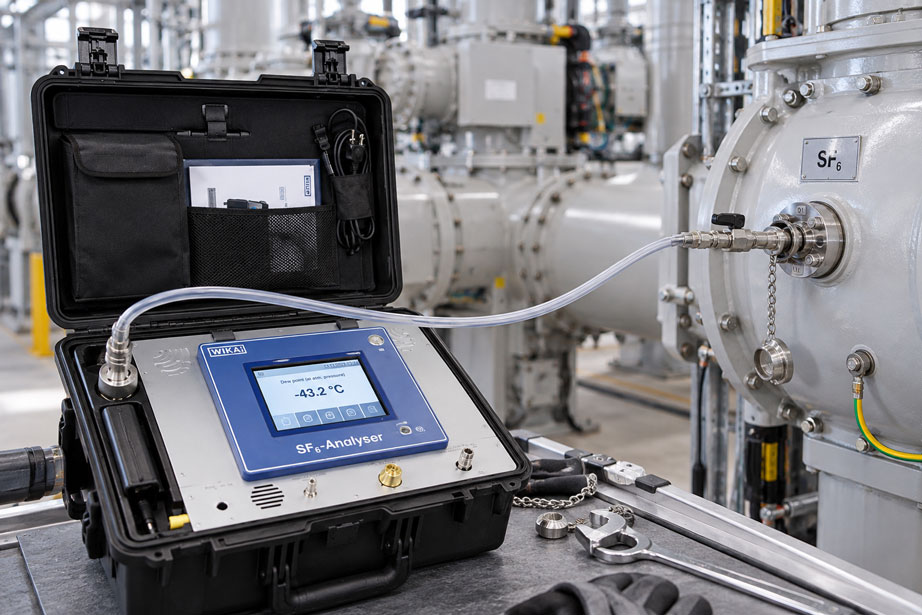
An SF6 gas-insulated switchgear system has been opened for maintenance work. The gas was previously recovered, the relevant gas compartment ventilated and seals or internal components were then inspected or replaced. Once the work has been completed, the gas compartment is evacuated and refilled with dry SF6.
The gas pressure is correct, the gas density is within the specified range and the system therefore appears ready for operation again. Nevertheless, one important question remains: how much moisture is actually present in the gas compartment?
This question can be particularly important after maintenance work. While the system is open, the interior comes into contact with ambient air. Moisture can accumulate on metal surfaces, insulating materials, dead spaces, hoses and service components. Refilling with dry SF6 afterwards therefore does not automatically mean that the entire gas compartment is immediately dry.
Some of the residual moisture may only gradually be released from surfaces and materials into the gas. The measured moisture value can therefore still change after filling even though no additional water has entered the system and no further SF6 has been added.
For recommissioning, it is therefore not only important which gas was supplied from the cylinder or service equipment. The actual condition of the gas inside the equipment must be evaluated.
The most important rule is therefore: After maintenance work, dew/frost point or moisture should only be assessed once the sample gas path, analyzer and gas compartment have reached a sufficiently stable condition for the intended test procedure. A single early reading taken immediately after filling may not yet fully represent the residual moisture of the complete system.
Why moisture is particularly relevant after maintenance work
SF6 is used in gas-insulated medium- and high-voltage equipment because of its excellent electrical insulation and arc-quenching properties. To use these properties reliably, it is not enough to have the correct gas quantity in the equipment. Gas quality is also part of the overall system condition.
Moisture is a particularly important parameter. Water can influence the electrical properties of the insulation system and, under unfavourable conditions, react with decomposition products. This can form aggressive and corrosive reaction products that place additional stress on internal surfaces and insulating materials.
During normal operation, an SF6 gas compartment is largely closed. Its moisture content therefore usually changes slowly, for example as a result of long-term permeation or ageing of sealing systems.
During maintenance, the situation is different. As soon as a gas compartment is opened or ventilated with ambient air, moisture can enter the system. Even if the compartment is subsequently evacuated carefully and filled with dry gas, residual moisture may remain on surfaces or within materials.
Moisture measurement before recommissioning therefore answers a different question from a routine gas-quality analysis during normal operation. In particular, it is intended to show whether the maintenance and refilling process has produced a sufficiently dry gas compartment.
Where residual moisture in the gas compartment can come from
Residual moisture does not necessarily have to be caused by moist SF6.
During an open maintenance procedure, ambient air enters the gas compartment. Depending on temperature and relative humidity, this air contains a certain amount of water vapour. This water vapour can settle on internal components.
Metal surfaces themselves do not absorb large quantities of water, but they can carry a thin moisture film. Insulating materials, surface coatings and certain polymer materials can absorb significantly more moisture and release it again later.
Service equipment is also part of this system. A filling hose that is not sufficiently dry, an adapter that was previously stored open or service equipment containing moisture in its internal gas path can introduce water into the gas compartment again.
Evacuation is another important factor. A sufficient vacuum is not only used to remove air before filling. Lowering the pressure also supports the release of moisture from surfaces and materials.
If evacuation was too short, the required vacuum level was not reached or the gas compartment was still comparatively moist, residual moisture can remain after filling.
The subsequent moisture measurement is therefore also an indirect quality check of the complete maintenance, evacuation and filling process.
Correctly understanding dew point and frost point
Moisture in a gas can be expressed in several different ways. In SF6 applications, the dew point or frost point is commonly used.
In simplified terms, the dew point is the temperature to which a gas would have to be cooled, at constant moisture content, before water vapour begins to condense.
If this temperature lies below freezing, it is physically more precise to speak of the frost point because, under the relevant conditions, ice or another solid water phase forms instead of liquid water.
In practical SF6 applications, the term dew point is also frequently used for very low negative temperatures. Depending on their configuration, modern analyzers can therefore display dew-point and frost-point values separately or calculate the corresponding values.
For interpretation:
The lower or more negative the dew point or frost point, the drier the gas.
A value of −45 °C therefore represents drier gas than a value of −20 °C, provided both values are specified under comparable reference conditions.
This qualification is important. Dew-point values can only be meaningfully compared if the pressure condition to which they refer is known.
Distinguishing atmospheric from pressure-related dew point
In SF6 systems, moisture can be expressed both as atmospheric dew/frost point and as dew/frost point at the current gas-compartment pressure.
These values are not identical.
If a gas is compressed while the absolute amount of water remains unchanged, the partial pressure of water vapour increases. This also changes the temperature at which saturation and condensation are reached.
A dew point at several bar gas-compartment pressure can therefore differ significantly from the value for the same gas condition converted to atmospheric pressure.
When evaluating limits from standards or manufacturer specifications, exactly the same reference basis must therefore be used.
If a specification states, for example:
atmospheric frost point ≤ −36 °C
this value must not be compared directly with a pressure dew point displayed at the current gas-compartment pressure.
Modern SF6 analyzers therefore allow different moisture quantities to be displayed. For traceable maintenance documentation, not only the numerical value but also the unit or reference basis used should always be recorded.
Do not mix dew point, ppmv and ppmw without checking
In addition to dew point and frost point, the water content can also be expressed in ppm.
ppmv describes a volume- or amount-of-substance-based proportion, while ppmw describes a mass-based proportion.
These two values are not numerically identical in SF6 because water and SF6 have very different molar masses.
A value of, for example, 100 ppmv must therefore not simply be interpreted as 100 ppmw.
The same applies when comparing ppm values with dew-point values. There is a physical relationship between ppm and dew point, but it depends on factors including pressure, gas type and reference conditions.
Consistent units are therefore essential in maintenance records.
If a value is documented as atmospheric frost point during one maintenance operation and only in ppmv during the next, trend assessment becomes unnecessarily difficult.
For recurring tests, the same measured quantity and the same reference condition should therefore be used wherever possible.
The role of temperature and pressure
The actual amount of water present in the SF6 and the risk of condensation are related, but they are not identical considerations.
At a warm ambient temperature, a gas can retain a certain amount of moisture in vapour form without difficulty. If the gas or an internal surface cools significantly, the system approaches saturation.
This is exactly why the dew point is so useful: it indicates how far the current moisture condition is from condensation.
For outdoor equipment, the temperature during maintenance is not the only relevant factor. The temperatures to which the switchgear may later be exposed during operation are also important.
A gas compartment that appears comfortably dry at +25 °C can be significantly closer to the condensation limit at very low winter temperatures.
Gas pressure also plays a role. SF6 is operated in switchgear at a defined operating pressure or gas density. For moisture assessment, it should therefore be known whether an atmospheric reference value or a value related to the actual gas-compartment pressure is being considered.
Temperature, pressure and moisture quantity must therefore be interpreted together.
Why dry filling gas alone is not enough
When refilling, dry SF6 or appropriately processed gas is normally used.
If this gas is measured directly at the outlet of the service equipment, the moisture value may be excellent.
However, this value initially describes the filling gas and not automatically the condition of the complete equipment.
Once the dry gas enters the gas compartment, it comes into contact with all internal surfaces and materials. If residual moisture is still present there, a new equilibrium begins to develop.
Water that was previously bound to surfaces or within materials can migrate into the dry gas.
As a result, the moisture value in the gas compartment after filling can be higher than the value of the gas originally introduced.
This is not a contradiction. The gas has absorbed moisture from the equipment.
For recommissioning, moisture measurement directly at the gas compartment is therefore significantly more informative than the certificate or quality of the filling gas alone.
Correctly assessing evacuation and drying
Evacuation before filling serves several purposes.
First, air is removed from the gas compartment. At the same time, the partial pressure of water vapour decreases, allowing moisture to be released more easily from surfaces and materials.
The effectiveness of this process does not depend solely on the final pressure shown by the vacuum gauge.
Evacuation time, equipment temperature, gas-compartment volume, internal surfaces and hygroscopic materials also play a role.
A very low pressure that is reached only briefly therefore does not automatically prove that all relevant components have been completely dried.
For equipment with a higher moisture load, a defined drying process may be required.
The manufacturer’s and maintenance instructions for the specific switchgear remain decisive. A general minimum time for all GIS systems would not be technically appropriate.
The subsequent moisture measurement does, however, provide valuable feedback on whether the result of the drying and evacuation process was actually sufficient.
Why the moisture value can still change after filling
After filling, the gas compartment does not necessarily reach full moisture equilibrium immediately.
The dry gas introduced into the compartment begins to absorb moisture from internal surfaces and insulating materials. This mass transfer takes time.
A measurement taken immediately after filling can therefore initially show a very low moisture value.
After some time, the value may rise even though the system is completely closed and leak-tight.
This does not automatically mean that a new leak has developed. The moisture may originate from inside the equipment.
Conversely, a stable low value after sufficient equilibration can provide a much stronger indication of a dry gas compartment than a single measurement taken immediately after filling.
The necessary waiting time before final assessment depends on the equipment, maintenance procedure and manufacturer specifications.
For this reason, no general waiting time should be applied to every SF6 system.
What matters is understanding the development over time and, for critical measuring points, carrying out a verification measurement where appropriate.
Avoid sampling hose and sampling errors
With very dry gases, even a small quantity of foreign moisture in the sample path becomes relevant.
A sampling hose that has been left open in a humid environment for an extended period can absorb water on its internal surface.
If very dry SF6 is subsequently passed through this hose, the gas initially absorbs some of this moisture. The analyzer may then display a higher moisture value than is actually present in the gas compartment.
Adapters and couplings can also influence the measured value if they have been stored open or exposed to humid ambient air immediately before measurement.
The sampling path should therefore be as short, clean and dry as possible and suitable for SF6.
Before the actual assessment, the sample path must be sufficiently exposed to the sample gas in accordance with the specified instrument procedure.
The opposite effect is also possible. If the hose was previously flushed intensively with extremely dry gas, its surface may initially absorb water from the sample and temporarily shift the measured value in the direction of “too dry”.
For very low moisture levels, stabilization of the measured signal is therefore particularly important.
Allow the analyzer to stabilize
Moisture measurement in the very dry range requires more attention than a simple pressure measurement.
The moisture sensor itself, internal lines and measuring chambers must reach a stable condition.
If an analyzer is brought, for example, from a cold vehicle into a warm switchgear room, significant temperature differences initially exist within the instrument.
The moisture sensor may also require a stabilization phase after extended storage.
The measuring procedure should therefore not be stopped as soon as the first plausible numerical value appears.
Instruments such as the GA11 evaluate the stability of the sensor values and can complete the measurement according to the stability criteria reached.
Particularly with very dry gas, the warm-up and recalibration period specified by the instrument manufacturer should also be observed.
A stable final value is significantly more informative for the maintenance decision than an early intermediate reading.
Apply limit values correctly
When considering the maximum permissible moisture content, there is often a desire for one universal dew-point limit.
In practice, this approach is too simplistic.
Normative limits exist for certain gas qualities and applications. In addition, switchgear manufacturers and operators may define their own requirements for new filling, reuse or recommissioning.
A limit value for reused SF6 is therefore not automatically identical to the acceptance criterion for a particular freshly serviced GIS.
The reference basis must also match. An atmospheric dew point or frost point cannot be directly compared with a pressure-related value.
Before approval, the following should therefore be clarified:
Which standard or manufacturer specification applies?
Which moisture quantity is being used?
To which pressure condition does the value refer?
Which limit values apply to this specific equipment condition?
Only then is an unambiguous pass/fail assessment possible.
Do not confuse moisture with purity
A very dry dew point does not automatically confirm that the SF6 is of completely satisfactory overall quality.
Moisture is only one gas-quality parameter.
During maintenance, for example, air may enter the gas compartment. After insufficient evacuation, this can affect the SF6 concentration or gas purity even if the water content is relatively low.
Conversely, SF6 can have high purity and still contain excessive moisture.
The questions are different:
Moisture: How much water is present in the gas?
Purity: What is the actual SF6 content, or how large is the proportion of other gases?
A complete gas-quality assessment therefore considers several measured quantities.
After extensive maintenance work, it can be useful to document moisture and purity together rather than drawing conclusions about total gas quality from a single dew-point value.
Assess moisture and decomposition products together
In SF6 systems that have already been in operation, decomposition products may also be relevant in addition to moisture and foreign gases.
During switching operations and electrical discharges, SF6 is partially decomposed. Under ideal conditions, the constituents subsequently recombine to a large extent.
If water and other reactants are present, however, undesirable by-products can form.
An increased moisture value after maintenance is therefore not only relevant because of possible condensation.
It can also make the chemical conditions inside the equipment less favourable.
If a gas compartment already contains decomposition products or has been exposed to relevant switching operations, a more comprehensive gas analysis may therefore be appropriate.
The dew point then describes only one part of the overall condition.
Practical example after GIS maintenance
Seals and an internal component are inspected on an SF6 gas-insulated switchgear bay. The SF6 is first recovered using service equipment and the relevant gas compartment is then ventilated.
After the mechanical work has been completed, the equipment is closed again. The gas compartment is evacuated according to the specified procedure and then filled with processed dry SF6 to the specified filling condition.
A moisture measurement is performed immediately after filling.
The analyzer shows, for example:
atmospheric frost point: −43 °C
The value appears very good.
After the equilibration time specified for the equipment, the measurement is repeated. The analyzer now shows, for example:
−35 °C
Such a change may indicate that the initially very dry SF6 has absorbed residual moisture from internal surfaces or insulating materials.
The second measurement may therefore represent the actual moisture condition of the gas compartment better than the value measured immediately after filling.
The value must now be compared with the acceptance criterion applicable to this equipment.
If it is outside the permissible range, the equipment should not simply be released for operation merely because the SF6 originally introduced was dry.
Instead, it must be determined whether further evacuation, drying, gas treatment or another measure is required in accordance with the manufacturer’s instructions.
The figures in this example are for illustration only and are not universally applicable acceptance limits.
Why a second measurement can be valuable
A verification measurement is particularly useful if relevant parts of the gas compartment were exposed to ambient air for a longer period during maintenance or if a stable condition cannot yet be assumed during the first measurement.
Comparing two measurements shows not only an absolute dew-point value but also its development over time.
If the moisture value remains stable, this indicates that the system has largely reached equilibrium.
If the moisture level rises significantly even though the gas compartment is closed and the pressure remains stable, this can indicate moisture release from internal materials.
A continuing increase over a longer period may have other causes and should be investigated accordingly.
Possible causes include moisture ingress through sealing systems or a problem within the gas compartment.
Trend assessment is therefore often more informative than one isolated measured value.
In systems with continuous moisture monitoring, this development can be tracked particularly effectively.
Systematically diagnose implausible moisture values
An unusual dew-point value should not immediately be attributed solely to the SF6 in the gas compartment.
With very dry gases, the complete measuring chain influences the result.
| Observation | Possible cause | Sensible check |
|---|---|---|
| Moisture value starts high and decreases during measurement | Moisture in the sampling hose or analyzer | Stabilize the measuring path and continue measurement until a stable value is reached |
| Moisture value starts very low and rises later | Residual moisture from the gas compartment or materials is being absorbed | Repeat the measurement after the specified equilibration time |
| Value fluctuates strongly | Unstable sampling, temperature differences or unstabilized sensor system | Check the measuring setup and instrument condition |
| Dew point is good, but overall gas quality is still questionable | Foreign gases or decomposition products | Additionally measure purity and, where appropriate, decomposition products |
| Moisture remains too high even after drying | Residual moisture in the equipment or insufficient drying process | Review the maintenance and evacuation process |
| Moisture rises over an extended period during operation | Permeation, sealing effects or moisture ingress | Investigate trend, leak tightness and equipment condition |
During diagnostics, only one influencing factor should be changed at a time wherever possible.
If a new sampling hose is used, the analyzer replaced and the gas compartment topped up at the same time, it will be almost impossible afterwards to determine which change caused the new measured value.
What should be done if the moisture value is too high?
If the permissible moisture value is exceeded after maintenance, a sampling or measurement error should first be ruled out.
If the elevated water content is confirmed, the next steps depend on the equipment and service concept.
One option is to recover the SF6, process it using suitable filters or gas-drying equipment and refill the gas compartment after appropriate preparation.
Depending on the equipment condition, renewed or extended evacuation and drying may also be required.
For equipment that is already in operation, systems are also available for drying the gas during operation.
It is important not simply to add particularly dry gas and assume that this automatically provides a permanent solution.
If the actual source of moisture remains in the equipment, the initially improved dew point can rise again later.
The cause, and not only the current measured value, should therefore be considered.
Handle sample gas with minimal emissions
A certain quantity of SF6 must be withdrawn from the equipment as sample gas for moisture measurement.
This gas should not be released unnecessarily into the atmosphere.
Modern analyzers therefore enable closed or low-emission sample-gas procedures.
Depending on the system, the withdrawn gas can be pumped directly back into the tested gas compartment, transferred into an external gas container or collected in a suitable gas recovery bag.
This not only reduces SF6 loss. It also allows repeated measurements to be performed without unnecessarily losing gas from the equipment during every analysis.
Particularly during maintenance involving several measuring points or verification measurements, sample-gas handling should therefore be planned before analysis begins.
Suitable SF6 measurement technology at ICS Schneider
Within its SF6 gas solutions, ICS Schneider Messtechnik offers equipment for analysis, monitoring, handling, filling, gas recovery and gas drying.
The WIKA GA11 is particularly suitable for mobile gas-quality testing. As standard, the analyzer determines moisture and gas composition or purity and, depending on its configuration, can additionally measure decomposition products.
This makes it particularly suitable for assessments after maintenance, filling and service work when not only gas pressure but the actual gas quality is to be verified before recommissioning.
The moisture sensor can provide several display quantities, including dew point or frost point, pressure-related moisture values and ppm values. This allows the output to be adapted to the relevant test specification or documentation requirements.
Another advantage is sample-gas handling. Depending on the measuring setup, the withdrawn gas can be pumped back into the gas compartment, transferred into an external container or collected in a suitable recovery system.
SF6 analyzers at ICS Schneider
For permanent condition monitoring, the WIKA GDHT-20 is available. The transmitter measures pressure, temperature and moisture and derives, among other values, gas density and dew/frost-point information.
This allows moisture development to be monitored continuously even after recommissioning. Particularly in systems where moisture ingress or long-term gas quality is critical, this enables trend assessment instead of relying only on individual spot measurements.
If excessive moisture has been confirmed, gas drying may be required depending on the system condition and service concept. The WIKA GAD-2000 is designed to reduce the moisture content in SF6 gas-filled equipment during operation.
Appropriate SF6 service equipment is also available for filling, cleaning, recovery and evacuation. Gas recovery, treatment and refilling can therefore be implemented as a closed service process.
For selecting the appropriate equipment, the following information should ideally be known: equipment type, gas-compartment volume, filling pressure or gas density, insulating gas used, expected moisture range, required output unit, required gas-quality parameters and intended sample-gas handling.
SF6 gas solutions at ICS Schneider
Further reading: Distinguishing SF6 gas density from gas pressure during filling
Conclusion
After maintenance work on an SF6 gas-insulated system, it is not enough to check only filling pressure or gas density.
The gas compartment can have the correct filling condition and still contain excessive residual moisture.
The cause does not necessarily lie in the SF6 introduced during filling. Moisture may have been absorbed by surfaces and insulating materials while the equipment was open, or it may enter the gas compartment through hoses, adapters and service equipment.
Careful evacuation reduces this residual moisture, but can only remove it reliably if vacuum level, duration and equipment condition are appropriate for the specific equipment.
After filling, moisture can also continue to redistribute between the dry SF6 and the internal materials. A very low dew point measured immediately after filling is therefore not always the final equilibrium value of the gas compartment.
For a reliable assessment, atmospheric and pressure-related dew/frost points must also be distinguished. ppmv, ppmw and dew point must likewise not be compared directly without knowing their reference conditions.
The permissible moisture level depends on the standard, manufacturer specification and maintenance instruction applicable to the equipment. A single general dew-point figure is therefore no substitute for the specific equipment release criterion.
By considering the gas compartment, measuring path, analyzer stabilization and development over time together, a significantly more meaningful moisture value is obtained. Gas analysis then becomes a direct quality check of the maintenance, evacuation and filling process – rather than merely a measurement of the gas that was introduced beforehand.
FAQ on moisture measurement in SF6 after maintenance work
Why should SF6 be checked for moisture after maintenance work?
When the gas compartment is opened, humid ambient air can enter the equipment. Water can remain on surfaces and in insulating materials and later migrate back into the SF6 after filling.
Is it sufficient to fill the equipment with dry SF6?
No. Dry filling gas does not automatically guarantee a dry gas compartment. Residual moisture within the equipment can subsequently migrate into the gas.
What is the dew point?
The dew point describes the temperature at which the water vapour contained in the gas begins to condense under the relevant conditions.
What is the frost point?
At very low temperatures, the frost point is physically more precise when a solid water phase forms instead of liquid water. In practical SF6 applications, the terms dew point and frost point are often used together.
Does a more negative dew point mean drier gas?
Yes, provided the values are specified under the same reference conditions. An atmospheric dew point of −45 °C represents drier gas than −25 °C.
Why must atmospheric and pressure-related dew point be distinguished?
The condensation point changes with gas pressure. The same water content can therefore produce different dew-point values at atmospheric pressure and at gas-compartment pressure.
What does ppmv mean?
ppmv describes the volume- or amount-of-substance-based proportion of water in the gas.
What does ppmw mean?
ppmw describes the mass-based water content. Because water and SF6 have different molar masses, ppmv and ppmw are not numerically identical.
Can the moisture value rise again after filling?
Yes. Dry SF6 can absorb residual moisture from internal surfaces and insulating materials. The measured value can therefore change during the equilibration phase.
How long should you wait after filling before measuring?
There is no universal waiting time. The required equilibration time depends on the equipment, maintenance process and manufacturer specifications.
Can a moist sampling hose distort the value?
Yes. With very dry SF6, moisture from the hose, adapter or couplings can significantly influence the measured value.
Why must the analyzer be stabilized?
The moisture sensor and internal gas paths require a stable thermal and moisture condition, especially at very low water contents. A value read too early can therefore be misleading.
Is −36 °C always the release limit for SF6?
No. This value is used in certain normative contexts, but it is not a universal release limit for every switchgear system and every equipment condition. The applicable standard and manufacturer and operator requirements are decisive.
Can the dew point be good while SF6 purity is poor?
Yes. Moisture and gas purity are different quality parameters. Foreign gases can be present even when the SF6 is very dry.
Why are decomposition products also relevant?
SF6 decomposition products can form during electrical switching and discharge processes. In combination with moisture, additional aggressive or corrosive compounds can be produced.
What should be documented?
At minimum, the measuring instrument, time of measurement, gas compartment, moisture quantity and unit, reference pressure, gas pressure or equipment condition and the acceptance criterion used should be traceable.
What can be done if the residual moisture is too high?
Depending on the equipment and service concept, renewed evacuation, gas treatment, drying or recovery and refilling may be appropriate. The exact measure depends on the manufacturer and operating requirements.
Can SF6 also be dried during operation?
For certain systems, gas-drying equipment is available that can reduce moisture in the SF6 gas compartment while the equipment remains in operation.
Which instrument is suitable for mobile SF6 moisture measurement?
The WIKA GA11 is designed for gas-quality analysis and measures moisture as a standard parameter. Depending on its configuration, purity and decomposition products can also be determined.
How can SF6 moisture be monitored continuously?
The WIKA GDHT-20 is designed for permanent monitoring of pressure, temperature, gas density and moisture or dew/frost point in SF6 gas-filled equipment.
What information is important when selecting an SF6 analyzer?
Important information includes the insulating gas or gas mixture used, expected moisture range, required output units, additional gas-quality parameters, gas-compartment pressure, sample-gas return requirements and whether mobile or continuous monitoring is required.