


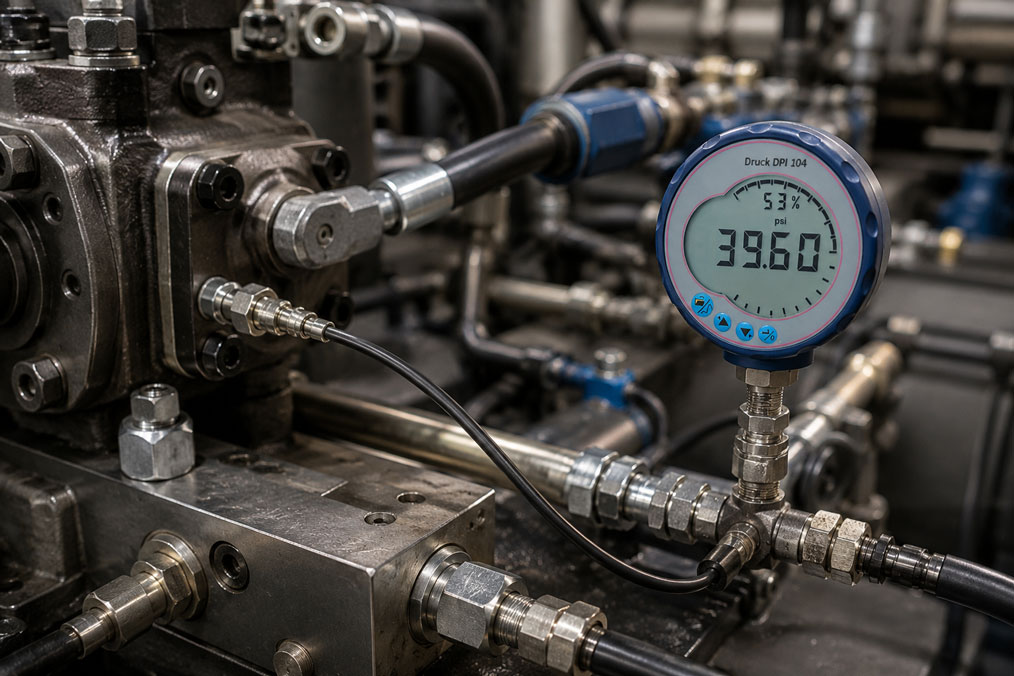
In hydraulic pressure measurements, the most suitable location for reading or connecting the measuring instrument is often not directly at the process. The measuring point may be located deep inside the machine compartment, directly at a pump, between moving components or in an area exposed to strong vibrations and high temperatures.
A MINIMESS® microbore hose transmits the pressure from the permanently installed measuring coupling to a pressure gauge, pressure sensor or portable test instrument. This means that the process line does not need to be opened and the measuring instrument does not have to be mounted directly on the machine.
DN2 and DN4 hoses are among the main options available. DN2 provides a particularly small internal volume, compact dimensions and, depending on the version, high pressure ratings. DN4 has a larger flow cross-section and is advantageous when longer lines, rapid pressure changes or a greater volumetric flow during filling and venting must be considered.
However, the nominal diameter alone does not determine suitability. Hose length, pressure load, temperature, hydraulic fluid, connecting fittings and the dynamic behaviour of the complete measuring chain must be considered together.
Table of contents
- What function a microbore hose performs
- Direct comparison of DN2 and DN4
- Distinguishing operating pressure from dynamic loading
- How nominal diameter and length influence the response
- Why pressure loss must be assessed differently for static measurements
- Selecting the correct hose length
- Considering temperature and hydraulic fluid
- Matching couplings, fittings and adapters
- Routing and protecting the hose safely
- Safe procedure for portable pressure measurements
- Systematically selecting DN2 or DN4
- Typical selection and application errors
- Practical example: Measuring pressure peaks at a hydraulic pump
- Which measuring instruments / products are suitable?
- Conclusion
- Frequently asked questions about microbore hoses
What function a microbore hose performs
The microbore hose connects a permanently installed measuring point to a temporarily or permanently connected measuring instrument. It transmits the hydraulic pressure through a small column of fluid.
Typical applications include:
- pressure checks during maintenance and commissioning
- connection of a digital or test pressure gauge
- temporary measurement using a reference pressure sensor
- recording pressure curves with a data logger
- moving the measuring instrument away from a hot or vibrating area
- connection of a portable hydraulic test case
Due to its small internal diameter, the hose contains only a small volume of fluid. As a result, significantly less hydraulic oil is displaced during connection and disconnection than with a conventional hydraulic line.
Nevertheless, a microbore hose is not a universal working line. It is primarily intended as a measuring, diagnostic or control line. It is not suitable for supplying a load or transmitting large volumetric flow rates.
Direct comparison of DN2 and DN4
| Characteristic | DN2 | DN4 |
|---|---|---|
| Internal diameter | Approx. 2 mm | Approx. 4 mm |
| Typical external diameter | Approx. 4.9 mm | Approx. 8 mm |
| Internal volume per metre | Approx. 3.1 ml | Approx. 12.6 ml |
| Typical pressure ratings | 400 or 630 bar | 315 or 450 bar |
| Space requirement | Very low | Larger, but still compact |
| Flow resistance | Higher | Lower |
| Typical strength | Compact high-pressure measurement with minimum fluid volume | Longer lines and more dynamic pressure transmission |
The internal volume increases with the square of the diameter. At the same length, a DN4 hose therefore contains approximately four times as much fluid as a DN2 hose.
DN2 is often the first choice for compact portable pressure measurements, short to medium hose lengths and high pressure ratings. DN4 is of interest when lower flow resistance is more important than minimum internal volume.
The table describes typical versions. The actual permissible pressure depends on the selected hose material and all fittings used.
Distinguishing operating pressure from dynamic loading
A rating of 630 bar printed on a hose does not automatically mean that every measuring line assembled with this hose may be operated continuously at a strongly pulsating pressure of 630 bar.
The following must be distinguished:
- maximum operating pressure for diagnostic and measuring tasks
- permissible pressure under continuous dynamic loading
- short-term test or burst pressure
- permissible rate of pressure rise
An occasional static control measurement subjects the hose to a different load than a test bench with several hundred thousand pressure cycles. The dynamic pressure rating must therefore be used for pulsating pump pressures, rapid valve operations or cyclical machine processes.
The maximum permissible operating pressure of the complete measuring line always corresponds to the lowest rating of its individual components. For example, a DN2 hose rated for 630 bar must not be operated at 630 bar if a fitting, coupling or adapter is approved for only 400 bar.
The connected pressure gauge or pressure sensor must also safely withstand the normal operating pressure and realistic pressure peaks.
How nominal diameter and length influence the response
In an ideal line that is completely filled with liquid, a pressure change propagates very quickly. In the actual measuring chain, however, the hose, hydraulic oil, measuring instrument and connections form a dynamic system.
The response is influenced by:
- internal diameter and length of the hose
- viscosity and temperature of the hydraulic oil
- elasticity of the hose wall
- compressibility of the fluid
- displacement volume of the measuring instrument
- air or gas bubbles in the measuring line
- cross-sections of couplings and adapters
DN2 has a higher hydraulic resistance than DN4. With long lines, cold and highly viscous oil or a measuring instrument with a relevant displacement volume, rapid pressure changes may therefore be damped or delayed more strongly.
DN4 reduces this resistance. This can be advantageous for dynamic measurements and longer hose lengths. However, the internal volume is larger and more fluid must be considered during venting or disconnection.
Air bubbles impair the dynamic response considerably more than a correctly selected hose diameter. Gas is compressible and can strongly damp short pressure peaks. A measuring line should therefore be completely filled with the intended fluid.
Why pressure loss must be assessed differently for static measurements
During a static pressure measurement, practically no continuous volumetric flow passes through the microbore hose once the pressure has equalised. Consequently, there is normally no relevant permanent pressure loss between the measuring point and the pressure gauge under steady-state conditions.
The small cross-section therefore does not automatically reduce the displayed static pressure.
Pressure loss primarily occurs when fluid is actually flowing through the hose. This happens, for example:
- when filling or venting the measuring line
- during a rapid pressure change
- with a measuring instrument that has a larger volumetric displacement
- when the hose is used as a control line
- when there is a leak in the connected assembly
For dynamic measurements, the flow resistance therefore acts as damping. A steadier measured value may be desirable, but it must not be confused with the accurate detection of short pressure peaks.
Selecting the correct hose length
The hose should be long enough to position the measuring instrument safely and make it easy to read. However, unnecessarily long lines increase the internal volume, pressure damping, weight and risk of mechanical damage.
Typical selection questions include:
- How far is the measuring point from the safe operating position?
- Must the hose be routed around protective covers or moving components?
- Are rapid pressure peaks or only static values to be measured?
- How viscous is the fluid at the lowest temperature?
- How much hose can be safely secured or stored in the service case?
For a simple maintenance measurement, the shortest practically usable length is usually the best choice. In a permanently installed test bench, DN4 may be more suitable if a greater distance and high temporal resolution are required at the same time.
Hose extensions consisting of several lines connected in series should be avoided. Every additional coupling increases the flow resistance and creates another potential leakage point.
Considering temperature and hydraulic fluid
Standard microbore hoses are frequently designed for mineral-oil-based hydraulic fluids. Other media must not be approved solely on the basis of a general compatibility table.
The following in particular must be checked:
- hose material
- inner tube and outer cover
- material of the fittings
- seals in the couplings
- temperature and pressure
- static or dynamic operating duration
At low temperatures, the viscosity of the hydraulic oil increases. This can slow the dynamic response, particularly with long DN2 lines.
The hose also becomes stiffer at low temperatures. The specified minimum bending radius may increase. Special hose versions are available for demanding low-temperature applications.
High temperatures reduce the permissible pressure load of many hose materials and accelerate ageing. Hose lines should therefore not be placed directly against hot pipes, exhaust systems or heated surfaces.
Matching couplings, fittings and adapters
MINIMESS® hoses can be assembled with different connections. These include connections for coupling series 1215, 1604, 1615 and 1620 as well as threaded, tube and pressure-gauge connections.
The following elements must be compatible to create a reliable measuring chain:
- coupling series at the permanently installed measuring point
- mating connection on the hose
- DN2 or DN4 nominal diameter
- pressure rating of all fittings
- thread and sealing principle at the measuring instrument
- materials and fluid compatibility
Adapter chains consisting of several reducers should be avoided. They increase the dead volume, weight and leakage risk. A hose line assembled with the correct end fittings is preferable.
A heavy digital pressure gauge should not be suspended directly from a small measuring coupling using several rigid adapters. The microbore hose allows the instrument to be positioned with less mechanical load and improved readability.
Routing and protecting the hose safely
Even a small measuring hose carries hydraulic fluid under high pressure. Damaged lines can release fine jets of fluid that may cause serious injuries.
The following must therefore be considered when routing the hose:
- do not fall below the minimum bending radius
- do not kink or twist the hose
- maintain clearance from sharp edges
- avoid contact with hot and moving components
- prevent abrasion using protective hoses or supports
- do not apply tensile loads to fittings and couplings
Anti-kink coils or additional protective hoses can be useful for portable measuring lines. However, they do not replace regular visual inspection.
Hoses with a damaged outer cover, exposed reinforcement, kinked sections or leaking fittings must no longer be used.
Safe procedure for portable pressure measurements
- Check the measuring task: Determine the expected operating pressure, pressure peaks, temperature and fluid.
- Inspect the measuring line: Check the pressure rating, connections, hose condition and identification.
- Select the measuring instrument: Match the measuring range, overload resistance and accuracy.
- Secure the working area: Route the hose so that no crushing, abrasion or trip hazards occur.
- Establish the connection: Connect the coupling axially and without lateral loading in accordance with the operating instructions.
- Check leak tightness: Inspect the coupling, hose fittings and measuring-instrument connection.
- Perform the measurement: Document the operating condition and pressure value.
- Depressurise the measuring assembly: Follow the specified safe procedure before disconnection.
- Install the protective cap: Clean and protect the measuring point after use.
Connection or disconnection under pressure is permissible only if the specific coupling and hose version is explicitly designed for this purpose. The operating instructions for the components being used are decisive.
Systematically selecting DN2 or DN4
DN2 is usually advantageous when:
- very little installation space is available
- the internal volume must be kept as small as possible
- a high pressure rating is required
- the hose is short to medium in length
- mainly static or slowly changing pressures are measured
DN4 is often useful when:
- a longer measuring line is required
- rapid pressure changes must be recorded
- the fluid has a high viscosity at low temperature
- the line is frequently filled or vented
- lower flow resistance is the main priority
The choice must not be based solely on the maximum pressure. A DN2 line is not inherently more accurate and a DN4 line is not inherently faster. The complete system consisting of the hose length, fluid, sensor, couplings and required temporal resolution is decisive.
Typical selection and application errors
| Error | Possible consequence | Better approach |
|---|---|---|
| Only the hose pressure rating is considered | A fitting or measuring instrument has a lower pressure rating | Determine the weakest component in the measuring chain |
| Static pressure rating used for continuous pulsating operation | Premature fatigue of the hose line | Take the dynamic pressure approval into account |
| Very long DN2 hose used with cold oil | Pressure peaks are delayed or damped | Shorten the line or assess DN4 |
| Air in the measuring line | Spongy and slow measuring response | Fill and vent the measuring line correctly |
| Several adapters and extensions | Additional leakage points and dead volume | Use a suitably assembled hose line |
| Hose routed under tension or with a tight bending radius | Damage to the hose and fittings | Provide sufficient length and strain relief |
| Untested special fluid used | Swelling, embrittlement or leakage | Have the fluid compatibility of the complete system confirmed |
Practical example: Measuring pressure peaks at a hydraulic pump
A mobile working machine is to be examined to determine whether brief pressure peaks occur when a valve closes rapidly. The measuring point is located directly at the pump, while the measuring instrument must be positioned approximately three metres away for safety and readability.
A long DN2 hose with a digital pressure gauge is used initially. The static operating pressure is displayed correctly. However, the suspected short pressure peaks are only weakly visible in the recorded pressure curve.
Several influencing factors are identified when the measuring chain is inspected:
- long DN2 line
- cold and consequently highly viscous hydraulic oil
- a small air bubble in the measuring hose
- strong averaging in the digital pressure gauge
The measuring line is completely vented and replaced with a suitably sized DN4 version. The filter setting of the measuring instrument is also adjusted.
The static pressure remains unchanged. However, the short pressure peaks are now recorded much more clearly and reproducibly.
The example shows that a microbore hose does not necessarily cause a relevant static pressure loss but can have a significant influence on the dynamic measurement result.
Which measuring instruments / products are suitable?
The MINIMESS® hoses category contains configurable DN2 and DN4 microbore hoses for pressure measurement, service and condition monitoring.
Additional measuring couplings, adapters, protective caps and accessories are available in the MINIMESS® couplings and hoses category.
MINIMESS® DN2 and DN4 hoses
The MINIMESS® hoses can be supplied as complete assemblies with different hose materials, lengths and end fittings.
Depending on the version, DN2 is available for operating pressures of 400 or 630 bar. DN4 is typically available for 315 or 450 bar. For dynamic applications, the respective lower continuous operating pressures specified for the version apply.
MINIMESS® series 1215 couplings
The MINIMESS® 1215 series is suitable for compact measuring and service points with limited installation space.
In combination with a suitable DN2 or DN4 hose line, pressure gauges and pressure sensors can be connected temporarily with minimal fluid loss.
MINIMESS® series 1620 couplings
The MINIMESS® 1620 series provides different process connections, materials and sealing versions for industrial measuring and service tasks.
To configure a complete measuring set, the coupling series, hose nominal diameter, pressure rating, hose length, fittings and intended measuring instrument must be defined.
ICS Schneider Messtechnik assists with configuring fully assembled microbore hoses and complete service sets. The operating and peak pressure, dynamic loading, fluid, temperature, required length, coupling series and desired measuring instrument are needed for the design.
Conclusion: DN2 and DN4 must match the complete measuring task
Microbore hoses allow hydraulic pressure measurements to be routed safely away from process areas that are difficult to access, hot or exposed to vibration.
DN2 provides a very small internal volume, compact dimensions and, depending on the version, pressure ratings of up to 630 bar. DN4 has a larger cross-section and lower flow resistance, which can be advantageous for longer lines and dynamic measurements.
In a static pressure measurement, there is normally no relevant permanent pressure loss after pressure equalisation. During rapid pressure changes, however, the hose diameter, length, oil viscosity, air bubbles and connected measuring instrument influence the response.
The permissible load on the measuring line is determined by its weakest component. For pulsating pressures, the dynamic pressure approval rather than only the static pressure rating must be considered.
A reliably functioning measuring chain is created by selecting a suitable hose length, correctly matched fittings, complete venting, safe routing and an appropriate pressure measuring instrument.
Frequently asked questions about microbore hoses
What do DN2 and DN4 mean?
The designation describes the approximate nominal diameter of the hose. DN2 has an internal diameter of approximately 2 mm, while DN4 has an internal diameter of approximately 4 mm.
Which hose is suitable for 630 bar?
Certain DN2 versions are available for measuring tasks up to 630 bar. The complete hose line, including the fittings and measuring instrument, must also be approved for this pressure.
Can DN4 also withstand 630 bar?
The hose and individual DN4 fittings may have different pressure ratings depending on the version. However, standard DN4 hoses are commonly rated for 315 or 450 bar. The data sheet for the specific configuration is decisive.
Does a long DN2 hose display a lower static pressure?
In a leak-tight and completely filled measuring line, the same static pressure should be established after pressure equalisation. However, the length may damp or delay rapid pressure changes.
When is DN4 advantageous compared with DN2?
The lower flow resistance of DN4 can be advantageous for long lines, high fluid viscosity, rapid pressure curves or frequent filling and venting.
Why does air in the measuring hose distort the result?
Air is compressible and acts like an elastic accumulator. This delays rapid pressure changes and damps pressure peaks.
May a microbore hose remain permanently installed on the machine?
This is permissible only if the hose, fittings, routing and dynamic loading are designed for permanent operation. A loose portable measuring line should be removed after the measurement.
Which information does ICS Schneider require for selection?
The required information includes the operating pressure, possible pressure peaks, static or dynamic application, fluid, temperature, required length, coupling series, measuring-instrument connection and requirements concerning temporal resolution.