


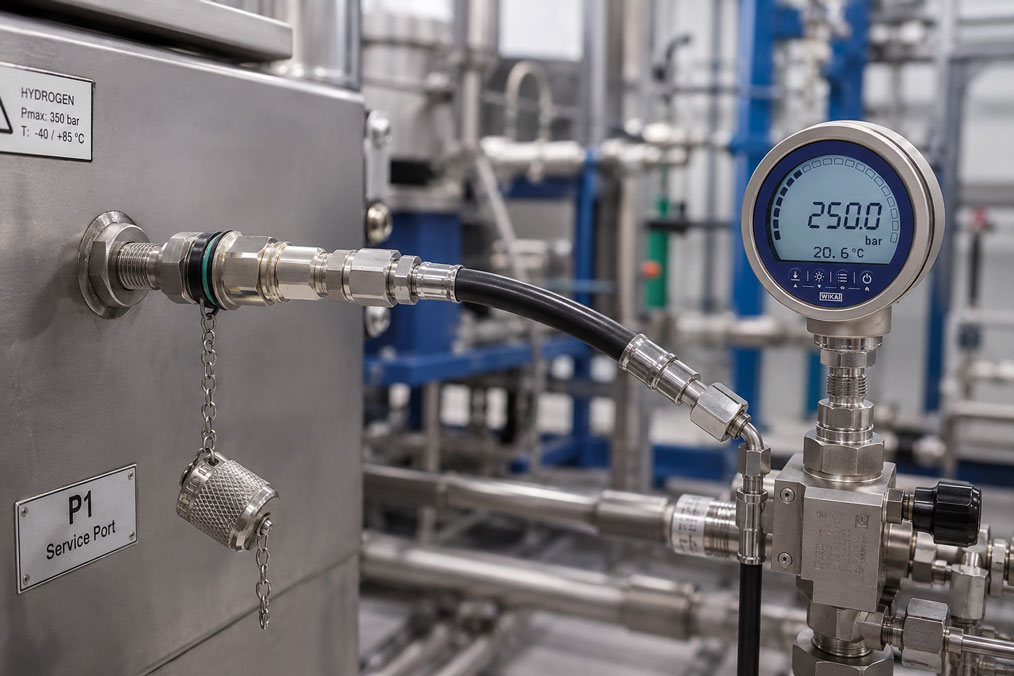
Temporary pressure measurements, functional tests and maintenance work are also regularly required on hydrogen systems. Defined service points are needed for this purpose, allowing a pressure gauge, pressure sensor or test instrument to be connected without having to open a process line or dismantle a fitting for every measurement.
With hydrogen, however, it is not sufficient simply to use a measuring coupling known from hydraulic applications without further verification. The gas can escape more easily through very small gaps and certain sealing materials. At the same time, high pressures, frequent pressure changes and rapid depressurisation can place additional stress on seals, hoses and connections.
A suitable service point must therefore be planned as a complete system. This includes the measuring coupling, valve technology, sealing materials, process connection, measuring hose, adapters, measuring instrument, venting path and the procedure for connecting and disconnecting the equipment.
This article explains what must be considered when planning hydrogen measuring points, when a DVGW gas coupling is useful and why self-closing connections reduce the risk but do not replace a professional leak-tightness test.
Table of contents
- Why hydrogen presents special requirements
- Which functions a service point can perform
- Considering the measuring point as a complete system
- Selecting the measuring coupling and gas charging valve correctly
- Metallic materials and hydrogen compatibility
- Considering sealing materials and gas permeation
- Distinguishing temporary hoses from permanently installed hoses
- Safely controlling residual gas and venting
- Temporarily connecting pressure gauges and pressure sensors
- Planning the installation location and accessibility
- Leak-tightness testing after installation and maintenance
- Preparing the test and service procedure
- Typical planning and installation errors
- Practical example: Pressure check on a hydrogen test bench
- Which measuring instruments / products are suitable?
- Conclusion
- Frequently asked questions about hydrogen service points
Why hydrogen presents special requirements
Hydrogen has a small molecular size and can escape through sealing points, elastomers and material structures that may remain leak-tight with other media. A connection that is tight when used with hydraulic oil is therefore not automatically suitable for gaseous hydrogen.
The following conditions, among others, must be considered during design:
- minimum and maximum operating pressure
- test pressure and short-term peak pressure
- gas and ambient temperature
- number and speed of pressure cycles
- hydrogen purity and possible accompanying substances
- indoor or outdoor installation
- corrosion and vibration exposure
- permissible leakage rate of the complete system
Particularly during rapid depressurisation, the gas can cool significantly at the outlet point. The lowest expected temperature is therefore not always the same as the normal ambient temperature.
Hydrogen can also form an ignitable mixture with air. Service points must therefore be arranged so that escaping residual gas cannot accumulate inside enclosed housings, recesses or poorly ventilated areas.
Which functions a service point can perform
Before selecting the equipment, it must be clarified what the connection is actually required for. A service point can perform different functions:
- temporary pressure measurement using a pressure gauge or digital pressure gauge
- connection of a reference pressure sensor
- functional check of a permanently installed transmitter
- pressure tapping for an external test instrument
- controlled filling or emptying
- sample extraction or connection of an analyser
- temporary monitoring during commissioning and troubleshooting
A connection intended for a brief control measurement is designed differently from a measuring line that remains connected to a data logger for several hours. Due to the higher gas flow rate, a filling connection also presents different requirements from a pressure measuring point.
Measuring, filling and venting functions should not be combined through the same connection without a technical review. The flow cross-section, valve function and permissible actuation may differ depending on the task.
Considering the measuring point as a complete system
The hydrogen suitability of one individual coupling does not demonstrate the suitability of the entire measuring chain.
A temporary measuring point may include, for example:
- process connection or screw-in thread
- gas charging valve or measuring coupling
- internal and external seals
- dust or protective cap
- mating coupling
- measuring hose or metallic line
- adapters and fittings
- pressure measuring instrument
- shut-off and venting option
All components must be approved at least for the intended pressure, temperature and gaseous hydrogen. The permissible operating pressure of the measuring chain is determined by its weakest component.
Different threads should, wherever possible, not be connected through several adapters installed one after another. Every additional sealing point increases the installation effort, dead volume and number of possible leakage paths.
Selecting the measuring coupling and gas charging valve correctly
MINIMESS® test points function as mechanically releasable non-return valves. When the mating coupling is connected, the internal valve mechanism is opened. After disconnection, the connection closes automatically.
Gas charging valves or gas couplings designed specifically for gaseous media should be used in gas applications. Compared with a general hydraulic test point, the following characteristics may be adapted:
- higher surface quality at the sealing points
- materials and elastomers suitable for gases
- qualified leakage testing
- defined version for hydrogen
- DVGW approval where applicable
The designation of the product series alone is not sufficient. Different materials, seals, pressure ratings and process threads may be available within the same series.
The specific part number and its corresponding hydrogen approval should therefore be verified before ordering.
DVGW version or application-specific hydrogen version?
DVGW approval may be required for measuring couplings in gas pressure-regulating systems and applications within the public gas supply network. However, it does not replace the assessment of the specific installation.
Different regulations and operator requirements may apply to industrial test benches, research facilities or internal process systems. The decisive factor is which approval and technical documentation are required for the respective measuring point.
Likewise, a general gas approval does not automatically mean that every version is approved for every hydrogen pressure and temperature.
Metallic materials and hydrogen compatibility
Stainless steels are frequently used for hydrogen service points. They offer good corrosion resistance and enable high-quality sealing surfaces.
However, the statement “made of stainless steel” is not sufficient for reliable selection. Suitability depends, among other things, on:
- exact material grade
- heat treatment and strength
- operating pressure and temperature
- static or cyclic loading
- component geometry and notch effects
- hydrogen purity and moisture
For certain hydrogen versions of MINIMESS® gas charging valves, Hydrotechnik specifies stainless steel 1.4571. However, this must not be interpreted to mean that every component made from this material is suitable for every H2 application without further assessment.
The materials of the mating coupling, adapter, hose fitting and measuring instrument must also be included in the assessment. A suitable coupling loses its benefit if an unapproved brass fitting or unsuitable hose is installed directly behind it.
Considering sealing materials and gas permeation
Elastomer seals can absorb hydrogen and allow a limited amount of the gas to permeate through them. During rapid depressurisation, gas previously dissolved in the elastomer may also cause blisters, cracks or internal damage.
The suitability of a sealing material depends, among other things, on:
- material compound and hardness
- maximum pressure
- rate of pressure change
- minimum and maximum temperature
- number of coupling cycles
- required leakage rate
Hydrotechnik uses FKM seals for certain hydrogen versions. Nevertheless, FKM must not be selected as a general solution for every hydrogen application. The tested sealing configuration within the specific product is decisive.
NBR, EPDM, FKM and PTFE have different properties. A simple chemical-compatibility table is not sufficient for dynamically operated high-pressure gas couplings.
During maintenance, seals must not be replaced with visually similar standard parts. The material, dimensions and approval must correspond to the original version.
Distinguishing temporary hoses from permanently installed hoses
A flexible measuring hose makes it easier to connect a test instrument. At the same time, it has a larger gas-wetted surface than a short metallic line and may be subjected to movement, bending and ageing.
| Version | Typical application | Important points |
|---|---|---|
| Polymer measuring hose | Temporary service and control measurement | Check hydrogen approval, pressure, temperature, permeation and service life |
| Stainless-steel corrugated hose | Longer-term or permanently connected application | Observe the bending radius, vibration, fittings and mechanical support |
| Metallic measuring line | Fixed installation with a defined routing | Provide stress-free installation, suitable fittings and venting |
| Direct adapter | Compact temporary connection of a sensor or pressure gauge | Limit the weight and leverage acting on the coupling |
Polymer measuring hoses should not remain permanently connected solely because they can withstand the nominal pressure. Hydrotechnik recommends stainless-steel corrugated hoses or suitable measuring lines for permanent applications.
For flexible lines, the minimum bending radius, protection against abrasion and suitable strain relief are important. The hose must not hang under tension from the coupling.
Hoses and lines should be kept as short as possible. An unnecessarily large internal volume increases the amount of gas that must be depressurised before disconnection and may also slow down the response of the connected measuring instrument.
Safely controlling residual gas and venting
Even a self-closing coupling does not necessarily close without releasing any gas. An enclosed volume remains between the two valve seats, inside the adapter and in the measuring hose.
Before disconnection, it must be clear how this residual gas will be depressurised safely. Depending on the system, possible solutions include:
- a defined vent line
- a small valve block with shut-off and venting functions
- return to a suitable low-pressure system
- release into a designated safe area
The gas must not be released uncontrollably into a control cabinet, enclosed machine housing or poorly ventilated room.
The pressure drop, noise, cooling and possible electrostatic or mechanical hazards must also be taken into account during depressurisation.
A long test hose should not be depressurised simply by loosening a fitting. The service assembly requires an intended and controllable venting path.
Temporarily connecting pressure gauges and pressure sensors
The connected measuring instrument must also be suitable for gaseous hydrogen. This applies not only to the pressure connection but to all wetted materials and seals.
The following points are particularly important for selection:
- measuring range and permissible overload
- gauge, absolute or differential pressure
- hydrogen compatibility of the measuring cell
- permissible gas and ambient temperature
- electrical approval and explosion protection
- weight and mechanical loading of the service point
A heavy digital pressure gauge should not be suspended directly from a small measuring coupling through several rigid adapters. A short suitable hose or supported mounting arrangement reduces the leverage acting on the connection.
For temporary electrical sensors, cables, connectors and data-acquisition equipment must be routed so that they do not create trip hazards or come into contact with hot or moving parts of the installation.
Planning the installation location and accessibility
A service point should be accessible without requiring the technician to reach across hot lines or stand directly in front of moving components.
A suitable installation location provides:
- sufficient space for the mating coupling and tools
- a safe working area
- good ventilation
- protection against mechanical damage
- the lowest possible vibration
- clear identification of the medium and pressure rating
The protective cap keeps the coupling side clean and protects it against damage. However, it is normally not an additional pressure-retaining shut-off device.
Service points should not be installed in locations where condensate, dirt or water can collect. Before coupling, the sealing surfaces must be clean and free from particles.
Leak-tightness testing after installation and maintenance
A leak-tightness test defined for the installation is required after initial installation, after replacement and after work on sealing points.
Depending on the requirements, different test methods may be used:
- pressure-hold test
- leak-detection spray at suitable accessible points
- electronic hydrogen leak detector
- forming-gas or helium leak test
- quantitative leakage-rate measurement
The appropriate method depends on the permissible leakage rate, system size, pressure, test medium and safety concept. A stable pressure-gauge reading alone does not prove adequate leak tightness.
Both the unactuated service point and the fully connected condition should be assessed during testing. At least the following points are therefore relevant:
- process thread or screw-in seal
- closed gas charging valve
- connection between the coupling and mating coupling
- hose fittings and adapters
- connection to the measuring instrument
Preparing the test and service procedure
A documented service procedure should be available for recurring measurements. It must comply with the risk assessment and operational approvals.
- Identify the components: Check the pressure rating, hydrogen approval and condition of the coupling, hose and measuring instrument.
- Check the working area: Assess ventilation, ignition sources, accessibility and personal protective equipment.
- Inspect the sealing surfaces: Remove the protective cap and inspect the coupling for contamination or damage.
- Prepare the measuring assembly: Check the shut-off and venting position of the test set.
- Establish the connection: Follow only the operating instructions for the coupling being used.
- Check leak tightness: Inspect the connected measuring assembly for leakage.
- Perform the measurement: Document the pressure and operating condition.
- Depressurise the measuring line: Safely release the enclosed gas through the intended path.
- Disconnect and inspect: Close the service point, check leak tightness and reinstall the protective cap.
The exact procedure must not be adopted from a general template without verification. The pressure, design and safety requirements of the specific installation and components are decisive.
Typical planning and installation errors
| Error | Possible consequence | Better approach |
|---|---|---|
| Standard hydraulic coupling used without H2 approval | Unknown gas tightness and material compatibility | Select a specific hydrogen version |
| Only the measuring coupling is assessed | An unsuitable hose or adapter remains unconsidered | Assess the complete measuring chain |
| Polymer hose permanently installed | Permeation, ageing and mechanical stress | Use a metallic line or corrugated hose suitable for permanent operation |
| No defined venting path | Residual gas is released uncontrollably during disconnection | Provide a shut-off and venting option |
| Several adapters installed in series | Additional leakage points and large dead volume | Select a suitable direct adapter or assembled line |
| Heavy measuring instrument mounted directly on a small coupling | Mechanical loading and possible loosening | Support the instrument or use a suitable hose |
| Seal replaced with a standard O-ring | Loss of hydrogen approval | Use only an approved original seal |
| Pressure reading regarded as proof of leak tightness | Small but relevant leakage remains undetected | Apply a suitable leak-testing method |
Practical example: Pressure check on a hydrogen test bench
On a test bench, the pressure upstream of a test specimen is to be checked regularly using a reference sensor. Previously, a fitting was opened and an adapter installed for this purpose. Repeated disassembly causes considerable work and places stress on the sealing point.
For the new version, a fixed service point with a stainless-steel gas coupling approved for gaseous hydrogen is provided. A short assembled test hose connects the service point to a supported reference pressure sensor.
A small shut-off and venting block is installed between the measuring hose and the sensor. After the measurement, the hose can therefore be depressurised in a controlled manner into a designated vent line before the mating coupling is disconnected.
During commissioning, the screw-in connection, the closed coupling and the fully connected test assembly are checked separately for leakage.
The new measuring point reduces the number of process fittings that need to be opened regularly. At the same time, the reference sensor and test hose remain connected to the hydrogen system only during the measurement.
The example shows that the safety and practical suitability of the system are not determined by the coupling alone. The complete measuring assembly, a controlled venting path and a clearly defined service procedure are decisive.
Which measuring instruments / products are suitable?
The MINIMESS® DVGW gas couplings and gas hoses category contains components for measuring, test and service connections in gas applications.
Further test points, adapters, hoses and accessories can be found in the MINIMESS® couplings and hoses category.
MINIMESS® 1215 gas coupling with DVGW approval
The MINIMESS® 1215 gas coupling with DVGW approval is a compact solution for pressure measurement and gas extraction on gas pressure-regulating systems.
Its small design makes it particularly suitable for confined installation conditions. For hydrogen, the specific material, sealing and pressure version must be defined clearly.
MINIMESS® 1620 for measuring, venting and service tasks
The MINIMESS® 1620 test point enables the temporary connection of measuring and test instruments while the system is pressurised.
The series is available with different materials, seals and process connections. Application-specific tested versions are available for gaseous hydrogen. The general standard version must not be used for H2 without confirmation.
Suitable gas hoses and measuring lines
Assembled measuring hoses approved for hydrogen can be used for temporary service work. The operating pressure, temperature, length, fittings and permissible service duration must match the application.
Suitable stainless-steel corrugated hoses or metallic measuring lines are frequently the better solution for longer-term or permanently connected measuring points.
Individual configuration of the test set
Depending on the measuring task, a complete service kit may consist of a mating coupling, hose, shut-off and venting block, direct adapter and a suitable pressure gauge or pressure sensor.
ICS Schneider Messtechnik assists with selecting the appropriate coupling series, materials, seals, hoses, adapters and measuring instruments. The hydrogen condition, minimum and maximum pressure, temperature, operating duration, process thread, required measuring instruments and necessary approvals are required for the design.
Conclusion: A hydrogen service point is more than a measuring coupling
Permanently installed measuring and service points simplify pressure checks and maintenance work because process fittings do not have to be opened for every measurement.
Hydrogen requires a gas charging or measuring coupling specifically approved for the application. The product-series designation, stainless-steel housing or name of a particular elastomer alone do not prove suitability.
The complete measuring chain consisting of the coupling, mating connector, hose, adapter, shut-off device, venting arrangement and measuring instrument must be assessed together for pressure, temperature, materials and leak tightness.
Polymer measuring hoses are primarily suitable for temporary service work. Metallic lines or suitable stainless-steel corrugated hoses are frequently more advantageous for permanently connected measuring points.
Before disconnection, the gas enclosed in the hose and adapters must be depressurised in a controlled manner. A self-closing coupling therefore does not replace a planned venting path.
After installation and maintenance, a suitable leak-tightness test is required both in the closed and connected condition. Only a complete and documented design creates a safe and practical hydrogen service point.
Frequently asked questions about hydrogen service points
Can a normal hydraulic measuring coupling be used for hydrogen?
Not without explicit approval. For hydrogen, the materials, seals, surfaces, pressure and leakage rate of the specific version must be verified.
Are all MINIMESS® couplings in the 1215 and 1620 series suitable for H2?
No. Different versions are available within the product series. The exact part number and hydrogen approval are decisive.
Which materials are used for H2 gas couplings?
For certain MINIMESS® versions, the manufacturer specifies stainless steel 1.4571 with FKM seals. The suitability applies only within the tested product configuration.
Is DVGW approval required for every hydrogen system?
This depends on the application and applicable regulations. Gas-supply systems may be subject to different requirements from an internal industrial test bench.
Does no hydrogen escape at all during disconnection?
A small residual volume may remain enclosed in the hose and between the valves. This must be depressurised through a defined path before disconnection.
Can a polymer measuring hose remain permanently connected?
Only if the manufacturer expressly approves it for permanent operation. Stainless-steel corrugated hoses or metallic measuring lines are frequently recommended for permanent applications.
How is the leak tightness of the service point tested?
The test method depends on the permissible leakage rate and safety concept. Possible methods include electronic leak detection, forming-gas, helium or pressure-hold testing.
Can a normal pressure gauge be connected temporarily?
Only if the measuring instrument, wetted materials, seals, pressure range and, where applicable, explosion-protection approval are suitable for the specific hydrogen application.
Why should the measuring hose be kept as short as possible?
A short hose reduces the internal volume, gas quantity, response time and the amount of hydrogen that must be released during venting.
Which information does ICS Schneider require for the design?
The required information includes whether the hydrogen is gaseous or liquid, the operating and test pressure, temperature range, process thread, operating duration, required measuring instrument, installation location, venting concept and necessary approvals.