


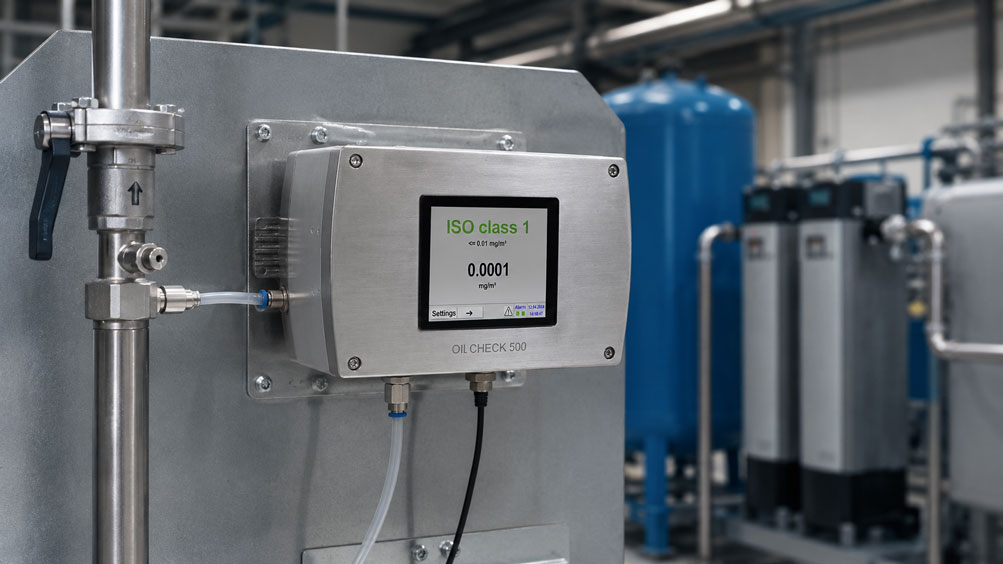
A compressed air system is monitored downstream of an activated carbon filter using a residual oil measuring device. The instrument displays, for example, only 0.004 mg/m³. Does this low value automatically mean that the total oil content of the compressed air is also only 0.004 mg/m³ and that the required compressed air quality class is definitely being met?
Not necessarily. Oil can occur in compressed air in different physical forms. In addition to liquid oil or larger oil droplets, there can be very fine oil aerosols and gaseous oil vapour. These contaminants differ not only in their physical state, but also in terms of separation, sampling and measurement method.
A measuring instrument for vaporous residual oil therefore initially answers the question of how much gaseous hydrocarbon contamination is present in the compressed air being tested. It is not automatically a measuring instrument for simultaneously present liquid droplets or oil aerosols.
This distinction is also reflected in the ISO 8573 series of standards. Liquid oil and oil aerosols are measured using different methods from oil vapour. When assessing a required oil purity class, the measurement task, measuring point and the oil phase actually being detected must therefore be clearly known.
A low oil vapour value therefore does not automatically prove that no oil aerosol is present. Conversely, very effective coalescing filtration can largely reduce aerosols while gaseous hydrocarbons continue to pass through the filtration system. Only when it is clear which oil phase is being measured can the measured value be interpreted correctly.
In which forms can oil occur in compressed air?
The term “oil in compressed air” initially sounds like a single measurable parameter. In reality, however, the contamination can occur in several physical states.
| Oil form | Physical state | Typical behaviour |
|---|---|---|
| Liquid oil | Larger liquid droplets or accumulations of liquid | Can collect on pipe walls, in vessels or at low points |
| Oil aerosol | Very small liquid droplets in the compressed air | Is transported with the air flow and must be removed using suitable aerosol separation |
| Oil vapour | Gaseous hydrocarbons or organic compounds | Behaves as a gas and is not removed by conventional particle or coalescing filters in the same way |
These three forms can occur simultaneously in the same compressed air system. Their respective proportions depend, among other things, on compressor type, lubricant, temperature, pressure, treatment system and operating condition.
Before selecting a measuring instrument, it should therefore already be clarified which form of oil is actually to be determined.
What is an oil aerosol?
An aerosol consists of very small liquid or solid particles dispersed in a gas. In the case of an oil aerosol, these are fine liquid droplets transported with the compressed air.
Such aerosols can originate, for example, from an oil-lubricated compressor. If oil droplets are strongly broken up during compression and flow, very fine droplets can form that do not immediately settle out of the air due to gravity.
Oil aerosols are therefore not the same as oil vapour. The oil substance remains in the liquid phase – only in the form of very small droplets.
Suitable coalescing or fine filters are typically used for separation. In these filters, small droplets are combined to form larger droplets, which can then be separated and removed via a condensate drain.
What is oil vapour?
In oil vapour, the relevant hydrocarbon components are present in the gas phase. They are not visible or microscopic liquid droplets, but gaseous organic compounds.
This is crucial from a measurement perspective. A filter that separates oil droplets very effectively mechanically or by coalescence does not automatically retain gaseous hydrocarbons to the same extent.
For particularly high-quality compressed air, additional treatment stages are therefore often used after aerosol filtration, for example activated carbon filters or activated carbon adsorbers. There, gaseous hydrocarbons are adsorbed onto a large active surface area.
An oil vapour monitor is typically installed downstream of such treatment to check whether the gaseous residual oil content remains within the desired range.
What does total oil content mean according to ISO 8573?
The purity classes for compressed air are described in ISO 8573-1 for particles, water and oil, among other parameters. For oil, the important point is that the corresponding classification refers to total oil content.
This total oil content can include portions of:
- liquid oil,
- oil aerosol and
- oil vapour
.
This has an important consequence: if only oil vapour is measured, only one component of the possible total oil content has initially been determined.
For a complete assessment, it must therefore be known whether liquid oil or aerosol has been sufficiently taken into account by the system design, upstream treatment or additional measurement methods.
Why are aerosol and oil vapour measured differently?
The different physical states require different sampling and measurement methods.
The ISO 8573 series of standards therefore separates the methods. Methods according to ISO 8573-2 are used for liquid oil and oil aerosols. Oil vapour, by contrast, is covered by ISO 8573-5.
| Oil contamination | Relevant standard | Basic principle |
|---|---|---|
| Liquid oil | ISO 8573-2 | Oil is collected from the compressed air sample and quantitatively determined |
| Oil aerosol | ISO 8573-2 | Aerosol is separated from the compressed air or collected on a suitable medium |
| Oil vapour | ISO 8573-5 | Gaseous oil components are determined using suitable sampling and analysis methods |
A measurement method for one phase should therefore not be used without verification to assess another phase.
Which treatment stage removes which type of oil contamination?
Compressed air treatment also follows this distinction. A single filter stage cannot automatically reduce every possible form of oil optimally.
| Treatment stage | Primary task | Limitation |
|---|---|---|
| Separator or prefilter | Reduce coarser liquid and particle contamination | Fine aerosols and oil vapour can remain |
| Coalescing filter | Combine and separate fine liquid aerosols | Gaseous oil vapour is not separated according to the same principle |
| Activated carbon filter | Adsorb gaseous hydrocarbon components | Capacity is limited and decreases as loading increases |
| Activated carbon adsorber | Achieve very low oil vapour levels for high-quality compressed air | Requires suitable prefiltration and operating conditions |
The correct sequence is important. An activated carbon element exposed to large quantities of liquid oil or aerosol can become loaded much faster than intended.
Reliable residual oil monitoring therefore always begins with correctly designed compressed air treatment.
Why does temperature influence the oil phase?
The distribution between liquid and gaseous phase depends, among other things, on temperature. As temperature increases, more volatile components may be present in gaseous form. When the air cools down, components may instead condense or adsorb onto surfaces.
The composition of oil contamination within a compressed air system can therefore change even if the original source remains unchanged.
One example is a hot compressed air flow immediately downstream of the compressor. Certain hydrocarbon components may predominantly be present in gaseous form there. After cooling and further treatment, the phase distribution can change.
Temperature must therefore be taken into account when interpreting an oil measurement. Measuring points should not be compared indiscriminately if pressure and temperature conditions differ significantly.
Where should the oil content be measured?
The correct measuring point depends on the question to be answered. If the performance of an individual treatment stage is to be assessed, measurements upstream and downstream of this component may be required. If, on the other hand, the compressed air quality at the point of use is to be verified, the measuring point must represent the air actually arriving there as accurately as possible.
Typical measuring points can include:
- downstream of the central compressed air treatment system,
- downstream of an activated carbon filter or activated carbon adsorber,
- after an oil-free compressor,
- upstream of a particularly sensitive production system,
- at a representative point in the distribution network.
A measurement directly at the treatment system does not necessarily answer the question of what air quality is actually present at the point of use after several hundred metres of piping.
Old pipelines may, for example, have accumulated deposits over many years. Changes in operating conditions can influence or transport such residues again.
Why is sampling so important?
At very low oil concentrations, sampling itself becomes an essential part of the measurement task. Hoses, lines and fittings can absorb or release organic substances or otherwise influence the measurement result.
Only clean sampling components suitable for the respective measurement should therefore be used. Manufacturers of residual oil measuring systems specify concrete requirements for material, flow rate, pressure, temperature and humidity.
With the OIL CHECK 500, for example, sampling is carried out via a suitable PTFE line or stainless-steel line. The device requires a defined measuring gas flow and is intended for a measuring point with upstream filtration and drying.
A line previously contaminated with oil or unsuitable cleaning agents can have a significant effect on a measurement in the lower µg/m³ or mg/m³ range.
What can a continuous oil vapour monitor do?
A laboratory analysis provides a very valuable snapshot at a defined point in time. However, operating conditions can change between two laboratory tests.
Continuous oil vapour monitoring can therefore be used to detect trends and changes at an early stage. A typical example is an activated carbon adsorber whose adsorption capacity decreases as loading increases.
If the oil vapour content downstream of this treatment stage gradually rises, a continuous measuring system can detect this development and trigger an alarm before the permissible internal quality limit is significantly exceeded.
The role of the device must nevertheless be understood correctly: an online oil vapour monitor monitors the gaseous oil component it detects. It does not automatically replace every normative measurement method for all oil phases.
Why is oil vapour measurement alone not always sufficient for assessing total oil?
Assume that an oil vapour monitor displays the following value downstream of the treatment system:
0.004 mg/m³
This value describes the vaporous residual oil content detected by the instrument.
If, at the same time, an additional oil aerosol content of:
0.008 mg/m³
were present, the total oil content would already be higher than the oil vapour value alone.
The oil vapour monitor cannot simply derive this aerosol fraction mathematically from its own measurement signal.
Particularly during initial qualification of a compressed air system, it is therefore important to clarify how all relevant oil phases are assessed. Once it has been demonstrated that liquid oil and aerosol are reliably controlled by the upstream treatment, continuous monitoring of the critical oil vapour component can provide valuable additional process reliability.
Practical example: low oil vapour value despite possible aerosol contamination
A production system requires very clean compressed air. An OIL CHECK 500 is installed downstream of the central treatment system. The displayed oil vapour content remains constant at approximately 0.003 mg/m³.
After maintenance, however, a problem occurs in an upstream coalescing filter stage. A defective condensate drain or heavily loaded filter element impairs the separation of liquid components.
The oil vapour monitor may continue to display a low gaseous residual oil value because the cause primarily affects the aerosol or liquid phase.
If only the oil vapour value were considered, this could create the false impression that the overall oil quality had remained unchanged.
During troubleshooting, the filter stages are therefore checked and the relevant oil phase is specifically considered. Only then can it be assessed whether the total oil content has actually changed.
This example shows that a measured value is only meaningful if it is clear which physical component the instrument actually measures.
Systematically diagnosing an oil problem in a compressed air system
- Define the required compressed air quality: Which oil class or maximum total oil content is required?
- Define the measurement task: Is total oil, oil aerosol, liquid oil or oil vapour to be assessed?
- Document the compressor type and possible oil sources.
- Check existing separators, coalescing filters and activated carbon stages.
- Define a representative measuring point.
- Take temperature, pressure and humidity at the measuring point into account.
- Select a measurement method suitable for the respective oil phase.
- Use clean and suitable sampling lines.
- If an unexpectedly high oil vapour value occurs, check the activated carbon or adsorber and possible external hydrocarbon sources.
- If an aerosol problem is suspected, inspect the coalescing filter, differential pressure, condensate drainage and upstream separation.
- After maintenance work, repeat the measurement under comparable conditions.
- For quality-critical processes, document measurement results and operating conditions.
Why continuous monitoring can make economic sense
Deteriorating compressed air quality can cause consequential costs far exceeding the price of a filter element. Depending on the application, oil contamination can affect products, coatings, pneumatic components or sensitive production processes.
A gradual loss of quality is particularly problematic. An activated carbon adsorber does not necessarily fail completely from one moment to the next. Its performance can change over a longer period.
Continuous trend monitoring makes it possible to detect such changes earlier and to align maintenance work more closely with the actual condition.
At the same time, filters or adsorbers can be prevented from being replaced unnecessarily early solely because of a fixed time interval, provided the maintenance concept and process requirements allow condition-based assessment.
Common mistakes
- Equating oil vapour with total oil: An oil vapour monitor does not automatically detect liquid oil and oil aerosol.
- Treating aerosol and vapour as the same physical state: Aerosols consist of liquid droplets, whereas oil vapour is gaseous.
- Treating a coalescing filter as an oil vapour filter: The mechanisms for aerosol separation and removal of gaseous hydrocarbons are different.
- Operating activated carbon without sufficient prefiltration: Liquid or aerosol contamination can place unnecessary stress on the treatment stage.
- Using unsuitable sampling hoses: At very low concentrations, the sampling system itself can influence the result.
- Selecting the measuring point purely for convenience: The measured air must be representative of the actual application.
- Ignoring temperature: Temperature changes can influence the distribution between gaseous and condensed components.
- Using an online measured value without verification as a complete normative proof: The specific measurement method and the oil phase detected must match the verification task.
- Equating an oil-free compressor with guaranteed oil-free compressed air at the point of use: Contamination can also originate from intake air, pipelines or other components.
- Immediately suspecting only the compressor when an elevated oil value is detected: Filters, adsorbers, the distribution network and sampling system must also be included in the diagnosis.
OIL CHECK 500 for continuous oil vapour monitoring
One specific measuring system for continuous monitoring of vaporous residual oil content is the OIL CHECK 500. The device is designed for compressed air and nitrogen as well as other gases on request.
The measuring range is 0.001 ... 5 mg/m³. The detection limit is 0.001 mg/m³. This makes the system particularly suitable for monitoring very high-quality treated compressed air.
The measured value is output as pressure- and temperature-compensated residual oil vapour content in mg/Norm m³. The instrument detects, among other substances, hydrocarbons, functional hydrocarbons and aromatics.
Typical measuring points include:
- downstream of an activated carbon filter,
- downstream of an activated carbon adsorber,
- downstream of an oil-free compressor,
- in each case with suitable upstream filtration and drying.
For integration into a monitoring system, the device provides, among other features, an RS-485 interface with Modbus RTU and a galvanically isolated 4 ... 20 mA output. Limit-value violations can therefore be integrated into higher-level process or alarm systems.
For the topic discussed here, however, the intended measurement task is particularly important: the OIL CHECK 500 is designed for highly sensitive measurement of vaporous residual oil content. Aerosols or liquid oil components should not enter the instrument inlet when installed as intended.
Suitable instruments can be found under compressed air quality at ICS Schneider. Further information on the measuring system used here can be found under OIL CHECK 500.
Conclusion
In compressed air, the term oil content does not automatically describe one single physical contaminant. Oil can occur as liquid, as finely dispersed aerosol or in the gas phase as oil vapour.
These forms behave differently. Aerosols are small liquid droplets and are separated, for example, by suitable coalescing filters. Gaseous hydrocarbons, by contrast, require other treatment mechanisms such as activated carbon adsorption.
Measurement technology must also take these differences into account. Liquid oil and aerosols are detected using different methods from oil vapour. A highly sensitive oil vapour monitor therefore provides valuable information about the gaseous residual oil fraction, but cannot automatically measure every other oil phase as well.
This distinction is particularly important when assessing compressed air quality according to ISO 8573. Total oil content can include several oil phases. In quality-critical applications, it must therefore be known which components have already been controlled through treatment or other tests.
A continuous system such as the OIL CHECK 500 can then perform a particularly valuable task: it permanently monitors the vaporous residual oil content and can therefore reveal gradual changes in treatment performance at an early stage between individual laboratory tests.
For reliable assessment of oil content, the following therefore applies: first determine whether liquid oil, aerosol or oil vapour is to be investigated, then select the appropriate measurement method and a representative measuring point, and never transfer a low individual measured value to an oil phase that the instrument used does not actually detect.
FAQ: Oil aerosol and oil vapour in compressed air
What is the difference between oil aerosol and oil vapour?
Oil aerosol consists of very small liquid oil droplets suspended in the compressed air. Oil vapour, by contrast, consists of gaseous hydrocarbon components. Both require different treatment and measurement methods.
What does total oil content mean in compressed air?
Total oil content can include liquid oil, oil aerosol and oil vapour. The measured value of one individual oil phase must therefore not automatically be equated with the total oil content.
Which standard covers oil aerosols in compressed air?
The measurement of liquid oil and oil aerosols is covered within the ISO 8573 series by ISO 8573-2.
Which standard covers oil vapour?
The determination of oil vapour content is covered by ISO 8573-5. The measurement method differs from aerosol measurement.
Can a coalescing filter also remove oil vapour?
A coalescing filter is primarily designed to separate liquid aerosols. Gaseous hydrocarbons are not removed according to the same separation mechanism. For very low oil vapour levels, activated carbon treatment stages are therefore used, for example.
Can an activated carbon filter replace oil aerosol filtration?
An activated carbon stage should not be regarded as a substitute for suitable upstream aerosol filtration. Liquid or aerosol contamination can place unnecessary load on the activated carbon.
Can an oil vapour monitor measure total oil content directly?
Not automatically. A device designed specifically to measure vaporous residual oil does not simultaneously detect every possible liquid or aerosol component.
Why does temperature influence oil measurement?
The distribution between gaseous and condensed phases is temperature-dependent. Changes in temperature can therefore influence which proportion of an oil contamination is present as vapour or liquid.
Where should a residual oil measuring device be installed?
The measuring point must match the question being investigated. For monitoring high-quality compressed air, for example, measurement downstream of an activated carbon filter or activated carbon adsorber, or at a representative point upstream of a sensitive consumer, may be appropriate.
Why is the sampling line important for residual oil measurements?
At very low hydrocarbon concentrations, unsuitable or contaminated lines can absorb or release substances and thereby distort the measurement result. Suitable clean materials and defined sampling conditions are therefore required.
What does the OIL CHECK 500 measure?
The OIL CHECK 500 continuously measures the vaporous residual oil content in compressed air or suitable gases. The measuring range is 0.001 to 5 mg/m³ and the detection limit is 0.001 mg/m³.
Where is the OIL CHECK 500 typically used?
Typical measuring points are downstream of an activated carbon filter or activated carbon adsorber and after an oil-free compressor. Suitable upstream filtration and drying are required for proper measurement.
May oil aerosols enter the OIL CHECK 500?
When installed as intended, no aerosols or liquid oil components should be present at the instrument inlet. The system is designed to measure vaporous residual oil content.
Can an oil-free compressor still supply contaminated compressed air?
Yes. Hydrocarbons can already enter via the intake air or originate from the piping and treatment system. The compressor designation alone therefore does not automatically describe the final air quality at the point of use.