


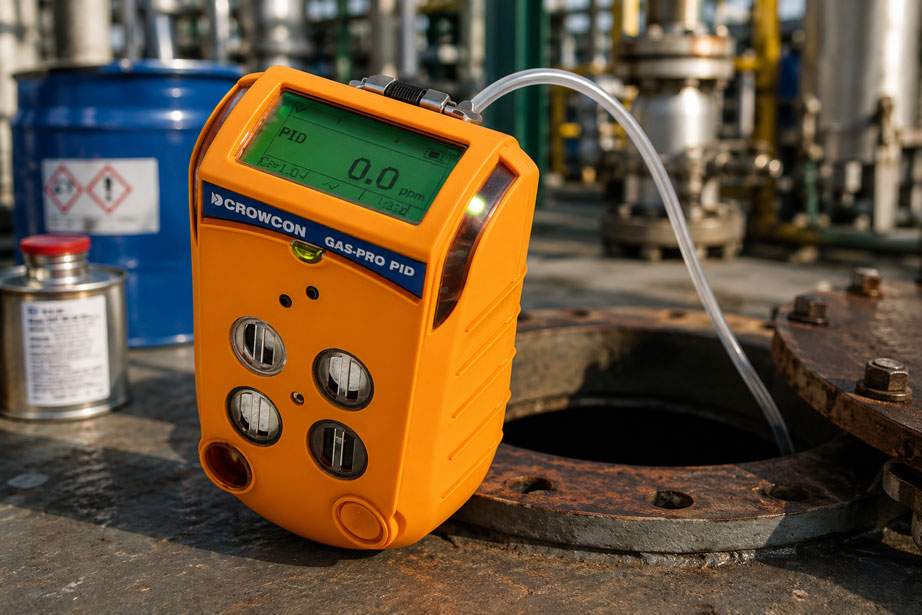
A PID gas detector displays, for example, a reading of 50 ppm VOC. At first glance, this value appears to be clear. In practice, however, the decisive question immediately arises: Does this value actually mean 50 ppm toluene, 50 ppm benzene, 50 ppm n-hexane, or merely a sensor response referenced to the calibration gas used?
In many cases, the answer is considerably more complex. A photoionization detector, or PID, responds to numerous volatile organic compounds, but not to every substance and not equally strongly to every detectable substance. The key factors include the energy of the UV lamp used, the ionization energy of the target substance and the relative sensitivity of the specific PID sensor to that compound.
Many portable PID instruments are calibrated with isobutylene. If, for example, toluene, benzene or n-hexane is then measured, the sensor initially produces a response referenced to this isobutylene calibration. If a concentration of the known target substance is to be derived from this response, a correction factor or response factor may have to be applied depending on the instrument. The same raw reading can therefore correspond to significantly different actual concentrations depending on the substance.
At the same time, a correction factor must not be confused with selectivity. If, for example, “toluene” is selected in the instrument menu, this normally only means that the PID response is converted using the stored correction factor for toluene. The sensor does not suddenly detect only toluene. If several ionizable VOCs are present in the atmosphere at the same time, they all contribute to the sensor signal.
The choice of lamp should also not be reduced to the simple rule that “more energy is better”. A 10.6 eV lamp can detect many industrially relevant VOCs and is therefore widely used in portable gas detectors. Substances with an ionization energy higher than the available photon energy, however, are not ionized or are not ionized sufficiently. At the same time, lamp energy alone says nothing about how strongly the sensor responds to a substance that can in principle be detected.
For a safety-related measurement, the target substances, lamp energy, correction factors, concentration range, sampling method, humidity and the specific measurement task must therefore be considered together. Another particularly important question is whether a single known substance or a changing or unknown gas mixture is present.
A PID is a highly sensitive measurement principle for many VOCs, but it is not a universal substance analyzer. A PID reading can only be interpreted correctly if it is known which substances may occur, whether they can be ionized by the lamp being used and how the specific instrument processes its readings and correction factors.
How Does a Photoionization Detector Work?
A photoionization detector uses ultraviolet light to temporarily ionize suitable gas molecules. In simplified form, the physical process can be represented as M + hν → M+ + e−. Here, M represents the molecule to be measured, hν the energy of the UV photon, M+ the positively charged ion and e− the released electron.
The ions and electrons generated are detected by an electric field inside the sensor. The electronics convert the resulting very small electrical current into a concentration signal. The substance is not permanently consumed as it would be in a catalytic combustion sensor. The ion and electron can recombine after the measurement.
Whether a usable signal is produced at all initially depends on whether the photon energy of the UV lamp is high enough to ionize the particular molecule. This is exactly why lamp energy is one of the most important technical specifications when selecting a PID gas detector.
What Does 10.6 eV Mean for a PID?
The specification 10.6 eV does not describe the concentration measuring range of the instrument. It indicates the photon energy of the UV lamp used. The unit eV stands for electronvolt. A 10.6 eV lamp is widely used in portable PID gas detectors because it can detect many industrially relevant VOCs.
Depending on the PID system, lamps with other energies are also available, for example 10.0 eV or 11.7 eV. In general, a higher lamp energy increases the number of substances that can potentially be ionized. However, this does not automatically mean that the measurement is better for every application. A higher lamp energy can also cause additional interfering substances to contribute to the measurement signal.
The lamp should therefore always be selected according to the substances that may actually occur rather than simply using the highest available energy.
Comparing Lamp Energy and Ionization Energy Correctly
Every substance requires a certain minimum amount of energy to remove an electron from its molecule. This substance property is known as ionization energy or, frequently, ionization potential. For an initial assessment, the photon energy of the PID lamp must be sufficiently high to overcome this threshold.
If, for example, a substance has an ionization potential of 9.24 eV and a 10.6 eV lamp is used, the available photon energy is above the required ionization energy. The substance can therefore in principle be ionized and detected by the PID. If the ionization potential is higher than the lamp energy, however, no usable PID signal is normally produced.
| Substance / Substance Group | Behavior with 10.6 eV PID | Practical Significance |
|---|---|---|
| Benzene, toluene, xylene | generally detectable | typical aromatic VOCs |
| Acetone, ethyl acetate, styrene | generally detectable | common solvents and process substances |
| n-Hexane | generally detectable | sensor response may differ considerably from isobutylene |
| Methane | not adequately detectable with a typical 10.6 eV lamp | PID does not replace combustible gas measurement |
| Oxygen / nitrogen / carbon dioxide | not detected as normal PID target gases | other sensor principles required |
The table also demonstrates an important limitation of the measurement principle. A PID does not automatically detect “all gases” and not every substance commonly classified as a VOC. A substance list based on the process and risk assessment is therefore required before selecting the instrument.
Which Substances Can a 10.6 eV PID Detect?
A 10.6 eV lamp can detect numerous volatile organic compounds. These include many aromatics, solvents, ketones, esters, alcohols, aldehydes, certain hydrocarbons and various sulfur- or nitrogen-containing compounds. Typical industrial target substances include benzene, toluene, xylene, acetone, n-hexane, ethyl acetate, styrene and trichloroethylene.
However, “detectable” does not mean that all of these substances produce the same reading at the same actual concentration. This difference in sensor response is precisely what is later accounted for using the respective response or correction factor.
In addition, certain substances outside the classic VOC classification may also produce a PID response. The term “VOC sensor” therefore primarily describes the typical application rather than a strictly defined list of all possible detectable substances.
Which Substances Does a PID Not Detect?
A common mistake is to regard a PID as a universal gas sensor. However, numerous safety-relevant gases have an ionization energy above the available lamp energy and are therefore not adequately detected by a typical 10.6 eV PID.
Methane is particularly important in this respect. A PID reading of 0 ppm VOC therefore does not automatically mean that no combustible gases are present. Oxygen deficiency or high carbon dioxide concentrations also cannot be derived from a PID value.
For a complete safety assessment, additional suitable sensor principles must therefore be used depending on the hazard. A PID complements a multi-gas monitoring concept but does not replace it.
Why Is Isobutylene Frequently Used for Calibration?
Since a PID responds differently to different substances, a defined reference substance is required for calibration. Isobutylene is very commonly used for this purpose. The instrument is exposed to a known isobutylene concentration and assigns the resulting sensor response to the corresponding ppm value.
If another substance is then measured, its actual concentration may differ considerably from the isobutylene concentration despite producing the same sensor signal. Some substances generate a stronger PID response and others a weaker one. The correction factor describes this relationship.
The value shown on the display must therefore always be interpreted in the context of the instrument configuration. A modern instrument may already apply the stored factor automatically and, for example, directly display a calculated toluene value. Other instruments continue to display isobutylene equivalents.
What Is a PID Correction Factor?
The correction factor, frequently also called a Correction Factor or Response Factor, describes the relative PID sensitivity to a particular substance compared with the calibration gas used. For a PID calibrated with isobutylene, a frequently used definition calculates the target substance concentration approximately as ctarget = PID reading × correction factor.
For isobutylene itself, the factor is defined as 1. If the correction factor is below 1, the PID responds more strongly to the target substance than to isobutylene. The actual target concentration is therefore lower than the uncorrected isobutylene-referenced value. If the factor is above 1, the PID responds more weakly and the corresponding target concentration is higher.
The exact definition and numerical value must always be taken from the correction-factor table for the specific instrument or sensor and lamp configuration being used. Factors from different PID systems must not be transferred without verification.
Correction Factors in Practical Examples
The magnitude of the correction factors clearly demonstrates why the displayed ppm value must not automatically be interpreted as the actual substance concentration without knowing the target substance. For the 10.6 eV PID example used here, the following values are assumed:
| Substance | Ionization Potential | Example Correction Factor | Result at 50 ppm Isobutylene Equivalent |
|---|---|---|---|
| Isobutylene | 9.24 eV | 1.0 | 50 ppm |
| Benzene | 9.24 eV | 0.50 | 25 ppm |
| Toluene | 8.82 eV | 0.56 | approx. 28 ppm |
| n-Hexane | 10.13 eV | 3.0 | approx. 150 ppm |
A PID raw value of 50 ppm can therefore correspond to very different actual concentrations depending on the target substance. This is exactly why the statement “the PID shows 50 ppm VOC” is not sufficient for a substance-specific assessment.
The values shown are example values from the underlying version. For a specific measurement, the current manufacturer table for the sensor being used is always decisive.
Considering the Correction Factor for Alarm Limits
Correct conversion becomes particularly critical when the PID is used for warning thresholds or occupational exposure limits. Assume that a PID calibrated with isobutylene is intended to monitor n-hexane and that the applicable factor for the system used is 3.0. If an alarm is required at an actual n-hexane concentration of 50 ppm, this would theoretically correspond to only about 50 ppm / 3.0 ≈ 16.7 ppm on the uncorrected isobutylene scale.
If the alarm threshold were incorrectly set to 50 ppm isobutylene equivalent, the actual n-hexane concentration could be considerably higher before the alarm is triggered. For safety-related settings, it must therefore be completely clear whether the instrument displays raw values or already corrected target-substance values.
Many modern PID instruments have a substance library and perform this conversion internally. Nevertheless, the user must understand what is actually being displayed and which assumptions are behind the value.
Why Selecting a Target Substance Does Not Make the PID Selective
An integrated substance library can easily lead to a misunderstanding. If, for example, toluene is selected in the instrument menu, the device normally only applies the stored toluene correction factor to the existing PID signal. The chemical selectivity of the sensor itself does not change.
If toluene, acetone and xylene are present in the atmosphere at the same time, all three substances can contribute to the measurement response if they can be ionized by the lamp being used. Without additional selective measurement technology, the PID has no information about how much of the signal originates from each individual substance.
A correction factor therefore means conversion – not substance identification.
What Happens with VOC Mixtures?
In industrial applications, VOCs often do not occur as a single pure substance. Paints, cleaning agents, fuel vapors, adhesives and chemical processes frequently contain several volatile components at the same time. The PID then responds to all components in the mixture that can be ionized by the UV lamp being used.
With an approximately linear sensor response, the overall signal consists of the contributions from the individual compounds. If the composition of the mixture is precisely known and remains stable over time, an effective mixture factor can be determined for certain applications. With an unknown or changing mixture, however, substance-specific conversion is not reliable.
In this case, the reading should be interpreted as an isobutylene equivalent or as a non-substance-specific VOC screening value. A specific concentration of an individual hazardous substance must not be inferred from an unknown combined signal without additional analysis.
Considering Humidity and Condensation Correctly
Humidity can affect PID measurements in different ways. Depending on the sensor design, high relative humidity can alter sensitivity. At the same time, high humidity must be distinguished from actual condensation. Liquid water droplets on the filter, lamp window or sensor electrodes can have a much greater effect than humidity alone within the permitted operating range.
Applications in which a warm and humid gas sample is transported through a hose into a significantly colder measuring instrument are particularly critical. If the dew point is reached or exceeded in the hose, condensation can form. This can not only affect the sensor response but also impair the sample path or filter.
For demanding measurements, the sample temperature, dew point, hose temperature and humidity specification of the instrument should therefore be considered together. A stated permissible range of, for example, 10 to 95% relative humidity does not automatically mean that the measurement response is completely independent of humidity throughout this entire range.
Diffusion, Pump Operation and Sampling Hose
Depending on the instrument configuration, a portable PID can either operate directly in the surrounding atmosphere or actively draw a sample using a pump. In diffusion mode, the sensor is located directly where the atmosphere is to be monitored. This mode is particularly suitable for personal monitoring, workplace measurements and immediate leak detection.
With an internal or external pump, the sample can instead be transported from a remote location to the instrument. This is required, for example, for pre-entry measurements in vessels, shafts or other areas that are not yet safe to access.
| Feature | Diffusion Mode | Pump Mode |
|---|---|---|
| Measurement location | directly at the instrument | remote measuring point possible |
| Sampling hose | normally not required | often part of the measurement system |
| Transport delay | no additional hose delay | hose filling time in addition to sensor response time |
| Substance losses in the hose | little or no hose influence | adsorption or condensation possible |
| Typical application | personal monitoring | remote sampling and pre-entry testing |
The sampling hose must not be regarded merely as a mechanical accessory. Certain VOCs can adsorb on the hose surface, condense inside it or be released again with a delay. The transport time of the sample also increases as hose length increases.
Sufficient time for hose filling time + sensor response time must therefore be allowed before evaluating the measured value. The hose material used must also be suitable for the target substances.
Measuring Range, Resolution and Overrange
In addition to lamp energy, the concentration measuring range of the PID must match the application. An instrument with, for example, a range of 0 to 1000 ppm and 1 ppm resolution performs a different task from a highly sensitive system intended for very low VOC concentrations.
Both the lowest relevant measured value and the maximum expected concentration must therefore be taken into account when selecting the instrument. Especially with correction factors significantly greater than 1, the actually usable target-substance range can differ considerably from the nominal isobutylene measuring range.
If a PID has, for example, a raw measuring range up to 1000 ppm isobutylene equivalent and a target substance with a factor of 3 is considered, the resulting target-substance scale may be significantly different. How the specific instrument handles this conversion and any overrange condition must be taken from its documentation.
Calibration, Bump Test and Zero Adjustment
A PID must be checked regularly. Zero adjustment, bump testing and calibration must be distinguished from one another. During zero adjustment, the instrument is exposed to a suitable VOC-free reference atmosphere and it is checked whether the display correctly returns to zero.
During a bump test, the instrument is briefly exposed to a test gas. This verifies that the sensor responds, the gas path is functioning and the intended alarms are triggered. Passing a bump test, however, does not automatically confirm full measurement accuracy.
During actual calibration, the reading is adjusted against a defined and known test-gas concentration. Isobutylene is commonly used for PID systems. The test-gas concentration, flow rate, exposure time and calibration interval must comply with the specifications of the relevant instrument manufacturer.
Contaminated PID Lamp and Decreasing Sensitivity
The UV lamp and sensor chamber directly influence the sensitivity of a PID. Certain substances can cause deposits on the lamp window or inside the measurement chamber over time. As a result, less UV energy reaches the gas sample and the sensor response can gradually decrease.
Typical indications include readings that are too low, slower response, poor repeatability or problems during bump testing or calibration. Depending on the instrument design, cleaning or replacement of filters, the lamp or sensor components may then be required.
Cleaning should not be performed using arbitrary methods. Lamp windows and electrodes are sensitive components and should only be treated according to the procedure specified by the manufacturer.
Why a PID Does Not Replace an LEL Sensor
A PID and a combustible gas sensor perform different measurement tasks. A PID can detect many solvent vapors at ppm concentrations. This is particularly important because, for some toxicologically relevant VOCs, concentrations of health concern may be reached long before the atmosphere approaches the lower explosive limit.
Conversely, a typical PID with a 10.6 eV lamp does not adequately detect methane. A reading of 0 ppm on the PID therefore does not indicate that there is no explosion hazard.
Depending on the hazard, a multi-gas instrument can therefore combine several sensor principles, for example oxygen measurement, a combustible gas sensor, electrochemical sensors for specific toxic gases and a PID for VOCs. The PID provides an additional VOC channel but does not replace the other required sensors.
Using a PID for Workplace and Pre-Entry Measurements
PID gas detectors are used, among other things, for solvent vapors, maintenance work, leak detection, tank and vessel measurements, painting processes and in the chemical and plastics industries. Their high sensitivity to numerous VOCs is particularly valuable because it enables rapid assessment even at comparatively low concentrations.
During pre-entry testing, however, it is not sufficient simply to place a PID into a vessel and evaluate the displayed VOC value. The risk assessment must first identify which substances may occur, whether the PID can detect them at all and which additional sensor principles are required.
The measuring points within a vessel, the required sampling time and the interpretation of alarm limits must also be defined in advance. If the composition of the atmosphere is unknown, the PID can provide a valuable screening value but not a unique chemical identification.
Practical Example: Solvent Vapors in a Vessel
A maintenance team needs to determine whether solvent vapors are still present in a process vessel before entry. The process information indicates that n-hexane was mainly used. A portable gas detector with a 10.6 eV PID is available for the measurement.
First, it is checked whether n-hexane can in principle be detected using the available lamp. Its ionization energy is below 10.6 eV, so PID measurement is fundamentally possible. The appropriate correction factor is then checked in the correction-factor table for the specific sensor being used. For the example considered here, CF = 3.0 is used.
Before measuring, it must also be clearly established whether the instrument displays the raw value as an isobutylene equivalent or already shows an automatically corrected n-hexane value. The functionality of the instrument is then checked according to the applicable operational and manufacturer-specific requirements.
If the sample is drawn through a hose, the transport time must be taken into account. Measurements are performed at the locations required by the risk assessment and the reading is only evaluated after sufficient sample transport and sensor response time.
If a PID without automatic correction displays, for example, 20 ppm isobutylene equivalent, a factor of 3 gives approximately 20 ppm × 3.0 = 60 ppm n-hexane. However, this calculation is only meaningful if n-hexane is actually the relevant or dominant PID-active substance.
At the same time, the PID provides no information about whether sufficient oxygen is present, whether methane or other combustible gases are present or whether another toxic substance that cannot be detected by the PID is present. These hazards must be assessed separately using the appropriate measurement principles.
Planning and Selection Checklist
- Identify all gases and vapors that may occur based on the process and risk assessment and check their ionization energies.
- Verify that the PID lamp used can in principle ionize the relevant substances.
- Define the required measuring range, resolution and maximum expected concentration.
- Check the correction factors of the specific sensor or instrument for the known target substances.
- Determine whether a defined single substance or a changing or unknown gas mixture is present.
- Specify whether the instrument should display isobutylene equivalents or already corrected target-substance values.
- Set alarm limits according to the actual instrument configuration.
- Adapt diffusion or pump operation, hose material and required transport time to the measurement task.
- Take humidity, condensation and sample temperature into account.
- Define the calibration, bump-test and maintenance concept and determine which additional gas sensors are required.
Common Mistakes
- Interpreting 10.6 eV as the concentration measuring range: The value describes the photon energy of the UV lamp.
- Assuming every VOC is automatically detectable: The ionization energy must be compatible with the lamp energy used.
- Ignoring the correction factor: An isobutylene-referenced raw value is then incorrectly interpreted as the actual target-substance concentration.
- Using a factor from an arbitrary table: The values must match the specific sensor, instrument and lamp type.
- Confusing target-substance selection in the menu with selectivity: Other ionizable substances continue to contribute to the PID signal.
- Evaluating an unknown mixture as a single substance: The PID does not provide unique substance identification without additional analysis.
- Using a PID as a substitute for a combustible gas sensor: Important gases such as methane may not be adequately detected by a 10.6 eV lamp.
- Ignoring humidity and condensation: Both can affect the sensor response and sample path.
- Failing to consider hose length and sampling time: The sample must first reach the sensor and certain VOCs can be delayed in the hose.
- Equating a bump test with full calibration: A function test confirms basic response but not automatically measurement accuracy.
- Overlooking contamination of the PID lamp: Deposits can gradually reduce sensitivity.
- Interpreting 0 ppm as “atmosphere safe”: Hazardous substances that cannot be detected by the PID may still be present.
Suitable PID Gas Detector
For mobile VOC measurements, the Crowcon Gas-Pro PID, for example, is available. The portable multi-gas instrument can be equipped with a 10.6 eV PID for detecting numerous volatile organic compounds and combines VOC measurement with additional gas channels in a portable multi-gas system.
For the application described here, the PID measuring range up to 1000 ppm, the 1 ppm resolution and the ability to monitor up to five gases depending on the instrument configuration are particularly relevant. An optional internal pump can be used for remote sampling and pre-entry measurements. Audible, visual and vibration alarms support its use as a portable gas warning instrument.
A multi-gas instrument is particularly useful when oxygen deficiency, specific toxic gases or a potentially combustible atmosphere must be monitored in addition to VOCs. The PID provides an additional measurement channel for VOCs, while the other hazards are detected using suitable sensor principles.
Further instruments for portable and fixed gas measurement applications can be found under Gas Detectors / Gas Warning Devices at ICS Schneider.
Further solutions for industrial measurement and process applications can also be found under Siemens Process Instrumentation.
Conclusion
A photoionization detector is a very powerful measurement principle for the rapid detection of numerous volatile organic compounds. However, the concentration shown on the display can only be evaluated correctly if the target substance, lamp energy and instrument configuration are known.
The lamp energy first determines which substances can be ionized at all. With a 10.6 eV lamp, the ionization potential of the target substance must be below the available photon energy. However, this condition alone says nothing about how strongly the sensor responds to the substance.
The different sensitivity to different VOCs is taken into account using the correction or response factor. With isobutylene calibration, the same PID raw value can therefore correspond to a considerably different actual concentration depending on the target substance. When alarm limits are set, it must therefore be absolutely clear whether the instrument displays isobutylene equivalents or already corrected target-substance values.
Particular caution is required with gas mixtures. A substance selected in the instrument menu and the corresponding correction factor do not make the sensor selective. If several ionizable compounds are present, they contribute jointly to the measurement signal. A PID is therefore highly suitable for screening and monitoring tasks but does not automatically provide unique chemical identification of an unknown mixture.
The practical measurement conditions are equally important. Humidity, condensation, hose material, sampling time, measuring range, lamp contamination and the calibration and maintenance condition can significantly influence the reliability of the reading.
The decisive selection question is therefore not simply: “Does the instrument have a PID?”, but rather: “Can the lamp used detect the relevant substances, which response factor applies to the specific instrument, is the gas composition known and can the displayed value be interpreted unambiguously for the actual safety or measurement task?”
FAQ: PID Gas Detectors for VOCs
What does 10.6 eV mean for a PID?
10.6 eV describes the photon energy of the UV lamp used. This energy largely determines which molecules can in principle be ionized. The value does not describe the concentration measuring range of the instrument.
Can a 10.6 eV PID detect all VOCs?
No. One of the decisive factors is the ionization energy of the particular substance. If it is higher than the available lamp energy, no usable PID signal is normally produced.
Why is a PID frequently calibrated with isobutylene?
Isobutylene serves as a defined reference substance. The different sensitivity to other substances can then be taken into account using manufacturer-specific correction or response factors.
How is a PID correction factor applied?
With the definition used in this article, the isobutylene-referenced raw value is multiplied by the correction factor of the target substance. Modern instruments may perform this conversion internally. The definition specified by the respective instrument manufacturer is always decisive.
What does a correction factor greater than 1 mean?
The PID responds less strongly to the target substance than to isobutylene. For the same sensor signal, the actual target-substance concentration is therefore higher than the uncorrected isobutylene value.
What does a correction factor below 1 mean?
The PID responds more strongly to the target substance than to isobutylene. The actual target-substance concentration is therefore lower than the uncorrected isobutylene-referenced reading.
Does a PID become selective if toluene is selected in the instrument?
No. The selection normally only causes the response factor stored for toluene to be applied to the sensor signal. Other ionizable substances can continue to contribute to the reading.
What does a PID display for a VOC mixture?
All components that can be ionized by the lamp being used can contribute to the overall signal. Without a known composition, the reading normally cannot be assigned uniquely to a single chemical compound.
Can a PID detect methane?
A typical PID with a 10.6 eV lamp does not adequately detect methane because its ionization energy is above the available lamp energy. A suitable different measurement principle is required for methane or for assessing a combustible atmosphere.
Does a PID replace a combustible gas sensor?
No. The two sensor principles perform different tasks. A PID can detect many VOCs at ppm levels, while a suitable combustible gas sensor is used to assess explosion hazards.
Can high humidity affect a PID?
Yes. Depending on the sensor design, high humidity can change the measurement response. Actual condensation on the filter, lamp window or sensor components is particularly critical.
Why is the sampling hose important for PID measurement?
The sample requires time to travel through the hose to the sensor. In addition, certain VOCs can adsorb on unsuitable hose materials, condense or be released again with a delay. Hose material and length are therefore part of the measurement system.
How often does a PID need to be calibrated?
The required interval depends on the instrument manufacturer, operating conditions and internal procedures. Frequent exposure to contaminating substances or safety-critical applications may require shorter inspection and calibration intervals.
Can a PID identify unknown solvent vapors?
No. A PID can indicate that ionizable substances are present, but it does not provide unique chemical identification. Additional selective analytical methods may therefore be required for unknown mixtures.