


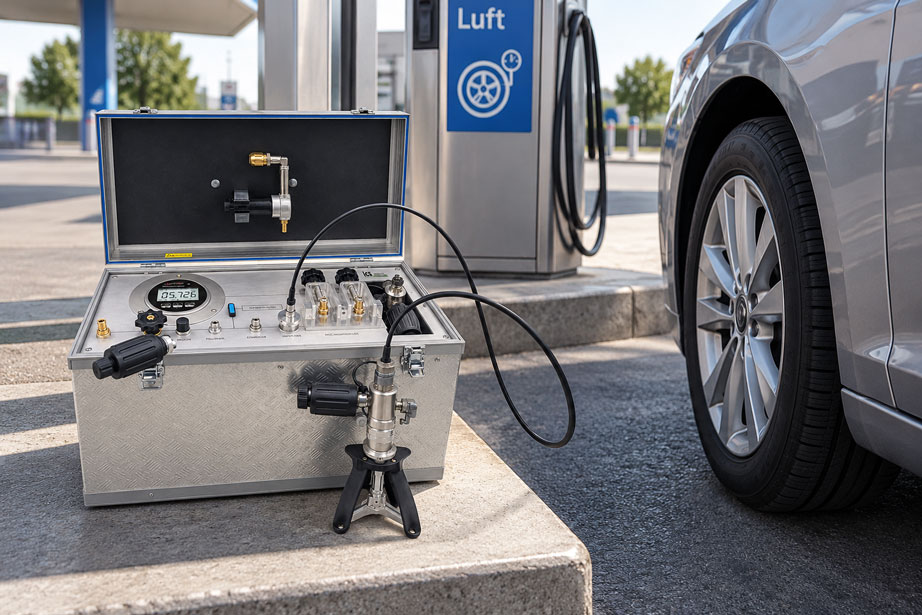
A tyre inflator gauge is to be tested directly at a petrol station. However, no suitable compressed-air connection is available at the test location, or the existing compressed-air supply is deliberately not to be used for the reference test circuit. Does this mean that the test has to be aborted or moved to a stationary test bench?
No. For a mobile test setup, the required test pressure can also be generated independently of an external compressed-air supply.
The PRM-25 combines several functions in one mobile test case:
- an integrated precision calibration hand pump,
- an internal compressed-air reservoir,
- a separate fine adjustment control,
- an integrated reference,
- test connections for tyre inflator gauges.
The hand pump is used primarily to generate the actual pressure. The buffer volume additionally provides compressed gas and helps stabilize the test circuit. The fine regulator and volume adjuster then allow the test pressure to be brought to the required test point in a much more controlled manner.
For reproducible mobile testing, each test point should therefore not be set solely by pumping. A clear separation is more practical: roughly build up the pressure using the hand pump or stored gas, then adjust it precisely using the fine adjustment control, allow it to stabilize, and only then compare the reference with the device under test.
How can a tyre inflator gauge be tested without a compressed-air supply?
For a comparison test, the reference and the tyre inflator gauge must be subjected to the same test pressure.
In simplified form:
Pressure generation → common test circuit → reference + tyre inflator gauge
For the basic comparison principle, the source of the pneumatic pressure is initially of secondary importance.
It can, for example, be provided by:
- an external compressed-air supply,
- a pressure reservoir or
- a manual pneumatic hand pump.
The decisive factor is that the pressure:
- can be generated to a sufficiently high level,
- can be adjusted precisely,
- remains sufficiently stable while readings are taken,
- is applied simultaneously to the reference and the device under test.
A hand pump therefore does not replace the reference.
It is merely the pressure generator.
The actual test pressure is determined by the reference gauge.
What does the mobile test setup look like?
A compact mobile test setup can be represented in simplified form as:
Hand pump → buffer / test circuit → reference → tyre inflator gauge
With the PRM-25, the essential components are already installed inside or directly on the test case.
This means that several separate instruments, adapters and pressure generators do not have to be assembled provisionally on site.
The user therefore has a defined test circuit.
This is particularly useful for applications:
- at petrol stations,
- in tyre service centres,
- in workshops,
- at company yards,
- at mobile service locations,
- at locations without a suitable compressed-air supply.
What is the function of the hand pump?
The hand pump mechanically generates the pneumatic test pressure.
When operated, ambient air is drawn in or compressed and fed into the test circuit.
For this purpose, the PRM-25 uses an integrated precision calibration hand pump for pressures up to:
40 bar
.
This provides considerable pressure reserve for typical tyre inflator gauges.
The hand pump is particularly suitable for:
- rapid initial pressure generation,
- larger pressure changes,
- filling the internal pressure reservoir,
- independent operation without an external air supply.
For the final very small pressure correction, however, the fine regulator is considerably more convenient.
What is the function of the buffer reservoir?
The PRM-25 has an integrated compressed-air reservoir with a volume of:
2 litres
.
It can be used both as a:
- buffer and
- compressed-air reservoir
.
This is useful in a mobile test device for several reasons.
A stored gas volume can provide pressure for several adjustment operations without every small pressure change having to be generated immediately by another pump stroke.
At the same time, the reservoir increases the total pneumatic volume.
This means that individual small volume changes can cause a smaller relative pressure step.
This supports more sensitive adjustment.
What is the difference between coarse pressure generation and fine adjustment?
A common operating mistake is to try to make both large pressure changes and the final fine adjustment using the same device.
It is more practical to separate the procedure into two steps.
Coarse pressure generation:
The pressure is brought close to the desired test point using the hand pump or the available buffer volume.
Fine adjustment:
The pressure is then slowly adjusted to the actual target value using the fine regulator or volume adjuster.
Example:
Required test point:
2.50 bar
First, the pressure is increased to approximately:
2.4 bar
.
The final:
0.1 bar
is then approached in a controlled manner using the fine adjustment.
This allows a test point to be reached much more smoothly than by using rapid pump strokes alone.
Why is a separate fine regulator useful?
Each stroke of a hand pump changes the gas volume in the system.
With a small test volume, even a small additional quantity of gas can cause a clearly visible pressure change.
The fine regulator, on the other hand, works by means of a controlled change in the effective volume or a finely metered pressure change.
This allows the test pressure to be changed in very small increments.
With the PRM-25, the pressure can be adjusted very finely.
However, this fine adjustability must not be confused with measurement accuracy.
How finely a pressure can be adjusted and how accurately its actual value is known are two different properties.
The reference is decisive for the actual pressure value.
How can a test point be approached without significant overshoot?
A target value should preferably be approached in a controlled manner from the same direction.
For an ascending measurement series, for example:
0 → 1 bar → 2 bar → 3 bar → ...
Coarse pressure generation should be stopped in good time before reaching the desired test point.
The final approach is then made slowly using the fine adjustment.
This prevents, for example, a required point of:
2.0 bar
from first being exceeded to:
2.3 bar
and then being reduced again in an uncontrolled manner.
Reproducible approach to the test point is particularly important when hysteresis or differences between ascending and descending pressure are to be investigated.
How can excessive pressure be corrected?
If a test point has been exceeded, the pressure must be reduced in a controlled manner.
A suitable pneumatic calibration setup therefore has a venting facility.
The pressure should not be reduced by:
- loosening a hose connection,
- unscrewing the device under test or
- opening a fitting in an uncontrolled manner
.
Instead, the test circuit is depressurized in a controlled manner via the intended venting or regulating function.
For reproducible tests, it is often better to approach a significantly overshot test point again from the intended loading direction.
Why must the pressure stabilize before taking a reading?
After pumping or a larger pressure change, the gas in the test circuit is not immediately in thermal equilibrium.
During compression, the gas initially heats up.
It then transfers heat to:
- hoses,
- fittings,
- reservoirs,
- measuring instruments,
- the surroundings
.
During this temperature equalization, the pressure can continue to change.
A value read immediately after a forceful pump stroke therefore does not necessarily correspond to the value present a few seconds later after stabilization.
The reference and tyre inflator gauge should only be compared once the test pressure has sufficiently stabilized.
What influence does the test volume have?
The pressure of an enclosed gas depends on its volume.
With a very small test volume, even a small change in volume causes a comparatively large pressure change.
A larger buffer volume can therefore make adjustment less sensitive to small volume changes.
However, there is another side to this.
A larger volume requires more gas to reach a higher pressure.
With purely manual pressure generation, the following must therefore be considered together:
- pump capacity,
- buffer volume,
- device-under-test volume,
- required test pressure
.
Why do hoses influence pressure generation?
Test hoses are not completely rigid components.
Under pressure, they can expand slightly.
In addition, every hose increases the pneumatic test volume.
Very long hoses or unnecessarily large hose volumes therefore lead to:
- higher gas demand,
- more pumping effort,
- longer stabilization times.
For a mobile test setup, the intended hose lengths and connections should be used.
Unnecessary additional extensions should be avoided wherever possible.
Why must the test circuit be leak-tight?
With purely manual pressure generation, a leak becomes noticeable particularly quickly.
The test pressure is initially adjusted correctly and then begins to fall continuously.
Possible causes include:
- tyre valve connections not fully seated,
- leaking hose connections,
- damaged seals,
- leakage at the tyre inflator gauge,
- a vent valve that is not completely closed.
Such a pressure change must not immediately be interpreted as a fault in the tyre inflator gauge.
The test circuit itself must first be checked for leaks.
What role does gas temperature play?
Pressure and temperature are linked in a pneumatic test circuit.
After rapid compression, the pressure may therefore initially appear slightly higher.
As the gas subsequently cools, the pressure decreases again.
This effect can be particularly visible with manual pressure generation because several rapid pump strokes may be performed in succession.
Consistent operation and sufficient stabilization therefore improve reproducibility.
Can operating the hand pump influence the pressure?
In sensitive pneumatic tests, even small thermal influences can become visible.
During operation, the hand pump is held and mechanically actuated.
This results in:
- compression heat in the gas,
- mechanical heating,
- heat input from the operator’s hands.
For typical tyre inflator gauges, this influence is not necessarily dominant.
However, it illustrates why the final value should not be recorded immediately after the last forceful pump stroke.
How should several test points be approached?
For a meaningful test, several pressure points are usually distributed over the relevant measuring range.
An example sequence could be:
0 → 1 → 2 → 3 → 4 bar
The actual test points depend on:
- the measuring range of the tyre inflator gauge,
- the applicable test procedure,
- the required tolerance,
- the intended application.
At each test point, the same procedure should be used wherever possible:
- Generate the coarse pressure.
- Approach the target value using the fine adjustment.
- Allow the pressure to stabilize.
- Read the reference value.
- Read the device-under-test value.
- Document the deviation.
What should be considered for ascending and descending tests?
Mechanical tyre inflator gauges can exhibit hysteresis.
The indicated value can therefore depend on whether a test point is approached from a lower or a higher pressure.
For a corresponding investigation, an ascending measurement series is carried out first.
The pressure is then increased beyond the upper test range and the same test points are approached again in the descending direction.
Example:
0 → 1 → 2 → 3 → 4 → 3 → 2 → 1 → 0 bar
The fine adjustment makes it easier to set identical pressure points reproducibly in both directions.
What changes when an external compressed-air supply is used?
If a suitable external compressed-air supply is available, it can also be used for pressure generation.
With the PRM-25, an external air supply can be connected via the intended compressed-air connection.
This is particularly advantageous for:
- many consecutive tests,
- frequent large pressure changes,
- reducing manual pumping effort.
Fine adjustment remains relevant even when an external supply is used.
A compressed-air line merely provides the energy or coarse pressure.
It does not guarantee that the required test point is applied precisely and stably.
What are the advantages of testing without external compressed air?
The most important advantage is independence from the test location.
The technician does not need a suitable stationary compressed-air connection immediately beside the tyre inflator gauge being tested.
This allows testing to be carried out directly, for example:
- at the petrol station or tyre inflation station,
- in the workshop yard,
- in a small workshop without a suitable test connection,
- in a mobile service vehicle,
- at temporary service locations.
In addition, the test is not dependent on pressure fluctuations or the quality of an unknown plant compressed-air network.
The complete test setup remains controllable.
What are the limits of purely manual pressure generation?
A hand pump is particularly practical for mobile applications and comparatively small pneumatic test volumes.
However, as the following increase:
- test pressure,
- test volume,
- gas consumption,
- number of tests
the manual effort also increases.
For a single tyre inflator gauge or a small number of mobile tests, this is usually not a problem.
For a large number of recurring tests, an external compressed-air supply may be more convenient.
However, this does not automatically improve the fundamental measurement quality.
The decisive factors remain the reference, test setup, pressure stability and reproducible procedure.
Practical example: testing directly at a petrol station
A service technician is to test several tyre inflator gauges at a petrol station.
No suitable external compressed-air connection for the reference test case is available directly at the test location.
The PRM-25 is therefore operated completely independently.
First, the tyre inflator gauge is connected to the intended test connection.
The required first test point is:
1.0 bar
The integrated hand pump is used to pressurize the test circuit to just below this value.
The final pressure steps are set using the fine regulator.
After a short stabilization period, the reference and the tyre inflator gauge are compared.
Further test points then follow, for example at:
2.0 bar
and:
3.0 bar
.
Between the test points, the available buffer volume is used so that not every small pressure step has to be generated exclusively by a pump stroke.
After the highest test point, the descending measurement series can be carried out using controlled pressure release.
At the end, the test circuit is completely returned to atmospheric pressure.
The complete test can therefore be carried out directly at the point of use without connecting the PRM-25 to an external compressed-air line.
Systematically testing a tyre inflator gauge without compressed air
- Position the PRM-25 securely at the test location.
- Check the measuring range of the integrated reference.
- Determine the measuring range of the tyre inflator gauge.
- Check the test hoses and connections.
- Connect the device under test correctly.
- Initially check the test circuit in a depressurized condition.
- Assess the zero point of the reference and the device under test.
- Generate the coarse pressure using the hand pump.
- Approach the required test point to just below the target value.
- Use the fine regulator to approach the test point precisely.
- Allow sufficient stabilization time.
- Read the reference and the device under test.
- Document the measured values and deviation.
- Approach further test points in the same way.
- If required, carry out a descending measurement series.
- After completion, vent the system completely in a controlled manner.
Systematically diagnosing unstable test pressure
- Check whether all valves are set correctly.
- Check that the device-under-test connection is fully seated.
- Check hoses and couplings for leaks.
- Observe whether the pressure falls only directly after pumping or continuously.
- Allow thermal stabilization.
- Check that the fine regulator is in the correct operating position.
- Check that the vent is fully closed.
- Check the device under test itself for leakage.
- Remove unnecessary additional hose volume.
- Repeat the test using a smaller pressure step.
- If necessary, check the stability of the test circuit without the device under test.
Common mistakes
- Setting every test point exclusively using pump strokes: This makes the final fine adjustment unnecessarily difficult.
- Significantly overshooting the test point and immediately regulating back: The loading direction becomes inconsistent and hysteresis assessment becomes more difficult.
- Taking a reading immediately after the final pump stroke: The gas may not yet have thermally stabilized.
- Equating finely adjustable pressure with high measurement accuracy: Adjustability and reference accuracy are different properties.
- Immediately attributing falling pressure to the device under test: The hose, coupling or valve may also be leaking.
- Loosening a hose connection to reduce pressure: Pressure should only be reduced in a controlled manner using the intended venting function.
- Using unnecessarily long test hoses: Additional volume increases pumping effort and stabilization time.
- Treating the buffer reservoir as the reference: It stores or buffers compressed air but does not measure the test pressure.
- Interpreting the hand pump as a measuring instrument: It generates pressure; the reference determines the actual value.
- Using different stabilization times: This reduces the reproducibility of comparative measurements.
- Assuming on-site compressed air is essential: The PRM-25 can be operated independently using its integrated hand pump.
- Leaving residual pressure in the test circuit after completion: The setup should be returned to atmospheric pressure in a controlled manner.
PRM-25 for mobile on-site testing
The PRM-25 is a mobile reference test system for testing or calibrating tyre inflator gauges.
The robust test case combines the essential components required for a mobile test setup.
The current version uses an integrated precision digital pressure gauge of type:
ADT681
as the reference.
For different test applications, reference pressure ranges of:
6 bar,10 bar,16 bar,25 bar,40 bar
are available.
For independent operation, the PRM-25 has an integrated precision calibration hand pump for pressure generation up to:
40 bar
.
It also includes an integrated:
2-litre compressed-air reservoir
.
This can be used as a buffer or compressed-air reservoir.
The test pressure can be adjusted precisely using the fine regulator and volume adjuster.
This makes the test setup particularly suitable for mobile applications where no external compressed-air supply is available at the point of use.
If an external air supply is available, it can also be used via the intended connection.
In addition, two tyre inflator gauges can be connected to the same test circuit simultaneously.
Further information can be found for the PRM-25 reference test system for tyre inflator gauges.
Further mobile pressure test and calibration solutions can be found under calibration cases / test cases at ICS Schneider.
Conclusion
An external compressed-air supply is not essential for testing a tyre inflator gauge.
With a suitable pneumatic hand pump, the required test pressure can be generated directly at the point of use.
The decisive factor is the separation between pressure generation and precise pressure adjustment.
The hand pump is suitable for larger pressure changes and coarse pressure generation.
The buffer reservoir provides additional gas volume and enables more flexible mobile operation.
The final approach to the test point is carried out in a controlled manner using the fine adjustment.
After each larger pressure step, sufficient time should be allowed for pneumatic and thermal stabilization.
A stable test point also requires a leak-tight test circuit, suitable connections and reproducible operating procedures.
With the PRM-25, the hand pump, 2-litre buffer reservoir, fine adjustment and reference are all combined in one mobile test case.
For reproducible mobile testing, therefore: generate the pressure roughly using the hand pump, use the buffer volume appropriately, approach the target value in a controlled manner using the fine adjustment, allow stabilization after each pressure change, and only then compare the reference with the tyre inflator gauge.
FAQ: Testing tyre inflator gauges without an external compressed-air supply
Can a tyre inflator gauge be tested without an existing compressed-air connection?
Yes. If the test pressure is generated using a suitable pneumatic hand pump, the comparison test can be carried out independently of a stationary compressed-air supply.
Can the PRM-25 be operated without external compressed air?
Yes. The integrated precision calibration hand pump allows pressure generation up to 40 bar and makes the test case independent of an external compressed-air supply for mobile on-site testing.
What is the function of the buffer reservoir in the PRM-25?
The integrated 2-litre reservoir can be used both as a buffer and as a compressed-air reservoir. This provides an additional gas volume for setting the pressure.
What is the fine regulator used for?
The hand pump is primarily suitable for coarse pressure generation. The fine regulator or volume adjuster can then be used to set the required test point much more precisely and in a controlled manner.
Why should the test point not be set using only the hand pump?
A pump stroke can cause a relatively large pressure step, particularly with a small test volume. Combining coarse pressure generation with fine adjustment enables more reproducible setting.
Why does the pressure continue to change after pumping?
The gas heats up during compression. As it subsequently returns to thermal equilibrium, the pressure can change. Sufficient stabilization time should therefore be allowed before taking a reading.
What should I do if the required test point has been exceeded?
The pressure should be reduced in a controlled manner using the intended regulating or venting facility. Hose or instrument connections should not be loosened while pressurized.
Why does the set test pressure slowly decrease?
Possible causes include thermal stabilization or leakage in the test circuit. The device-under-test connection, hoses, couplings, valves and the device under test itself should be checked.
Is a larger buffer reservoir automatically better?
Not necessarily. A larger pneumatic volume can reduce the effect of small pressure changes, but it also requires more gas for a pressure increase. Buffer volume and pressure generation must suit the test setup.
Can external compressed air also be used?
Yes. The PRM-25 also has a connection for an external compressed-air supply. For many recurring tests, this can reduce the amount of manual pumping required.
Is the hand pump the reference for the test pressure?
No. The hand pump only generates the pressure. The actual test pressure is determined using the integrated precision digital pressure gauge as the reference.
Which reference pressure gauge is installed in the current PRM-25?
The current product description specifies the ADT681 precision digital pressure gauge as the integrated reference.
Which pressure ranges are available for the PRM-25?
The current product description specifies reference ranges of 6, 10, 16, 25 or 40 bar.
Can two tyre inflator gauges be tested simultaneously?
Yes. The PRM-25 has two test connections, allowing two tyre inflator gauges to be subjected to the same test pressure simultaneously.
Where is an independently operated PRM-25 particularly useful?
Typical applications include mobile tests at petrol stations, workshops, tyre service centres or other locations where no suitable external compressed-air supply is available directly at the test location.