


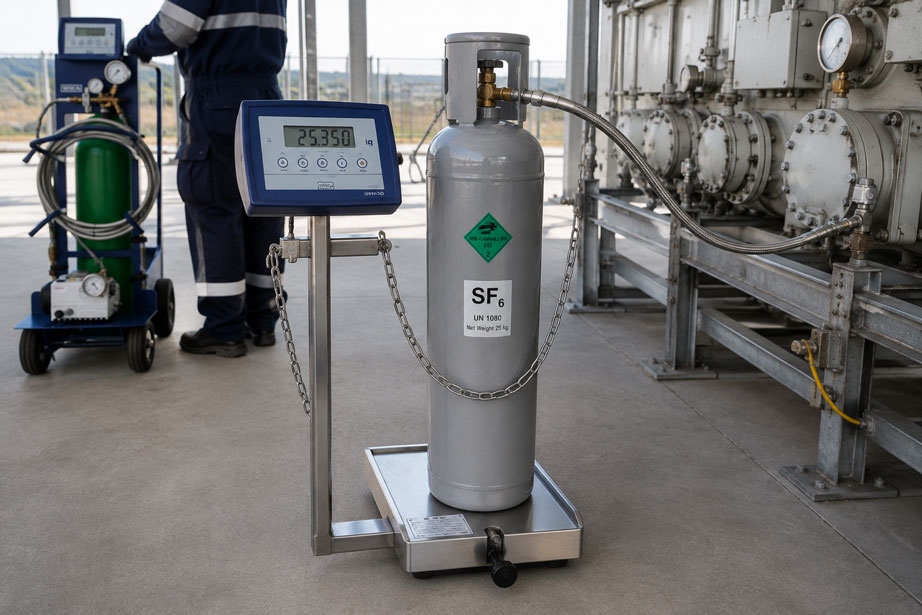
An SF₆ gas cylinder still indicates an apparently sufficient pressure.
Nevertheless, it remains unclear:
How much SF₆ is actually still contained in the cylinder?
With many compressed gases, it may seem reasonable to estimate the remaining gas quantity from the cylinder pressure.
With SF₆, however, this can lead to significant misinterpretations.
The reason:
SF₆ can be present in a gas cylinder partly in liquid form and partly in gaseous form. As long as both phases are present, the pressure is strongly determined by temperature and phase equilibrium – and not directly by the remaining total mass.
Two cylinders can therefore indicate a similar pressure at the same temperature while containing significantly different SF₆ masses.
For service work on gas-insulated switchgear, mass is therefore the much more suitable parameter for:
- SF₆ filling quantity,
- recovered SF₆ quantity,
- remaining contents of a gas cylinder,
- gas inventory,
- mass balance and documentation.
The basic relationship is:
Net gas mass = gross weight − tare
During a filling operation, the transferred gas quantity can be determined from the change in cylinder weight:
transferred SF₆ mass = cylinder weight before − cylinder weight after
For recovery, the corresponding relationship is:
recovered SF₆ mass = cylinder weight after − cylinder weight before
In practice, however, a reliable mass balance is only possible if the scale is set up correctly and no external forces influence the measurement result.
Typical sources of error include:
- hoses pulling on or supporting the cylinder,
- a cylinder partially resting on a frame,
- uneven ground,
- missing or incorrectly used tare function,
- incorrect cylinder tare weight,
- taking a reading while the cylinder or hose is still moving,
- overloading the scale,
- failure to document initial and final weights.
A high-accuracy scale can only measure the force that is actually transferred completely to its load cell.
SF₆ service equipment can be found at ICS Schneider under SF₆ Service Equipment. Further instruments for SF₆ service, analysis and monitoring can be found under SF₆ Gas Solutions.
Table of Contents
- Why SF₆ should be weighed rather than estimated from cylinder pressure
- Why liquefied SF₆ affects the pressure indication
- Distinguish between tare, gross weight and net gas mass
- Determine the filled SF₆ quantity from the weight change
- Determine the recovered SF₆ quantity
- Calculate the remaining quantity in an SF₆ cylinder
- Correctly determine the remaining receiving capacity
- Observe the permissible filling mass of the cylinder
- Set up the gas cylinder scale correctly
- Avoid force bypasses
- Consider the influence of connected hoses
- Use zero setting and tare function correctly
- Correctly read a stable measured value
- Protect the scale against overload
- Distinguish between temperature effects and weight measurement
- Create an SF₆ mass balance
- Document filling and recovery quantities
- Importance for emission and gas balances
- Typical fault patterns
- Systematic procedure for weighing
- Practical example: topping up an SF₆ switchgear system
- Suitable ICS products
- Conclusion
- FAQ
Why SF₆ should be weighed rather than estimated from cylinder pressure
The pressure of a gas cylinder is an important operating parameter in many applications.
However, it does not automatically answer the question:
How many kilograms of SF₆ are still present?
For an idealized gas stored exclusively in gaseous form, there would be a more direct relationship between pressure, temperature, volume and amount of substance.
The approximate basis would be:
p · V = n · R · T
However, an SF₆ cylinder can additionally contain liquid SF₆.
In this case, a simple pressure reading does not reliably describe the total mass inside the cylinder.
Mass can be directly balanced
Mass offers one decisive advantage for service work:
Anything leaving the cylinder reduces its mass.
Anything entering the cylinder during recovery increases its mass.
This means that a transfer can be determined directly by gravimetric measurement.
Example
Cylinder weight before filling a system:
72,40 kg
Cylinder weight after filling:
67,15 kg
Transferred mass:
72,40 kg − 67,15 kg = 5,25 kg SF₆
Provided that no relevant gas mass was otherwise lost during the process or remained in additional components not included in the balance, this means that:
5,25 kg SF₆
was removed from the cylinder.
Why liquefied SF₆ affects the pressure indication
Depending on temperature, pressure and filling level, SF₆ can be partially liquefied in a compressed-gas cylinder.
The cylinder can therefore simultaneously contain:
liquid SF₆ + gaseous SF₆
The pressure is then largely determined by temperature
As long as liquid and gas phases are present simultaneously, a temperature-dependent phase equilibrium is established.
If gas is withdrawn from the vapor space, some of the liquid can evaporate.
As a result, the pressure can move back toward the equilibrium pressure corresponding to the temperature.
Consequence in practice
A cylinder may already have lost a significant amount of mass even though its pressure has not decreased to the same extent.
Therefore:
Cylinder pressure is not a reliable indication of the remaining SF₆ mass.
When no liquid phase remains
If only gaseous SF₆ remains, the relationship between mass, pressure and temperature changes.
Even then, however, weighing remains considerably simpler and more reliable for precise inventory purposes than estimating the quantity from pressure alone.
Distinguish between tare, gross weight and net gas mass
For clear documentation, three quantities must be distinguished.
Tare
The tare is the empty weight of the gas cylinder or the tare weight specified for the cylinder.
In simplified form:
Tare = mass of the empty cylinder
Gross weight
The gross weight is the current total weight measured by the scale:
Gross weight = cylinder + contained SF₆
Net gas mass
The contained SF₆ mass is calculated as:
mSF6 = mgross − mtare
Example
Tare weight indicated on the cylinder:
42,70 kg
Current gross weight:
69,85 kg
Contained SF₆ mass:
69,85 kg − 42,70 kg = 27,15 kg
The cylinder therefore contains, by calculation:
27,15 kg SF₆
Do not estimate the tare weight
The tare weight should be taken from the clear cylinder marking or the corresponding cylinder documentation.
The following approach is not appropriate:
“These cylinders weigh approximately 43 kg when empty.”
Even small differences between individual cylinders would directly affect the calculated gas mass.
Determine the filled SF₆ quantity from the weight change
When filling or topping up a system, the delivered SF₆ mass can be determined from the decrease in weight of the supply cylinder.
Basic equation:
mfilled = mcylinder, before − mcylinder, after
Example
Weight before the filling process:
61,82 kg
Weight after the filling process:
58,47 kg
This results in:
mfilled = 61,82 kg − 58,47 kg = 3,35 kg
The documented quantity withdrawn from the cylinder is therefore:
3,35 kg SF₆
Always document the initial and final values
Recording only the calculated difference:
3,35 kg
is less transparent than recording:
before 61,82 kg → after 58,47 kg → difference 3,35 kg
Complete documentation enables a later plausibility check.
Determine the recovered SF₆ quantity
During recovery, the balance works in the opposite direction.
The receiving or storage cylinder becomes heavier.
Therefore:
mrecovered = mcylinder, after − mcylinder, before
Example
Weight of the receiving cylinder before recovery:
48,20 kg
Weight after recovery:
55,75 kg
Therefore:
55,75 kg − 48,20 kg = 7,55 kg SF₆
was transferred into the cylinder.
Consider the contents of the lines
For particularly accurate balances, it must be considered that after a transfer SF₆ may remain in:
- hoses,
- valves and fittings,
- filters,
- service equipment.
How these residual quantities are handled depends on the service procedure used and the required accuracy of the mass balance.
Calculate the remaining quantity in an SF₆ cylinder
The current remaining quantity can be determined from the gross weight and tare:
mremaining = mgross − mtare
Example
Tare:
39,60 kg
Current weight:
46,35 kg
Remaining quantity:
46,35 kg − 39,60 kg = 6,75 kg SF₆
Why this is important for service work
Before a service operation, this can be used to check whether the available gas inventory is sufficient for the planned work.
Example:
A service operation is expected to require:
8 kg SF₆
However, the cylinder contains only:
6,75 kg SF₆
The available inventory is clearly insufficient.
A pressure check alone might not have revealed this situation clearly.
Correctly determine the remaining receiving capacity
During recovery, the amount of gas already contained in the cylinder is not the only important factor.
Another key question is:
How much additional SF₆ may the receiving cylinder still accept?
For this purpose, the permissible maximum filling mass of the specific cylinder must be known.
Calculation using net gas masses
If the permissible maximum net SF₆ filling mass is known:
mremaining capacity = mSF6,max − mSF6,current
Alternatively using the permissible gross weight
If a permissible maximum gross weight is clearly specified:
mremaining capacity = mgross,max − mgross,current
Example
Permissible SF₆ filling mass of the cylinder:
30,0 kg
Currently contained SF₆ mass:
18,4 kg
Calculated remaining capacity:
30,0 kg − 18,4 kg = 11,6 kg
The permissible maximum filling mass must only be taken from the markings and documentation applicable to the specific cylinder.
Observe the permissible filling mass of the cylinder
A gas cylinder must never be filled further simply because the scale indicates a calculated difference from an assumed target value.
The decisive requirements are those applicable to the respective pressure vessel, including:
- markings,
- approvals,
- filling regulations,
- manufacturer specifications,
- operational requirements.
Water capacity is not the same as permissible gas mass
The geometric cylinder volume or the specified water capacity must not automatically be interpreted as the available filling capacity for SF₆.
The permissible filling quantity must be suitable for the:
- medium,
- pressure vessel,
- temperature range,
- permissible operating condition.
Particularly important during recovery
During recovery, a service unit may continue transferring gas even when the receiving cylinder is already close to its permissible filling limit.
The scale is therefore not only used for documentation.
It also enables continuous monitoring of the mass actually received.
The permissible filling limit of the storage cylinder must not be exceeded.
Set up the gas cylinder scale correctly
A precise gas cylinder scale requires suitable installation conditions.
The surface should be:
- level,
- stable,
- sufficiently load-bearing,
- free from strong vibrations.
Do not tilt or mechanically constrain the scale
If part of the weighing frame rests on a raised surface or the frame touches a fixed object at the side, the force transmission can be altered.
The measurement result is then no longer reliable.
The cylinder must rest completely on the scale
The entire weight force of the cylinder must act on the scale in accordance with its intended design.
Problematic situations include:
- the cylinder leaning against a wall,
- the cylinder standing partly on an edge in the floor,
- the valve guard or cylinder body being supported,
- a transport frame carrying part of the weight.
Ensure stability
Heavy gas cylinders must be secured against falling over.
However, the restraint must not be arranged in such a way that it carries a significant part of the weight and thereby influences the measurement result.
On the WIKA GWS-10, a retaining chain on the weighing frame increases the stability of the cylinder.
Avoid force bypasses
In weighing technology, a force bypass refers to an alternative force path through which part of the weight force bypasses the actual load cell.
The principle:
actual cylinder mass ≠ force completely detected by the load cell
Typical force bypasses
- cylinder leaning against a railing,
- frame touching a wall,
- rigid pipe carrying part of the weight,
- a tightly tensioned hose pulling upward,
- cylinder restraint attached too tightly to an independent support structure.
Why a few hundred grams can be relevant
For a transfer of, for example:
2,0 kg SF₆
an additional force error of:
0,2 kg
would already represent:
10 %
of the quantity to be determined.
A precise scale alone therefore does not guarantee a precise transfer measurement.
Consider the influence of connected hoses
During SF₆ service, the gas cylinder is normally connected to the service unit or switchgear by a hose.
This hose can transmit forces to the cylinder.
Typical error
A relatively stiff hose is routed in such a way that it:
- pulls upward on the cylinder valve,
- pushes sideways against the cylinder,
- rests on a frame and partially relieves the cylinder weight.
Consequence
The scale no longer detects only the weight force of the cylinder.
If the hose position changes during the transfer, the indicated value can even change without a corresponding amount of gas having been transferred.
Practical check
Before starting, check whether:
- the hose is routed without significant mechanical tension,
- sufficient movement allowance is provided,
- no rigid support is created,
- the cylinder stands freely on the scale.
After connecting the hose, the weight indication should be checked again for plausibility.
Use zero setting and tare function correctly
The terms zero setting and tare are often used interchangeably, but depending on the weighing system they can serve different practical purposes.
Determine the absolute mass
If the actual gas mass contained in the cylinder is to be determined, the current gross weight is typically measured and the known tare weight of the cylinder is then subtracted.
Track the transfer directly
For an individual filling operation, a tare or relative indication can be particularly practical.
The starting value is set to:
0,00 kg
.
The display then directly indicates the change in weight during the transfer.
Nevertheless record the original value
For traceable documentation, it is advisable to additionally record the absolute initial and final values.
This allows the transfer value to be independently recalculated later.
Correctly read a stable measured value
Small fluctuations in the indication may occur during a transfer.
Possible causes include:
- movement of the hose,
- vibrations,
- touching the cylinder,
- movement of the weighing frame.
Do not document the value during mechanical movement
The final value should only be recorded when:
- the cylinder is stationary,
- nobody is touching the cylinder or hose,
- the indication is stable.
Use the same measuring conditions
The mechanical conditions should be as identical as possible for the initial and final measurements.
If the hose hangs freely at the beginning but is supported by the floor or frame during the final reading, the two values are not optimally comparable.
Protect the scale against overload
Before placing the gas cylinder on the scale, it must be checked whether:
maximum possible gross weight ≤ permissible load of the scale
Consider the gross weight
The contained SF₆ mass is not the only relevant factor.
The scale supports:
cylinder + valve + gas + any components permanently included in the weighing
Overload can have permanent consequences
Mechanical overload can:
- damage the load cell,
- change the zero point,
- cause permanent measurement deviations.
The permissible weighing range of the specific instrument must therefore be observed before use.
Distinguish between temperature effects and weight measurement
Ambient temperature has a significant influence on the pressure of an SF₆ cylinder.
However, it does not change the mass of the SF₆ contained in the cylinder.
Example
A closed gas cylinder is moved from a cold environment into a warmer building.
After temperature equalization, the pressure may be higher.
As long as no gas has escaped or been added:
mSF6 = constant
Advantage of gravimetric determination
This is exactly why mass is so useful for inventory and transfer balancing.
It is considerably less susceptible to misinterpretation caused by temperature-related pressure changes.
The scale itself has operating conditions
However, this does not mean that temperature is completely irrelevant to the scale.
Weighing equipment has a permissible ambient and operating range.
The manufacturer’s specifications for the respective weighing system must therefore be observed.
Create an SF₆ mass balance
During service work, several mass values can be linked together.
A simple scheme is, for example:
initial inventory + added SF₆ − withdrawn SF₆ = calculated final inventory
For a gas cylinder
Example:
Initial inventory:
25,00 kg
Withdrawal for system A:
4,20 kg
Withdrawal for system B:
2,60 kg
Calculated remainder:
25,00 − 4,20 − 2,60 = 18,20 kg
A final weighing should confirm this inventory within the expected measurement and balance uncertainty.
Investigate discrepancies
If the scale instead indicates, for example:
17,55 kg
there is a discrepancy compared with the documented balance of:
0,65 kg
The following should then be checked:
- were all transfers recorded?
- were initial and final values transferred correctly?
- was the correct tare weight used?
- did gas remain in service equipment or hoses?
- was there a leak or release?
- was there a force bypass during one of the weighings?
Document filling and recovery quantities
Reliable service documentation should contain more than just a single final value.
Useful information
- date and time,
- system or equipment ID,
- gas cylinder ID,
- gas type and, where applicable, gas status,
- tare weight of the cylinder,
- gross weight before the transfer,
- gross weight after the transfer,
- calculated transfer mass,
- type of operation: filling or recovery,
- service equipment used,
- responsible person,
- where applicable, comments regarding deviations.
Example of a filling record
| Parameter | Value |
|---|---|
| System | Switchgear bay Q07 |
| Cylinder | SF6-024 |
| Tare | 42,70 kg |
| Weight before filling | 69,85 kg |
| Weight after filling | 66,40 kg |
| Quantity filled | 3,45 kg |
| Remaining quantity in cylinder | 23,70 kg |
| Operation | Topping up |
Check the calculation
Remaining quantity after the operation:
66,40 kg − 42,70 kg = 23,70 kg
Quantity withdrawn:
69,85 kg − 66,40 kg = 3,45 kg
This makes it possible to trace both the transfer and the remaining inventory from the same raw values.
Importance for emission and gas balances
SF₆ is a fluorinated greenhouse gas with a very high global warming potential.
A traceable quantity balance is therefore important not only for operational inventory purposes but also from an environmental and documentation perspective.
EU F-Gas Regulation
Regulation (EU) 2024/573 contains requirements governing the handling of fluorinated greenhouse gases.
For systems subject to the corresponding record-keeping requirements, quantities must be documented that were, among other things:
- added during installation or service,
- added during maintenance,
- recovered.
Weighing provides a reliable basis for this
By determining:
mass before → mass after → difference
a directly traceable basis for a mass balance is created.
Which statutory record-keeping and reporting requirements apply in a specific case must be determined based on the particular system, application and current regulatory requirements.
Typical fault patterns when weighing SF₆ gas cylinders
| Observation | Possible cause | Recommended check |
|---|---|---|
| Cylinder pressure appears normal, but the gas is insufficient for the planned service operation | Pressure was incorrectly used as a measure of the remaining mass | Weigh the cylinder and calculate the net SF₆ mass |
| Scale suddenly indicates a different weight after connecting the hose | Hose force is acting on the cylinder | Route the hose without mechanical tension |
| Indication changes when the hose is moved | Force bypass or mechanical force input | Check hose routing |
| Remaining quantity appears implausible | Incorrect tare weight used | Check cylinder marking |
| Scale indicates too little weight | Cylinder is partially supported by a wall or frame | Check that the cylinder is standing freely |
| Measured value fluctuates | Vibration, movement or hose forces | Allow the system to settle and read again |
| Balance differs from documented transfers | Transfer not recorded, residual gas or measurement error | Check individual records and weighing conditions |
| Absolute cylinder inventory is unknown after taring | Only the relative weight difference was documented | Also record absolute initial and final weights |
| Cylinder appears to still contain a large amount of gas because pressure remains high | Liquid/gas phase equilibrium not taken into account | Determine remaining mass gravimetrically |
| Recovery cylinder is approaching its filling limit without this being known | Remaining capacity was not calculated before use | Compare current and permissible maximum filling mass |
| Zero point is incorrect after mechanical overload | Load cell may have been overloaded | Check or recalibrate the scale |
Systematic procedure for weighing
The following procedure is recommended for a traceable SF₆ transfer:
- Identify the cylinder: Check the unique cylinder ID and gas type.
- Record the tare weight: Take the value from the cylinder marking or documentation.
- Check the permissible filling mass: Particularly for recovery cylinders before starting work.
- Check the scale: Verify weighing range, condition and operational readiness.
- Set up the scale on a level surface: Use a stable and sufficiently load-bearing surface.
- Position the cylinder completely on the scale: Avoid force bypasses.
- Secure the cylinder: Secure against falling over in accordance with manufacturer and safety requirements.
- Connect the hoses: Follow the specified SF₆ service procedures.
- Check hose routing: No significant pulling, pushing or supporting forces should act on the cylinder.
- Record the initial weight: Document a stable absolute value.
- If appropriate, set the tare/relative function: Display the transfer change directly.
- Perform the transfer: Carry out the filling or recovery procedure in accordance with the service equipment and system requirements.
- Monitor filling limits: Particularly when recovering SF₆ into storage cylinders.
- Allow the system to settle: Avoid mechanical influences before taking the final reading.
- Document the final weight: Record the absolute value.
- Calculate the difference: Determine the filled or recovered gas mass.
- Calculate the remaining inventory: Gross weight minus tare.
- Check the balance for plausibility: Compare expected and measured quantities.
- Complete the service record: Clearly assign the values to the correct system and cylinder.
Practical example: topping up an SF₆ switchgear system
During maintenance of gas-insulated switchgear, it is determined that SF₆ must be topped up.
The actual gas mass introduced is to be determined for documentation purposes.
Step 1: Identify the gas cylinder
The cylinder used has a specified tare weight of:
41,80 kg
.
Step 2: Place the cylinder on the scale
The cylinder is positioned on a suitable SF₆ gas cylinder scale and secured against falling over in accordance with the intended design.
The scale indicates:
63,65 kg
Step 3: Determine the initial inventory
The contained SF₆ mass is:
63,65 kg − 41,80 kg = 21,85 kg
Step 4: Connect the hose
After connecting the hose, the scale suddenly indicates:
63,35 kg
even though no SF₆ has yet been transferred.
Step 5: Find the cause
The service hose is routed very tightly and slightly pulls upward on the cylinder valve.
This mechanically relieves the scale by approximately:
0,30 kg
.
The hose routing is corrected.
The indication returns to:
63,65 kg
.
Step 6: Top up the system
The filling process is performed according to the procedure specified for the system and the service equipment used.
Step 7: Record the final weight
After completion and once the setup is stable, the scale indicates:
60,40 kg
Step 8: Calculate the filled mass
The gas mass withdrawn from the cylinder is:
63,65 kg − 60,40 kg = 3,25 kg SF₆
Step 9: Determine the remaining inventory
The cylinder still contains:
60,40 kg − 41,80 kg = 18,60 kg SF₆
Result
The service record can now document the following values in a traceable manner:
- initial weight: 63,65 kg,
- final weight: 60,40 kg,
- filled SF₆ mass: 3,25 kg,
- remaining SF₆ mass: 18,60 kg.
The example also demonstrates why the mechanical installation conditions are important.
If the unloading effect caused by the hose of:
0,30 kg
had not been detected, the mass balance would have been distorted accordingly.
For reliable SF₆ mass balances, both the accuracy of the scale and the mechanical boundary conditions must therefore be correct.
Suitable ICS products for weighing and filling SF₆ gas cylinders
WIKA GWS-10 – Portable SF₆ gas cylinder scale
The WIKA GWS-10 available from ICS was specifically designed for mobile SF₆ service operations.
Its applications include:
- monitoring the filling of SF₆ gas,
- monitoring the withdrawal of SF₆ gas,
- gas cylinder inventory,
- incoming inspection of gas cylinders.
Precise mass measurement
WIKA specifies an accuracy for the GWS-10 of:
±30 g
.
This enables even comparatively small changes in mass during a service operation to be reliably detected.
Tare function
The digital display has a tare function.
This allows the weight change during a filling or withdrawal operation to be tracked directly.
To determine the absolute remaining SF₆ quantity, the empty weight specified on the gas cylinder can additionally be used:
Net SF₆ mass = measured total weight − empty weight
Mechanical design
The GWS-10 consists of:
- a foldable weighing frame,
- a digital display,
- a load cell.
The weighing frame is made of galvanized steel and has a low platform height.
This makes it comparatively easy to position heavy gas cylinders on the scale.
A retaining chain on the frame increases the stability of the gas cylinder.
Protection for mobile service
The GWS-10 is specified with the degree of protection:
IP65
.
The foldable design facilitates transport and storage during mobile service operations.
Further information can be found under WIKA GWS-10 Portable SF₆ Gas Cylinder Scale at ICS Schneider.
WIKA GFU08 – SF₆ filling cart with scale
If a complete system for filling or topping up is required in addition to pure weight measurement, ICS offers the WIKA GFU08 series.
The series includes different versions:
- GFU08-B – filling cart,
- GFU08-W – filling cart with scale,
- GFU08-E – filling cart with vacuum pump,
- GFU08-C – filling cart with scale and vacuum pump.
Mass balance directly during filling
In the corresponding versions, a high-accuracy scale enables precise determination of the transferred SF₆ quantity.
The system is therefore particularly suitable for applications in which:
- filling quantities are documented,
- gas inventories are balanced,
- emission reporting is supported.
Further information can be found under SF₆ Service Equipment at ICS Schneider.
Which solution is suitable for which application?
| Application | Suitable solution |
|---|---|
| Mobile determination of SF₆ cylinder inventory | WIKA GWS-10 |
| Monitoring an individual filling or withdrawal operation | WIKA GWS-10 |
| Inventory of multiple SF₆ gas cylinders | WIKA GWS-10 |
| Incoming inspection of an SF₆ cylinder | WIKA GWS-10 |
| Mobile SF₆ filling cart with integrated weight monitoring | WIKA GFU08-W |
| Filling cart with scale and vacuum pump | WIKA GFU08-C |
| Establishing a traceable SF₆ mass balance | GWS-10 or GFU08 with scale |
An overview of the available systems can be found under SF₆ Service Equipment at ICS Schneider.
Conclusion
The pressure of an SF₆ gas cylinder is not a reliable indication of the gas mass still contained in the cylinder.
The main reason is the possibility of a two-phase condition consisting of:
liquid SF₆ + gaseous SF₆
As long as both phases are present, the pressure is strongly determined by temperature and phase equilibrium.
For filling quantities, recovery quantities and inventory levels, gravimetric determination is therefore considerably more suitable.
The basic relationship is:
Net gas mass = gross weight − tare
For a transfer:
Filling quantity = weight before − weight after
or, for recovery:
Recovered quantity = weight after − weight before
However, for the difference to actually correspond to the transferred SF₆ mass, the scale must be mechanically integrated correctly.
In particular, the following should be avoided:
- force bypasses,
- the cylinder leaning sideways against another object,
- rigid supports,
- hose forces,
- readings taken while the system is moving or unstable.
During recovery, the remaining receiving capacity of the cylinder must also be known.
The maximum permissible SF₆ filling mass of the specific compressed-gas cylinder must never be exceeded.
For traceable documentation, not only differential values but preferably also the following should be recorded:
- tare weight,
- initial weight,
- final weight,
- calculated transfer quantity,
- remaining quantity,
- cylinder and system identification.
This turns a simple weight measurement into a reliable SF₆ mass balance.
For practical applications:
Identify the cylinder → check the tare → determine the permissible filling mass → set up the scale on a level surface → position the cylinder completely and securely → avoid force bypasses → connect the hose without mechanical tension → document the initial weight → transfer SF₆ according to the specified service procedure → monitor filling limits → record a stable final value → calculate the difference and remaining quantity → assign the values to the correct system and cylinder → document the mass balance.
FAQ: Weighing SF₆ Gas Cylinders and Determining Filling Quantities
Why should an SF₆ gas cylinder be weighed?
Weighing makes it possible to determine the actual SF₆ mass contained in the cylinder. This is particularly important for filling operations, recovery, inventory and mass balances.
Can I determine the remaining SF₆ quantity from the cylinder pressure?
Not reliably. If SF₆ is simultaneously present in liquid and gaseous form inside the cylinder, the pressure is largely determined by temperature and phase equilibrium.
Why does the SF₆ cylinder pressure remain relatively high despite gas withdrawal?
As long as a liquid phase is still present, additional SF₆ can evaporate when gas is withdrawn. The pressure therefore does not decrease proportionally to the total mass removed.
What does tare mean for a gas cylinder?
The tare is the empty weight of the gas cylinder or the tare weight specified for that cylinder.
What is the gross weight of an SF₆ cylinder?
The gross weight is the current total mass of the cylinder and the SF₆ contained in it.
How do I calculate the contained SF₆ mass?
The net gas mass is calculated as gross weight minus tare weight: mSF6 = mgross − mtare.
How do I determine the filled SF₆ quantity?
For a supply cylinder, the weight is determined before and after filling. The difference corresponds to the mass withdrawn from the cylinder, provided that no additional unaccounted gas losses or residual quantities are present.
How do I determine the recovered SF₆ quantity?
The receiving cylinder is weighed before and after recovery. The increase in weight corresponds to the SF₆ mass received.
How do I calculate the remaining quantity in an SF₆ cylinder?
The tare weight specified for the specific cylinder is subtracted from the current gross weight.
How do I calculate the remaining capacity of a receiving cylinder?
The currently contained net gas mass is subtracted from the permissible maximum SF₆ filling mass. The permissible filling mass must be taken from the data applicable to the specific cylinder.
Can I calculate the permissible SF₆ filling quantity from the cylinder volume?
The permissible filling mass should not be independently derived solely from the geometric cylinder volume or specified water capacity. The marking, approval and filling requirements of the specific compressed-gas cylinder are decisive.
Why is the permissible filling mass particularly important during recovery?
Because the receiving cylinder becomes continuously heavier during recovery and its permissible filling limit must not be exceeded.
What is a force bypass?
A force bypass occurs when part of the weight force is not transmitted through the load cell but is instead supported, for example, by a wall, frame or hose.
Can an SF₆ hose influence the weight measurement?
Yes. A tensioned or unfavorably supported hose can pull or push on the cylinder and thereby change the indicated weight.
How should the SF₆ hose be routed during weighing?
In accordance with the intended service setup, it should be routed with as little mechanical tension as possible so that no significant mechanical forces are transferred to the weighed cylinder.
May the gas cylinder lean against a wall?
For accurate weighing, the wall should not support part of the cylinder weight. At the same time, the cylinder must be secured against falling over in accordance with applicable safety and manufacturer requirements.
Why must the scale stand on a level surface?
Stable and intended force transmission into the load cell is a prerequisite for reliable weight measurement.
What is the purpose of the tare function on a gas cylinder scale?
It can be used, for example, to set the starting value of a transfer to zero and then directly read the change in weight.
Should I record the initial and final weights despite using the tare function?
Yes. Absolute initial and final values improve traceability and allow the transfer quantity to be independently recalculated later.
When should the final value be read?
When the cylinder, hose and scale are stationary and the indication is stable.
Can temperature change the SF₆ cylinder pressure?
Yes. The pressure of SF₆ is temperature-dependent and can therefore change significantly as the temperature changes.
Does temperature also change the SF₆ mass?
Not as long as the cylinder remains closed and no gas is added or removed. This is exactly why mass measurement is useful for inventory and transfer balances.
Why is a scale better than a pressure gauge for SF₆ inventory?
The scale directly determines the total mass. A pressure gauge, on the other hand, indicates pressure, which is not proportional to the contained gas mass, particularly when SF₆ is partially liquefied.
Which data should an SF₆ filling record contain?
Useful information includes system ID, cylinder ID, tare weight, initial and final weights, calculated transfer quantity, type of operation, date and responsible person.
Why are SF₆ mass balances important?
They help to document gas inventories, quantities added, quantities recovered and possible discrepancies in a traceable manner.
Are there legal documentation requirements for SF₆?
The current EU F-Gas Regulation contains record-keeping requirements for certain systems and activities, including quantities added and recovered. Which requirements apply in an individual case must be assessed based on the specific system and activity.
What is the WIKA GWS-10?
The WIKA GWS-10 is a portable SF₆ gas cylinder scale for monitoring SF₆ filling and withdrawal as well as gas cylinder inventory and incoming inspection.
How accurate is the WIKA GWS-10?
WIKA specifies an accuracy of ±30 g.
Does the WIKA GWS-10 have a tare function?
Yes. The digital display has a tare function for convenient determination of weight changes.
What degree of protection does the WIKA GWS-10 have?
The GWS-10 is specified with IP65 protection.
Is the WIKA GWS-10 suitable for mobile service operations?
Yes. The scale has a foldable weighing frame and is designed for portable use.
Can the WIKA GWS-10 also be used for inventory?
Yes. Gas cylinder inventory is explicitly listed as one of its intended applications.
Can the GWS-10 also be used for incoming inspection?
Yes. WIKA lists incoming inspection of gas cylinders as an application.
What is the WIKA GFU08 series?
The GFU08 series consists of modular SF₆ filling carts for low-emission or, according to the manufacturer’s concept, emission-free filling and topping up of SF₆ gas compartments.
Which GFU08 version has a scale?
The GFU08-W is designed as a filling cart with scale. The GFU08-C combines a scale and vacuum pump.
Can an SF₆ filling cart help with a mass balance?
Yes. In versions equipped with a scale, the transferred gas mass can be directly determined from the change in cylinder weight.
Where can I find the WIKA GWS-10 at ICS Schneider?
Further information can be found under WIKA GWS-10 Portable SF₆ Gas Cylinder Scale at ICS Schneider.
Where can I find additional SF₆ service equipment?
An overview can be found under SF₆ Service Equipment at ICS Schneider.
Where can I find additional SF₆ gas solutions at ICS Schneider?
Further products for SF₆ service, gas quality and system monitoring can be found under SF₆ Gas Solutions at ICS Schneider.