


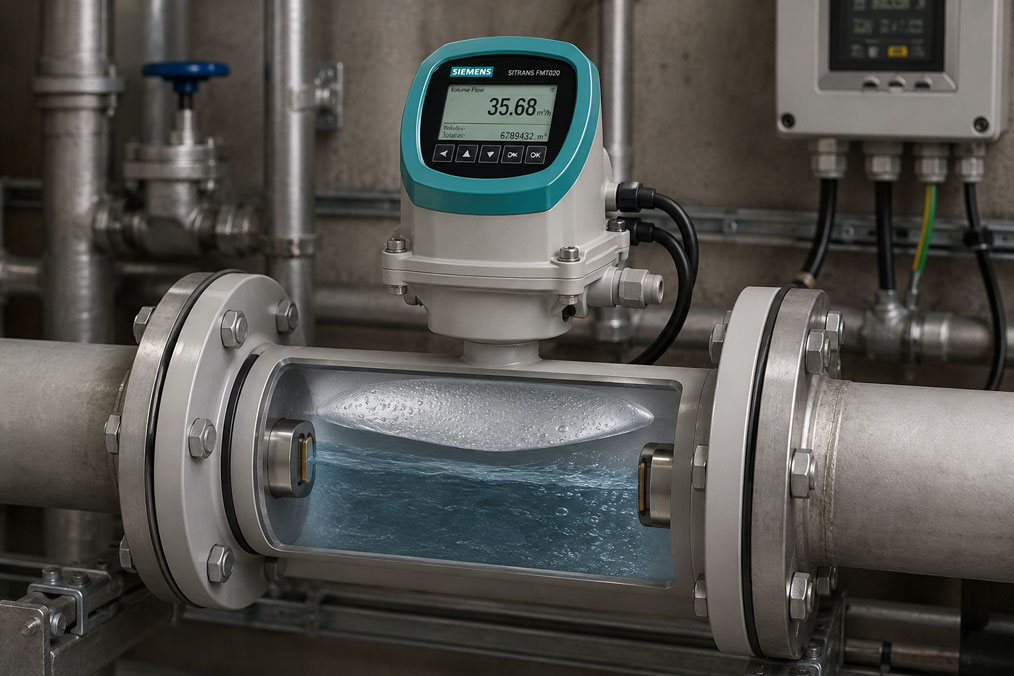
The tank is filled, the pump is running and, according to the plant operator, the pipeline is pressurised. Nevertheless, the SITRANS MAG reports “Empty Pipe”. The first suspicion often falls on the flowmeter itself. In many cases, however, the cause is not the transmitter but the measuring point itself.
An electromagnetic flowmeter requires more than just a completely filled pipeline. The measuring electrodes must maintain reliable contact with a sufficiently conductive medium and must be referenced to a defined electrical potential. Air pockets, partial filling, insulating deposits, very low conductivity or an unsuitable potential equalisation arrangement can therefore trigger an empty-pipe alarm even though liquid is present in the pipe.
For reliable troubleshooting, the empty-pipe threshold should therefore not be changed immediately. First, the filling condition, electrode contact, medium, grounding and wiring must be checked. Only then should the transmitter parameterisation be assessed.
Siemens solutions for electromagnetic flow measurement can be found under Siemens Flow Measurement. Further field instruments are grouped under Siemens Process Instrumentation.
Table of Contents
- How does a SITRANS MAG detect an empty pipe?
- Why does Empty Pipe appear even though liquid is present?
- Detecting partial filling and trapped air
- Checking electrode contact and deposits
- Considering the conductivity of the medium
- Correctly implementing grounding and potential equalisation
- Checking electrode cables and remote mounting
- Correctly interpreting diagnostic values
- Do not change the Empty-Pipe threshold too quickly
- Systematic troubleshooting
- Practical example from a water system
- Which SITRANS MAG components are suitable?
- Conclusion
- Frequently asked questions
a href=”#praxisbeispiel”>Practical example from a water system
How does a SITRANS MAG detect an empty pipe?
An electromagnetic flowmeter operates according to Faraday’s law of induction. Coils generate a magnetic field through the measuring tube. When an electrically conductive liquid moves through this field, a voltage is generated between the opposing measuring electrodes. This voltage is proportional to the average flow velocity.
For this principle to work reliably, the electrodes must be electrically connected to the medium. When the pipe is completely empty, this contact is missing. Modern transmitters can detect this condition through the electrical characteristics of the electrode circuit and derive an empty-pipe status from it.
The alarm therefore does not necessarily mean:
“There is no liquid anywhere in the entire pipeline.”
Rather, it means that the transmitter does not detect sufficiently plausible electrode contact with the medium at the measuring point.
This is precisely why apparently contradictory fault patterns can occur.
Why does Empty Pipe appear even though liquid is present?
Several different causes can look electrically similar to the transmitter. An air pocket at the electrodes can cause the same loss of electrode contact as a strongly insulating deposit. A medium close to the lower conductivity limit or an impaired potential equalisation arrangement can also influence the diagnosis.
| Observation | Probable Cause | First Check |
|---|---|---|
| Alarm only at low flow | Partial filling or air pocket | Check filling condition and pipe routing |
| Alarm after extended operation | Deposits on the electrodes | Inspect measuring tube and electrodes |
| Alarm only with a specific medium | Conductivity too low or fluctuating | Check conductivity of the medium |
| Alarm after modification of the pipeline | Potential equalisation or grounding changed | Check grounding connections and pipe material |
| Alarm after work on remote wiring | Electrode cable, shielding or moisture | Check cable and terminal compartment |
| Alarm directly after pump start | Air in the measuring tube | Check venting and installation position |
Troubleshooting should therefore always begin with the actual process condition, not with the electronics.
Detecting partial filling and trapped air
An electromagnetic flowmeter fundamentally requires a completely filled measuring tube for correct volumetric flow measurement.
Measuring points at hydraulic high points are particularly critical. Gas or air can accumulate there while the rest of the pipeline continues to carry liquid. From the outside, the system may appear completely filled, while the electrodes are temporarily exposed to air.
Similar situations occur in downward-sloping pipelines with a free outlet. If there is insufficient backpressure downstream of the flowmeter, the measuring tube can partially drain.
A typical symptom is a fault that depends strongly on the operating condition: at high pump output, the measurement works correctly, while at low flow the Empty-Pipe alarm suddenly appears.
During troubleshooting, particular attention should therefore be paid to pump condition, pipe routing and pressure conditions. If the sensor is installed at a high point, it should be checked whether air can accumulate there. In systems with strongly varying operating conditions, a venting option or a hydraulically more favourable measuring position may be required.
Even a filled pipeline can contain air bubbles. In wastewater, sludge or strongly aerated media, these bubbles can pass the electrodes during flow and temporarily influence the diagnosis.
Checking electrode contact and deposits
The measuring electrodes provide the electrical connection between the medium and the transmitter. Their surfaces should therefore remain in continuous contact with the process medium.
Heavy deposits are comparatively uncommon in water applications, but they can still occur with iron-containing water, limescale or biological growth. In wastewater and process applications, grease, sludge, fibres and chemical deposits may also occur.
A conductive deposit is not necessarily problematic. It becomes critical when an insulating layer forms between the electrode and the medium. The electrode impedance then increases and the transmitter may increasingly interpret the condition as a poorly wetted or dry electrode.
The development over time is therefore an important diagnostic indicator. If a measuring point works reliably after cleaning and the fault returns only after several weeks or months, this strongly indicates contamination or deposit formation.
If deposits occur repeatedly, cleaning alone is not sufficient. The medium, electrode material, flow velocity and installation conditions should also be assessed.
Considering the conductivity of the medium
Electromagnetic flowmeters require an electrically conductive medium. Water and wastewater normally fulfil this requirement without difficulty. Demineralised water, certain solvents or very weakly ionised process liquids can be more critical.
If the actual conductivity approaches the lower permissible limit of the measuring system, not only does the flow signal become more difficult to evaluate, but assessment of the electrode contact may also become less reliable.
An important question in the case of sporadic empty-pipe alarms is therefore:
Does the fault not occur with water but appear when another process medium is used?
If so, the actual conductivity of the medium under real process conditions should be checked and compared with the requirements of the sensor and transmitter being used.
A universal conductivity limit should not be assumed for all SITRANS MAG combinations. Sensor, transmitter, cable configuration and application must be considered together.
Correctly implementing grounding and potential equalisation
The measuring voltage generated by an electromagnetic flow sensor is very small. The measurement therefore requires a stable electrical reference potential between the medium and the measuring system.
This is a frequently underestimated source of faults.
With electrically conductive metal pipes, the required potential equalisation may already be established via the pipeline, depending on the sensor and installation. With plastic pipes, internally electrically insulated piping systems or certain flange configurations, additional grounding or medium contact may be necessary.
Depending on the SITRANS sensor, integrated grounding electrodes or separate grounding rings can be used for this purpose. The specified installation method of the particular sensor type is always decisive.
A fault can occur, for example, if an originally metallic pipe section is replaced by plastic and the previous electrical connection to the medium is lost. Mechanically, the system continues to operate as before, but electrically the flowmeter no longer has a clean reference potential.
Loose grounding wires, corroded connections or undefined potential differences between the pipeline and the sensor can also cause problems.
Grounding in this context should not be confused with the protective earth connection of the transmitter housing. For the measurement itself, the specified potential equalisation between medium, sensor and pipeline is particularly important.
Checking electrode cables and remote mounting
With compactly mounted instruments, sensor and transmitter are located directly together. With remote versions, however, coil and electrode signals are routed to the transmitter via separate cables.
The electrode signal in particular is sensitive. Damaged cables, moisture in the terminal compartment, contaminated terminals or incorrect shielding can alter the electrical conditions.
An important diagnostic question is therefore:
Did the fault appear for the first time after work on the sensor, transmitter or wiring?
If so, the terminal assignment, shield connections and cable condition should first be compared with the Siemens documentation for the relevant device generation.
A damaged electrode cable must not be replaced with an arbitrary instrumentation cable. The specified cable types and connection methods must be used for sensitive electrode circuits.
Correctly interpreting diagnostic values
With a SITRANS MAG, the displayed flow value should not be the only parameter considered. The transmitter provides additional diagnostic information that can be very helpful during troubleshooting.
With older systems using MAG 5000 or MAG 6000, the error log is particularly useful. The MAG 6000 has integrated empty-pipe detection and self-diagnostics. In newer systems with SITRANS FMT020, additional measurement and diagnostic information such as electrical conductivity is available.
However, an individual diagnostic value should never be assessed in isolation. The time-related correlation is often more informative:
Does the Empty-Pipe status increase at the same time as conductivity decreases? Does the alarm always appear after the pump stops? Or does it only occur after several weeks of operation?
By correlating these conditions, process, installation and contamination problems can be distinguished much more quickly.
Do not change the Empty-Pipe threshold too quickly
Many diagnostic functions have parameters or device-specific sensitivity settings.
A common mistake is to immediately reduce the sensitivity or completely disable the function when an empty-pipe alarm becomes disruptive.
This may make the message disappear, but not its cause.
If the measuring tube is actually partially empty, the flow measurement remains unreliable. If electrode contamination is present, the measuring point will continue to deteriorate. And if potential equalisation is missing, additional measurement errors can occur.
The threshold should therefore only be assessed after filling condition, medium, electrodes, grounding and wiring have been proven to be correct.
Systematic troubleshooting
| Step | Check | Assessment |
|---|---|---|
| 1 | Is the pipe really completely filled? | Check high points, free outlets and low system pressure |
| 2 | Is air or gas present in the medium? | Observe pump start, venting and process behaviour |
| 3 | Is conductivity sufficient? | Assess the medium under actual process conditions |
| 4 | Are the electrodes clean? | Check for deposits, insulation and damage |
| 5 | Is potential equalisation correct? | Check grounding electrodes, grounding rings and pipe material |
| 6 | Is the remote wiring in good condition? | Check electrode cable, shielding and moisture |
| 7 | Are diagnostics and parameterisation plausible? | Only now assess Empty-Pipe settings |
This sequence prevents a real process problem from merely being hidden by a parameter change.
Practical example from a water system
In a water treatment plant, an electromagnetic flowmeter sporadically reports “Empty Pipe”. According to the operating personnel, however, the pipeline is permanently filled with water.
During normal production, the measurement works reliably. The fault occurs mainly at night, when the flow rate is significantly reduced.
First, the electrodes and wiring are checked. Both are found to be in good condition. The conductivity of the water is also fully suitable for the application.
However, inspection of the pipe routing shows that the flowmeter is installed almost at the highest point of a horizontal pipe section. At low pump output, the line pressure drops considerably and air accumulates at exactly this location.
During the day, the higher flow largely carries the air away. During reduced night-time operation, however, a gas pocket forms in the upper section of the measuring tube.
The alarm was therefore correct: the pipeline was not completely empty, but the electrodes temporarily had no stable contact with the liquid.
After improving the venting and the hydraulic operating conditions, the alarm disappears without changing the Empty-Pipe sensitivity.
The example illustrates an important principle:
An empty-pipe alarm is not automatically an electronics fault. It can provide real information about the hydraulic conditions at the measuring point.
Which SITRANS MAG components are suitable?
SITRANS FMT020
The SITRANS FMT020 is the current transmitter generation and the successor to the widely used MAG 5000/6000 series.
In addition to volumetric flow and flow velocity measurement, it supports measurement of electrical conductivity as well as empty-pipe monitoring and device diagnostics. This is particularly useful for the troubleshooting described here because it makes it easier to distinguish between process conditions and electrode-related problems.
SITRANS FMS500
The SITRANS FMS500 is a current sensor solution for water and wastewater applications. Together with the FMT020, it forms the SITRANS FM520 system.
The sensor has integrated grounding electrodes. Depending on the installation, additional grounding rings may therefore be unnecessary. Nevertheless, the complete potential equalisation must be implemented according to the intended installation method.
SITRANS FM MAG 5000 and MAG 6000
MAG 5000 and MAG 6000 are still installed in many existing systems together with sensors such as MAG 5100 W, MAG 1100 or MAG 3100.
The MAG 6000 in particular provides extensive self-diagnostics, including empty-pipe detection and error logging. In the event of faults, the available diagnostics should therefore be fully evaluated before replacing the sensor or transmitter.
Under Siemens Flow Measurement, you will find suitable components and systems for electromagnetic flow measuring points.
ICS Schneider Messtechnik provides support in selecting, replacing and troubleshooting SITRANS MAG sensors and transmitters as well as in assessing grounding, measuring range, medium and installation conditions.
Conclusion
A SITRANS MAG “Empty Pipe” alarm does not necessarily mean that the entire pipeline is dry. The decisive factor is whether the measuring electrodes have a plausible electrical contact with the medium.
Partial filling and air pockets are particularly common causes. They often occur only under certain operating conditions and are therefore easily overlooked. Insulating electrode deposits, low conductivity or incorrect potential equalisation can also influence the Empty-Pipe diagnosis.
Grounding should be checked particularly carefully after modifications. If, for example, a metal pipe is replaced by plastic, the electrical conditions at the measuring point can change fundamentally.
With remote versions, the electrode cable is also part of the measuring chain. Moisture, incorrect cables or faulty shielding can therefore also play a role.
The most sensible diagnostic approach is to first check whether the pipe is really full, then inspect the medium and electrodes, afterwards assess grounding and wiring, and only change the parameterisation at the end.
This prevents a real process or installation fault from merely being concealed by a less sensitive alarm threshold.
Frequently asked questions about the SITRANS MAG Empty-Pipe alarm
Why does the SITRANS MAG report an empty pipe even though water is present?
The measuring tube may be partially filled or an air pocket may be present at the electrodes. Electrode deposits, low conductivity or unsuitable potential equalisation can also influence the diagnosis.
Can air in the pipe trigger an Empty-Pipe alarm?
Yes. If air is directly present at a measuring electrode, the required electrical contact with the medium can be lost.
Can contamination of the electrodes behave like an empty pipe?
Yes. Insulating deposits in particular can impair the electrical coupling between the electrode and the medium.
What role does conductivity play?
Electromagnetic flowmeters require a sufficiently conductive medium. At very low conductivity, both flow measurement and electrode monitoring can become more difficult.
Does a SITRANS MAG always require grounding rings?
No. This depends on the sensor type and the pipe installation. Some sensors have integrated grounding electrodes. In other applications, grounding rings or additional potential equalisation measures may be required.
Why does the fault occur only at low pump output?
At low pressure or low flow, the measuring tube may partially drain or air may accumulate at a hydraulic high point.
Should I simply disable the Empty-Pipe function?
Not before the cause has been clarified. A disabled alarm can conceal an actually partially filled or electrically problematic measuring point.
What should be checked after work on the pipeline?
In addition to the filling condition, particular attention should be paid to whether the pipe material, grounding, potential equalisation or installation position has changed.
What is the current successor to MAG 5000 and MAG 6000?
For modernisation projects and new systems, the SITRANS FMT020 is available as the current transmitter generation.