


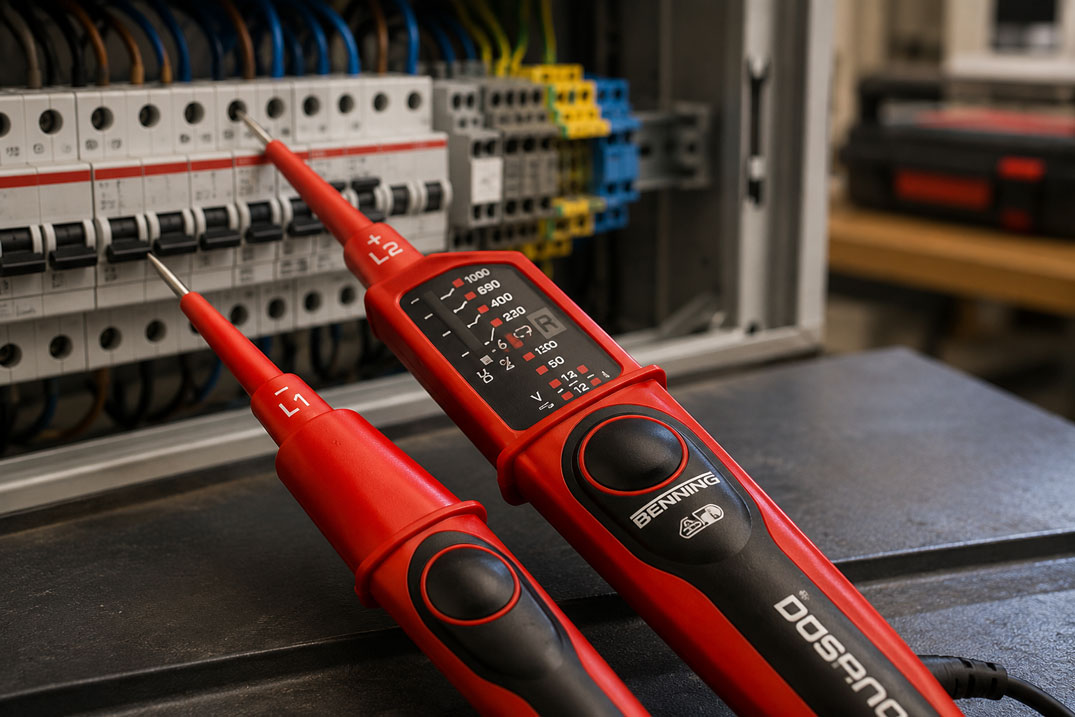
In electrical installations, it repeatedly happens that a measuring device displays a voltage even though no load is working or the cable has actually been disconnected. This is often referred to as phantom voltage, induced voltage or stray voltage.
For qualified electricians, this situation is particularly critical: Is the voltage actually dangerous and loadable, or is the measuring device only displaying a high-impedance voltage induced capacitively or inductively? Incorrect assessment can lead to dangerous wrong decisions.
This article explains how phantom voltages occur, why multimeters and simple voltage testers can lead to misinterpretations and why a 2-pole voltage tester with load switching is the better choice in many applications.
You can find an overview of suitable devices in our category
Voltage testers / meter start-up testers.
Table of contents
- What is phantom voltage?
- Why does phantom voltage occur in electrical installations?
- Typical fault patterns in practice
- Why multimeters can display phantom voltages
- Why a 2-pole voltage tester is useful
- What does load switching do?
- Correctly assessing load switching and RCD tripping
- Safe procedure for unclear voltage indication
- Typical applications in electrical installation and industry
- Which voltage testers are suitable?
- Practical examples from everyday work
- Checklist for assessing phantom voltage
- Conclusion
- FAQ: Frequently asked questions about phantom voltage and load switching
What is phantom voltage?
Phantom voltage is a voltage displayed by a measuring device even though it is not loadable or only very limitedly loadable. In practice, the terms induced voltage, capacitive coupling, inductive coupling or stray voltage are also used.
A phantom voltage is not necessarily caused by an active power supply in the circuit being tested. It can arise, for example, from neighboring live cables, long parallel cable runs, open conductors or capacitive coupling.
| Term | Meaning | Practical assessment |
|---|---|---|
| Phantom voltage | Apparent voltage without sufficient load capacity | Can cause measuring devices to indicate voltage although no usable circuit is present. |
| Induced voltage | Voltage is transferred by neighboring conductors | Common with long or parallel cable runs. |
| Capacitive coupling | Electric field couples voltage into a cable | Typical with long cable runs and high-impedance measurement. |
| Inductive coupling | Magnetic field influences neighboring conductors | Can occur with load currents, motor cables or parallel cable routes. |
| Loadable voltage | Voltage can supply current under load | Particularly relevant for safety assessment. |
Important: A displayed voltage must never be ignored too quickly. First, it must be safely checked whether a dangerous voltage is actually present or whether it is a non-loadable phantom voltage.
Why does phantom voltage occur in electrical installations?
Phantom voltages occur particularly often where cables are routed in parallel over longer distances. Electrical coupling exists between the conductors. As a result, a disconnected or open conductor can pick up a voltage even though it is not directly connected to an active voltage source.
The longer the cables are and the higher the input impedance of the measuring device, the more likely such a voltage becomes visible. Control cabinet wiring, control cables, installation cables, cable ducts, frequency converter cables or unconnected conductors can also be affected.
- Parallel cable routing: Live and disconnected conductors run next to each other over longer distances.
- Open conductors: Unconnected conductors can pick up voltage.
- Long cable runs: The longer the cable, the stronger the coupling effect can be.
- High-impedance measurement: A multimeter hardly loads the circuit and also displays very small voltages.
- Control and signal cables: In machines and control cabinets, different circuits can be located very close to each other.
- Backfeed: In modern installations, additional voltage sources or feedback effects can occur.
| Cause | Typical environment | Possible effect |
|---|---|---|
| Cables routed in parallel in cable duct | Building installation, industrial plant, mechanical engineering | Disconnected cable still shows voltage. |
| Open or unused conductor | Junction box, control cabinet, terminal box | Measuring device shows implausible voltage against N or PE. |
| High-impedance multimeter | Service, troubleshooting, maintenance | Voltage is displayed although no load can be operated. |
| Control cable next to power cable | Machines, pumps, conveyor technology | Interference voltages or measurement uncertainty can occur. |
| Frequency converter or motor cable | Drive technology, industry, plant engineering | Interference can influence measured values. |
Typical fault patterns in practice
Phantom voltages usually become noticeable when measured value and system behavior do not match. The measuring device shows a voltage, but a load does not work. Or a disconnected cable continues to show a voltage value although the circuit has actually been isolated.
| Fault pattern | Possible cause | Assessment |
|---|---|---|
| Multimeter shows 80 V, but load does not run | High-impedance or induced voltage | Test with 2-pole voltage tester and suitable load. |
| Disconnected cable still shows voltage | Capacitive coupling from neighboring cable | Systematically check conductor assignment and disconnection. |
| Different measuring devices show different values | Different input impedance of the devices | Consider measuring principle and circuit loading. |
| Voltage immediately collapses under load | Non-loadable phantom voltage | No usable supply, but still perform safety test properly. |
| Control cable shows unexpected voltage | External voltage, backfeed or coupling | Do not prematurely assess as harmless; clarify the cause. |
It is particularly important to distinguish between phantom voltage and real external voltage. External voltage can definitely be dangerous and loadable. Therefore, every unclear indication must first be taken seriously from a safety perspective.
Why multimeters can display phantom voltages
Many digital multimeters have a high input impedance. This is very useful for precise measurements because the measuring circuit is hardly loaded. However, exactly this property can lead to confusion when troubleshooting electrical installations.
A high-impedance measuring device can display an induced voltage even though this voltage would immediately collapse under a small load. This creates the impression that a cable is still actively supplied, even though no loadable voltage is present.
| Measuring device | Typical behavior | Risk with phantom voltage |
|---|---|---|
| Digital multimeter | Very high-impedance and accurate voltage measurement | Can clearly display induced voltages. |
| Single-pole phase tester | Reacts to phase or electric field | No safe statement about loadable voltage. |
| Non-contact voltage tester | Detects electric fields without contact | Can be influenced by cable routing and environment. |
| 2-pole voltage tester | Tests between two defined points | Significantly more suitable assessment in practice. |
| 2-pole voltage tester with load switching | Additionally loads the circuit | Helps to better identify non-loadable voltages. |
A multimeter remains important for many measuring tasks. However, for the practical safety assessment of an unclear voltage indication, a suitable 2-pole voltage tester with load switching is often more appropriate.
Why a 2-pole voltage tester is useful
A 2-pole voltage tester measures directly between two defined points, for example between phase conductor and neutral conductor, phase conductor and protective conductor or between two phase conductors. This provides a much clearer statement than a single-pole or non-contact test.
With phantom voltages, it is particularly important that the test device suits the application. A suitable 2-pole voltage tester can help distinguish between real voltage, induced voltage and unclear conditions.
- Clear measuring points: Testing is carried out between two defined points.
- Practical indication: Many devices clearly display voltage levels or specific measured values.
- Robust design: Voltage testers are designed for everyday use in electrical installation and industry.
- Additional functions: Depending on the device, continuity testing, phase rotation indication or measuring point illumination are available.
- Load switching: With suitable devices, the circuit can be deliberately loaded.
2-pole voltage testers such as the
DUSPOL® analog,
the
DUSPOL® expert
or the
DUSPOL® digital
are particularly relevant for such testing tasks in electrical trade and industry.
What does load switching do?
Load switching is a function in which the voltage tester additionally loads the circuit being tested. This can cause a non-loadable phantom voltage to collapse, while a real power supply continues to be indicated.
This is particularly helpful if a high-impedance measuring device previously displayed a voltage whose cause was unclear. Load switching makes it easier to assess whether a voltage is actually loadable or only caused by coupling.
| Without load switching | With load switching | Practical significance |
|---|---|---|
| High-impedance voltage may be displayed | Non-loadable voltage often collapses | Phantom voltage can be identified more easily. |
| Induced voltage remains visible | Voltage is assessed under load | Measured value becomes more practical. |
| Unclear statement with open cables | Better distinction between real and apparent voltage | Helps with troubleshooting and safety assessment. |
| Multimeter may show residual voltage | 2-pole tester assesses the voltage under greater load | Misinterpretations are reduced. |
Devices such as the
DUSPOL® analog
offer load switching with vibration alarm. The
HT7
and the
HT10
are also examples of digital 2-pole voltage testers with load switching.
Correctly assessing load switching and RCD tripping
Some 2-pole voltage testers also enable deliberate tripping of a 30 mA RCD via load switching. This function can be helpful in certain situations, but it must be assessed correctly.
Important: Deliberate RCD tripping with a voltage tester does not replace a complete RCD test with a suitable installation tester. It only shows a functional response and is not equivalent to a standard-compliant test of tripping time, tripping current and protective measure.
| Function | Benefit | Limit |
|---|---|---|
| Load switching | Helps assess induced voltages | Must be used appropriately for the installation and measuring situation. |
| Deliberate RCD tripping | Can show a response of the RCD | Does not replace a complete RCD test. |
| RCD test with installation tester | Tests protective measure with defined test parameters | Requires suitable test device and professional execution. |
| Voltage testing | Clarifies whether voltage is present between two points | Is not automatically a protective measure test. |
Load switching should therefore be used deliberately. Above all, it must be clear what effect it can have in the respective installation and whether protective devices, control systems or connected loads may be affected.
Safe procedure for unclear voltage indication
An unclear voltage indication must not be prematurely assessed as harmless. First, it must always be assumed that a dangerous voltage may be present. Only through structured testing can the cause be narrowed down more reliably.
Basic procedure
- Secure the work situation: Do not continue working as long as the voltage indication is unclear.
- Check the test device: Visually inspect the device, leads and test probes.
- Check function on a known voltage: Ensure that the test device works correctly.
- Measure with 2 poles: Test between all relevant conductors and reference points.
- Compare measured values: Assess different conductor combinations and measuring points.
- Use load switching deliberately: Only if device, installation and situation are suitable for it.
- Document the cause: Especially during maintenance, servicing and recurring faults.
| Test step | Why important? | Typical mistake |
|---|---|---|
| Take indication seriously | Real external voltage is also possible | Measured value is prematurely dismissed as phantom voltage |
| Test 2-pole at defined points | This is the only way to obtain a clear statement | Only single-pole or non-contact preliminary testing is used |
| Test between L-N, L-PE and N-PE | Neutral conductor or protective conductor problems can be detected | Only one conductor combination is tested |
| Assess load switching | Helps with non-loadable voltages | Function is used without knowledge of the installation |
| Check device again after measurement | Device failure during testing is detected | Final check is omitted |
Work on electrical installations may only be carried out by qualified persons. Company safety rules and applicable electrical standards must always be observed.
Typical applications in electrical installation and industry
Phantom voltages and induced voltages occur in many areas. They are particularly common with long cable runs, complex control cabinets, control cables, industrial plants and buildings with many circuits routed in parallel.
| Application | Typical problem | Suitable test strategy |
|---|---|---|
| Building installation | Disconnected cable still shows voltage | Test with 2 poles and assess load switching. |
| Control cabinet construction | Control cables show unclear voltages | Check conductor assignment, external voltage and coupling. |
| Machine service | Backfeed or residual voltages from drives | Systematically check measuring points and observe manufacturer instructions. |
| Industrial plant | Parallel power cables influence measured values | Use robust 2-pole voltage tester. |
| Energy supply | Interference voltages or unclear mains conditions | Use suitable test device with appropriate measurement category. |
For demanding applications in industry and energy technology, digital voltage testers such as the
MULTISAFE DSP4
or the
MULTISAFE DSP5
can be a suitable solution.
Which voltage testers are suitable?
The right choice depends on whether the main focus is classic voltage testing, load switching, digital display, robust industrial design, meter start-up test or additional functions such as phase rotation indication and continuity testing.
| Product | Especially relevant for | Note |
|---|---|---|
| DUSPOL® analog | Robust 2-pole voltage testing with load switching | Particularly interesting when induced voltages need to be assessed by deliberate load switching. |
| DUSPOL® expert | Electrical trade and industry with additional functions | Combines safe voltage testing with functions such as continuity testing, measuring point illumination and cable break detector. |
| DUSPOL® digital | Digital voltage testing with accurate display | Useful when frequency, resistance or diode testing are additionally relevant. |
| HT7 | Digital voltage testing up to 690 V AC/DC with load switching | Suitable when LCD display, illumination and load switching are desired. |
| HT10 | 2-pole voltage testing up to 1000 V AC/DC with load switching | Relevant for applications where a larger voltage range and CAT IV suitability are required. |
| C.A 771 | Phantom voltage detection, self-test and robust voltage testing | Interesting when unclear voltage indications and high safety requirements are the focus. |
| PRÜFBALL ZAP350L / ZAP1050L | Meter start-up test and detection of interference voltages | Particularly relevant for energy suppliers, grid operation and meter applications. |
| MULTISAFE DSP4 | Digital voltage testing in industry and energy technology | Suitable when robust design and precise display are to be combined. |
You can find a complete overview in the category
Voltage testers / meter start-up testers.
Practical examples from everyday work
Example 1: Disconnected cable still shows voltage
A cable was disconnected in the distribution board. When tested with a multimeter, around 70 V are still displayed. However, a load cannot be operated. The cause may be capacitive coupling from cables routed in parallel. With a suitable 2-pole voltage tester and load switching, it can be better assessed whether the voltage is loadable.
Example 2: Different measuring devices show different values
A digital multimeter displays a voltage, while a 2-pole voltage tester does not indicate dangerous voltage. The difference can be caused by different input impedances. It is important not only to look at the numerical value, but also to assess the measuring method and the loadability of the voltage.
Example 3: Control cable in the control cabinet shows unclear voltage
In a control cabinet, a voltage is measured on an open control cable. Coupling, backfeed or real external voltage are possible. Here, testing should be carried out systematically between all relevant reference points and the wiring should be traced. A premature assumption of harmless phantom voltage would be risky.
Example 4: Meter start-up and interference voltage in grid operation
When working on meter positions or in energy supply, interference voltages and unclear indications can occur. A robust voltage tester with load switching and meter start-up test such as the
PRÜFBALL ZAP350L / ZAP1050L
can be a suitable solution in such applications.
Example 5: Long cable runs in an industrial plant
In an industrial plant, power cables and control cables run over longer distances in the same cable route. During maintenance work, unclear voltages are displayed on disconnected cables. Here, structured 2-pole testing with a suitable voltage tester is important in order to distinguish between coupling, backfeed and real voltage.
Checklist for assessing phantom voltage
This checklist can be used to assess an unclear voltage indication in a structured way.
| Check question | Why important? | Assessment |
|---|---|---|
| Was the indication first treated as a possible hazard? | Real external voltage can be dangerous. | Do not prematurely dismiss it as phantom voltage. |
| Was testing carried out with 2 poles between defined measuring points? | Only two clear measuring points provide a reliable statement. | Test L-N, L-PE, N-PE and relevant phase conductors. |
| Was a high-impedance multimeter used? | High-impedance devices can display induced voltages. | Consider measuring method and input impedance. |
| Are there cables routed in parallel? | They can cause capacitive or inductive coupling. | Check cable route and cable routing. |
| Is the voltage loadable? | Phantom voltage often collapses under load. | Use suitable voltage tester with load switching. |
| Could backfeed be present? | Backfeed can cause real dangerous voltage. | Check UPS, PV, control circuits, frequency converters and external supply. |
| Was the test device checked before and after testing? | Device faults can lead to incorrect assessment. | Check function on a known voltage. |
| Is the test device suitable for measurement category and voltage? | Incorrect device category can be dangerous. | Observe data sheet, CAT category and voltage range. |
Conclusion: Detect phantom voltage safely and do not misinterpret it
Phantom voltages are a common practical problem in electrical installations. They occur due to capacitive or inductive coupling, long cable runs, open conductors or parallel cable routing. High-impedance multimeters in particular can display such voltages even though they are not loadable.
Nevertheless, an unclear voltage indication must never be ignored too quickly. First, it must always be safely checked whether a real and dangerous voltage is present. A suitable 2-pole voltage tester with load switching helps to better identify induced and non-loadable voltages.
For electrical installation, industry, control cabinet construction and energy supply, robust 2-pole voltage testers such as
DUSPOL® analog,
DUSPOL® expert,
DUSPOL® digital,
HT10
or
C.A 771
are therefore a useful solution.
You can find a suitable preselection in our category
Voltage testers / meter start-up testers.
FAQ: Frequently asked questions about phantom voltage and load switching
What is phantom voltage?
A phantom voltage is a displayed voltage that is not loadable or only very limitedly loadable. It can arise, for example, through capacitive or inductive coupling in long or parallel cable runs.
Is phantom voltage dangerous?
A pure phantom voltage is usually not loadable. Nevertheless, a displayed voltage must never be assessed as harmless too quickly, as real external voltage or backfeed may also be present.
Why does my multimeter show voltage although the cable is disconnected?
Many multimeters measure with very high input impedance. This means they can display induced voltages that would immediately collapse under load. A suitable 2-pole voltage tester should be used for assessment.
What does load switching on a voltage tester do?
Load switching additionally loads the circuit being tested. Non-loadable phantom voltages often collapse as a result, while a real power supply continues to be indicated.
Why is a 2-pole voltage tester better suited?
A 2-pole voltage tester tests between two defined points. This makes the statement significantly clearer than with a single-pole or non-contact test.
Can a voltage tester with load switching trip an RCD?
Some voltage testers can deliberately trip a 30 mA RCD via load switching. However, this function does not replace a complete RCD test with a suitable installation tester.
How do I distinguish phantom voltage from real voltage?
The decisive factor is whether the voltage is loadable and whether it remains present under load. A suitable 2-pole voltage tester with load switching can help make this distinction more reliably.
Can an apparent phantom voltage also be backfeed?
Yes. Especially in modern installations with UPS systems, PV systems, frequency converters, control circuits or external supplies, real backfeed can be present. Therefore, the cause must always be checked systematically.
Which voltage tester is suitable for phantom voltages?
Suitable devices are 2-pole voltage testers with an appropriate voltage range, measurement category and, depending on the application, load switching. Examples are
DUSPOL® analog,
DUSPOL® expert,
DUSPOL® digital,
HT10
or
C.A 771.
Where can I find suitable voltage testers?
You can find an overview in the category
Voltage testers / meter start-up testers. There you will find various 2-pole voltage testers, devices with load switching, robust test devices and meter start-up testers.