


Temperature data loggers for the cold chain and storage: Reliably documenting limit values
Temperature-sensitive foods, pharmaceuticals, laboratory samples, chemicals and technical products often have to be stored within a narrowly defined temperature range during storage and transport. Even a temporary deviation can impair shelf life, effectiveness, quality or usability.
However, a single temperature measurement during goods receipt only shows the condition at that specific moment. It does not reveal whether the temperature was outside the permissible range during the night, during a power failure, while a door was open, during transshipment or over the course of a multi-day transport.
Temperature data loggers automatically record measured values at defined intervals and store them together with the date and time. This creates a traceable temperature profile from which limit-value violations, the duration and timing of a deviation and possible correlations with operational events can be identified.
For reliable documentation, however, it is not sufficient to place just any logger in a refrigerator or transport box. The measuring range, accuracy, response time, measuring interval, memory capacity, sensor position, alarm limits and evaluation software must be suitable for the application.
It is equally important to distinguish between air temperature and product temperature. A logger positioned in the airflow reacts quickly when a door is opened, while the temperature of the stored goods often rises much more slowly. Conversely, an unfavourably positioned logger may display stable values even though a critical warm zone has already developed elsewhere in the storage area.
This article explains how temperature data loggers for cold chains, refrigerators, cold stores, storage rooms and transport should be selected, positioned, configured and evaluated. It also explains the significance of EN 12830, HACCP, GDP, calibration and electronic reports depending on the application.
Table of contents
- Why continuous temperature recording is required
- What is meant by an uninterrupted cold chain
- Which information is required before selection
- Distinguishing between air temperature and product temperature
- Measuring range and permissible operating temperature
- Accuracy, resolution and measurement uncertainty
- Internal or external temperature sensor?
- Correctly assessing the response time of the logger
- Positioning data loggers in refrigerators and storage rooms
- Temperature mapping and routine monitoring
- Using loggers in packaging, vehicles and transport containers
- Defining the appropriate measuring interval
- Limit values, alarm delays and alarm events
- Calculating memory capacity and recording duration
- Battery life and data security
- Display, LED alarm and direct checking
- Reading out measured data and creating reports
- Data integrity, timestamps and traceability
- Correctly interpreting EN 12830
- HACCP and temperature monitoring
- GDP, GxP and 21 CFR Part 11 in pharmaceutical applications
- Calibration and regular functional testing
- What to do in the event of a limit-value violation
- Typical errors in temperature recording
- Practical example: Recurring temperature peaks in a cold store
- Selection guide for typical applications
- Which measuring instruments / products are suitable?
- Conclusion
- Frequently asked questions about temperature data loggers
Why continuous temperature recording is required
A conventional thermometer displays the current temperature value. A min./max. thermometer additionally stores the lowest and highest value since it was last reset. However, neither device provides complete information about when a deviation occurred and how long it lasted.
A data logger, by contrast, stores a chronologically ordered series of measurements. This makes it possible to distinguish, for example, whether a refrigerator was too warm for two minutes while goods were being removed or whether the temperature remained above the permissible limit for several hours.
This distinction is crucial for quality assessment. Many temperature-sensitive products do not react solely to reaching a certain value, but to the combination of temperature and exposure time.
A documented time series also supports troubleshooting. If temperature increases occur at the same time every day, possible causes include door openings, defrost cycles, cleaning work or the storage of new goods. Irregular and prolonged deviations, on the other hand, are more likely to indicate a technical fault, power failure or insufficient cooling capacity.
Recording therefore serves not only as retrospective evidence. It also supports preventive maintenance, process optimisation and the assessment of refrigeration equipment, packaging and transport routes.
What is meant by an uninterrupted cold chain
The cold chain includes all process steps during which goods are manufactured, temporarily stored, transported, transshipped and handed over to the recipient under defined temperature conditions.
A typical supply chain may include the production warehouse, order-picking area, loading bay, transport vehicle, distribution warehouse, recipient and finally a refrigerator. Every transfer point can represent a thermal weak point.
Areas in which actively refrigerated rooms are left are particularly critical. These include open cold-store doors, unrefrigerated loading zones, parked pallets, temporary storage in transport depots or delivery vehicles during longer stops.
A temperature data logger documents only the location where it is positioned. A logger inside a cold store therefore does not automatically confirm the temperature of goods that had previously been left unrefrigerated on a loading ramp for several hours.
For uninterrupted monitoring, it must therefore be defined whether the logger is intended to monitor a storage room, an individual shipment, a pallet, a transport container or the climate inside the vehicle.
For particularly critical products, a combination may be appropriate: stationary loggers in the warehouse, transport loggers in selected shipments and additional spot measurements during goods receipt and dispatch.
Which information is required before selection
The description “temperature data logger for a refrigerator” is still too imprecise for technical selection. A refrigerator for food products has different requirements from a pharmaceutical refrigerator, a deep-freeze warehouse or a transport container with dry ice.
At least the following points should be clarified before selecting the instrument:
- product to be monitored and permissible temperature range
- stationary storage or transport
- ambient, air, surface or product temperature
- lowest and highest possible temperature
- required accuracy and resolution
- required measuring interval
- duration of a typical recording
- limit values and required alarm delays
- internal or external sensor
- degree of protection and possible exposure to moisture or cleaning
- display, LED indication or remote alarm
- USB, Bluetooth, NFC, wireless or cloud-based evaluation
- required report format
- calibration and certificate requirements
- EN 12830, HACCP, GDP, GxP or other requirements
The number of measuring points is also important. A small pharmaceutical refrigerator may potentially be monitored with one routine logger. A large high-bay warehouse, by contrast, normally requires several measuring points whose positions are derived from temperature mapping.
Distinguishing between air temperature and product temperature
Most compact data loggers initially measure the temperature of the surrounding air. This reacts quickly to open doors, cooling activity, defrost cycles or newly stored warm goods.
The product temperature generally changes more slowly. A bottle, a densely packed box or a complete pallet has a significantly greater thermal mass than the surrounding air.
A brief increase in air temperature therefore does not automatically mean that the product has reached the same value. Conversely, a product that has already warmed up may remain too warm for a long time even though the air temperature quickly returns to the permissible range after storage.
For a meaningful assessment, it must therefore be clear which measured variable is to be documented:
- The air temperature describes the performance and climate of the storage or transport area.
- The surface temperature provides information about the condition of packaging or goods.
- The core temperature describes the temperature inside a product, but often requires a penetration or simulation probe.
- A product simulation uses a thermally inert medium to reproduce the response behaviour of a typical product.
During routine monitoring, air temperature is frequently measured because deviations and technical faults become visible quickly. For the release of specific goods after a temperature deviation, an additional product-related assessment may be required.
A logger must therefore not automatically be equated with product release without further assessment. The decisive factors are the product specification, stability data, duration of the deviation and, where applicable, the actual product temperature.
Measuring range and permissible operating temperature
The measuring range must cover all temperatures that may occur during normal operation, cleaning, defrosting, transport and possible fault conditions.
For a refrigerator with a target range of 2 to 8 °C, a logger with a considerably wider range, for example from −20 or −30 °C to +70 °C, is often sufficient from a metrological perspective. This means that major faults and temporary storage conditions can also be recorded.
For deep-freeze rooms, the lower limit must be sufficiently low. A data logger specified only down to −20 °C is not suitable for an environment at −25 °C, even if its display still shows a value there.
Temperatures close to −80 °C may occur during transport with dry ice. A sensor technology specifically designed for this purpose is required. A standard cold-store logger must not be placed in dry-ice packaging merely because of its compact design.
The measuring range and operating temperature of the complete logger must be distinguished from each other. An external probe may be capable of measuring down to −100 °C, while the logger housing itself may only be operated at significantly higher temperatures.
In such cases, the instrument remains outside the extreme temperature zone and only the external probe is routed into the measuring area.
Accuracy, resolution and measurement uncertainty
The resolution specifies the increments in which a measured value is displayed or stored. A resolution of 0.1 °C does not automatically mean an accuracy of ±0.1 °C.
Accuracy describes the permissible deviation of the logger under defined conditions. Depending on the instrument, it may be the same across the complete measuring range or vary between different temperature ranges.
For monitoring between 2 and 8 °C, the accuracy should be assessed specifically in this range. A good specification at room temperature is of little value if the deviation is significantly larger in the actual refrigeration range.
In addition to the instrument specification, the overall assessment includes other influences:
- calibration deviation of the sensor
- resolution and rounding
- positioning within the storage room
- response time of the probe
- temperature gradients within the room
- self-heating or heat conduction through the housing
- ageing and long-term drift
Limit values should therefore not be configured as though the measurement were completely error-free. The permissible measurement uncertainty and the operational response strategy must be taken into account when defining pre-alarm and main-alarm limits.
Internal or external temperature sensor?
A data logger with an internal sensor is compact and easy to position. However, it measures the temperature at the housing and reacts depending on the thermal mass of the housing and the air movement.
An internal sensor is often sufficient for general monitoring of the ambient air in a refrigerator, cold room or storage area.
An external probe offers advantages when:
- measurements are required at a difficult-to-access location
- the logger housing must remain outside the refrigerated area
- a product simulation or core-temperature measurement is planned
- two different measuring points are required simultaneously
- the temperature lies outside the permissible range of the housing
The cable of the external probe must not be routed through a refrigerator door in a manner that keeps the seal permanently open. Even a small gap can result in additional heat input, icing and a distorted temperature profile.
Suitable cable feedthroughs should be used when routing cables through walls or doors. The probe must also be secured against accidental removal and mechanical damage.
A two-channel logger can simultaneously record the rapidly changing air temperature and a slower product simulation. This makes it easier to determine whether a short-term air-temperature deviation actually affected the stored product.
Correctly assessing the response time of the logger
The response time describes how quickly the sensor follows a temperature change. A t90 value is frequently specified. This describes the time after which the sensor has reached 90 percent of a defined temperature change.
The response time does not depend solely on the sensor. Air velocity, installation, housing, protective cap and the surrounding medium also influence the result.
An exposed sensor in an airflow responds faster than a logger positioned between densely packed boxes. A probe in a liquid responds differently from an identical probe in still air.
A very fast response is not advantageous in every application. A fast air probe clearly records every brief door opening. For assessing the product temperature, a slower simulation probe may be more appropriate.
The measuring objective must therefore be defined before selection. Rapid detection of technical faults and the most realistic possible simulation of the product temperature are two different tasks.
Positioning data loggers in refrigerators and storage rooms
The position of the logger frequently has a greater influence on the reliability of the results than a small difference in instrument accuracy.
A logger positioned directly in front of the evaporator or cold-air outlet may measure considerably lower temperatures than the goods. An instrument placed immediately next to the door, on the other hand, reacts particularly strongly to every opening event.
Other unsuitable positions may include:
- directly on a cold or warm wall surface
- in the immediate vicinity of a heater or lighting
- in direct sunlight
- at a location with insufficient air circulation
- behind a densely stacked pallet
- immediately next to newly introduced warm goods
For small refrigerators, the routine sensor should be installed at a position representative of the stored products. It must not be left loose on a shelf where it can be moved during loading.
In larger storage rooms, the position should be derived from a spatial assessment of the temperature distribution. Particular attention should be paid to doors, ceiling areas, floor level, refrigeration units, external walls and areas with poor air circulation.
A position at the suspected warmest point is often appropriate for alarm purposes. Depending on the risk assessment, an additional measuring point at the coldest location may be necessary if freezing or frost damage must be prevented.
Temperature mapping and routine monitoring
Temperature mapping examines the spatial temperature distribution within a storage area. Several loggers are operated simultaneously at defined positions for this purpose.
The aim is to identify warm and cold zones, temperature differences between upper and lower areas and the influence of doors, refrigeration systems and loading.
Mapping should be performed under conditions representative of subsequent operation. Depending on the application, measurements may be required in both empty and loaded conditions, during summer and winter conditions or during typical operating processes.
The results are used to determine, among other things:
- permissible and unsuitable storage areas
- positions of the permanent monitoring sensors
- required alarm limits
- influence of door openings and defrost cycles
- possible improvements to air distribution
Mapping is not the same as subsequent routine monitoring. During mapping, many measuring points are used over a limited period. During normal operation, selected loggers then continuously monitor the relevant locations.
After major changes to the refrigeration system, storage layout, airflow or use, a new mapping exercise may be necessary. Recurring unexplained deviations may also justify a new spatial assessment.
Using loggers in packaging, vehicles and transport containers
For transport applications, it must first be decided whether the climate inside the vehicle or the specific shipment is to be monitored.
A permanently installed vehicle logger displays the air temperature inside the cargo area. However, it does not automatically document the conditions inside insulated packaging or at the centre of a pallet.
A shipment logger is packed with the goods and accompanies them to the recipient. This means that the recording can be assigned directly to the relevant delivery.
The position inside the packaging should be defined reproducibly. A logger placed directly on a cold pack or dry ice may measure significantly lower local temperatures than the goods. A device positioned directly against the outer wall reacts more strongly to the environment than a logger at the centre of the packaging.
For large pallets or containers, a single logger cannot record all possible temperature zones. Depending on the risk assessment, several instruments may be required at different positions.
A start delay is frequently useful for transport applications. It prevents an unintended alarm from being triggered while the shipment is still being prepared or before final packaging.
At the destination, the recipient should be able to determine from a clear indication whether a limit value was violated. For the subsequent assessment, the time, duration and temperature level of the deviation are required from the complete report.
Defining the appropriate measuring interval
The measuring interval determines how often a measured value is stored. An interval that is too long may miss brief but relevant temperature events. An unnecessarily short interval, on the other hand, creates large data volumes and, depending on the instrument, reduces battery life and the possible recording duration.
For a stable storage room, an interval of several minutes may be sufficient. Shorter intervals may be required where doors are opened frequently, in small transport packaging or where temperature changes occur rapidly.
The following must be considered when defining the interval:
- thermal speed of the process
- permissible duration of a deviation
- response time of the sensor
- memory capacity of the instrument
- battery life
- evaluation and documentation requirements
A measuring interval of one minute offers no advantage if the sensor, because of its housing, only responds substantially to a temperature change after 20 or 30 minutes.
Conversely, a fast-response probe with an interval of one hour may completely miss several relevant events.
The measuring interval should therefore be treated as part of the complete measuring chain and not considered independently of the sensor and application.
Limit values, alarm delays and alarm events
Many data loggers allow a lower and upper limit value to be entered. If either value is exceeded, the instrument stores an alarm event or indicates it via the display or an LED.
The alarm limit must correspond to the product specification. It must not be derived solely from a general refrigerator setpoint.
An alarm delay is useful in many applications. A brief door opening can temporarily increase the air temperature without endangering the goods. An alarm without a delay would frequently be triggered unnecessarily in such cases.
An excessively long delay, on the other hand, may conceal an actual fault. The permissible duration must be derived from the product, storage room, thermal inertia and risk assessment.
Depending on the system, different alarm levels may be configured:
- pre-alarm for early intervention
- main alarm in the event of an actual limit-value violation
- time-delayed alarm after a defined duration
- alarm in the event of an instrument fault, sensor break or low battery
An alarm is only effective if a defined response follows. It must be specified who receives the notification, which immediate measures are taken and how the affected goods are labelled or quarantined.
Calculating memory capacity and recording duration
The possible recording duration results from the memory capacity, number of measuring channels and measuring interval.
With a single-channel logger, one value is stored per measuring time. With several channels, the memory may be filled correspondingly faster depending on the instrument design.
The basic calculation is:
Recording duration = number of storable data records × measuring interval
It must also be considered whether events, alarm states or additional measured variables also use memory capacity.
For transport recording, the memory capacity should cover a period significantly longer than the planned transport duration. Delays, weekends, customs clearance or return transport can extend the actual operating time.
A large memory is advantageous for stationary long-term measurements. However, it does not replace regular data backups and checking. An instrument capable of recording for a year should not be read out for the first time only after twelve months.
Battery life and data security
The specified battery life normally applies under defined conditions. Very low temperatures, short measuring intervals, frequent wireless transmission or active display illumination can reduce the operating time.
For deep-freeze applications, it must be checked whether the battery type used operates reliably at the intended temperature.
A good logger retains previously stored data even if the battery is empty or replaced. Nevertheless, the battery status should be checked before every transport or at defined maintenance intervals.
With replaceable batteries, it must be clarified whether the user is permitted to replace the battery and whether the seal, degree of protection and instrument configuration remain intact afterwards.
For critical applications, it should also be defined what happens in the event of an instrument failure. Depending on the risk, a second measuring point or replacement logger may be required.
Display, LED alarm and direct checking
A display enables direct checking of the current measured value, minimum and maximum values, battery status and alarm condition. This is particularly practical for stationary storage facilities.
Transport loggers frequently feature a simple green or red LED indication. This allows the recipient to determine immediately whether the shipment was transported within the configured conditions.
However, a green indication does not replace complete data evaluation in every case. For quality-critical deliveries, examination of the full temperature profile may be required even if no alarm was triggered.
Conversely, a red LED does not automatically mean that the goods are unusable. The report must show which limit was exceeded, for how long and at what time. Only then can a product-related assessment be made.
Reading out measured data and creating reports
Depending on the logger, evaluation can be performed via USB, memory card, Bluetooth, NFC, wireless transmission or a cloud platform.
For simple applications, a PDF or CSV report is often sufficient. For larger installations, central databases, automatic alarms and long-term trend analysis are useful.
A meaningful report should contain at least:
- unique logger or serial number
- start and end time of the recording
- configured measuring interval
- configured limit values
- temperature profile
- minimum and maximum value
- time and duration of alarm events
- calibration status or reference to the certificate
- assignment to a storage area, shipment, batch or transport
Graphs make rapid assessment easier. For detailed analysis, the raw data should additionally be available in a suitable format.
With automatically generated PDF reports, it must be checked whether the file is created in a tamper-resistant form and whether the configuration and measured data can be assigned unambiguously to the instrument.
Data integrity, timestamps and traceability
A temperature record is only reliable if it is possible to clearly trace which instrument recorded the data, at which location and during which period.
Before starting, the time, date and, where applicable, time zone must be checked. For international transport, it must be defined whether the report uses local time or a standard reference time.
Daylight-saving time changes can also make interpretation more difficult. A documented time basis prevents events from being assigned incorrectly to a transport stage.
Additional functions may be required in regulated applications:
- user management
- protection against unauthorised changes
- audit trail
- electronic signatures
- versioning of the configuration
- secure data backup and archiving
A simple Excel export is practical for many operational applications. For GxP-relevant electronic documentation, however, software that can be validated and provides additional security functions may be required.
Correctly interpreting EN 12830
EN 12830 describes requirements, test methods and suitability criteria for temperature recorders used during the transport, storage and distribution of temperature-sensitive goods.
The standard considers not only the actual temperature sensor, but the complete recording system. Depending on the design, this includes measuring performance, time recording, data storage, mechanical resistance and environmental conditions.
For certain applications involving quick-frozen food, the use of appropriately suitable temperature-recording instruments is legally relevant.
However, an EN 12830 test does not mean that the logger is automatically suitable for every food product, temperature zone and cleaning environment.
The following must additionally be checked:
- specific measuring range
- accuracy class or instrument specification
- degree of protection
- measuring interval
- calibration status
- sensor position and installation
The standard also does not replace the operational definition of the permissible product temperature. This is derived from legal requirements, the product specification and the relevant quality or HACCP system.
HACCP and temperature monitoring
HACCP stands for Hazard Analysis and Critical Control Points. The procedure is used to systematically identify and assess possible food-safety hazards and control them through suitable measures.
Temperature may be a critical or important process parameter. Whether a measuring point actually represents a critical control point must be defined within the company’s HACCP plan.
A data logger described as HACCP-compliant or certified by HACCP International may be particularly suitable for food applications. However, it does not replace:
- the company’s hazard analysis
- the definition of product-specific limit values
- suitable operating instructions
- employee training
- defined corrective actions
- regular checking of the measuring instruments
The logger provides the measured data. Assessment and response remain part of the company’s quality system.
In the event of a limit-value violation, it must therefore be documented in a traceable manner which goods were affected, how the deviation was assessed and which measures followed.
GDP, GxP and 21 CFR Part 11 in pharmaceutical applications
Pharmaceuticals and other pharmaceutical products are frequently subject to stricter requirements concerning qualification, calibration, documentation and data integrity.
For storage areas, temperature mapping is generally performed under representative conditions. The positions of the subsequent monitoring sensors are derived from the results.
Monitoring instruments must be calibrated within the relevant temperature range and checked at defined intervals. Alarms must be configured appropriately and their function tested regularly.
During transport, it must be possible to demonstrate that the storage conditions specified on the packaging or in the product specification were maintained. Deviations must be documented and assessed professionally.
GxP applications may require a validated software environment. Where reference is made to the requirements of US 21 CFR Part 11, relevant aspects include controlled user rights, an audit trail, electronic records and protection against unnoticed changes.
A logger with a corresponding software option is not automatically validated for every pharmaceutical application. Validation applies to the complete system used and the specific operational process.
Calibration and regular functional testing
Calibration compares the indication of the logger with a traceable reference value. The deviation identified is documented.
A factory calibration report supplied with the instrument may be sufficient for simple applications. For higher quality requirements, an accredited calibration certificate may be necessary.
The calibration range should cover the actual application. A logger intended for a range of 2 to 8 °C should not be assessed exclusively at room temperature.
Depending on the risk, multi-point calibration may be appropriate, for example near the lower limit, in the middle of the operating range and near the upper limit.
The calibration interval is not identical for every application. It depends, among other factors, on:
- required accuracy
- instrument stability
- frequency of use
- mechanical and thermal loading
- results of previous calibrations
- legal or operational requirements
Comparison or functional tests can be performed between calibrations. These do not replace a complete calibration, but can identify a damaged or significantly drifting sensor at an early stage.
What to do in the event of a limit-value violation
A limit-value violation should not simply be deleted by resetting the logger. The data must first be secured and the affected goods clearly identified.
At least the following information is relevant for assessment:
- highest or lowest measured temperature
- start and end of the deviation
- total duration outside the permissible range
- position of the logger
- type of measurement: air, surface or product simulation
- affected batch or shipment
- known cause
- product-specific stability or shelf-life data
For pharmaceutical products, the release decision must generally be made by appropriately qualified responsible personnel and, where necessary, with the involvement of the manufacturer.
For food products as well, a deviation should not be assessed solely on the basis of a single maximum value. Product temperature, exposure duration and microbiological or qualitative risks must be taken into account.
After the product assessment, the technical cause must be rectified. Otherwise, the same deviation may occur again.
Typical errors in temperature recording
| Error | Possible effect | Better approach |
|---|---|---|
| Logger mounted directly in front of the cold-air outlet | Values that are too low and not representative | Define the position based on the temperature distribution |
| Logger positioned immediately next to the refrigerator door | Numerous brief air-temperature alarms | Use a representative position or a deliberately defined warm point |
| Air temperature equated with product temperature | Incorrect assessment of brief temperature peaks | Take thermal inertia and product data into account |
| Measuring interval selected too long | Brief deviations remain undetected | Adapt the interval to process dynamics and permissible duration |
| Measuring interval selected unnecessarily short | Large data volume and reduced battery life | Consider sensor response and actual information requirements |
| Alarm without delay despite frequent door openings | Numerous irrelevant alarm notifications | Use a justified alarm delay or product simulation |
| Alarm delay too long | A genuine refrigeration fault is detected too late | Define the delay based on the product and risk |
| Logger left loose in the storage room | Unknown or changing measuring position | Secure the instrument permanently and document its position |
| Probe cable trapped in the door seal | Heat input, icing and damaged cable | Use a suitable cable feedthrough |
| Transport logger placed directly on a cold pack | Local measured value that is too low | Position the logger according to the qualified packaging arrangement |
| Incorrect time or time zone configured | Events cannot be assigned to the transport process | Check the time basis before every use |
| Calibration performed only at room temperature | Unknown deviation in the actual refrigeration range | Select calibration points within the relevant operating range |
| Data read out only in the event of an alarm | Long-term trends and gradual problems remain undetected | Provide for regular evaluation and trend analysis |
| Red alarm indication automatically treated as loss of goods | Unnecessary quarantine or disposal | Assess duration, temperature level and product stability professionally |
Practical example: Recurring temperature peaks in a cold store
Temperature-sensitive products are stored in a cold store within a specified range of 2 to 8 °C. A compact temperature data logger is mounted on a wall near the entrance door.
The weekly evaluation shows brief peaks between 9 and 11 °C on almost every working day. The limit-value violations each last approximately ten to twenty minutes.
A fault in the refrigeration system is initially suspected. However, an inspection of the compressor and configured setpoints reveals no abnormalities.
When reviewing the time profile, it becomes apparent that the temperature peaks almost always occur during morning order picking. During this period, the door is repeatedly left open and warm air from the hall flows directly past the logger.
It initially remains unclear whether the stored products are also heated beyond the permissible level. A two-channel data logger is therefore used for a comparative measurement.
The internal sensor continues to record the air temperature near the previous measuring point. An external probe positioned in a suitable thermal product simulation is connected to the additional input.
During the next order-picking period, the air temperature again rises significantly above 8 °C. However, the product simulation changes only slightly and remains within the defined assessment criteria.
Spatial mapping is additionally performed using several loggers. This shows that the previous position immediately next to the door is not representative of the entire storage area. A slightly warmer zone that had not previously been monitored is instead identified in the rear upper section.
As a result, the permanent monitoring logger is installed at the critical position identified during mapping. A separate measuring point remains in the door area in order to monitor the operational influence of order picking.
The alarm strategy is also adjusted. Brief door events initially generate a pre-alarm, while a prolonged exceedance triggers a main alarm. The permissible durations are defined on the basis of the product specification and operational risk assessment.
The example shows that neither simply shifting the limit value nor ignoring brief peaks would be a technically appropriate solution. Only the combination of the temperature profile, product simulation and temperature mapping enables a reliable assessment.
Selection guide for typical applications
| Application | Important characteristics | Suitable logger type |
|---|---|---|
| Simple refrigerator or small storage room | Compact design, display, limit-value indication and sufficient measuring range | Single-channel logger with internal sensor |
| Long-term monitoring in a cold store or freezer warehouse | Large memory, long battery life, robust degree of protection and good accuracy | Robust long-term logger with Pt100 or precise NTC sensor |
| Simultaneous recording of air and product temperature | Internal sensor plus connection for an external probe | Two-channel temperature data logger |
| Individual transport shipment | Start/stop function, clear alarm status and automatic PDF report | Compact transport logger |
| Transport with dry ice | Measuring range down to approximately −80 °C and suitable battery | Dry-ice transport logger |
| Transport of sensitive technical or pharmaceutical products | Simultaneous recording of temperature, humidity and, where applicable, shock | Multi-parameter transport logger |
| Large storage room or cold store | Several loggers, shared evaluation and documented mapping | Multi-point or wireless monitoring system |
| GxP-relevant application | Calibration, user management, audit trail and software capable of validation | Logger with suitable CFR or GxP software |
Which measuring instruments / products are suitable?
The temperature data logger category contains different instruments for refrigerators, cold rooms, freezer warehouses, transport packaging and industrial long-term measurements.
The higher-level data loggers and universal measuring instruments category additionally includes solutions for humidity, pressure, current, voltage and combined measured variables.
testo 174T for simple refrigeration and storage monitoring
The testo 174T mini temperature data logger is suitable for compact refrigerators, cold rooms and simple storage applications.
It has an internal NTC sensor, a measuring range of −30 to +70 °C and a memory for up to 16,000 measured values. The current measured value and possible limit-value violations can be viewed on the display.
The stored data is retained even if the battery is empty or replaced. The instrument meets the requirements of EN 12830 and is intended for typical applications in the food sector.
A corresponding interface and suitable software are required for configuration and evaluation. The testo 174T is particularly suitable when a cost-effective, local temperature-monitoring solution that is read out regularly is required.
testo 176T1 for precise long-term measurements
The testo 176T1 temperature data logger uses an internal Pt100 sensor and is suitable for more precise long-term recordings in cold stores and freezer rooms.
The large memory for up to two million measured values and long battery life enable extended monitoring periods. The robust IP68 housing is suitable for more demanding storage and industrial environments.
The instrument is tested in accordance with EN 12830 and can be evaluated using different software versions. A software option designed for the requirements of electronic records according to 21 CFR Part 11 is available for pharmaceutical applications.
testo 175T2 for air and product temperature
The testo 175T2 temperature data logger has an internal temperature sensor and an additional connection for an external NTC probe.
This allows the air temperature inside the cold room and, at the same time, a product simulation, the temperature between packages or a temporary core-temperature measurement to be recorded.
The logger stores up to one million measured values and provides a display for current values, min./max. indication, limit values and alarm status. It is tested according to EN 12830 and designed for food applications.
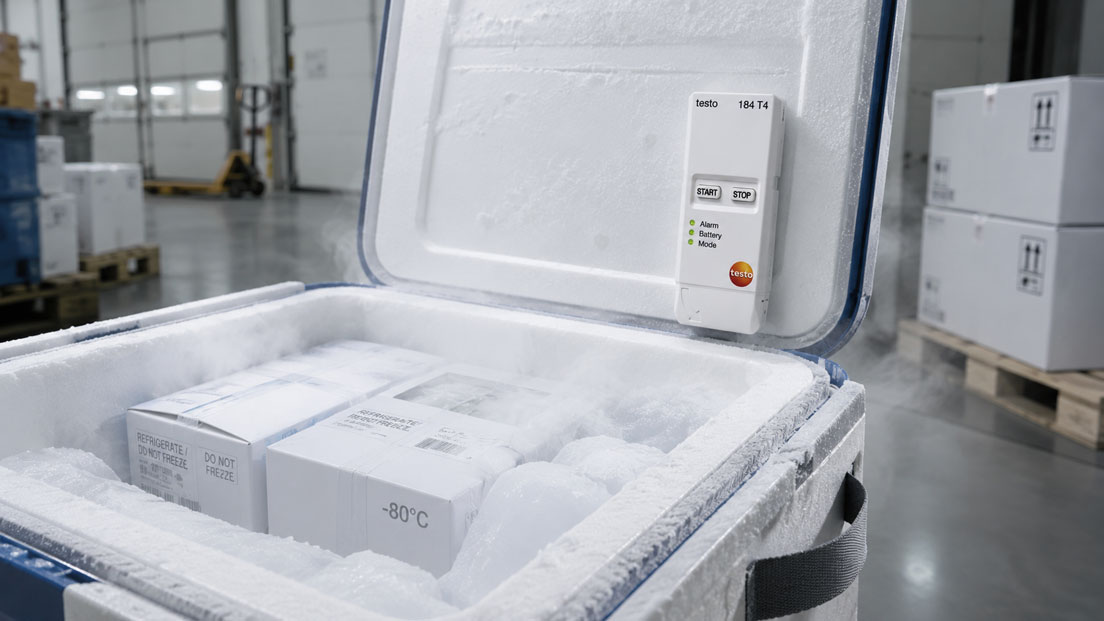
testo 184T4 for dry-ice transport
The testo 184T4 temperature data logger was developed for transport monitoring at very low temperatures and can be used down to −80 °C.
It is particularly suitable for pharmaceutical products, biological samples and other goods transported with dry ice.
At the destination, an LED immediately indicates whether the programmed limit values were maintained. When connected to a computer, a PDF report is generated automatically. The configuration, operating instructions and other instrument data are stored directly in the logger.
testo 184G1 for temperature, humidity and shock
In addition to temperature, the testo 184G1 records relative humidity and mechanical shock events.
This makes it suitable for sensitive pharmaceuticals, foods, electronic products, works of art and other valuable transported goods for which more than temperature alone is relevant.
The instrument provides direct alarm indication, USB and NFC interfaces and an automatically generated PDF report. For pure deep-freeze transport, however, it must be checked whether its temperature range is sufficient; the testo 184T4 is the more suitable version for dry ice.
Selection based on the specific application
A compact single-channel logger is not automatically the most economical solution if an external probe, a larger memory or a regulated software environment will later be required.
The temperature range, measuring interval, recording duration, sensor position, report format, calibration requirement and required alarm function should therefore be considered together during product selection.
ICS Schneider Messtechnik assists with selection for refrigerators, cold stores, storage rooms, transport packaging and temperature mapping. For quality-critical applications, information about the product specification, permissible limit values, number of measuring points and documentation requirements should also be provided.
Conclusion: Reliable cold-chain documentation begins before the logger is started
A temperature data logger creates a traceable profile and shows when and for how long goods or a storage area were exposed to particular temperature conditions.
However, the reliability of the information depends significantly on correct selection and use. The measuring range, accuracy, response time, measuring interval, memory, battery and reporting function must be suitable for the specific task.
The sensor position is equally decisive. A logger positioned at the cold-air outlet or directly next to a door may provide values that are not representative of the stored goods. In larger storage rooms, the position should be derived from temperature mapping.
Air temperature and product temperature must not be equated. Brief air-temperature peaks may be insignificant for a thermally inert product, while prolonged deviations may be relevant despite a moderate maximum temperature.
Limit values and alarm delays must be derived from the product specification and risk assessment. An alarm without a defined response does not improve product safety.
EN 12830, HACCP, GDP and 21 CFR Part 11 address different aspects. The appropriate instrument version depends on whether food products, pharmaceuticals, laboratory samples or technical products are being monitored.
Only the combination of a suitable logger, documented position, plausible configuration, regular calibration and professional evaluation enables reliable documentation of storage and the cold chain.
Frequently asked questions about temperature data loggers
What is a temperature data logger?
A temperature data logger automatically measures the temperature at defined intervals and stores the values together with the date and time.
What is the difference between a data logger and a thermometer?
A thermometer normally displays the current value. A data logger creates a complete chronological profile and also documents periods during which no one is present.
Is a min./max. thermometer sufficient for a refrigerator?
It shows the lowest and highest value, but not the time or duration of the deviation. A data logger provides more meaningful information for traceable cold-chain documentation.
Which temperature should a refrigerator data logger measure?
This depends on the products being stored. The permissible range must be derived from the product specification, labelling, legal requirements or the company’s quality system.
Where should the logger be positioned inside a refrigerator?
It should be installed at a representative and permanently documented position. Direct proximity to the door, evaporator, fan or wall surfaces can distort the result.
Should the logger be installed at the warmest point?
A warm point identified during mapping may be appropriate for alarm purposes. An additional cold point may be relevant if the product must not freeze.
What is temperature mapping?
During mapping, several loggers are used simultaneously to determine the spatial temperature distribution and identify warm and cold zones within a storage area.
How many loggers are required for temperature mapping?
This depends on the size, geometry, rack height, airflow and risk assessment. A large storage room cannot be characterised adequately with a single logger.
Does a refrigerator also have to be mapped?
This depends on the application and quality requirements. Qualification or spatial testing may be required in regulated pharmaceutical applications. Small units may sometimes be supplied pre-qualified, but must still be installed and operated correctly.
What is the difference between air temperature and product temperature?
The air temperature reacts quickly to door openings and refrigeration. The product temperature generally changes more slowly because of the greater thermal mass.
Can a brief air-temperature peak be ignored?
Not in general. The duration, temperature level, product type and actual product temperature must be assessed. A brief peak may be insignificant, but must still be evaluated in a traceable manner.
How can the product temperature be simulated?
An external probe can be positioned inside a thermally inert simulation medium. The material and design must correspond to the product being monitored.
What is a core-temperature measurement?
This measures the temperature inside a product. Depending on the product, it may require a penetration probe and may not always be non-destructive.
Which measuring range is suitable for a refrigerator?
A range from, for example, −20 or −30 °C to well above room temperature covers many refrigerator and cold-room applications. The specific instrument specification must be suitable for the lowest possible temperature.
Which logger is suitable for dry ice?
An instrument specified down to approximately −80 °C is required. The testo 184T4 is intended for such transport applications.
What does an accuracy of ±0.5 °C mean?
Under the specified conditions, the indicated value may be up to 0.5 °C above or below the actual value.
Does a resolution of 0.1 °C also mean an accuracy of ±0.1 °C?
No. Resolution describes only the smallest displayed increment. The actual measurement deviation may be larger.
How frequently should a data logger measure?
The interval depends on the process speed, permissible duration of a deviation, sensor response, memory and battery life. Intervals of several minutes are frequently used.
Is a measuring interval of one minute always better?
No. With a slow-response sensor, this merely creates more similar measured values. The measuring interval should correspond to the actual response time.
Can a long measuring interval miss temperature peaks?
Yes. If a deviation occurs completely between two measuring points, it may not be recorded.
What is an alarm delay?
The alarm is triggered only if a limit value is violated for longer than the configured period. This allows brief, deliberately tolerated events to be filtered out.
How long should the alarm delay be?
It must be derived from the product requirement, thermal inertia, refrigeration equipment and risk assessment. There is no universally applicable value.
What does a red alarm indication on a transport logger mean?
At least one configured alarm criterion was violated. For product assessment, the magnitude, timing and duration must be checked in the complete report.
Are the goods automatically unusable if the logger indicates an alarm?
No. Release depends on the product, temperature profile and available stability or shelf-life data.
How long does a temperature data logger store data?
This depends on the memory capacity, measuring interval and number of channels. The possible duration should be calculated before use.
Is data lost if the battery becomes empty?
Many modern loggers retain the stored data. However, this property must be confirmed in the data sheet of the specific instrument.
Does cold temperature affect battery life?
Yes. Low temperatures can reduce the available battery capacity. The operating-time specification must be assessed for the actual application temperature.
Can a data logger be cleaned inside a cold room?
Only in accordance with its degree of protection. IP65, for example, protects against water jets under defined conditions, while IP68 describes more extensive protection. Cleaning chemicals must be assessed separately.
What happens when a cold logger is removed from the cold area?
Condensation can form in warm, humid air. The instrument should be acclimatised and protected against moisture in accordance with the manufacturer’s instructions.
Can a logger be read out via Bluetooth?
Depending on the model, evaluation via Bluetooth and an app may be possible. Other instruments use USB, NFC, memory cards, WLAN or wireless transmission.
What is an automatic PDF report?
With certain transport loggers, a file containing the measured profile, limit values and alarm events is generated automatically when the instrument is connected to a computer.
Is a PDF report tamper-proof?
This depends on the instrument and system used. Data integrity, user rights and records of changes must be assessed separately for regulated applications.
Why is the correct time important?
Only with a correct timestamp can temperature events be assigned to door openings, transport stages, power failures or handovers.
What does EN 12830 mean?
The standard describes requirements and tests for temperature-recording instruments used during the transport, storage and distribution of temperature-sensitive goods.
Does every temperature data logger require EN 12830?
No. The requirement depends on the product, application and legal or operational specifications. The standard is particularly relevant for certain food applications.
What does HACCP-compliant mean for a logger?
The instrument is intended for integration into a HACCP-based food-safety system. However, it does not replace the company’s hazard analysis or the definition of limit values and corrective measures.
Is HACCP a data logger standard?
No. HACCP is a procedure for the systematic control of food-safety hazards.
What does GDP mean in temperature monitoring?
GDP describes good distribution practice for medicinal products. This includes suitable storage and transport conditions, mapping, calibration, alarm functions and traceable records.
What does GxP mean?
GxP is a collective term for regulated good practices, such as GMP, GDP or GLP. The specific requirements depend on the relevant area of activity.
What is 21 CFR Part 11?
The US regulation contains requirements concerning electronic records and electronic signatures. Relevant applications require, among other things, user management, audit trails and secured data.
Is a logger with CFR software automatically validated?
No. The complete application consisting of the instrument, software, configuration, IT environment and workflow must be validated in accordance with the company’s procedure.
How frequently must a temperature data logger be calibrated?
The interval depends on the risk, accuracy, operating conditions, previous results and regulatory or operational requirements.
Which calibration points are appropriate?
The points should cover the actual operating range. For a range of 2 to 8 °C, measuring points near the limits and within the range are appropriate.
Is a factory calibration report sufficient?
It may be sufficient for simple applications. For higher quality or accreditation requirements, a traceable or accredited certificate may be necessary.
Can a logger be calibrated in-house?
A comparison test is possible, but does not automatically replace a professionally performed traceable calibration.
What should be documented in the event of a limit-value violation?
The temperature level, duration, time, affected goods, logger position, possible cause, assessment and measures taken should be documented in a traceable manner.
Which data logger is suitable for a simple refrigerator?
A compact logger such as the testo 174T may be suitable for typical refrigerator and storage applications, provided that the measuring range, accuracy and documentation requirements are appropriate.
Which logger is suitable for precise long-term monitoring?
The testo 176T1 offers a Pt100 sensor, large memory, long battery life and a robust housing for long-term monitoring of refrigerated and frozen storage areas.
How can air temperature and product temperature be measured simultaneously?
A two-channel instrument such as the testo 175T2 can record the air temperature internally and an additional temperature via an external probe.
Which logger is suitable for transport monitoring?
Instruments from the testo 184 series are suitable for pure temperature monitoring during transport. If humidity and shock also need to be recorded, the testo 184G1 may be appropriate.
Which information is required for product selection?
The temperature range, application, measuring location, measuring interval, recording duration, accuracy, limit values, alarm function, interface, degree of protection, calibration and regulatory requirements are required.