


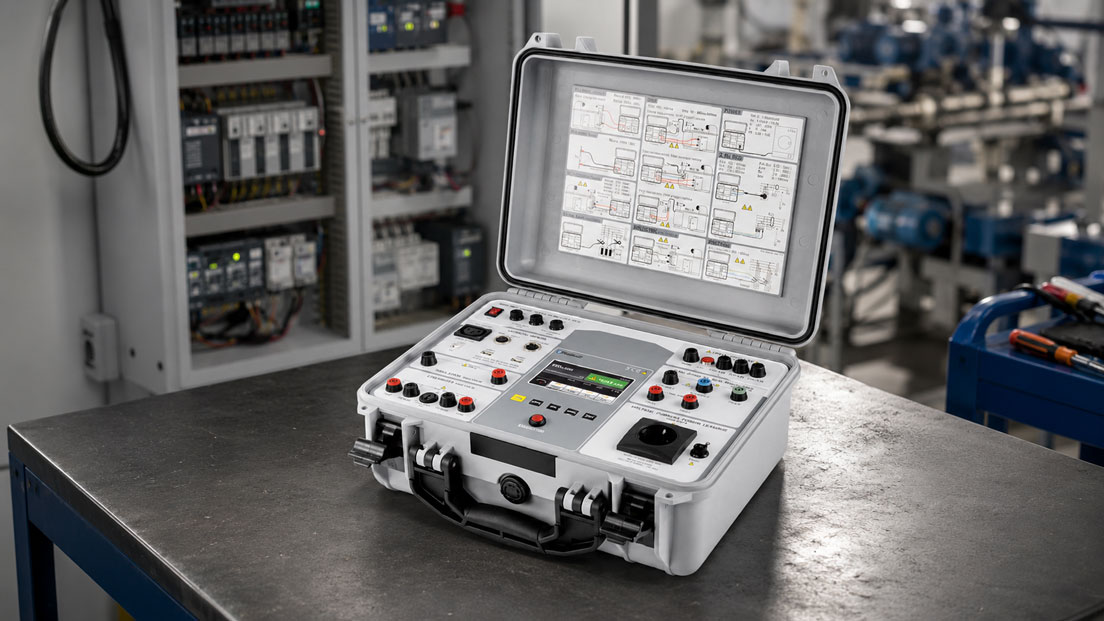
The electrical equipment of machines must be safely designed, tested and documented. For machine builders, control cabinet manufacturers, maintenance teams and testing service providers, machine testing according to VDE 0113 / EN 60204-1 is therefore a key topic. It is not only about whether a machine works. What matters is whether protective conductor, insulation, electrical strength, residual voltage, leakage currents and disconnection conditions have been safely evaluated.
In practice, machine testing is often confused with classic installation testing according to VDE 0100. Both testing areas overlap, but they pursue different objectives. While installation testing considers the electrical installation of a building or plant, testing according to EN 60204-1 focuses on the electrical equipment of machines.
This article explains which tests are particularly important for machine testing, how protective conductor testing, insulation testing, high-voltage testing and residual voltage measurement should be classified, and which test instruments are suitable for these tasks.
You can find suitable devices in our categories
Device testing VDE 0701-0702 / machine testers / EN60204
and
installation testers and VDE test instruments.
For machine testing, the
FULLTEST 3 machine and plant tester
is particularly relevant. Depending on the testing task, C.A 6161 and C.A 6163 can also be suitable machine testers.
Official background information can be found, among others, at
Gesetze im Internet on BetrSichV Section 14, inspection of work equipment,
BAuA TRBS 1201, inspections and checks of work equipment
and the
DGUV/IFA practical guidance on testing the electrical equipment of machines.
Table of contents
- Why is machine testing according to VDE 0113 / EN 60204-1 important?
- VDE 0100 or VDE 0113: what is the difference?
- Typical test procedure for electrical equipment of machines
- Visual inspection and documentation check
- Protective conductor test: 200 mA, 10 A or 25 A?
- Insulation testing with suitable test voltages
- High-voltage test and electrical strength
- Residual voltage measurement after shutdown
- Leakage current and differential current measurement
- RCD test, loop impedance and disconnection conditions
- Limit values, test duration and documentation
- FULLTEST 3: machine tester for VDE 0113 / EN 60204-1
- C.A 6161 and C.A 6163: machine testing with test sequences and documentation
- Product comparison: which machine tester is suitable?
- Practical examples from machine building, control cabinet construction and maintenance
- Checklist: preparing machine testing
- Conclusion
- FAQ: frequently asked questions about machine testing according to VDE 0113 / EN 60204-1
Why is machine testing according to VDE 0113 / EN 60204-1 important?
Machines contain electrical equipment, control systems, drives, control cabinets, protective conductor connections, sensors, actuators and often complex electronic components. A simple functional test is not sufficient to assess the electrical safety of a machine.
Machine testing is intended to show whether the electrical equipment has been safely designed and whether protective measures are effective. This includes, among other things, protective conductor connections, insulation condition, electrical strength, residual voltages after shutdown, leakage currents and disconnection conditions.
Testing is particularly important for new machines, after modifications, after repairs, during recurring inspections and as part of final inspections. For operators, the German Ordinance on Industrial Safety and Health is also relevant, as work equipment must be used safely and, if necessary, inspected by a competent person.
VDE 0100 or VDE 0113: what is the difference?
Testing according to VDE 0100 refers to electrical installations, for example building installations, distribution boards, circuits, protective measures and network systems. Machine testing according to VDE 0113 / EN 60204-1, on the other hand, considers the electrical equipment of a machine.
This is important in practice because a machine is not automatically fully tested just because the building installation has been tested. Conversely, a machine test does not replace testing of the upstream electrical installation.
| Testing area | Focus | Typical examples |
|---|---|---|
| VDE 0100 | Electrical installations and systems | Building installation, circuits, distribution boards, sockets, protective measures. |
| VDE 0113 / EN 60204-1 | Electrical equipment of machines | Machine control cabinet, motors, control circuits, protective conductor, residual voltage. |
| DGUV / BetrSichV context | Safe use of work equipment | Testing by competent persons, inspection intervals, documentation, risk assessment. |
Typical test procedure for electrical equipment of machines
A meaningful test procedure does not start with the measuring instrument, but with preparation. This includes documents, circuit diagram, risk assessment, machine documentation, manufacturer information and the definition of which tests are required and permissible on the specific machine.
This is typically followed by visual inspection, protective conductor test, insulation test, high-voltage test, residual voltage measurement, leakage current or differential current measurement, functional tests and documentation of the results. Depending on the machine, additional tests may be required.
For complex machines, tests should not be carried out in an uncoordinated way. Frequency inverters, electronic assemblies, EMC filters, surge protection, sensors and safety controllers can influence certain test voltages or test procedures. For this reason, the selection of the test method must always be adapted to the machine, standard and manufacturer documentation.
Visual inspection and documentation check
Visual inspection is an essential part of machine testing. It is often underestimated, but it detects many faults before electrical measurements are carried out. These include damaged cables, loose terminals, missing markings, unsuitable protective conductor connections, missing covers or unsuitable cable entries.
The documentation must also be checked. Circuit diagrams, terminal diagrams, protective conductor routing, equipment identification and manufacturer information must match the machine. Without clean documentation, later troubleshooting becomes much more difficult.
For machines in industrial environments, mechanical influences, vibration, temperature, moisture, oil, cooling lubricants and dust must also be considered. Electrical safety does not only depend on the circuit diagram, but also on the real installation situation.
Protective conductor test: 200 mA, 10 A or 25 A?
The protective conductor test checks whether conductive touchable parts are reliably connected to the protective conductor system. This is intended to ensure that dangerous touch voltages are avoided in the event of a fault and that protective measures can become effective.
In practice, different test currents are used depending on the test task. Measurements with 200 mA are often used for continuity tests. Higher test currents such as 10 A or 25 A can be relevant for machine and control cabinet testing when the load capacity and quality of the protective conductor connection are to be checked under more realistic conditions.
Important: the correct test current results from the standard requirement, test objective, machine design and manufacturer information. A test instrument must therefore not only display a resistance value, but also reliably provide the required test currents.
| Test type | Typical purpose | Practical evaluation |
|---|---|---|
| Continuity test with 200 mA | Basic test of protective conductor connections. | Fast, simple and suitable for many connections. |
| Protective conductor test with 10 A | Test with higher test current. | Relevant for machines, control cabinets and more robust connections. |
| Protective conductor test with 25 A | Loadable test of protective conductor connections. | Particularly interesting for machine testers with high-current function. |
Insulation testing with suitable test voltages
The insulation test evaluates whether there is sufficient insulation resistance between active conductors and the protective conductor system. It is important for detecting damaged insulation, moisture effects, incorrect wiring or contamination.
Typical test voltages are 100 V, 250 V, 500 V or 1000 V DC, depending on the circuit and application. Which test voltage may be used and is useful depends on the machine and the connected components. Electronic assemblies, frequency inverters, controllers and EMC components can be sensitive to unsuitable test voltages.
Before insulation testing, it should therefore be checked whether components need to be disconnected, bypassed or handled according to manufacturer information. An incorrect insulation test can not only deliver incorrect results, but in the worst case damage electronic components.
High-voltage test and electrical strength
The high-voltage test, also known as dielectric strength test, checks the electrical strength of the equipment. An increased test voltage is applied to detect weaknesses in the insulation or design.
This test is particularly relevant for final inspections, control cabinets, machine building and electrical equipment where an electrical strength test is required. The test voltage and test duration must not be selected arbitrarily. They must match the standard, the device under test, the design and the manufacturer information.
Machine testers such as the FULLTEST 3 support high-voltage tests up to the kV range. This is helpful when machines or control cabinets are to be tested according to defined test procedures. At the same time, this test is safety-critical and may only be carried out by qualified persons with suitable protective measures.
Residual voltage measurement after shutdown
Many machines contain capacitors, power supplies, frequency inverters, DC links or EMC filters. After shutdown, dangerous residual voltages can remain for a certain time. For this reason, residual voltage measurement is an important part of machine testing.
During residual voltage measurement, it is checked whether touchable or accessible points are discharged to a safe level within the permissible time after disconnection from the supply. This test is particularly important for machines with plug connections, DC links or electrical energy storage components.
A suitable machine tester can record and document the discharge time or residual voltage after shutdown. This makes evaluation easier and prevents dangerous residual voltages from being overlooked.
Leakage current and differential current measurement
Leakage currents are caused, among other things, by filters, long cables, electronic drives, frequency inverters or capacitive coupling. In modern machines, leakage currents are therefore often a relevant issue.
Leakage current measurement helps evaluate whether unwanted currents are flowing via protective conductors or other paths. Differential current measurement considers the difference between outgoing and returning current. Both measurements can provide indications of insulation problems, EMC filters, damaged cables or faulty consumers.
Realistic interpretation is important. Not every leakage current is automatically a fault. The decisive factors are magnitude, operating condition, circuit, protective measure and permissible limit values.
RCD test, loop impedance and disconnection conditions
If a machine or its supply is protected by RCDs, circuit breakers or fuses, disconnection conditions must be evaluated. Depending on the design, RCD testing, loop impedance, line impedance or testing of automatic disconnection may be relevant.
These tests must match the network type, protection concept and machine. For mobile machines, machines with plug connection, machines in TT or TN systems and machines with frequency inverters, different aspects may be important.
A machine tester with RCD test, loop impedance measurement and differential current measurement can help cover several test tasks in one device.
Limit values, test duration and documentation
Limit values and test duration must not be taken generally from a blog article. They result from the applicable standard, the specific machine, the risk assessment, the manufacturer information and the test objective. Incorrect selection is particularly critical for high-voltage testing, insulation testing and residual voltage measurement.
The documentation should clearly show what was tested, which test instrument was used, which test parameters were applied and which result was achieved. At minimum, this includes machine identification, test date, tester, measuring instrument, serial number or calibration evidence, test points, measured values, evaluation and notes on defects.
Automatic test sequences, memory functions and interfaces make documentation much easier. Especially in series testing, control cabinet construction, final inspection or recurring inspections, these functions save time and reduce transmission errors.
FULLTEST 3: machine tester for VDE 0113 / EN 60204-1
The
FULLTEST 3
is a multifunction tester for testing machines and plants according to VDE 0113 / EN 60204-1. It is particularly suitable for users who want to perform protective conductor testing, insulation testing, high-voltage testing, residual voltage measurement and differential current measurement with one device.
Particularly relevant are protective conductor testing with 200 mA and with a test current greater than 25 A, insulation testing with 100/250/500/1000 V DC, high-voltage testing with adjustable test voltage up to 5100 V AC, residual voltage measurement, differential current measurement, RCD test and USB interfaces.
This makes the FULLTEST 3 very suitable for machine builders, control cabinet manufacturers, testing service providers and maintenance teams who need a specialized device for machine testing and electrical safety.
| FULLTEST 3 function | Benefit | Typical application |
|---|---|---|
| Protective conductor test 200 mA and >25 A | Testing protective conductor connections with different test currents. | Machines, control cabinets, protective conductor systems. |
| Insulation test 100/250/500/1000 V DC | Adaptation to different circuits and components. | Machine control system, main circuit, control circuits. |
| High-voltage test up to 5100 V AC | Testing electrical strength. | Final inspection, control cabinet construction, machine building. |
| Residual voltage measurement | Evaluation of dangerous residual voltages after shutdown. | Machines with DC links, power supplies or capacitances. |
| Differential current measurement and RCD test | Supports evaluation of protective measures. | Maintenance, recurring inspection and troubleshooting. |
C.A 6161 and C.A 6163: machine testing with test sequences and documentation
The C.A 6161 and C.A 6163 are machine and control cabinet testers for extensive electrical safety tests. They are particularly suitable for users who need automatic test sequences, touchscreen operation, memory functions and documentation.
Typical testing tasks include continuity testing, insulation testing, high-voltage testing, leakage current measurement, discharge time, RCD testing and further tests on machines, control cabinets and electrical equipment. The C.A 6163 is particularly interesting when higher test performance, 25 A continuity testing or more extensive documentation and interface functions are required.
These devices are particularly suitable for series testing, final inspection, production, testing laboratories and maintenance when test procedures need to be reproducible and documented.
Product comparison: which machine tester is suitable?
The selection of the right machine tester depends on which tests need to be performed, whether high voltage is required, which protective conductor test currents are necessary and how important automatic test procedures and documentation are.
| Device / category | Strengths | Typical application |
|---|---|---|
| FULLTEST 3 | Protective conductor test, insulation, high voltage, residual voltage, differential current, RCD test. | Machine testing according to VDE 0113 / EN 60204-1. |
| C.A 6161 | Machine and control cabinet testing with automatic test sequences. | Final inspection, recurring inspection, maintenance and documentation. |
| C.A 6163 | Extended machine testing with 25 A continuity testing, high-voltage testing and large memory. | Testing laboratory, series testing, machine building and control cabinet construction. |
| Machine testers / EN60204 | Overview of test instruments for machines, devices and electrical equipment. | Selection according to standard, test current, test voltage and documentation requirements. |
Practical examples from machine building, control cabinet construction and maintenance
Example 1: Final inspection of a new machine
A machine builder performs an electrical safety test before delivery. Protective conductor connections are checked, insulation is evaluated, residual voltage after shutdown is measured and the results are documented. A machine tester such as the FULLTEST 3 is particularly suitable for such tasks.
Example 2: Control cabinet test with high-voltage test
A control cabinet is to be tested as part of the final inspection. In addition to continuity and insulation testing, a dielectric strength test is planned. A test instrument is required that can safely provide the suitable test voltage and document the test procedure.
Example 3: Machine with frequency inverter and residual voltage
A machine contains frequency inverters and DC links. After shutdown, voltage can remain present for some time. A residual voltage measurement shows whether discharge occurs within the permissible time and whether warning notices or technical measures are required.
Example 4: Recurring inspection in maintenance
In a production plant, machines are tested regularly. Automatic test sequences, memory functions and uniform test reports help make results comparable and reduce testing effort.
Example 5: Faulty protective conductor connection
A poor protective conductor connection is found on a machine. With a protective conductor test using a suitable test current, the affected connection can be narrowed down. Afterwards, terminal, cable, housing connection and mechanical connection are checked.
Checklist: preparing machine testing
Good preparation reduces measurement errors, avoids damage to electronic components and ensures traceable results.
| Check question | Why important? | Recommendation |
|---|---|---|
| Which standard and test purpose apply? | Test scope and limit values depend on the specific case. | Check EN 60204-1, manufacturer documentation and risk assessment. |
| Are circuit diagrams and documentation available? | Without documents, test points are difficult to trace. | Provide circuit diagram, terminal diagram and equipment identification. |
| Which protective conductor test currents are required? | 200 mA, 10 A or 25 A fulfil different test tasks. | Select suitable machine tester. |
| May insulation or high-voltage testing be carried out? | Electronic components can be sensitive. | Observe manufacturer information and disconnection instructions. |
| Does residual voltage need to be tested? | Capacitors and DC links can remain dangerous. | Document discharge time and residual voltage. |
| Are leakage currents to be expected? | Filters and frequency inverters can cause leakage currents. | Plan leakage current and differential current measurement. |
| Is a test report required? | Test results must remain traceable. | Use device with memory, interface or software. |
Conclusion: machine testing requires the right test instrument and a clear test procedure
Machine testing according to VDE 0113 / EN 60204-1 is much more than a simple functional test. Protective conductor testing, insulation testing, high-voltage testing, residual voltage measurement, leakage current and differential current measurement as well as documentation are central elements of a safe evaluation.
Which tests are required in each individual case depends on the machine, standard, risk assessment, manufacturer information and test purpose. For this reason, test scope, limit values and test duration should always be defined and documented professionally.
For these tasks, the
FULLTEST 3
is particularly suitable, as it covers central machine tests such as protective conductor testing, insulation testing, high-voltage testing, residual voltage measurement and differential current measurement in one device. For users focusing on automatic test sequences, touchscreen operation and extensive documentation, C.A 6161 and C.A 6163 can also be suitable solutions.
FAQ: frequently asked questions about machine testing according to VDE 0113 / EN 60204-1
What is machine testing according to VDE 0113 / EN 60204-1?
Machine testing evaluates the electrical equipment of machines. This includes, among other things, protective conductor connections, insulation, electrical strength, residual voltage, leakage currents, disconnection conditions and documentation.
What is the difference between VDE 0100 and VDE 0113?
VDE 0100 concerns electrical installations and systems. VDE 0113 / EN 60204-1 concerns the electrical equipment of machines. Both areas can be connected, but they do not replace each other.
Why is protective conductor testing important for machines?
It checks whether conductive touchable parts are reliably connected to the protective conductor system. This is important so that protective measures can become effective in the event of a fault.
When are 200 mA, 10 A or 25 A used?
200 mA is often used for continuity testing. Higher test currents such as 10 A or 25 A can be relevant for machine and control cabinet testing. The specific selection must be made according to standard, test objective and machine design.
Which test voltages are used for insulation testing?
Typical test voltages are 100 V, 250 V, 500 V or 1000 V DC. Which test voltage is suitable depends on the circuit, machine, components and manufacturer information.
What is a high-voltage test?
The high-voltage test evaluates the electrical strength of equipment. An increased test voltage is applied. This test is safety-critical and may only be carried out professionally.
Why does residual voltage need to be tested?
After shutdown, machines can still contain dangerous voltages due to capacitors, power supplies or DC links. Residual voltage measurement checks whether this voltage is reduced quickly enough.
What is the difference between leakage current and differential current?
Leakage current describes unwanted currents via protective conductors or other paths. Differential current is the difference between outgoing and returning current. Both measurements help evaluate protective measures and fault sources.
What is the FULLTEST 3 suitable for?
The FULLTEST 3 is suitable for machine testing according to VDE 0113 / EN 60204-1, especially for protective conductor testing, insulation testing, high-voltage testing, residual voltage measurement, differential current measurement and RCD testing.
What are C.A 6161 and C.A 6163 suitable for?
C.A 6161 and C.A 6163 are suitable for machine and control cabinet testing with automatic test sequences, touchscreen operation, memory functions and documentation. They are particularly interesting for final inspection, series testing and maintenance.
What belongs in a test report?
A test report should include machine, tester, date, test instrument, test parameters, measured values, evaluation, defects and, if applicable, references to standard, manufacturer documentation and risk assessment.