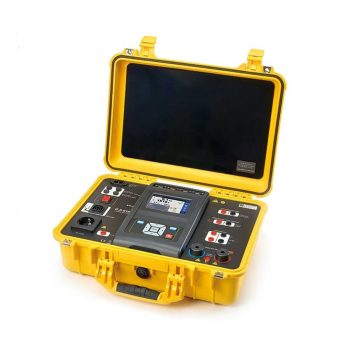
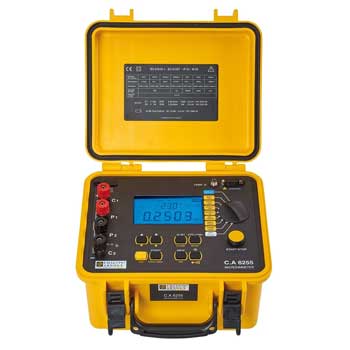
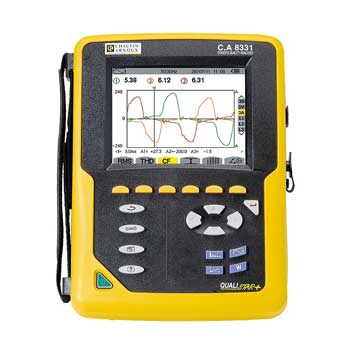
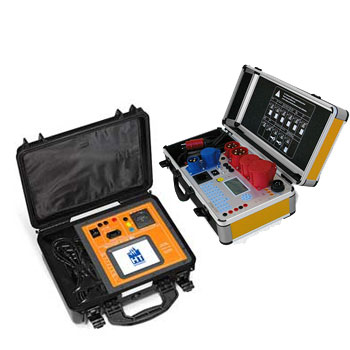
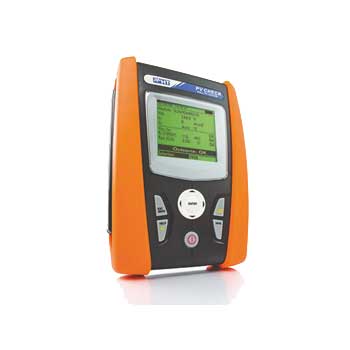
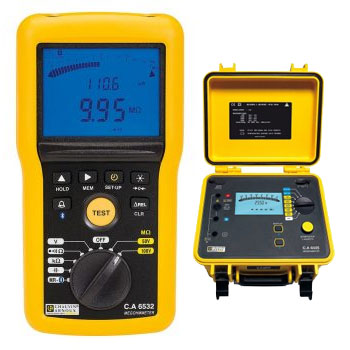
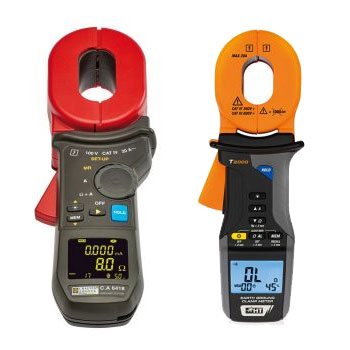
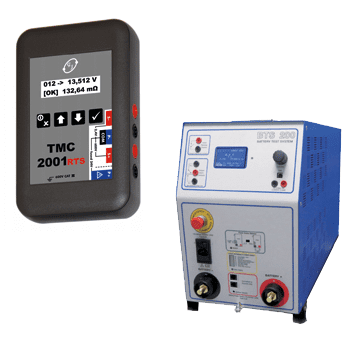
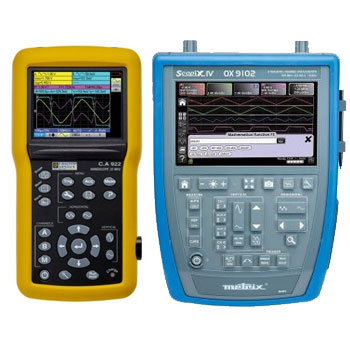


























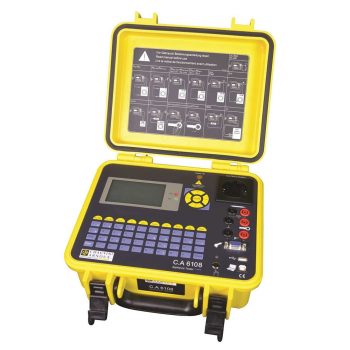
- Tests according to the regulatory reference bases
- Customizable automatic scripts
- Colour touch screen usable with gloves
- Multilingual interface
- Customizable visual inspections
- 3 kV dielectric tests, insulation 1 GΩ, continuity 10 A
- RCD tests from 6 mA to 1000 mA
- Direct and differential leakage current
- Discharge time
- Automatic printing of Pass/Fail sticker
- Interfaces for barcode, RFID, remote control and lamps
- Storage of up to 100,000 tests
- 1 USB-B port and 2 USB-A ports
- Wifi communication
- Analysis and report generation software for PC
- Firmware updates via USB drive
Datasheet |
User Manual |
- Großformatiges Display mit hohem Kontrast
- Schutzleiterwiderstandsmessung mit 200 mA und 10A Prüfstrom
- Direkte Identifizierung der Prüflinge über Tastatur, Barcode- oder Transponderscanner
- Stromzangenanschluss für die Prüfung von Geräten mit Festanschluss und Drehstromprüflingen über CEE-Adapter
- Prüfung von Verlängerungsleitungen Standard oder mit RCD Typ A/B (Baustromverteiler) bzw. PRCD, PRCD-S, PRCD-K (Option)
- Kaltgeräteanschluss- und Verlängerungsleitungen direkt prüfbar
- Automatischer Prüfablauf mit Klartextanweisungen in Deutsch und Anschlusspiktogrammen
- Gut-/Schlecht-Bewertung über LEDs (grün/rot)
- Funktionstest mit Leistungsmessung in Echt-Effektivwert
- Prüfungen nach DIN VDE 544-4 / IEC 6974-4 freischaltbar (Option)
- Prüfung der Standby-Stromaufnahme nach EU-Verordnung 1275/28 (Option)
- Datenspeicher für 100000 Messungen und 32 Kunden
- Datenaustausch über USB-Stick und USB-Kabel
- Datenbank-Software mit Upload der Stammdaten vom PC
- Extrem robustes Gehäuse für den Feldeinsatz
Datasheet |
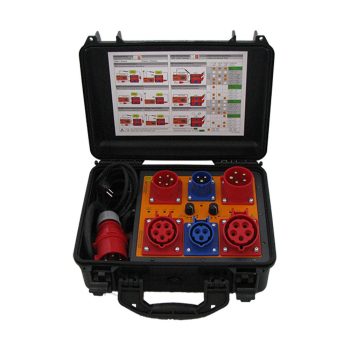
Zur komfortablen Prüfung von CEE Verlängerungsleitungen (Rpe, Riso, IEA, Verdrahtung) und aktiver Prüfung 3-phasiger Verbraucher (Differenzstrommessung)
- Bei Verlängerungsleitungen mit Funktions- und Drehfeldprüfung
- Anschluss: 16 A CEE 5-polig
- zur aktiven Prüfung 3-phasiger Verbraucher unter Funktion Rpe, Riso, Ipe/Ib (Ersatz-, Differenz-, direktes Verfahren)
- zur aktiven Prüfung von Schweißgeräten
Datenblatt
|
Bedienungsanleitung
|
- Tests according to the regulatory reference bases
- Customizable automatic scripts
- Colour touch screen usable with gloves
- Multilingual interface
- Customizable visual inspections
- 5 kV dielectric test, insulation 50 GΩ, continuity 25 A
- Direct, differential, substitution and touch leakage voltage
- Unweighted / weighted measurement networks, reversal of L-N polarity, welding machine
- Discharge time
- Automatic printing of Pass/Fail sticker
- Interfaces for barcode, RFID, remote control and lamps
- Storage of up to 100,000 tests
- 1 USB-B port and 2 USB-A ports
- Wifi communication
- Analysis and report generation software for PC
- Firmware updates via USB drive
Datasheet |
User Manual |
- Capacitive colour touch screen
- Automatic test sequences
- Storage of the tests on memory card up to 32 GB
- 5 kVAC/ 6 kVDC HV dielectric test, 25 A continuity, 1,000 V isolation
- Substitute direct leakage current, PE, differential leakage current
- and touch leakage current
- External and internal discharge time up to 10 s / 550 V peak
- P, Q, S, Pf, Cos φ, THDU, THDI, U and I functional test
- Inputs/outputs to pedal, indicator lamps, PC
- Compatible with TT, TN and IT networks, 230 V / 115 V
Datasheet
|
Multifunction Tester for safety of machinery IEC/EN60204-1 and low voltage switchgears and controlgears IEC/EN61439-1-2
IEC/EN60204-1 Measuments:
Power Frequency Dielectric withstand voltage with test voltage of 1000VAC
Testing protection against indirect contact:
- Continuity of protective conductors with test current 200mA
- Automatic disconnection of the supply (RCD, MCB, Fuse)
- RCD tripping (RCD AC, A, B) up to 1A on TT Systems
- Magneto-thermal protections (MCB curve verificaiton on B, C, D, K) and fuses (gG, aM) on TN Systems
Insulation resistance measurement with test voltage of 500VDC
Discharging of residual voltage V<60V in 5sec/1sec
IEC/EN61439-1-2 Measurements:
Clearances and Creepage distances:
- Dielectric withstand voltage with test voltage of up to 3400/5100VAC
Continuity of earth system and protective conductors ≥10A
Power Frequency Dielectric withstand voltage with test voltage of 1800VAC
Alternative power-frequency voltage test up to 5100VAC
Test on enclosures of insulating material:
- Dielectric Withstand voltage with test voltage up to 2835V
Discharging of residual voltage V<60V in 5sec/1sec
Datasheet
|
- Für alle Prüflinge mit Schuko-, Kaltgerätestecker, 16A 1P CEE, 16A 3CEE und 32A 3CEE Anschluss
- Prüfen von Verlängerungsleitungen (mit Verdrahtungstest)
- Automatisch oder manuell einstellbare Prüfabläufe
- Kein Umstecken der Prüflinge erforderlich
- Klartextbedienung mit Gut-/Fehleranzeige
- Funktionstest mit Echt-Effektivwert und Leistungsanzeige bis 24 kW
- Dateneingabe über Tastatur, Barcodeleser oder PC
- Überprüfung des Netzanschlusses auf Drehfeld & PE
- Automatische Abschaltung bei gefährlichem Fehlerstrom des Prüflings
- Speicher für 16.000 Prüflinge
- Anschluss für Strommessung über Zange
- Anschluss für Tempertarurmessung
- Anschluss für Barcodescanner oder Transponderleser
- Benutzername mit / ohne Passwortschutz
Datenblatt
|
Appliance Testing (VDE 0701/0702)
Test instruments for appliance testing according to VDE 0701/0702 are used to check electrical appliances for safety, protective measures and compliance — especially after repair, maintenance or before recommissioning. They verify protective earth, insulation, leakage current, safety functions and general operational integrity. The goal is to ensure electrical safety and compliance before reuse or distribution.
FAQ
What is VDE 0701/0702 appliance testing?
It is the testing procedure for electrical appliances after repair or before first use, covering protective earth check, insulation measurement, leakage current test and verification of protective and safety functions.
When is such testing required?
After repair or modification of an electrical appliance, before its first operation after manufacture, when returning serviced equipment to use, or periodically in the case of commercial use.
Which tests are typically performed?
Common tests include protective earth continuity and resistance, insulation resistance, insulation or double-insulation checks (for class II devices), leakage current measurement, functional tests, and, if applicable, RCD or protective device testing.
How is the protective earth conductor tested?
The protective earth is tested for continuity and permitted resistance under a defined test current to ensure safe fault current path.
How does the insulation test work?
The appliance is subjected to a defined test voltage between live parts and earth or protective conductors; high resistance indicates intact insulation, low resistance indicates possible insulation failure.
How is leakage current or touch current measured?
Leakage current testing checks if unintended current flows via housing or protective conductor and whether the value stays within safe limits. Excessive leakage indicates potential safety faults.
Which safety functions are checked?
Depending on device class, protective earth connection, double insulation, protective separation, correct grounding and functional safety devices (fuses, switches) are verified.
Who may perform the test?
A qualified electrician or a trained technician with knowledge of applicable standards and testing procedures may perform the VDE 0701/0702 test.
What happens if the appliance fails the test?
If the appliance fails — for example due to insufficient protective earth continuity or poor insulation — it must not be put back into service. Repairs must be made and the test repeated.
How often should repeated tests be performed?
In commercial or public use, appliances are often subjected to periodic retesting — depending on regulations, usage intensity and environment.
What documentation is required?
Test results, date, tester identity, device data and any corrective measures must be documented. This provides proof of compliance and ensures traceability.
Which test instruments are typically used?
Common instruments include appliance testers with protective earth, insulation resistance and leakage current measurements, combined with continuity, voltage test and RCD-test functions. For some devices, clamp meters or current transformers may also be used.
What safety precautions need to be observed?
Testing must be done with correct protective equipment, devices must be properly isolated where required, and test voltage and current must match the device specifications and safety class.
What distinguishes simple from professional testers?
Professional testers offer higher test voltages and currents, automated test sequences, data storage, result logging, better safety and more comprehensive measurement coverage.
What must be considered for Class II or double-insulated devices?
Since these devices lack a protective earth, tests focus on insulation and protective separation rather than earth continuity. Insulation and double-insulation integrity are critical.
Why is leakage current measurement important?
Leakage or touch current testing ensures that no unintended conductive paths exist; even small leakage currents can pose safety hazards, especially in devices with metal housings.
When is a device cleared for reuse?
Only when all test results meet the required safety thresholds, documentation is complete and all detected defects have been addressed; then the device may be re-commissioned or returned to service.
Does testing differ for portable vs. permanently installed equipment?
Yes — portable appliances often require more frequent testing intervals; permanently installed devices follow different maintenance and retesting schedules depending on regulations and environment.
Why is calibration of the test instrument important?
Only properly calibrated test instruments ensure accurate, reliable and legally compliant test results, especially when tests serve as official safety documentation.


Datasheet
Datasheet