


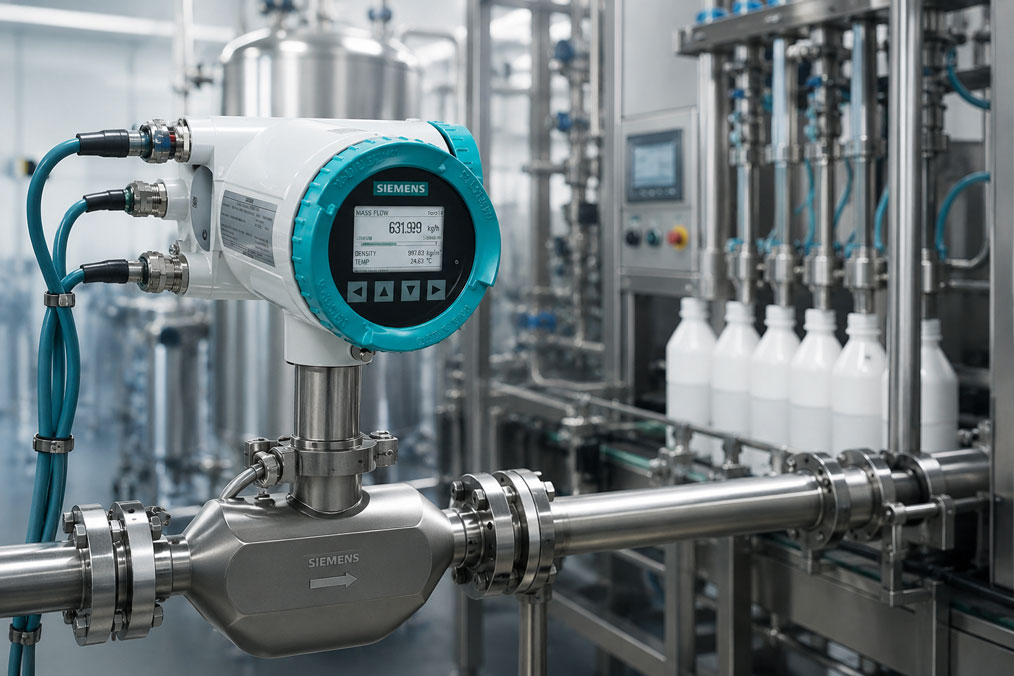
Dosing and filling processes must be repeatable, fast and traceable. Whether food, additives, chemicals, paints, pharmaceutical liquids or high-value auxiliary substances: in the end, it is often not only important how much volume has flowed, but what mass has actually been dosed or filled.
Coriolis flowmeters are particularly interesting for such tasks because they measure mass flow directly. In many applications, this eliminates the uncertain conversion of volume via density, temperature or recipe assumptions. Especially with changing media, small flow rates, batch processes or quality-critical filling operations, this can be a major advantage.
This article explains why Coriolis measurement is so valuable in dosing and filling, what role mass flow, density, fast signal response, valve control, repeatability and 4–20 mA signal testing play, and what should be considered during selection, installation and quality assurance.
Table of contents
- Basics: Why mass can be decisive in dosing and filling
- Coriolis measuring principle: Direct mass flow instead of volume assumption
- Batch processes: Dosing to a target quantity
- Recipes and additive dosing
- Correctly evaluating density, temperature and media changes
- Reliably measuring small flow rates
- Fast signal response and valve control
- Installation, pipe routing and process conditions
- Repeatability, quality assurance and documentation
- 4–20 mA, control system and signal testing with UPS4E
- Table: Selection criteria for Coriolis measurement in dosing and filling
- Practical example: Additive dosing in a mixing plant
- Table: Common errors in Coriolis dosing measurements
- Which measuring instruments / products are suitable?
- Conclusion: Direct mass flow measurement makes dosing more stable
- FAQ: Frequently asked questions about Coriolis measurement in dosing and filling
Basics: Why mass can be decisive in dosing and filling
In many dosing and filling processes, volume is traditionally used. This is easy to understand and sufficient for many applications. However, as soon as density, temperature, viscosity or media composition change, a purely volumetric approach can become inaccurate.
One liter of a medium does not automatically always have the same mass. With temperature-dependent liquids, concentrates, additives, solvents or recipe components, density can fluctuate. Anyone dosing by volume must either ignore these influences or compensate for them mathematically.
When dosing by mass, however, the target value is directly linked to the recipe, container content or material input. If 2.500 kg of an additive are required, mass is the decisive value. The volume can change, but the target quantity remains the same.
Coriolis flowmeters address exactly this point. They measure mass flow directly and, depending on the system, can additionally provide density, temperature and derived values. This creates a reliable measurement basis for filling, additive dosing, mixing processes and quality assurance.
Coriolis measuring principle: Direct mass flow instead of volume assumption
A Coriolis flowmeter directly measures the mass of a flowing medium via the movement of the measuring tube. The mass flow influences the vibration of the measuring tube. The flow value is calculated from this change. As a result, the measuring principle is not dependent on a purely volumetric view.
This is particularly helpful when media are not constant. With paints, additives, chemicals, pharmaceutical liquids or food components, density and flow properties can vary. A Coriolis device still measures the mass directly, provided that the medium and process conditions match the device.
Another advantage is the multiparameter capability of many Coriolis systems. In addition to mass flow, depending on the device, density, temperature, volume flow or totalizers can also be provided. This is often valuable for process control and documentation.
Especially in recipe processes, this makes it easier to trace which quantity of a medium was actually introduced into the process. For quality assurance, batch documentation and material balance, this is much more meaningful than a purely momentary view of volume flow.
Batch processes: Dosing to a target quantity
In batch processes, a defined quantity is introduced into a vessel, mixer, reactor, filling head or process section. The measurement must not only record the current flow, but also reliably totalize the accumulated quantity.
In practice, dosing usually consists of several phases. First, the system fills quickly to save time. Shortly before the target quantity is reached, the flow is reduced or the valve is transferred into a fine dosing phase. At the end, overrun must be considered because medium may still be present in the line, valve or nozzle after the valve closes.
Coriolis measuring devices can help here because they record the mass that has actually flowed. However, it is crucial that measuring device, transmitter, valve and control system work together. A highly accurate sensor alone is not enough if the valve is too sluggish or the control system does not process the shut-off point cleanly.
For repeatable batch results, target value, shut-off point, overrun correction, signal update, valve response and process pressure must be considered together. Especially with small quantities or short dosing times, the dynamics of the overall system become decisive.
Recipes and additive dosing
In recipe processes, several components are often combined with one another. A main component is supplemented with additives, colors, concentrates, active ingredients, aromas, solvents or auxiliary substances. The quality of the end product then depends heavily on whether the small quantities are dosed reliably.
Additives in particular are often expensive or process-critical. Overdosing can increase costs or change product properties. Underdosing can mean that the recipe does not achieve the desired effect. Precise and repeatable quantity measurement is therefore important.
When dosing by volume, the density of the additive must be known and stable. When dosing by mass, the value relevant for the recipe is measured directly. This simplifies assessment, especially when batches, temperatures or media qualities vary.
In plants with multiple recipes, parameterization is also important. Different target quantities, media, valve characteristics and overrun values must be managed cleanly. Good Coriolis measurement supports the process, but it does not replace correct recipe management and plant logic.
Correctly evaluating density, temperature and media changes
A key advantage of Coriolis technology is direct mass flow measurement. In addition, depending on the device and application, density information can be used for plausibility checks, media identification or quality assurance.
In filling and dosing, density can be a valuable additional value. If a medium is accidentally mixed up, a concentration deviates or air is contained in the medium, the density can change. This does not automatically mean that every density value is sufficient as a quality check, but it can be an important indication.
Temperature also plays a role. It influences viscosity, density, flow behavior and in some cases also the behavior of valves, hoses or seals. Especially with hot-filled products, chilled media or temperature-dependent recipes, temperature should not be ignored.
When changing media, attention must also be paid to cleaning, residual quantities, air bubbles and wetting. A Coriolis flowmeter can measure very precisely, but trapped air, incomplete filling or product residues in the measuring tube can influence the process value.
Reliably measuring small flow rates
Many dosing tasks involve small flow rates. This applies especially to additives, concentrates, laboratory and pilot plants, high-value liquids or pharmaceutical applications. In such cases, even small quantities must be recorded reliably.
The smaller the dosing quantity, the more strongly short switching times, dead volumes, overrun, air bubbles, valve behavior and signal resolution affect the result. An error of a few grams can already be relevant for small batch sizes.
When selecting the measuring device, the maximum flow should therefore not be the only consideration. The actually used working range is decisive. A device designed for high flow rates may not operate optimally with very small quantities.
For low flow rates, compact Coriolis sensors with a suitable nominal size, appropriate process connections and fast signal processing are particularly interesting. It is important that sensor, transmitter and control system achieve the desired dosing accuracy in the real process, not only in the data sheet.
Fast signal response and valve control
In filling and dosing, response time is decisive. The measured value must be available quickly enough so that the control system can react in time. If the signal is too slow or too heavily damped, the target quantity can be exceeded.
The valve also influences accuracy. A fast-closing valve can reduce overrun, but depending on medium and plant, it may generate pressure surges. A slower valve is gentler, but with short dosing times it can lead to inaccurate shut-off points.
Many systems therefore work with coarse/fine dosing. First, filling is carried out at high flow rate, then fine dosing is performed at reduced flow rate. The Coriolis measurement provides the quantity value, while the control system calculates shut-off points and overrun corrections.
The correct setting usually only emerges during commissioning and optimization on the real process. Measured value update, damping, valve opening, valve closing time, overrun quantity and recipe parameters must be coordinated with one another.
Installation, pipe routing and process conditions
The installation of a Coriolis flowmeter must match the medium and the plant. In many applications, Coriolis devices do not require long straight inlet and outlet sections like some other measuring principles, but mounting, filling and mechanical conditions are still important.
The measuring tube should be completely filled with medium. Gas bubbles, foam formation or two-phase flow can disturb the measurement. With highly viscous media, sticky products or media containing solids, it must be checked whether the measuring device and nominal size are suitable.
Mechanical stress should also be avoided. Pipework must be designed so that no impermissible forces act on the measuring device. Vibrations, pump pulsations or unfavorable supports can influence repeatability.
For hygienic applications, suitable process connections, materials, cleanability and surfaces are important. For chemicals or solvents, on the other hand, material compatibility, pressure range, temperature range and explosion protection are more strongly in focus.
Repeatability, quality assurance and documentation
In dosing and filling processes, repeatability is often more important than a single ideal measured value. The plant should not only dose correctly once, but deliver stable results over many batches, shifts and product changes.
For quality assurance, target quantity, actual quantity, deviation, timestamp, recipe, product, measuring point and, where applicable, density or temperature should be documented. In regulated industries or internal test equipment monitoring, regular calibration or comparison testing may additionally be required.
Good documentation also helps with troubleshooting. If a batch is outside tolerance, it can be checked whether flow, density, valve time, overrun correction or process pressure were abnormal.
Material balance is particularly important with high-value media. If dosed mass, filled containers, remaining quantity and rejects are traceable, losses, overfilling and process deviations can be evaluated more effectively.
4–20 mA, control system and signal testing with UPS4E
Coriolis flowmeters and transmitters are often integrated into a control system via analog or digital signals. In addition to pulse, frequency or digital interfaces, a 4–20 mA signal can also be used for mass flow, density, temperature or another process value.
In dosing and filling, it is important that signal assignment is clear. The control system must know whether the 4–20 mA signal represents the current mass flow, volume flow, density or another measured variable. The scaling must also match the application correctly.
The UPS4E current loop calibrator / loop calibrator is suitable for testing the current loop. It can be used to measure or simulate mA signals in order to check transmitter, wiring, analog input and PLC scaling separately.
This is very helpful especially during commissioning. If the filling system displays incorrect values, the Coriolis sensor is not automatically measuring incorrectly. The cause may also be scaling, input card, signal assignment or incorrect interpretation in the control system. Targeted 4–20 mA testing cleanly separates these levels from one another.
Table: Selection criteria for Coriolis measurement in dosing and filling
| Criterion | Why important? | Practical effect |
|---|---|---|
| Measuring range | The actual dosing range must be recorded well | Select sensor not only according to maximum flow, but according to working range |
| Repeatability | Batches and containers should be filled uniformly | Decisive for recipe accuracy, reject avoidance and quality assurance |
| Signal response | Control system and valve must react in time | Particularly important for small quantities and short batch times |
| Density information | Can make media changes or concentration deviations visible | Useful for plausibility checks and process documentation |
| Process connection | Must match pipework, hygiene, pressure and medium | Select flange, thread or hygienic clamp connection appropriately |
| Output signal | Control system must interpret the correct measured value correctly | Parameterize 4–20 mA, pulse, frequency or digital communication cleanly |
Practical example: Additive dosing in a mixing plant
In a mixing plant, a liquid additive is to be dosed in small quantities into a main component. The recipe specifies the additive quantity in kilograms. Previously, dosing was volumetric, with results fluctuating slightly depending on temperature and batch.
After conversion to Coriolis measurement, the actually dosed mass is recorded. The plant works with fast coarse dosing and slower fine dosing shortly before the target quantity is reached. The transmitter provides the current mass flow and totalized value to the control system.
During commissioning, it is found that valve overrun has a measurable influence. The control system is therefore adjusted so that it shuts off shortly before the target quantity and accounts for the residual quantity from line and valve.
In addition, the 4–20 mA signal is checked to ensure that the PLC receives the correct measured value with the correct scaling. Afterwards, several batches show significantly better repeatability. Quality assurance can document target quantity, actual quantity, deviation and batch reference traceably.
Table: Common errors in Coriolis dosing measurements
| Error | Possible consequence | Better approach |
|---|---|---|
| Sensor selected only according to maximum flow | Small dosing quantities are not measured optimally | Evaluate normal working range and smallest dosing quantity |
| Valve overrun not considered | Container or batch is regularly overfilled | Optimize shut-off point and overrun correction in the control system |
| Excessive damping set | Signal responds too slowly to flow changes | Adjust damping to dosing time and valve response |
| Air bubbles in the measuring tube | Unstable or implausible measured values | Ensure proper pipe routing, venting and complete filling |
| Incorrect signal assignment in the PLC | Control system does not process the desired measured value | Clearly assign mass flow, density, temperature and totalized value |
| 4–20 mA scaling not checked | Control system displays incorrect flow or quantity values | Check current loop with UPS4E and document scaling |
Which measuring instruments / products are suitable?
For low flow rates, high-value fluid additives, pilot plants, research and development as well as precise dosing tasks, the SITRANS FCS100 precision Coriolis flow sensor is particularly interesting. It is suitable for applications where small mass flows must be measured reliably and compact design as well as suitable process connections are important.
For Coriolis flow measurement systems that require a powerful transmitter with multiparameter measurement, diagnostics, communication and dosing functions, the SITRANS FCT030 transmitter is relevant. It is especially interesting where measured values are not only displayed, but integrated into dosing control, process control systems or plant automation.
The category Coriolis / Vortex provides a suitable starting point for the general selection of appropriate flow solutions. It includes Coriolis and vortex solutions for different media, measuring ranges, process conditions and plant concepts.
If Coriolis transmitters with 4–20 mA outputs are integrated into PLCs, displays or control systems, the UPS4E current loop calibrator / loop calibrator should also be considered. It helps during commissioning, troubleshooting and regular checking of the current loop without replacing the actual flow measurement.
Conclusion: Direct mass flow measurement makes dosing more stable
Coriolis flowmeters are particularly valuable for dosing and filling when the actually dosed mass is decisive. They reduce dependence on volume assumptions, density compensation and temperature-related conversions, and provide a direct measured variable for recipe, batch and quality assurance.
However, the best accuracy does not come from the sensor alone. Measuring range, installation, complete filling, valve control, signal response, overrun correction, parameterization and documentation must all match. Especially with small flow rates and short dosing times, the entire measuring and control chain determines the result.
With suitable Coriolis components such as the SITRANS FCS100, appropriate transmitters such as the SITRANS FCT030, clean PLC integration and targeted 4–20 mA testing with the UPS4E, dosing and filling processes can be designed to be more precise, more repeatable and better documented.
FAQ: Frequently asked questions about Coriolis measurement in dosing and filling
Why is Coriolis measurement interesting for dosing?
Coriolis measuring devices measure mass flow directly. This is particularly valuable when recipes, additives or filling quantities are defined by mass and density or temperature can fluctuate.
What is the advantage of mass instead of volume?
Mass is the more stable target value for many recipes. A volume can change with density and temperature. Mass, on the other hand, remains the directly relevant value for material input, recipe and filling quantity.
Can a Coriolis flowmeter also measure density?
Many Coriolis systems can provide density and temperature in addition to mass flow. Density information can be helpful for plausibility checks, media identification or quality assurance.
Is Coriolis suitable for small flow rates?
Yes, if sensor size and measuring range are selected appropriately. For small additive quantities, laboratory and pilot plants or high-value liquids, specially designed Coriolis sensors for low flow rates are useful.
Why is valve control so important in dosing?
The valve determines how quickly the flow starts, decreases and stops. Even with accurate measurement, a sluggish or poorly adjusted valve can lead to overdosing or underdosing.
What does overrun mean in filling?
Overrun is the quantity that still enters the container or process after the shut-off signal. It is caused by valve response, line, nozzle or residual movement of the medium and must be considered for precise dosing.
When is coarse/fine dosing useful?
Coarse/fine dosing is useful when filling should be fast, but an accurate target quantity must be reached at the end. First, dosing is performed at high flow rate, then at a lower flow rate to approach the target quantity precisely.
What role does damping play?
Damping stabilizes a signal, but delays the response. In dosing processes, excessive damping can cause the control system to react too late. The setting must match the dosing time and valve dynamics.
Can air bubbles disturb Coriolis measurement?
Yes. Gas bubbles, foam formation or incompletely filled measuring tubes can lead to unstable or implausible measured values. Pipe routing, venting and process conditions should therefore be planned carefully.
Which signals are used with Coriolis transmitters?
Depending on the transmitter, analog signals such as 4–20 mA, pulse or frequency outputs, relay or digital outputs as well as digital communication can be used. The decisive point is that signal and scaling match the control task.
Why should a 4–20 mA signal be checked separately?
Even if the Coriolis sensor measures correctly, the control system can display incorrect values if scaling, wiring or input card are not correct. The UPS4E can be used to test the current loop separately.
What is important when changing recipes?
When changing recipes, target quantity, medium, density, valve behavior, overrun correction and cleaning condition should be considered. Product residues or air in the measuring tube can influence the next batch.
When is Coriolis better than a volumetric flowmeter?
Coriolis is particularly advantageous when mass is directly relevant, density fluctuates, media change, small quantities are dosed or high repeatability is required. For simple, stable volume flows, another measuring principle may also be sufficient.
What should be documented in quality assurance?
Useful data includes target quantity, actual quantity, deviation, batch number, recipe, medium, timestamp, measuring point and, where applicable, density, temperature and relevant plant states. This makes filling and dosing traceable.
What is the most important practical tip?
The most important practical tip is: Do not only look at the sensor. For precise dosing, Coriolis measurement, transmitter, valve, control system, signal testing, overrun correction and documentation must be coordinated together.