


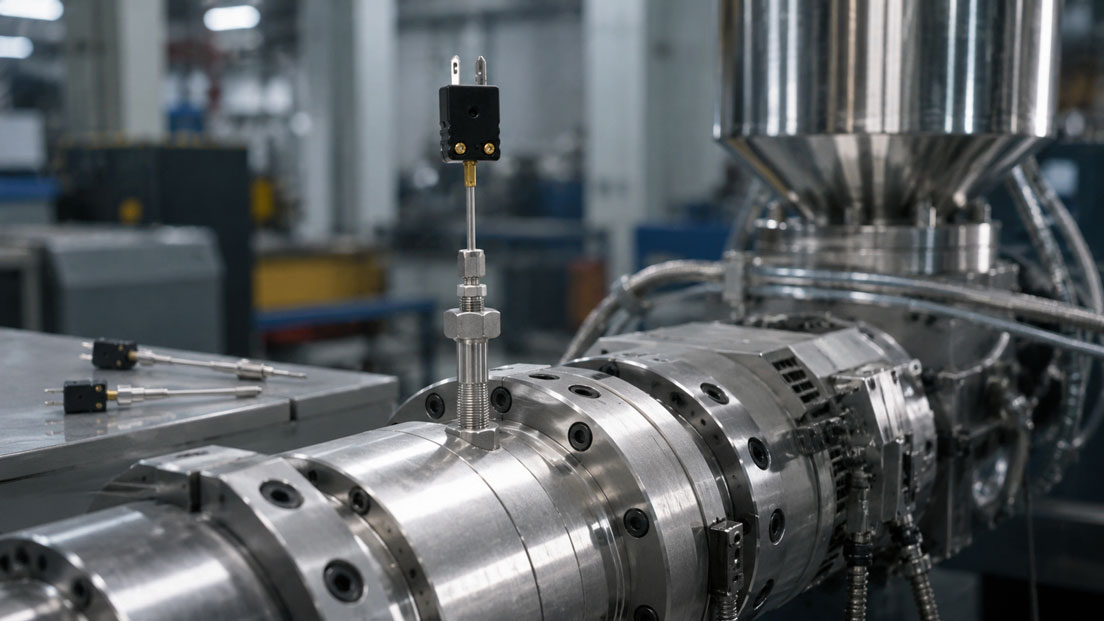
In plastics processing, temperature directly determines product quality, process stability and reject rate. Especially on extruders, it is not always sufficient to monitor only the housing or barrel temperature. The actual melt temperature of the plastic melt is often decisive.
A thermocouple for melt temperature measurement is inserted into the process in such a way that it measures as close as possible to the melt. This makes it possible to detect deviations that would not be visible from heating band, tool or housing temperatures alone. Especially in extrusion, injection molding, compounding and melt handling, this information is relevant to quality.
This article explains why melt temperature and housing temperature must not be equated, what role insertion depth, response time, sensor design, mechanical load and process connection play, and what should be considered when replacing thermocouples in existing systems.
Table of contents
- Basics: Why melt temperature is important in the plastics industry
- Melt temperature instead of only housing temperature
- Why thermocouples are often used on extruders
- Insertion depth and position of the sensor tip
- Response time: How quickly does the sensor need to react?
- Sensor design, tip and mechanical load
- Process connection and replacement in existing systems
- Typical measurement errors with extruder thermocouples
- Signal transmission, temperature transmitter and 4–20 mA
- Table: Selection criteria for thermocouples on extruders
- Practical example: Fluctuating melt temperature despite stable heating zones
- Table: Common causes of incorrect melt temperature values
- Which measuring instruments / products are suitable?
- Conclusion: Measuring melt temperature correctly instead of merely displaying temperature
- FAQ: Frequently asked questions about thermocouples on extruders
Basics: Why melt temperature is important in the plastics industry
In plastics processing, temperature influences almost every process step. It affects viscosity, flow behavior, shear, pressure build-up, mold filling, surface quality, dimensional accuracy and material properties. Even small temperature deviations can lead to fluctuations in the final product.
In extruders, the material is melted and conveyed by heating zones, screw movement, friction and shear energy. The actual temperature of the plastic melt is therefore not created only by the set heating band temperatures. Screw speed, throughput, material type, moisture content, back pressure and process condition also influence the melt temperature.
For this reason, the mere display of barrel or housing temperature is only part of the picture. It describes the temperature at a surface or near a heating zone, but not necessarily the temperature of the melt in the process. For quality and process control, however, the temperature of the melt is often decisive.
A screw-in melt thermocouple is used specifically to measure the temperature in the area of the melt. This makes it easier to assess process deviations, incorrect insertion depths, sluggish control, material changes or unfavorable operating conditions.
Melt temperature instead of only housing temperature
The housing temperature of an extruder is often measured using sensors on the barrel wall or in heating bands. This measurement is important for controlling the heating zones, but it does not automatically indicate the actual temperature of the plastic melt.
Melt temperature describes the temperature of the material in the process. It can differ from the barrel temperature because mechanical energy additionally introduces heat into the melt. Especially at higher screw speeds, with viscous materials or highly shearing process settings, the melt can be warmer than the housing temperature alone would suggest.
The opposite is also possible. With short residence times, unsuitable heating or material changes, the melt may not yet have fully reached the desired temperature level, even though the heating zone has already reached its setpoint. The process then appears stable on the display while the product is still fluctuating.
Melt temperature measurement helps make this difference visible. It is particularly important when surface defects, strand fluctuations, uneven throughput, material degradation or problems in downstream processing occur.
Why thermocouples are often used on extruders
Thermocouples are widely used in the plastics industry because they are robust, comparatively fast and suitable for high temperatures. They generate a temperature-dependent mV signal and, depending on the design, can be connected directly to a controller, display, temperature transmitter or process control system.
For extruder applications, thermocouples with a suitable mechanical design are particularly important. The sensor tip must withstand the process, the connection must fit the machine and the cable must be suitable for temperature, movement, abrasion and the environment.
Thermocouples of type J or K are frequently used. Which type is suitable depends on the temperature range, plant standard, controller, existing wiring and process requirement. The decisive point is that sensor, cable, evaluation device and configured thermocouple type match.
An incorrectly selected or incorrectly parameterized thermocouple type can lead to systematically incorrect temperature values. Therefore, when replacing sensors in existing systems, not only the mechanical fit should be considered, but also type, polarity, cable, connector and evaluation.
Insertion depth and position of the sensor tip
Insertion depth is one of the most important points in melt temperature measurement. If the sensor tip is located too far outside the actual melt stream, the sensor tends to measure the temperature of the housing or an edge zone. If it protrudes too far into the process, it can be mechanically loaded or influence the material flow.
The correct position depends on extruder type, screw geometry, installation point, process connection, material and desired measurement task. Melt temperature measurement at the adapter, nozzle or before the tool can provide different information than measurement in an earlier zone of the barrel.
With adjustable versions, manual adjustment of the immersion depth is a major advantage. This allows the sensor tip to be adapted to the specific installation point. However, this setting must be made deliberately and documented so that later spare parts or maintenance work do not lead to different measuring conditions.
A seemingly small change in insertion depth can have a significant effect on melt temperature measurements. Two sensors with the same thermocouple type can provide different values if the sensor tip is positioned at different depths in the process.
Response time: How quickly does the sensor need to react?
Response time describes how quickly a temperature sensor reacts to a change in process temperature. In extruder processes, this is important because material changes, throughput changes, screw speed, standstill or start-up processes can change the temperature of the melt.
A slow sensor displays temperature changes with a delay. This may be sufficient for steady processes, but it is problematic when fast deviations need to be detected or controlled. A measurement that is too slow can mean that process problems only become visible after rejects have already been produced.
A very fast sensor design can detect dynamic changes better, but depending on its design it may be more mechanically sensitive. For this reason, response time, robustness and process load must be weighed against each other.
In practice, it is not only the sensor that is decisive. Insertion depth, heat transfer, material contact, melt flow, sensor diameter and evaluation device also influence the actual response time of the measuring point. A fast sensor tip is of little use if it does not have good contact with the melt.
Sensor design, tip and mechanical load
Thermocouples on extruders are exposed to significantly higher mechanical loads than many simple temperature sensors. The sensor tip can be exposed to pressure, shear forces, vibrations, material flow, cleaning processes and temperature changes. The design must therefore match the application.
A robust sensor design protects the thermocouple from mechanical damage. At the same time, it must not unnecessarily impair heat transfer. The more solid the tip is, the more robust it can be, but it may also react more slowly.
With abrasive or filled plastics, for example with glass fibers, mineral fillers or additives, mechanical stress must be considered especially carefully. Frequent cleaning and changeover processes can also influence service life.
The cable and the transition to the sensor are also important. High ambient temperatures, movement, tensile load or unfavorable cable routing can lead to contact problems or cable breakage. Proper strain relief and a suitable cable design are therefore part of the measuring point quality.
Process connection and replacement in existing systems
When replacing a thermocouple in an existing extrusion system, the temperature measurement function is not the only important factor. It is also decisive whether thread, insertion length, sealing surface, cable outlet, connector, thermocouple type and installation situation match the existing machine.
A replacement sensor may be mechanically screwable and still deliver different measured values if the sensor tip ends at a different position or the design differs. Especially with melt temperature sensors, comparability of the installation situation is crucial.
Before replacement, the existing data should therefore be recorded: thermocouple type, process connection, insertion length, adjustable immersion depth, cable design, connection type, existing controller parameterization and operating temperature. Photos of the installation situation can also help.
After replacement, it should be checked whether the displayed temperature value is plausible. If the new sensor delivers significantly different values, this does not automatically indicate a sensor defect. The cause may also be a different insertion depth, better heat transfer, incorrect thermocouple type, reversed polarity or different controller parameterization.
Typical measurement errors with extruder thermocouples
Measurement errors with thermocouples on extruders are often not caused by the sensor alone, but by the entire measuring point. Incorrect insertion depth, poor contact with the melt, incorrect thermocouple type, damaged cable or unsuitable evaluation can significantly falsify the temperature value.
A common error is confusing melt temperature with barrel temperature. If a sensor does not reach far enough into the melt area, it measures the environment of the housing more strongly. The value then appears stable, but represents the actual melt temperature only insufficiently.
The polarity of the thermocouple is also important. If it is reversed, the displayed value can react implausibly. Depending on the evaluation device, the error is immediately noticeable or only becomes apparent when the temperature changes.
In addition, transition terminals, incorrect compensation cables or unsuitable extension cables can cause errors. Thermocouples require suitable cables and connections so that the mV signal is transmitted correctly to the evaluation device.
Signal transmission, temperature transmitter and 4–20 mA
Thermocouples provide a small mV signal. This signal is sensitive to incorrect cable routing, unsuitable connection points, thermoelectric voltages at transitions and incorrect parameterization of the evaluation device. In many machines, the thermocouple is connected directly to a temperature controller.
In larger systems or over longer signal distances, a temperature transmitter can be useful. It converts the thermocouple signal into a standardized output signal, for example 4–20 mA. This makes it easier to transmit the temperature value to a PLC, process control system or remote display.
If a temperature transmitter with a 4–20 mA output is used, the current loop should be checked separately. The sensor can measure correctly while scaling, wiring, analog input or display still deliver incorrect values.
The UPS4E current loop calibrator / loop calibrator is suitable for this test. It can be used to measure or simulate mA signals in order to assess the temperature transmitter, cable, PLC input and scaling separately. The thermocouple test itself is not replaced by this, but usefully complemented.
Table: Selection criteria for thermocouples on extruders
| Criterion | Why important? | Practical effect |
|---|---|---|
| Thermocouple type | Type J, K or another design must match the evaluation | Incorrect type leads to systematically incorrect temperature values |
| Insertion depth | Sensor tip must capture the relevant zone of the melt | Too little depth measures more of the housing; too much depth can be mechanically critical |
| Sensor design | Tip must match medium, pressure, shear and response time | Influences robustness, service life and response behavior |
| Process connection | Thread, sealing surface and insertion length must match the machine | Important for tight, safe and comparable replacement |
| Cable and connection | Thermocouple cable must match environment and evaluation | Prevents signal errors, cable breakage and incorrect polarity |
| Signal processing | Controller, transmitter or PLC must be correctly parameterized | Only then does the sensor signal become a plausible temperature value |
Practical example: Fluctuating melt temperature despite stable heating zones
Surface defects repeatedly occur on the product at an extrusion line. The heating zones of the extruder show stable values, and the control system reports no abnormalities. Nevertheless, product quality fluctuates depending on throughput and material batch.
A closer look shows that mainly barrel and tool temperatures have been evaluated so far. The actual melt temperature was only assumed indirectly. A screw-in melt thermocouple is installed at a suitable point to measure the temperature of the melt closer to the process.
After commissioning, the melt temperature shows that the melt becomes significantly warmer than expected at higher screw speed. The housing temperature remains largely stable. The cause is therefore not in the heating zone control, but in the additional heat input caused by shear.
By adjusting process parameters, evaluating the melt temperature and documenting material changes, the process becomes more stable. The example shows why melt temperature provides different information than housing temperature alone.
Table: Common causes of incorrect melt temperature values
| Fault pattern | Possible cause | Better approach |
|---|---|---|
| Temperature value appears too low | Sensor tip does not sufficiently reach the melt | Check insertion depth and position of the measuring point |
| Value reacts very slowly | Sensor design too solid or poor heat transfer | Assess sensor design and contact with the melt |
| Value jumps or drops out intermittently | Cable break, intermittent contact or damaged connection point | Check cable, connector, terminal and strain relief |
| Value changes in the wrong direction | Thermocouple polarity reversed | Check polarity and terminal assignment |
| New sensor shows a different value than old sensor | Different insertion depth, tip or thermocouple type | Compare mechanical and electrical design with old device |
| PLC shows a different temperature than controller | Scaling, transmitter or 4–20 mA input incorrectly parameterized | Check mA loop with UPS4E and verify scaling |
Which measuring instruments / products are suitable?
The TC47-MB screw-in melt thermocouple is suitable for direct melt temperature measurement on extrusion machines. It is particularly interesting for applications in the plastics industry where the temperature of the melt must be captured close to the process.
The category thermocouples provides a suitable starting point for selecting further solutions. Depending on the measuring point, nozzle, manifold block, bayonet or other thermocouple versions may also be relevant in addition to melt thermocouples.
For testing, simulation and troubleshooting on thermocouple measuring chains, the C.A 1621 calibrator for thermocouple sensors is a suitable supplement. It supports checking thermocouple types and mV signals and helps separate sensor, cable and evaluation more clearly from one another.
If the thermocouple signal is transmitted to a PLC, display or process control system via a temperature transmitter as 4–20 mA, the UPS4E current loop calibrator / loop calibrator should also be considered. It can be used to check whether the mA loop, wiring and scaling are working correctly.
When selecting a sensor, thermocouple type, temperature range, process connection, insertion length, immersion depth, sensor design, cable design, ambient temperature, mechanical load and signal processing should be considered together. Especially on extruders, the complete measuring point determines the quality of the temperature value.
Conclusion: Measuring melt temperature correctly instead of merely displaying temperature
In the plastics industry, melt temperature on extruders is an important process value. It shows what is actually happening to the melt and complements the classic housing or heating zone temperature. Especially in the case of quality problems, material changes, fluctuating throughput or demanding recipes, this measurement can provide decisive information.
A suitable thermocouple must match the application mechanically, thermally and electrically. Insertion depth, sensor tip, response time, process connection, cable and evaluation significantly influence the result. A sensor that fits mechanically is not automatically metrologically comparable.
With a suitable screw-in melt thermocouple such as the TC47-MB, clean installation, correct thermocouple evaluation and supplementary testing of the thermocouple or 4–20 mA measuring chain, melt temperature on extruders can be measured much more reliably and used for process optimization and quality assurance.
FAQ: Frequently asked questions about thermocouples on extruders
Why is housing temperature on the extruder not always sufficient?
Housing temperature mainly describes the temperature near the barrel, heating zone or surface. The actual plastic melt can deviate significantly from this due to shear, throughput, material properties and process condition.
What is melt temperature?
Melt temperature is the temperature of the plastic mass or melt in the process. It is often closer to actual product quality than a pure housing or heating band temperature.
Why are thermocouples used on extruders?
Thermocouples are robust, temperature-resistant and well suited for industrial applications. In a suitable design, they can be screwed into extruders, adapters or tool areas close to the process.
Which thermocouple types are commonly used?
Thermocouples of type J or K are frequently used in the plastics industry. The decisive factor is that thermocouple, cable and evaluation device are set or designed for the same type.
Why is insertion depth so important?
Insertion depth determines where the sensor tip measures. If it is too short, more of the environment or housing is measured. If it is too long, it can be mechanically loaded or influence the process.
What happens if the sensor tip does not properly reach the melt?
Then the measured value may be too low, too sluggish or not representative. The sensor does display a temperature, but it may not describe the actual melt temperature.
Why does a new sensor show a different value than the old one?
Possible causes include different insertion depth, different sensor design, better or poorer heat transfer, different thermocouple type, reversed polarity or different parameterization of the evaluation device.
Can a thermocouple be connected the wrong way round?
Yes. If the polarity is reversed, the temperature value can react implausibly. Therefore, terminal assignment, cable type and polarity should be checked carefully during replacement.
What role does response time play?
Response time determines how quickly temperature changes become visible. In dynamic processes or fast material changes, a sluggish measuring point can display process deviations too late.
What should be considered with abrasive plastics?
Filled or abrasive materials can mechanically load the sensor tip more heavily. The sensor design must therefore match the medium, pressure, shear and expected service life.
Can a temperature transmitter be useful?
Yes. If the thermocouple signal is to be transmitted over longer distances or integrated into a PLC, a temperature transmitter can convert the signal into a standardized output signal such as 4–20 mA.
How does the UPS4E help at a thermocouple measuring point?
The UPS4E does not test the thermocouple directly. It is useful when a temperature transmitter outputs a 4–20 mA signal. The current loop, wiring, PLC input and scaling can then be checked.
How do you test a thermocouple measuring chain?
Depending on the setup, sensor, cable, evaluation and transmitter can be considered separately. A thermocouple calibrator can test or simulate mV or thermocouple signals. With a 4–20 mA output, the current loop is additionally tested.
What should be documented when replacing sensors in existing systems?
Important points include thermocouple type, process connection, insertion length, set immersion depth, sensor design, cable, connection type, controller parameterization and installation point. This keeps the new sensor comparable to the old one.
What is the most important practical tip?
The most important practical tip is: Always consider melt temperature measurement as a complete measuring point. Sensor, insertion depth, sensor design, process contact, cable and evaluation must match so that the displayed value truly describes the melt temperature.