


In practice, the same question comes up very often in pressure calibration: Should calibration be performed pneumatically with air or gas, or is hydraulic calibration with oil or water the better choice? The answer does not depend only on the pressure range. Safety, stability, media compatibility, risk of contamination, venting, accuracy requirements and the type of device under test are also decisive.
Pneumatic calibration is particularly practical for low and medium pressures, for vacuum, for clean measuring points and for many on-site tests. Hydraulic calibration, on the other hand, is often used at higher pressures when working with liquids is more stable and safer. Both methods have clear advantages, but also typical sources of error.
This article explains when air is sufficient, when oil or water is more suitable, why compressible media must be assessed differently from a safety perspective, and what must be considered regarding calibration pump, reference instrument, device under test, 4–20 mA signal, venting and documentation.
Table of contents
- Basics: What is the difference between pneumatic and hydraulic pressure calibration?
- Pneumatic pressure calibration: When air or gas is useful
- Hydraulic pressure calibration: When oil or water is the better choice
- Safety: Why compressible media must be assessed differently
- Pressure range and device under test: Choosing the medium to match the task
- Oil, water or air: Consider contamination and media compatibility
- Pressure stability, venting and fine adjustment
- Reference instrument, accuracy and calibration points
- 4–20 mA pressure transmitters: Testing pressure and output signal together
- Table: Pneumatic or hydraulic?
- Practical example: Selecting the right calibration pump in service
- Table: Typical errors in pressure calibration
- Which measuring instruments / products are suitable?
- Conclusion: The right medium makes calibration safer and more stable
- FAQ: Frequently asked questions about pneumatic and hydraulic pressure calibration
Basics: What is the difference between pneumatic and hydraulic pressure calibration?
In pneumatic pressure calibration, the test pressure is generated with air or a suitable gas. This is particularly practical because the medium is clean, no liquid enters the device under test, and vacuum as well as low to medium positive pressures can be generated easily. Typical applications include pressure gauges, pressure transmitters, differential pressure sensors, pressure switches or simple functional tests in service.
In hydraulic pressure calibration, the pressure is generated with a liquid, usually hydraulic oil, water or another suitable test medium. Compared with gases, liquids are hardly compressible. This allows higher pressures to be generated and held more stably. Hydraulic calibration is therefore particularly relevant for high-pressure gauges, pressure sensors, pressure switches, hydraulic components and pressure measuring points with higher measuring ranges.
The difference is therefore not only the medium, but the behavior of the entire test setup. Air can be compressed and stores energy in the process. Liquids are significantly less compressible, but require clean filling, careful venting and attention to contamination or media compatibility.
Good pressure calibration therefore starts with the question: Which pressure range is to be tested, which device under test is connected, which medium is allowed to enter the device under test, and how stable must the pressure be during measurement?
Pneumatic pressure calibration: When air or gas is useful
Pneumatic calibration is ideal when clean, dry and comparatively low pressures need to be tested. Especially for on-site service, commissioning, control cabinet work, laboratory testing or maintenance, a pneumatic hand pump is very practical. No oil is carried along, the setup remains clean, and the device under test is not exposed to liquid.
A typical advantage is easy handling. A pressure transmitter or pressure gauge can be quickly tested with a pneumatic calibration pump, a reference instrument and suitable connections. Vacuum tests can also be performed well pneumatically if the pump is designed for this.
Pneumatics are particularly useful for low measuring ranges, differential pressure measurements, pressure switches in the lower range, HVAC applications, process air, clean gases and devices under test that should not come into contact with oil or water.
Limits arise when very high pressures have to be generated or when the pressure must be held particularly stable. Since air is compressible, small changes in volume, leaks, temperature changes or hose movements can visibly influence the pressure. The higher the pressure and the larger the enclosed volume, the stronger this effect becomes.
Hydraulic pressure calibration: When oil or water is the better choice
Hydraulic pressure calibration is particularly suitable when higher pressures need to be tested. Oil or water are much less compressible than air. As a result, pressure generation at high pressures is more stable, and small volume changes have less effect than in a pneumatic test.
Typical applications include high-pressure gauges, pressure sensors, pressure switches, hydraulic measuring points, test benches, mechanical engineering, maintenance of hydraulic systems and calibrations above the usual pneumatic ranges. Hydraulic calibration can also provide better pressure stability with long test lines or larger device volumes.
However, the test medium must match the device under test. Hydraulic oil is obvious in many hydraulic applications, but may be unacceptable in oxygen, ultra-pure gas, food, pharmaceutical, water or certain process applications. Water or demineralized water can be an alternative if materials, seals and corrosion protection are suitable.
Hydraulic systems must be carefully vented. Air bubbles in the test section make the otherwise stable hydraulic test more elastic and make fine adjustment more difficult. Venting is therefore not a secondary issue in hydraulic calibrations, but a prerequisite for reproducible results.
Safety: Why compressible media must be assessed differently
The most important safety difference between pneumatic and hydraulic calibration lies in the compressibility of the medium. Gases store significantly more energy in the compressed volume during pressure build-up. If a component fails, a connection is loosened or a hose bursts, this energy can be released suddenly.
For this reason, high pressures should not be generated pneumatically without careful assessment. Pneumatic tests are clean and convenient, but as pressure increases, the risk from stored energy must be assessed carefully. Particular caution is required with large volumes, unsuitable hoses, unsafe adapters or unknown devices under test.
Hydraulic tests are often considered easier to control at high pressures because liquids are less compressible. However, this does not mean that hydraulic high-pressure tests are harmless. Hydraulic systems can also be dangerous in the event of leakage, hose failure or incorrect installation. Escaping fluid at high pressure can also cause injury.
The following applies to both methods: Pressure calibrations may only be carried out with suitable pumps, approved hoses, suitable adapters, intact seals and qualified personnel. Before loosening connections, the pressure must be completely relieved. The maximum pressure of pump, reference, device under test, hose and adapter must never be exceeded.
Pressure range and device under test: Choosing the medium to match the task
The pressure range is a central selection factor. For vacuum, low pressure and many medium pressure ranges, a pneumatic pump is often the fastest and cleanest solution. However, if the measuring range is significantly higher, hydraulic pressure generation usually becomes more appropriate.
The device under test plays just as important a role as the pressure range. A pressure transmitter for dry gases should not be filled with oil without checking. A pressure gauge from a hydraulic system, on the other hand, is often uncritical with oil as the test medium. An oxygen device, an ultra-pure gas sensor or a sensor for food applications must not simply be tested with arbitrary oil or contaminated water.
The internal design of the device under test is also important. Some pressure measuring devices have small internal volumes and stabilize quickly. Others have larger volumes, capillary lines, diaphragm seals or protection systems. The larger the volume, the more pronounced the effects of air, temperature and trapped bubbles become.
For pressure switches, the switching point is also important. For a clean switching point test, the pressure must be approached slowly and in a controlled manner. Here, not only the medium is decisive, but also the fine adjustment of the pump and the reading of the reference.
Oil, water or air: Consider contamination and media compatibility
The choice of test medium must not be made only from the perspective of the pump. It is also decisive what the device under test will later see in the process and which media it can tolerate. A device under test can be contaminated, damaged or rendered unusable for its actual application by the wrong calibration medium.
Oil is very common in hydraulics and offers good lubrication and stable pressure transmission. However, it can be problematic if the device under test is later used in water, gas, oxygen, food, pharmaceutical or ultra-pure applications. Even small oil residues can be critical there.
Water can be useful when oil is to be avoided. However, corrosion, material compatibility, seals, risk of freezing and drying must be considered. Demineralized water can be useful in certain cases, but it is not automatically compatible with every measuring point.
Air or gas is cleaner in terms of liquid residues, but not always suitable for high pressures or large volumes. The air should also be dry and clean so that no moisture or particles enter the device under test.
Pressure stability, venting and fine adjustment
A calibration is only meaningful if the set pressure is stable enough to allow a useful comparison between the device under test and the reference. If the pressure fluctuates during reading, the calibration quickly becomes a rough functional test.
In pneumatic tests, temperature changes, hand heat, hose movements, small leaks or elastic volumes can cause pressure changes. After setting the pressure, it is therefore advisable to wait briefly until the value has stabilized. Especially in small measuring ranges, even a small disturbance can become visible.
In hydraulic tests, venting is decisive. Air bubbles in the system behave like a compressible cushion. The pressure then becomes harder to fine-adjust, drops after pumping or reacts with a delay. Careful filling and venting significantly improves stability.
Fine adjustment of the pump is also important. A good calibration pump should not only generate pressure, but also allow it to be adjusted in a controlled and sensitive way. Especially with pressure switches, tight tolerances or multi-point calibrations, a precise fine adjuster is more important than maximum pressure performance alone.
Reference instrument, accuracy and calibration points
In addition to pressure generation, the reference instrument is decisive. A calibration pump generates the pressure, but the evaluation is carried out using a reference, for example a reference pressure gauge, a digital pressure calibrator or a portable pressure calibrator with an internal sensor.
The accuracy of the reference should match the accuracy requirement of the device under test. A rough reference is not sufficient to properly evaluate a precise pressure transmitter. At the same time, a very high-quality reference is of little help if the pressure build-up is unstable or the measuring point has not been properly vented.
Calibration points should be distributed across the relevant measuring range. Rising and falling points are often useful to identify hysteresis and repeatability. For pressure switches, switching point and reset point must be considered separately.
For tests requiring documentation, measuring range, calibration points, reference instrument, serial number, calibration status, test medium, ambient temperature and result should be recorded traceably. Only then can it later be assessed under which conditions the device under test was checked.
4–20 mA pressure transmitters: Testing pressure and output signal together
For pressure transmitters, it is not enough to generate only the mechanical pressure. If the transmitter outputs a 4–20 mA signal, it must also be checked whether the output signal correctly matches the applied pressure. The pressure value at the reference and the electrical signal belong to the same measuring chain.
A typical example is a pressure transmitter with 0…10 bar and 4–20 mA. At 0 bar, the output should be close to 4 mA, at 5 bar close to 12 mA and at 10 bar close to 20 mA. If the pressure is applied correctly but the mA signal does not match, the cause may be the transmitter, wiring, power supply, load or scaling.
The UPS4E current loop calibrator / loop calibrator is suitable for checking the current loop. It can measure and simulate mA signals and helps separate the pressure part of the calibration from the electrical evaluation.
In practice, it is useful to combine pressure calibration with signal testing. The calibration pump generates the test pressure, the reference evaluates the pressure, and the current loop calibrator checks the output signal or the PLC input. This makes it clear whether the error lies in the pressure sensor, current loop or control system scaling.
Table: Pneumatic or hydraulic?
| Criterion | Pneumatic calibration | Hydraulic calibration |
|---|---|---|
| Typical medium | Air or suitable gas | Oil, water or suitable test medium |
| Typical use | Vacuum, low pressure, medium pressures, clean devices under test | High pressure, hydraulics, stable pressure generation |
| Advantage | Clean, fast, no liquid entry | Stable at high pressures, low compressibility |
| Main critical point | Compressibility and stored energy at higher pressure | Venting, liquid residues and media compatibility |
| Typical source of error | Leakage, temperature change, excessive volume | Air bubbles, wrong oil, insufficient cleaning |
| Particularly suitable for | Gas pressure, vacuum, differential pressure, service testing | High-pressure gauges, hydraulic pressure sensors, pressure switches |
Practical example: Selecting the right calibration pump in service
A service technician is to check several pressure measuring instruments. The list includes a differential pressure transmitter for ventilation, a pressure switch for compressed air, a 0…16 bar pressure transmitter with 4–20 mA and a hydraulic pressure gauge up to 400 bar.
For the differential pressure transmitter and the pressure switch in the compressed air range, a pneumatic calibration pump is useful. It is clean, mobile and well suited for low to medium pressures. Since no liquid should enter the devices under test, a hydraulic pump would be unnecessary and potentially problematic here.
The 0…16 bar pressure transmitter can also be tested pneumatically, provided that pump, hose, adapter and safety assessment are suitable. In addition, its 4–20 mA output is checked with a current loop calibrator so that pressure value and output signal can be evaluated together.
For the hydraulic pressure gauge up to 400 bar, however, a hydraulic calibration pump is the right choice. The pressure range is significantly higher, and a liquid enables stable high-pressure generation. Before the test, care is taken to ensure that the test medium matches the pressure gauge and that the line is carefully vented.
The example shows: In many service cases, one single pump is not enough for all tasks. The right combination of pneumatic pump, hydraulic pump, reference instrument and current loop calibrator leads to safe and traceable results more quickly.
Table: Typical errors in pressure calibration
| Error | Possible consequence | Better approach |
|---|---|---|
| Generated too high a pressure pneumatically | Increased risk due to stored energy | Check pressure range and safety assessment beforehand |
| Hydraulic system not vented | Pressure is unstable or difficult to fine-adjust | Fill and vent the test section carefully |
| Wrong test medium used | Contamination or damage to the device under test | Consider media compatibility and later application |
| Reference too inaccurate | Calibration result is not meaningful | Select reference to match the device under test accuracy |
| Only pressure tested, mA signal ignored | Transmitter appears correct, but PLC shows wrong values | Check 4–20 mA signal with UPS4E and verify scaling |
| Adapter or hose unsuitable | Leakage, safety risk or measurement error | Check pressure rating, connection and seals before testing |
Which measuring instruments / products are suitable?
Pneumatic calibration pumps are suitable for clean on-site tests, vacuum and low to medium pressures. They are particularly practical when pressure needs to be generated without a liquid medium and the device under test must remain clean.
Hydraulic calibration pumps are the right choice for higher pressures, hydraulic applications and stable high-pressure generation. They are suitable for applications where oil, water or another suitable test medium may be used and stable pressure generation in the higher range is required.
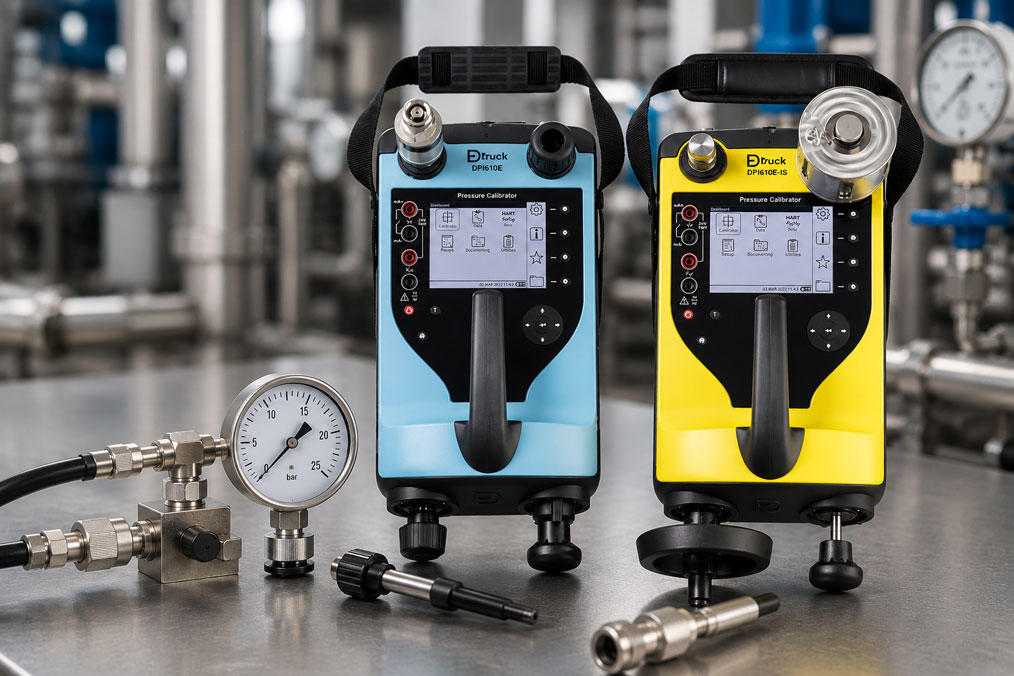
If a compact all-in-one tool for pressure generation, pressure measurement, electrical measurement and documentation is required, the DPI610E / DPI610E-IS portable pressure calibrators are particularly interesting. Depending on the version, pneumatic and hydraulic variants are available, allowing many service and calibration tasks to be handled with an integrated system.
For pressure transmitters with a 4–20 mA output, the UPS4E current loop calibrator / loop calibrator should also be planned. It helps measure or simulate mA signals and test the electrical measuring chain up to the PLC, display or process control system.
For a complete calibration solution, suitable reference pressure gauges, digital reference pressure sensors, adapters, hoses, seals and, where applicable, calibration certificates should also be considered. The best pump alone is not enough if the reference, connections or test medium do not match the task.
Conclusion: The right medium makes calibration safer and more stable
Whether pneumatic or hydraulic pressure calibration is the right choice depends on pressure range, device under test, safety requirement, media compatibility and desired stability. Air is clean, fast and ideal for many low to medium pressure ranges. Oil or water are often more stable and better suited for higher pressures and hydraulic applications.
However, the decision should never be made based only on pressure range. Compressibility, stored energy, venting, contamination risk, reference accuracy, adapters, hoses and the output signal of the device under test are just as important.
With the right combination of pneumatic or hydraulic calibration pump, suitable reference, clean test medium and targeted 4–20 mA testing with the UPS4E, the result is a calibration that not only generates pressure, but also delivers a reliable and traceable result.
FAQ: Frequently asked questions about pneumatic and hydraulic pressure calibration
When is pneumatic pressure calibration useful?
Pneumatic pressure calibration is useful for vacuum, low to medium pressures, clean devices under test and applications where no liquid may enter the device under test. It is particularly practical for on-site service, commissioning and many compressed air or gas pressure measuring points.
When should hydraulic calibration be used?
Hydraulic calibration is useful for higher pressures, hydraulic applications and devices under test where oil or water is permitted as the test medium. At high pressures, it usually offers more stable pressure generation than air.
Why is air more critical at high pressures?
Air is compressible and stores energy during pressure build-up. If a hose, adapter or device under test fails, this energy can be released suddenly. Pneumatic high-pressure tests must therefore be assessed especially carefully.
Is hydraulic calibration automatically safe?
No. Hydraulic systems often operate at very high pressures. Leaks, wrong adapters, damaged hoses or escaping fluid can be dangerous. Hydraulic tests also require suitable equipment and qualified personnel.
Which test medium is better: oil or water?
This depends on the device under test and its later application. Oil is typical for hydraulics, but can be problematic in gas, oxygen, food or ultra-pure applications. Water avoids oil residues, but corrosion, drying and material compatibility must be considered.
Why is venting so important in hydraulic calibration?
Air bubbles act like a compressible cushion. This makes the pressure harder to stabilize and fine-adjust. Careful venting significantly improves repeatability and pressure stability.
Why does the test pressure slowly drop after adjustment?
Possible causes include leaks, temperature changes, elastic hoses, trapped air or a device under test that has not yet stabilized. In hydraulic systems, air in the test section is often a cause.
Can a pressure transmitter be tested with only a pump?
Mechanically, pressure can be generated with a pump. For a complete test of a pressure transmitter, however, the output signal must also be evaluated, for example 4–20 mA, voltage or digital measured value.
How do you correctly test a 4–20 mA pressure transmitter?
The test pressure is generated with a calibration pump and measured with a reference. At the same time, the mA signal is checked. With the UPS4E, the current signal can be measured or simulated to evaluate transmitter, wiring and PLC scaling.
What role does the reference play in pressure calibration?
The reference provides the comparison value for the calibration. It must be more accurate and more suitable than the device under test. Without a suitable reference, the meaningfulness of the calibration is limited.
How many calibration points are useful?
This depends on the device under test and requirements. Several points across the measuring range are often checked, for example 0 %, 25 %, 50 %, 75 % and 100 %. Rising and falling points help detect hysteresis.
Why should the pump measuring range match the device under test?
A pump that is too small will not reach the desired pressure. An unnecessarily large high-pressure pump can be difficult to control sensitively in small measuring ranges. The range should match the task.
May an oxygen sensor be calibrated with oil?
This should not be done without explicit approval. Oil in oxygen applications can be critical. Such measuring points require suitable, clean and approved procedures and components.
What is particularly important with pressure switches?
Pressure switches must be approached slowly and in a controlled manner. Switching point and reset point should be recorded separately. Good fine adjustment of the pump is particularly important here.
What is the most important decision question?
The most important question is: Which medium and pressure range safely match the device under test and its later application? Only then should pump, reference, adapter and test procedure be selected.