


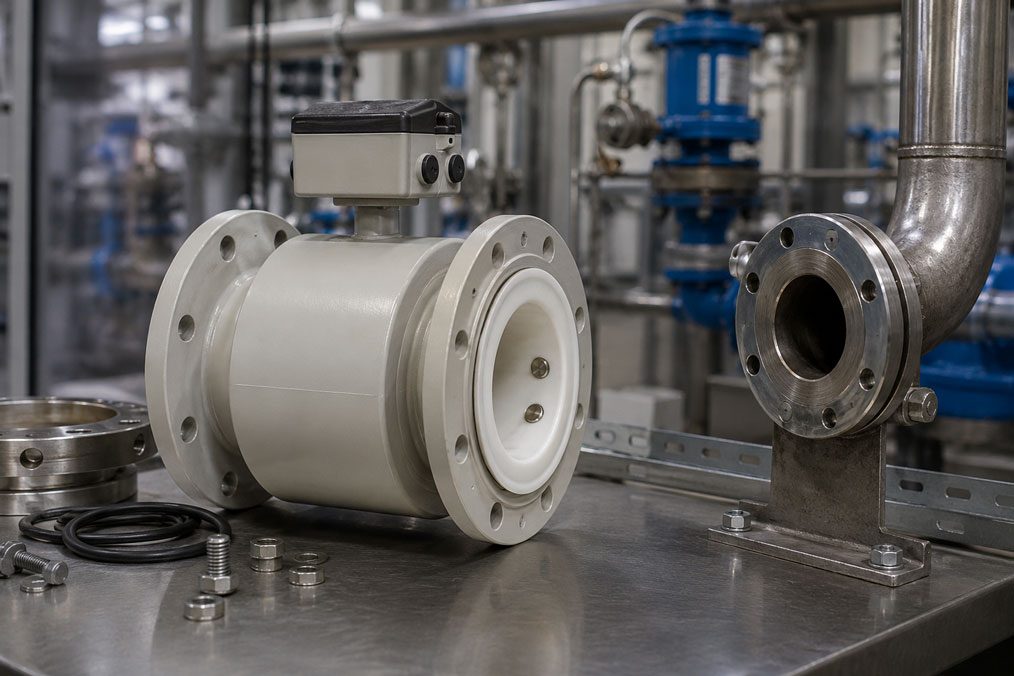
When selecting an electromagnetic flowmeter, suitability is determined not only by the nominal diameter, measuring range and electronics. The measuring tube lining and the material of the measuring electrodes are in direct contact with the process medium and must withstand its chemical, thermal and mechanical stresses over the long term.
An unsuitable lining can swell, become brittle, detach from the measuring tube or deform under vacuum. Unsuitable electrodes can corrode, develop coatings or be damaged by abrasive solids. The consequences range from unstable measured values to complete failure of the flow sensor.
Material selection must therefore not be based solely on the name of the medium. Concentration, temperature, pressure, flow velocity, solids content, cleaning procedures and possible contaminants must be assessed together.
Table of Contents
- What are the functions of liners and electrodes?
- Selecting materials systematically
- Direct comparison of PTFE, PFA and EPDM
- When is a PTFE lining suitable?
- When does PFA offer advantages?
- When is EPDM suitable?
- Abrasion, solids and flow velocity
- Considering vacuum, pressure and temperature
- Electrodes made of stainless steel, Hastelloy, titanium and tantalum
- Do not overlook seals and process connections
- CIP, SIP and hygienic applications
- Classifying typical applications correctly
- Typical material-selection errors
- Which process data are required?
- Which products are suitable?
- Conclusion
- Frequently asked questions
What are the functions of liners and electrodes?
The metallic measuring tube of an electromagnetic flowmeter must be electrically insulated from the conductive medium. This function is performed by the internal lining, often referred to as the liner.
The liner fulfils several functions:
- electrical insulation between the medium and metallic measuring tube,
- protection of the measuring tube against corrosion,
- resistance to process and cleaning media,
- absorption of mechanical stresses caused by pressure, vacuum and solids,
- formation of a defined and preferably smooth measuring-tube geometry.
The measuring electrodes detect the voltage generated by the movement of the conductive medium. In conventional electromagnetic flowmeters, they are located directly in the medium and must therefore be electrically conductive as well as chemically and mechanically resistant.
The liner and electrodes must be considered as a combined material system. A highly resistant electrode provides no benefit if the lining or a seal is attacked by the medium at the same time.
Selecting materials systematically
A reliable selection process involves several steps:
- Describe the medium completely: The trade name alone is not sufficient. Specify the chemical composition, concentration and possible contaminants.
- Record the temperatures: Consider the normal temperature, maximum process temperature and temperatures during cleaning and sterilisation.
- Clarify the pressure conditions: Specify the operating pressure, pressure surges, cleaning pressure and possible vacuum conditions.
- Assess mechanical stress: Check solids, particle size, hardness, concentration and flow velocity.
- Define hygiene and approval requirements: Document requirements for drinking water, food, pharmaceutical or hazardous-area applications.
- Consider the complete measuring point: Assess liners, electrodes, seals, grounding rings and process connections together.
- Obtain manufacturer approval: Have the final material selection confirmed on the basis of the complete process data.
Chemical-resistance tables provide only a preliminary selection. A material that is suitable for a diluted medium at room temperature may be unsuitable at a higher concentration or temperature.
Direct comparison of PTFE, PFA and EPDM
| Criterion | PTFE | PFA | EPDM |
|---|---|---|---|
| Material group | Fluoropolymer | Fluoropolymer | Elastomer |
| Typical strength | Broad chemical and thermal resistance | Chemical resistance combined with good mechanical dimensional stability | Water applications, elasticity and frequent drinking-water approvals |
| Typical applications | Chemical and general process industry | Chemical, food, pharmaceutical and demanding temperature-change applications | Drinking water, raw water and selected water processes |
| Vacuum exposure | Must be assessed carefully depending on sensor design, nominal diameter and temperature | Often mechanically more stable with a suitable sensor design | Only within the expressly approved pressure and vacuum limits |
| Abrasive media | Only following manufacturer assessment | Only following manufacturer assessment | Suitable for certain water and solids applications, but not universally abrasion-resistant |
| Oils and hydrocarbons | Must be assessed for the specific medium | Must be assessed for the specific medium | Frequently critical or unsuitable |
| Hygienic applications | Possible with a suitably designed hygienic sensor | Frequently used in hygienic sensor designs | May be used as a sealing or lining material depending on the approval |
The table shows typical tendencies. It does not constitute approval for a specific medium.
When is a PTFE lining suitable?
PTFE is frequently used in the chemical and general process industries. The material offers broad resistance to many aggressive media and, depending on the sensor design, can be used at comparatively high temperatures.
Typical applications include:
- acids and alkalis following confirmed compatibility assessment,
- chemical process liquids,
- media for which elastomer linings do not provide sufficient resistance,
- applications with elevated process temperatures,
- general industrial liquid measurement.
In many electromagnetic flowmeters, PTFE is used as a moulded or inserted liner. Depending on the design, the lining may not be bonded over its entire surface to the measuring tube. Strong vacuum or rapid temperature changes can therefore cause mechanical stress.
Before selection, the following points in particular must be checked:
- permissible negative pressure for the specific nominal diameter,
- medium temperature during operation and cleaning,
- pressure-temperature limits of the sensor,
- possible temperature changes,
- abrasion caused by solids,
- permissible flow velocity.
A general statement such as “PTFE is chemically resistant” is not sufficient for approving a measuring point.
When does PFA offer advantages?
PFA also belongs to the fluoropolymer group and provides broad chemical resistance. In electromagnetic flowmeter construction, depending on the design, PFA can be permanently bonded to a supporting inner tube or moulded into a mechanically stable form.
PFA may therefore offer advantages in applications involving:
- changing process temperatures,
- vacuum or negative-pressure conditions,
- hygienic applications,
- smaller nominal diameters,
- aggressive process and cleaning media,
- applications with high requirements for a smooth internal surface.
However, PFA is not automatically suitable for every aggressive medium or vacuum application. The specific design, wall thickness, support, nominal diameter and the pressure-temperature combination approved by the manufacturer are decisive.
The available electrode materials may also depend on the selected lining. Not every liner and electrode combination is available in every nominal diameter.
When is EPDM suitable?
EPDM is an elastic lining material frequently used in water and drinking-water applications. Depending on the sensor design, various national and international drinking-water approvals are available.
Typical applications include:
- drinking water,
- raw water,
- cooling and service water,
- water treatment,
- selected wastewater processes,
- certain food and beverage applications.
EPDM offers good resistance to water and ageing. However, EPDM is frequently unsuitable for mineral oils, fuels and many hydrocarbon-containing media.
For wastewater, it must therefore be determined whether oils, greases, solvents or other hydrocarbons may occur. Cleaning chemicals, flocculants and changing pH values must also be included in the assessment.
An existing drinking-water approval applies only to the specifically certified sensor and material version. The designation EPDM alone does not confirm approval.
Abrasion, solids and flow velocity
In slurries, suspensions and liquids containing solids, the liner is subjected not only to chemical but also to mechanical stress.
Abrasion depends on factors including:
- particle hardness,
- particle size and shape,
- solids concentration,
- flow velocity,
- installation position,
- flow profile,
- operating duration.
A low concentration of hard, sharp-edged particles can be more critical than a higher concentration of softer components.
For abrasive media, depending on the manufacturer, special linings such as Linatex, soft rubber or ceramic are available in addition to EPDM and hard rubber. PTFE and PFA should be used for severe abrasion only if the manufacturer explicitly confirms the application.
The electrodes are also subjected to mechanical stress. Deposits, particle impact or an unfavourable electrode geometry can affect the measuring signal.
Considering vacuum, pressure and temperature
The permissible load on an electromagnetic flowmeter is not determined solely by the flange pressure rating. The lining can limit the actual usable pressure and temperature range.
Important operating conditions include:
- normal positive operating pressure,
- pressure surges when pumps and valves are switched,
- negative pressure on the suction side of a pump,
- vacuum during emptying or cleaning,
- high temperatures during CIP or SIP processes,
- rapid temperature changes.
Negative pressure can cause a liner to detach from or deform inside the supporting measuring tube. The risk may increase with rising temperature and nominal diameter.
The pressure-temperature tables for the specific sensor must therefore be used for every design. The maximum temperature stated in a material table must not simply be adopted as the permissible continuous operating temperature of the complete flowmeter.
Electrodes made of stainless steel, Hastelloy, titanium and tantalum
| Electrode material | Typical strength | Typical limitation |
|---|---|---|
| Stainless steel 316L or 316Ti | Economical standard solution for many water and non-aggressive process media | Critical with chloride-containing, strongly acidic or corrosive media |
| Hastelloy C | Increased resistance to many corrosive and chloride-containing media | Not universally resistant; check the precise alloy and process data |
| Titanium | Good resistance in many oxidising and chloride-containing media | Unsuitable for certain reducing acids |
| Tantalum | Very high resistance to many strongly acidic media | Fluorine-containing media, certain alkalis and abrasion are particularly critical |
| Platinum or platinum-iridium | High chemical resistance for special process applications | High cost and unsuitable for certain mechanical loads |
Stainless steel as the standard electrode
Stainless-steel electrodes are suitable for many water, cooling-water, food and general process applications. They are economical and available in numerous sensor versions.
However, localised corrosion may occur with chloride-containing media, brine, strong acids or high temperatures. The precise grade of stainless steel must also be considered.
Hastelloy for increased corrosion resistance
Hastelloy electrodes are frequently selected when stainless steel does not provide sufficient resistance. Nickel-chromium-molybdenum alloys offer increased resistance to many chloride-containing and chemically aggressive media.
However, the designation Hastelloy alone is not specific enough. C-22, C-276 and other alloys can differ in their resistance. The precise alloy must therefore be considered in the ordering code and material assessment.
Tantalum for particularly aggressive media
Tantalum provides very high corrosion resistance to many acids and is therefore used in demanding chemical applications.
Important limitations include:
- fluorine-containing media and fluorine compounds,
- certain strongly alkaline processes,
- abrasive solids,
- mechanical loads,
- high material costs.
Tantalum is relatively soft and must not be selected for abrasive slurries solely because of its chemical resistance.
Titanium for oxidising and chloride-containing media
Under suitable conditions, titanium forms a protective oxide layer. It can therefore be suitable for many oxidising media and certain chloride loads.
However, this protective effect may be limited in reducing acids or oxygen-depleted process conditions. A specific media assessment is also required in this case.
Do not overlook seals and process connections
The resistance of an electromagnetic flowmeter is not determined exclusively by the liner and electrodes. Depending on the design, further wetted components may include:
- flange or clamp seals,
- grounding rings,
- process connections,
- measuring and grounding electrodes,
- adapters and reducers,
- bolts and mating flanges.
A seal can fail significantly earlier than a PTFE or PFA liner. EPDM, FKM, FFKM or PTFE seals, for example, must therefore be assessed separately.
During installation, the seal must not protrude into the measuring tube. A protruding or incorrectly centred seal can disturb the flow profile, cause deposits and place mechanical stress on the liner.
The flanges must be aligned parallel to one another. Pulling misaligned pipelines together using the sensor bolts can damage the flow sensor and its lining.
CIP, SIP and hygienic applications
For food, beverage and pharmaceutical applications, a chemically resistant lining alone is not sufficient. The complete sensor must have a hygienic design.
The following must be considered:
- hygienic process connections,
- suitable surfaces and materials,
- low-dead-space design,
- permissible cleaning chemicals,
- concentration and temperature of the CIP media,
- duration and frequency of cleaning cycles,
- SIP temperature and sterilisation duration,
- required food or pharmaceutical approvals.
A sensor may withstand the actual product medium but be damaged by hot alkali, acid or pure steam during cleaning.
PFA and ceramic are frequently used in hygienic electromagnetic flowmeters. However, their specific suitability depends on the sensor design, seals, electrodes, process connection and approval.
A hygienic clamp connection does not automatically make a sensor suitable for CIP or SIP. The relevant approval must be confirmed by the data sheet and certification.
Classifying typical applications correctly
| Application | Frequent preliminary selection | Particularly important checks |
|---|---|---|
| Drinking water | EPDM with stainless-steel or Hastelloy electrodes | Specific drinking-water approval of the complete sensor version |
| Municipal wastewater | EPDM, NBR or hard rubber with Hastelloy electrodes | Oils, hydrocarbons, solids and abrasion |
| Acidic process liquid | PTFE or PFA with Hastelloy, tantalum or platinum | Type of acid, concentration, temperature and contaminants |
| Chloride-containing medium | PTFE or PFA with Hastelloy or titanium | Chloride concentration, temperature, oxygen content and pH value |
| Abrasive suspension | Special rubber or ceramic lining | Particle hardness, grain size, velocity and electrode wear |
| Food and beverages | PFA or ceramic in a hygienic sensor design | CIP/SIP media, seals and required approvals |
| Process with negative pressure | Mechanically supported liner approved for vacuum | Nominal diameter, temperature and minimum absolute pressure |
These examples serve only as a preliminary selection. The actual material combination must be confirmed by the manufacturer for the specific process.
Typical material-selection errors
The medium is specified only using a generic term
Descriptions such as “acid”, “wastewater” or “cleaning agent” are not sufficient. The composition and concentration are missing.
Only normal operation is considered
CIP, SIP, flushing, plant shutdown and fault conditions can create significantly higher stresses.
The electrodes are selected correctly, but the liner is not
The electrodes are corrosion-resistant while the lining swells or becomes brittle.
EPDM is used generally for all wastewater
Oils, fuels or solvents in the wastewater can attack the lining.
PTFE is used without assessing vacuum conditions
Negative pressure and elevated temperature can cause the lining to deform mechanically.
Tantalum is selected for abrasive media because of its chemical resistance
The soft electrode is mechanically stressed by solids.
The seal is not assessed
The liner is suitable, but the flange or clamp seal is not.
The maximum material temperature is adopted as the sensor approval
The flange, pressure rating, nominal diameter and sensor design may reduce the permissible range.
An approval is assumed solely on the basis of the material name
EPDM or stainless steel alone does not confirm drinking-water, food or pharmaceutical approval.
Which process data are required?
At least the following information should be available for a reliable material selection:
- precise designation and chemical composition of the medium,
- concentration of all relevant components,
- pH value,
- possible contaminants and changing product batches,
- minimum, normal and maximum medium temperature,
- operating, cleaning and sterilisation temperature,
- minimum and maximum process pressure,
- possible negative pressure or minimum absolute pressure,
- solids content, particle size and particle hardness,
- expected flow velocity,
- CIP and SIP media including concentration and exposure time,
- required nominal diameter and process connections,
- drinking-water, hygiene, ATEX or other approvals,
- preferred liner, electrode and sealing materials.
If media compatibility is uncertain, a safety data sheet, a detailed process description and any available experience with previously used materials should be provided.
Which products are suitable?
Electromagnetic flowmeters
The electromagnetic flowmeters category includes sensors for water, wastewater, chemicals, food, pharmaceuticals and general process applications.
Depending on the model, available options include:
- PTFE, PFA, EPDM, NBR, hard-rubber and special linings,
- electrodes made of stainless steel, Hastelloy, titanium, tantalum or platinum,
- inline and insertion versions,
- hygienic and industrial process connections,
- compact or remote mounting,
- 4–20 mA, HART, pulse, relay and digital interfaces,
- drinking-water, hygienic and hazardous-area versions.
SITRANS FM MAG 3100
The SITRANS FM MAG 3100 is a versatile industrial electromagnetic flow sensor for water, chemical and process applications.
Depending on the nominal diameter and configuration, the following are available:
- linings made of soft rubber, EPDM, PTFE, PFA, ebonite or Linatex,
- electrodes made of AISI 316 Ti, Hastelloy C, platinum, titanium or tantalum,
- nominal diameters from DN 15 to DN 2,000,
- medium temperatures up to 180 °C, depending on the version,
- operating pressures up to 100 bar, depending on the flange and configuration,
- drinking-water and hazardous-area versions.
The wide range of materials enables adaptation to different chemical, thermal and mechanical requirements.
SITRANS FM MAG 5100 W
The SITRANS FM MAG 5100 W is designed specifically for water-industry applications.
Typical features include:
- linings made of EPDM, NBR rubber or ebonite hard rubber,
- electrodes made of Hastelloy C-276,
- integrated grounding electrodes,
- nominal diameters up to DN 2,000,
- versions with various drinking-water approvals.
For wastewater applications, oil, hydrocarbons and abrasive components must be assessed separately.
Hygienic electromagnetic flowmeter versions
For food, beverage and pharmaceutical applications, hygienic sensors such as the SITRANS FM MAG 1100 F or corresponding current successor solutions are available.
Depending on the version, they offer:
- PFA or ceramic lining,
- Hastelloy or platinum electrodes,
- hygienic process connections,
- stainless-steel housing,
- versions for CIP and SIP processes.
The specific availability, approval and material combination must be checked using the current product range and ordering code.
Flow measurement technology
In addition to electromagnetic flowmeters, the broader flow measurement technology category also includes Coriolis, ultrasonic, vortex, thermal and mechanical flowmeters.
If no suitable combination of liner and electrodes is available, another measuring principle may be more appropriate. This applies, for example, to non-conductive media, very low conductivity or particularly difficult chemical or abrasive conditions.
Conclusion: Liners and electrodes must jointly suit the complete process
The selection of an electromagnetic flowmeter must not end with the nominal diameter and output signal. Liners, electrodes, seals and process connections largely determine whether the sensor will withstand the medium over the long term.
PTFE provides broad chemical and thermal resistance but must be assessed particularly carefully for vacuum and mechanical stress. Depending on the sensor design, PFA can offer advantages with temperature changes, hygienic requirements and negative pressure. EPDM is frequently a suitable solution for water and drinking-water applications but is critical with oils and hydrocarbons.
Stainless-steel electrodes are sufficient for many non-aggressive media. Hastelloy offers increased corrosion resistance, while titanium, tantalum or platinum are used for specific chemical requirements. However, no material is universally resistant.
The complete process conditions are always decisive: medium, concentration, temperature, pressure, vacuum, solids, flow velocity and cleaning and sterilisation procedures.
A material compatibility table can support preliminary selection. However, final approval must be provided by the manufacturer on the basis of the specific sensor version and complete process data.
Frequently asked questions about electromagnetic flowmeter linings and electrodes
Which lining is suitable for aggressive chemicals?
PTFE or PFA are frequently selected initially. However, actual suitability depends on the chemical, concentration, temperature, pressure and possible contaminants.
What is the difference between PTFE and PFA?
Both materials are fluoropolymers with broad chemical resistance. Depending on the sensor design, PFA can be integrated more firmly into the mechanical structure and may offer advantages under vacuum, temperature changes or in hygienic applications.
Is EPDM suitable for wastewater?
EPDM may be suitable for many water and wastewater applications. If the medium contains oils, fuels, solvents or other hydrocarbons, compatibility must be assessed particularly carefully.
When are Hastelloy electrodes required?
Hastelloy is frequently used when stainless steel does not provide sufficient resistance to chloride-containing or corrosive media. The specific Hastelloy alloy and process must be assessed.
Is tantalum suitable for all acids?
No. Tantalum is highly resistant to many acids but can, for example, be attacked by fluorine-containing media. It is also soft and is only of limited suitability for abrasive processes.
Which lining is suitable for drinking water?
EPDM and hard rubber are frequently used in drinking-water electromagnetic flowmeters. However, the specific drinking-water approval of the complete sensor is decisive, not simply the material name.
Can a PTFE liner be used under vacuum?
Only within the limits approved by the manufacturer. The nominal diameter, temperature, sensor design and minimum absolute pressure influence vacuum resistance.
Which information does ICS Schneider require for selection?
The required information includes the medium and concentration, temperature, pressure and vacuum, solids content, flow velocity, cleaning conditions, nominal diameter, process connection and required approvals and materials.