


An oxygen concentration of 2 % can place completely different demands on measurement technology depending on the process. In a combustion plant, the O₂ value needs to be measured quickly and continuously for process optimization, whereas in a protective gas atmosphere, even a few ppm of oxygen may already be critical. In a biogas plant, in turn, factors such as moisture, methane, hydrogen sulfide and maintenance requirements play a decisive role in addition to the measuring range.
For this reason, selecting an oxygen analyzer is not simply a matter of finding a suitable measuring range. Paramagnetic, electrochemical and zirconium dioxide-based sensors respond differently to pressure, moisture, accompanying gases, temperature and changing process conditions. Response time, calibration strategy and service life also differ considerably.
It is particularly important to distinguish between the actual oxygen measurement and the complete measurement chain. Even a highly selective analyzer can produce incorrect readings if the sample gas condenses on its way to the instrument, ambient air is drawn into the system, the sample gas pressure fluctuates or the sample line is excessively long.
The appropriate O₂ measurement principle therefore depends on the measuring range, gas composition, moisture, pressure, required response time and maintenance concept – not solely on the desired reading in % O₂.
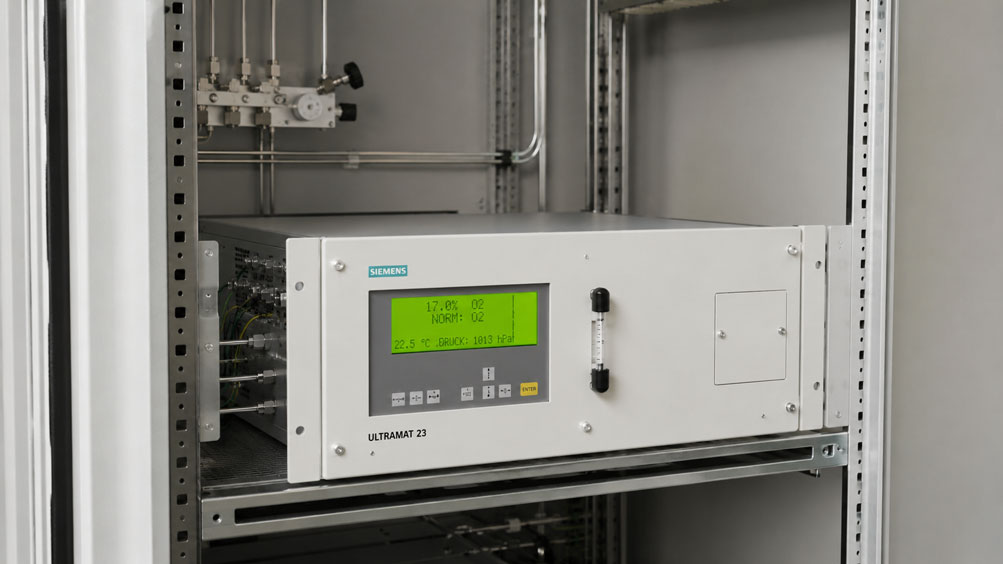
For different requirements, ICS Schneider offers, among others, the Siemens SIPROCESS GA700 OXYMAT 7 with a paramagnetic measurement principle, the Siemens ULTRAMAT 23 with optional electrochemical or paramagnetic oxygen measurement, as well as the Siemens OXYMAT 64 for trace oxygen measurement using a ZrO₂ sensor.
Further solutions can be found under Siemens Process Instrumentation at ICS Schneider and under Gas Measuring and Gas Warning Instruments.
Table of Contents
- Why the measurement principle is decisive in O₂ analysis
- What is actually measured in an oxygen measurement?
- Direct comparison of O₂ measurement principles
- Paramagnetic oxygen measurement
- SIPROCESS GA700 OXYMAT 7 as a paramagnetic example
- Electrochemical oxygen measurement
- Electrochemical O₂ measurement with the ULTRAMAT 23
- ZrO₂ measurement for trace oxygen
- OXYMAT 64 for low O₂ concentrations
- Other oxygen measurement principles
- Selecting the measuring range to suit the application
- Why sample gas pressure must be taken into account
- Sample gas flow and sample transport
- Moisture, dew point and condensation
- Accompanying gases and cross-sensitivities
- Pay particular attention to combustible accompanying gases
- Correctly assessing analyzer response time
- Why the sample line can change the T90 time
- When sample gas conditioning is required
- Zero point, span point and calibration gas
- Comparing the maintenance requirements of the measurement principles
- Distinguishing process measurement from safety monitoring
- Systematically selecting an O₂ analyzer
- Typical faults in oxygen analysis
- Comparison of typical applications
- Suitable Siemens O₂ analyzers from ICS Schneider
- Conclusion
- FAQ
Why the measurement principle is decisive in O₂ analysis
Oxygen has physical and chemical properties that can be utilized by different measurement methods.
Paramagnetic measurement, for example, takes advantage of the fact that, unlike most other gases, oxygen is strongly paramagnetic.
Electrochemical sensors, on the other hand, generate an electrical signal through a chemical reaction that depends on the oxygen concentration or oxygen partial pressure.
ZrO₂ sensors utilize the oxygen-ion conductivity of heated zirconium dioxide ceramic.
These differences have a direct effect on:
- measuring range,
- selectivity,
- response time,
- service life,
- sensitivity to moisture,
- pressure influence,
- behavior in the presence of accompanying gases,
- calibration and maintenance.
What is actually measured in an oxygen measurement?
In process analytics, oxygen is frequently specified as a volume fraction:
% O₂
For trace measurements, concentrations are frequently specified in:
ppm or vpm O₂
The oxygen partial pressure nevertheless remains decisive
The partial pressure of a gas component can be described in simplified form as:
pO2 = xO2 × pges
Where:
pO2is the oxygen partial pressure,xO2is the oxygen fraction,pgesis the total pressure of the gas mixture.
If the sample gas pressure changes, the sensor signal may therefore also change depending on the measurement principle.
A concentration reading in % O₂ therefore does not mean that the sample gas pressure is irrelevant to the measurement.
Direct comparison of O₂ measurement principles
| Measurement principle | Typical application | Strength | Particular points to consider |
|---|---|---|---|
| Paramagnetic | Continuous process analysis, combustion, purity measurement | No consumable electrochemical O₂ sensor, wide measuring range dynamics | Sample gas pressure, reference gas, accompanying gases and sample gas conditioning |
| Electrochemical | O₂ in the percentage range, multi-component analyzers | Compact and economical | Sensor ageing, moisture, chemically problematic accompanying gases |
| ZrO₂ | Trace oxygen | Very low O₂ concentrations can be measured | High sensor temperature and influence of combustible accompanying gases |
| Optical methods | Application-dependent gas or liquid measurements | No conventional consumable electrochemical cell required | Optical conditions, gas composition and specific sensor technology |
Paramagnetic oxygen measurement
Compared with most other process gases, oxygen is strongly paramagnetic. It is therefore attracted by an inhomogeneous magnetic field.
Paramagnetic oxygen analyzers use this physical effect to determine the O₂ concentration.
In the paramagnetic alternating-pressure method used by Siemens, the difference between the sample gas and reference gas generates a pressure- or flow-dependent measurement signal.
A major advantage of the principle
is that no electrochemical oxygen cell is continuously consumed.
This makes the method particularly suitable for:
- continuous process measurements,
- long-term plant monitoring,
- small O₂ measuring spans,
- purity measurements close to 100 % O₂.
However, the measurement principle is not free from influencing factors
When designing the measurement system, the following factors, among others, must be taken into account:
- sample gas pressure,
- reference gas,
- gas composition,
- sample gas flow,
- temperature,
- sample conditioning.
SIPROCESS GA700 OXYMAT 7 as a paramagnetic example
The SIPROCESS GA700 OXYMAT 7 offered by ICS Schneider measures oxygen according to the paramagnetic alternating-pressure method.
ICS and Siemens specify, among other things
- small measuring spans starting from 0…0,5 % O₂,
- measurements up to 100 % O₂,
- physically suppressed zero point for ranges such as 99,5…100 % O₂,
- T90 time of 1,9 seconds,
- vibration compensation,
- maximum ambient temperature of 50 °C for the standard module,
- a microflow sensor without direct contact with the sample gas.
The last point is particularly interesting for demanding gas mixtures
Because the microflow sensor does not come into direct contact with the sample gas, the sensitive detector component is not directly exposed to the process gas.
This can be advantageous for applications involving:
- corrosive components,
- high requirements for service life,
- continuous operation.
Electrochemical oxygen measurement
Electrochemical oxygen sensors generate an electrical signal through electrochemical reactions at electrodes.
Within the specified operating range, the resulting signal is related to the oxygen concentration or oxygen partial pressure.
These sensors are particularly attractive
when a:
- compact,
- economical,
- comparatively simple
O₂ measurement is required.
In contrast to a purely physical measurement principle
the electrochemical measuring cell is subject to ageing or consumption.
Its service life depends, among other things, on:
- oxygen exposure,
- temperature,
- gas composition,
- operating time,
- sensor chemistry.
Electrochemical O₂ measurement with the ULTRAMAT 23
The Siemens ULTRAMAT 23 is designed as a multi-component gas analyzer and can, among other options, be equipped with an electrochemical oxygen sensor.
For the electrochemical oxygen channel, Siemens specifies
- configurable measuring ranges from 0…5 % to 0…25 % O₂,
- a typical service life of approximately two years at 21 % O₂,
- a repeatability of ≤ 0,05 % O₂,
- a T90 time of no more than 30 seconds at approximately 1,2 l/min sample gas flow, depending on dead time and configured damping.
The range of applications is strongly determined by the sample gas
Siemens explicitly specifies restrictions for the electrochemical O₂ sensor in the presence of certain accompanying gases.
Problematic substances include:
- chlorine-containing compounds,
- fluorine-containing compounds,
- heavy metals,
- aerosols,
- mercaptans,
- basic components such as NH₃ at higher concentrations.
The moisture level must also be appropriate
For the electrochemical oxygen channel, an H₂O dew point of at least:
2 °C
is specified.
At the same time, condensation must not occur.
This clearly demonstrates that:
gas that is too dry
and:
condensing gas
can be equally problematic.
ZrO₂ measurement for trace oxygen
If very small residual quantities of oxygen rather than percentage values need to be determined, a different measurement principle can be considered.
At high temperatures, zirconium dioxide can conduct oxygen ions.
If different oxygen partial pressures are present on the two sides of a ZrO₂ membrane, an electrical potential difference is generated.
The fundamental measurement effect
is therefore based on the difference between:
O₂ partial pressure of the sample gas
and:
O₂ partial pressure of the reference gas
The method is particularly suitable
for very low oxygen concentrations.
Typical applications include:
- technical high-purity gases,
- protective gas processes,
- air separation,
- heat treatment,
- monitoring oxygen-deficient atmospheres.
OXYMAT 64 for low O₂ concentrations
The Siemens OXYMAT 64 offered by ICS Schneider is specifically designed for measuring trace oxygen.
ICS specifies the smallest measuring range as
0 … 10 ppm O₂
The ZrO₂ sensor operates at approximately
650 °C
In this process
the sample gas flows through the interior of the heated tubular sensor, while its outer surface is exposed to ambient air as a reference.
For different gas matrices
different sensor versions are available for this measurement principle.
Siemens distinguishes, among others, between:
- catalytically active ZrO₂ sensors,
- catalytically inactive ZrO₂ sensors.
This distinction is important
because combustible accompanying components may react with oxygen at the hot sensor.
As a result, oxygen may be converted inside the measuring cell and influence the indicated residual O₂ concentration.
Other oxygen measurement principles
In addition to paramagnetic, electrochemical and ZrO₂-based methods, other O₂ measurement principles are available.
Depending on the application, these include, for example:
- optical oxygen sensors using luminescence quenching,
- special laser-optical methods,
- other electrochemical solid-state sensors.
These methods are not automatically better or worse
Their suitability depends on whether:
- gaseous or dissolved oxygen is being measured,
- an extractive or in-situ measurement is required,
- trace or percentage ranges are relevant,
- the gas composition remains constant,
- optical windows or measuring paths can be kept clean.
The specific application is therefore always decisive when making a selection.
Selecting the measuring range to suit the application
An oxygen analyzer should not be selected solely on the basis of whether its maximum measuring range includes the expected value.
The actually required measuring span is decisive
Combustion optimization with typical O₂ concentrations in the percentage range places different demands on the measurement system than protective gas monitoring with only a few ppm.
| Application | Typical magnitude | Suitable principle |
|---|---|---|
| Combustion process | % O₂ | Paramagnetic or, depending on the application, electrochemical |
| Biogas / multi-component analysis | % O₂ | Electrochemical or paramagnetic depending on gas composition |
| Oxygen purity monitoring | close to 100 % O₂ | Paramagnetic with suppressed zero point |
| Protective gas / high-purity gas | ppm O₂ | ZrO₂ trace oxygen measurement |
An excessively large measuring range
can reduce the usable resolution and degrade the accuracy assessment for the application.
An excessively small measuring range
can, on the other hand, regularly result in range exceedances.
Why sample gas pressure must be taken into account
Sample gas pressure is frequently underestimated when working with O₂ analyzers.
Many measurement methods respond at least indirectly to oxygen partial pressure or to physical properties of the gas flow.
For the electrochemical O₂ channel of the ULTRAMAT 23
the technical specifications are referenced, for example, to a sample gas pressure of:
1.013 hPa absolute
Siemens specifies an atmospheric pressure influence of
< 0,2 % of the measured value per 1 % pressure change
This means
With strongly fluctuating process or sampling pressures, it must be determined whether:
- pressure regulation,
- pressure compensation,
- defined sample pressure reduction
are required.
Sample gas flow and sample transport
An extractive gas analyzer does not measure directly in the process but requires a continuous sample gas flow.
The flow rate influences, among other things:
- transport time,
- response time,
- pressure conditions inside the analyzer,
- gas exchange in the measuring cell.
Insufficient flow
can delay the measurement and cause old gas fractions to remain longer in the line or measuring cell.
Excessive flow
can, on the other hand:
- cause an impermissible pressure drop,
- overload the sample gas conditioning system,
- create measurement conditions outside the specification.
Therefore
The sample gas flow is a specified operating parameter and should not be set according to the principle that “more is faster”.
Moisture, dew point and condensation
Moisture influences oxygen measurement in several ways.
First of all, water vapor changes the composition of the gas mixture.
In addition, condensate can
- impair measuring cells,
- block filters,
- obstruct sample lines,
- damage electrochemical sensors,
- wash out soluble gas components.
This is why sample gas conditioning is frequently used with extractive analyzers
This may consist, for example, of:
- particulate filter,
- sample gas cooler,
- condensate separator,
- pump,
- pressure regulator,
- flow control.
However, excessive drying can also be problematic
For the electrochemical oxygen sensor of the ULTRAMAT 23, Siemens explicitly specifies a minimum moisture level or an H₂O dew point of at least 2 °C.
The sample gas conditioning system must therefore be matched to the sensor being used.
Accompanying gases and cross-sensitivities
In a real process, the sample gas practically never consists solely of oxygen and nitrogen.
Depending on the application, it may contain:
- CO₂,
- CO,
- CH₄,
- H₂,
- NO and NO₂,
- SO₂ and H₂S,
- NH₃,
- hydrocarbons,
- water vapor.
These accompanying gases must be specified during instrument selection
This is because they can:
- react directly with the sensor,
- change the physical properties of the gas mixture,
- react on hot sensor surfaces,
- poison the sensor chemistry,
- attack materials in the gas path.
The question is therefore not only
How much O₂ is present?
But also
What gas mixture is this oxygen contained in?
Pay particular attention to combustible accompanying gases
The gas composition must be assessed particularly carefully for measurement principles that operate at high sensor temperatures.
In the OXYMAT 64
the ZrO₂ sensor is heated to approximately:
650 °C
Combustible components
can react with the available oxygen at the sensor surface.
This can locally change the oxygen concentration
The analyzer would then not necessarily detect the original O₂ concentration of the unchanged process gas.
For this reason, Siemens offers different sensor versions
with different catalytic behavior.
The selection must be matched to the actual gas composition.
Correctly assessing analyzer response time
The response time determines how quickly an actual change in oxygen content becomes visible at the output or on the display.
This is frequently specified using the:
T90 time
T90 means
the time after a concentration step change at which approximately 90 % of the final signal change has been reached.
For the OXYMAT 7
ICS specifies a T90 time of:
1,9 s
For the electrochemical O₂ channel of the ULTRAMAT 23
depending on dead time and damping, at approximately 1,2 l/min:
≤ 30 s
is specified.
However, these values are not automatically the response time of the complete system
This is because the following also contribute:
- sample extraction,
- sample line,
- filter,
- sample gas cooler,
- pump,
- gas volume in connecting hoses.
Why the sample line can change the T90 time
A fast analyzer can still respond very slowly when used with a poorly designed sampling system.
The volume of a line is
approximately:
V = π × d² / 4 × L
where:
d= internal diameter,L= line length.
From the volume and flow rate, the transport time can be approximately calculated as
t ≈ V / Q
This makes it clear that
a long line with a large internal diameter can create considerable dead time.
The overall response therefore consists of
transport time + sample gas conditioning + analyzer response + electronic damping
When sample gas conditioning is required
A process gas should only be supplied to an extractive analyzer within the permissible operating conditions.
Sample gas conditioning is particularly useful or necessary if the gas:
- contains dust,
- can condense,
- is too hot,
- is subject to strongly fluctuating pressure,
- has an unsuitable flow rate,
- contains aerosols or liquid droplets.
However, it is important that
sample gas conditioning must not impermissibly alter the composition being measured.
For example:
- leaks can introduce ambient air,
- unsuitable hoses can adsorb gas components,
- condensation can remove soluble components,
- pumps or seals can introduce additional contamination.
Especially with trace oxygen
even a very small leak can dominate the measurement result.
Zero point, span point and calibration gas
The calibration strategy depends on the measurement principle and measuring range.
In principle, a distinction is made between
- zero point verification,
- span or end-point verification,
- functional testing with a known gas.
For a percentage-range O₂ analyzer
ambient air containing approximately:
20,9 % O₂
can, for example, be used for certain testing or calibration functions, provided that this is specified by the manufacturer for the particular configuration.
The ULTRAMAT 23
has an AUTOCAL function using ambient air depending on the measured component.
Different requirements apply to trace oxygen
With the OXYMAT 64, the zero point cannot simply be adjusted using pure nitrogen.
For low measuring ranges, Siemens requires a test gas matched to the range with a small, defined residual O₂ concentration.
For example
for a measuring range of:
0 … 10 ppm O₂
a corresponding low-concentration O₂ test gas is required.
Comparing the maintenance requirements of the measurement principles
Maintenance requirements should also be taken into account during instrument selection.
| Measurement principle | Typical maintenance focus |
|---|---|
| Paramagnetic | Gas path, filters, reference gas supply, calibration and sample conditioning |
| Electrochemical | Additionally, ageing and replacement of the sensor cell |
| ZrO₂ | Sensor condition, gas purity, calibration and assessment of combustible accompanying gases |
For the electrochemical O₂ channel of the ULTRAMAT 23
Siemens specifies, for example, a typical sensor service life of:
approx. 2 years at 21 % O₂
This specification is not a guaranteed universal replacement interval
The actual service life depends on the operating conditions.
Distinguishing process measurement from safety monitoring
A process gas analyzer and a gas warning instrument do not automatically perform the same task.
A process analyzer
is used, for example, for:
- process control,
- quality control,
- combustion optimization,
- purity monitoring.
A gas warning system
is typically used for:
- personnel safety,
- monitoring hazardous atmospheres,
- warning of oxygen deficiency or oxygen enrichment.
Therefore
An existing process O₂ measurement must not automatically be used as a substitute for a required safety-related gas warning system.
The necessary safety function must be independently assessed for the specific plant.
Systematically selecting an O₂ analyzer
- Define the measurement task: Distinguish between process control, quality, purity and safety monitoring.
- Define the O₂ range: ppm, low percentage range, 0…25 % or purity measurement close to 100 %.
- Record the complete gas composition: Also specify accompanying gases and potential interfering components.
- Determine moisture: Evaluate water vapor content, dew point and condensation risk.
- Determine sample gas pressure: Consider minimum, normal and maximum pressure.
- Determine sample gas temperature: Distinguish between the temperature at the process and at the analyzer inlet.
- Define the required response time: Take process dynamics and control requirements into account.
- Select the measurement principle: Evaluate paramagnetic, electrochemical or ZrO₂ according to the application.
- Plan sampling: Define the sampling point, line length and line material.
- Determine sample gas conditioning: Provide filters, cooler, pump, pressure regulation and flow control where required.
- Check cross-sensitivities: Compare the gas mixture with the manufacturer’s specifications.
- Define the calibration strategy: Specify zero, test and span gases.
- Consider maintenance: Plan filter replacement, sensor service life and calibration intervals.
- Evaluate the overall response time: Do not consider only the analyzer’s T90 time.
- Document the measuring point: Record pressure, temperature, flow rate, gas composition and measuring range.
Typical faults in oxygen analysis
| Observation | Possible cause | Recommended check |
|---|---|---|
| O₂ value fluctuates with process pressure | Pressure influence on measurement | Check sample gas pressure and pressure regulation |
| O₂ value rises unexpectedly | Ambient air is being drawn into the sample line | Check the sample gas path for leaks |
| Very low O₂ value cannot be reproduced | Leak or unsuitable sample path | Check the entire sampling system for ingress of air |
| Reading responds very slowly | Large line volume or low flow rate | Calculate the sample transport time |
| Measured value drifts over several months | Possible ageing of the electrochemical sensor cell | Check calibration and sensor condition |
| Electrochemical sensor fails prematurely | Unsuitable moisture level or aggressive accompanying gases | Check gas composition and dew point |
| Condensate inside the analyzer | Insufficient sample gas conditioning | Check dew point, cooler and condensate drainage |
| ZrO₂ measurement indicates too little oxygen | Possible reaction of O₂ with combustible accompanying gases | Check gas composition and sensor version |
| Measured value changes significantly after filter replacement | Previous filter was clogged or sample flow changed | Check flow and pressure before/after the filter |
| Analyzer responds quickly, but overall measurement remains slow | Dead time of the sample line | Check line volume, pump capacity and flow rate |
| Measured value is correct only with ambient air | Possible gas matrix or calibration problem | Use test gas under representative conditions |
| Multiple analyzers indicate different O₂ values | Different measurement principles or sampling conditions | Compare pressure, moisture, sample gas conditioning and calibration |
Comparison of typical applications
Example 1: Oxygen in a combustion plant
In a combustion plant, the residual O₂ content is to be monitored continuously in order to optimize the air supply.
The concentration is in the percentage range and changes should be detected quickly.
A paramagnetic method is particularly interesting for such a task.
The OXYMAT 7 offers:
- continuous O₂ measurement,
- small measuring spans,
- short T90 time,
- no consumable electrochemical O₂ cell.
Example 2: Multi-component analysis with O₂
In an application, additional gas components are to be measured continuously alongside oxygen.
In this case, a multi-component analyzer can be more economical than several separate instruments.
The ULTRAMAT 23 can combine different measurement principles in one instrument and, depending on the configuration, additionally measure O₂ electrochemically or paramagnetically.
Example 3: Protective gas with only a few ppm residual O₂
During heat treatment under protective gas, the system is monitored to determine whether oxygen is entering the process.
A percentage-range O₂ analyzer would not be sufficiently sensitive for this task.
A measuring range of:
0 … 10 ppm O₂
can, however, detect small amounts of oxygen ingress.
The OXYMAT 64 with ZrO₂ sensor is designed for this purpose.
Result
All three applications measure the same gas component, but require different measurement concepts due to the concentration, gas composition and process requirements.
Suitable Siemens O₂ analyzers from ICS Schneider
For different process oxygen analysis tasks, ICS Schneider offers several Siemens solutions as dedicated products.
SIPROCESS GA700 OXYMAT 7
SIPROCESS GA700 – OXYMAT 7 Module
The OXYMAT 7 is particularly suitable for continuous paramagnetic oxygen measurements.
ICS specifies, among other things:
- paramagnetic alternating-pressure method,
- smallest measuring span 0…0,5 % O₂,
- measurements up to 100 % O₂,
- measuring ranges close to 100 % O₂ with physically suppressed zero point,
- T90 time 1,9 seconds,
- vibration compensation,
- no direct sample gas contact with the microflow sensor.
ULTRAMAT 23
The ULTRAMAT 23 is particularly interesting when oxygen is to be measured together with additional gas components.
Different measurement principles are available depending on the configuration.
For the electrochemical O₂ channel, Siemens specifies, among other things:
- measuring ranges from 0…5 to 0…25 % O₂,
- typical sensor service life of approximately two years at 21 % O₂,
- repeatability ≤ 0,05 % O₂,
- AUTOCAL depending on the measured component,
- multi-component measurement in one analyzer.
OXYMAT 64
The OXYMAT 64 is designed for trace oxygen.
ICS specifies, among other things:
- ZrO₂ sensor principle,
- smallest measuring range 0…10 ppm O₂,
- sensor operation at approximately 650 °C,
- catalytically active or inactive sensor versions,
- applications involving high-purity gases, air separation and protective atmospheres.
Which instrument is the right one?
In simplified terms, the selection can be categorized as follows:
continuous %O₂ process measurement → OXYMAT 7
O₂ together with additional components → ULTRAMAT 23
trace oxygen in the ppm range → OXYMAT 64
However, the final selection must always be based on the complete gas composition and process conditions.
Conclusion
Oxygen can be measured using different physical and electrochemical methods. Which principle is suitable depends far more on the application than on the fact that all of them indicate the same measured variable, O₂.
Paramagnetic methods are particularly suitable for continuous process measurements
They utilize a characteristic physical property of oxygen and do not require a consumable electrochemical O₂ cell.
Electrochemical sensors provide a compact and economical solution
However, they have a limited service life and can be sensitive to moisture and certain accompanying gases.
ZrO₂ sensors provide access to very low oxygen concentrations
With the OXYMAT 64, the smallest measuring range extends down to 0…10 ppm O₂. Due to the high sensor temperature, however, combustible accompanying components in particular must be taken into account.
Pressure and moisture are part of the measurement task
Selecting the correct concentration range alone is not sufficient. Sample gas pressure, flow, temperature and dew point must remain within the specified operating conditions.
Sample conditioning can be just as important as the analyzer
Filters, lines, pumps, coolers and pressure regulation determine which gas actually reaches the measuring cell.
The response time must also be considered as an overall value
A short T90 time of the sensor is of little benefit if the sample takes one minute to reach the analyzer through a long line.
For practical applications
Define the measurement task → determine the required O₂ range → record the complete gas composition → evaluate pressure, temperature, moisture and flow → define the required response time → select the appropriate paramagnetic, electrochemical or ZrO₂ measurement principle → check cross-sensitivities → design sampling and sample gas conditioning → define calibration gases and maintenance concept → evaluate overall response time → test the analyzer under representative process conditions → document the measuring point and operating parameters.
FAQ: Measuring oxygen correctly in process applications
Which measurement principles are used for oxygen?
In process gas analysis, paramagnetic, electrochemical and ZrO₂-based measurement principles are used, among others.
Which O₂ measurement principle is the most accurate?
There is no general answer to this question. The achievable measurement quality depends on the measuring range, gas composition, pressure, moisture, sampling and the specific analyzer.
How does paramagnetic oxygen measurement work?
It utilizes the strong paramagnetic property of oxygen. A measurable physical effect is generated in a magnetic field, from which the O₂ concentration is determined.
What is the advantage of a paramagnetic oxygen analyzer?
The measurement principle does not require a conventional consumable electrochemical O₂ cell and is therefore particularly suitable for continuous process measurements.
What is the OXYMAT 7?
The Siemens SIPROCESS GA700 OXYMAT 7 is a paramagnetic oxygen analyzer for continuous process gas analysis.
What is the smallest measuring range of the OXYMAT 7?
ICS specifies a smallest measuring span of 0…0,5 % O₂.
Can the OXYMAT 7 measure oxygen close to 100 %?
Yes. Thanks to a physically suppressed zero point, ranges including 99,5…100 % O₂ are possible.
How quickly does the OXYMAT 7 respond?
ICS specifies a T90 time of 1,9 seconds for the OXYMAT 7 module. The overall response time of a system can be considerably longer due to sampling.
How does an electrochemical O₂ sensor work?
Oxygen participates in electrochemical reactions inside the measuring cell. The resulting electrical signal is used to determine the O₂ concentration.
Does an electrochemical oxygen sensor wear out?
Yes. Electrochemical measuring cells generally have a limited service life, which depends on sensor design and operating conditions.
How long does the O₂ sensor of the ULTRAMAT 23 last?
Siemens specifies a typical service life of approximately two years at 21 % O₂ for the electrochemical oxygen channel.
What measuring range does the electrochemical O₂ channel of the ULTRAMAT 23 have?
The measuring ranges can be configured from 0…5 % to 0…25 % O₂.
Can the ULTRAMAT 23 measure several gases simultaneously?
Yes. The ULTRAMAT 23 is designed as a multi-component analyzer and can measure different gas components depending on the configuration.
Can the ULTRAMAT 23 also measure O₂ paramagnetically?
Yes. Siemens specifies both electrochemical and paramagnetic oxygen sensor technology for the ULTRAMAT 23 depending on the instrument version.
Why is moisture important for electrochemical oxygen sensors?
Conditions that are too dry may be unsuitable for certain sensors, while condensation must also be avoided. The specific moisture specification of the sensor must therefore be observed.
Which accompanying gases are problematic for the electrochemical O₂ sensor of the ULTRAMAT 23?
Siemens specifies chlorine- and fluorine-containing compounds, heavy metals, aerosols, mercaptans and basic components, among others, as restrictions.
How does a ZrO₂ oxygen sensor work?
A heated zirconium dioxide ceramic becomes conductive to oxygen ions. The oxygen concentration is determined from the potential difference generated by different O₂ partial pressures.
What is the OXYMAT 64 suitable for?
The OXYMAT 64 is particularly suitable for trace oxygen measurements in high-purity gases, protective gas processes and similar applications.
What is the smallest measuring range of the OXYMAT 64?
ICS specifies a smallest measuring range of 0…10 ppm O₂.
At what temperature does the ZrO₂ sensor of the OXYMAT 64 operate?
The sensor is controlled at approximately 650 °C.
Why are combustible accompanying gases important with a ZrO₂ sensor?
They can react with oxygen at the hot sensor and thereby influence the local oxygen concentration.
What is the difference between a catalytically active and inactive ZrO₂ sensor?
The sensor variants use different electrode materials and therefore react differently to combustible accompanying components. The appropriate version must be selected according to the gas composition.
Why does pressure influence an O₂ measurement?
Many measurement principles respond directly or indirectly to the oxygen partial pressure or to pressure-dependent properties of the sample gas.
Can a pressure change cause an incorrect O₂ value?
Yes. If the measurement principle being used has a relevant pressure influence and no suitable compensation or pressure regulation is applied, the indicated value may change.
Why is the sample gas flow important?
It influences transport time, gas exchange in the measuring cell, pressure conditions and therefore the response time of the complete measurement system.
Is a higher sample gas flow always better?
No. The flow rate must remain within the operating conditions specified by the manufacturer.
Why must condensation be prevented?
Condensate can impair sensors, measuring cells, filters and lines and can also change the composition of the gas sample.
Why do I need a sample gas cooler?
A sample gas cooler may be required when a hot and moist process sample needs to be brought to defined conditions. Whether it is suitable depends on the measured component and the application.
Can sample gas conditioning distort the O₂ value?
Yes. Leaks in particular can introduce ambient air into an oxygen-deficient sample gas and thereby cause significant errors.
Why are leaks particularly critical for ppm O₂ measurements?
Ambient air contains approximately 21 % O₂. Even very small amounts of air can therefore significantly distort a trace oxygen measurement in the ppm range.
What does T90 mean?
T90 is the time after a concentration change at which approximately 90 % of the final signal change has been reached.
Is the T90 time of the analyzer the total response time of the measuring system?
No. The transport time in the sample line, sample gas conditioning, dead volumes and, where applicable, electronic damping must also be taken into account.
Which measurement principle is suitable for combustion plants?
Paramagnetic oxygen analyzers such as the OXYMAT 7 are particularly interesting for such continuous process applications.
Which measurement principle is suitable for only a few ppm of oxygen?
For trace oxygen, a ZrO₂ system such as the OXYMAT 64 may be suitable, provided that the gas composition and operating conditions are compatible with it.
Which instrument is suitable for O₂ together with CO₂ or CH₄?
The ULTRAMAT 23 is designed as a multi-component analyzer and can measure multiple gas components simultaneously depending on the configuration.
Can ambient air be used for calibration?
For certain instruments and functions, yes. However, this must be explicitly specified for the relevant measured component and configuration. Special test gases are frequently required for trace oxygen.
Is a process O₂ analyzer automatically a gas warning instrument?
No. Process analysis and safety-related gas warning are different tasks and must be assessed separately.
Where can I find the OXYMAT 7 at ICS Schneider?
Further information can be found under SIPROCESS GA700 OXYMAT 7 at ICS Schneider.
Where can I find the ULTRAMAT 23 at ICS Schneider?
Further information can be found under Siemens ULTRAMAT 23 at ICS Schneider.
Where can I find the OXYMAT 64 at ICS Schneider?
Further information can be found under Siemens OXYMAT 64 at ICS Schneider.
Where can I find further Siemens process instrumentation?
An overview can be found under Siemens Process Instrumentation at ICS Schneider.
Where can I find further gas measuring instruments?
An overview can be found under Gas Measuring and Gas Warning Instruments at ICS Schneider.