


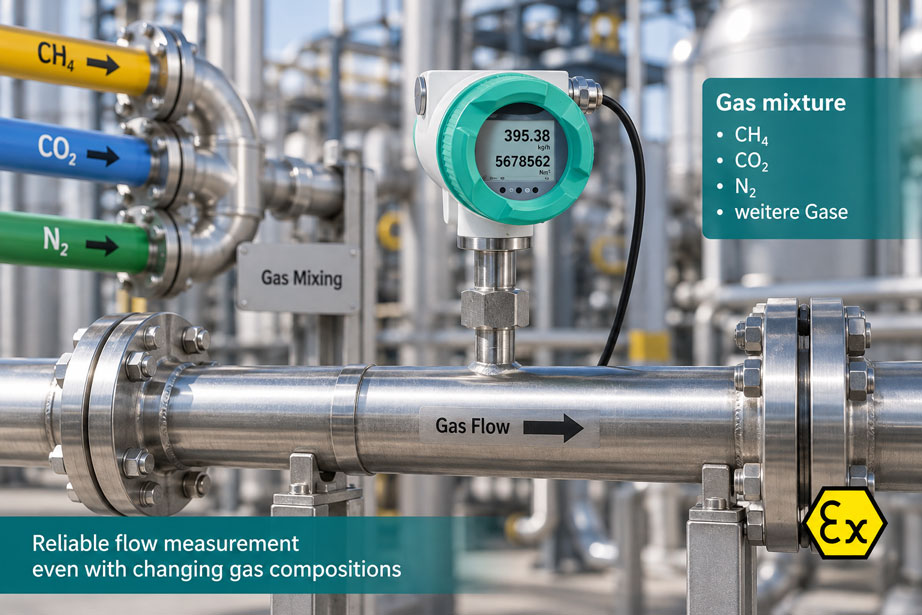
Thermal mass flow meters are widely used in industrial gas networks, energy systems, process plants and utility systems because they can measure gas flow without moving mechanical measuring elements and are suitable for consumption measurement, process monitoring and material balances. The measuring principle is particularly attractive for compressed air, nitrogen, oxygen, argon, carbon dioxide, natural gas, hydrogen and numerous defined gas mixtures.
However, one frequently underestimated characteristic of the thermal measuring principle is its dependence on the medium. A thermal mass flow meter does not respond solely to how much gas flows through the pipe per unit of time. Its sensor signal is generated by heat transfer between a heated sensing element and the gas flowing past it. This heat transfer depends directly on the thermophysical properties of the respective gas.
If the composition of a gas mixture changes, properties such as heat capacity, thermal conductivity, density and viscosity may also change. The relationship stored in the device between sensor signal and flow rate may then no longer exactly match the current gas composition. The measuring instrument can operate completely stably and still indicate a systematically shifted flow value.
This effect is particularly relevant for biogas, natural gas, forming gas, process exhaust gases, fuel gases, flare gases or other applications in which mixture ratios can change between different operating conditions.
The key point is: In thermal mass flow measurement, the gas composition is part of the measurement task. A fixed gas mixture and a dynamically changing gas mixture are not metrologically the same. For reliable measured values, composition, gas correction, calibration and installation conditions must be considered together.
Table of Contents
- 1. How does a thermal mass flow meter work?
- 2. Why is the thermal measuring principle gas-dependent?
- 3. What happens with a changing gas mixture?
- 4. Clearly defining the gas composition
- 5. What is a gas correction factor?
- 6. Why a fixed correction factor is not always sufficient
- 7. Gas conversion and calibration are not the same
- 8. Considering flow profile and installation conditions
- 9. Distinguishing between mass flow and standard volumetric flow
- 10. Moisture, condensate and contamination
- 11. Correctly diagnosing typical measurement deviations
- 12. Practical examples of changing gas mixtures
- 13. Selection criteria for a suitable mass flow meter
- 14. When should another measuring principle be considered?
- 15. Suitable flow measurement technology from ICS Schneider
- 16. Conclusion
- 17. Frequently asked questions about thermal mass flow meters and gas mixtures
1. How does a thermal mass flow meter work?
Thermal mass flow meters use the heat transfer between a heated sensing element and the gas flowing past it. Depending on the sensor design, for example, a defined temperature difference between a heated sensor and a reference sensor is maintained, or the electrical power required for heating is evaluated.
As the gas flow increases, more heat is dissipated from the heated sensing element. The electronics detect this change and calculate the flow rate from it.
The key advantage compared with purely operating-volume-based measurement is that the sensor signal can be directly linked to a mass-related quantity. Many industrial devices therefore output either a mass flow rate, for example in kg/h, or a standard volumetric flow rate in Nm³/h referenced to defined standard conditions.
With a correctly designed measuring point, this often eliminates the need for separate calculation of the standard volumetric flow from the operating volumetric flow, process pressure and process temperature.
However, direct mass-related measurement does not mean that the method is independent of the gas. Heat transfer itself is part of the measuring principle – and it depends on the gas.
2. Why is the thermal measuring principle gas-dependent?
Different gases transport heat differently. Nitrogen behaves thermally differently from carbon dioxide, methane, argon, helium or hydrogen. Gas mixtures also have their own thermophysical properties, which result from the type and proportion of their components.
For a thermal mass flow meter, this means that the same actual mass flow of two different gases does not necessarily generate the same thermal sensor signal.
| Influencing factor | Importance for thermal measurement | Possible consequence of a change |
|---|---|---|
| Heat capacity | Helps determine how much heat a gas flow can absorb and transport | Change in the relationship between heating power and mass flow |
| Thermal conductivity | Influences heat transfer at the sensing element | Shift in the thermal sensor signal |
| Density | Influences the flow condition and conversion between mass and volume | Particularly relevant for standard volume values and changing process conditions |
| Viscosity | Influences flow profile and heat transfer | Additional change in the actual characteristic curve possible |
| Gas composition | Determines the combined physical properties of the mixture | The stored gas characteristic may no longer match the current process gas |
For this reason, a thermal mass flow meter is calibrated, adjusted or parametrized using a manufacturer-specific gas model for a particular gas or defined gas mixture.
The term “mass flow meter” must therefore not be confused with “medium-independent flow meter”.
3. What happens with a changing gas mixture?
With a constant gas mixture, the situation is comparatively straightforward. If a process gas permanently consists of two or more components in a known mixing ratio, a suitable measuring instrument can be configured for this defined mixture.
The situation becomes more problematic when the mixing ratio changes during operation.
A typical example is a biogas plant. The methane and carbon dioxide content can vary depending on process conditions, feedstock, treatment or operating mode. Another example is a forming gas network in which different H₂/N₂ mixtures are used. In fuel gas and process gas networks, compositions may also change during product changes, start-up procedures or changes in upstream processes.
If the composition changes, the thermal characteristics of the gas also change. A sensor whose electronics continue to assume the originally stored gas composition interprets the new thermal behavior using a characteristic curve that may no longer be an exact match.
This is particularly difficult to detect because no conventional error signal necessarily occurs. The flow value may appear steady, stable and reproducible while still containing a systematic error.
4. Clearly defining the gas composition
For the selection and sizing of a thermal mass flow meter, information such as “biogas”, “natural gas”, “forming gas” or “process gas” is often insufficient. What matters is which components are actually present and within which limits their proportions may vary.
For a gas mixture, a composition matrix should therefore be created wherever possible for the relevant operating conditions. This should include normal operation, possible minimum and maximum proportions of individual components as well as start-up, shutdown and fault conditions.
The basis used for specifying concentrations is also important. Depending on the application and gas model, proportions may be stated, for example, as mole fractions, volume fractions or mass fractions. These values must not be treated as equivalent without verification.
For moist process gases, the moisture basis must also be clearly defined. A gas analysis on a dry basis describes a different composition from the same analysis including water vapor.
For device selection and configuration, the composition definition required by the device manufacturer or the calculation model used should therefore be applied exactly.
5. What is a gas correction factor?
Thermal mass flow meters are often operated using gas correction factors or gas conversion factors. These can be used to transfer an existing calibration or characteristic curve to another gas or to a specific gas mixture.
For example, a device may originally have been characterized using a reference gas. If another gas is subsequently to be measured, the electronics can use a conversion model specified by the manufacturer.
Modern systems may use extensive gas databases and characteristic maps for this purpose. These can take into account not only individual physical properties but also the actual behavior of the sensor type used.
It is important to understand that a gas correction factor is not a universally valid physical constant of a gas. It is linked to the measuring principle used, the specific sensor model, the underlying calibration and, where applicable, the pressure, temperature and flow conditions under consideration.
A correction factor taken from another manufacturer’s data sheet should therefore not simply be transferred to a different thermal mass flow meter.
Do not confuse the gas correction factor with the K-factor of other flow meters
The term K-factor is used with different meanings in flow measurement. With turbine or pulse-output flow meters, for example, a K-factor often describes the number of pulses per unit of volume.
A gas correction or conversion factor used with a thermal mass flow meter has a different function. It describes the transfer or adjustment of a gas characteristic curve.
Documentation, ordering and parametrization should therefore always clearly specify which factor is meant.
6. Why a fixed correction factor is not always sufficient
A single gas correction factor is particularly useful when the new gas or gas mixture is known and remains largely constant during operation.
With a changing composition, however, a fundamental problem arises: each relevant mixture composition may have a different thermal characteristic curve.
A device configured for a defined fixed mixture, for example, does not automatically detect that the actual mixture ratio has subsequently changed. The stored parametrization is initially only a calculation specification.
It is also too simplistic to assume that a particular gas always causes a fixed percentage deviation compared with another gas. Depending on the sensor technology and measuring range, the relationship may be nonlinear. Modern devices therefore sometimes use characteristic maps, gas databases or empirically determined correction models rather than just one constant factor.
| Process situation | Metrological assessment | Possible strategy |
|---|---|---|
| Pure gas with constant composition | Well-defined measurement task | Calibration or gas parametrization for this gas |
| Defined constant gas mixture | Well manageable if the mixing ratio is known | Configure or size the device for the actual mixture |
| Slowly changing gas mixture | Additional influence from composition | Evaluate the range of variation and include it in the measurement uncertainty budget |
| Several known operating recipes | Different defined mixtures | Check whether a device with suitable gas switching or multiple stored characteristic curves can be used |
| Continuously and strongly changing composition | Fixed mixture parametrization may be insufficient | Consider online gas analysis with dynamic correction or another measurement concept |
| Unknown composition | Thermal measurement error cannot be reliably quantified | Analyze gas composition or evaluate another measuring principle |
7. Gas conversion and calibration are not the same
A particularly important distinction must be made between mathematical gas conversion and actual calibration using the process gas or a representative gas mixture.
With gas conversion, an existing calibration is transferred to another gas using physical property data, correction factors or a manufacturer-specific model. This can be a very effective solution for many applications.
An actual calibration using the intended gas mixture, on the other hand, directly verifies the relationship between the measurement signal and a traceable reference flow under defined conditions.
The higher the accuracy requirement, the more important this distinction becomes.
For consumption monitoring in an internal gas network, a validated manufacturer conversion may be entirely sufficient. For test benches, material balances, billing processes or efficiency calculations with tight measurement uncertainty requirements, however, calibration or verification using a representative process gas may be necessary.
There is no universal rule here either. The required measurement uncertainty and the characteristics specified by the device manufacturer for the respective gas configuration are decisive.
8. Considering flow profile and installation conditions
If a flow value changes unexpectedly, the gas composition is often quickly suspected as the cause when gas mixtures are involved. This may be correct, but it does not necessarily have to be.
Thermal insertion sensors measure the flow locally or within a limited area of the pipe cross-section. For the total flow calculated from this measurement to be correct, the flow profile must be sufficiently reproducible.
Pipe bends, T-pieces, reducers, expansions, valves, control valves and other fittings can change the velocity profile and create turbulence. Manufacturers therefore specify defined upstream and downstream straight pipe lengths for their devices.
These requirements should not be replaced by generic rules of thumb. The required straight pipe length depends on the measuring instrument and the type of upstream flow disturbance.
Additional factors must also be considered with insertion sensors: correct insertion depth, orientation relative to the direction of flow, actual internal pipe diameter and a suitable sensor position.
A version with an integrated measuring section can offer advantages, particularly for smaller pipe dimensions, because the sensor position and measuring geometry are already defined by design. Nevertheless, the manufacturer’s requirements for pipe installation must also be observed in this case.
9. Distinguishing between mass flow and standard volumetric flow
In gas networks, flow is frequently specified in Nm³/h or Nl/min. This is not the actual volume of gas under the current process conditions, but a volume converted to defined reference conditions.
These reference conditions must be clearly defined. Different plants, instruments or industries may use different reference conditions.
When comparing different measuring points, therefore, not only the unit “Nm³/h” should be documented, but also the corresponding reference temperature and reference pressure.
With changing gas mixtures, the standard density is also relevant. If the composition changes, the relationship between actual mass flow and standard volumetric flow also changes.
This demonstrates why a correct gas definition is important not only for the thermal sensor characteristic but also for obtaining a reliable standard volumetric flow value.
10. Moisture, condensate and contamination
Water vapor is also a component of a gas mixture. In applications with changing humidity, the gas composition therefore also changes in the strict sense.
With low and stable moisture levels, this effect may be negligible depending on the required measurement accuracy. With significantly fluctuating moist process gases, however, it should at least be evaluated.
Liquid droplets, condensate, oil mist or deposits on the sensing element can be even more critical. The thermal measuring principle requires defined heat transfer between the sensor and the gas. If a liquid film or deposit changes the sensor surface, this introduces an additional influence on heat transfer behavior.
An apparent “gas mixture error” may therefore in practice also be caused by contaminated or wetted sensing elements.
For gases that may form condensate, process pressure, temperature, dew point and installation location should therefore be considered together.
11. Correctly diagnosing typical measurement deviations
Because different causes of error can produce similar symptoms, diagnosis should be carried out systematically. The fact that the gas composition has changed does not in itself prove that every observed change in flow is caused by the gas correction factor.
| Observation | Possible cause | Recommended check |
|---|---|---|
| Flow indication changes at the same time as the gas recipe | Gas composition no longer matches the stored characteristic curve | Compare the current gas analysis with the gas composition stored in the device |
| Constant deviation after changing to another gas | Incorrect gas parametrization or unsuitable conversion factor | Check device parameters and manufacturer data |
| Deviation changes across the measuring range | A single correction factor does not adequately represent the actual characteristic curve | Check multipoint correction, manufacturer characteristic map or process-gas calibration |
| Measured value changes after modification of the piping | Changed flow profile | Check upstream straight length, sensor position and pipe geometry |
| Measured value drifts slowly | Contamination or deposits on the sensor | Inspect or clean the sensing element according to the manufacturer’s instructions |
| Measured value jumps when condensate occurs | Wetting of the thermal sensing element | Investigate dew point, gas temperature and liquid ingress |
| Flow value appears plausible but the material balance does not match | Incorrect gas mixture, incorrect reference conditions or leakage | Check gas composition, standard conditions and balance boundaries |
| Deviation only occurs at high flow rates | Flow profile, measuring range or nonlinear gas correction | Check measuring range, characteristic curve and installation conditions |
Stability is not proof of correctness
An especially important diagnostic principle is: A stable measured value is not automatically a correct measured value.
If the gas characteristic used by the device does not match the actual gas mixture, the sensor can deliver highly reproducible but systematically shifted values.
This is one reason why regular plausibility checks against process data, gas analyses or suitable reference measurements are advisable for critical applications.
12. Practical examples of changing gas mixtures
Biogas
Biogas typically contains several components, with methane and carbon dioxide making up a significant proportion. Depending on the process, their proportions can vary. Additional components and moisture may also be present depending on the treatment process.
If a thermal mass flow meter is configured for a specific CH4/CO2 ratio, this parametrization initially corresponds exactly to this defined mixture. If the actual composition changes significantly, it must be evaluated how much the resulting measurement deviation increases.
Forming gas
Forming gas usually consists of hydrogen and nitrogen in a defined mixing ratio. As long as this ratio remains constant, a corresponding device configuration can be used.
However, if different forming gas recipes are used in the same plant, it should not be assumed that a single mixture characteristic will provide the same measurement accuracy for all mixtures.
Natural gas and fuel gases
The term natural gas does not describe an identical chemical composition worldwide. Although methane is generally the main component, the proportions of other hydrocarbons, nitrogen and carbon dioxide can vary.
For simple consumption monitoring, certain fluctuations may remain within the permissible overall measurement uncertainty. For more demanding material or energy balances, however, it should be verified whether the specific range of composition is sufficiently taken into account by the measuring system used.
Process gases and exhaust gases
In process gases, the composition may change depending on recipe, load condition or process phase. In such cases, it is often not one single “normal mixture” that matters, but the entire permissible composition range.
For highly dynamic multicomponent gases, external gas analysis in combination with suitable online correction may therefore be required.
13. Selection criteria for a suitable mass flow meter
A thermal flow sensor should not be selected solely on the basis of pipe diameter and maximum flow. Especially with gas mixtures, the definition of the medium is one of the most important design parameters.
For qualified device selection, at least the following information should be available:
- Gas or complete gas composition,
- minimum, normal and maximum proportions of the components,
- information on whether the composition is constant or changing,
- moisture content or dew point,
- minimum, normal and maximum flow,
- operating pressure and operating temperature,
- internal pipe diameter and pipe geometry,
- available upstream and downstream straight pipe lengths,
- required unit and reference conditions,
- required measurement uncertainty,
- required output signals and communication protocols,
- any requirements for ATEX, IECEx or other approvals.
With changing gas mixtures, an additional key question should be answered: Does the flow rate need to be determined with the same accuracy over the entire composition range, or is it sufficient to measure the main operating condition with high accuracy while accepting a larger measurement uncertainty during transitional conditions?
This decision can have a significant influence on the most suitable measuring technology.
14. When should another measuring principle be considered?
Thermal mass flow meters are very well suited to many industrial gas applications. However, with strongly and unpredictably changing gas compositions, the required correction can become complex.
In such cases, it should be evaluated whether another measuring principle offers advantages for the specific measurement task.
A Coriolis mass flow meter does not determine mass flow via gas-dependent heat transfer and is therefore significantly less dependent on the thermal composition of the gas with regard to the actual mass flow signal. For gases, however, factors including density, pressure, measuring range, device size and pressure drop must still be considered.
Differential-pressure and ultrasonic methods are also not automatically completely independent of gas composition. With differential-pressure measurement, gas density is relevant for calculating the flow. With ultrasonic methods, gas composition influences, among other things, the speed of sound; additional gas data are also required for mass-flow or standard-volume calculations.
Changing the measuring principle therefore does not automatically eliminate every requirement to know the gas composition.
The complete measurement task is always decisive: composition range, flow range, pressure, temperature, required measurement uncertainty, available installation space, permissible pressure drop and investment cost.
15. Suitable flow measurement technology from ICS Schneider
ICS Schneider Messtechnik offers various solutions for industrial flow and consumption measurement of gases. An overview can be found in our Flow Measurement Technology category and specifically under Consumption Meters for Gases and Compressed Air.
IVA550 – thermal mass flow sensor as an insertion probe
The IVA550 operates according to the thermal mass flow principle and is suitable for numerous technical and industrial gases. Depending on the version, special gases and defined gas mixtures can also be taken into account.
The insertion design is particularly suitable for larger pipe sizes and enables comparatively flexible retrofitting. For reliable measurement, however, sensor position, installation orientation, internal pipe diameter and the required straight pipe lengths must be taken into account correctly.
IVA570 – thermal flow measurement with a defined measuring section
The IVA570 also uses the thermal mass flow principle but is supplied with an integrated measuring section.
In addition to various pure gases, defined gas mixtures can also be taken into account with the appropriate configuration. The intended mixing ratio must be known when the device is specified.
The integrated measuring section offers the particular advantage of a defined sensor and pipe geometry. Correct pipe installation and the required upstream and downstream conditions nevertheless remain part of the measuring point design.
Special case: hydrogen
The influence of changing gas composition is particularly relevant with hydrogen due to its specific thermal properties. We cover this application separately and in greater detail in the technical article “Measuring Thermal Mass Flow of Hydrogen with Changing Purity: Considering Gas Composition as a Measurement Error”.
16. Conclusion
Thermal mass flow meters enable reliable and low-maintenance flow measurement for numerous industrial gases and defined gas mixtures. One of their main advantages is direct mass-related measurement or the direct output of a gas volume flow referenced to defined conditions.
However, this characteristic must not be confused with independence from the gas composition. The thermal measuring principle is based on heat transfer between a heated sensing element and the gas. If the gas composition changes, the physical properties on which the measurement characteristic is based can also change.
With a known and constant gas mixture, the measurement task can generally be managed effectively. The device can be configured, corrected or calibrated for the actual mixture.
With dynamically changing gas mixtures, however, a fixed parametrization is not necessarily sufficient. It must then be assessed how large the composition fluctuations are, what influence they have on the required measurement uncertainty and whether dynamic gas correction, online gas analysis or an alternative measuring principle is required.
Another important aspect is diagnosis: Not every deviation of a thermal mass flow meter is caused by the gas mixture. Flow profile, upstream straight lengths, sensor position, contamination, moisture, condensate and reference conditions can also be decisive influencing factors.
If gas composition, calibration, gas correction, flow conditions and process states are considered together during the design stage, the result is a measuring point whose values not only appear plausible but can also be reliably used for consumption monitoring, process control and material balances.
17. Frequently asked questions about thermal mass flow meters and gas mixtures
Can a thermal mass flow meter measure gas mixtures?
Yes. Suitable thermal mass flow meters can be configured or parametrized for defined gas mixtures. The decisive requirement is that the composition or mixing ratio is known and supported by the device or calibration model used.
Why does a thermal mass flow meter need to know the gas?
The measuring principle is based on heat transfer between a heated sensing element and the gas. Because different gases have different thermophysical properties, the relationship between sensor signal and flow depends on the gas type or gas composition.
What happens if the composition changes during operation?
The gas characteristic stored in the device may then no longer precisely match the current gas. This can result in an additional measurement error even though the sensor and electronics are operating correctly.
What is a gas correction factor?
A gas correction factor, or gas conversion factor, is used to transfer an existing thermal calibration or characteristic curve to another gas or gas mixture. The factor is device- and model-dependent and should be based on manufacturer data or a validated calculation model.
Can a fixed factor simply be used for every gas?
Not necessarily. Depending on the sensor principle and measuring range, the relationship between measurement signal and flow may be nonlinear. Modern devices therefore sometimes use characteristic maps or more complex gas models instead of one constant factor.
Can I use the gas correction factor from another manufacturer?
This should not be done without technical verification. Correction factors may depend on the sensor principle used, device design, calibration model and process conditions. The specifications of the respective device manufacturer are decisive.
Does a mass flow meter automatically detect when the gas mixture changes?
As a rule, not simply by selecting a mixture configuration. A device that has been parametrized for a particular mixing ratio does not automatically know that this ratio has changed in the actual process. Automatic adjustment requires suitable device functions or information about the current gas composition.
Can online gas analysis be used for correction?
In suitable systems, this is generally possible. The current gas composition can then be used to adjust the flow model. In dynamic processes, however, measurement and transport times must also be considered so that the composition value and the flow value refer to the same gas condition at the same point in time.
Why are upstream straight pipe lengths important for thermal mass flow meters?
Pipe bends, valves, reducers and other fittings can change the flow profile. Especially with insertion sensors, this can mean that the local velocity at the sensor is no longer sufficiently representative of the entire pipe cross-section. For this reason, the upstream and downstream straight pipe lengths specified by the manufacturer must be observed.
Is a thermal mass flow meter independent of pressure and temperature?
For the actual mass flow measurement, thermal mass flow meters do not require the same external pressure and temperature compensation as a purely operating-volume-based measurement. However, this does not mean that pressure and temperature are completely irrelevant. They can influence gas properties, the operating range and the validity of a gas conversion and must remain within the conditions specified for the device.
What is the difference between kg/h and Nm³/h?
kg/h directly describes a mass flow rate. Nm³/h, by contrast, describes a gas volume converted to defined reference conditions for pressure and temperature. The underlying standard or reference conditions must therefore always be known when using Nm³/h.
Can changing humidity influence the measured value?
Yes. Water vapor changes the composition of the gas mixture. At sufficiently high or strongly fluctuating moisture levels, this can be relevant to the measurement uncertainty. Condensation or liquid droplets on the sensor can additionally have a significant influence on thermal measurement.
Can a calibrated sensor still indicate an incorrect value?
Yes. A calibration confirms the behavior under the respective calibration conditions. If the sensor is subsequently operated with a different gas composition or under unfavorable installation conditions, the process measurement can still contain an additional deviation.
When should another measuring principle be considered?
If the gas composition changes strongly, continuously and partly unpredictably while low measurement uncertainty is required, the necessary thermal gas correction can become complex. In such cases, it should be evaluated whether, for example, a Coriolis system or another flow measurement method offers advantages for the specific application.
What information does ICS Schneider require for device selection?
Particularly useful information includes the gas composition and its range of variation, flow range, operating pressure, temperature, moisture or dew point, pipe dimensions, available upstream and downstream straight pipe lengths, required reference conditions, output signals, required accuracy and, where applicable, required Ex approvals.