


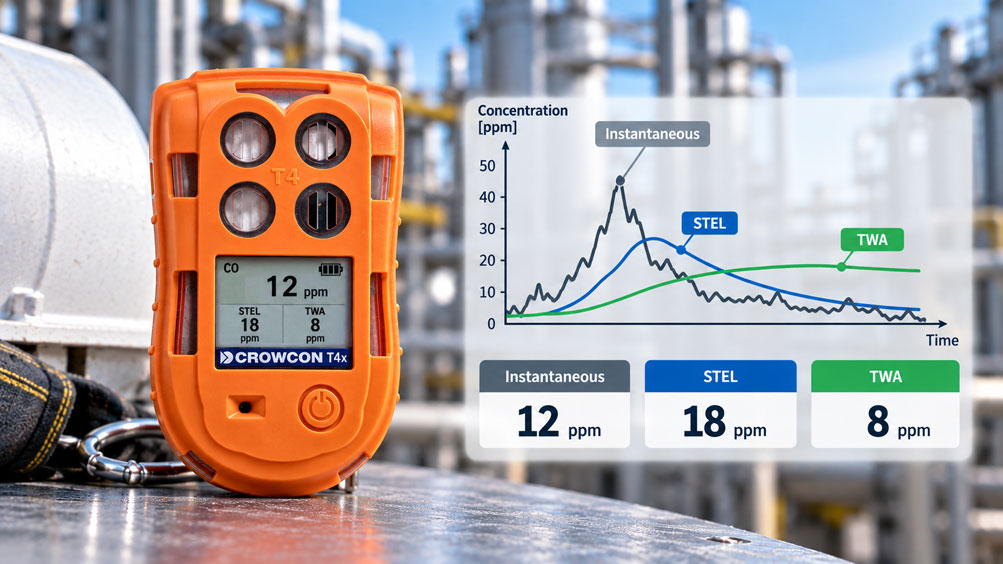
A portable gas detector can monitor several different values and alarm conditions at the same time. The display may currently show, for example, a carbon monoxide or hydrogen sulfide concentration. Low and High alarms may also be configured. For toxic gases, many instruments additionally calculate time-weighted values such as STEL and TWA.
These values must not be confused with one another. A high current gas concentration represents a different hazardous situation from exposure accumulated over a longer period. Conversely, a TWA or STEL alarm can occur even though the gas value currently displayed has already fallen significantly.
At first, this can appear contradictory to the user: Why does the instrument continue to alarm even though the surrounding atmosphere now appears to be clean again? Or why does a short, high gas peak immediately trigger an alarm while the TWA value is still comparatively low?
The explanation lies in the different time-based evaluations. The instantaneous value considers the current sensor reading. STEL evaluates short-term exposure over a defined time window. TWA considers exposure over a much longer period. In addition, a gas detector can store a peak value that simply records the highest measured value and is therefore not a time-weighted exposure value either.
The key point is: Instantaneous value, Low/High alarm, STEL, TWA and peak value answer different questions. For a correct assessment, it is therefore necessary to know not only the alarm thresholds but also the averaging time, sensor behavior, gas type, sampling method and device configuration.
Table of Contents
- 1. Which values can a gas detector display?
- 2. What does the instantaneous value mean?
- 3. Distinguishing Low and High instantaneous alarms
- 4. What does STEL mean?
- 5. What does TWA mean?
- 6. Instantaneous value, STEL and TWA compared directly
- 7. Typical alarm scenarios in practice
- 8. Why peak value and instantaneous value are not the same
- 9. For which gases are TWA and STEL relevant?
- 10. Distinguishing device alarm thresholds from occupational exposure limits
- 11. Taking sensor response and T90 into account
- 12. Distinguishing diffusion measurement from pumped sampling
- 13. Why wearing position matters for exposure assessment
- 14. What does a bump test verify for these alarm types?
- 15. Why calibration and alarm testing have different purposes
- 16. Systematically identifying typical misinterpretations
- 17. Correctly documenting exposure and alarm data
- 18. Suitable gas detectors from ICS Schneider
- 19. Conclusion
- 20. Frequently asked questions about TWA, STEL and instantaneous values
1. Which values can a gas detector display?
A modern portable gas detector processes far more information than just a single concentration value. Depending on the sensor configuration and device setup, several alarm types and stored values can be available at the same time.
For toxic gases, the current measured value and time-dependent exposure parameters are typically relevant. For flammable gases, on the other hand, the current concentration as a percentage of the lower explosive limit is often the main parameter. For oxygen, the system monitors whether the concentration falls below or rises above defined limits.
| Value / alarm type | What is evaluated? | Time-related consideration |
|---|---|---|
| Instantaneous value | Currently measured gas concentration | Current sensor value, taking sensor response into account |
| Low Alarm | Exceeding or falling below a first alarm threshold | Instantaneous |
| High Alarm | Exceeding a higher alarm threshold | Instantaneous |
| STEL | Short-term average exposure to a toxic gas | Defined short-term window, commonly 15 minutes on many instruments |
| TWA | Longer-term time-weighted exposure to a toxic gas | Defined long-term period, commonly 8 hours on many instruments |
| Peak | Highest value recorded during a period | Maximum value since the beginning or reset of the evaluation period |
Which of these values is decisive for a specific hazard depends on the gas, application and applicable exposure limits.
2. What does the instantaneous value mean?
The instantaneous value is the concentration currently determined by the gas detector. For carbon monoxide, for example, this may be displayed in ppm, for oxygen in vol.%, and for flammable gases often in % LEL.
However, the term “instantaneous value” must not be interpreted to mean that the instrument detects a concentration change with absolutely no delay.
Several physical and electronic processes occur between a change in the atmosphere and the displayed value:
Atmosphere → gas transport to the sensor → diffusion or pump → sensor response → signal processing → display
Each of these steps takes time.
The displayed current value is therefore the current output of the real measuring chain, not the theoretical gas concentration at exactly the same microsecond.
Nevertheless, this value is crucial for alarming. If it exceeds or falls below a correspondingly configured instantaneous alarm threshold, a Low or High alarm is triggered.
3. Distinguishing Low and High instantaneous alarms
Many portable gas detectors have at least two alarm levels that refer directly to the current measured value.
A Low alarm typically serves as an initial warning level. A High alarm indicates a higher concentration or correspondingly more critical situation.
For toxic gases, both alarm levels are usually rising alarms: the higher the measured concentration, the greater the hazard.
With oxygen, the situation is different. Both oxygen deficiency and oxygen enrichment can be relevant. A device can therefore have, for example, a falling alarm for oxygen deficiency and a rising alarm for oxygen enrichment.
For flammable gases, alarms are often based on % LEL. Here too, the alarm is primarily an assessment of the current concentration and not a TWA or STEL exposure calculation.
The important distinction is:
Low and High alarms respond to the current measured value. TWA and STEL respond to an exposure value calculated over time.
4. What does STEL mean?
STEL stands for Short-Term Exposure Limit. In portable gas detectors for toxic gases, it is typically used to evaluate a short-term average exposure.
Many instruments use a rolling 15-minute time window for this purpose.
The key word is “average”.
The instrument does not consider only the gas value currently displayed, but also the gas exposure over the defined preceding period.
A time-weighted average can be represented in simplified form as:
C̄ = Σ(Ci · Δti) / T
Here, Ci represents a particular gas concentration, Δti the duration of that concentration and T the total period under consideration.
This means that a short concentration peak influences the STEL value, but it is not automatically equal to the STEL value.
An example using purely hypothetical concentrations illustrates the principle:
If a concentration of 20 ppm is measured for ten minutes and then 0 ppm for five minutes, the average over these 15 minutes is:
(20 ppm × 10 min + 0 ppm × 5 min) / 15 min ≈ 13.3 ppm
This numerical value is provided solely to explain the mathematical principle and does not represent a recommended alarm threshold for any specific substance.
With a rolling STEL window, the average changes continuously. Older measured values leave the calculation window while new values are added.
5. What does TWA mean?
TWA stands for Time Weighted Average.
In personal gas detectors, TWA is typically used to evaluate longer-term exposure to toxic gases.
For many portable instruments, this calculation is based on a period of eight hours.
The principle is similar to STEL, but over a much longer period.
A moderate concentration that persists for several hours can therefore cause a TWA alarm even though a very high instantaneous value never occurred.
Conversely, a very short high concentration peak can trigger a High alarm without automatically exceeding the longer-term TWA value.
This is not a contradiction. The two alarm types assess different hazard situations.
Exposure history is part of the TWA value
A TWA value has a time history. If a personal gas detector is switched off during a work shift and later switched on again, it is therefore important to know how the instrument handles the exposure that has already accumulated.
Some instruments provide specific functions for continuing the TWA history. This can prevent a brief device shutdown during a break from removing the previously measured exposure from the assessment.
The exact behavior depends on the instrument used and should be checked in the operating instructions.
6. Instantaneous value, STEL and TWA compared directly
| Property | Instantaneous value | STEL | TWA |
|---|---|---|---|
| Basic concept | Current concentration | Short-term average exposure | Longer-term average exposure |
| Typical application | Acute gas hazard | Short-term toxic exposure | Exposure over a work shift |
| Typical time basis | Current sensor value | Often 15 minutes | Often 8 hours |
| Response to a short high peak | Immediate strong response | Peak influences the average | Influence is averaged over a longer period |
| Response to moderate continuous exposure | Possibly no High alarm | May become relevant | Particularly relevant |
| After exposure ends | Falls again with the sensor value | May remain elevated because of previous exposure | Remains influenced by the exposure history |
This table shows why looking only at the current display is not always sufficient.
A worker may leave an area, subsequently measure clean air again and still have a relevant STEL or TWA value. The current atmosphere and the previous personal exposure are two different pieces of information.
7. Typical alarm scenarios in practice
Short, very high gas release
A valve leak causes a high concentration of a toxic gas to be released for a short period.
The current measured value rises very quickly. The Low alarm may be triggered first, followed shortly afterward by the High alarm.
STEL also increases because the high concentration is included in the short-term window. TWA also rises, but the same short event has a very different effect over the longer evaluation period.
After the worker leaves the area, the instantaneous value falls again. The STEL value, however, may remain elevated for some time.
Moderate concentration over a longer period
A poorly ventilated work area contains a comparatively moderate concentration of a toxic gas over an extended period.
The concentration may remain below a high instantaneous alarm threshold and still, with increasing exposure duration, generate a TWA value that triggers a long-term alarm.
This situation demonstrates the purpose of time-weighted exposure monitoring particularly clearly.
Several short exposures during a shift
During a work shift, a worker repeatedly enters different areas with elevated gas concentrations.
Each individual stay may be relatively short. For long-term exposure assessment, however, the sum or time-weighting of the individual exposures is relevant.
The TWA value therefore considers the exposure history and not only the current workplace.
8. Why peak value and instantaneous value are not the same
Many gas detectors also allow a peak value to be displayed.
The peak value is the highest measured value recorded within a defined period or since the peak function was last reset.
It is therefore different from the instantaneous value.
Example:
The instrument may currently show only 2 ppm, while the peak memory still displays 80 ppm. This means that a measured value of at least 80 ppm has been recorded at some point since the beginning of the period under consideration.
The peak value does not, however, indicate how long this concentration persisted.
It is therefore not a substitute for STEL or TWA.
| Value | Question it answers |
|---|---|
| Instantaneous value | What concentration is the instrument measuring now? |
| Peak | What was the highest value measured during the period under consideration? |
| STEL | What was the average short-term exposure? |
| TWA | What is the time-weighted longer-term exposure? |
9. For which gases are TWA and STEL relevant?
In portable gas detectors, TWA and STEL are used primarily for toxic gases.
Typical examples, depending on the instrument and sensor configuration, include:
- carbon monoxide CO,
- hydrogen sulfide H2S,
- sulfur dioxide SO2,
- nitrogen dioxide NO2,
- ammonia NH3, or
- other toxic gases.
Oxygen and flammable gases are generally assessed differently.
For oxygen, the instrument is intended to provide an immediate warning of oxygen deficiency and, where applicable, oxygen enrichment.
For flammable gases, the current concentration is evaluated relative to the lower explosive limit.
The fact that a multi-gas detector has TWA and STEL functions therefore does not mean that these calculations are automatically applied to every installed measuring channel.
The sensor type, gas type and device configuration are decisive.
10. Distinguishing device alarm thresholds from occupational exposure limits
The alarm threshold configured in the gas detector is initially a device setting.
Although it should be based on the risk assessment and applicable exposure limits, it is not automatically identical to every regulatory limit.
This is particularly important for instruments used internationally. Manufacturers may supply devices with different regional default configurations.
TWA and STEL are internationally established terms. The specific legal assessment of workplace exposure, however, depends on the respective country, substance and regulatory framework.
In Germany, occupational exposure limits and peak limitation requirements under the relevant hazardous-substance regulations must be taken into account in particular.
For certain substances, a short-term value may be considered as an average over a defined period. In other cases, an additional value may be specified that must not be exceeded at any time.
This makes one point clear:
The designation “STEL” on an instrument does not replace the need to verify which short-term exposure limit actually applies to the specific substance and workplace.
Likewise, a factory alarm configuration should not automatically be assumed to be suitable for every application without verification.
11. Taking sensor response and T90 into account
Even the so-called instantaneous value has a time-related behavior.
Every gas sensor requires a certain amount of time for its output signal to follow a new gas concentration after a concentration change.
A commonly used parameter is T90. In simplified terms, it describes the time required for a sensor to reach a defined proportion – typically 90% – of its final response after a concentration change.
This response time depends, among other things, on:
- sensor technology,
- target gas,
- filters and membranes,
- temperature,
- gas transport and
- device design.
For an acute gas hazard, therefore, not only the configured alarm threshold is relevant, but also how quickly the gas actually reaches the sensor and how quickly the sensor responds.
An instrument with a correctly configured High alarm can only warn of a hazard in time if the entire measuring chain responds quickly enough.
12. Distinguishing diffusion measurement from pumped sampling
In personal gas detectors, gases often reach the sensors by diffusion. The instrument is worn on the body and monitors the atmosphere in the immediate vicinity of the user.
For clearance measurements of tanks, shafts or other difficult-to-access areas, instruments with pumps or external sampling systems are often used instead.
With pumped measurement, an additional transport path is created:
Measuring point → probe → sampling hose → filter → pump → sensor
A gas change at the end of a ten- or twenty-meter hose therefore does not appear simultaneously on the device display.
Hose volume, flow rate, gas type, sorption and filters influence the transport time.
For clearance measurements, this time must be taken into account before the measured value is evaluated.
The distinction is also important when interpreting TWA and STEL. A remote spot measurement taken from a vessel initially describes the atmosphere inside that vessel. It is not automatically identical to the personal exposure of a worker over an entire work shift.
13. Why wearing position matters for exposure assessment
With a personal gas detector, TWA and STEL are intended to provide information about the wearer’s exposure.
For this purpose, the instrument must measure an atmosphere that is as representative as possible of the air the worker is breathing.
A personal gas detector should therefore be worn in the intended breathing zone in accordance with company procedures and the manufacturer’s instructions.
An instrument that remains on a tool trolley throughout an entire shift may measure a different atmosphere from the worker moving between several work areas.
A TWA value is therefore not merely a mathematical property of the instrument. Its significance also depends on whether the device has accompanied the actual personal exposure situation in a representative manner.
14. What does a bump test verify for these alarm types?
A bump test is a functional test performed with suitable test gas.
Typically, it verifies whether:
- the test gas reaches the sensor,
- the sensor responds to the gas,
- the measured value moves in the expected direction,
- the intended alarm function is triggered and
- the audible, visual and, where applicable, vibrating alarms operate correctly.
However, a short bump test does not automatically correspond to a real STEL or TWA exposure.
By definition, a TWA value requires a longer time history. An STEL value is likewise based on averaging over a defined time window.
It would therefore be technically incorrect to conclude from a brief gas application alone that the complete TWA or STEL calculation has been practically verified over the corresponding averaging period.
The test procedure specified by the manufacturer is decisive.
With automatic test stations, device configuration, sensor data and test results can additionally be documented or checked.
15. Why calibration and alarm testing have different purposes
A sensor can respond to gas and trigger an alarm even though its quantitative measurement accuracy is already outside the desired limits.
This is exactly why a distinction must be made between a bump test and calibration.
Bump test
The bump test primarily answers the question:
Does the device respond to gas and does the intended warning function work?
Calibration or calibration check
This verifies how closely the displayed value agrees with a known test gas concentration.
Example:
Test gas: defined CO concentration
Display: measured CO concentration
The measurement deviation can be assessed from the difference.
If the sensor response is incorrect, the TWA and STEL values are also calculated from incorrect concentration values.
The mathematical averaging process can then function perfectly correctly even though the input values are already incorrect.
Correct TWA or STEL functionality therefore first requires a sensor that measures with sufficient accuracy.
16. Systematically identifying typical misinterpretations
| Observation | Possible explanation | Check |
|---|---|---|
| Instantaneous value is low again, but STEL still alarms | Previous high exposure is still within the STEL time window | Review STEL history and event sequence |
| No High alarm, but TWA alarm | Moderate concentration over a longer period | Review exposure profile over the entire shift |
| High alarm, TWA still low | Short, strong concentration peak | Check peak and event log |
| Peak significantly higher than current value | Peak stores an earlier maximum value | Check the time of the peak event |
| Instrument responds slowly during a clearance measurement | Transport time in the sampling hose or slow sensor response | Consider gas path, flow rate and T90 |
| TWA appears implausibly low after changing devices | Exposure history from the previous device was not transferred | Check personnel assignment and device change procedure |
| STEL/TWA expected on O₂ or flammable-gas channel | Alarm concept of the measuring channel misunderstood | Check device configuration and operating instructions |
| Bump test passed, but exposure values still questionable | Bump test does not automatically confirm quantitative accuracy | Perform calibration or accuracy check |
Do not assess the cause of an alarm based only on the current display
After an alarm, the currently visible gas value should not be considered in isolation.
Depending on the instrument, the following may also be useful:
- alarm type,
- peak value,
- STEL value,
- TWA value,
- time of the event and
- data logging.
This makes it easier to determine whether the alarm was caused by an acute concentration peak, a short-term average exposure or a longer-term exposure.
17. Correctly documenting exposure and alarm data
Depending on the model, modern personal gas detectors store measurement data and alarm events.
This information can be very valuable for occupational safety, root-cause analysis and device management.
However, useful documentation should record more than just the fact that a “gas alarm” occurred.
Important information includes:
- affected gas channel,
- alarm type,
- alarm threshold or device configuration,
- measured value,
- peak value,
- STEL or TWA, where relevant,
- time and duration,
- affected work area and
- measures taken.
Especially in the case of repeated warnings, this can reveal whether the same process step, workplace or activity is repeatedly involved.
A device fleet with centralized data management also makes it easier to monitor device condition, bump testing, calibration and event logs.
18. Suitable gas detectors from ICS Schneider
ICS Schneider Messtechnik offers various solutions for personal and industrial gas monitoring. An overview is available under Gas Measuring Devices / Gas Detectors and specifically under Portable Gas Detectors.
Crowcon T4 and T4x
The Crowcon T4 is a portable four-gas personal protection detector for carbon monoxide, hydrogen sulfide, oxygen and flammable gases.
For toxic gas channels, STEL and TWA values are monitored in addition to the current gas concentrations. A TWA resume function allows the accumulated exposure history to be continued under the intended conditions after a brief device shutdown.
The Crowcon T4x extends the T4 platform with features including modern MPS™ sensor technology for flammable gases and long-life oxygen sensor options.
Crowcon UnoIQ
The Crowcon UnoIQ is a compact single-gas detector with modular sensor cartridges.
Depending on the sensor configuration, the instrument supports Low and High alarms as well as TWA and STEL alarms. This allows targeted personal protection against one specific gas hazard.
Crowcon DuoIQ
The Crowcon DuoIQ monitors up to two gas hazards simultaneously.
Depending on the gas channel, Low/High, TWA and STEL functions are also available. Different electrochemical, IR, pellistor and oxygen sensor technologies allow the instrument to be adapted to the respective hazard.
Crowcon IQhub for bump testing and calibration
The Crowcon IQhub enables compatible gas detectors to be tested and calibrated automatically.
The station supports bump tests, calibrations, charging and device management and can be used together with Crowcon Connect for documenting a device fleet.
Further information on the correct testing of portable gas detectors can be found in the technical article “Bump Test Passed, Calibration Failed: Correctly Interpreting Response Time and Sensor Deviation”.
The organizational requirements for use, testing and device management are also covered in the article “Gas Detectors According to DGUV: Correctly Organizing Use, Operation, Bump Testing and Calibration”.
19. Conclusion
TWA, STEL and instantaneous value are not different terms for the same gas alarm. They evaluate different aspects of gas exposure.
The instantaneous value describes the concentration currently determined by the sensor. Low and High alarms compare this value directly with defined alarm thresholds.
STEL, on the other hand, evaluates short-term average exposure. Many personal gas detectors use a rolling 15-minute period for this purpose.
TWA considers a much longer exposure history, commonly based on an eight-hour period on many instruments.
For this reason, a STEL or TWA alarm can remain active even though the current gas value has already fallen again. Conversely, a short high concentration peak can immediately trigger a High alarm while the longer-term TWA value remains comparatively low.
The peak value must also be distinguished. It stores a maximum value but does not evaluate its duration.
Ultimately, the significance of all alarm types depends on the sensor measuring the gas correctly. Sensor response, sampling path, device location, wearing position, calibration and device configuration are therefore just as important as the configured alarm thresholds.
For a reliable assessment, the complete chain must be considered:
Atmosphere → sampling → sensor → instantaneous value → time-based evaluation → alarm threshold → warning → operational response.
Correct configuration therefore does not begin with the question of which value the instrument can be set to, but with the risk assessment and the limits applicable to the specific substance and workplace.
20. Frequently asked questions about TWA, STEL and instantaneous values
What does TWA mean on a gas detector?
TWA stands for Time Weighted Average. On portable gas detectors, this value typically describes the time-weighted average exposure to a toxic gas over a longer period, often eight hours.
What does STEL mean?
STEL stands for Short-Term Exposure Limit. The instrument evaluates the short-term average exposure to a toxic gas. On many portable gas detectors, a rolling 15-minute time window is used for this purpose.
What is the instantaneous value?
The instantaneous value is the gas concentration currently determined by the instrument. It is influenced by sensor response time and, where applicable, by gas transport to the sensor.
Is the instantaneous value the same as the peak value?
No. The instantaneous value shows the current concentration. The peak value stores the highest value recorded within a defined period or since the last reset.
Can STEL alarm even though the current gas value is already low again?
Yes. If a sufficiently high exposure occurred during the immediately preceding minutes, the rolling short-term average can still remain elevated even though the current concentration has already fallen.
Can TWA alarm without a previous High alarm?
Yes. A moderate concentration can produce a relevant time-weighted exposure over a longer period even though it never reaches the higher instantaneous alarm threshold.
Can a High alarm occur while TWA is still low?
Yes. A very short high concentration peak can immediately trigger the current High alarm. Because of its short duration, its effect on the longer-term TWA value may be considerably smaller.
Do TWA and STEL also apply to oxygen?
On typical portable multi-gas detectors, oxygen is evaluated using immediate low and high alarms. TWA and STEL functions are primarily intended for toxic gas channels. The specific device configuration is always decisive.
Do TWA and STEL apply to flammable gases in % LEL?
On conventional personal protection instruments, the explosion hazard from flammable gases is typically monitored using current alarm thresholds in % LEL. TWA and STEL are primarily concepts for evaluating toxic exposure.
Is STEL automatically the same as the German short-term exposure value?
Not necessarily. STEL is an internationally established term and is implemented as a 15-minute average on many instruments. The limits and peak limitation requirements applicable in Germany must nevertheless be checked for the specific substance using the relevant regulations.
Can I simply leave the factory alarm thresholds unchanged?
This should be checked for the specific application. Instruments can be delivered with regional default values. Alarm thresholds must match the risk assessment, substance, workplace and applicable operational or regulatory requirements.
What happens to the TWA value when the instrument is switched off?
This depends on the gas detector and its configuration. Some instruments provide functions that allow exposure history to be continued after a brief shutdown. Before use, it should be known how the instrument handles TWA, STEL and peak data when switched off.
Why is the wearing position of the gas detector important?
A personal gas detector is intended to measure the atmosphere to which the worker is actually exposed. If the instrument is located somewhere else, its TWA or STEL value may represent a different gas exposure from that experienced by the worker.
Can pumped clearance measurement be used for personal TWA assessment?
A pumped measurement from a remote vessel initially describes the atmosphere drawn from that location. A personal TWA assessment, on the other hand, requires measurement that sufficiently represents the worker’s actual exposure over the relevant period. The two measurement tasks should therefore not automatically be treated as equivalent.
Does a bump test automatically verify the complete TWA and STEL function?
A bump test primarily verifies the sensor response to test gas and the intended alarm functions in accordance with the manufacturer’s procedure. A short gas application does not automatically reproduce the complete TWA or STEL averaging process over hours or minutes.
Why is calibration important for TWA and STEL?
TWA and STEL are calculated from the measured concentration values. If the sensor systematically indicates incorrect concentrations because of a sensitivity deviation, the time-weighted values calculated from those concentrations will also be incorrect.
What information does ICS Schneider require to select a gas detector?
Useful information includes the gases to be monitored, expected concentration ranges, use as a personal gas detector or for clearance measurement, required number of sensors, need for a pump, sampling distance, hazardous area, required alarm types, operating duration, desired data logging, test and calibration strategy, and the operational or regulatory alarm limits to be applied.