


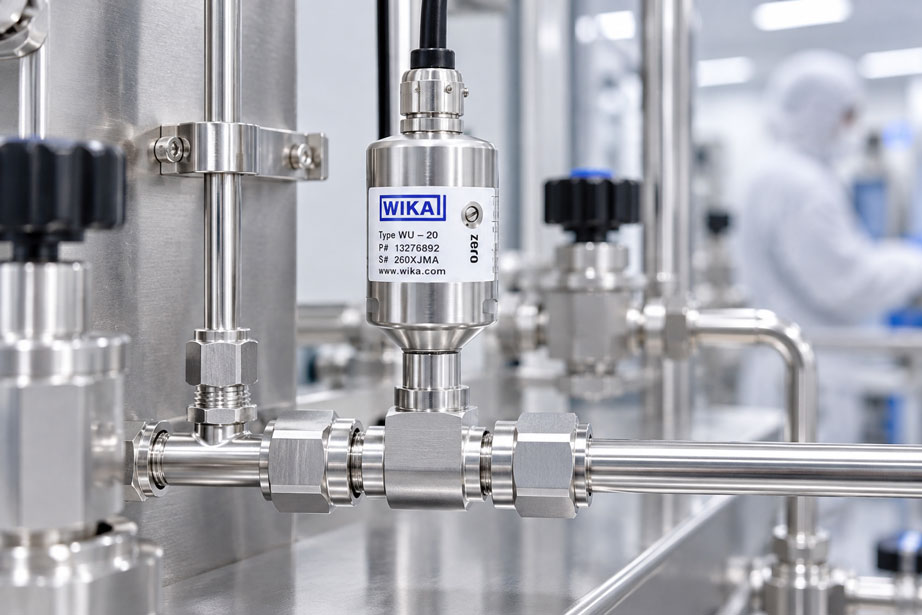
In a conventional compressed-air or process-gas system, a pressure transmitter is often selected primarily according to measuring range, accuracy, output signal and process connection. For an ultra-high-purity gas supply, this approach is not sufficient.
In such a system, the pressure sensor itself becomes part of the wetted high-purity gas system. Every internal sensor surface, every adapter, seal, tee and additional line volume comes into contact with the gas and can therefore influence the purity of the system.
The problem does not necessarily have to be obvious. A pressure transmitter can operate perfectly correctly from a metrological point of view and still be unsuitable for an ultra-high-purity application. A large dead volume can retain residual gas from a previous process step. Rough internal surfaces can promote adsorption and desorption. An unsuitable fitting can generate particles. Lubricants, elastomers or residues from a previous calibration can introduce substances into the gas path that would be completely uncritical in a conventional industrial installation.
Especially in semiconductor, photovoltaic, laboratory and specialty-gas supply applications, such effects can be more important than a few tenths of a percent difference in pure pressure accuracy.
Another important factor is purgeability. When switching between two ultra-high-purity gases or commissioning a newly installed line, the existing gas must be displaced from all wetted areas. Every non-flow-through branch extends this process. This applies not only to pipes and valves, but also to the pressure measuring point itself.
The most important rule is therefore: When measuring the pressure of ultra-high-purity gases, it is not enough for the sensor to match the pressure range. The complete wetted measuring point should have as little dead volume as possible, small and high-quality internal surfaces, suitable materials, clean connections and as few potential sources of particles, moisture or foreign substances as possible.
What does UHP mean for a pressure measuring point?
UHP stands for Ultra High Purity. In such a gas system, it is not sufficient for a component simply to be mechanically leak-tight and able to withstand the required operating pressure. It must also be designed to influence the purity of the transported gas as little as possible.
Depending on the process, different types of contamination can be relevant. These include particles, water, oxygen, hydrocarbons, residual gases from a previous process step or substances outgassing from seals and other materials.
The permissible concentrations vary considerably between applications. “Ultra-high purity” is therefore not a single technical limit class from which all requirements for a pressure transmitter can automatically be derived.
A gas supply system for a general laboratory application may have different purity requirements from a semiconductor process using ultra-high-purity specialty gases.
Nevertheless, some design principles remain similar: keep wetted volumes as small as possible, use suitable materials, provide high-quality internal surfaces and perform all installation and service work in a way that prevents unnecessary foreign substances from entering the system.
The pressure transmitter must therefore be considered not only as an electrical measuring instrument, but as a wetted process component.
Why the pressure sensor itself is part of the high-purity gas system
A pressure sensor requires a connection between the process gas and the measuring cell. Even if this connection is only a few millimetres in size, it contains a certain gas volume.
The process gas wets the pressure connection, internal passages and the actual isolation or sensing diaphragm.
This creates surfaces on which molecules can accumulate. It also creates an additional internal volume that must be filled or exchanged during commissioning, gas changes and purging operations.
With a conventional compressed-air sensor, this effect is practically never considered. For pressure measurement alone, it is usually insignificant.
In an ultra-high-purity gas system, however, even a very small volume can contribute to a so-called memory effect. After a gas change, the previous gas initially remains in this area. Only through diffusion or sufficient gas exchange does the composition gradually approach that of the new gas phase.
The design of the pressure measuring point therefore influences how quickly a high-purity gas system actually reaches the required purity condition after installation or a gas change.
Why dead volume is critical with ultra-high-purity gases
In this context, dead volume refers to a gas-filled area that is connected to the process but is not, or only very weakly, flushed by the actual gas flow.
Typical dead volumes can occur in adapters, tees, valve chambers, sensor connections and long branch lines.
For static pressure measurement, such a volume is not fundamentally problematic for pressure transmission. After sufficient time, the same static pressure will be established there as in the main line.
For gas purity, however, the situation is different.
Assume that a line initially contains nitrogen. It is then switched to an ultra-high-purity process gas. The main line is continuously flushed and the nitrogen is quickly displaced there.
In a 150 mm-long branch line to a pressure transmitter, however, there is almost no directed flow. Gas exchange takes place much more slowly.
The old gas can therefore remain in the system for longer and diffuse back into the main flow.
The larger the dead volume and the larger the wetted surface area of this region, the longer complete cleaning or purging can take.
This is particularly unfavourable in processes involving frequent gas changes.
Distinguishing branch-line and flow-through measurement
A conventional pressure measuring point is often implemented using a tee. The main line continues straight through while the pressure transmitter is connected via a side branch.
From a measurement perspective, this is very practical. The sensor sees the line pressure without requiring the entire gas flow to pass through the measuring instrument.
From the perspective of a UHP gas system, however, this creates a branch volume.
One alternative is a flow-through design. In this configuration, the pressure transmitter has a gas inlet and a gas outlet. The process gas path passes through the wetted sensor housing or through the intended flow channel.
This avoids a comparable long, non-flow-through branch to the measuring point.
This can significantly improve purgeability, especially when a compact valve or gas-panel geometry is being built.
A flow-through sensor is therefore not “more accurate” simply because the gas flows through it. Its main advantage is the integration of the measuring point into a defined gas path.
Another option is a modular surface-mount system. In this case, the pressure transmitter is mounted directly onto a gas block or substrate designed for this purpose. Additional tubing and external fittings can therefore be reduced.
The most appropriate design depends on the complete gas panel, not on the sensor alone.
Why surface finish is important
A technically clean internal surface offers several advantages in ultra-high-purity gas systems.
A rough metal surface has a greater actual surface area than a geometrically identical very smooth surface. Microscopic recesses and machining marks can create additional areas where molecules, moisture or particles can accumulate.
Smooth, high-quality machined or electropolished surfaces therefore make cleaning, purging and achieving stable purity conditions easier.
Electropolishing electrochemically removes microscopic surface peaks and produces a very uniform surface.
For UHP components, surface finish is often described by the Ra value.
A lower Ra value indicates lower average surface roughness.
For actual process quality, however, a single roughness value is not the only relevant factor. Manufacturing, cleaning, packaging, installation and subsequent handling must also be suitable for the application.
An excellently electropolished component cannot provide its intended benefits if its process side is subsequently left unprotected on a dusty workbench.
Adsorption and desorption on internal surfaces
Gas molecules can adhere to a surface. This process is known as adsorption.
These molecules can later leave the surface again. This reverse process is known as desorption.
This effect is relevant in ultra-high-purity gas systems because surfaces can release substances from a previous condition back into the gas stream with a time delay.
Water is particularly critical. If a system has been exposed to humid ambient air for an extended period, water molecules can accumulate on internal surfaces.
Once connected to a dry high-purity gas system, these molecules do not disappear instantly. The dry gas gradually absorbs moisture from the surfaces.
A gas analyzer may therefore show elevated residual moisture for an extended period even though the supplied gas itself is very dry.
The same basic principle applies to other adsorbable substances.
The smaller the unnecessary internal surface area of a measuring point and the higher the quality of that surface, the easier it is to limit this influence in principle.
Consistently avoid particle contamination
The term “particle-free” should not be understood as an absolute condition for a technical measuring point.
In practice, the objective is to maintain the particle cleanliness specified for the process and to avoid generating or introducing unnecessary additional particles during installation, operation and maintenance.
A typical source of particles is the mechanical installation itself.
Damaged threads, contaminated sealing surfaces, metal abrasion or unsuitable sealing materials can introduce material into the gas path.
Improper installation can therefore degrade the complete purity chain even when the sensor itself is fundamentally suitable for UHP applications.
Process connections should therefore only be assembled using suitable tools and in accordance with the specified installation torques.
Protective surfaces must not be touched or damaged with unsuitable tools.
Loose metal chips, fibres from cleaning cloths or remnants of packaging material also have no place in an ultra-high-purity gas measuring point.
Particle control in a high-purity gas system therefore begins not with the sensor principle, but with unpacking and installation.
Face-seal connections instead of arbitrary process fittings
Standard industrial pressure sensors frequently use threads such as G 1/4, 1/4 NPT or similar process connections.
Such connections are very suitable for many applications. In UHP gas systems, however, special metal-sealed face-seal connections are frequently used.
In this case, sealing is not achieved using a pipe thread with sealing tape or sealing compound, but by means of defined high-quality sealing surfaces and a dedicated gasket.
This offers several advantages for high-purity gas systems.
The gas path can be designed very compactly, the sealing point is reproducible and arbitrary thread sealants do not have to be used directly adjacent to the process gas.
The quality of the sealing surfaces is particularly important during installation.
Scratches or damage can impair both gas tightness and cleanliness of the connection.
A face-seal connection should therefore not be treated like an ordinary pipe fitting. The installation instructions of the fitting manufacturer and sensor manufacturer are part of the quality of the measuring point.
Critically assess seals and elastomers
In a conventional gas application, a sealing material is selected primarily according to pressure, temperature and chemical resistance.
In a high-purity system, additional criteria apply.
Certain polymer materials can absorb gases or moisture and release them again later. Permeation and outgassing can also be relevant.
This does not mean that elastomers are fundamentally unsuitable in every high-purity gas system.
It does mean, however, that an arbitrary O-ring is not acceptable simply because it appears chemically compatible with the process gas.
For particularly demanding UHP systems, metallic sealing concepts are therefore frequently used.
The permissible seal must be derived from the specific process standard and the intended system design.
For this reason, sealing materials should not be improvised during sensor replacement even if they fit mechanically into the connection.
Select materials to suit the high-purity gas
The wetted materials must be compatible both with the required gas purity and with the chemical exposure.
316L stainless steel is widely used in ultra-high-purity gas supply systems because it is easy to process, corrosion-resistant and available with high-quality surfaces.
However, this does not automatically make every 316L component equivalent.
Material quality, manufacturing, welding process, surface treatment, cleaning and packaging all influence the later suitability.
For aggressive specialty gases, other materials or alloys may also be required.
The sensor diaphragm itself must also be considered.
A pressure transmitter does not consist only of its visible process connection. The actual measuring cell or diaphragm also has a specific material and is in direct contact with the gas.
Media compatibility should therefore always be checked for the complete combination of wetted materials.
Why purgeability is part of measuring-point quality
A high-purity gas system often has to be purged after installation, maintenance or a gas change.
The required gas consumption depends, among other things, on how quickly foreign gases can be removed from all connected volumes.
In a fully flow-through straight line, the existing gas is displaced comparatively efficiently.
A non-flow-through side branch behaves differently. Mass transfer there takes place much more strongly through diffusion and local mixing.
This means that a comparatively small branch volume can have a disproportionately large influence on the time required to reach an extremely low residual-gas concentration.
A compact UHP measuring setup is therefore not attractive only for space-saving reasons.
It can help reduce purge time and the amount of high-quality process gas required.
This effect can also have economic significance, particularly with expensive specialty gases.
Consider dead volume and surface area together
Dead volume and wetted surface area are often considered separately, but they are physically closely linked.
A long thin tube can have a relatively small internal volume while still providing a comparatively large internal surface area.
A short compact cavity, by contrast, may have a similar volume but a significantly smaller surface area.
For pure pressure equalization, the volume may be decisive. For adsorption and desorption effects, however, the surface area may be more important.
In UHP design, it is therefore not sufficient to look only at the data-sheet value “dead volume”.
The complete gas path is relevant:
Main line → valve → adapter → sensor connection → measuring cell
A sensor with a very small internal volume loses some of its advantage if a large tee and long connection line are installed upstream.
The measuring point must be considered as a system.
Moisture and residual gases as contamination sources
Moisture is one of the particularly persistent contaminants in ultra-high-purity gas systems.
A sensor that has been stored open in normal room air for a long period before installation does not automatically have the same surface condition as an originally clean-packaged UHP component.
After connection to dry gas, the absorbed moisture must first be removed again from the wetted area.
The same applies to residual gas.
If a pressure sensor was previously operated with another gas, gas initially remains in its internal volume after depressurization.
During a subsequent gas change, this residual gas is diluted and displaced, but is not necessarily removed completely and immediately.
For critical applications, it should therefore be known which gases a measuring instrument has previously been exposed to.
A pressure sensor used indiscriminately between different test systems may be completely satisfactory in terms of accuracy and still become unsuitable for purity reasons.
Clean installation of the pressure measuring point
A UHP component should also be installed like a UHP component.
Before work begins, the work area, tools and required components must be prepared cleanly.
Sealing surfaces should not be touched with bare fingers. Tools must not transfer particles or residues to wetted areas.
Fitting components must be clean and undamaged.
Depending on the system specification, components may be blown out with clean and filtered gas before installation.
It is important that the gas used for cleaning itself meets the purity requirements. Blowing out a UHP connection with unfiltered shop compressed air would defeat the purpose of the procedure.
Installation aids must also be critically assessed. Thread greases, lubricants and sealing compounds should only be used near the gas path if they are explicitly specified for the particular process design.
After installation, the specified tightness or leak test must be carried out in addition to checking mechanical function.
Remove protective caps only immediately before installation
Protective caps and cleanroom packaging may initially appear to be unimportant transportation details for a pressure sensor.
For ultra-high-purity components, however, they perform an important function.
They prevent dust, moisture and foreign substances from reaching the high-quality process surfaces during storage and transport.
A process connection should therefore not be opened hours before installation and then left exposed on a workbench.
The protective packaging should ideally only be removed when the component can be installed immediately.
Spare devices that have already been unpacked should also not be stored without suitable protection in toolboxes or shelves.
The condition of the connection surface is part of the later gas quality.
Plan calibration without contamination
A high-accuracy UHP pressure transmitter must be capable of being checked or calibrated regularly or in accordance with the applicable quality requirements.
However, calibration itself must not become a contamination event.
A pressure sensor from an ultra-high-purity gas line should therefore not simply be connected to a hydraulic calibration pump and exposed to oil without prior assessment.
Even if the device can mechanically tolerate hydraulic pressure, oil residues can enter the internal gas path and impair subsequent high-purity gas use.
For UHP gas sensors, pneumatic testing using a suitable clean and dry test medium is often considerably more appropriate.
The hose, adapters and pressure controller must also be clean.
A calibrator previously used on a contaminated compressed-air system or with other process gases should not automatically be used for UHP calibration.
After calibration, a defined purging process may also be required before the sensor is reinstalled in the actual process.
Calibration quality and process purity must therefore be planned together.
Does a small dead volume also affect measurement dynamics?
With gases, additional volume can also influence the dynamics of a measuring path.
A pressure signal propagates very quickly, but long thin lines create a pneumatic system consisting of flow resistance and compressible gas volume.
A narrow line combined with a larger sensor dead volume can therefore damp or delay rapid pressure changes.
In a normal static gas supply, this effect may be completely insignificant.
With rapid valve switching, pulsations or control processes, however, it can become relevant.
For this reason as well, a compact measuring point without unnecessarily long capillaries is advantageous when rapid pressure changes need to be detected.
However, the main reason for small volumes in UHP applications is often purity and purgeability rather than response time alone.
These two topics should therefore not be confused.
Practical example: pressure measurement in a high-purity gas panel
In a gas panel for a semiconductor process, an ultra-high-purity process gas is regulated and supplied to a production system.
The pressure downstream of the pressure regulator is to be monitored continuously.
Initially, the plan is to connect a conventional industrial pressure sensor via a tee, a short pipe nipple and an adapter.
From a metrological point of view, this arrangement would work.
However, from a UHP perspective, several additional volumes become apparent: the side bore of the tee, the pipe nipple, the adapter and the internal pressure connection of the sensor.
During normal steady-state operation, this does not initially produce an obvious pressure error.
During commissioning or a gas change, however, the branch path takes considerably longer until the previous gas has been completely displaced.
In addition, the standard transmitter has a process connection design that is not intended for the purity requirements of the gas panel.
The measuring point is therefore converted to a UHP design.
A transmitter designed for ultra-high-purity gases is integrated directly into the gas line or modular gas block. The wetted paths become shorter, additional adapters are eliminated and the specified high-purity connections can be installed according to the procedure defined for the gas panel.
The new sensor does not measure better simply because its pressure measuring principle is fundamentally different.
The decisive advantage is that the complete measuring point better matches the purity and purging strategy of the gas supply system.
Systematically diagnose contamination problems
If a high-purity gas system takes an unusually long time to reach the specified gas quality after maintenance or sensor replacement, the gas supplier or main line should not be the only areas investigated.
New or modified measuring points can also be the cause of increased residual-gas or moisture signals.
| Observation | Possible cause | Sensible check |
|---|---|---|
| Gas purity improves only very slowly after a gas change | Large dead volume or long non-flow-through branch | Check gas path and measuring-point geometry |
| Moisture briefly increases after sensor replacement | Sensor or adapter was exposed to ambient air | Check purging and stabilization procedure |
| Particle count increases after maintenance | Installation abrasion, contaminated components or damaged sealing surfaces | Inspect installation and connection points |
| Foreign gas is detected despite long flushing of the main line | Residual gas in branch lines or sensor volumes | Identify non-flow-through areas |
| Pressure signal responds unusually slowly | Long narrow connection line combined with gas volume | Check measuring line, cross-section and dead volume |
| Gas quality changes after sensor calibration | Unsuitable test medium or contaminated calibration setup | Review calibration and cleaning process |
The diagnosis should always consider the complete connection chain.
A high-quality UHP pressure sensor cannot compensate for an unsuitable adapter or a long branch line.
Selecting single-end, flow-through or surface-mount
Different mechanical concepts are available for UHP pressure transmitters because different gas-panel geometries place different demands on the measuring point.
A single-end version has one process connection and therefore operates similarly to a conventional pressure transmitter.
It is suitable when the pressure measuring point can be sensibly integrated into a short side connection and the resulting measuring-point geometry meets the purity requirements.
A flow-through version, by contrast, has a defined flow path through the device. It can be particularly useful when a non-flow-through pressure measuring branch is to be avoided.
Surface-mount versions are designed for modular gas supply systems. They are mounted directly onto suitable gas blocks or substrates.
This can reduce tubing, additional fittings and external connection volume.
| Design | Basic principle | Typical advantage in a UHP system |
|---|---|---|
| Single-end | One process connection | Simple integration at a defined measuring branch |
| Flow-through | Gas path through the transmitter | Very good integration into a flow-through gas path |
| Surface-mount | Mounted on a modular gas block | Compact design with few external tubing connections |
The mechanical design should therefore already be defined during gas-panel design rather than added later once the piping system has already been constructed.
Suitable UHP pressure transmitters at ICS Schneider
Within its pressure measurement technology range, ICS Schneider Messtechnik offers special WIKA pressure transmitters for ultra-high-purity gas applications.
The WIKA WU-20, WU-25 and WU-26 are specifically designed for gas panels, semiconductor, display and photovoltaic applications as well as specialty- and bulk-gas supply.
The series combines high-accuracy pressure measurement with a mechanical design developed for ultra-high-purity gas paths.
Depending on the version, the wetted areas include 316L components in accordance with SEMI F20. The internal surfaces are electropolished. Very small internal dead volumes are specified for the series.
The WU-20 is designed as a single-end version.
The WU-25 is the flow-through version and is therefore particularly suitable for measuring points where the pressure transmitter is to be integrated directly into a continuously flushed high-purity gas path.
The WU-26 is designed as a modular surface-mount version for compact gas supply systems.
The three designs therefore allow not only the measuring range and output signal, but also the wetted geometry to be adapted to the gas panel.
For applications requiring a local display or additional switching functions, the WIKA WUD-20, WUD-25 and WUD-26 are also available.
This series is likewise designed for ultra-high-purity applications and offers the corresponding mechanical variants: single-end, flow-through and surface-mount.
For selection, in addition to minimum and maximum process pressure, the gas type, purity requirement, required connection geometry, permissible materials, required surface finish, Ex requirements, output signal, installation space and planned purging strategy should be known.
Especially with specialty gases, the complete device configuration should be checked for media compatibility. The designation “UHP” does not replace the specific assessment of the gas being used.
WIKA WU-20 / WU-25 / WU-26 Ultra High Purity Transducer at ICS Schneider
WIKA WUD-20 / WUD-25 / WUD-26 Ultra High Purity Transducer at ICS Schneider
Measurement technology for the semiconductor industry at ICS Schneider
Conclusion
With ultra-high-purity gases, the pressure transmitter is not merely a measuring instrument at the edge of the process. Its wetted components are part of the actual high-purity gas system.
A technically sound UHP pressure measuring point must therefore not only measure correctly, but also be easy to purge and introduce as few additional contamination sources into the gas path as possible.
Dead volume plays a central role. A non-flow-through measuring branch can retain residual gas from a previous operating condition for considerably longer than the continuously purged main line. During a gas change, this can create a memory effect even though the main piping system has already been completely flushed with the new gas.
The internal surface is equally important. High-quality, smooth or electropolished surfaces reduce areas where moisture, foreign substances and particles can accumulate. At the same time, the complete connection chain must be taken into account. A UHP sensor with a very small internal volume loses its advantage if it is connected via a large tee, several adapters and a long branch line.
Installation also determines purity. Sealing surfaces, protective caps, tools and fitting components must be handled cleanly. A single installation chip or unsuitable sealing compound can impair a high-quality UHP component not only mechanically but also from a process perspective.
Flow-through and surface-mount designs can enable particularly compact and easily purged measuring points. Whether they are actually advantageous compared with a single-end version depends, however, on the complete design of the gas panel.
Finally, calibration must also match the purity strategy. A pressure transmitter designed for ultra-high-purity gases should not subsequently be contaminated by an unsuitable test medium or a contaminated calibration setup.
By considering pressure range, materials, surface finish, dead volume, connection geometry, particle control and purgeability together, the result is a pressure measuring point that not only operates accurately but also influences the quality of the ultra-high-purity gas process as little as possible.
FAQ on pressure measurement with ultra-high-purity gases
What distinguishes a UHP pressure transmitter from a conventional pressure sensor?
In addition to pressure measurement, a UHP transmitter is designed for ultra-high-purity gas paths. Important features can include very small dead volumes, high-quality wetted materials, particularly smooth or electropolished surfaces and special high-purity process connections.
Why is dead volume important in a pure pressure measurement?
For the static pressure value, a small dead volume is often not decisive. For gas purity and purgeability, however, it is: residual gas can remain considerably longer in non-flow-through volumes.
What is a memory effect in a gas path?
This means that substances or gases from a previous operating condition are released back into the current gas stream with a time delay. Dead spaces as well as adsorption and desorption on surfaces can cause this effect.
Why is a long branch line unfavourable?
It creates additional volume that is not directly flushed and additional wetted surface area. During a gas change, complete exchange there often takes significantly longer than in the main flow.
What is a flow-through pressure transmitter?
In a flow-through design, the process gas path passes through the intended wetted structure of the transmitter. This can avoid a conventional long measuring branch.
What does surface-mount mean?
A surface-mount transmitter is installed directly on a dedicated modular gas block or substrate. This enables particularly compact gas panels with few external tubing connections.
Is a flow-through version more accurate?
Not simply because of the flow-through principle. Its main advantage in UHP systems is integration into an easily purged gas path. The actual measuring accuracy depends on the sensor specification.
Why are UHP surfaces electropolished?
Electropolishing produces a very smooth and uniform metal surface. This allows adhesion, surface contamination and cleaning or purging to be controlled more effectively.
What does the Ra value mean?
Ra describes the average surface roughness. A low Ra value indicates a particularly smooth surface.
Is a 316L sensor automatically suitable for every high-purity gas application?
No. In addition to the alloy, surface condition, manufacturing, cleaning, gas type, temperature and all other wetted materials are decisive.
Why are face-seal connections attractive for high-purity gases?
They provide a defined high-quality sealing point without requiring arbitrary thread sealants directly adjacent to the gas path. The specific connection must be assembled according to the specified installation instructions.
Can PTFE tape be used in a UHP gas system?
This should not be assumed in general. Whether a thread sealant is permitted depends on the specific connection and purity concept. Many UHP systems deliberately use metal-sealed face-seal connections.
Why should the protective cap only be removed immediately before installation?
It protects the high-quality process surface from particles, moisture and mechanical damage during storage and handling.
Can normal shop compressed air be used for blowing out components?
For an ultra-high-purity gas path, only a cleaning medium that meets the purity requirements of the system should be used. Unfiltered or oil-contaminated shop compressed air can itself become a source of contamination.
Why is moisture critical at high-purity gas measuring points?
Water can adsorb on internal surfaces and later desorb back into a dry gas. As a result, the required residual moisture level may only be reached after an extended purging period.
Can a sensor be used immediately for high-purity gas after previously being used with another gas?
Not necessarily. Residual gas or adsorbed substances may remain in the internal volume and on surfaces. The required cleaning and purging must be appropriate for the particular application.
Can a UHP pressure sensor be hydraulically calibrated with oil?
For later use in an ultra-high-purity gas process, exposure to oil should not take place without prior assessment. Oil residues can contaminate the wetted side. Clean pneumatic calibration is the more appropriate strategy for many UHP gas applications.
Does dead volume also affect response time?
Combined with long or very narrow connection lines, additional gas volume can damp or delay rapid pressure changes. In many UHP applications, however, purgeability is more important than this dynamic effect.
Which WIKA sensor is suitable for a conventional UHP measuring branch?
The WIKA WU-20 or WUD-20 is designed as a single-end version for corresponding ultra-high-purity pressure measuring points.
Which sensor is suitable for a flow-through gas path?
The WIKA WU-25 or WUD-25 is designed as a flow-through version.
Which version is suitable for modular gas panels?
The WIKA WU-26 or WUD-26 is designed as a surface-mount version for integration into corresponding modular gas supply systems.
What information is required to select a UHP pressure transmitter?
Important information includes gas type, purity requirement, minimum and maximum pressure, required pressure type, process connection or gas-panel geometry, wetted materials, surface requirements, temperature range, Ex requirements, output signal and the intended cleaning and purging strategy.