


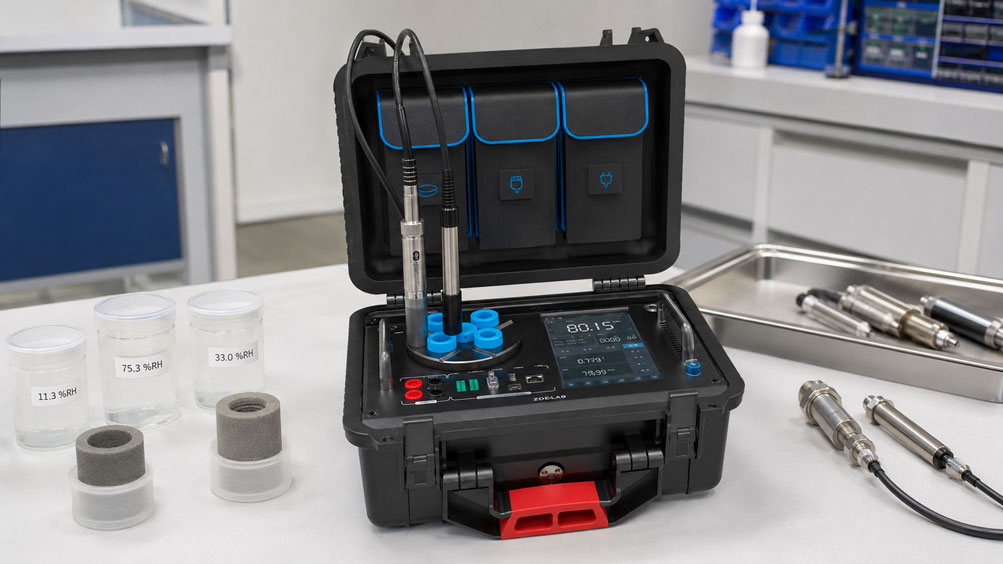
A humidity sensor is placed in a reference chamber and, after a few minutes, indicates 72% RH instead of the expected 75% RH. The obvious conclusion is that the sensor has drifted by 3% RH. After another 20 minutes, however, the reading rises to 74.8% RH. In another case, the sensor and reference agree well at 30% RH but suddenly differ by several percent at 90% RH.
Such observations do not automatically mean that the humidity sensor is faulty. In humidity calibration, temperature equilibrium, stabilization time, airflow, reference value and probe positioning are integral parts of the measurement.
Relative humidity in particular is highly sensitive to temperature differences. The sensor, reference and test air should therefore be at essentially the same temperature. Even small temperature gradients between the device under test and its surroundings can cause a deviation that is easily misinterpreted as sensor drift.
There are essentially two very practical methods available for comparison testing: saturated salt solutions with defined humidity fixed points and controlled humidity generators or humidity chambers. Both methods can provide reliable results, but they differ considerably in terms of flexibility, stabilization time, effort and achievable measurement uncertainty.
Suitable calibration equipment can be found at ICS Schneider under humidity calibrators. An overview of suitable measuring instruments and sensors can be found under humidity measuring instruments and humidity sensors.
Table of Contents
- What is actually checked during humidity calibration?
- Why relative humidity is so temperature-dependent
- How saturated salt solutions generate humidity fixed points
- Typical salt solutions and humidity ranges
- Why the salt solution really must be saturated
- Measuring the temperature of the salt solution and chamber
- Why stabilization time is more important than sensor response time
- Calibration with a salt solution step by step
- Calibration with a humidity generator or humidity chamber
- Using a reference hygrometer correctly
- Homogeneity and position in the test chamber
- Considering airflow and probe loading
- Why the dew point becomes critical at high humidity
- One-point, two-point or multi-point testing?
- Detecting hysteresis with increasing and decreasing humidity
- Avoiding contamination of the humidity sensor
- Do not confuse calibration and adjustment
- Evaluating measurement uncertainty correctly
- Typical fault patterns during humidity calibration
- Systematic test procedure
- Practical example: apparent sensor drift in a cleanroom
- Suitable humidity calibrators
- Conclusion
- FAQ
What is actually checked during humidity calibration?
During calibration, the indicated or output measured value of a humidity sensor is compared with a known reference value.
The basic relationship is:
Measurement deviation = DUT reading − reference value
If, for example, the device under test indicates 74.1% RH and the reference value is 75.0% RH, the result is:
Deviation = 74.1% RH − 75.0% RH = −0.9% RH
However, this value is only meaningful if it has been ensured that:
- the reference value is correct,
- the sensor and reference are exposed to the same climatic conditions,
- temperature equilibrium has been reached,
- humidity is stable,
- no condensation is present,
- the measuring chamber is sufficiently homogeneous.
Humidity calibration is therefore much more than simply placing a sensor in a box and reading two numbers.
Why relative humidity is so temperature-dependent
In simplified terms, relative humidity describes the ratio between the actual water vapor partial pressure and the saturation vapor pressure at the respective temperature:
RH = pwater / psaturation(T) · 100%
The saturation vapor pressure of water changes significantly with temperature.
This means:
With the same absolute amount of water vapor, relative humidity can change solely as a result of a temperature change.
This is exactly why a temperature difference between the reference and device under test is problematic during humidity calibration.
A sensor that is slightly colder than the surrounding air may measure a higher relative humidity. If it is slightly warmer, the indicated value may be lower.
This effect becomes particularly critical as relative humidity increases.
For careful calibration, it is therefore not sufficient to ask:
“Is the humidity stable?”
It is equally important to ask:
“Are the device under test, reference and surroundings really at the same temperature?”
How saturated salt solutions generate humidity fixed points
Certain saturated salt solutions establish a characteristic water vapor partial pressure in a closed space above the solution.
This creates a reproducible relative humidity at a defined temperature.
The method is attractive because different salts can be used for different humidity ranges.
Typical setup:
saturated salt solution → closed salt chamber → defined vapor space → humidity sensor
After sufficient time, equilibrium is established between the salt solution and the water vapor in the closed volume.
The sensor can then be checked against this humidity point.
Advantages of this method include:
- comparatively simple setup,
- no active humidity control required,
- suitable for intermediate checks and verification measurements,
- several defined humidity ranges possible using different salts.
The disadvantage:
The user cannot freely select the humidity value.
Each salt solution generates a specific equilibrium value depending on temperature.
Typical salt solutions and humidity ranges
Several salt systems are commonly used for humidity testing.
| Salt | Typical humidity range at room temperature | Typical application |
|---|---|---|
| Lithium chloride – LiCl | approx. 11% RH | Dry reference point |
| Magnesium chloride – MgCl2 | approx. 33% RH | Low to medium humidity point |
| Sodium chloride – NaCl | approx. 75% RH | Very commonly used upper test point |
| Potassium chloride – KCl | approx. 85% RH | High humidity range |
| Potassium sulfate – K2SO4 | approx. 97% RH | Very high humidity range |
The values in this table are for guidance only.
For actual calibration, you must not simply calculate with “11%, 33% or 75%”.
The exact reference value must be determined from the actual temperature and the valid reference data or calibration certificate for the salt solution being used.
The degree of temperature dependence varies depending on the salt.
Why the salt solution really must be saturated
The defined humidity point is only generated under the intended conditions of a saturated solution.
A practical saturated salt solution therefore typically contains:
- a liquid phase,
- and some additional undissolved salt.
The undissolved salt indicates that the solution is not simply completely diluted at the respective temperature.
If too much water is added and all the salt dissolves completely, the concentration may fall below the saturation limit. The expected humidity fixed point then no longer applies automatically.
Other problematic conditions include:
- contamination of the solution,
- mixing different salt systems,
- contaminated chambers,
- using unsuitable water for self-prepared solutions,
- dried-out salt preparations.
For quality-relevant tests, prepared or documented reference systems are therefore preferable to improvised setups.
Measuring the temperature of the salt solution and chamber
When calibrating with a salt solution, temperature measurement is an integral part of determining the reference value.
The decisive temperature is not simply the room temperature measured somewhere on the wall.
What matters is the temperature of the salt chamber or the system in which the sensor and reference are located.
A problematic situation would be, for example:
- room temperature 23 °C,
- salt chamber was previously in a vehicle at 10 °C,
- sensor comes from a process at 40 °C,
- calibration starts immediately after assembly.
Under these conditions, neither temperature nor humidity in the system can yet be in equilibrium.
The sensor reading will initially change as a result of thermal adaptation and not necessarily because of its calibration characteristic.
Why stabilization time is more important than sensor response time
The response time of a humidity sensor and the required stabilization time of a calibration are two different things.
A sensor may, for example, have a response time of only a few seconds.
Nevertheless, the complete calibration setup may require considerably longer because the following must all equilibrate:
- temperature of the sensing element,
- temperature of the probe body,
- temperature of the cable,
- temperature of the chamber material,
- humidity of the gas volume,
- moisture loading of filters and protective caps.
A particularly common mistake is therefore:
“The measured value has barely changed for two minutes, so the calibration is stable.”
This does not necessarily mean that it is.
A better criterion is a defined stability window.
For example, it can be specified that:
- the reference humidity varies only slightly over a defined period,
- the DUT reading is also stable,
- the temperatures of the reference and device under test have sufficiently equilibrated.
The time required depends strongly on the device under test, filter, chamber size and initial temperature.
With salt systems, several tens of minutes are entirely normal. If a warm probe comes directly from a process or a cold calibrator has just been transported, complete thermal stabilization may take considerably longer.
Calibration with a salt solution step by step
A defined procedure is advisable for reproducible testing.
- Define the test plan: Which humidity points are to be checked?
- Select suitable salt references: for example, one low and one high point.
- Check the condition of the reference: inspect the salt solution, chamber, seals and documentation.
- Condition the system: allow the calibrator, sensor and accessories to remain at the test location long enough to reach temperature equilibrium.
- Measure the temperature: determine the temperature of the respective salt chamber.
- Insert the sensor: keep the probe opening exposed for as short a time as possible.
- Seal the chamber: close all unused openings.
- Avoid unnecessary contact with the sensor: hand heat can change the probe temperature.
- Wait for stabilization: do not work solely according to a fixed number of minutes.
- Determine the reference value: use the correct RH value for the actual measured temperature.
- Document the as-found value: read the device under test before any adjustment.
- Calculate the deviation: DUT minus reference.
- Check the next humidity point: for multi-point testing, it is generally sensible to proceed in a defined sequence from dry to humid.
- Adjust if necessary: only if intended and technically required.
- Perform a verification check: after adjustment, recheck the relevant points.
The as-found value is particularly important.
If a sensor is immediately adjusted to the reference, the information about how large its deviation actually was before adjustment is lost.
Calibration with a humidity generator or humidity chamber
A controlled humidity generator or humidity chamber actively generates defined temperature and humidity conditions.
Unlike a salt solution, different setpoints can be selected within the operating range of the instrument.
This is particularly practical for:
- multi-point calibrations,
- several sensors simultaneously,
- automatic test sequences,
- hysteresis tests,
- testing at different temperatures.
A typical test plan could, for example, include:
- 20% RH,
- 40% RH,
- 60% RH,
- 80% RH
at a defined temperature.
For more demanding testing, several different temperatures can additionally be used.
However, one important point also applies to an automatic humidity generator:
The fact that the instrument has reached its setpoint does not automatically mean that the device under test has fully stabilized.
A generator may control the chamber atmosphere very quickly, while a solid process probe with a metal housing or a sensor with a dense filter may require considerably longer to reach temperature equilibrium.
Using a reference hygrometer correctly
In a humidity chamber, the setpoint is often controlled using an internal sensor.
For high-quality comparison measurements, an additional calibrated reference hygrometer can be used.
The measuring chain then consists, for example, of:
humidity generator → reference hygrometer → device under test
It is important that the reference and device under test are exposed to conditions that are as comparable as possible.
They should therefore:
- be located in the same test volume,
- not be positioned in opposite temperature zones,
- be inserted to a comparable depth,
- not be placed directly against cold or warm chamber walls,
- not shield each other from the airflow.
The quality of the calibration can never be assessed more accurately than the quality and traceability of the reference used allow.
Homogeneity and position in the test chamber
A humidity chamber does not necessarily have exactly the same temperature and relative humidity at every position.
Differences may be caused, for example, by:
- chamber walls,
- door or lid,
- humidification and drying system,
- air circulation,
- number and size of devices under test.
Two terms are therefore important:
- Stability: How much does the value at one position change over time?
- Homogeneity or uniformity: How much do different positions within the test volume differ?
A chamber can be very stable over time while still showing different values at two positions.
The reference and device under test should therefore be positioned as close to each other as practical, provided this does not interfere with airflow.
Considering airflow and probe loading
The airflow inside an active humidity chamber is used to distribute temperature and humidity as evenly as possible.
Too many devices under test or poorly positioned devices can alter this airflow.
Problematic examples include:
- large transmitter housings directly in front of the air outlet,
- several probes mounted very close together,
- loose cable bundles inside the test volume,
- open probe ports through which ambient air can enter.
For multiple calibrations, it is therefore not sufficient merely to check whether the sensors physically fit inside the chamber.
The chamber design and airflow concept must also be suitable for the number and size of the devices under test.
Why the dew point becomes critical at high humidity
The dew point is the temperature at which the existing amount of water vapor just reaches saturation.
If a surface becomes colder than the dew point, water can condense.
At high relative humidity, the dew point is only slightly below the air temperature.
Even a small temperature gradient can therefore become problematic.
Example:
A probe is transferred from a cool room into a warm chamber at high humidity. The probe body is initially still significantly colder than the chamber air.
Condensation may then form locally on the sensor.
Possible consequences include:
- humidity indication close to 100% RH,
- very long recovery time,
- changed sensor characteristics,
- contamination due to dirty condensate.
For tests in the upper humidity range, sufficient thermal preconditioning is therefore particularly important.
One-point, two-point or multi-point testing?
One-point test
A one-point test is suitable, for example, for:
- quick intermediate checks,
- monitoring a particularly important operating point,
- trend monitoring of a sensor.
However, it does not reliably show whether the complete humidity characteristic is correct.
Two-point test
In a two-point test, one low and one higher humidity point are used.
A classic example is:
- low point using LiCl,
- higher point using NaCl.
This makes it much easier to detect both an offset and a change in characteristic slope.
Multi-point test
For high-quality sensors and quality-critical applications, a multi-point test is useful.
It can reveal, for example:
- nonlinear deviations,
- errors occurring only in the upper humidity range,
- hysteresis,
- temperature-dependent deviations.
The test points should cover the actual operating range of the application as closely as possible.
Detecting hysteresis with increasing and decreasing humidity
A humidity sensor may provide different readings at the same humidity value depending on whether the point is approached from a lower or higher humidity level.
This behavior is known as hysteresis.
A test sequence consisting only of, for example:
20 → 40 → 60 → 80% RH
provides only limited information about this effect.
An additional return sequence:
80 → 60 → 40 → 20% RH
can reveal whether the same test point is reached reproducibly from both directions.
An actively controlled humidity generator is particularly convenient for hysteresis testing because the setpoints can be approached in a controlled manner.
Avoiding contamination of the humidity sensor
Humidity sensors can be affected by deposits and certain chemical substances.
The condition of the probe should therefore be checked before calibration.
Typical problems include:
- dust on the filter,
- oil mist,
- cleaning agents,
- solvent vapors,
- process deposits,
- condensate residues.
A contaminated filter can also increase response time.
This creates a potentially misleading effect:
The sensor may eventually reach the correct final value, but it takes much longer than expected.
If the calibration is stopped too early, the slow response may incorrectly appear to be a measurement deviation.
A filter should only be cleaned or replaced in accordance with the sensor manufacturer’s instructions.
Do not confuse calibration and adjustment
The terms calibration and adjustment are often used interchangeably in practice, but they describe different processes.
Calibration
Calibration determines the magnitude of the deviation of a measuring instrument from a reference.
The instrument is not necessarily changed.
Adjustment
During adjustment, the measuring instrument is deliberately modified so that its indication or output signal agrees more closely with the reference value.
For traceable documentation, it is therefore useful to record:
- As Found: condition of the sensor before adjustment,
- As Left: condition after any adjustment has been performed.
A sensor should not automatically be adjusted simply because a deviation was found at a single test point that had not yet fully stabilized.
Evaluating measurement uncertainty correctly
A calibration consists of more than just the reference value and sensor indication.
Contributors to the actual uncertainty budget may include:
- uncertainty of the humidity reference,
- uncertainty of the temperature measurement,
- temperature difference between reference and device under test,
- chamber stability,
- spatial homogeneity of the chamber,
- resolution of the device under test,
- repeatability,
- hysteresis,
- reference drift,
- influence of probe position.
When using a salt solution, the uncertainty of the respective humidity fixed point at the relevant temperature must also be considered.
A common misconception is:
“My reference has an uncertainty of ±0.5% RH, so my entire calibration also has an uncertainty of ±0.5% RH.”
This is normally not correct.
The reference is only one contributor within the complete measuring chain.
Typical fault patterns during humidity calibration
| Observation | Possible cause | Recommended check |
|---|---|---|
| Sensor indicates significantly too little humidity immediately after insertion | Sensor or probe body still too warm | Allow temperature equilibration and observe the measurement trend |
| Measured value continues to rise slowly over 20 to 30 minutes | System has not yet reached humidity and temperature equilibrium | Increase stabilization time |
| Large deviation only at high humidity | Temperature gradient, condensation or sensor hysteresis | Compare temperatures and check the return sequence |
| NaCl test does not indicate exactly 75% RH | Reference value assumed without temperature correction | Measure salt chamber temperature and use the correct reference value |
| Two sensors in the same chamber differ significantly | Different position, temperature or filter response time | Swap probe positions and repeat stabilization |
| All devices under test show a similar deviation from the reference | Possible reference problem or chamber gradient | Check with an independent reference or a second position |
| Sensor responds very slowly after process operation | Filter contaminated or sensor contaminated | Inspect the sensor and protective filter |
| Measured value jumps after the chamber is opened | Ambient air has entered the test volume | Close the chamber again and allow full stabilization |
| After adjustment, one point is correct but other points are not | Nonlinearity or unsuitable one-point adjustment | Perform a multi-point test |
| Increasing and decreasing humidity measurements differ | Sensor hysteresis | Perform a defined increasing/decreasing humidity cycle |
Systematic test procedure when sensor drift is suspected
If a humidity sensor shows implausible values during operation, it should not be adjusted immediately.
A useful procedure is:
- Check the application: Is the comparison value in the process actually reliable?
- Check the sensor condition: Inspect the filter, contamination and possible condensation.
- Condition the sensor sufficiently: Allow process and calibration temperatures to equilibrate.
- Establish the first reference point: Use a salt solution or humidity chamber.
- Measure the temperature: The device under test and reference must be thermally comparable.
- Wait for stabilization: Observe the trend rather than only a single reading.
- Document the as-found value: Do not perform any adjustment yet.
- Check a second humidity point: Preferably sufficiently far from the first point.
- Add further points: Particularly within the sensor’s actual operating range.
- Check hysteresis: If high accuracy is required, also approach setpoints in the reverse direction.
- Evaluate measurement uncertainty: Consider reference, temperature and chamber.
- Only then make a decision: Accept, adjust, clean or replace the sensor.
Practical example: apparent sensor drift in a cleanroom
Several humidity and temperature sensors are used in a cleanroom. During operation, one of the sensors consistently indicates approximately 3% RH less than a portable check instrument.
The sensor is removed and tested in a humidity reference at approximately 75% RH.
After five minutes, the device under test indicates 71.8% RH.
The initial assumption is:
The sensor has an offset of approximately −3% RH.
Step 1: Do not adjust the reading immediately
The device under test is initially left unchanged. Instead, the measured value continues to be observed.
After 15 minutes, it indicates 73.6% RH.
After 30 minutes, the measured value is already considerably closer to the reference value.
Step 2: Compare temperatures
The temperature indication shows that at the beginning of the test the sensor was still significantly warmer than the reference chamber.
The apparent humidity error was therefore caused at least partly by the temperature difference.
Step 3: Check a second point
After complete stabilization, an additional low humidity point is checked.
The deviation is also within the expected limits there.
Step 4: Investigate the cause at the original installation location
During inspection in the cleanroom, it becomes apparent that the permanently installed sensor is mounted closer to a warmer wall surface than the portable check instrument.
The two instruments therefore do not measure exactly the same air temperature.
Because relative humidity is directly temperature-dependent, this explains a substantial part of the observed difference.
Result: Premature adjustment would have altered a correctly functioning sensor. The actual cause was thermal stabilization during the test and different measuring conditions at the installation location.
The example demonstrates the most important principle:
During humidity calibration, thermal and hygrometric equilibrium must first be established before a deviation is evaluated as sensor drift.
Suitable humidity calibrators for salt and chamber methods
For regular testing of several humidity sensors, actively controlled humidity generators offer the particular advantage over individual salt references that different humidity and temperature points can be approached deliberately.
Huminator II – humidity and temperature calibrator for sensors and data loggers
The Huminator II is designed for humidity calibration of measuring instruments, probes and data loggers from various manufacturers.
The specified operating range includes:
- Temperature: 5 °C to 50 °C,
- relative humidity: 5% RH to 95% RH.
The system features an integrated, accessible and replaceable reference probe. Measurement points and test sequences can be programmed, and measured values can be displayed and stored graphically or in tabular form.
The measuring chamber allows different sensor designs to be accommodated simultaneously.
The fast control response of the generator is particularly useful in practice. Nevertheless, every calibration must distinguish between:
stability of the generator and complete stabilization of the device under test.
A solid sensor or a probe coming directly from a significantly warmer or colder process may require additional time even when the chamber itself is already stable.
Further information can be found under Huminator II at ICS Schneider.
EP-Z600 – portable humidity calibrator for service and on-site testing
The EP-Z600 is designed as a portable humidity generator for mobile calibration and service applications.
Its features include:
- 7-inch touchscreen,
- integrated rechargeable battery for up to 8 hours of operation,
- RS232,
- RS485,
- USB,
- LAN,
- optional or configuration-dependent wireless communication.
A mobile system is particularly useful when sensors need to be tested as close as possible to their actual installation location.
However, the same principle applies here: If a sensor comes directly from a warm or cold process, sufficient time for temperature equilibrium must be allowed before evaluating the humidity deviation.
Further information can be found under EP-Z600 at ICS Schneider.
EP-Z6000 – humidity generator with larger test volume
The EP-Z6000 is particularly suitable for applications requiring a larger test volume or several or larger devices under test.
The system offers, among other features:
- 2-liter chamber volume,
- 9-inch touchscreen,
- RS232 and RS485 interfaces,
- USB and LAN,
- chamber conditions designed for good homogeneity.
When several sensors are inserted simultaneously, care should still be taken to ensure that airflow is not unnecessarily obstructed and that the reference and devices under test are positioned representatively.
Further information can be found under EP-Z6000 at ICS Schneider.
1000 – compact humidity generator
The Humidity Generator 1000 is designed as a compact benchtop solution for humidity calibration.
Specified features include:
- compact design,
- quickly replaceable desiccant,
- optimized airflow,
- customized probe openings,
- weight of 8.4 kg,
- humidity accuracy of ±1.0% RH or better.
Custom probe openings are particularly useful when different sensor designs need to be inserted reproducibly into the test volume.
Further information can be found under Humidity Generator 1000 at ICS Schneider.
Salt solution or active humidity generator?
| Requirement | Suitable method |
|---|---|
| Simple intermediate check of a sensor | Saturated salt solution |
| Cost-effective two-point test | Two suitable salt references |
| Set arbitrary humidity points | Active humidity generator |
| Multi-point calibration | Humidity generator or humidity chamber |
| Testing several sensors | Chamber with sufficient test volume and homogeneity |
| Testing humidity at different temperatures | Humidity/temperature generator |
| Investigating hysteresis | Programmable humidity generator with increasing and decreasing humidity sequence |
| High-quality traceable comparison measurement | Humidity generator plus suitable calibrated reference |
An overview of the available instruments can be found under humidity calibrators at ICS Schneider.
Conclusion
When calibrating humidity sensors, the accuracy of the reference alone does not determine the quality of the result.
At least equally important are temperature equilibrium, sufficient stabilization time, homogeneity of the test volume, probe position and a clean sensor condition.
Saturated salt solutions are a simple and very useful way to generate defined humidity points for intermediate and comparison testing. However, it is essential that the solution is actually in the required state and that the reference value corresponding to the actual temperature is used.
Active humidity generators offer considerably greater flexibility. Several humidity points, different temperatures and hysteresis tests can be approached deliberately. When several devices under test are used, chamber homogeneity and airflow must also be considered.
The most common practical mistake is evaluating the measured value too early.
A stable indication does not automatically mean that thermal equilibrium has been reached.
Especially at high relative humidity, even small temperature differences can cause significant deviations. In the worst case, a perfectly functioning sensor is adjusted even though only the calibration setup itself had not yet stabilized.
For reliable humidity calibration, the following procedure therefore applies:
define the reference → equalize temperature → position the device under test correctly → wait for equilibrium → document the as-found value → check additional measuring points → only then decide whether adjustment is necessary.
FAQ: Calibrating a humidity sensor with salt solutions or a humidity chamber
Can a humidity sensor be calibrated using a salt solution?
Yes. Saturated salt solutions can generate defined humidity fixed points inside a closed chamber. The actual reference value depends on the salt solution used and the temperature.
Which salt solution generates approximately 11% relative humidity?
Lithium chloride, LiCl, is frequently used for a low humidity reference point of approximately 11% RH. For evaluation, the exact value at the actual temperature must be taken into account.
Which salt solution generates approximately 33% RH?
Saturated magnesium chloride, MgCl2, generates a humidity value of approximately 33% RH at room temperature.
Which salt solution generates approximately 75% RH?
Sodium chloride, NaCl, is very frequently used as a reference around 75% RH. The exact value is temperature-dependent.
Which salt solution is suitable for very high humidity?
Potassium sulfate, K2SO4, can generate a reference point of approximately 97% RH. Testing in this humidity range is particularly sensitive to temperature gradients because of the proximity to the dew point.
Does the salt solution have to be saturated?
Yes. The defined humidity point requires the intended saturated state of the solution. With a self-prepared system, an appropriate solid salt phase should still be present to ensure saturation.
Why does the reference value of a salt solution change with temperature?
The equilibrium vapor pressure above the salt solution and the saturation vapor pressure of water are temperature-dependent. The reference value must therefore be determined for the actual temperature of the salt chamber.
Can I simply use exactly 75% RH for NaCl?
For a rough functional check, the approximate value may be useful. For documented calibration, however, the reference value valid at the actual temperature should be used.
How long does a humidity sensor need to stabilize in a salt reference?
This depends on the sensor, filter, chamber, initial humidity and especially the temperature difference. Several tens of minutes are normal for many tests. With significantly different initial temperatures, complete stabilization may take considerably longer.
Is it sufficient if the measured value has not changed for two minutes?
Not necessarily. The indication may appear stable while the probe body is still thermally adjusting. A defined stability criterion for both humidity and temperature is more reliable.
Why is temperature so important during humidity calibration?
Relative humidity is directly temperature-dependent. Even small temperature differences between the device under test and the reference can therefore cause a measurable humidity deviation.
Why is temperature error particularly large at high humidity?
At high relative humidity, the air is closer to saturation. A small temperature change therefore alters the relative distance from saturation particularly strongly.
What happens if the sensor is colder than the chamber during calibration?
It may measure a higher relative humidity than intended for the chamber air. At sufficiently high humidity, the sensor surface may even fall below the dew point and condensation may occur.
What happens if condensation forms on the humidity sensor?
The sensor may temporarily indicate an extremely high humidity value and may then require time to dry. Contaminated condensate can also influence the sensor characteristics.
Should calibration begin at low or high humidity?
For many procedures, a defined sequence from dry to humid is useful. Among other things, this can reduce the risk of carrying moisture from a high humidity point into a lower reference point.
Is a one-point calibration sufficient?
It may be sufficient for an intermediate check at an important operating point. However, it provides little information about characteristic slope, nonlinearity and hysteresis.
Why is a two-point test better?
A low and a higher reference point allow offset and characteristic slope to be assessed much more effectively.
When should several humidity points be checked?
Multi-point tests are particularly useful where high accuracy is required, the operating range is wide, the application is quality-critical or nonlinear sensor deviations are suspected.
What is hysteresis in a humidity sensor?
Hysteresis means that the sensor may indicate slightly different values at the same humidity depending on whether that point is approached from a lower or higher humidity level.
How is the hysteresis of a humidity sensor tested?
The sensor is tested at several humidity points, first in an increasing sequence and then in a decreasing sequence. The results at identical setpoints are compared.
Which is better: salt solution or humidity chamber?
Salt solutions are simple and economical for defined individual points. A controlled humidity chamber or humidity generator is more flexible because different setpoints can be selected within the operating range and automated multi-point tests can be performed.
Does a humidity chamber require a reference hygrometer?
This depends on the instrument design and quality requirements. Some systems have an integrated reference. For demanding comparison calibrations, an additional traceably calibrated reference may be useful.
Where should the reference and device under test be positioned in the humidity chamber?
They should be located in comparable areas of the test volume and not directly against chamber walls or in different temperature zones. At the same time, airflow should not be unnecessarily obstructed.
Can several humidity sensors be calibrated simultaneously?
Yes, provided the chamber is suitable for the number and size of the devices under test. The sensors should not shield each other from airflow, and the homogeneity of the test volume must be taken into account.
What is the difference between stability and homogeneity?
Stability describes the change over time at one position. Homogeneity describes the differences between different positions within the chamber. Both quantities are relevant to reliable calibration.
Can a contaminated filter affect the calibration?
Yes. A contaminated filter can slow humidity equalization and therefore cause a very long response time. Contamination of the actual sensing element can additionally change the measurement characteristics.
Should a sensor be adjusted immediately when a deviation is detected?
No. First check whether the reference, temperature equilibrium, stabilization and sensor condition are correct. Only a reproducibly confirmed deviation should be used as the basis for adjustment.
What do As Found and As Left mean?
As Found describes the condition of the sensor before adjustment. As Left documents the condition after any adjustment has been performed. Both values are important for traceability of the calibration.
Which factors contribute to the measurement uncertainty of humidity calibration?
These include reference uncertainty, temperature measurement, temperature gradients, chamber stability, homogeneity, repeatability, hysteresis, resolution and drift.
Which humidity calibrator is suitable for programmable multi-point tests?
The Huminator II, for example, is suitable for such applications. It generates defined humidity and temperature conditions and offers programmable measuring points and measurement sequences.
Which calibrator is suitable for mobile humidity testing?
The EP-Z600 is designed as a portable humidity calibrator and features, among other things, an integrated rechargeable battery and various communication interfaces.
Which system is suitable for several or larger devices under test?
The EP-Z6000 offers a test volume of 2 liters and is particularly useful for applications requiring a larger chamber or test volume.