


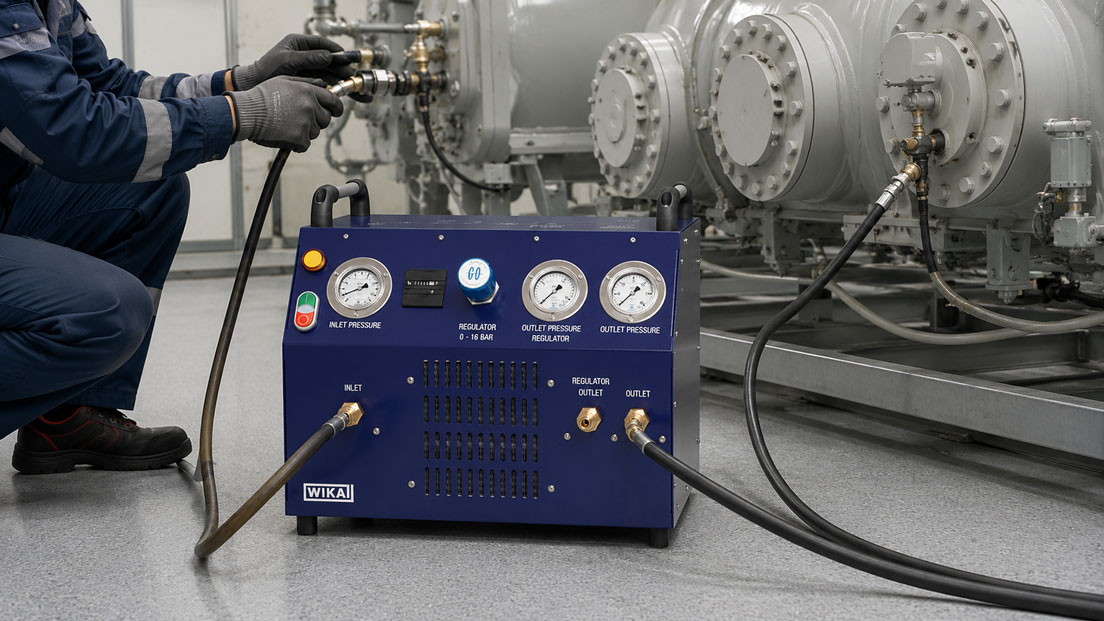
SF₆ is used as an insulating and arc-extinguishing gas in gas-insulated switchgear, circuit breakers and other electrical equipment. Whenever a gas compartment is opened, serviced, topped up or decommissioned, the gas must be handled in a controlled manner.
A conventional compressor or general-purpose vacuum pump is not sufficient for this task. SF₆ service equipment must operate gas-tight, prevent contamination of the insulating gas and return the gas as completely as possible to a suitable storage vessel.
The tasks of filling, evacuation and recovery are often confused. During evacuation before filling, air and moisture are removed from an empty gas compartment. During recovery, however, the SF₆ already present in the system is extracted and stored in a gas cylinder.
This article explains which equipment is required for the individual work steps, when a portable modular system is sufficient and when a complete SF₆ service cart is the more suitable solution.
Table of contents
- Which tasks must be distinguished during SF₆ service
- Typical procedure for maintenance and refilling
- Evacuating the gas compartment before filling
- Filling SF₆ in a controlled and metered manner
- Recovering SF₆ from the switchgear
- Why the residual pressure is decisive
- Filtering SF₆ and assessing gas quality
- Weighing gas cylinders and documenting the gas quantity
- Selecting hoses, valves and couplings correctly
- Preventing gas losses through leak testing
- Safety and handling contaminated gas
- Portable individual modules or a complete service cart?
- Typical errors during SF₆ gas transfer
- Practical example: Servicing an SF₆ switchgear panel
- Which measuring instruments / products are suitable?
- Conclusion
- Frequently asked questions about SF₆ service equipment
Which tasks must be distinguished during SF₆ service
The term “SF₆ service unit” covers several different functions. Depending on the maintenance task, not all of them are automatically required.
| Work step | Objective | Typical equipment |
|---|---|---|
| Evacuation | Remove air and moisture from the empty gas compartment | Vacuum pump |
| Filling | Transfer SF₆ from a gas cylinder into the system | Transfer unit, pressure regulation, scale and filling hose |
| Recovery | Extract SF₆ from the system into a storage vessel | Transfer unit and, where necessary, vacuum compressor |
| Filtering | Reduce moisture, particles and decomposition products | SF₆ filter unit |
| Analysis | Determine purity, moisture and decomposition products | SF₆ gas analyser |
| Weighing | Determine the transferred or recovered gas quantity | Gas cylinder scale |
The correct combination of equipment depends on the gas-compartment volume, initial pressure, required residual pressure, gas condition, maintenance frequency and available working time.
Typical procedure for maintenance and refilling
For scheduled maintenance, the procedure can be simplified as follows:
- Identify the system: Check the gas type, filling pressure, gas quantity, connections and manufacturer’s specifications.
- Prepare the storage vessel: Check the approval, remaining capacity, condition and valve connection.
- Connect the service lines: Use suitable, clean and gas-tight hoses and couplings.
- Recover the SF₆: First extract the gas with the transfer unit and then, where necessary, with the vacuum compressor.
- Open and service the gas compartment: Only after following the prescribed release and safety procedure.
- Evacuate the gas compartment: Remove air and moisture before filling.
- Check leak tightness: Inspect the system and service connections.
- Fill with SF₆: Monitor the gas quantity or the temperature-related filling pressure.
- Check gas quality and gas density: Document the operating condition.
- Depressurise the service lines: Return residual gas in a controlled manner and disconnect the hoses safely.
The exact sequence depends on the switchgear, service equipment and internal operating instructions.
Evacuating the gas compartment before filling
After maintenance, the opened gas compartment initially contains ambient air. If SF₆ were filled immediately, oxygen, nitrogen and moisture would remain in the system. This can impair the gas quality and electrical properties.
A vacuum pump such as the WIKA GVP-10 is therefore used to prepare the gas compartment for filling. It evacuates the empty gas compartment before the actual filling process.
The following factors are particularly important for a good result:
- a sufficiently low final pressure
- pump capacity suitable for the gas-compartment volume
- gas-tight hoses and connections
- sufficient evacuation time
- dry and clean service lines
- a stable vacuum-hold test before filling
If the pressure rises significantly after the vacuum pump is switched off, possible causes include a leak, outgassing moisture or a section of the system that has not been evacuated sufficiently.
The vacuum pump used for filling preparation must not be confused with the vacuum compressor used for SF₆ recovery. The GVP-10 removes air from the empty gas compartment. The GVC-10, by contrast, transfers existing SF₆ from the system into a storage vessel.
Filling SF₆ in a controlled and metered manner
During filling, the gas is transferred from a supply cylinder into the previously evacuated gas compartment. Depending on the system manufacturer, filling is controlled using the gas mass, filling pressure, temperature-compensated gas density or a combination of these variables.
The WIKA GTU-10 can transfer SF₆ from a storage vessel into gas-insulated equipment. Its oil-free compressor prevents lubricants from the compressor from entering the insulating gas.
The following points are decisive during filling:
- correct gas type and gas quality
- approved storage cylinder
- permissible filling and operating pressure
- current gas temperature
- correct cylinder position and secure fastening
- controlled opening of the valves
- monitoring of the transferred gas mass
Filling too quickly can cause significant temperature changes. As a result, the pressure currently displayed may differ from the later equilibrium condition. The final assessment should therefore be carried out after sufficient temperature equalisation.
Recovering SF₆ from the switchgear
Before an SF₆-filled system is opened, the existing gas must be recovered as completely as possible. Releasing it into the environment is neither technically nor environmentally acceptable.
The GTU-10 can pump SF₆ from the system into a suitable gas cylinder. During storage, the gas can be liquefied inside the vessel, allowing the storage capacity of the cylinder to be used more efficiently.
Storage cylinders, valves, hoses and supply lines must be approved for the pressures that occur. For a GTU-10 application involving gas liquefaction, the connected storage components must be rated for at least 50 bar.
As the pressure inside the gas compartment falls, the normal transfer compressor operates increasingly slowly. If a particularly low residual pressure is required, an additional SF₆ vacuum compressor is used.
Why the residual pressure is decisive
After the first recovery stage, SF₆ remains inside the gas compartment. The amount of gas left depends on the final pressure and the volume of the system.
The WIKA GVC-10 is combined with the GTU-10 to evacuate SF₆ gas compartments to a residual pressure below 5 mbar absolute.
A low residual pressure is important because it:
- reduces the remaining quantity of SF₆ inside the gas compartment
- limits gas losses when the compartment is subsequently opened
- reduces exposure of service personnel
- enables more accurate accounting of the recovered gas quantity
In addition to the equipment, the achievable final pressure depends on the gas-compartment volume, hose cross-section, line resistance, leak tightness and operating time.
Filtering SF₆ and assessing gas quality
Recovered SF₆ may contain moisture, particles or decomposition products. Particularly after electrical switching operations or faults, the gas must not be considered equivalent to new gas without further testing.
The WIKA GPF-10 filter unit has a 3-in-1 filter cartridge for reducing:
- solid particles
- reactive decomposition products
- moisture
Filtering alone does not confirm that the gas may be reused. Before refilling, it may be necessary to analyse the SF₆ purity, moisture and decomposition products.
Suitable instruments can be found in the SF₆ gas analysers category.
Heavily contaminated gas or gas outside the permissible quality limits must be treated or subjected to an appropriate further process in accordance with operational and legal requirements.
Weighing gas cylinders and documenting the gas quantity
The pressure inside an SF₆ cylinder alone does not provide a reliable indication of the gas mass it contains. Particularly when part of the gas is liquefied, the pressure does not change proportionally to the quantity withdrawn or filled.
A gas cylinder scale is therefore a central component of gas accounting. The WIKA GWS-10 determines the transferred gas quantity with an accuracy of up to ±30 g.
A scale can be used to:
- determine the filled gas mass
- document the recovered gas quantity
- check the remaining capacity of the storage cylinder
- assess the plausibility of gas losses
- manage cylinder inventories
Before transfer, the permissible filling mass, tare weight and maximum cylinder load must be known. A gas cylinder must not be filled based solely on the indicated pressure.
Selecting hoses, valves and couplings correctly
The leak tightness of the service equipment does not end at the equipment housing. Hoses, couplings, valves and adapters form part of the gas-carrying measuring and transfer chain.
The following must be checked when selecting the components:
- SF₆ suitability and permissible operating pressure
- vacuum suitability
- hose length and internal diameter
- sealing materials
- connections on the switchgear and gas cylinder
- self-closing valves
- protection against contamination and moisture
Unnecessarily long or undersized hoses increase evacuation and transfer times. Several adapters installed one after another increase dead volume and the risk of leakage.
Suitable components can be found in the SF₆ hoses and gas refill sets and SF₆ valves and couplings categories.
Preventing gas losses through leak testing
Before every gas transfer, the complete assembly should be checked for leak tightness. This includes not only the switchgear but also:
- cylinder valve
- transfer and vacuum hoses
- couplings and adapters
- inlet and outlet of the service equipment
- filter housing
- venting and bypass valves
A pressure-hold or vacuum-hold test can identify major leaks. A suitable electronic leak detector may be required for particularly small leakage rates.
After servicing, the connections on the switchgear should also be checked again. A correct filling weight or stable filling pressure does not automatically prove that the system will remain leak-tight over the long term.
Safety and handling contaminated gas
SF₆ is non-flammable. In enclosed areas, however, escaping gas can displace air. Working areas must therefore be adequately ventilated and monitored in accordance with the risk assessment.
After electrical arc events, reactive and harmful decomposition products may be present in the gas and on the internal surfaces of the system. Contaminated equipment may only be opened or handled in accordance with the prescribed protection and cleaning procedure.
Safe service includes, among other things:
- trained and authorised personnel
- internal work and release instructions
- suitable personal protective equipment
- ventilation or room monitoring
- clear identification of gas cylinders
- separation of new gas, used gas and contaminated gas
- documentation of the transferred gas quantity
The operating instructions for the switchgear, service equipment and gas vessels are decisive for the specific procedure.
Portable individual modules or a complete service cart?
The portable WIKA equipment series allows the required functions to be combined from individual modules:
- GVP-10 for filling preparation
- GTU-10 for transfer and filling
- GVC-10 for deep recovery
- GPF-10 for gas filtration
- GWS-10 for gas accounting
A modular system is advantageous when:
- the equipment is transported frequently
- only individual functions are required
- installation space is limited
- small to medium gas quantities are handled
A complete service cart is useful when larger gas compartments are serviced regularly or short service times are required. Units in the GPU series integrate filling, recovery, evacuation and, depending on the version, gas filtration into one system.
The SF₆ service equipment category contains both portable modules and more powerful service units.
Typical errors during SF₆ gas transfer
| Error | Possible consequence | Better approach |
|---|---|---|
| Evacuation and recovery are confused | Unsuitable equipment or incomplete work procedure | Use the GVP-10 for air and the GTU-10/GVC-10 for SF₆ |
| The gas compartment is filled without sufficient vacuum | Air and moisture remain in the system | Check the final pressure and perform a vacuum-hold test |
| Transfer ends at an excessively high residual pressure | An unnecessarily large quantity of SF₆ remains in the gas compartment | Provide a vacuum compressor for deep evacuation |
| The gas cylinder is assessed only by pressure | Uncertain gas quantity or risk of overfilling | Weigh the cylinder during transfer |
| Used gas is reused without testing | Moisture or decomposition products enter the system | Filter the gas and analyse its quality |
| Unsuitable hoses or adapters | Leakage, long transfer times or contamination | Use components suitable for SF₆ and vacuum service |
| Hoses are disconnected while containing residual gas | SF₆ is released uncontrollably | Return residual gas to the system before disconnection |
Practical example: Servicing an SF₆ switchgear panel
An internal component must be replaced in a gas-insulated switchgear panel. The gas compartment contains several kilograms of SF₆ and must be opened completely.
First, the storage cylinder is placed on the GWS-10 gas cylinder scale. The SF₆ is then transferred from the system into the cylinder using the GTU-10.
After the gas-compartment pressure has fallen significantly, the GVC-10 is connected. This allows the SF₆ remaining at low pressure to be recovered to a large extent.
After the mechanical work has been completed, the gas compartment is evacuated using the GVP-10. A vacuum-hold test indicates whether the system and the newly installed connections are sufficiently leak-tight.
The recovered gas is analysed and, where necessary, treated using the GPF-10 filter unit. The system is then refilled while monitoring the gas mass, pressure and temperature.
Finally, the gas density, gas quality and leak tightness are checked. The filled, recovered and, where applicable, additional gas quantities are documented.
Which measuring instruments / products are suitable?
WIKA GTU-10 for transfer and filling
The WIKA GTU-10 is suitable for extracting SF₆ from systems, combining partially filled gas cylinders and filling gas-insulated equipment.
The oil-free compressor and compact design make the unit particularly suitable for portable service applications.
WIKA GVC-10 for low residual pressures
The WIKA GVC-10 is combined with the transfer unit when SF₆ gas compartments must be evacuated to below 5 mbar absolute.
WIKA GVP-10 for filling preparation
The WIKA GVP-10 evacuates the empty gas compartment before filling and thereby reduces the amount of air and moisture.
WIKA GPF-10 for gas treatment
The WIKA GPF-10 filters particles, reactive decomposition products and moisture from the gas flow.
WIKA GWS-10 for determining the gas quantity
The WIKA GWS-10 enables precise weight monitoring during filling and recovery.
Complete SF₆ service units
Integrated service units such as the GPU-B and GPU-S series are available for regularly recurring work and larger gas quantities. They combine several process steps in one portable system.
ICS Schneider Messtechnik assists with designing the appropriate SF₆ service equipment. The required information includes the gas-compartment volume, operating and filling pressure, required residual pressure, expected gas quantity, maintenance frequency, existing gas cylinders and required functions.
Conclusion: Every work step requires the appropriate SF₆ service equipment
Evacuation, filling and recovery are different tasks. A vacuum pump removes air and moisture before filling, while the transfer unit and vacuum compressor recover the existing SF₆ from the system.
The GTU-10 performs the actual gas transfer. For particularly low residual pressures, it is combined with the GVC-10. The GVP-10 prepares the empty gas compartment for refilling.
The filter unit, gas cylinder scale and gas analysis complement the process. They enable controlled gas treatment, traceable gas accounting and an assessment of whether recovered SF₆ can be reused.
Clean hoses suitable for vacuum operation, appropriate couplings, controlled handling of residual gas and a complete leak-tightness test are equally important.
The correct solution results from the complete service chain – from the system connection and gas recovery through to documenting the quantity of gas refilled.
Frequently asked questions about SF₆ service equipment
What is the difference between evacuation and recovery?
During evacuation, air and moisture are removed from an empty gas compartment. During recovery, the existing SF₆ is extracted from the system and stored.
Can the GTU-10 evacuate the gas compartment completely?
The GTU-10 performs the gas transfer. For recovery down to a particularly low residual pressure, the GVC-10 vacuum compressor is additionally used.
What is the GVP-10 required for?
The GVP-10 evacuates the empty gas compartment before filling so that as little air and moisture as possible remain in the system.
Why must an SF₆ gas cylinder be weighed?
Particularly when the gas is liquefied, the cylinder pressure does not provide reliable information about the contained gas mass. The scale enables accurate gas accounting.
Can recovered SF₆ be refilled immediately?
Not in every case. Depending on its condition, the moisture, purity and decomposition products must be analysed and the gas may need to be filtered or treated further.
Why are oil-free compressors important?
They prevent lubricants from the compressor from entering the insulating gas and impairing its quality.
What function does the GPF-10 filter unit perform?
It reduces particles, reactive decomposition products and moisture in the SF₆ gas flow.
When is a complete service cart useful?
For frequent maintenance operations, large gas compartments and short required processing times, an integrated system is usually more efficient than several individual modules.
Which information does ICS Schneider require for selection?
The required information includes the gas-compartment volume, gas quantity, operating pressure, required final or residual pressure, maintenance frequency, gas condition, existing connections and required functions such as filtration, analysis or weighing.