


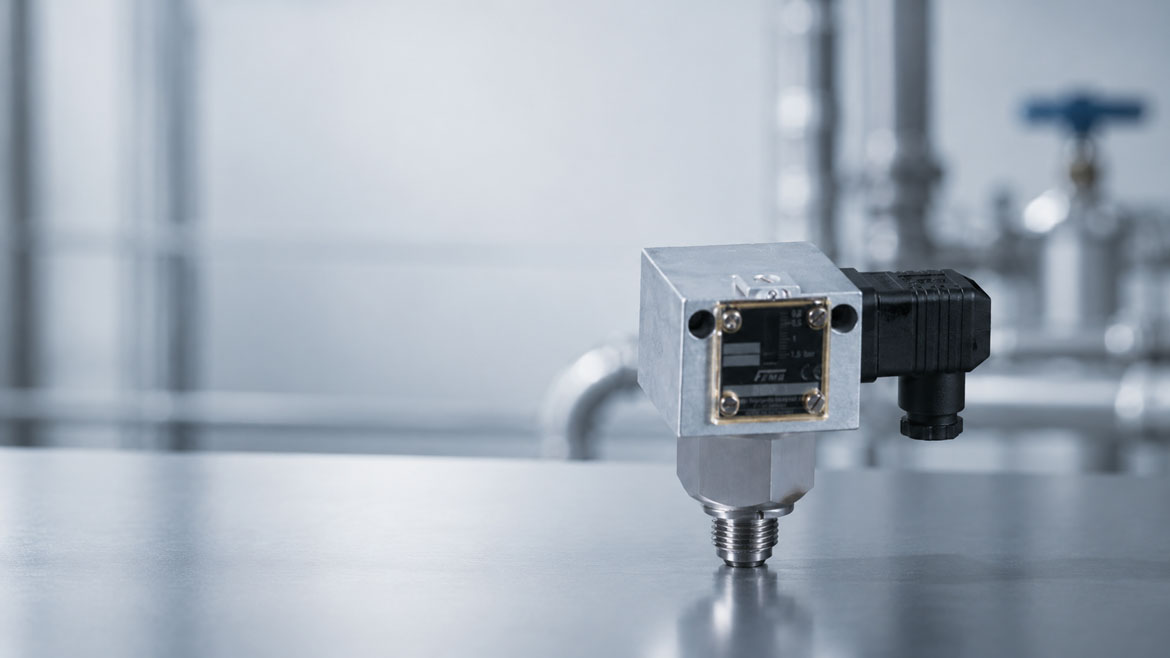
Choosing the right FEMA pressure switch: switching range, medium and application clearly explained
Mechanical pressure switches are used in many industrial systems to monitor pressure, trigger switching operations or reliably control system conditions. FEMA pressure switches are particularly widespread in practice because they are robustly designed and operate without electronic pressure measurement.
However, mistakes often occur during selection: the switching range is chosen too narrowly, the medium does not match the material, the switching differential is underestimated, or a standard pressure switch is used even though a pressure monitor, pressure limiter or differential pressure switch is actually required.
This article explains what you should pay attention to when selecting a FEMA pressure switch and which technical details are important for a safe and reliable design.
You can find an overview of suitable devices in our category
FEMA pressure switches.
Table of contents
- What is a mechanical pressure switch used for?
- The most important selection criteria for FEMA pressure switches
- Selecting the correct switching range
- What does switching differential or hysteresis mean?
- Medium: liquid, gas, steam or oil?
- Pressure switch, pressure monitor or pressure limiter?
- Common mistakes when selecting pressure switches
- Practical examples for correct selection
- Checklist: information required for selection
- Conclusion
- FAQ: frequently asked questions about selecting FEMA pressure switches
What is a mechanical pressure switch used for?
A mechanical pressure switch monitors a defined pressure value. When the set switching point is reached, the device actuates an electrical contact. This allows pumps, compressors, valves, burners, warning signals or safety functions to be switched.
- Overpressure monitoring: The switch reacts when a specified pressure is exceeded.
- Vacuum monitoring: The switch monitors vacuum or falling pressure.
- Differential pressure monitoring: The switch compares two pressure points, for example upstream and downstream of a filter.
- Minimum pressure monitoring: The switch signals when a minimum pressure is not reached.
- Maximum pressure monitoring: The switch signals or switches off when a limit pressure is exceeded.
Typical areas of application include hydraulics, pneumatics, pumping systems, compressors, burner technology, steam systems, hot water systems, filter monitoring, mechanical engineering and process engineering.
The most important selection criteria for FEMA pressure switches
For a pressure switch to operate reliably, several technical factors must match. It is not enough to know only the desired switching point.
| Criterion | Why it is important | Typical mistakes |
|---|---|---|
| Switching range | The desired switching point must be within the adjustable range. | The switching point is too close to the upper or lower end of the setting range. |
| Switching differential | It determines the distance between the switching point and reset point. | The hysteresis is not taken into account, causing the system to switch unexpectedly. |
| Medium | Liquids, gases, steam or oil place different demands on materials and seals. | The pressure switch is not chemically or thermally suitable for the medium. |
| Maximum permissible pressure | The device must also be able to safely withstand short-term pressure peaks. | Only the normal operating pressure is considered, while pressure peaks are ignored. |
| Temperature | Medium and ambient temperature influence device selection. | Hot media are considered without a cooling section, siphon or suitable installation arrangement. |
| Electrical contact | The switch must match the control system, PLC or safety circuit. | Switching capacity, contact type or connection type are not checked. |
| Approval | Special approvals may be required for hazardous areas, fuel gases, steam or safety-related applications. | A standard pressure switch is selected for an application with special requirements. |
Selecting the correct switching range
The switching range indicates the pressure range in which the pressure switch can be set. The desired switching point should ideally not be directly at the edge of the setting range. In practice, it is often better to choose a range where the switching point is approximately in the middle or upper-middle area.
Example: If a pressure of 5 bar is to be monitored, not every pressure switch with an upper range value above 5 bar is automatically optimal. The switching differential, permissible maximum pressure, medium and desired switching behavior are also decisive.
Practical rule for preselection
- The desired switching point must be safely within the setting range.
- The normal operating pressure must not be too close to the switching point if pressure fluctuations occur.
- Pressure peaks must remain below the maximum permissible pressure of the device.
- At very low pressures, special attention should be paid to resolution and switching differential.
- For changing operating states, the reset point should also be calculated.
For many industrial applications with liquids and gases, the
FEMA pressure switches for liquids and gases
are suitable.
What does switching differential or hysteresis mean?
The switching differential describes the distance between the switch-on point and the reset point. It prevents a pressure switch from constantly switching on and off due to small pressure fluctuations.
Especially with pumps, compressors or pulsating media, the switching differential is an important factor. If it is not taken into account, frequent switching, contact wear or unstable system behavior can occur.
| Term | Meaning | Example |
|---|---|---|
| Switching point | Pressure value at which the switch is actuated. | The contact switches at 6 bar. |
| Reset point | Pressure value at which the contact switches back. | The contact resets at 5.5 bar. |
| Switching differential | Difference between switching point and reset point. | In this example, 0.5 bar. |
In many mechanical pressure switches, the switching differential is determined by the design. It should therefore be considered when selecting the device.
Medium: liquid, gas, steam or oil?
The medium to be monitored is one of the most important selection criteria. A pressure switch suitable for compressed air is not automatically suitable for steam, hydraulic oil, fuel gas or aggressive liquids.
Important questions about the medium
- Is the medium a liquid or a gas?
- Is the medium aggressive, corrosive, contaminated or viscous?
- What is the temperature of the medium during normal operation?
- Can pressure surges or pulsations occur?
- Is a special approval required, for example for fuel gases or hazardous areas?
- Are specific materials or seals required?
For standard applications in mechanical engineering, hydraulics and pneumatics, universal pressure switches such as the
DCM3 universal pressure switch
or devices from the
DCM/DNM pressure switch and pressure monitor series
are often used.
Pressure switch, pressure monitor or pressure limiter?
In many enquiries, the general term pressure switch is used. Technically, however, different functions may be meant. The distinction is particularly important in safety-related applications.
| Device function | Typical task | Example application |
|---|---|---|
| Pressure switch | Switching or signalling at a set pressure value. | Pump control, compressor monitoring, mechanical engineering. |
| Pressure monitor | Monitoring of a limit value with a defined switching function. | Heating systems, burners, compressed air or hydraulic systems. |
| Pressure limiter | Safety-related limitation of a pressure value, often with manual reset. | Steam, hot water, fuel gases or liquid fuels. |
| Differential pressure switch | Monitoring the pressure difference between two measuring points. | Filter monitoring, pump protection, flow monitoring. |
For safety-related applications such as fuel gases, steam or hot water, special pressure monitors or pressure limiters are often required. One example is the
DWR pressure monitor for hot water, steam, gas and liquid fuels.
Common mistakes when selecting pressure switches
Many operating problems are not caused by a defective pressure switch, but by incorrect selection or unfavorable installation conditions.
- The switching range is too narrow: The desired switching point is at the edge of the setting range.
- The switching differential is not taken into account: The system switches too early, too late or too frequently.
- Pressure pulsations are underestimated: Pumps or compressors cause rapid pressure changes.
- The medium does not match the device: Materials, seals or temperature limits are unsuitable.
- The maximum pressure is not checked: Pressure peaks can damage the switching element.
- The mounting position is ignored: In sensitive measuring ranges, the installation position can have an influence.
- Approvals are missing: Standard devices are selected for hazardous areas, fuel gases or safety-related systems.
Anyone who checks these points before ordering reduces the risk of failure and avoids unnecessary queries during technical clarification.
Practical examples for correct selection
Example 1: Pump monitoring in a water line
A pump is to be switched off when the pressure rises too high. In this case, the switching range, maximum permissible pressure and expected pressure surges are decisive. If the pump generates strong pulsations, the switching differential must be sufficiently large or the pressure line must be appropriately stabilized.
Example 2: Filter monitoring via differential pressure
With a filter, the absolute pressure is not decisive; the pressure drop between inlet and outlet is. If the differential pressure increases, this may indicate increasing filter contamination. Differential pressure switches such as the
FEMA DDCM differential pressure monitors
are suitable for such applications.
Example 3: Fuel gas or steam application
For fuel gases, steam or hot water, a simple universal pressure switch is often not sufficient. Special requirements regarding approval, design, temperature, safety and reset function may apply. In such cases, it should be specifically checked whether a pressure monitor or pressure limiter is required.
Checklist: information required for selection
The more precise the technical information, the more reliably a suitable FEMA pressure switch can be selected.
| Information | Example |
|---|---|
| Desired switching point | Switching at 6 bar with rising pressure |
| Operating pressure | Normal operation 4 to 5 bar |
| Maximum pressure / pressure peaks | Short-term up to 10 bar |
| Medium | Compressed air, water, hydraulic oil, steam, gas |
| Medium temperature | For example 20 °C, 80 °C or 180 °C |
| Ambient temperature | For example -20 to +60 °C |
| Pressure connection | G 1/4, G 1/2, 1/4 NPT, 1/2 NPT |
| Electrical connection | Terminal connection, plug connection, cable gland |
| Contact function | Normally closed, normally open or changeover contact |
| Approval | ATEX, DVGW, TÜV, SIL or other requirements |
Conclusion: the right pressure switch depends on more than just the pressure range
Selecting the right FEMA pressure switch does not start with the price, but with the application. Switching range, switching differential, medium, temperature, pressure connection, electrical switching function and possible approvals must be considered together.
For simple industrial monitoring tasks, universal pressure switches can be a suitable solution. For fuel gases, steam, hot water, hazardous areas or safety-related functions, however, specially suitable pressure monitors, pressure limiters or Ex pressure switches are required.
If you are unsure which pressure switch is suitable for your application, a structured technical clarification will help. You can find an initial product selection in our overview of
FEMA pressure switches.
FAQ: frequently asked questions about selecting FEMA pressure switches
Which FEMA pressure switch is suitable for general industrial applications?
For many standard applications in mechanical engineering, pneumatics or hydraulics, universal pressure switches are suitable. One example is the
DCM3 universal pressure switch. However, the switching range, medium, pressure connection and electrical contact function are always decisive.
What is the difference between a pressure switch and a pressure monitor?
A pressure switch switches at a set pressure value. A pressure monitor is often used for limit value monitoring and, depending on the version, can meet special requirements. For applications with fuel gases, steam, hot water or liquid fuels, special pressure monitors such as the
DWR pressure monitor may be required.
When do I need a differential pressure switch?
A differential pressure switch is required when it is not the absolute pressure but the pressure difference between two measuring points that needs to be monitored. Typical applications include filter monitoring, pump protection or flow monitoring. For liquids and gases,
FEMA DDCM differential pressure monitors can be used.
Why does my pressure switch keep switching on and off?
The switching point is often too close to the normal operating pressure, or the switching differential is too small for the pressure fluctuations in the system. Pump pulsations, pressure surges or an unfavorable installation location can also cause a pressure switch to switch too frequently.
Can a pressure switch for water also be used for steam?
Not automatically. Steam places higher demands on temperature resistance, installation and safety. Depending on the application, additional measures such as a cooling section or siphon may be required. It must also be checked whether a special pressure monitor or pressure limiter is necessary.
What information is important for an enquiry?
Important information includes switching point, operating pressure, maximum pressure, medium, medium temperature, ambient temperature, pressure connection, electrical connection type, contact function and required approvals. Without this information, a pressure switch can only be roughly preselected.
When is an Ex pressure switch required?
An Ex pressure switch is required when pressure has to be monitored in potentially explosive atmospheres. In this case, zone, gas or dust group, temperature class and type of protection must match the system. Special versions are available for such applications, such as
Ex-DCM / Ex-DNM pressure switches
or
Ex-DWR pressure monitors.
What does switching differential mean in a mechanical pressure switch?
The switching differential is the distance between the pressure value at which the contact switches and the pressure value at which it switches back. It prevents the switch from constantly switching back and forth due to small pressure fluctuations.
Can the switching differential be adjusted?
This depends on the device type. In some pressure switches, the switching differential is fixed; in other versions, it can be adjusted within certain limits. This point should therefore be checked when selecting the device.
Where can I find an overview of FEMA pressure switches?
You can find a structured overview in the
FEMA pressure switches category. It includes various series for liquids, gases, differential pressure, hazardous areas and safety-related applications.