


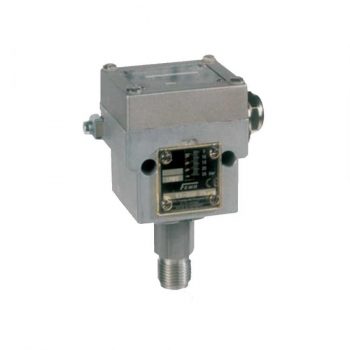
- Pressure monitor for fuel gases
- liquid fuel and steam
- according to ATEX 2014/34/EU
- SPCO


 Datasheet Datasheet
|
|
Operating manual
|

Ex-DWR Pressure Monitors and Pressure Limiters for Hazardous Areas
FEMA Ex-DWR pressure monitors and pressure limiters are used for safety-related pressure monitoring in potentially explosive atmospheres. They are particularly suitable for applications with fuel gases, liquid fuels, steam, hot water and oil where pressure limits must be monitored reliably and safety-related switching functions must be triggered.
The Ex-DWR series is designed as a pressure monitor or pressure limiter for maximum and minimum pressure monitoring. It can be used in systems where tested pressure monitoring as well as explosion protection requirements must be fulfilled. Typical applications include burner systems, gas pressure regulating lines, steam systems, hot water systems, boiler systems, process plants and industrial energy supply systems.
The devices are designed according to ATEX 2014/34/EU for potentially explosive atmospheres. Depending on the version, Ex-DWR variants are described with type of protection Ex de IIC T6. The protection rating is IP65 when installed correctly. IECEx and SIL2 according to IEC 61508-2 are also specified, making the series suitable for demanding safety-related applications.
As a pressure switch of special construction, Ex-DWR is intended for applications with high requirements regarding operational safety, switching reliability and system availability. The series can be used for maximum pressure monitoring and minimum pressure monitoring. When used as a pressure limiter, an external lockout can be integrated into the safety chain.
Pressure detection is mechanical. The applied pressure acts on a measuring element which actuates a switching contact when the set limit value is reached. The switching signal can be used for shutdown, alarm, release or lockout functions within the system control.
Typical Applications
- Pressure monitoring in potentially explosive atmospheres
- Maximum and minimum pressure monitoring in fuel gas systems
- Pressure monitoring for liquid fuels, for example heating oil
- Monitoring of steam and hot water systems
- Pressure monitoring in gas pressure regulating lines and burner controls
- Safety shutdown in case of inadmissible pressure increase or pressure drop
- Integration into safety chains with external lockout
Advantages of FEMA Ex-DWR Pressure Monitors
- For hazardous areas: designed for potentially explosive atmospheres according to ATEX 2014/34/EU
- For several media: suitable for fuel gases, liquid fuels, steam, hot water and oil
- Pressure monitor or pressure limiter: suitable for monitoring or safety-related pressure limitation depending on the application
- Maximum and minimum pressure monitoring: suitable for upper and lower pressure limits
- Ex de IIC T6: depending on the version, suitable for demanding explosion protection requirements
- IP65: robust design for industrial ambient conditions
- SIL2 possible: depending on the version, suitable for safety-related applications according to IEC 61508-2
Ex-DWR Pressure Monitors at ICS Schneider
ICS Schneider offers FEMA Ex-DWR pressure monitors and pressure limiters for industrial applications with increased requirements regarding pressure monitoring and explosion protection. The devices are suitable for operators, plant manufacturers and service companies that require a robust mechanical solution for hazardous areas.
When selecting the correct Ex-DWR device, the medium, pressure range, required switching point, function as pressure monitor or pressure limiter, maximum or minimum pressure monitoring, Ex zone, type of protection, temperature class, electrical switching capacity, protection rating, process connection, installation situation and required approvals should be considered. For Ex applications, the design should always be based on the specific system classification and applicable explosion protection requirements.
FAQ – Frequently Asked Questions about FEMA Ex-DWR Pressure Monitors and Pressure Limiters
1. What is a FEMA Ex-DWR pressure monitor?
A FEMA Ex-DWR pressure monitor is a mechanical switching device used to monitor pressure limits in potentially explosive atmospheres. It actuates an electrical contact when the set switching point is reached.
2. What is Ex-DWR used for?
Ex-DWR is used for maximum and minimum pressure monitoring in systems with fuel gases, liquid fuels, steam, hot water or oil. Typical applications include burner systems, gas pressure regulating lines, steam systems and process plants.
3. Is Ex-DWR suitable for potentially explosive atmospheres?
Yes. The Ex-DWR series is designed according to ATEX 2014/34/EU for potentially explosive atmospheres. Depending on the version, type of protection Ex de IIC T6 is specified.
4. Can Ex-DWR be used as a pressure limiter?
Yes. Depending on the version, Ex-DWR can be used as a pressure monitor or pressure limiter. For pressure limiter applications, an external lockout can be integrated into the safety chain.
5. What does maximum pressure monitoring mean?
Maximum pressure monitoring means that an upper pressure limit is monitored. When this limit is reached or exceeded, the pressure monitor triggers a switching function.
6. What does minimum pressure monitoring mean?
Minimum pressure monitoring means that a lower pressure limit is monitored. If this value is undershot, shutdown, alarm or lockout can be triggered.
7. Which media is Ex-DWR suitable for?
Depending on the version, Ex-DWR is suitable for fuel gases, liquid fuels, steam, hot water and oil. Exact suitability must be checked based on the technical data and operating conditions.
8. What protection rating does Ex-DWR have?
Ex-DWR versions are described with protection rating IP65, provided they are installed and connected correctly.
9. What does Ex de IIC T6 mean?
Ex de IIC T6 is an explosion protection marking. It refers to a combination of flameproof enclosure and increased safety, gas group IIC and temperature class T6. The exact application must match the Ex zone and system classification.
10. Does Ex-DWR require a supply voltage?
No supply voltage is required for mechanical pressure detection itself. An electrical connection is only required for the switching contact or switching signal.
11. Is SIL information available for Ex-DWR?
Yes. SIL2 according to IEC 61508-2 is specified in the product information. Whether this is sufficient for the specific safety function must be verified as part of the system assessment.
12. What information is important for selecting the correct device?
Important information includes the medium, pressure range, switching point, function as pressure monitor or pressure limiter, maximum pressure load, Ex zone, type of protection, temperature class, electrical switching capacity, process connection, mounting position, protection rating and required approvals.