


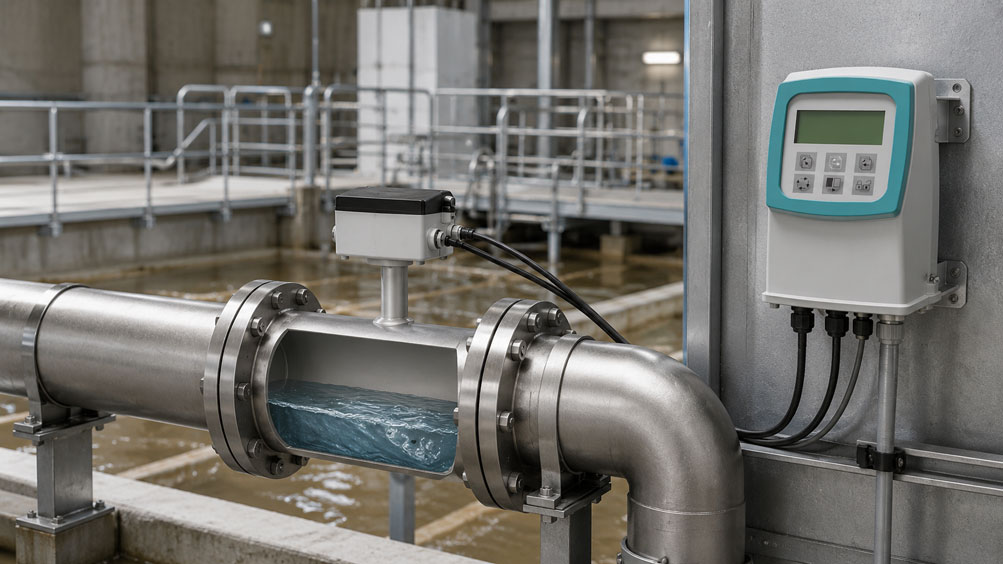
An electromagnetic flowmeter shows a stable flow value even though an air pocket has visibly formed in the horizontal pipe. The electrodes of the flow sensor are positioned at the sides of the pipe and are still completely covered by liquid. Does this mean that the indicated value must still be correct? This is precisely where a common misinterpretation of electromagnetic flowmeters occurs.
A conventional inline electromagnetic flowmeter is designed for a measuring tube that is completely filled with electrically conductive liquid. The induced voltage at the electrodes is used to determine the flow velocity and, together with the known full pipe cross-section, to calculate the volumetric flow rate. If the pipe is partially filled with air, these geometric conditions are no longer valid. A particularly problematic aspect is that such a condition does not necessarily result in an immediate and unambiguous error message.
The position of the measuring electrodes plays an important role here. In a horizontal pipe, they are usually positioned at the sides so that neither air accumulates directly at the electrodes nor sediment settles on them. However, this favorable position can also mean that the electrodes remain wetted even when the pipe is only partially filled. The flowmeter may therefore continue to receive an electrical signal even though the pipe is no longer completely filled.
Reliable electrode wetting is therefore not the same as a completely filled measuring tube. With a conventional electromagnetic flowmeter, both conditions must be fulfilled: the electrodes must remain reliably wetted and the entire measuring tube cross-section must be filled with the medium.
Why does an electromagnetic flowmeter require a completely filled pipe?
The electromagnetic measuring principle is based on Faraday’s law of induction. An electrically conductive liquid moves through a magnetic field. This generates an electrical voltage that is detected by electrodes in the measuring tube and is related to the flow velocity of the medium.
The transmitter uses this information to determine the volumetric flow rate. The calculation assumes a known pipe cross-sectional area that is completely filled with liquid. In simplified form, the relationship can be expressed as Q = v × A. Here, v is the determined mean flow velocity and A is the cross-sectional area of the completely filled measuring tube.
With partial filling, however, the actual flow area changes. In addition, the electrical field distribution and the relationship between the electrode signal and the mean flow velocity are altered. A conventional electromagnetic flowmeter normally has no information about the actual wetted cross-sectional area at any given time. A correct volumetric flow rate therefore cannot simply be calculated from an electrode signal that is still present.
What happens in a partially filled pipe?
Partial filling does not necessarily mean that the measuring tube is almost empty. Even a permanently present air pocket in the upper part of the pipe violates one of the fundamental requirements of conventional electromagnetic flow measurement. Depending on the fill level and electrode position, very different symptoms may occur.
| Condition in the measuring tube | Possible behavior | Assessment |
|---|---|---|
| Pipe completely filled | Electrodes fully wetted, stable measuring conditions | Normal operating condition |
| Small air pocket in the upper section | Electrodes may still remain completely wetted | Indication may appear plausible, but the measured value is not reliably valid |
| Liquid level drops into the electrode area | Signal becomes unstable or diagnostics may respond | Measurement can no longer be used reliably |
| Electrodes no longer sufficiently wetted | Empty-pipe detection or electrode error may occur | Flow measurement is typically rejected or identified as faulty |
The second case is particularly critical. A steady indication can easily create the impression that the measurement is functioning correctly. In reality, however, the instrument knows neither the current fill level nor the actual flow cross-section. A stable numerical value is therefore not proof of a correct volumetric flow measurement.
What role does electrode position play?
In horizontally installed electromagnetic flowmeters, the measuring electrodes are normally positioned at the sides. In clock-face terms, this corresponds approximately to the 3 o’clock and 9 o’clock positions. There is a good reason for this: air tends to accumulate in the upper part of the pipe, while sediments or solids tend to settle at the bottom. If the electrodes were positioned at the top or bottom, gas bubbles or deposits could directly interfere with the measurement.
The lateral electrode position therefore improves operating reliability when the measuring tube is completely filled. However, it cannot compensate for partial filling. If the liquid level drops only to just above the side-mounted electrodes, both measuring points may still remain wetted. The electromagnetic flowmeter can therefore continue to generate an apparently clean signal even though a significant air volume is already present above the liquid.
Correct electrode positioning therefore solves a different problem from pipe filling: it protects the electrodes as effectively as possible from gas accumulation and sediments. It does not turn a conventional electromagnetic flowmeter into a measuring instrument for partially filled pipes.
What does empty-pipe detection actually detect?
Many modern electromagnetic flowmeters feature empty-pipe detection or a function for monitoring electrode wetting. This diagnostic function is very useful, but it should not be interpreted as continuous measurement of the pipe fill level. Its primary purpose is to detect when the electrical conditions at the electrodes are no longer consistent with a properly filled measuring tube.
As long as both measuring electrodes still have sufficient contact with the conductive liquid, a partially filled pipe may therefore not necessarily be identified as “empty”. The exact function depends on the instrument design and configuration. Empty-pipe detection therefore does not replace a suitable hydraulic installation.
This is important for troubleshooting: if the electromagnetic flowmeter does not indicate an empty-pipe alarm, this does not automatically mean that the pipe is 100% full. The diagnostic function only confirms that its specific criteria for detecting an empty pipe are currently not fulfilled.
Why can incorrect values occur despite a stable indication?
A particularly dangerous measurement error is one that appears plausible. If an electromagnetic flowmeter displays obviously fluctuating or completely unrealistic values, the cause is usually investigated quickly. A value that is incorrect by a few or even several percent but remains stable, on the other hand, can go unnoticed for a long time.
| Observation | Possible cause | Recommended check |
|---|---|---|
| Measured value changes strongly with pump speed but not proportionally as expected | Partial filling or changing air pocket | Check the hydraulic conditions at the measuring point |
| Value becomes unstable at low flow rates | Pipe no longer remains completely filled at low pumping rates | Observe operating conditions at minimum flow |
| Empty-pipe alarm occurs only intermittently | Liquid level fluctuates around the electrode area | Inspect pipe routing and fill level |
| Electromagnetic flowmeter indicates a stable value but comparison measurement differs | Electrodes wetted, but pipe not completely filled | Ensure complete filling and repeat the comparison |
If partial filling is suspected, a correction using a calibration factor or transmitter parameter should therefore not be attempted first. If the physical installation conditions are not fulfilled, configuration changes cannot reliably compensate for the resulting measurement error.
How can partial filling be prevented by proper installation?
The best solution is to position the measuring point so that the electromagnetic flowmeter remains completely filled with medium under all intended operating conditions. Vertical pipe sections with upward flow are particularly favorable. Here, the direction of flow supports complete filling and entrained air can be transported further upwards more easily.
In horizontal pipes, the flow sensor should not be installed at a hydraulic high point. Air and gases can accumulate there. Free outlets downstream of the flowmeter, downward-sloping pipes and situations in which the downstream section can drain are also critical.
- Install the measuring point in a permanently filled pipe section: Preferably at a lower section of the pipe or in a rising pipe.
- Position the electrodes laterally in horizontal installations: This helps prevent direct air accumulation at the top and sediment deposits at the bottom of the electrodes.
- Avoid a free outlet downstream of the electromagnetic flowmeter: If necessary, design the pipe routing so that sufficient back pressure or a permanently filled measuring section is maintained.
- Consider minimum operating conditions: A measuring point may remain fully filled at nominal flow but become partially empty when pump output is significantly reduced.
- Check venting and pump conditions: Air entering on the suction side can also affect a pipe section that appears to be completely filled.
Systematically diagnosing partial filling
Diagnosis should not begin exclusively at the transmitter, but with the pipe hydraulics. The first step is to determine whether the pipe at the installation point actually remains pressurized or completely filled under all operating conditions. Pipe slope, pump position, valves, high points and the outlet downstream of the electromagnetic flowmeter provide important indications.
It is also useful to compare different operating conditions. If the deviation occurs mainly at low pumping rates and disappears at higher pump speeds, this may indicate changing pipe filling conditions. Noticeable changes after pump start-up or after longer shutdown periods also suggest that air and pipe filling should be investigated first.
Only once complete pipe filling has been confirmed should other potential causes such as medium conductivity, potential equalization, electrode deposits, configuration or electrical faults be investigated systematically.
Practical example: electromagnetic flowmeter in a sloping pipe
In a wastewater plant, an electromagnetic flowmeter is installed horizontally in a pipe that slopes slightly downward downstream of the meter and then discharges freely into a tank. At high pump output, the instrument shows plausible values. When the pumping rate is reduced, the indicated flow increasingly deviates from the expected pump data. However, no permanent empty-pipe alarm is generated.
During inspection, an air pocket is found in the upper part of the measuring tube at low flow rates. The laterally positioned measuring electrodes initially remain completely covered by wastewater. The electromagnetic flowmeter can therefore continue to evaluate an electrode signal. However, the actual wetted cross-section no longer corresponds to the full pipe cross-section on which the instrument’s volumetric flow calculation is based.
After the pipe routing is modified, the flow sensor is relocated to a permanently filled section. Only then do the flow values agree reproducibly with the comparison measurement even at low pumping rates.
This example shows why the absence of an empty-pipe alarm is not proof that the pipe is completely filled. Partial filling is particularly critical as long as the side-mounted electrodes remain wetted.
What should be done if the pipe does not remain completely full?
If complete pipe filling cannot be ensured by the installation design, an attempt should not be made to adapt a conventional electromagnetic flowmeter to this operating condition through configuration. Instead, the measuring principle must be selected according to the actual hydraulic situation.
For open channels or partially filled conduits, for example, a flow measurement method can be used that evaluates the liquid level or head together with a known channel geometry. Special open-channel flow measurement systems are available for such applications. The correct solution depends on whether the application involves an open channel, a deliberately partially filled pipe, or merely an unwanted partial-filling condition in what should actually be a closed pressurized pipe.
For this reason, one of the key questions when selecting the instrument is whether the pipe will actually remain completely filled under all operating conditions. If this cannot be guaranteed, it should be taken into account before selecting the flowmeter.
Common mistakes
- Assuming “no empty-pipe alarm” means “pipe is full”: As long as the electrodes remain sufficiently wetted, partial filling may under certain conditions remain undetected.
- Considering electrode position as a solution for partial filling: The 3/9 o’clock arrangement improves electrode conditions but does not replace a completely filled measuring tube.
- Installing the electromagnetic flowmeter at a high point in the pipe: Air and gases can accumulate there and interfere with the measurement.
- Checking only nominal operating conditions: Completely different filling conditions may occur at reduced pump output or after plant shutdown.
- Correcting the measurement error using a calibration factor: A changing liquid level does not produce a constant error that can be reliably compensated by a single factor.
- Confusing a stable indication with a correct measurement: Even a physically invalid measuring condition can produce a plausible-looking numerical value.
Electromagnetic flowmeters for water and process applications
Electromagnetic flowmeters are highly suitable for conductive liquids such as water, wastewater, chemical media and many slurries, provided that the fundamental installation requirements are fulfilled. These include, in particular, a completely filled measuring tube, reliably wetted electrodes, sufficient electrical conductivity and correct potential equalization.
For water and wastewater applications, the Siemens SITRANS FM MAG 5100 W is, for example, a suitable electromagnetic flow sensor. Combined with a compatible transmitter such as the MAG 6000, it forms a complete flow measurement system. Even with a high-quality measuring instrument, however, correct hydraulic installation remains essential.
Suitable electromagnetic flowmeters and other flow measurement technologies can be found under flow measurement technology at ICS Schneider and in the electromagnetic flowmeters category.
Conclusion
A conventional electromagnetic flowmeter requires a completely filled pipe. Positioning the electrodes laterally at approximately the 3 and 9 o’clock positions is appropriate for horizontal pipes because it protects the electrodes from air accumulation in the upper section and sediment deposits in the lower section. However, it does not enable reliable measurement in a partially filled pipe.
An air pocket above the electrodes is particularly critical. The electrodes may remain completely wetted and the electromagnetic flowmeter may continue to indicate a stable value. Nevertheless, the physical conditions required for volumetric flow calculation are no longer fulfilled because the actual flow area no longer corresponds to the full measuring tube cross-section.
Empty-pipe detection should therefore not be overinterpreted. It is an important diagnostic function, but it is not a continuous fill-level sensor. The absence of an empty-pipe alarm does not automatically confirm that the pipe is 100% full.
For reliable electromagnetic flow measurement, the following applies: keep the pipe completely filled at all times, position the electrodes correctly and assess the hydraulic installation at both minimum and maximum flow. If complete filling cannot be guaranteed, a measuring concept suitable for partially filled pipes or open-channel flow must be selected.
FAQ: Electromagnetic flowmeters in partially filled pipes
Can an electromagnetic flowmeter measure in a partially filled pipe?
A conventional inline electromagnetic flowmeter is designed for a completely filled measuring tube. It may continue to display values under partially filled conditions, but these values cannot be reliably interpreted as the correct volumetric flow rate.
Why must an electromagnetic flowmeter be completely filled with liquid?
The volumetric flow calculation is based on the measured flow velocity and the known full pipe cross-section. Under partially filled conditions, these geometric and electrical requirements are no longer fulfilled.
How should the electrodes of an electromagnetic flowmeter be positioned in a horizontal installation?
Typically, they should be positioned laterally at approximately the 3 and 9 o’clock positions. This helps prevent air accumulation in the upper part of the pipe and sediment deposits in the lower part from directly affecting the measuring electrodes.
Can an electromagnetic flowmeter display a stable value even if the pipe is partially filled?
Yes. If the side-mounted measuring electrodes remain completely wetted, the instrument may continue to receive a stable signal. In this case, however, a stable value does not automatically mean that the calculated volumetric flow is correct.
Does empty-pipe detection identify every partially filled pipe?
No. Depending on the instrument, empty-pipe detection monitors the electrical conditions or electrode wetting. An air pocket above electrodes that are still wetted therefore does not necessarily have to be detected as an empty pipe.
Why is a high point in the pipe unfavorable for an electromagnetic flowmeter?
Air and gases can accumulate at hydraulic high points. This can cause the measuring tube to become partially empty or impair electrode wetting.
Is vertical installation better for an electromagnetic flowmeter?
A vertical pipe with upward flow is often advantageous because the measuring section is more likely to remain completely filled and air can be transported upward with the flow.
Can the measurement error of a partially filled pipe be calibrated out?
Normally not reliably if the fill level changes. The error depends on liquid level, flow distribution and operating condition and therefore cannot simply be eliminated using a constant correction factor.
What should be checked if an electromagnetic flowmeter only shows incorrect values at low flow rates?
In addition to configuration and conductivity, it should be checked in particular whether the pipe remains completely filled at low pumping rates. Sloping pipes and free outlets are especially critical.
Which measuring principle is suitable if the pipe is permanently partially filled?
In this case, a measuring concept specifically designed for partially filled pipes or open channels should be used, taking the actual fill level or flow geometry into account.